
Note: This article contains affiliate links. If you click on these links and make a purchase, we may earn a small commission at no extra cost to you. This helps support our research and content. Read our full affiliate disclosure here.
Choosing the right Color All-in-One Printer for your home office matters because this device often handles everything from client proposals to expense tracking and occasional photos. You need dependable print speed, clear color output, and a scanner that produces readable digital files, all without constant fiddling. This guide shortlists the top multifunction printers designed for home-office workflows. We evaluated options that balance daily reliability, simple setup, and the connectivity features remote workers rely on. Below you will find concise reviews of the seven best picks and an explanation of the criteria we used to select them.
Top Picks at a Glance
| Best Overall The best all-around choice for most situations | Epson EcoTank ET-2980 |  |
| Best Quality Built to a higher standard if you want something more solid | Canon imageCLASS MF753Cdw II |  |
| Best Value The sweet spot between price and what you get | Brother Work Smart 1360 MFC-J1360DW | 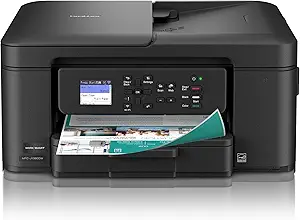 |
| Best Budget The cheapest option that still gets the job done reliably | Canon PIXMA TS3720 | 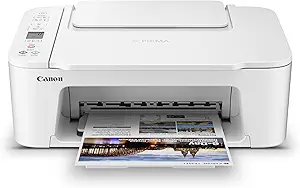 |
| Top Rated A top-rated pick with lots of positive feedback | Xerox C245 Color Multifunction Printer |  |
| Most Popular A crowd favorite that many people choose with confidence | HP DeskJet 2855e All-in-One Printer | 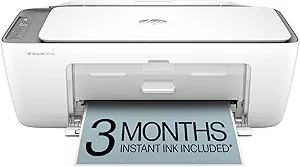 |
| Best Seller A high-volume bestseller chosen again and again | Epson EcoTank ET-2800 |  |
Epson EcoTank ET-2980

| Printer Type | Inkjet |
|---|---|
| Print Speed B&W | 15 pages_per_minute |
| Print Speed Color | 8 pages_per_minute |
| Print Resolution | 4800 x 1200 |
| Connectivity | USB, Wi-Fi |
The Epson EcoTank ET-2980 is a cartridge-free color all-in-one that prints, scans and copies while prioritizing low running costs through large refillable ink tanks and included bottle ink. It uses PrecisionCore technology and a permanent printhead to deliver up to 4800 x 1200 dpi photo-quality output and prints at roughly 15 ppm for black and 8 ppm for color, with automatic duplexing for two-sided documents. Setup is aimed at home users: USB and Wi-Fi connectivity plus the Epson Smart Panel app let you print from laptops and mobile devices. The oversized ink bottles reduce how often you replace supplies and the box includes enough ink claimed to last up to three years under typical home use, which is the main practical benefit for families or small home offices. Limitations include modest paper capacity and average color speed compared with higher-end models, and photo-heavy or high-volume business users may prefer a faster unit with a larger input tray. For everyday home office printing the ET-2980 balances quality and low operating cost effectively.
Best for: Buyers who want low ongoing ink costs and reliable everyday color printing for a home office or family use, and who value wireless convenience and high print resolution over large input capacity.
Less Ideal for: People who need heavy daily volume, faster color throughput, or large paper trays for business environments should consider more robust office-focused models.
- Refillable EcoTank system with bottles included that greatly reduces cartridge replacements
- High 4800 x 1200 dpi resolution for sharp text and good photo-quality prints
- Automatic two-sided printing saves paper and time for document jobs
- Wireless and USB connectivity with Epson Smart Panel mobile printing
- Relatively small paper capacity compared with higher-end home office models
Verdict: Choose the ET-2980 if you want a home all-in-one that cuts ink costs with refillable tanks while still delivering sharp, photo-capable prints.
Canon imageCLASS MF753Cdw II

| Printer Type | Laser |
|---|---|
| Print Speed | 35 pages_per_minute |
| Maximum Print Resolution Color | 1200 x 1200 dpi |
| Printer Connectivity Type | Ethernet, USB, Wi-Fi |
| Duplex | Automatic |
The Canon imageCLASS MF753Cdw II is a work-focused color laser multifunction printer that handles printing, scanning, copying and faxing for a small or home office. It delivers fast output—up to 35 ppm in color or black-and-white—with a 7 second first page print time, a 50-sheet duplex ADF for two-sided scanning, and automatic duplex printing to save paper. The 5" color touchscreen and multiple connectivity options including Wi‑Fi, Ethernet and USB make setup and mobile printing straightforward, while two paper trays and a 250-sheet standard capacity keep running without frequent refills; capacity can be expanded with an optional cassette. Print quality is sharp at 1200 x 1200 dpi when paired with Canon Genuine Toner 069, and energy usage is modest at 24 watts. Expect typical laser maintenance like replacing toner and occasional calibration, and realize the unit is relatively heavy and desk-space demanding compared with compact inkjets. For buyers who prioritize speed, reliability and crisp color output, this model suits everyday office document production.
Best for: Buyers who need reliable, high‑speed color printing and full multifunction capability for a busy home office or small business, and who prioritize throughput and image quality over compact size.
Less Ideal for: If you need a lightweight, ultra-compact printer for occasional home use or very low-volume printing, a small inkjet will be a better fit.
- Fast print speed up to 35 ppm for color and B&W
- High print resolution (1200 x 1200 dpi) for crisp text and graphics
- Automatic duplex printing and 50-sheet duplex ADF for two-sided workflows
- Multiple connectivity options including Wi‑Fi, Ethernet and USB for easy mobile and network printing
- 250-sheet standard paper capacity with optional expansion for longer runs
- Large and heavy compared with compact home office printers
- Requires Canon Genuine Toner 069 for rated yields which adds to operating cost
Verdict: Choose the MF753Cdw II when fast, reliable color output and full duplex multifunction features are the top priorities for a home office.
Brother Work Smart 1360 MFC-J1360DW

| Printer Type | Inkjet |
|---|---|
| Functions | Print, Copy, Scan |
| Duplex | Automatic |
| Maximum Sheet Capacity | 150 |
| Connectivity | USB, Wi-Fi |
The Brother Work Smart 1360 is a compact all-in-one inkjet aimed at home and small home-office use, combining printing, copying, and scanning in a space-saving chassis. It offers wireless and USB connectivity with mobile printing support via AirPrint and Mopria and includes a 20-sheet automatic document feeder for quick multi-page scans or copies. Automatic duplex printing and a 150-sheet input tray reduce trips to the paper drawer for two-sided jobs and moderate print volumes, while print speeds of up to 16 ppm black and 9 ppm color keep basic document workflows moving. The 1.8" color display and Brother Mobile Connect app simplify setup, cloud printing and ink monitoring with Page Gauge. Expect good color output for reports and flyers, but keep in mind this is an inkjet designed for moderate daily use rather than heavy commercial loads, and standard-yield starter cartridges mean you will replace ink sooner if you print frequently. Built-in support for Brother genuine LC501 ink and optional high-yield cartridges helps manage running costs and reliability over time.
Best for: Buyers who want a compact, no-nonsense multifunction printer for a home office and prioritize reliable everyday document printing, easy mobile/cloud printing, and automatic duplex to save paper.
Less Ideal for: Not the best choice for small businesses or users who need high monthly page volumes, high-capacity ink systems, or advanced photo-quality color printing.
- Automatic two-sided printing reduces manual flipping for reports and handouts.
- Wireless, Wi-Fi Direct, AirPrint and Mopria support make mobile and cloud printing straightforward.
- 20-sheet ADF plus flatbed scanner handles multi-page scanning and copying tasks.
- 150-sheet input tray accommodates moderate home office workloads without constant refilling.
- Page Gauge and Brother Mobile Connect app simplify ink monitoring and remote management.
- Uses standard starter cartridges out of the box, so initial ink yield is limited for heavy printing.
- Small color display is functional but not as convenient as larger touchscreens.
Verdict: A compact, feature-focused all-in-one that delivers reliable wireless printing, duplexing, and easy mobile/cloud workflows for an efficient home office setup.
Canon PIXMA TS3720

| Printer Type | Inkjet |
|---|---|
| Maximum Media Size | 8.5 x 14 inch |
| Print Speed B&W | 7.7 pages_per_minute |
| Print Speed Color | 4 pages_per_minute |
| Connectivity | USB, Wi‑Fi |
The Canon PIXMA TS3720 is a small all‑in‑one inkjet aimed at everyday home use, offering print, copy, and flatbed scan functions in a compact package. It uses a two‑cartridge hybrid ink system with pigment black for sharp text and dye color inks for photos, and can produce borderless photos up to 5” x 7” and documents up to 8.5” x 14”. Setup and mobile printing are straightforward via the Canon PRINT app, AirPrint, or Mopria, and the rear paper tray holds about 60 sheets for casual printing. Print speeds are modest — about 7.7 ppm black and 4 ppm color — so it handles schoolwork, web pages, and occasional photos well but is not meant for heavy daily duty. The 1.5” LCD makes basic jobs and copying simple, and dual‑band Wi‑Fi gives stable wireless connections. Expect the usual small‑printer compromises: single‑sided printing only, limited paper capacity, and two basic ink cartridges that can make per‑page color costs higher than laser or high‑yield systems. For light, low‑cost home printing this PIXMA balances size, ease of use, and photo capability.
Best for: Buyers seeking an affordable, compact color all‑in‑one for occasional home office tasks, schoolwork, and photos who prioritize easy setup and mobile printing over high throughput.
Less Ideal for: Users who regularly print large volumes, need automatic double‑sided printing, or want the lowest long‑term cost per page should consider other printer types.
- Compact footprint that fits small home office spaces
- Easy wireless and mobile printing via Canon PRINT, AirPrint, and Mopria
- Hybrid two‑cartridge ink system for sharp black text and decent color photos
- Borderless photo printing up to 5” x 7” and support for varied media types
- Rear tray with up to 60‑sheet plain paper capacity for light batch jobs
- Print speeds are relatively slow compared with higher‑end home office models
- Single‑sided printing only, no automatic duplexing
- Small ink cartridges can increase color cost per page for frequent printing
Verdict: A budget‑friendly, easy‑to‑use color all‑in‑one that fits small home offices and mobile printing needs.
Xerox C245 Color Multifunction Printer

| Printer Type | Laser |
|---|---|
| Functions | Print, Scan, Copy |
| Print Speed | 26 pages_per_minute |
| Connectivity | Ethernet, USB, Wi-Fi |
| Duplex | Automatic |
The Xerox C245 is a small-footprint color laser multifunction printer designed for home offices and small teams that need dependable everyday printing, scanning, and copying. It delivers professional-looking color and black-and-white output at a rated 26 pages per minute and supports automatic two-sided printing to cut paper use. The unit includes a flatbed scanner plus a 50-sheet document feeder for batch scanning or copying, and connectivity covers Wi-Fi, Ethernet, and USB along with Apple AirPrint and Mopria for easy mobile printing. Setup is simplified by the Xerox Easy Assist app and a 2.8-inch color touchscreen for basic on-device tasks. Practical benefits include Energy Star qualification, optional high-yield toners for lower running cost, and built-in security features to protect documents. Trade-offs are its modest 50-sheet input capacity and midrange power draw, so it is best where compactness and consistent day-to-day reliability matter more than high-volume throughput or very large paper trays.
Best for: Buyers who prioritize a reliable, business-quality color laser that fits on a small desk and consistently handles everyday home office tasks with straightforward mobile and network printing.
Less Ideal for: Users who need heavy daily volume printing, very large paper trays, or the lowest possible power consumption should consider higher-capacity or alternative models.
- Consistent 26 ppm color and B&W output for steady daily workloads
- Automatic duplexing and 50-sheet feeder streamline two-sided jobs and scanning
- Wi-Fi, Ethernet, USB, AirPrint, and Mopria for flexible mobile and network printing
- Guided smartphone setup via Xerox Easy Assist and a color touchscreen for simple operation
- 50-sheet maximum tray capacity limits large batch printing without frequent reloads
- Relatively high power consumption compared with some compact inkjet alternatives
Verdict: A compact, dependable color laser all-in-one that delivers business-quality output and straightforward mobile networking for home office users who value reliability.
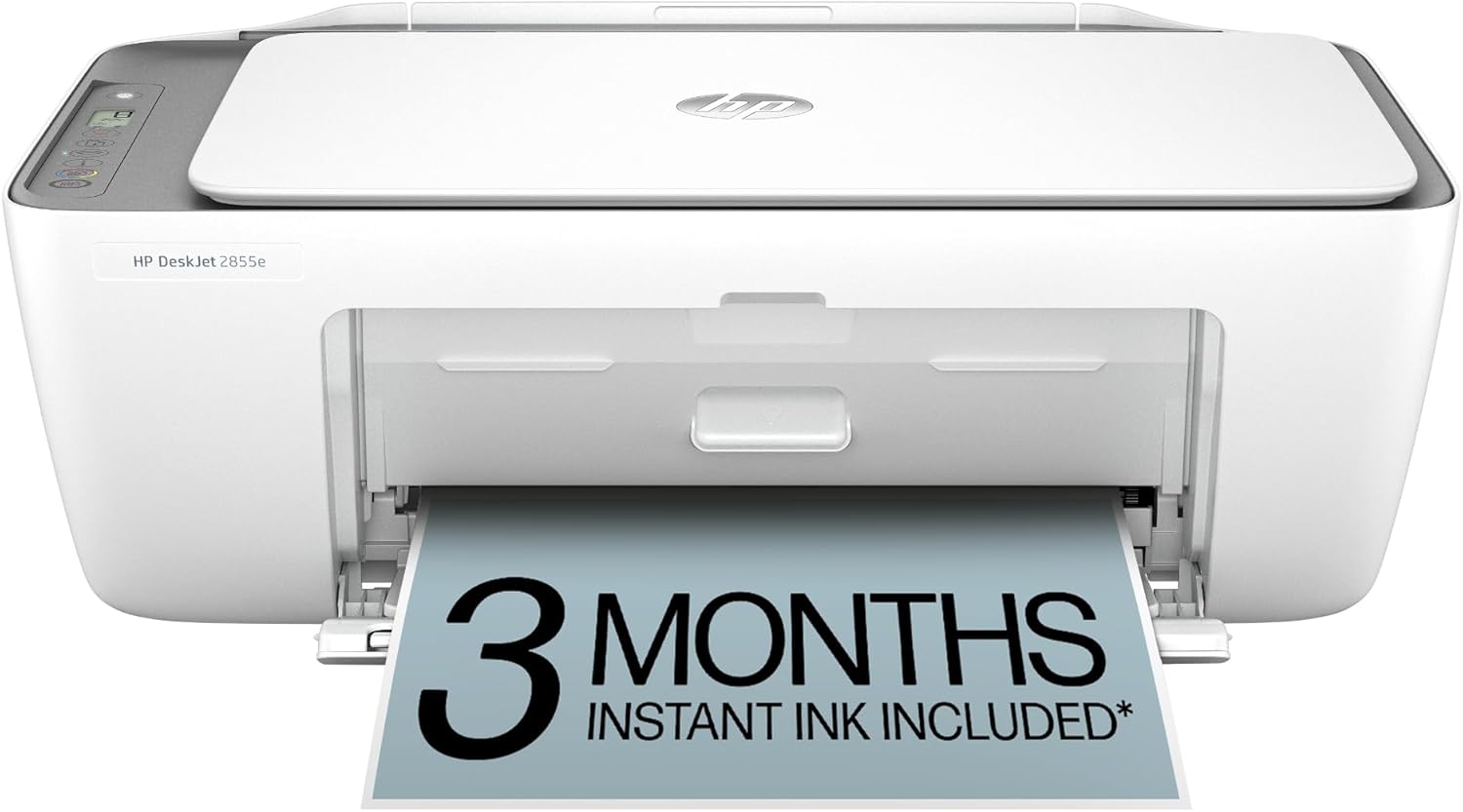
HP DeskJet 2855e All-in-One Printer
| Printer Type | Inkjet |
|---|---|
| Print Resolution (Color) | 4800 x 1200 dpi |
| Print Speed (Color) | 5.5 pages_per_minute |
| Input Capacity | 60 sheets |
| Connectivity | single band wi-fi (2.4ghz only); USB 2.0 |
The HP DeskJet 2855e is a small home-office all-in-one that handles everyday color and black-and-white printing, flatbed scanning, and copying. It connects via single-band 2.4 GHz Wi‑Fi or USB 2.0 and is controlled from the HP app on smartphones and tablets, which also enables HP+ activation and a three-month Instant Ink trial. Print quality can reach up to 4800 x 1200 dpi for color photos and 600 dpi for black-and-white documents, and the 60-sheet input tray suits light to moderate daily tasks like letters, recipes, and occasional photos. Speed is modest at about 5.5 ppm color and 7.5 ppm mono, and duplexing is manual, so heavy duplex workflows require extra handling. The printer is compact and energy efficient for a consumer device, but it uses HP 67 cartridges which may be costly over time without an ongoing ink plan. Setup is straightforward through the app, and AI-driven formatting helps trim unwanted content from web pages before printing.
Best for: Buyers who want an affordable, compact all-in-one for light home-office use and value easy mobile setup, app control, and a bundled Instant Ink trial to simplify ink replacement.
Less Ideal for: Users who need fast, high-volume printing, automatic duplexing, or 5 GHz Wi‑Fi connectivity should consider more robust office-class models.
- Small footprint fits home desks and shelves
- Wireless printing and smartphone app control make mobile printing simple
- Flatbed scanner enables basic scanning and copying tasks
- 60-sheet input tray handles everyday home-office volumes
- High maximum color resolution for better photo and graphic prints
- Single-band 2.4 GHz Wi‑Fi only, no 5 GHz support
- Manual duplex requires flipping pages for two-sided prints
- Not designed for high-volume or fast office printing
Verdict: A compact, app-focused all-in-one that fits light home-office tasks and includes an Instant Ink trial to simplify ink replenishment.
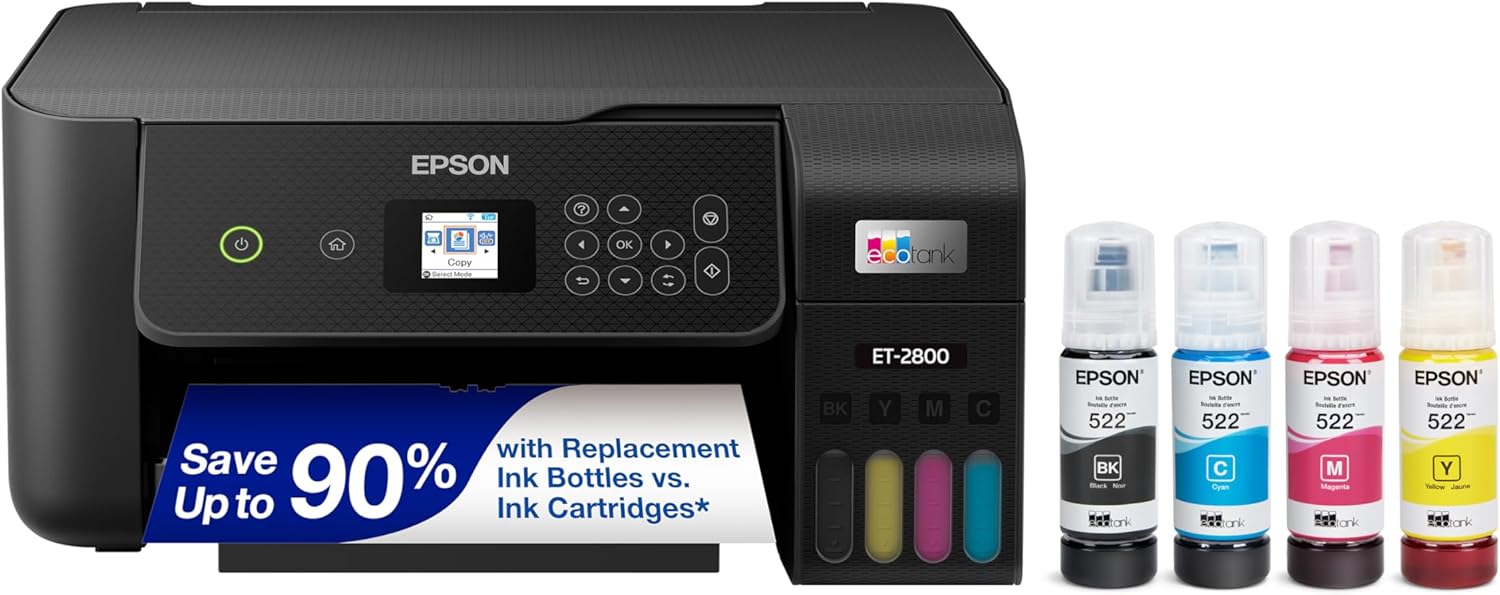
Epson EcoTank ET-2800
| Printer Type | Inkjet |
|---|---|
| Print Resolution | 5760 x 1440 dpi |
| Print Speed | 10 ppm (B&W), 5 ppm (Color) |
| Connectivity | USB, Wi-Fi |
The EcoTank ET-2800 replaces cartridges with high-capacity refillable ink tanks so you can print large runs without frequent replacements, and Epson includes enough ink to handle many months of home printing. It prints, copies, and scans using PrecisionCore Micro Piezo heat-free technology that yields sharp text and reasonably detailed photos, and offers wireless and voice-activated printing plus USB connectivity for straightforward setup. Paper handling is aimed at home use with a single tray and a 100-sheet capacity, and print speeds are modest at about 10 ISO pages per minute for black and 5 ppm for color. The included ink bottles dramatically lower ongoing ink costs and reduce cartridge waste, but Epson recommends genuine ink to protect performance and warranty. The unit lacks automatic two-sided printing and advanced office features like an ADF, so it is best for typical household documents, schoolwork, and occasional photos rather than heavy multi-page office workflows.
Best for: Buyers who prioritize low ongoing ink costs, reliable everyday printing, and a simple wireless setup for a home office or family use.
Less Ideal for: Those who need fast duplexing, frequent multi-page scanning or copying, or advanced office features for heavy daily workloads.
- Cartridge-free high-capacity refillable ink tanks significantly reduce how often you need to replace ink
- Includes a large amount of starter ink so you can print many pages before buying replacements
- Wireless and voice-activated printing plus USB support make setup and everyday use simple
- PrecisionCore Micro Piezo print engine produces sharp text and good color detail for home projects
- No automatic duplex printing or automatic document feeder, limiting productivity for long multi-page jobs
- Color print speed is relatively slow compared with higher-end home-office models
Verdict: Choose the ET-2800 if you want a dependable home all-in-one that cuts ink cost and waste with refillable tanks while keeping setup and everyday use simple.
Choosing the Right Color All-in-One Printer for Home Office: Key Factors to Consider
Print Speed and Duty Cycle
Print speed matters because your workflow can be interrupted when basic documents take too long. Look for manufacturers' pages-per-minute ratings for both black and color pages and consider real-world expectations: text-only jobs typically print faster than color pages with heavy graphics.
Duty cycle guidance helps you choose a device that can handle your typical monthly volume. Choosing a printer with a duty cycle comfortably above your expected use reduces wear and helps avoid premature maintenance.
Color Output and Paper Handling
Color accuracy and tonal range are important if you produce client-facing documents, presentations, or occasional photos. Check whether the device offers color calibration options or dedicated photo modes, and whether it supports the paper sizes and weights you plan to use.
Paper handling features such as a usable input tray size, manual feed for specialty stock, and reliable duplexing affect daily convenience. A printer that jams often or misfeeds heavier paper will cost time and patience.
Scanner Quality and Feeder Convenience
Home-office scanners need to capture readable, searchable documents. A flatbed is essential for books or thick originals, while an automatic document feeder (ADF) speeds up multi-page scanning. Check scanner resolution and whether the ADF supports duplex scanning if you frequently scan two-sided originals.
Software features like automatic cropping, deskewing, and OCR matter for turning paper into editable files. Reliable feeder mechanics reduce rescans and manual intervention.
Connectivity and Mobile Printing
Modern home offices require flexible ways to send jobs to the printer. Built-in Wi-Fi, Ethernet, and Bluetooth offer different benefits: Wi-Fi enables untethered placement; Ethernet provides stable connections for wired setups; Bluetooth can simplify quick mobile prints.
Mobile printing compatibility, cloud printing, and vendor apps determine how easily you can print from phones and tablets. Look for straightforward network setup and good app-based scanning to cloud services if you work across devices.
Operating Cost and Consumables
Beyond the initial purchase, ink or toner and replacement frequency are significant ongoing costs. Evaluate page yield estimates and whether high-yield cartridges or refillable tanks are available to reduce per-page expense.
Also consider how often the device needs maintenance parts replaced and whether the manufacturer provides options for lower-cost consumables. Lower operating costs are especially relevant if you print regularly.
Ease of Use and Maintenance
A home-office printer should be easy to set up, with an intuitive control panel or a helpful mobile app. Clear status indicators, simple paper-loading mechanics, and easy-to-replace cartridges reduce the time you spend on upkeep.
Firmware update procedures and the availability of straightforward troubleshooting guides also matter. Devices that minimize required technical intervention keep your workflow uninterrupted.
Setting Up a Home-Office Printer
Placement and network setup are the first practical steps after unboxing. Place the printer near your primary workspace while leaving enough clearance for paper trays and the scanner lid to open fully. If possible, use a wired Ethernet connection for the most reliable network performance, or a dual-band Wi-Fi network to reduce interference.
Follow the manufacturer's recommended setup flow in the device app to register, connect to Wi-Fi, and install drivers. For mobile printing, install the vendor app on your phone and enable any recommended cloud or email printing options for quick access from tablets and smartphones.
- Choose a stable, level surface with adequate ventilation.
- Connect via Ethernet if you need consistent throughput for large files.
- Use 5 GHz Wi-Fi when available for better performance in busy networks.
Optimizing Print Quality for Documents and Photos
For everyday office documents, use the standard or economy print mode to conserve consumables without sacrificing legibility. For presentations or images, switch to a higher-quality color mode and select the correct paper type in the print settings to improve color rendition and saturation.
If color accuracy is critical, perform any available color calibration and use ICC profiles when printing from desktop design software. Also, choose heavier, coated paper when printing graphics to reduce ink bleed and enhance sharpness.
- Use draft mode for internal documents to save ink.
- Select the proper paper type for better color results.
- Calibrate color for important client-facing prints.
Scanning Workflows That Save Time
Design scan workflows around the documents you handle most often. For invoices and receipts, set the scanner to a compact PDF with OCR so files are searchable and small. For multi-page contracts, use the ADF with duplex scanning enabled to process both sides automatically.
Automate file naming and destination folders in the scanner software to keep digital documents organized. If you share scans frequently, configure direct-to-cloud or email options within the scanning app for one-step distribution.
- Use OCR for editable, searchable documents.
- Enable duplex ADF scanning to halve processing time for two-sided originals.
- Set consistent file naming rules in the scan software.
Managing Consumables and Reducing Costs
Track your monthly print volume and compare it with manufacturer yield estimates to plan supplies. Opt for high-yield cartridges or tank-based designs if you print heavily; for light users, standard cartridges may be more cost-effective due to lower upfront expense.
Buy only recommended consumables to reduce the risk of printhead issues. When possible, keep a spare set of the most frequently replaced cartridges on hand to avoid downtime.
- Monitor ink levels and order replacements before critical jobs.
- Use power-saving modes and duplex printing to reduce consumable use.
- Keep firmware updated to ensure accurate ink-level reporting.
Security and Privacy Considerations
Home-office printers are networked devices that can expose documents if not secured. Enable password protection for device settings and use WPA2 or WPA3 for wireless networks. Disable unnecessary network services like remote administration unless you need them.
For sensitive documents, prefer secure scan-to-email or encrypted transfer methods. Regularly install firmware updates to patch security vulnerabilities and reduce the risk of unauthorized access.
- Enable network encryption and strong administrator passwords.
- Restrict open access protocols when not required.
- Update firmware periodically to keep security protections current.
How We Chose the Best Color All-in-One Printer for Home Office
We focused on devices that fit typical home-office use: moderate monthly print volumes, mixed color and monochrome tasks, and frequent scanning or copying. Selection prioritized printers with proven print and scan quality for mixed documents, reliable wired and wireless connectivity, and compact footprints that fit home-office desks. We also considered operating costs by checking typical consumable yields and the availability of efficient cartridge or tank options. Evaluation criteria included measurable print speed for text and color pages, scanner resolution and feeder reliability for multi-page jobs, network and mobile connectivity options, and daily usability features such as control-panel clarity and automatic double-sided printing. We excluded heavy-duty office machines built for large teams, single-function printers without scanning, and models lacking basic security or networking capabilities. Final picks represent a balance of fast document handling, accurate color output, easy scanning and copying, and user-friendly setup and maintenance. The scoring criteria below reflect the concrete dimensions that mattered most in our selection process.
Our full evaluation process is outlined in our review methodology.
FAQ
How much should I expect to print per month with a home-office color all-in-one?
Home-office usage commonly ranges from a few dozen to several hundred pages per month depending on the role. Estimate your typical monthly output and choose a device whose recommended monthly duty cycle exceeds that to avoid accelerated wear.
Is inkjet or laser better for color documents in a home office?
Inkjet devices often produce richer color and better photo results, while color laser printers can offer faster text output and lower per-page cost for high volumes. The best choice depends on whether color fidelity or per-page economy matters more for your workflow.
Do I need an automatic document feeder for a home office?
An ADF is very useful if you regularly scan or copy multi-page documents. For occasional single-page scans, a flatbed may suffice, but an ADF with duplex capability saves time for two-sided originals.
How can I lower my printing costs without sacrificing quality?
Use draft or economy modes for internal documents, print duplex to halve paper use, and consider high-yield cartridges or refillable tanks if your volume justifies them. Also, print in black-and-white when color is unnecessary.
What connectivity should I prioritize for a home-office printer?
If your workspace has strong Wi-Fi, dual-band wireless is convenient. If you transfer large files frequently or want maximum reliability, Ethernet is preferable. Mobile printing compatibility is important if you work from phones or tablets.
Final Verdict
When choosing a Color All-in-One Printer for a home office, prioritize the features that match how you work most: print speed and reliable duplexing for document-heavy tasks, color fidelity for client-facing materials, or low operating costs for high-volume printing. Balance connectivity and scanner capabilities so the device integrates cleanly with your workflows. Focus on a printer whose recommended monthly duty cycle exceeds your typical output, offers scanning and mobile features you will use, and keeps consumable costs manageable. That approach will lead to a dependable, low-friction home-office printing setup.