
Note: This article contains affiliate links. If you click on these links and make a purchase, we may earn a small commission at no extra cost to you. This helps support our research and content. Read our full affiliate disclosure here.
Picking the right color smart light bulb changes how a room feels, from subtle warm whites to saturated RGB accents. You want bulbs that deliver accurate colors, responsive control, and reasonable energy use so lighting enhances daily life without frustration. This guide covers seven shortlisted color smart light bulbs chosen for their color fidelity, connectivity, and app or voice control experience. Read on to understand the practical tradeoffs—brightness, compatibility, and long-term reliability—that matter when installing smart color lighting in any room. Next, we walk through features and decision points that help match the right bulb to your setup before the product list.
Top Picks at a Glance
| Best Overall The best all-around choice for most situations | LIFX Color A19 800 Lumens |  |
| Best Quality Built to a higher standard if you want something more solid | Philips Hue A19 White & Color 3-Pack |  |
| Best Value The sweet spot between price and what you get | SYLVANIA Smart+ WiFi A19 |  |
| Best Budget The cheapest option that still gets the job done reliably | Tapo L531E Multicolor Smart Bulb |  |
| Top Rated A top-rated pick with lots of positive feedback | Govee Smart A19 Light Bulb H6008 |  |
| Most Popular A crowd favorite that many people choose with confidence | Amazon Basics Smart A19 LED Bulb | 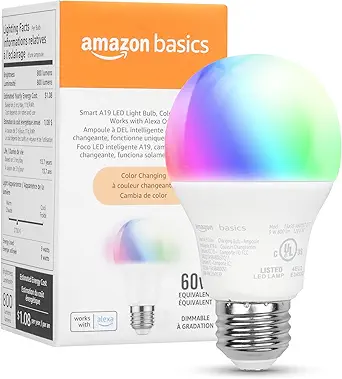 |
| Best Seller A high-volume bestseller chosen again and again | Kasa Smart Bulb KL125P2 |  |
LIFX Color A19 800 Lumens

| Light Output Maximum | 800 lumens |
|---|---|
| Power Consumption | 9 watts |
| Light Color | RGB + Tunable White |
| Connectivity Protocol | Wi-Fi |
| Light Source Operating Life | 25000 hours |
These LIFX SuperColor A19 bulbs turn ordinary fixtures into fully controllable smart lights that prioritize color quality and ease of use. They screw into standard E26 sockets and connect directly over 2.4GHz Wi‑Fi (with Bluetooth for setup), so no hub is required; pairing with Apple HomeKit can be done via the included Matter QR code. The bulbs produce up to 800 lumens and a wide tunable white range plus billions of RGB colors, letting you create scenes, schedules, and music-synced effects from the LIFX app or voice assistants. Practical benefits include strong color saturation for mood lighting, schedules for circadian-friendly shifts, and compatibility with Siri, Alexa and Google Assistant. Battery-free, low 9W power draw and a long rated life (25,000 hours) keep operating costs low. Limitations are typical for smart bulbs: they rely on a stable 2.4GHz network for full feature control and the 800-lumen output is best suited to lamps and medium rooms rather than large, brightly lit spaces.
Best for: Buyers who want high-quality color and flexible smart control for living rooms, bedrooms, or lamps and who value easy setup and wide ecosystem compatibility.
Less Ideal for: Anyone needing a single bulb to brightly illuminate large open-plan spaces or who lacks a reliable 2.4GHz Wi‑Fi network.
- Vivid SuperColor output with billions of colors and wide tunable white range
- No hub required — connects via 2.4GHz Wi‑Fi with Bluetooth-assisted setup and Matter HomeKit pairing
- App features include schedules, scenes, music sync, and grouping for flexible lighting control
- Energy efficient 9W LED with a long rated life of 25,000 hours
- 800-lumen brightness may be insufficient for very large rooms or as a sole overhead light
Verdict: Choose these LIFX bulbs if you want vivid, app-driven color and reliable, hub-free smart lighting for mood, routines, and voice control.
Philips Hue A19 White & Color 3-Pack

| Number of Items | 3 |
|---|---|
| Bulb Shape Size | A19 |
| Bulb Base | E26 |
| Light Output Maximum | 806 lumens |
| Connectivity Protocol | Bluetooth, Zigbee |
These Philips Hue A19 White and Color bulbs bring full-color smart lighting to standard E26 fixtures and are designed for both quick Bluetooth setups and expanded Hue Bridge systems. In daily use they serve as general room lighting or mood accents, offering warm-to-cool whites and millions of colors that can be dimmed or brightened from the Hue app or voice assistants. The bulbs output roughly 800 lumens (60W-equivalent) while consuming about 9 watts, and they work with Alexa, Google Assistant, and Apple HomeKit when paired as required. Bluetooth supports control of up to 10 lights in one room for simple installs, while adding a Hue Bridge unlocks routines, remote access, and more reliable Zigbee mesh control for larger setups. Color rendering is serviceable for home use and Energy Star certification helps efficiency. Limitations include reliance on a separate Bridge to access the full feature set and the modest CRI of 80, which is fine for ambiance but not ideal for color-critical tasks.
Best for: Buyers who want high-performance, color-capable smart bulbs that prioritize reliable ecosystem features and advanced lighting scenes for mood and routines.
Less Ideal for: Users who need the highest color accuracy for photography, professional tasks, or who want full remote and multi-room control without adding a Hue Bridge.
- Full white-to-color range with millions of hues for mood and accent lighting
- Works with Bluetooth for quick setup and voice control via Alexa and Google Assistant
- Energy-efficient 9W LED output with about 800 lumens of brightness
- Compatible with Hue Bridge to enable routines, remote control, and expanded smart-home integration
- Full feature set requires adding a Hue Bridge for remote access and advanced automations
- Color rendering index of 80 is adequate for ambiance but not for color-critical work
Verdict: Choose these Philips Hue A19 bulbs if you want high-performance, full-color smart lighting that scales from simple Bluetooth control to a robust Hue Bridge ecosystem.
SYLVANIA Smart+ WiFi A19

| Light Output Maximum | 800 lumens |
|---|---|
| Light Color | Multicolor |
| Color Temperature | 2700 Kelvin to 6500 Kelvin |
| Connectivity Protocol | Wi‑Fi |
| Light Source Operating Life | 15000 hours |
The SYLVANIA Smart+ WiFi A19 is a full‑color smart LED bulb designed to replace a 60W incandescent while adding color and scheduling control via the free SYLVANIA Smart app or voice assistants. It connects directly to a 2.4 GHz Wi‑Fi network so no hub is required, and supports Alexa, Google Assistant, and Siri Shortcuts for hands‑free commands. You can pick from 16 million colors, tune white from warm to daylight, dim the bulb from the app, and create timers or routines to automate lighting across rooms. With 800 lumens output, high efficiency, and a 90+ CRI, it produces accurate, vibrant light suitable for living rooms, kitchens, and accent lighting. The bulbs are rated for about 15,000 hours and work best in open indoor fixtures; they are not compatible with fully enclosed fixtures and require a 2.4 GHz Wi‑Fi connection. Setup is straightforward, but users who only have 5 GHz networks or need HomeKit native support will find limitations.
Best for: Buyers who want an easy, hub‑free way to add vivid color, tunable white, and scheduled automation to everyday indoor lighting while prioritizing reliable voice and app control.
Less Ideal for: People whose homes run exclusively on 5 GHz Wi‑Fi, who need native HomeKit integration, or who plan to install bulbs inside fully enclosed fixtures should consider other options.
- Full RGB plus tunable white with 16 million colors for flexible mood and task lighting
- No hub required — connects to 2.4 GHz Wi‑Fi for remote control and scheduling
- High CRI (90+) and 800 lumens deliver accurate color and usable room brightness
- Works with Alexa, Google Assistant, and Siri Shortcuts for voice control and automation
- Requires a 2.4 GHz Wi‑Fi network and is not compatible with Apple HomeKit natively
- Not rated for use in fully enclosed fixtures which limits some fixture choices
Verdict: A practical, hub‑free full‑color smart bulb that delivers strong color, tunable white, and dependable voice/app control for everyday home lighting.
Tapo L531E Multicolor Smart Bulb

| Light Source Wattage | 9 watts |
|---|---|
| White Brightness | 800 lumens |
| Color Temperature | 2500K-6500K |
| Connectivity Protocol | Wi-Fi |
| Color Rendering Index | 90 |
The Tapo L531E is a multicolor A19 smart LED bulb designed for everyday smart lighting and mood scenes. It connects directly to 2.4 GHz Wi‑Fi so no hub is required, and you control it from the Tapo app or with Alexa and Google Assistant voice commands. The bulb puts out about 800 lumens (a 60W equivalent) with a CRI over 90, supports fully dimmable whites from warm to cool and 16 million RGBW hues, and offers a wide 220 degree beam for broad coverage. Useful extras include scheduling, away mode, scene presets and built-in energy monitoring so you can track consumption over time. On the downside it uses 2.4 GHz Wi‑Fi only and relies on the Tapo app ecosystem for advanced features, so users expecting thread or cloud-agnostic integrations may find limits. For typical rooms, parties, or accent lighting it delivers flexible color and solid color-rendering at an affordable power draw.
Best for: Buyers who want a low-cost, full-color smart bulb that covers both mood lighting and everyday white-light needs and who prefer easy Wi‑Fi setup and voice control.
Less Ideal for: People who need hub-based or multi-protocol smart home integration, outdoor-rated bulbs, or advanced local-control ecosystems without vendor apps.
- 16 million RGBW colors plus tunable white for flexible mood and task lighting
- 800 lumens with CRI>90 for accurate, bright color rendering
- Works with Alexa and Google Assistant and offers app scheduling and scene presets
- No hub required — connects directly to 2.4 GHz Wi‑Fi
- Built-in energy monitoring to view real-time and historical usage
- Compatible only with 2.4 GHz Wi‑Fi and requires the Tapo app for full control
- Not designed for outdoor use
Verdict: A budget-friendly full-color smart bulb that delivers strong color performance, tunable whites, and energy monitoring without needing a hub.
Govee Smart A19 Light Bulb H6008

| Wattage | 9 watts |
|---|---|
| White Brightness | 800 lumens |
| Light Source Operating Life | 50000 hours |
| Connectivity Protocol | Bluetooth, Wi-Fi |
| Control Method | App, Voice |
These Govee A19 smart bulbs turn standard E26 sockets into fully controllable color lights for everyday rooms. You control them with the Govee Home app or voice assistants and can switch between 16 million colors, preset scene modes, timers, and schedules without a separate hub. The bulbs support both Wi‑Fi and Bluetooth direct connection and include a music sync mode that changes color and brightness to sound detected via your phone. At 9 watts they produce about 800 lumens of white brightness and are rated for around 50,000 hours, so they are energy efficient and built for long life. Practical limitations include the need for stable 2.4 GHz Wi‑Fi for full cloud features and the bulbs not working behind smart switches, which can complicate installations on switched circuits. The bulbs are straightforward to set up for routine lighting scenes, reliable daily schedules, and immersive color accents, but expect occasional app updates and the usual smart‑home dependency for advanced features.
Best for: Buyers who prioritize dependable, long‑running color lighting that integrates with voice assistants and want reliable daily schedules and scene control without a hub.
Less Ideal for: People who need bulbs that work on switched circuits or with 5 GHz only networks, or who require fully local-only solutions without app/cloud dependencies.
- Wide color range with 16 million colors and 54 preset scene modes for flexible ambiance
- Works with major voice assistants and Apple HomeKit for hands‑free control
- Dual connectivity (Wi‑Fi and Bluetooth) lets you control bulbs locally or remotely
- Long rated life (50,000 hours) and low power draw (9W) for energy efficiency
- Requires stable 2.4 GHz Wi‑Fi for full remote and cloud features
- Not compatible with smart switches that cut power to the bulb
Verdict: A dependable, energy‑efficient color smart bulb pack that delivers long life and seamless voice and app control for everyday smart lighting needs.
Amazon Basics Smart A19 LED Bulb

| Wattage | 9 watts |
|---|---|
| Bulb Shape Size | A19 |
| Bulb Base | E26 |
| Light Output Maximum | 800 lumens |
| Network Connectivity | 2.4 GHz Wi-Fi only |
This Amazon Basics Smart A19 bulb replaces a standard 60W incandescent with a 9W LED that offers 16 preset colors, adjustable white at 2700K, and dimming from 5% to 100% via the Alexa app or voice. Setup is straightforward: screw into an E26 socket, connect to your 2.4 GHz Wi-Fi, and add the bulb in the Alexa app with no hub required. In daily use the bulb is convenient for mood lighting, routines, and remote on/off scheduling from the app, and grouping lets you control rooms at once. The bulb is intended for indoor use and supports damp locations such as bathrooms. Important limitations are explicit: it only works with Alexa, it does not support 5 GHz networks, and it is not compatible with physical dimmer switches, so dimming must be done in-app or by voice. For buyers wanting easy Alexa integration and a simple color-capable smart bulb, this model delivers solid performance without extra smart-home complexity.
Best for: Buyers who prioritize easy, Alexa-driven smart lighting and want a simple color bulb they can set up quickly without adding a hub.
Less Ideal for: People who use Google Assistant, Apple HomeKit, SmartThings, or rely on 5 GHz Wi-Fi networks or physical dimmer switches should consider alternatives.
- Direct Wi-Fi connection with no hub required for quick setup
- Works with Alexa for voice control and routines
- Offers 16 preset colors plus dimmable white for versatile mood lighting
- Energy efficient 9W LED equivalent to a 60W incandescent
- Only compatible with Alexa and not other voice platforms
- Requires 2.4 GHz Wi-Fi and does not support 5 GHz networks
- Not compatible with physical dimmer switches
Verdict: If you want an affordable, Alexa-native color bulb that is quick to install and use without a hub, this Amazon Basics A19 is an easy, reliable choice.
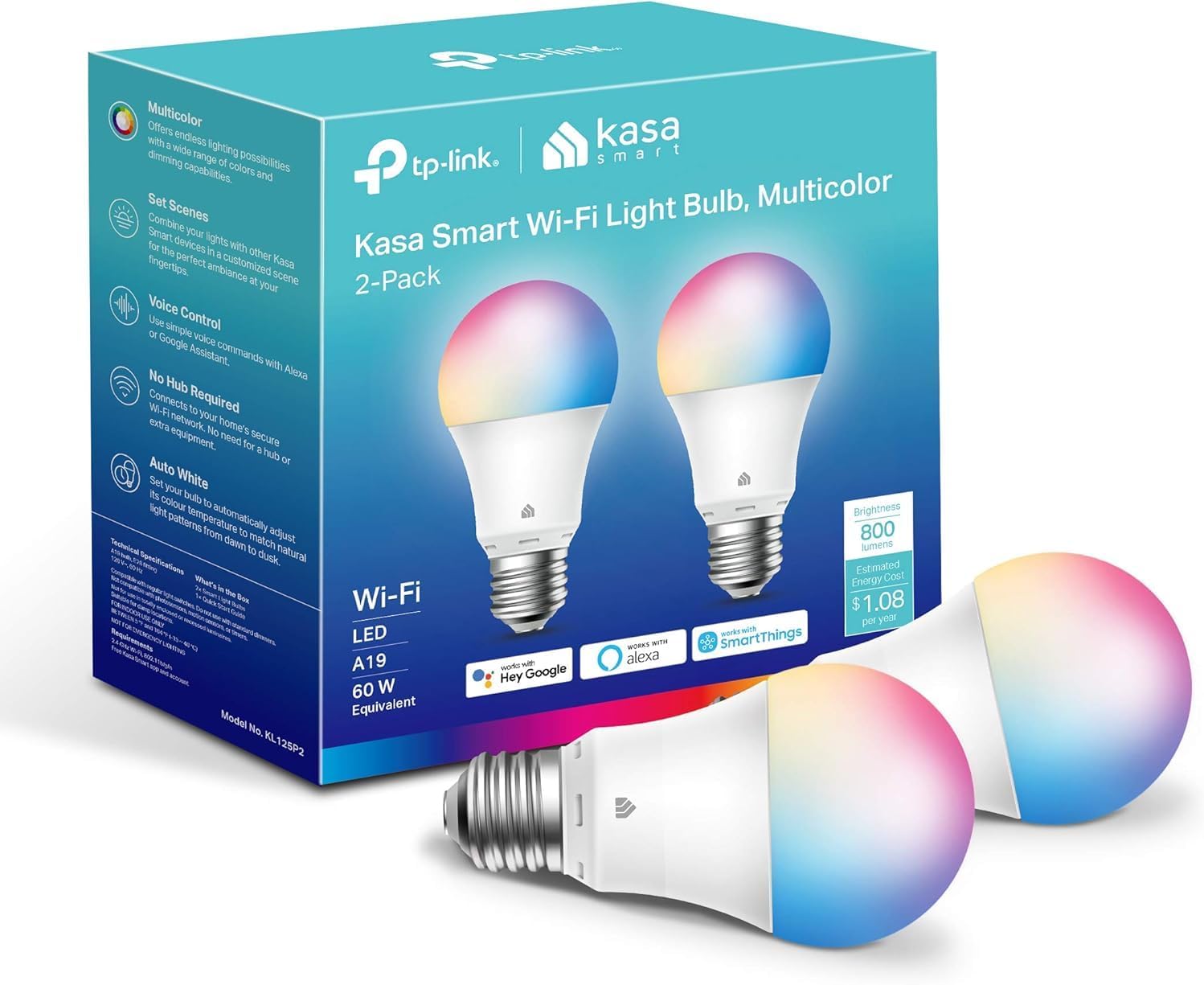
Kasa Smart Bulb KL125P2
| Light Output | 800 lumens |
|---|---|
| Power Consumption | 9 watts |
| Base | E26 |
| Color Temperature | 2500K–6500K |
| Connectivity Protocol | Wi‑Fi (2.4 GHz) |
The Kasa KL125P2 is a full‑color A19 smart LED bulb that replaces a 60W incandescent while drawing 9W, and it is designed for easy in‑home use with no hub required. You control color, warm-to-cool whites, and brightness from the Kasa app or with Alexa and Google Assistant, and the bulb supports scheduling, timers, and an auto white mode that shifts color temperature with the day. It reports energy use so you can track consumption, and the 800‑lumen output is suitable for most living rooms, bedrooms, and task areas. Setup is straightforward on a 2.4 GHz Wi‑Fi network and the bulb is UL listed for safety, which should reassure cautious buyers. Limitations include the requirement for 2.4 GHz Wi‑Fi only and dependency on the vendor app for advanced features, so users wanting local-only control or multi-band Wi‑Fi support may find it restrictive.
Best for: Buyers who prioritize a reliable, easy-to-set-up color smart bulb with voice control and safety certifications and who want predictable app-driven automation.
Less Ideal for: Users who need 5 GHz Wi‑Fi support, local-only control, or who prefer bulbs that integrate directly with third‑party smart home platforms without the vendor app.
- Full color plus tunable white (2500K–6500K) for flexible scenes and ambiances
- No hub required; connects directly to 2.4 GHz Wi‑Fi for voice and remote app control
- Energy monitoring and scheduling for tracking usage and automating routines
- 800 lumens output at a 9W draw replaces a 60W incandescent while saving energy
- UL listed safety and wide compatibility with Alexa and Google Assistant
- Only supports 2.4 GHz Wi‑Fi, so it will not connect to 5 GHz networks
- Advanced functions rely on the Kasa app rather than local or third‑party integrations
Verdict: A dependable, UL‑listed full‑color smart bulb that delivers flexible scenes, reliable voice and app control, and energy monitoring without needing a hub.
Choosing the Right Color Smart Light Bulb: Key Factors to Consider
Color Range and Accuracy
A wide and accurate color range determines whether a bulb can reproduce subtle warm whites and saturated colors convincingly. Accurate whites matter for everyday tasks and skin tones, while vivid RGB capability affects mood lighting and scenes. Bulbs advertise different color gamuts and color temperature ranges; look for specs that show both Kelvin range and color gamut coverage.
Mismatched or poorly calibrated color output forces constant adjustments and can make coordinated lighting scenes look inconsistent across fixtures. If you plan to use bulbs for photography, video calls, or precise task lighting, prioritize bulbs with better color rendering and user-adjustable white balance.
Connectivity and Network Reliability
How a bulb connects to your home network affects responsiveness and integration. Options include direct Wi-Fi, Bluetooth, Zigbee, or proprietary hubs. Consider whether you need local control when the internet is down, and how easily the bulb re-joins a network after a power outage.
Network reliability also impacts multi-bulb setups where synchronized scenes matter. If you have an existing smart home hub, choose bulbs compatible with that protocol to reduce network fragmentation and simplify automations.
Brightness and Room Suitability
Lumens indicate how bright a bulb will be and determine whether it is suitable for general room lighting or only accent and decorative use. Higher lumen bulbs work better for living rooms and kitchens, while lower lumen, softer bulbs are better for bedside lamps and ambient backlighting.
Also consider beam angle and diffusing design because two bulbs with similar lumen ratings can produce very different perceived light when used in recessed fixtures or shades.
App Controls and Automation Options
The mobile app and automation features shape the everyday experience of using smart bulbs. Look for apps that offer scene presets, color picking, scheduling, sunrise/sunset options, and group controls. Integration with voice assistants and routines can make common tasks hands-free.
A well-designed app reduces friction when creating multi-bulb scenes and automations. If you rely on third-party smart home platforms, verify whether the bulb supports native integrations or requires workarounds.
Energy Use and Rated Lifespan
Energy-efficient LEDs lower operating cost and produce less heat. Check wattage equivalents and lumens-per-watt to compare efficiency. Longer rated lifespans reduce replacement frequency and are especially important for hard-to-reach fixtures.
Also consider standby power draw for bulbs that maintain a network connection. Some bulbs consume more power when idle, which adds up across many fixtures in a home.
Physical Fit and Dimming Compatibility
Ensure the bulb fits your fixture in size and base type. Some color smart bulbs are larger or have different heat sinks that can prevent closing lamp shades or fitting into compact fixtures. Check socket type and clearance before buying.
Verify dimmer compatibility if you plan to use a wall dimmer. Many smart bulbs require the wall switch to remain on and do not work with traditional dimmer modules unless the dimmer is designed for LED and smart bulb use.
Choosing Between Hub and Hubless Systems
Decide whether to use bulbs that connect directly to Wi-Fi or those that require a separate hub. Hubless bulbs simplify initial setup and reduce hardware, but hubs can offload wireless traffic, improve responsiveness in larger installations, and provide local automation.
Consider future expansion. If you plan to install many bulbs or other smart devices, a hub-based ecosystem often scales better and reduces the number of Wi-Fi endpoints. Hubless systems are convenient for small installs or single-room upgrades.
- Hubless: easier setup, depends on home Wi-Fi
- Hub-based: better network separation, may support local control
- Large installs often benefit from a dedicated hub
Setting Up Color Scenes and Ambiance
Create reusable scenes that combine color, brightness, and timing to match activities such as reading, movie watching, or entertaining. Test scenes in the actual fixture and room since perception changes with surface colors and furnishings.
Use grouped controls to apply scenes across multiple bulbs with one command. Start with a few core scenes and refine them rather than trying to build dozens of one-off presets.
- Start with warm white, cool white, and one accent color
- Name scenes clearly for quick voice control
- Test scenes at different times of day for consistency
Optimizing for Energy Savings and Longevity
Reduce runtime by combining smart scheduling, presence detection, and motion sensors so lights are only on when needed. Lowering brightness for ambient scenes extends bulb life and cuts energy use.
Regular firmware updates can improve efficiency and reliability. Check that the bulb manufacturer provides timely updates and clear instructions for applying firmware without disrupting automations.
- Use schedules and sensors to limit unnecessary runtime
- Lower brightness or use warm dim scenes to extend life
- Install bulbs with well-documented firmware update paths
Mixing Color Bulbs with White-Only Fixtures
When combining color bulbs with white-only fixtures, aim for consistent white balance by choosing color bulbs that allow precise white temperature control. Mismatched whites can make rooms look uneven under mixed lighting.
Use separate circuits or grouped scenes to isolate colored accents from task lighting so that color shifts do not impede activities that need accurate color rendering.
- Group color accents separately from task lights
- Match white temperature across fixtures for uniformity
- Label zones in the app for faster control
Troubleshooting Common Connectivity Problems
If a bulb drops from the network, try power-cycling and verifying signal strength at the fixture location. Wi-Fi density, interference, and distance from the router or hub commonly affect reliability.
Keep firmware current and document how to factory-reset or re-pair bulbs before deploying many units. Understanding the recovery steps prevents long downtimes and helps maintain synchronized scenes.
- Check signal strength and relocate router or add a repeater
- Document reset and re-pairing procedures
- Avoid placing bulbs behind metal fixtures that block signal
How We Chose the Best Color Smart Light Bulb
We focused on attributes that most directly affect the everyday experience of using color smart light bulbs. First, color accuracy and gamut were prioritized because undefined or oversaturated colors undermine mood lighting goals. Second, connectivity reliability was evaluated to ensure bulbs respond consistently via app or hub, including local control and recovery behavior after power cycles. Third, brightness and lumen output were considered so bulbs can function for both accent and general lighting. Fourth, app usability and available automation options were weighed since a confusing app can negate hardware strengths. Fifth, energy efficiency and rated life were reviewed because long runtimes and lower power draw reduce maintenance and operating cost. We excluded specialty fixtures, single-color bulbs, and bulbs that require proprietary wiring or nonstandard sockets. We also filtered out products with inconsistent user feedback on firmware reliability or those lacking documented color calibration. The final picks balance measurable specs with practical control and longevity factors that matter in day-to-day home lighting.
Our full evaluation process is outlined in our review methodology.
FAQ
Will color smart bulbs work if my internet goes out?
It depends on the bulb and connection method. Bulbs connected via a local hub or using Bluetooth may allow basic local control without internet, while some Wi-Fi-only bulbs rely on cloud services for advanced features. Check whether the bulb supports local control and whether scenes are stored locally or in the cloud.
How many color bulbs can I group together for synchronized scenes?
Group limits vary by platform and app, but most systems support dozens of bulbs in a single group. Performance can be affected by network bandwidth and the control method, so for large installs consider grouping by room or zone to keep responsiveness high.
Are color smart bulbs safe to use in enclosed fixtures?
Enclosed fixtures can trap heat and shorten LED lifespan. Use bulbs rated for enclosed fixtures if you must place them inside sealed shades. Otherwise, choose fixtures with ventilation or install bulbs in open housings for better cooling.
Can I use a wall dimmer with smart color bulbs?
Most smart bulbs require the wall switch to remain on and do not work reliably with conventional dimmers. If you want physical dimming, use a dimmer designed for smart bulbs or install an in-wall smart switch that supports smart bulb operation.
How accurate are the white temperatures on color bulbs?
White temperature accuracy varies by bulb and calibration. Many bulbs let you adjust color temperature across a Kelvin range, but perceived color depends on the bulb's calibration and room finishes. For critical tasks, test bulbs in your setting to confirm they meet your needs.
Final Verdict
Prioritize color accuracy, reliable connectivity, and the control experience when choosing a color smart light bulb. Consider room brightness needs and whether you will expand to many bulbs, as those decisions affect whether a hub or hubless approach is best. Balance energy efficiency and rated lifespan against the features you use most to minimize replacements and maintenance. With a clear sense of how you will control and group your lights, you can confidently select a bulb that delivers the right ambiance and dependable performance.