
Note: This article contains affiliate links. If you click on these links and make a purchase, we may earn a small commission at no extra cost to you. This helps support our research and content. Read our full affiliate disclosure here.
When a building needs continuous hot water without the footprint of storage tanks, a commercial electric tankless water heater can be the practical choice. You want dependable on-demand capacity, predictable operating costs, and gear sized for peak flow and local electrical infrastructure. This guide looks at a shortlist of the top commercial electric tankless water heaters, focusing on flow performance, energy efficiency, and installation considerations. We examined units appropriate for restaurants, multifamily buildings, and light industrial sites to surface options that meet heavy-use demands. Below are the best picks for common commercial use cases, followed by detailed buying guidance and answers to frequent installer and owner questions.
Top Picks at a Glance
| Best Overall The best all-around choice for most situations | WINTEMP WN36 36kW Tankless Water Heater |  |
| Best Quality Built to a higher standard if you want something more solid | Stiebel Eltron Tempra 24 Trend |  |
| Best Value The sweet spot between price and what you get | NOVIEEX 27kW Tankless Water Heater |  |
| Best Budget The cheapest option that still gets the job done reliably | SIVUATEK V7B-140B 14kW Tankless Heater |  |
| Top Rated A top-rated pick with lots of positive feedback | Optimal opti12 12kW Tankless Heater |  |
| Most Popular A crowd favorite that many people choose with confidence | Rheem RTEX-18 Tankless Electric Heater |  |
| Best Seller A high-volume bestseller chosen again and again | Rheem RTEX-24 Tankless Electric |  |
WINTEMP WN36 36kW Tankless Water Heater

| Wattage | 36 KW |
|---|---|
| Voltage | 240 volts |
| Flow Rate | 8.7 gpm |
| Maximum Temperature | 140 °F |
| Mount Type | Wall |
The WINTEMP WN36 is a high-capacity electric tankless water heater built for whole-house use in medium to large properties. It uses self-modulating technology to adjust power with incoming water temperature and flow, producing up to 8.7 gallons per minute so multiple showers and fixtures can run without depleting a tank. Installation is wall-mounted and requires substantial electrical infrastructure: the unit runs on 240V, draws up to 150A, and calls for four 40A double-pole breakers and heavy-gauge wiring. It includes an LED display, temperature lock, WiFi remote control for convenient setpoint changes, and safety features such as overheat, leakage, and dry-fire protection; it is ETL certified and comes with a two-year warranty. The compact footprint saves space compared with traditional tanks, but the high amperage requirement means professional electrical work and a strong service panel are essential. For commercial or multi-bath residential settings the unit delivers reliable continuous hot water, though expect higher upfront installation complexity and electrical cost compared with lower-power models.
Best for: Buyers who need a dependable on-demand hot water source for commercial use or multi-bath homes and prioritize continuous flow and temperature control over simple DIY installation.
Less Ideal for: Anyone with limited electrical capacity, tight installation budgets, or single-fixture needs should consider lower-power models or traditional tank heaters instead.
- High continuous output up to 8.7 gpm suitable for multiple fixtures
- Self-modulating control improves temperature stability and energy use
- Built-in WiFi and LED display allow remote temperature control and monitoring
- Multiple safety protections and ETL certification for reliable operation
- Compact wall-mounted design saves floor space compared with tank heaters
- Requires a very large electrical supply and four 40A double-pole breakers which increases installation complexity
- Not suitable where existing electrical service cannot support up to 150A draw without panel upgrades
Verdict: Choose the WINTEMP WN36 when you need high continuous flow and smart temperature control for commercial or multi-bath installations where robust electrical service is available.
Stiebel Eltron Tempra 24 Trend

| Wattage | 24 KW |
|---|---|
| Voltage | 240 volts |
| Maximum Temperature | 140 °F |
| Maximum Pressure | 150 psi |
| Power Source | Hard Wiring Required |
The Tempra 24 Trend is a compact, hard-wired electric tankless water heater built for steady on-demand hot water delivery in small commercial or heavy residential settings. It uses self-modulating electronics to match power to flow, which improves efficiency and helps keep outlet temperatures consistent while two simultaneous showers are running in warm climates. The unit mounts on the wall and features a digital LED temperature display for easy adjustment and monitoring. Installation requires substantial electrical service and two 50A breakers because it draws from a 240V, 24 kW supply, so plan for appropriate wiring and a qualified electrician. The internal copper heating elements and silent electronic operation make it reliable and low-noise in use, and the compact footprint saves space compared with tank systems. Limitations include flow-rate dependence on inlet temperature—performance drops in colder climates—and the need for sizable electrical capacity, which can add to installation cost and complexity.
Best for: Buyers who prioritize reliable, efficient on-demand hot water and who can provide robust electrical infrastructure for installation in small commercial or busy residential use.
Less Ideal for: Places without available high-capacity electrical service or projects that need large simultaneous hot-water flow in cold climates.
- Self-modulating control for energy-efficient heating and steady water temperature
- Compact wall-mounted design that saves space compared with tanks
- Digital LED display for precise temperature setting and monitoring
- Copper heating system for consistent heat transfer and quiet operation
- Requires high electrical service (240V, significant amperage) and professional wiring
- Capacity and flow are limited by inlet water temperature, reducing simultaneous-use performance in cold climates
Verdict: Choose the Tempra 24 Trend when you need compact, energy-smart electric on-demand hot water and have the electrical capacity to support a 24 kW installation.
NOVIEEX 27kW Tankless Water Heater

| Power | 27 kW |
|---|---|
| Voltage | 240V |
| Max flow rate | 7.4 GPM |
| Temperature range | 77°F–140°F |
The NOVIEEX 27kW electric tankless water heater is built to supply continuous hot water for larger homes or small commercial applications that need multiple outlets at once. Wall-mounted and compact, it delivers up to 7.4 gallons per minute so you can run several fixtures simultaneously without noticeable temperature drop, and an LED display lets you set temperature in 1°F increments between 77°F and 140°F. The unit uses on-demand heating to avoid standby losses and claims very high energy conversion efficiency, which can lower operating costs compared with storage tanks. It also packs a broad safety suite including dry-fire protection, over-temperature cutoff, leakage and grounding protections, IPX4 waterproofing, and smart self-diagnostics. Because it requires a heavy electrical feed (240V, 112.5A max draw) and multiple double-pole breakers, professional installation by a licensed electrician is mandatory; that higher installation complexity and electrical capacity needs are the main considerations for buyers. For sites with adequate electrical service, this unit provides high flow, precise temperature control, and strong safety features in a compact footprint.
Best for: Buyers who want a compact, high-flow electric tankless unit to replace a large storage heater and are prepared to upgrade electrical service for lower operating costs and reliable multi-point hot water.
Less Ideal for: Homes or businesses without sufficient 240V electrical capacity or those unable to accommodate the required breaker and wiring upgrades should consider lower-power or gas alternatives.
- High maximum flow rate up to 7.4 GPM supports 3–4 simultaneous fixtures
- Precise digital temperature control in 1°F increments with LED display
- On-demand operation reduces standby losses and improves energy efficiency
- Comprehensive safety features including dry-combustion prevention and over-temperature cutoff
- Requires substantial electrical capacity and professional installation
- Manufacturer warranty limited to one year
Verdict: A compact, high-flow electric tankless heater that delivers multi-point hot water and precise temperature control when you can provide the necessary electrical infrastructure.
SIVUATEK V7B-140B 14kW Tankless Heater

| Wattage | 14 KW |
|---|---|
| Voltage | 240 volts |
| Flow Rate | 2.3 gpm |
| Maximum Temperature | 110 °F |
| Mount Type | Wall mounted |
The SIVUATEK V7B-140B is a compact, wall-mounted 14 kW electric tankless unit meant for point-of-use installations such as a single sink or shower. It self-modulates power based on flow and set temperature, so you get near-instant hot water up to about 110°F and a consistent output at the rated 2.3 gpm. The unit includes a digital display and touch controls for easy temperature adjustments and shows real-time status, which simplifies everyday use. Built-in safety features include leakage protection, overheat protection, and auto-stop, and the model is ETL listed. Its small footprint and standard 1/2" NPT fittings make DIY installation feasible in many locations, and the advertised energy efficiency helps keep operating costs down. Expect limited simultaneous flow for larger commercial demands since 14 kW and 2.3 gpm are sized for single fixtures or light duty; professional electrical capacity (240V, sufficient breakers) and correct sizing are required for reliable service in commercial settings.
Best for: Buyers who need an affordable, compact electric tankless heater to provide instant hot water to a single fixture or light commercial point-of-use location and prioritize straightforward controls and basic safety features.
Less Ideal for: Facilities that require high simultaneous hot-water demand or whole-building service should choose higher-capacity commercial units with greater flow and power ratings.
- Compact point-of-use design fits close to fixtures and saves space
- Self-modulating control maintains stable outlet temperature as flow varies
- Digital touch display for simple temperature setting and status feedback
- Multiple safety protections and ETL listing for added reliability
- Standard 1/2" NPT plumbing fittings simplify installation
- Rated flow and power (2.3 gpm at 14 kW) limit use to single fixtures or light commercial duty
- Maximum advertised temperature and flow may be inadequate for simultaneous multi-fixture commercial needs
Verdict: A space-saving, budget-friendly 14 kW point-of-use electric tankless heater that reliably supplies instant hot water to a single fixture in light commercial settings.
Optimal opti12 12kW Tankless Heater
| Wattage | 12000 watts |
|---|---|
| Flow Rate | 2.5 gpm |
| Maximum Temperature | 105 °F |
| Efficiency | 99.9% |
| Maximum Pressure | 150 psi |
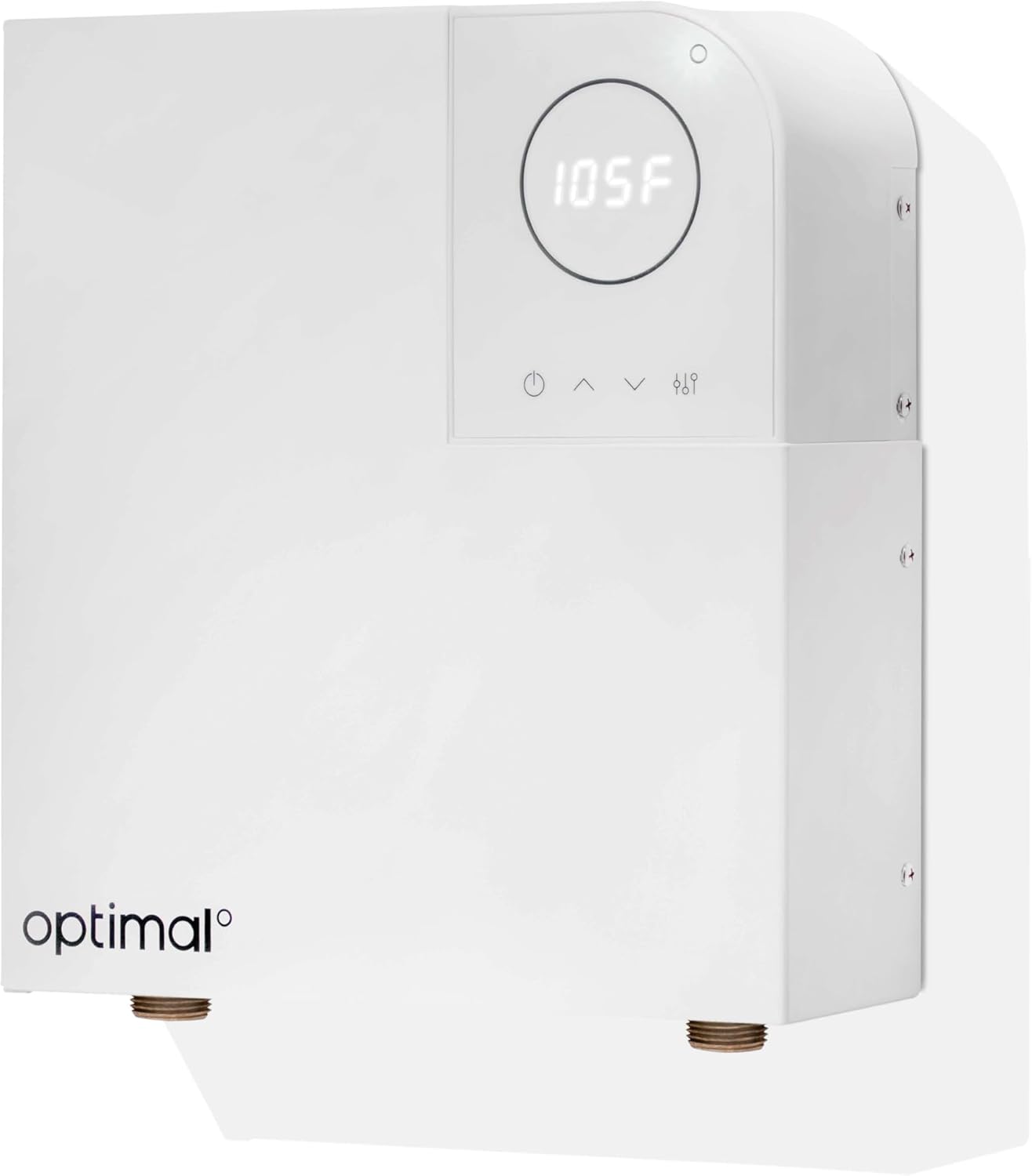
The Optimal opti12 is a compact 12 kW electric tankless water heater built for continuous hot water delivery in light commercial or demanding residential settings. It uses ultrasonic flow sensing and self‑modulating control to provide up to 2.5 gallons per minute while maintaining up to 105°F output, and the unit includes anti‑freezing, overheat, dry‑combustion protection and an integrated error code indicator for easier troubleshooting. Installation is straightforward with standard 3/4 inch water connections and wall mounting, and the built‑in LED diagnostics and app‑ready smart features simplify monitoring and service. Practical benefits include space savings compared with tank systems, high listed efficiency and protection against common failure modes that supports long life — the listing even notes a 25‑year residential warranty covering components. Limitations are its modest flow rate, which means it is best for single‑point or light multi‑fixture use rather than large simultaneous demands, and it requires appropriate 208V/240V electrical capacity for full performance.
Best for: Buyers who prioritize long‑term reliability and built‑in protections and need a compact, serviceable electric unit for single‑point or light commercial hot water needs.
Less Ideal for: Facilities that need high simultaneous flow for multiple showers or large production uses should choose a higher‑capacity commercial unit instead.
- Self‑modulating control and ultrasonic flow sensing for stable temperature delivery
- Multiple safety protections including anti‑freezing, dry‑fire and overheat prevention
- Compact wall mount design saves space compared with tank water heaters
- Built‑in diagnostics and LED error codes simplify maintenance and troubleshooting
- Maximum flow rate of 2.5 gpm limits simultaneous hot water use for multiple fixtures
- Requires appropriate high‑voltage electrical supply for full 12 kW operation
Verdict: A compact, reliability‑focused 12 kW electric tankless heater with robust safety and diagnostic features ideal for single‑point or light commercial applications.
Rheem RTEX-18 Tankless Electric Heater
| Wattage | 18000 watts |
|---|---|
| Voltage | 240 volts |
| Flow Rate | 4.4 gpm |
| Heat Output | 18 KW |
| Maximum Temperature | 140 °F |
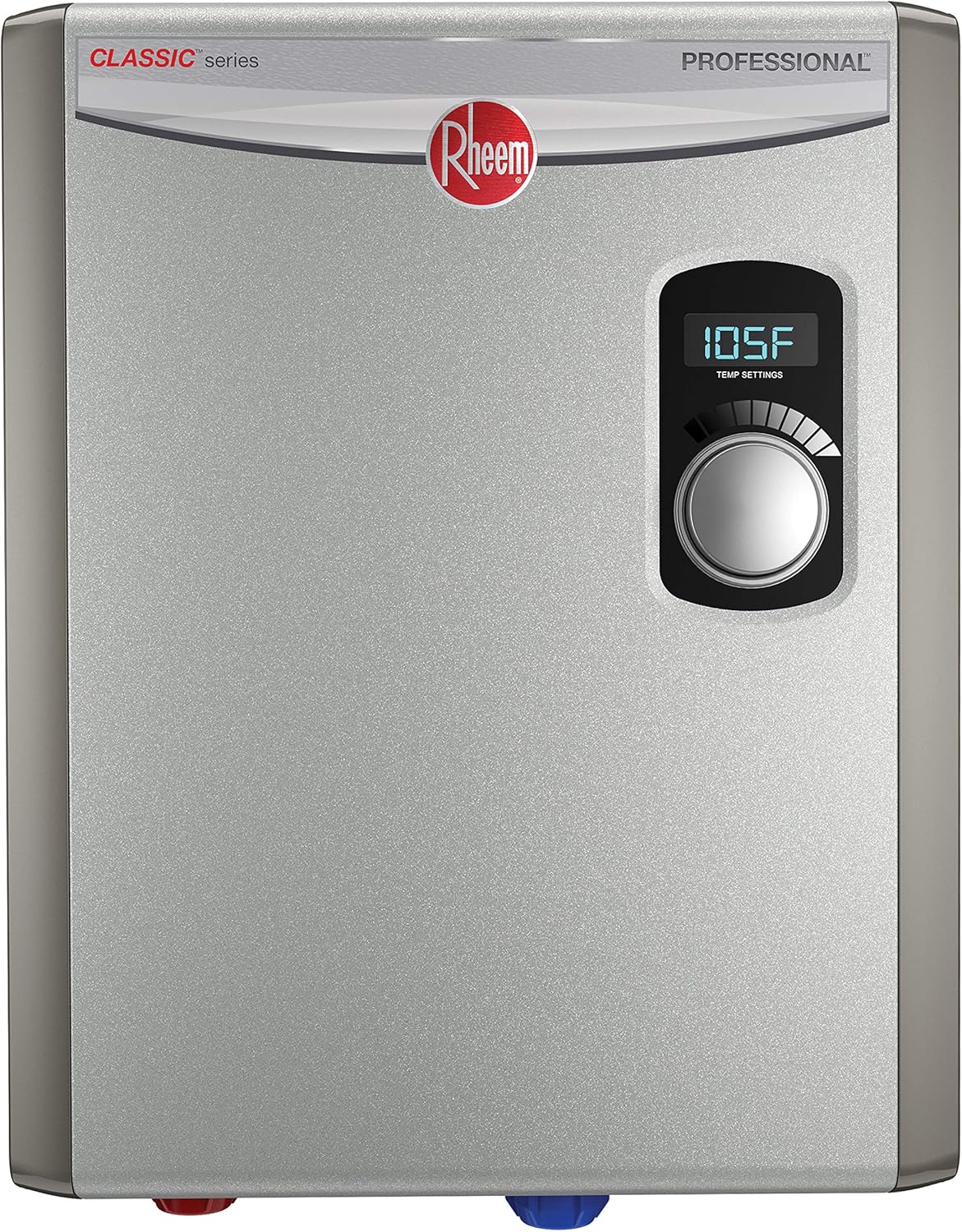
The Rheem RTEX-18 is an 18 kW, 240 V tankless electric unit built to supply continuous hot water for mid-range whole-home or light commercial use. It uses two field-serviceable copper immersion heating elements and self-modulating controls that vary power to match demand, which helps efficiency and reduces wasted energy when flow is low. A front LED temperature display provides precise setpoint control and the unit requires no venting, saving installation space and simplifying placement on a wall near the service point. With a rated max flow around 4.4 gpm and a maximum outlet temperature of 140 F, it can handle a shower plus additional fixtures in moderate inlet-temperature regions but will be limited when multiple showers run in cold climates. Practical benefits include compact footprint, straightforward NPT water connections, and simple servicing of heating elements. Important limitations are the need for substantial electrical capacity (240 V, high-amp breakers) and the 4.4 gpm ceiling, which constrains simultaneous high-flow demands in larger commercial setups.
Best for: Buyers who want a compact, energy-conscious tankless electric unit for whole-home or light commercial use and who prioritize documented performance and established brand reputation.
Less Ideal for: Large commercial sites or high-demand installations that need multiple high-flow fixtures running at once or locations without sufficient 240 V electrical capacity.
- Self-modulating control adjusts power to match hot water demand for better efficiency
- Compact wall-mounted design saves space and allows flexible placement
- Digital LED temperature control for precise setpoint adjustments
- Field-serviceable copper heating elements simplify maintenance
- Maximum flow of 4.4 gpm limits simultaneous high-flow use in colder climates
- Requires significant 240 V electrical service and high-amp breakers
Verdict: Choose the RTEX-18 when you need a compact, energy-efficient electric tankless heater that reliably delivers on-demand hot water for mid-range whole-home or light commercial applications.
Rheem RTEX-24 Tankless Electric

| Wattage | 24 KW |
|---|---|
| Voltage | 240 volts |
| Flow Rate | 5.9 gpm |
| Maximum Temperature | 140 °F |
| Mount Type | Wall |
The Rheem RTEX-24 is a compact, wall-mounted electric tankless water heater built to supply continuous hot water for multiple fixtures without a storage tank. It uses self-modulating power control and a front digital temperature display for straightforward setpoint adjustment, and the unit provides up to 5.9 GPM in warm climates, which covers a couple of showers and sinks running at once. Installation requires significant electrical capacity — three 40 A double-pole breakers and a recommended 200 A household service — so it is best suited to commercial or larger residential electrical systems. The stainless steel construction and no-vent design make indoor mounting simple where space is limited, and the lack of standby heat loss improves efficiency compared with tank models. Limitations include the high electrical demand and dependence of actual flow and outlet temperature on incoming groundwater temperature, so performance will vary by climate and plumbing layout.
Best for: Buyers who prioritize reliable, on-demand hot water for multiple fixtures and want a compact, energy-efficient electric solution and who have robust electrical service or can upgrade their panel.
Less Ideal for: Homes or businesses with limited electrical service, small breaker panels, or where incoming water is very cold without supplemental heating should consider lower-kW models or gas alternatives instead.
- Delivers up to 5.9 GPM for simultaneous showers and sinks in suitable climates
- Self-modulating power control increases efficiency by using only required power
- Compact wall-mounted design saves space compared with tank heaters
- Digital temperature control on the front makes setpoint changes easy
- Stainless steel construction and no-vent requirement allow flexible indoor installation
- Requires heavy electrical capacity (3 x 40 A breakers and recommended 200 A service)
- Flow rate and delivered temperature depend on incoming groundwater temperature
Verdict: Choose the RTEX-24 when you need compact, whole-home electric on-demand hot water and have the electrical capacity to support a 24 kW tankless unit.
Choosing the Right Commercial Electric Tankless Water Heater: Key Factors to Consider
Continuous Flow Rate and Peak Demand
Commercial users need to match a unit's rated continuous flow to the facility's peak simultaneous draw. Calculate peak demand by adding flow rates of fixtures likely to operate at once, such as multiple sinks, dishwashers, and showers. Compare that aggregate to the heater's rated GPM at your expected temperature rise.
A heater that meets average demand but not peak draw will cause temperature drop or cycling under load. Oversizing conservatively for occasional surges reduces the risk of cold-water sandwiching and maintains steady temperatures during busy periods.
Temperature Rise and Inlet Water Conditions
Commercial electric tankless heaters specify output flow at particular temperature rises. Know your incoming groundwater temperature and the target output temperature to determine the actual available flow. In colder climates, the same unit will deliver less hot water for a high temperature rise than in milder regions.
Hard or mineral-rich inlet water affects heat-transfer surfaces and may reduce long-term performance. Confirm water chemistry considerations and plan for appropriate filtration or softening where needed to protect heating elements and maintain efficiency.
Electrical Service and Wiring Requirements
Commercial electric tankless heaters can demand high amperage and specific phase configurations. Verify building electrical capacity, available breaker space, and whether single- or three-phase power is required. Upgrading service panels or adding dedicated feeders can be a substantial additional cost and install time factor.
Check whether the unit allows staged modules or parallel installation to spread load. Also review manufacturer guidance on wire gauge, breaker sizing, and required disconnects to ensure compliance with local codes.
Installation Footprint and Venting Needs
Electric tankless units have a smaller physical footprint than tank heaters but still require secure mounting, proper clearances, and space for servicing. Plan wall or rack layouts that allow easy access to electrical terminals and hydraulic connections.
Because these are electric, they do not require combustion venting, but they do need appropriate access for wiring and plumbing. Consider proximity to high-demand fixtures to minimize pipe runs and heat loss.
Maintenance, Serviceability, and Diagnostics
Commercial duty cycles demand straightforward maintenance. Look for models with accessible service panels, replaceable heating elements or modules, and clear diagnostic indicators or digital fault codes. Ease of flushing and scale management is important when inlet water has minerals.
Readily available documentation and support for replacement parts reduce downtime. Units designed with modular components make repairs faster and help keep facilities operational during service events.
Certifications, Warranty, and Compliance
Commercial installations often require products that meet local code and industry standards. Confirm applicable electrical and plumbing certifications and whether the unit is rated for commercial use. Warranty terms that cover commercial applications are important because duty cycles are heavier than residential.
Ensure documentation supports code inspection and that service procedures align with the installer and facility maintenance capabilities.
Sizing a Commercial Electric Tankless System
Start by mapping simultaneous hot-water activities during peak operation. Create a usage profile listing fixtures and appliances with typical GPM draws and estimate how many will be used together during the busiest period. Use that profile to select a unit or modular arrangement with sufficient continuous flow at the expected temperature rise.
If a single unit cannot meet demand, consider installing multiple units in parallel or selecting a modular system that stages heating elements. This approach improves redundancy and lets you scale capacity while managing electrical load distribution.
- Measure inlet water temperature before sizing for accurate temperature rise calculations
- Account for future expansion or increased occupancy when possible
- Plan for parallel installation or redundancy for critical facilities
Electrical Infrastructure and Panel Planning
A thorough electrical assessment is essential. Confirm the building service can support continuous high-current draws and that distribution panels have space for dedicated breakers and appropriate disconnects. Discuss three-phase versus single-phase requirements with an electrician early in the planning process.
Document conductor sizes, breaker ratings, and any needed panel upgrades in the installation plan. When multiple units are used, design feeder and metering strategies to balance load and minimize nuisance trips.
- Verify main service capacity and reserve ampacity
- Include accessible disconnects and clear labeling for each heater
- Coordinate with local electrical inspector on panel and feeder changes
Protecting Units From Hard Water and Scale
Mineral buildup reduces heat-transfer efficiency and shortens component life. In commercial settings, scale management is a practical maintenance priority. Implement softening or filtration if water tests indicate high hardness or scaling potential.
Make a flushing schedule part of preventive maintenance and choose units designed for easy descaling. Mechanical filtration ahead of the unit can trap particulates that might erode element surfaces or flow sensors.
- Test water hardness and chemistry before installation
- Use inline strainers to protect flow sensors
- Schedule routine flushing and inspection intervals
Controls, Monitoring, and Integration
Advanced controls and remote monitoring reduce service calls and help track energy use. Look for units with digital thermostats, modulating control, and diagnostic readouts. Integration-ready models can communicate status to building management systems for centralized alerts and usage data.
For larger installations, centralized control that stages multiple heaters based on demand improves efficiency and extends component life by avoiding continuous maxed-out operation.
- Require clear fault codes and status indicators
- Consider network-enabled units for remote diagnostics
- Use staging controls to reduce cycling and even out load
Redundancy and Service Planning
Commercial operations need contingency plans. Designing redundancy into the hot-water system prevents downtime during maintenance or component failure. Parallel units allow one device to be taken offline without interrupting service if overall capacity remains sufficient.
Establish a parts and service protocol with local technicians and maintain a spare critical component inventory. Quick turnaround for element replacement or control board swaps minimizes disruption to operations.
- Include bypass piping to isolate units for service
- Maintain a documented service contract and spare-part list
- Plan for staged replacements to avoid full system outages
How We Chose the Best Commercial Electric Tankless Water Heater
We prioritized product attributes that matter most in commercial installations. Key evaluation criteria included certified continuous flow rate at realistic temperature rises, electrical supply requirements and breaker/phase compatibility, energy efficiency and thermal regulation, and robustness of construction for commercial duty cycles. We also considered ease of installation from a plumbing and electrical standpoint, available serviceability features such as replaceable components and clear error codes, and applicable certifications for commercial use. Products were excluded if they lacked clear continuous-flow specifications, required proprietary wiring beyond standard commercial practice, or lacked commercial-grade certifications. We favored units with documented testing data for flow at common commercial temperature rises and with control features that allow integration with building systems. The scoring leaned on measurable specs rather than marketing claims so readers can compare based on the parameters that affect real-world performance and operating costs.
Our full evaluation process is outlined in our review methodology.
FAQ
How do I calculate the right GPM for my commercial site?
Add the flow rates of fixtures and appliances likely to operate at once during peak periods. Factor in any future increases in demand and use the inlet-to-output temperature rise to determine the heater's actual capacity at that temperature.
Can multiple electric tankless units be run in parallel?
Yes. Running units in parallel is a common strategy to meet higher peak demand and provide redundancy. Ensure electrical load distribution and controls are designed to stage or balance the units properly.
What electrical upgrades might be necessary for installation?
Upgrades can include additional breakers, larger conductors, new feeders, or even a service panel increase depending on total amperage demand. A licensed electrician should evaluate the site to determine required changes and code compliance.
How does water hardness affect these units?
Hard water can cause scale buildup on heating elements and heat-transfer surfaces, reducing efficiency and lifespan. Implement filtration, softening, or a regular descaling schedule when water chemistry indicates a risk.
Are electric tankless heaters suitable for all commercial applications?
They are well suited for many light to medium commercial uses such as offices, small restaurants, and multifamily units. Very high-demand industrial processes or locations without adequate electrical service may require alternate solutions.
Final Verdict
Choosing the right commercial electric tankless water heater depends on matching continuous flow capacity to peak demand, ensuring the electrical infrastructure can support continuous high amperage, and planning for water quality and maintenance. Prioritize units with clear flow ratings at your required temperature rise, simple serviceability, and control features that support staging or building integration. For commercial projects, lean toward conservative sizing for peak periods, design redundancy when downtime is unacceptable, and coordinate early with electrical and plumbing professionals to avoid installation delays. These steps will help you select a solution that delivers reliable hot water and manageable operating costs.