
Note: This article contains affiliate links. If you click on these links and make a purchase, we may earn a small commission at no extra cost to you. This helps support our research and content. Read our full affiliate disclosure here.
If you run a bakery or are scaling production, the right commercial mixer for bakery use transforms efficiency and consistency. You need equipment that handles heavy doughs and long runtimes without frequent downtime. This guide spotlights seven shortlisted commercial mixers chosen for their heavy-duty motors, bowl capacities, and serviceability. We evaluated each option for the demands of a professional kitchen, from mixing dense doughs to whipping large volumes of batter. Read on to see which machines meet the common operational priorities bakers face and why those evaluation points matter.
Top Picks at a Glance
| Best Overall The best all-around choice for most situations | VEVOR 15Qt Commercial Mixer |  |
| Best Quality Built to a higher standard if you want something more solid | KitchenAid Commercial 8-Quart Mixer KSM8990CU |  |
| Best Value The sweet spot between price and what you get | BOSBAK 15QT Commercial Stand Mixer |  |
| Best Budget The cheapest option that still gets the job done reliably | CuisinAid Commercial Mixer 15QT |  |
| Top Rated A top-rated pick with lots of positive feedback | ZACME 8.4QT Commercial Stand Mixer |  |
| Most Popular A crowd favorite that many people choose with confidence | Happybuy Commercial Food Mixer 15Qt |  |
| Best Seller A high-volume bestseller chosen again and again | VEVOR Commercial Food Mixer 30Qt |  |
VEVOR 15Qt Commercial Mixer

| Capacity | 13.6 liters |
|---|---|
| Wattage | 500 watts |
| Number of Speeds | 3 |
| Voltage | 110 volts |
| Noise Level | 70 db |
The VEVOR 15Qt Commercial Mixer is a heavy-duty stand mixer built for small bakery and restaurant workflows. It pairs a 500W motor and gear-driven transmission with three speed settings to handle tasks from low-speed dough kneading to high-speed whipping, and the included dough hook, flat beater, and wire whip cover common commercial mixing needs. A built-in timer and a wheel-style bowl lift make hands-off operation easier during batch work, while the stainless steel bowl and attachments are corrosion resistant and simple to clean. Safety features include a clear guard with an automatic shutdown if the cover is not secured. Expect industrial-level noise around 70 dB and a fairly large footprint, so plan for a dedicated counter area. The mixer is practical for busy bakeries or cafés that need reliable, easy-to-maintain mixing for doughs, batters, and creams, but it is a substantial piece of equipment intended for commercial rather than casual home use.
Best for: Bakeries, cafes, and small commercial kitchens that need a durable, easy-to-clean mixer for regular batch work and want straightforward controls and a timer to streamline production.
Less Ideal for: Home cooks with limited counter space or those who only mix infrequently should consider smaller, lighter mixers instead.
- Robust 500W gear-driven motor suited for continuous commercial mixing
- Three included attachments (dough hook, flat beater, wire whip) for versatile recipes
- 15-quart stainless steel bowl and food-grade attachments resist corrosion and are easy to clean
- Built-in 30-minute timer and wheel-style bowl lift support repeatable, hands-off batches
- Safety guard with automatic shutdown when not securely closed
- Noise level around 70 dB is noticeable in small kitchens
- Large footprint and weight make it impractical for occasional home use
Verdict: A rugged, no-nonsense 15-quart commercial mixer that delivers versatile, reliable mixing for busy bakery and light commercial environments.
KitchenAid Commercial 8-Quart Mixer KSM8990CU

| Capacity | 8 quarts |
|---|---|
| Wattage | 500 watts |
| Number of Speeds | 10 |
| Voltage | 120 volts |
The KitchenAid Commercial Series 8-Quart Bowl Lift Mixer is built for bakery use where long runs and dense doughs are routine. It uses a high-efficiency DC motor and PowerCore technology to deliver steady torque with reduced heat buildup, so it can knead large batches — KitchenAid states it handles more than 8 pounds of dough — without frequent cool-downs. The bowl-lift design keeps the heavy stainless-steel bowl secure during mixing and makes attachment engagement solid for heavy-duty tasks. Controls are simple: a 10-speed knob and soft-start feature minimize splash and give gradual ramping into full speed. Commercial-grade stainless-steel accessories, including a spiral dough hook and an 11-wire whip, are included and are dishwasher-safe for quicker cleanup. This mixer is NSF certified and includes speed control protection to prevent accidental starts while cleaning. The main trade-offs are its substantial weight and footprint, which require dedicated counter or stand space, and the lack of digital controls or programmable timers that some modern commercial mixers offer.
Best for: Bakers and small commercial kitchens that need a durable, high-torque mixer to run large batches and handle frequent dough work with minimal heat-related slowdowns.
Less Ideal for: Home cooks with limited kitchen space or operations that need compact, lightweight mixers or programmable/digital workflow features.
- NSF certified for commercial use, meeting health-inspection standards
- Powerful, efficient DC motor with PowerCore tech for long mixing without overheating
- 8-quart stainless steel bowl and commercial-grade attachments handle large batches
- Bowl-lift design provides stable beater-to-bowl contact for heavy doughs
- Speed control protection and soft-start reduce accidental starts and splash-out
- Large and heavy, requiring a dedicated counter or stand
- No digital interface or programmable mixing presets
Verdict: Choose this mixer if you need a tough, NSF-certified commercial machine that reliably kneads and mixes large bakery batches without overheating.
BOSBAK 15QT Commercial Stand Mixer

| Capacity | 15 quarts |
|---|---|
| Wattage | 600 watts |
| Voltage | 110 volts |
| Number of Speeds | 3 |
| Noise Level | 76 db |
The BOSBAK 15QT Commercial Stand Mixer is built for high-volume baking tasks like dough, batter, and whipping. It uses a 600W motor and three speed settings with a timer and audible end-cycle alert to handle several pounds of dough per batch; the planetary action plus included dough hook, flat beater, and wire whip cover kneading, mixing, and whipping needs. The stainless steel 15-quart bowl locks into a metal lift mechanism for secure operation and easier loading and cleaning, and safety features such as an auto stop when the splash guard opens and overload protection help protect the motor during heavy use. At roughly 76 dB it is quieter than many commercial machines, but it is still a heavy, stationary unit intended for a prep area rather than occasional countertop use. Setup requires running the empty machine briefly after delivery per the instructions. For busy bakery or pizzeria workflows this mixer offers durable basic functionality, though it lacks fine-grain speed control beyond the three preset settings and is large and heavy to move.
Best for: Bakers and small commercial kitchens that need a durable, no-frills planetary mixer to produce frequent medium-to-large batches reliably and safely.
Less Ideal for: Home cooks who need a lightweight, portable countertop mixer or operations that require precision variable-speed controls for delicate tasks.
- Commercial 15-quart stainless steel bowl with bowl lock for large batches
- Includes dough hook, flat beater, and wire whip for versatile mixing tasks
- 600W motor with overload protection and auto safety stop to protect the machine
- Timer with end-of-cycle alert and sturdy metal lift for safe, convenient operation
- Splash guard and lower-noise operation (about 76 dB) for cleaner, less intrusive use
- Only three fixed speed settings, so limited fine speed control
- Heavy and bulky design not suited for frequent relocation
Verdict: A sturdy, safety-focused 15QT commercial mixer that reliably handles repeated medium-to-large bakery batches for professional kitchens.
CuisinAid Commercial Mixer 15QT

| Capacity | 15 quarts |
|---|---|
| Wattage | 600 watts |
| Voltage | 110 volts |
| Number of Speeds | 3 |
This CuisinAid 15QT commercial mixer is a straightforward, no-frills stand mixer aimed at light-to-moderate bakery tasks. It pairs a 600W motor with a 15-quart stainless steel bowl and three speeds (130/233/415 RPM) to handle kneading, mixing, and whipping; included attachments are a dough hook, flat beater, and wire whip. The mixer is built for foodservice environments with a safety guard that stops the unit if opened, adjustable bowl height, and anti-skid feet to reduce movement during heavy batches. Practical benefits include a bowl that can mix roughly 3.5 lbs of dough per batch and simple knob controls that are easy to train staff on. Limitations are the modest 600W motor and only three speed settings, which may stretch under very heavy or continuous high-volume use, and the unit is basic on features compared with higher-end commercial mixers that offer planetarian action or multiple speed presets. For budget-minded bakeries this mixer delivers core functionality and durable stainless-steel parts but expect to trade advanced control and extreme duty performance for a lower purchase cost.
Best for: Bakeries, pizzerias, and small commercial kitchens that need a rugged, affordable mixer for routine doughs, batters, and whipped preparations and prioritize straightforward operation and durable materials.
Less Ideal for: High-volume production bakeries or pastry shops that require heavy-duty motors, fine speed control, or planetary mixers for continuous, large-capacity mixing should consider more powerful commercial models.
- Large 15-quart stainless steel bowl suitable for typical bakery batches
- Includes dough hook, flat beater, and wire whip for versatile mixing tasks
- Safety guard with automatic shutoff and anti-skid feet improves operator safety and stability
- Simple knob controls and three clear speed settings make operation intuitive
- 600W motor and only three speeds may struggle with very heavy or continuous commercial loads
- Basic feature set lacks advanced mixing actions and fine speed control
Verdict: A budget-friendly 15-quart commercial mixer that gives bakeries essential mixing power and durable stainless-steel construction without premium features.
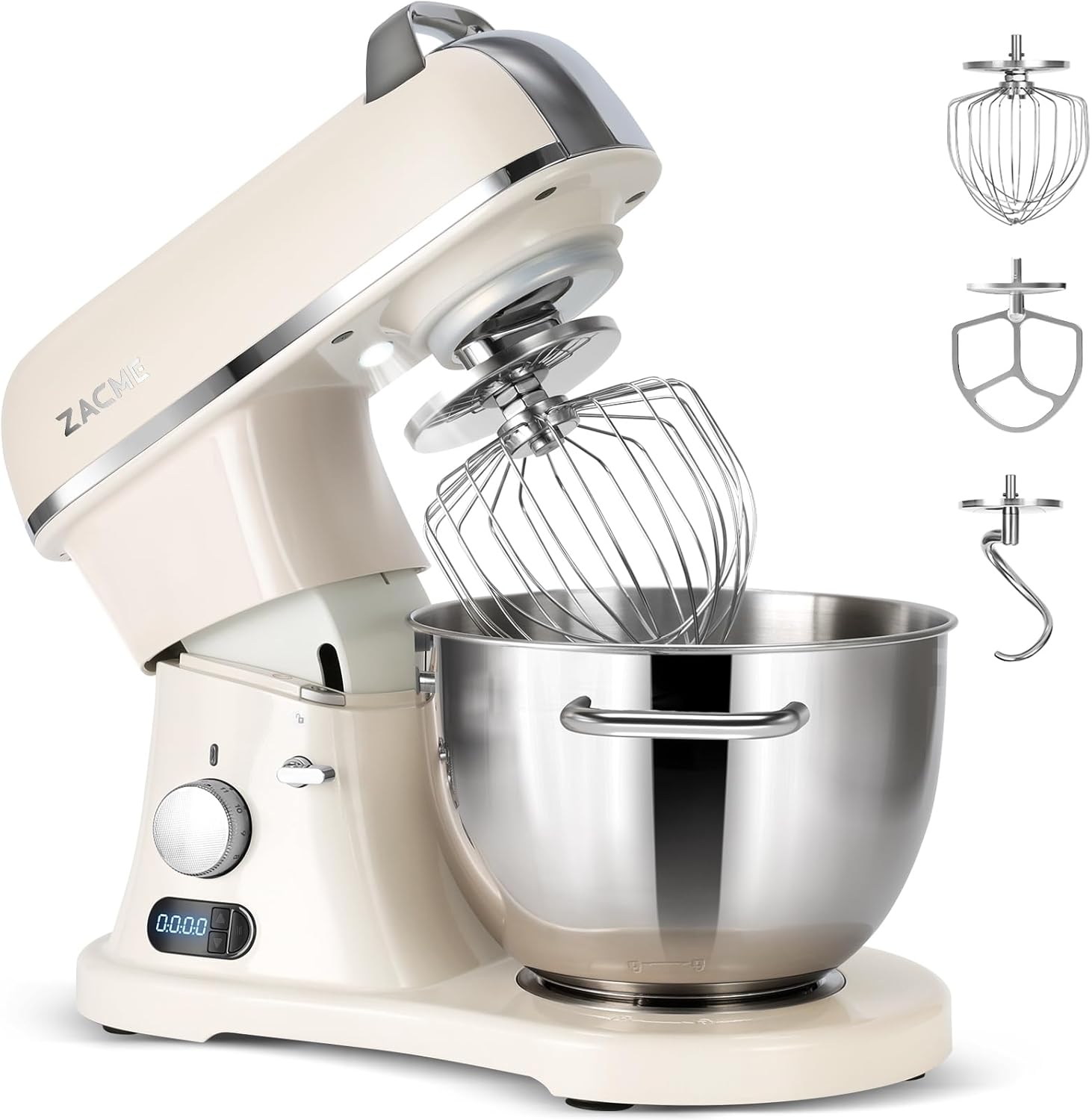
ZACME 8.4QT Commercial Stand Mixer
| Capacity | 8.4 quarts |
|---|---|
| Wattage | 800 watts |
| Number of Speeds | 11 |
| Voltage | 120 volts |
| Noise Level | 48 db |
The ZACME 8.4QT Commercial Stand Mixer is built for sustained, high-volume baking tasks and feels more industrial than a typical home model. Its 800W DC motor, metal gears and dual cooling fans let it handle long kneading sessions and larger dough batches up to about 3 kg without overheating, while the planetary mixing action and included dough hook, flat beater and wire whip deliver thorough mixing from batter to bread dough. The tilt-head design and LED time display make accessory changes and timing straightforward, and anti-slip suction feet plus a heavy aluminum die-cast body keep the machine stable and quiet compared with lighter plastic units. Noise is kept reasonably low on slower speeds but will rise toward the top end during heavy loads. This is a heavy, countertop-forward unit that needs permanent space and a bit of care when moving, and replacement parts or service may be less convenient than for mainstream legacy brands. For bakeries or serious home bakers who need a reliable, NSF-standard commercial mixer, it offers strong performance and durability.
Best for: Bakeries, cafés, and serious home bakers who prioritize durable, commercial-grade construction and continuous mixing performance for large batches.
Less Ideal for: Casual bakers who need a lightweight, easily storable mixer or shoppers who rely on widespread third-party service and parts networks.
- Industrial-grade aluminum die-cast body and metal gearing for long-term durability
- 800W DC motor with dual cooling allows extended mixing without overheating
- Large 8.4-quart stainless steel bowl and included stainless accessories for commercial-size batches
- Digital LED display with time setting and 11 speed levels for precise control
- NSF/ANSI 8-2023 compliance and anti-slip feet for stable, professional use
- Heavy and bulky, not easy to move or store
- Noise increases on high speeds despite low-noise design
- May require brand-specific parts or service that are less common than legacy brands
Verdict: Choose this mixer when you need a robust, NSF-standard commercial machine that will handle large, repeated batches reliably.
Happybuy Commercial Food Mixer 15Qt

| Capacity | 15 quarts |
|---|---|
| Wattage | 600 watts |
| Number of Speeds | 3 |
| Noise Level | 75 db |
| Voltage | 120 volts_of_alternating_current |
This Happybuy commercial mixer is built for small bakery and pizzeria kitchens that need a heavy-duty, no-frills workhorse. The 600W gear-driven motor and three speed settings cover common tasks from slow dough kneading to high-speed whipping, and the included dough hook, flat beater, and wire whip make it versatile for doughs, batters, and creams. The 15-quart stainless steel bowl and food-grade mixing components handle larger batches and are easy to clean, while the adjustable bowl height and safety shield with automatic shutoff add practical convenience. The added timer dial (up to 30 minutes) is useful when you need to set and walk away for repeatable mixes. Expect noticeable vibration and a fairly loud operating level at 75 dB, and the unit is physically large and heavy so it suits fixed commercial counters rather than occasional home use. For bakeries that need reliable batch mixing without advanced electronics, this mixer delivers solid, straightforward performance.
Best for: Shop buyers who prioritize proven, functional equipment and want a reliable, heavy-duty mixer for frequent batch mixing in bakeries, pizzerias, or small commercial kitchens.
Less Ideal for: Home cooks with limited counter space or businesses that require quiet, low-vibration operation or advanced electronic controls should consider other options.
- 15-quart stainless steel bowl accommodates larger commercial batches
- 600W gear-driven motor with three speeds for dough, mixing, and whipping
- Includes dough hook, flat beater, and wire whip for common bakery tasks
- Safety shield with automatic shutoff and adjustable bowl height for safer operation
- Detachable parts and stainless steel construction make cleaning straightforward
- Operates at a relatively high noise level (75 dB)
- Heavy and large footprint requires a dedicated counter space
Verdict: A straightforward, durable 15-quart commercial mixer built for bakeries that need reliable batch mixing with minimal fuss.
VEVOR Commercial Food Mixer 30Qt

| Capacity | 28.5 liters |
|---|---|
| Wattage | 1100 watts |
| Number of Speeds | 3 |
| Noise Level | 70 db |
| Voltage | 110 volts |
The VEVOR 30Qt commercial food mixer is a floor-standing, gear-driven mixer built to handle large batches in a bakery or food-service kitchen. It uses a 1100W motor and three speed settings (low 130, medium 193, high 458 rpm) to knead dough, mix fillings, and whip creams; the package includes a dough hook, flat beater, and wire whisk plus a guard and automatic shutoff if the cover is opened. The lever-style bowl adjuster and detachable stainless steel bowl and beaters make loading and cleanup straightforward, and the built-in timer (0–30 minutes) helps standardize batch times. At roughly 70 dB during operation and with a heavy, stable build, it feels like a pro appliance suited to continuous kitchen use. Important practical limits are its large footprint and substantial weight, which require a permanent placement and two people to move, and the control set is basic knob-style with only three speeds, so it is less flexible than multi-speed planetary mixers for delicate tasks.
Best for: Bakers and commercial kitchens that need a durable, no-nonsense mixer capable of running frequent medium to large batches and that prioritize reliable, easy-to-use equipment.
Less Ideal for: Small home bakers with limited space or operations that require a very lightweight, portable mixer or very fine speed control should look elsewhere.
- Large 28.5L (30Qt) stainless steel bowl handles bakery-sized batches.
- Powerful 1100W gear-driven motor for consistent mixing under load.
- Includes three common attachments (dough hook, flat beater, wire whisk) for versatile recipes.
- Safety guard with automatic shutdown and lever bowl adjuster improve day-to-day workflow.
- Detachable stainless components are rust-resistant and easier to clean.
- Heavy and bulky so it is not portable and needs a dedicated space and help to move.
- Only three fixed speeds limit fine control for very delicate or highly technical mixing tasks.
Verdict: Buy this mixer if you want a heavy-duty, bakery-ready 30Qt machine that reliably handles large batches with simple, proven controls.
Choosing the Right Commercial Mixer for Bakery: Key Factors to Consider
Motor Power and Torque
Motor power determines whether a mixer can handle dense doughs, long mixing cycles, and continuous bakery workloads. Higher-rated motors with robust torque reduce the chance of stalling when mixing heavy bread or enriched doughs. Consider the duty cycle rating and whether the motor is designed for intermittent or continuous operation.
A stronger motor often means greater longevity under professional use, but it can also consume more power and generate heat. Look for mixers with thermal protection and cooling designs that allow sustained operation without frequent shutoffs.
Bowl Capacity and Batch Flexibility
Bowl capacity directly affects how much you can produce per batch and whether a mixer fits your bakery's volume needs. Larger bowls let you scale production and reduce the number of batches, while smaller bowls give tighter control for delicate mixing tasks.
Also consider whether the mixer supports multiple bowl sizes or attachments that expand capacity range. Proper capacity matching reduces overworking the machine and improves mixing consistency for different recipes.
Build Materials and Construction
Durable construction materials like stainless steel bowls and cast-metal gear housings resist wear and stand up to daily use in a commercial kitchen. Solid construction reduces vibration and improves drivetrain longevity, which matters when mixers run for hours each day.
Check for corrosion-resistant finishes and heavy-duty fasteners. Robust builds often translate to lower long-term maintenance needs and a lower risk of unexpected breakdowns during peak production.
Sanitation and Ease of Cleaning
Sanitation is critical in a bakery. Smooth surfaces, rounded edges, and easily removable parts make cleaning faster and reduce hidden food traps. Machines that allow quick disassembly of bowls, whips, and seals minimize downtime between shifts and lower contamination risk.
Consider whether seals and gaskets are readily accessible and replaceable, and whether the mixer design keeps electrical components shielded from moisture during cleaning cycles.
Serviceability and Parts Availability
Frequent use means components will eventually need service or replacement. Mixers that provide easy access to belts, gears, and electrical components reduce repair time and service labor costs. A machine that accepts standard replacement parts or has modular components is easier to keep running.
Also think about local service support and the availability of common wear parts. The ability to perform routine maintenance without specialized tools helps keep the mixer in regular production.
Noise, Vibration, and Operator Comfort
High noise and vibration levels can create a stressful work environment and may indicate suboptimal mounting or drivetrain issues. Mixers with well-damped motors and stable mounts reduce operator fatigue and the risk of components loosening over time.
Evaluate stated decibel levels if available and prioritize models with stable frames and balanced attachments to minimize vibration transmission to counters and floors.
Matching Mixer Capacity to Production Volume
Estimate your average and peak batch sizes to determine the bowl capacity you need. A mixer that is too small forces repeated batches and increases labor, while an oversized machine can be inefficient for small, delicate jobs.
Consider whether you will mainly produce high-volume items like loaves or smaller artisan batches. If your menu mixes both, look for machines that support different bowl sizes or offer attachments to adapt to varying recipes.
- Calculate daily dough tonnage from recipes and expected sales
- Factor in proofing and scaling time to avoid production bottlenecks
- Plan for future capacity growth when selecting bowl size
Attachments and Versatility for Bakery Tasks
Commercial mixers often accept a range of attachments for tasks like dough hooking, whisking, and paddle mixing. The right set of attachments expands the machine's utility beyond basic dough work.
When choosing a mixer, confirm which attachments are compatible and whether the gearbox supports sustained use with each accessory. Versatile attachments can help you handle icings, fillings, and small-batch batters without extra equipment.
- Standard attachments: dough hook, flat beater, whisk
- Optional tools: scraper, spiral hook, planetary accessories
- Check manufacturer guidance on duty cycle with heavy attachments
Installation, Space, and Power Requirements
Commercial mixers require dedicated space and appropriate electrical supply. Before purchase, verify dimensions, clearance needs for bowl removal and attachment changes, and the location of controls to ensure ergonomic operation.
Electrical requirements vary by motor size and duty cycle. Confirm that your kitchen electrical infrastructure can support the motor amperage and that cord length and plug type match local codes.
- Measure vertical and horizontal clearance for bowl and attachment removal
- Plan for vibration isolation or dedicated stands for heavy models
- Confirm power supply and consult an electrician if upgrading circuits
Routine Maintenance Tasks to Expect
Routine maintenance is straightforward if the mixer is designed for serviceability. Expect to clean bowls and attachments after each use, inspect seals and gaskets regularly, and lubricate gear housings according to the service schedule.
Keep a spare set of common wear parts on hand to minimize downtime. Train staff on basic checks like belt tension and unusual noises so small issues are caught before they cause failures.
- Daily: wash bowls and attachments, wipe exterior surfaces
- Weekly: inspect seals and fasteners, check attachment fit
- Monthly: check gearbox lubricant and motor ventilation
Safety Features and Operator Training
Safety interlocks, emergency stop controls, and guarded drive assemblies reduce the risk of operator injury. Ensure any mixer you choose has clear safety features and that staff are trained on their correct use.
Develop written procedures for safe operation, cleaning, and maintenance. Regular training reduces accidents and prolongs equipment life by ensuring consistent, correct usage.
- Look for bowl guards and interlock switches
- Provide PPE guidance for staff when operating large mixers
- Document lockout/tagout steps for servicing
How We Chose the Best Commercial Mixer for Bakery
We focused on attributes that matter in a high-volume bakery environment and filtered out light-duty and consumer-grade machines. Primary evaluation criteria included motor power and torque, because strong, reliable motors handle heavy dough without overheating; bowl capacity and gearing, to match batch sizes and mixing speed; build quality and materials, since stainless and cast-metal parts last longer under frequent use; and serviceability, meaning ease of routine maintenance and access to replaceable components. We also weighed noise and vibration levels for a safer, more comfortable workspace, and sanitation features like removable seals and smooth surfaces that reduce cleaning time. Products were excluded if they lacked documented specifications for continuous-duty operation, had limited service support, or were designed only for light domestic use. We prioritized mixers with clear specifications for duty cycle, motor rating, and capacity, and we favored designs that make maintenance straightforward for busy bakery staff.
Our full evaluation process is outlined in our review methodology.
FAQ
What bowl capacity is best for a small bakery?
A small bakery often benefits from a mid-sized bowl that balances batch size with control. Choose a capacity that allows you to produce typical daily quantities in one or two batches without overfilling, and consider expandable options if you expect growth.
How important is duty cycle rating for commercial mixers?
Duty cycle indicates how long a mixer can run before needing rest. For bakery use, favor mixers rated for continuous or extended duty to avoid overheating during peak production periods. Intermittent-duty machines may not be suitable for heavy, continuous workloads.
Can I use the same mixer for dough and batters?
Often you can, but heavy dough work stresses the drivetrain more than light batters. If you plan to alternate tasks frequently, select a mixer with appropriate motor capacity and compatible attachments, and follow recommended duty cycles for each task.
How often should I replace seals and gaskets?
Replacement intervals depend on usage and cleaning practices. Inspect seals and gaskets regularly for wear or cracks and replace them proactively if you notice leakage or loss of seal integrity. Busy kitchens may need to replace these parts more frequently.
What maintenance will keep a commercial mixer reliable?
Regular cleaning, scheduled lubrication, monitoring motor temperature, and checking fasteners will keep a mixer reliable. Maintain a simple log of service tasks and train staff to report unusual noises or changes in performance promptly.
Final Verdict
Choosing the right commercial mixer for bakery operations means balancing motor strength, bowl capacity, and ease of maintenance against your production patterns. Prioritize machines with duty cycles and motor torque suited to heavy dough work, and factor in sanitation and serviceability to minimize downtime. By matching capacity and attachments to your menu and training staff on routine maintenance, you can select a mixer that reliably supports day-to-day baking and scales with your needs.