
Note: This article contains affiliate links. If you click on these links and make a purchase, we may earn a small commission at no extra cost to you. This helps support our research and content. Read our full affiliate disclosure here.
If you run a bakery, cafe, or commissary kitchen, the Commercial Dough Mixer you pick determines how reliably you hit production targets and maintain dough consistency. The right mixer reduces prep time, handles frequent use without overheating, and lets staff work faster with less fatigue. This guide shortlists the top commercial dough mixers across typical professional capacities and motor ratings, focusing on real-world needs like throughput, reliability, and serviceability. We evaluated options against the criteria most important to busy kitchens so you can quickly identify machines that match your volume and space requirements. Read on for the top picks and the factors that matter when spec-ing a mixer.
Top Picks at a Glance
| Best Quality Built to a higher standard if you want something more solid | Eurodib Spiral Mixer LM30T |  |
| Best Value The sweet spot between price and what you get | LEEVOT Commercial Mixer SZM-30 |  |
| Best Budget The cheapest option that still gets the job done reliably | GOSHET Commercial Dough Mixer 10L |  |
| Top Rated A top-rated pick with lots of positive feedback | ZACME 8.4QT Commercial Stand Mixer |  |
| Most Popular A crowd favorite that many people choose with confidence | KitchenAid Commercial 8-Quart Mixer |  |
| Best Seller A high-volume bestseller chosen again and again | VEVOR Commercial Food Mixer 15Qt |  |
Eurodib Spiral Mixer LM30T

| Capacity | 30 quarts |
|---|---|
| Voltage | 220 volts |
| Wattage | 3080 watts |
| Number of Speeds | 2 |
The Eurodib LM30T is a commercial spiral mixer built for high-volume dough work in bakeries, pizzerias, and pastry shops. Its spiral hook and bowl design deliver efficient gluten development while keeping heat low, so you get consistent dough texture for breads and pizzas. The 30-quart bowl and 28.5 lb kneading capacity suit medium-to-large production runs, and the two-speed controls (spiral 185 RPM, bowl 15 RPM) give the operator simple, reliable mixing performance. The unit is stainless steel with painted cast iron components and includes a timer, bowl guard safety, and knob controls for straightforward operation. At 220V and roughly 3 kW motor power, it is intended for commercial electrical setups and offers the durability expected for daily use, though it requires proper installation and a matching power circuit. This mixer focuses on robust build and mixing consistency rather than advanced electronics, so it is a practical choice where dependable, heavy-duty mixing is the priority.
Best for: Bakers and foodservice operators who prioritize durable, high-capacity mixing and consistent dough quality for regular commercial production.
Less Ideal for: Home bakers or operations without a 220V commercial circuit and those who want programmable or digitally controlled mixers.
- Spiral hook design promotes efficient gluten development and consistent dough texture.
- Commercial-grade construction and stainless steel components for daily heavy use.
- 30-quart bowl with a 28.5 lb kneading capacity suits medium-to-large production runs.
- Simple two-speed controls, timer, and bowl guard for safe, reliable operation.
- Requires 220V commercial power and appropriate circuit installation.
- Relatively basic controls with no digital or automated mixing programs.
Verdict: Choose the Eurodib LM30T when you need a rugged, high-capacity spiral mixer that reliably produces consistent dough for commercial baking.
LEEVOT Commercial Mixer SZM-30

| Wattage | 1250 watts |
|---|---|
| Capacity | 28.4 liters |
| Number of Speeds | 3 |
| Material | Stainless Steel (304 drum) |
The LEEVOT SZM-30 is a heavy‑duty 30 qt commercial stand mixer designed for kitchens that need to process large batches of dough and mixes. It uses a 1250W motor to drive three interchangeable tools — dough hook, flat beater, and wire whip — across three speeds (100, 166, 360 RPM) and includes a 60‑minute timer and a liftable bowl for precise mixing depth. Built mostly from 304 food‑grade stainless steel with a foundry iron body, the unit feels solid and is intended for frequent use in bakeries, pizzerias, and restaurant kitchens. Practical features include a safety guard that cuts power if opened, removable components for cleaning, overload protection, and plastic foot mats to protect counters. Expect efficient, even mixing for large batches (up to 22 lb dough) but plan for ventilation space since the motor runs hot during long cycles and the machine is heavy and large, which limits portability. The controls are straightforward knob settings rather than digital microadjustments, which keeps operation simple but less precise than higher‑end commercial models.
Best for: Buyers who need a rugged, no‑frills commercial mixer to handle frequent large batches in a professional kitchen and prioritize durable construction and simple reliable controls.
Less Ideal for: Home bakers with limited counter space or kitchens that require a lightweight, portable mixer should look at smaller or countertop models instead.
- Large 30 qt (28.4 L) stainless steel bowl handles up to 22 lb of dough for high‑volume batches
- Powerful 1250W motor with three speed settings for dough, fillings, and whisking
- 304 food‑grade stainless steel mixing parts and removable accessories for durability and easy cleaning
- Safety guard with automatic shutoff and overload protection for safer commercial use
- Unit is heavy and physically large, making it difficult to move or fit in small kitchens
- Motor runs hot under extended use and requires clearance for ventilation
Verdict: Choose the SZM-30 when you need a sturdy, high‑capacity commercial mixer that reliably handles large dough batches with simple, serviceable controls.
GOSHET Commercial Dough Mixer 10L

| Capacity | 10 liters |
|---|---|
| Wattage | 750 watts |
| Voltage | 110 volts |
| Number of Speeds | 7 |
| Material | Stainless Steel 201 |
This GOSHET commercial dough mixer is built for small bakery or food-service use where reliable, hands-off mixing is needed. It pairs a 750W copper-core motor with a chain drive and spiral stirring rod to knead dough more consistently than manual mixing, and the 10-liter (2.6 gal) bowl handles roughly 2.2 to 11 pounds of dough so you can mix batches for small production runs. Controls are push-button with seven speeds and two rotation options (about 100/200 r/min) for different dough consistencies, and a safety guard with interlock cuts power when not closed. The stainless steel construction and rubber support feet aim to keep the unit durable and stable in a commercial kitchen. Expect a straightforward, utilitarian machine: it focuses on function over frills and does not include timers or digital controls beyond basic buttons. It is suited to kitchens that need simple, heavy-duty mixing rather than a compact countertop appliance for occasional home baking.
Best for: Buyers wanting a no-nonsense, heavy-duty mixer for regular small-batch commercial baking who prioritize durability and mixing performance over advanced electronics.
Less Ideal for: Home bakers who only make occasional small batches or buyers who need programmable timers, touchscreen controls, or a very compact countertop unit.
- Powerful 750W copper-core motor for consistent kneading
- Large 10L bowl suitable for 2.2–11 lb dough batches
- Spiral stirring rod and chain drive deliver more uniform mixing
- Stainless steel construction resists wear and corrosion
- Safety guard with automatic power cut when not closed
- Basic push-button controls without advanced digital or timing features
- IPX1 waterproof level offers limited splash protection only
Verdict: A rugged, high‑power 10L mixer that delivers reliable, uniform dough mixing for budget-conscious small commercial kitchens.
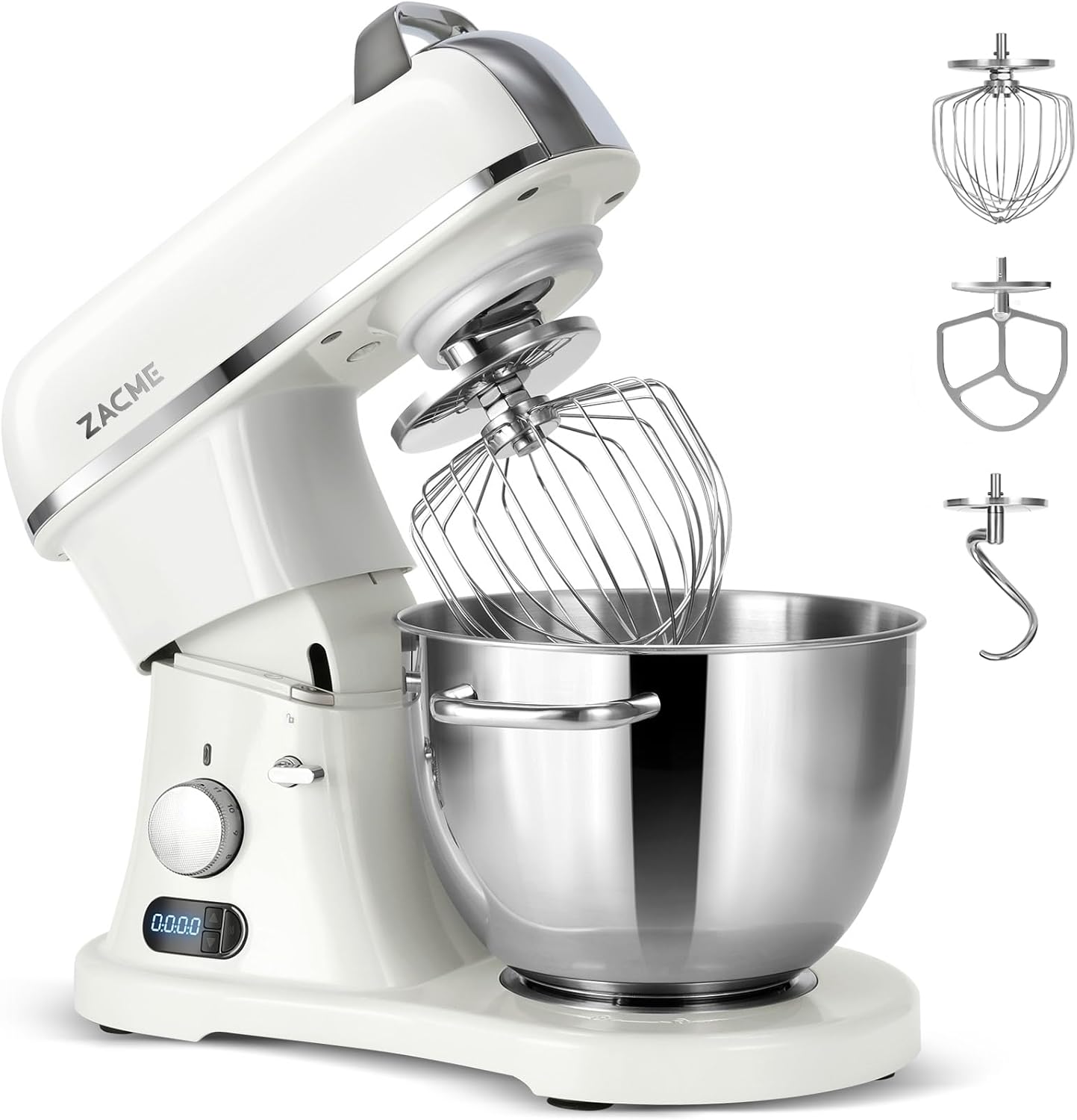
ZACME 8.4QT Commercial Stand Mixer
| Capacity | 8.4 quarts |
|---|---|
| Wattage | 800 watts |
| Number of Speeds | 11 |
| Noise Level | 48 db |
| Voltage | 120V |
This ZACME 8.4QT commercial stand mixer is built for heavy use, pairing an 800W DC motor and metal gears with an aluminum die-cast body and stainless steel bowl to handle large batches reliably. It is typically used for kneading dough, mixing batters, whipping cream, and other bakery tasks where consistent power and long run times matter; planetary mixing and three included stainless attachments (dough hook, flat beater, wire whip) deliver thorough, hands-free mixing. The LED display and countdown timer make multi-tasking easier, while 11 speed settings and a tilt-head design simplify ingredient addition and accessory changes. Practical benefits for commercial kitchens include dual cooling fans to prevent overheating during marathon sessions, suction feet for stability, and a noise rating that remains modest on low speeds. Limitations to consider are the mixer s weight and footprint which make it less portable and more of a permanent countertop appliance, and its higher-capacity focus may be overkill for users who only bake very small batches.
Best for: Buyers who prioritize a dependable, heavy-duty mixer for frequent or commercial baking will appreciate its durable construction, cooling system, and high-capacity bowl for large batches.
Less Ideal for: Casual home bakers who only make small batches or need a lightweight, compact mixer should consider smaller consumer models instead.
- Industrial-grade aluminum die-cast body and metal gears for durable, long-term use
- Powerful 800W DC motor with 11 speeds handles heavy dough and large batches
- 8.4 quart stainless steel bowl and included stainless attachments support commercial-scale recipes
- Dual cooling fans and overload protection allow extended operation without overheating
- Digital LED display with countdown timer simplifies monitoring during long mixes
- Heavy and bulky, not designed for frequent relocation or small kitchens
- Higher capacity and commercial orientation may be unnecessary for occasional home bakers
Verdict: A robust, commercial-grade stand mixer designed to deliver reliable, continuous performance for large-batch baking and professional kitchens.
KitchenAid Commercial 8-Quart Mixer

| Capacity | 8 quarts |
|---|---|
| Wattage | 500 watts |
| Number of Speeds | 10 |
| Voltage | 120 volts |
The KitchenAid Commercial Series 8-Quart Bowl Lift Mixer is built to handle frequent, large-batch mixing in a commercial kitchen. It uses a bowl-lift design and a 1.3 HP motor (0.44 HP to the bowl) with PowerCore technology to maintain consistent torque and reduced heat buildup during long kneading or whipping cycles. The mixer includes commercial-grade stainless-steel attachments — spiral dough hook, flat beater and 11-wire whip — and soft-start plus speed control protection to minimize splash and accidental starts. With an 8-quart stainless bowl it can process sizable batches (KitchenAid cites multiple loaves or many dozens of cookies) and its NSF certification and orange safety cord signal commercial compliance. Practical limitations are its substantial weight and footprint which make it less suited to tight counters, and its manual controls mean there is no programmability for repetitive automated cycles. For bakeries, restaurants, or serious home bakers needing robust, reliable mixing capacity, it offers durable, serviceable performance; for small kitchens or occasional use it may be more machine than required.
Best for: Buyers who prioritize proven commercial reliability and compliance and need a durable mixer that runs long shifts in a bakery, cafe, or busy restaurant.
Less Ideal for: Home cooks with minimal counter space or those who only mix small, infrequent batches should consider smaller, lighter mixers instead.
- NSF certified for commercial use and built for heavy daily workloads
- Powerful, efficient motor with PowerCore technology for consistent torque and reduced heat
- Commercial-grade stainless steel attachments included (spiral hook, flat beater, 11-wire whip)
- Bowl-lift design provides stable, secure mixing for heavy doughs
- Large and heavy unit that requires substantial counter or floor space
- Manual controls without programmable cycles limit automation for repetitive commercial tasks
Verdict: If you need a commercial‑grade, NSF‑certified mixer that reliably handles large batches and long runs, this KitchenAid 8‑quart bowl‑lift model is a dependable choice.
VEVOR Commercial Food Mixer 15Qt

| Capacity | 14 liters |
|---|---|
| Wattage | 550 watts |
| Number of Speeds | 3 |
| Noise Level | 70 db |
| Voltage | 110 volts |
The VEVOR Commercial Food Mixer is a heavy-duty 15‑quart stand mixer designed for small commercial kitchens, bakeries, and cafes. Its 550W gear-driven motor powers three adjustable speeds—low for kneading, medium for mixing fillings, and high for whipping—while a 0–30 minute timer stops the machine automatically when a cycle finishes. The unit ships with three common mixing attachments: a dough hook, flat beater, and wire whisk, and food-contact parts are stainless steel for easier cleaning and corrosion resistance. A safety guard and automatic shutdown if the cover is open help prevent accidents in busy environments, and the lever-style bowl lift speedably raises and lowers the bowl compared with traditional wheels. At about 70 dB it is audible but typical for commercial gear. Expect a substantial, cast-iron build and a machine sized for frequent, larger-batch use rather than occasional home baking; installation space and weight should be planned for. For kitchens that need a straightforward, durable mixer for everyday dough and batter work, this covers the essentials without complex electronics.
Best for: Buyers who want a no-frills, durable commercial mixer for regular bakery or restaurant use and prioritize reliable operation and safety over advanced electronics.
Less Ideal for: Home bakers who need a lightweight, compact mixer for occasional use or operators who require precise digital controls and very low-noise performance.
- Robust 550W gear-driven motor suitable for frequent commercial use.
- Three practical mixing speeds and a 0–30 minute timer for repeatable batch control.
- Food-grade stainless steel bowl and attachments for corrosion resistance and easier cleaning.
- Safety guard plus automatic shutdown when the cover is open to reduce accident risk.
- Lever-style bowl lift for faster, easier adjustment than hand wheels.
- At roughly 70 dB operational noise is noticeable in small workspaces.
- Heavy cast-iron construction requires dedicated counter or floor space and may be difficult to move.
Verdict: A sturdy, safety-focused 15‑quart commercial mixer that delivers reliable, straightforward performance for daily bakery and restaurant mixing tasks.
Choosing the Right Commercial Dough Mixer: Key Factors to Consider
Motor Durability and Duty Cycle
Commercial dough mixers run long, repetitive cycles that stress the motor. Look for motors rated for continuous or rated duty cycles that match your busiest shift patterns. A robust motor with thermal protection and adequate cooling will resist overheating during back-to-back batches and reduce downtime.
Motors designed for commercial use often include sealed bearings, stronger windings, and serviceable cooling vents. These features influence long-term maintenance costs and the likelihood of mid-shift failures, which are disruptive in high-volume kitchens.
Bowl Size and Batch Throughput
Bowl capacity determines how much dough you can process per cycle and directly affects labor and scheduling. Match capacity to your typical batch sizes and peak production windows to avoid running multiple tiny batches.
Consider how bowl shape and bowl-to-tool clearances affect mixing performance for different dough hydrations. Larger capacity mixers also require more floor space and may need higher power connections, so balance throughput with available footprint and electrical supply.
Build Quality and Serviceability
A heavy-gauge, welded frame and metal gear housings stand up better to the high torque and shock loads of dough mixing. Corrosion-resistant finishes and durable paint reduce long-term wear in humid kitchen environments.
Serviceability matters as much as initial build. Easy access to belts, gears, and electrical components shortens repair time. Availability of replacement parts and a straightforward lubrication schedule cut long-term operating costs and keep the mixer in production.
Speed Range and Mixing Controls
Different doughs need different mixing actions. A mixer with a wide and smooth speed range allows proper development for lean bread, enriched doughs, and laminated dough. Look for variable-speed drives or multi-speed gearboxes with consistent output torque.
Reliable, easy-to-set controls reduce operator error. Preset timers, slow-start functions, and soft-start features protect dough structure and reduce spillage. Controls that are intuitive speed up staff training and reduce inconsistent results.
Safety Features and Compliance
Commercial kitchens must prioritize staff safety. Look for interlocked guards, emergency-stop switches, and compliance with local electrical and food-equipment safety standards. These features protect operators and reduce liability.
Noise level and vibration control also factor into a safe work environment. Units with dampening mounts and balanced tooling reduce fatigue and the risk of repetitive-motion incidents over long shifts.
Power Requirements and Installation
Commercial mixers may require three-phase power or higher-amperage single-phase circuits. Verify electrical needs before purchase to avoid costly rewiring. Voltage and phase affect motor performance, control type, and long-term reliability.
Also consider where the mixer will sit in the workflow. Floor-mounted or countertop installations have different anchoring and ventilation needs. Adequate clearance for the bowl, attachment changes, and cleaning should be part of installation planning.
Sizing Your Mixer to Kitchen Volume
Estimate daily dough production in weight rather than number of loaves to account for varying loaf sizes and formulas. From that number, calculate how many batches per hour you need given a reasonable mixing and rest cadence. Choose a mixer whose bowl capacity and duty cycle match that throughput with a margin for peak days.
If space or power is constrained, consider increasing batch frequency with a smaller machine rather than oversizing the mixer and under-utilizing its capacity. Oversized machines can be harder to clean and may not mix smaller batches efficiently.
- Plan for peak production, not average day
- Think in total dough weight per hour
- Allow service and cleaning clearances
Installation, Ventilation, and Electrical Needs
Confirm the required electrical service and whether the unit needs three-phase power. Proper wiring and circuit protection are essential for safe operation and consistent motor performance. Engage an electrician early to verify compatibility with your facility.
Provide ventilation and clearance so the mixer can dissipate heat. Poor ventilation shortens motor life and can trigger thermal cutouts during busy shifts. Place mixers away from direct humidity sources and give service technicians room to access components.
- Verify voltage and phase requirements
- Ensure clearance for ventilation and maintenance
- Include circuit protection and locked power disconnects
Sanitation and Daily Cleaning Practices
Design cleaning procedures that protect both food safety and equipment longevity. Removable bowls and toolings speed turnaround, but avoid pressure-washing electrical housings. Use food-safe cleaners that do not corrode metal finishes and follow manufacturer-recommended schedules for disassembly and lubrication.
Train staff on safe cleaning steps to avoid damaging seals, bearings, or electrical components. A consistent cleaning routine reduces the risk of contamination and helps spot wear early, leading to fewer unexpected repairs.
- Use detachable components where possible
- Avoid direct water on motors and controls
- Inspect seals and bearings during routine cleaning
Accessories and Attachment Flexibility
Attachments expand a mixer's utility beyond dough to include mixing batters, mashing, or whipping. Ensure the mixer accepts the attachments you need and that the mounting system is robust. The ability to swap tools quickly reduces downtime between tasks.
Consider storage and spare parts for frequently used attachments. Modular systems with widely available accessory parts simplify long-term operations and reduce lead times for replacements.
- Confirm attachment compatibility and mounting strength
- Plan storage for spare bowls and tools
- Prefer common attachment standards for parts availability
Operator Training and Ergonomics
Operator technique affects dough development and machine life. Train staff on proper loading, mixing times, and how to spot signs of motor strain. Ergonomic features such as tilt heads or hydraulic lifts reduce injury risk and speed bowl removal.
Clear labeling of controls and simple start/stop procedures minimize mistakes in busy service environments. Regularly review safe operation checklists and maintenance logs with staff to maintain consistent performance.
- Train on loading limits and mixing sequences
- Use ergonomic lift or tilt mechanisms when available
- Keep simple, visible control labeling for staff
How We Chose the Best Commercial Dough Mixer
We focused on specifications and features that matter to commercial kitchens rather than consumer convenience extras. Primary evaluation criteria included motor durability and cooling design, because continuous or repeated heavy loads are common in professional use; bowl and batch capacity, to match output goals and avoid repeated small batches; build quality and serviceability, so units survive daily wear and are easy to maintain; speed range and mixing controls, because versatile speed selection yields better dough development across formulas; and safety and compliance features, which protect staff and simplify inspections. We excluded small consumer countertop appliances and hobbyist models that lack commercial duty cycles or a replaceable-serviceable design. Units were filtered for machines intended for professional kitchens, with three-phase or heavy-duty single-phase motors as applicable. We prioritized documented duty cycles, cooling strategies, and parts accessibility rather than marketing claims. Where applicable, we also checked that attachments and accessory support matched common bakery tasks.
Our full evaluation process is outlined in our review methodology.
FAQ
What mixer capacity do I need for a small bakery?
Capacity depends on daily dough weight. For small bakeries with modest volumes, a mixer that handles several medium-sized batches per hour is often enough. Estimate your busiest day production and choose a capacity with a margin to avoid overworking the motor.
Can a commercial dough mixer run continuously during a long shift?
Many commercial mixers are rated for heavy-duty cycles but not all are designed for nonstop continuous operation. Check the rated duty cycle and cooling method; scheduled rests and proper ventilation preserve motor life during long shifts.
Are three-phase mixers necessary for commercial kitchens?
Three-phase motors offer smoother power delivery and can be more efficient for high-capacity mixers. Whether you need three-phase depends on the mixer size and your facility's electrical service. An electrician can advise on whether to adapt your supply or choose a heavy-duty single-phase unit.
How often should I service bearings and gears?
Service intervals depend on usage intensity, but proactive checks monthly and lubrication per the manufacturer's schedule are common. High-use environments may need more frequent inspections to catch wear before it causes failure.
What safety features should I prioritize?
Interlocked guards that prevent operation with the bowl open, emergency-stop switches, and thermal overload protection are essential. Also consider features that reduce operator strain, such as tilt locks and slow-start controls.
Final Verdict
Choose a commercial dough mixer by prioritizing the specifications that align with your production rhythm. Match bowl capacity and duty cycle to peak throughput, pick a motor design and cooling method suited to continuous or repeated use, and favor machines with straightforward service access to minimize downtime. Balance power and footprint with your facility's electrical capacity and sanitation workflow. The right mixer reduces labor, improves dough consistency, and protects uptime. Use the evaluation criteria above to weigh tradeoffs and select a machine that meets your output targets and long-term maintenance preferences.