
Note: This article contains affiliate links. If you click on these links and make a purchase, we may earn a small commission at no extra cost to you. This helps support our research and content. Read our full affiliate disclosure here.
If you regularly produce large batches of dough, batters, or fillings, the right commercial mixer for baking saves time and reduces strain. You need equipment built for continuous use, generous bowl capacity, and motors that maintain speed under heavy loads. This guide highlights the top shortlisted commercial mixers for baking, explaining the features that matter for production kitchens and serious home bakers. Below we summarize the best options and the criteria used to evaluate them, including power delivery, capacity, and durability, so you can match a machine to your workflow.
Top Picks at a Glance
| Best Quality Built to a higher standard if you want something more solid | Winco EMP-10 Planetary Mixer |  |
| Best Value The sweet spot between price and what you get | ROVSUN Commercial Stand Mixer 30QT |  |
| Best Budget The cheapest option that still gets the job done reliably | KIOMGLE 30QT Commercial Dough Mixer |  |
| Top Rated A top-rated pick with lots of positive feedback | ZACME 8.4QT Commercial Stand Mixer |  |
| Most Popular A crowd favorite that many people choose with confidence | KitchenAid Commercial 8-Quart Mixer KSM8990CU |  |
| Best Seller A high-volume bestseller chosen again and again | VEVOR Commercial Food Mixer 15Qt |  |
Winco EMP-10 Planetary Mixer

| Capacity | 10 liters |
|---|---|
| Wattage | 750 |
| Number of Speeds | 3 |
| Voltage | 120 volts |
The Winco EMP-10 is a purpose-built commercial planetary mixer for bakery and foodservice tasks that need consistent, heavy-duty mixing. It uses a gear-driven, high-torque 750W motor and three speed settings to handle everything from batters and frostings to thick doughs, while the 10-liter 304 stainless steel bowl with safety guard and interlocking mechanism keeps ingredients secure during operation. The cast-iron construction and non-slip rubber feet make the unit stable under load and suited to daily use in busy kitchens. It ships with a whip, flat beater and spiral dough hook and accepts industry-standard #12 hub attachments for optional accessories. Practical limitations include a relatively heavy weight that makes it less portable and a simple three-speed control instead of variable-speed dial, which gives less fine control for delicate tasks. For bakers who prioritize durability and throughput, the EMP-10 delivers reliable, straightforward performance; for precision mixing or frequent repositioning, a lighter or variable-speed model might be preferable.
Best for: Bakers and small commercial kitchens that need a rugged, high-capacity mixer that can run reliably for frequent batch work and handle dense doughs.
Less Ideal for: Home cooks who need a lightweight, countertop-friendly mixer or users who require precise variable-speed control for delicate emulsions.
- Commercial-grade die-cast iron construction for durability under heavy use
- 10-liter 304 stainless steel bowl with safety guard and interlocking mechanism
- Gear-driven high-torque 750W motor suited for thick doughs and large batches
- Includes whip, flat beater and spiral dough hook and fits standard #12 attachment hub
- Non-slip rubber feet provide stable operation during mixing
- Only three fixed speeds rather than a continuously variable control
- Heavy unit makes it less convenient to move or store
Verdict: Buy this if you need a durable, high-torque commercial mixer that reliably handles large batches and heavy doughs.
ROVSUN Commercial Stand Mixer 30QT

| Capacity | 30 quarts |
|---|---|
| Number of Speeds | 3 |
| Wattage | 550 watts |
| Voltage | 110 volts |
| Noise Level | 60 db |
The ROVSUN 30QT commercial stand mixer is built for small bakery and food‑service kitchens that need a durable, high‑capacity mixer. It uses a stainless steel removable bowl and three included attachments (dough hook, flat beater, wire whisk) to handle dough, batters, and whipped mixtures. Speed settings span low to high (130, 193, 458 RPM) so you can mix heavy dough at low speed and aerate egg whites at high speed, and an upgraded timer lets you run mixes up to 30 minutes without monitoring. Safety features include a guard that triggers an automatic shutdown if not closed properly, plus a separate start/stop control and a removable handle for easier storage. The motor is specified at 1100W in some sections and 550W in others, and the unit is marketed for continuous commercial use, but buyers should confirm the correct wattage and ensure their power circuits match. Noise is listed near 60 dB, so it runs reasonably quietly for its class. Overall, it offers practical, food‑grade construction and useful controls for a busy bakery, with straightforward cleaning and safety features that speed daily operation.
Best for: Bakers and small commercial kitchens that prioritize high batch capacity, durable food‑grade construction, and simple, reliable controls to speed prep work.
Less Ideal for: Home cooks who only need occasional small batches or operations requiring certified heavy industrial continuous‑duty equipment should look elsewhere.
- Large 30‑quart stainless steel bowl suitable for commercial batch sizes
- Three distinct attachments for dough, batter, and whipping tasks
- Three speed settings with timer for hands‑off mixing
- Safety guard with automatic shutoff prevents operation when open
- Removable bowl and handle simplify cleaning and storage
- Product listings show inconsistent motor wattage which buyers should verify before purchase
- No detailed specification for continuous duty cycle or commercial certification
Verdict: This is a practical, food‑grade 30QT stand mixer that gives bakeries and café kitchens a reliable, easy‑to‑clean workhorse for everyday mixing tasks.
KIOMGLE 30QT Commercial Dough Mixer

| Capacity | 30 quarts |
|---|---|
| Wattage | 1500 watts |
| Voltage | 110 volts |
| Noise Level | 85 db |
This KIOMGLE 30QT commercial dough mixer is built for frequent, large-batch dough work in small bakeries, schools, and restaurants. The 1500W copper-wire motor with double gears and belts delivers steady power while the mixing arm rotates at about 40 r/min to knead large volumes; the 30-quart stainless steel bowl handles big batches and flips 90 degrees for easier cleaning and dough removal. Safety features include detachable stainless steel side gear covers and a latch that locks the bowl during operation, and the forward/reverse switch helps with both mixing and dislodging dough. Practical downsides are its substantial weight and footprint, and the listed noise level around 85 dB means it is loud in tight workspaces. The machine focuses on durability with cast-iron supports, rubber belts, and oil seals to reduce leakage, but it is a straightforward, no-frills commercial mixer with push-button controls rather than precise speed dials or electronic timers.
Best for: Bakers and small commercial kitchens that need a durable, high-capacity mixer to handle frequent large-batch dough production without premium controls.
Less Ideal for: Home cooks with limited space or anyone who needs a quiet, lightweight countertop mixer for occasional use.
- Large 30-quart stainless steel bowl suits big dough batches
- Robust 1500W motor with double-gear drive for consistent kneading
- Bowl flips 90 degrees and has a latch for easier cleaning and safe removal
- Forward and reverse rotation simplifies mixing and releasing dough
- Durable construction with cast iron supports and corrosion-resistant materials
- Loud operation at about 85 dB which may be disruptive in small kitchens
- Heavy and bulky making it difficult to move or fit in tight spaces
Verdict: Choose this mixer if you need a rugged, high-capacity machine that reliably handles frequent large-batch dough mixing in a commercial kitchen.
ZACME 8.4QT Commercial Stand Mixer
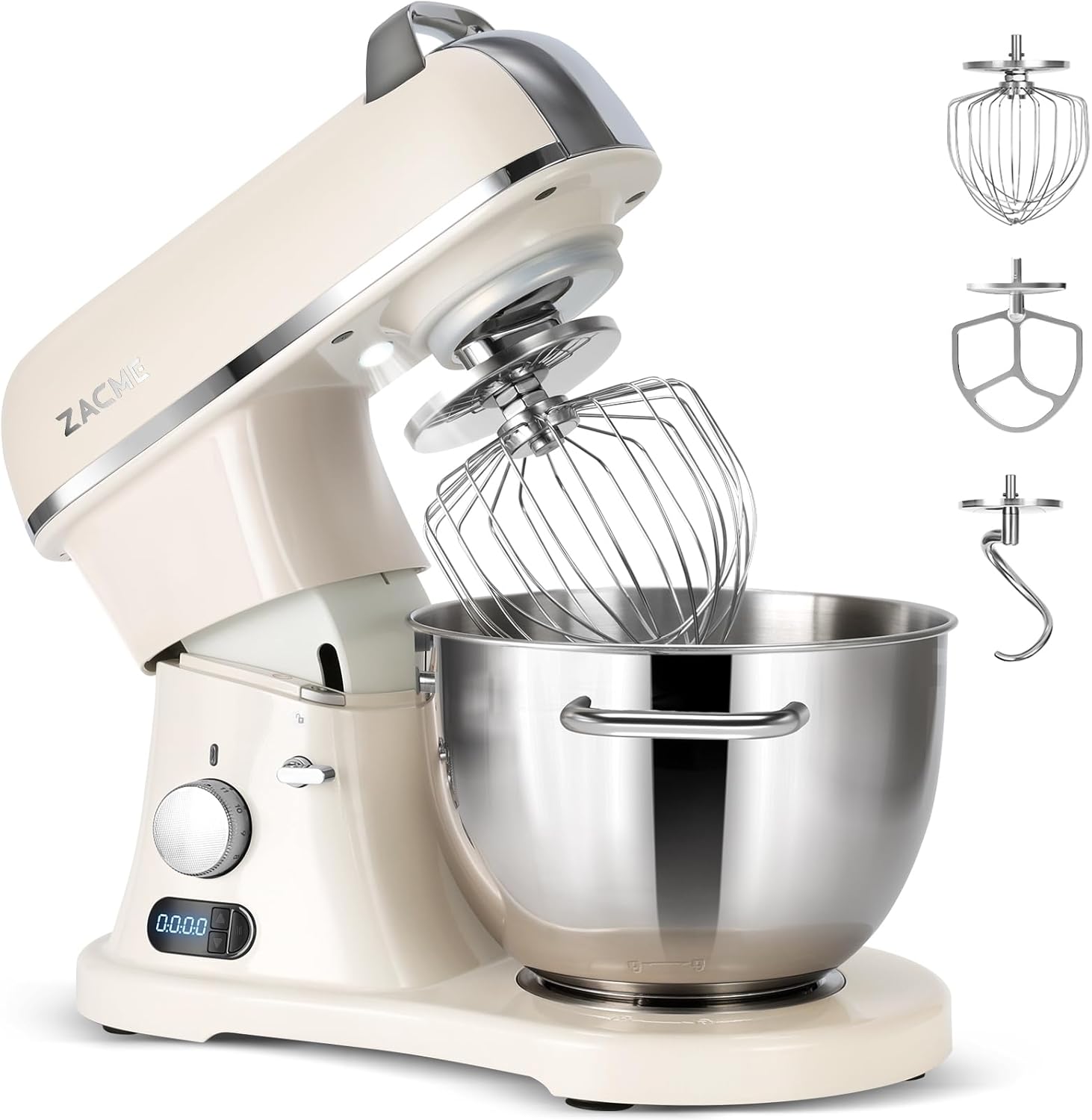
| Capacity | 8.4 quarts |
|---|---|
| Wattage | 800 watts |
| Number of Speeds | 11 |
| Noise Level | 48 db |
| Voltage | 120 volts |
This ZACME commercial stand mixer is built for regular, high-volume baking. Its 800W DC motor, metal gears, and aluminum die-cast body deliver the kind of durability and torque needed for kneading large batches of dough, and the 8.4 quart stainless bowl and included dough hook, flat beater, and wire whip handle most recipes from bread to meringue. Planetary mixing and an 11‑speed range offer thorough, even mixing, while the LED display with a timer helps manage long runs without constant monitoring. Noise is reasonably low on lower speeds and the dual cooling fans protect the motor during marathon sessions. Practical touches like a tilt head, anti-slip feet, removable bowl, and NSF/ANSI 8-2023 compliance make it suitable for professional settings as well as busy home bakers. Expect a substantial unit that weighs in heavy and takes counter space, so it is less convenient if you need a lightweight, portable mixer or a minimalist footprint in a small kitchen.
Best for: Bakers who prioritize a durable, commercial-capable mixer for frequent large-batch baking and want a machine that can run long sessions reliably in a shop or busy home kitchen.
Less Ideal for: Casual bakers who need a lightweight, compact, or highly portable mixer for occasional small-batch use should consider smaller consumer models instead.
- Commercial-grade aluminum die-cast body and metal gears for long-term durability
- Powerful 800W DC motor with dual cooling fans for continuous, heavy use
- Large 8.4 quart stainless steel bowl and included stainless accessories for big batches
- 11 speed settings, planetary mixing, and LED timer for precise control and hands-off operation
- Meets NSF/ANSI 8-2023 standard and has anti-slip feet for stable, professional use
- Large and heavy footprint limits portability and requires ample counter or storage space
- No explicit dishwasher-safe claim for all attachments in structured specs, so cleaning expectations vary
Verdict: Choose this ZACME 8.4QT mixer when you need a rugged, high-capacity machine built to handle regular commercial-style baking.
KitchenAid Commercial 8-Quart Mixer KSM8990CU

| Capacity | 8 quarts |
|---|---|
| Wattage | 500 watts |
| Number of Speeds | 10 |
| Voltage | 120 volts |
The KitchenAid Commercial Series 8-Quart Bowl Lift Stand Mixer is built for bakery and restaurant use where large batches and heavy doughs are routine. It uses a high-efficiency DC motor with PowerCore technology and a bowl-lift design to provide steady beater-to-bowl contact while handling long kneading or whipping tasks with reduced heat buildup. The mixer includes commercial-grade stainless steel attachments: a spiral dough hook, flat beater, and an 11-wire whip, and the 8-quart bowl can mix large quantities like multiple dozen cookies or several loaves of bread in one run. Ten speed settings, soft-start operation, and speed control protection make it easier to start heavy mixes without splash-out and reduce accidental starts during cleaning. This model is NSF certified for commercial environments and designed for long service life, but it is a large, heavy unit that belongs in a dedicated prep area rather than a small home kitchen and requires appropriate counter or stand support.
Best for: Bakers and small commercial kitchens that need a durable, NSF-certified mixer to handle frequent large batches and long mixing or kneading cycles with consistent performance.
Less Ideal for: Casual home bakers with limited counter space or those who only make small batches should consider lighter, smaller domestic mixers instead.
- NSF certified for commercial use and built to withstand heavy, repeated use
- Powerful, efficient DC motor with PowerCore technology reduces heat buildup during long runs
- 8-quart stainless steel bowl handles large batches for baking or dough kneading
- Includes commercial-grade stainless steel attachments including spiral dough hook and 11-wire whip
- Bowl-lift design and soft-start reduce splash and keep beats consistent on heavy loads
- Large and heavy footprint makes it impractical for small counters or occasional home use
- At commercial specification and weight, it may need a dedicated stand or reinforced surface
Verdict: Choose this NSF-certified 8-quart KitchenAid when you need a rugged, commercial-grade mixer that reliably handles large bakery batches and intensive kneading.
VEVOR Commercial Food Mixer 15Qt

| Capacity | 14 liters |
|---|---|
| Wattage | 550 watts |
| Voltage | 110 volts |
| Number of Speeds | 3 |
| Noise Level | 70 db |
This floor-standing commercial mixer is designed to handle medium-volume bakery tasks with a 14 L (15 qt) stainless steel bowl, a 550W gear-driven motor, and three included attachments: dough hook, flat beater, and wire whisk. It offers three speeds that map to common kitchen needs—low for kneading, medium for mixing fillings and batters, and high for whipping—plus a 0–30 minute timer that automatically stops the machine. Safety and convenience are addressed with a guard that prevents splashes and an automatic shutdown if the cover is opened, and the lever-style bowl lifter makes raising and lowering the bowl quicker than wheel-type mechanisms. Constructed with cast iron components and stainless-steel food-contact parts, the mixer is built for heavy use and easier cleaning. Expect typical commercial noise around 70 dB and a substantial unit weight, so it is best installed in a stable workspace. The motor power and single-phase 110V supply suit small bakeries and cafes, but kitchens needing continuous high-capacity batches may prefer higher-watt models.
Best for: Bakers and small commercial kitchens that prioritize a robust, factory-quality mixer that reliably handles regular batches without complex controls.
Less Ideal for: Large production bakeries that require continuous high-capacity mixing or operators who need a lightweight, portable countertop machine.
- 550W gear-driven motor with three speed settings for kneading, mixing, and whipping
- 14 L (15 qt) stainless steel bowl and three common attachments for versatile bakery tasks
- Lever-style bowl lifter simplifies raising and lowering the bowl during use
- Safety guard and automatic shutdown when the cover is open reduce accident risk
- Cast iron construction and stainless food-contact parts improve durability and cleanability
- Noise level around 70 dB may be loud in small or quiet kitchens
- Unit is heavy and bulky, requiring a permanent, stable installation
Verdict: A sturdy, straightforward 15-quart commercial mixer that delivers dependable mixing for small bakeries and foodservice operations.
Choosing the Right Commercial Mixer for Baking: Key Factors to Consider
Motor Power and Torque
Higher continuous motor power and strong torque matter because dough and dense batters can stall weak motors. A motor with adequate torque maintains consistent mixing speed under load, which preserves gluten development and ensures uniform mixing.
Consider whether the motor has a duty-cycle rating and cooling features. A machine rated for continuous or heavy intermittent use is a better fit for bakery work than a mixer designed for short domestic tasks.
Bowl Capacity and Lift Mechanism
Bowl volume determines how much you can mix in a single batch and affects workflow efficiency. Choose bowl sizes that match your typical batch yields to reduce multiple mixes and save labor time.
The lift mechanism impacts operator ergonomics and safety. A robust planetary head or bowl-lift design with positive locking is preferable for frequent use. Check that the lift action is smooth and that attachments engage securely at all speeds.
Construction Quality and Materials
Commercial mixers endure high-cycle use, so heavy-gauge steel bodies, cast-iron gears, and stainless-steel bowls prolong service life. Corrosion-resistant finishes and sealed bearings reduce maintenance frequency and downtime.
Inspect how load-bearing components are engineered and whether common wear parts are replaceable. Machines built for repairability will cost less to operate over their lifespan than units that require full assembly replacements.
Control Options and Speed Range
Effective control lets you tailor mixing action for different tasks, from gentle folding to high-speed whipping. A wide and linear speed range is useful for versatile bakery operations that handle delicate creams as well as stiff doughs.
Look for models with reliable, repeatable controls and clear markings. Variable-speed drives and soft-start features reduce ingredient splatter and protect mechanical components from shock loading.
Accessory Compatibility and Versatility
A mixer that accepts a broad set of attachments increases utility across recipes. Standard accessories include dough hooks, flat beaters, whips, and optional attachments like meat grinders or pastry rollers for multiuse kitchens.
Assess whether accessories are proprietary or industry-standard, how they mount, and whether they are sold separately. Versatile machines reduce the need for additional specialty equipment.
Serviceability and Support
Easy access to wear parts, clear service manuals, and a network for replacement components matter in commercial settings where downtime is costly. Machines designed for straightforward maintenance let you perform routine tasks quickly.
Check for features like removable panels, standardized fasteners, and clear points for lubrication. Consider whether the mixer's design allows routine checks without specialized tools.
Match Mixer Size to Your Output
Estimate typical daily batch volumes before choosing capacity. A mixer that is too small forces repeated batches and increases labor, while an oversized machine may be inefficient and harder to clean. Factor in peak production days and any seasonal spikes when sizing equipment.
If you produce multiple product types, plan for a primary machine that handles your heaviest mixes plus a smaller stand-by for delicate tasks. Consider the physical footprint and where mixers will sit in relation to worktables and ovens.
- Check maximum recommended dough weight for each bowl size
- Allow clearance for bowl removal, attachment changes, and cleaning
- Plan workflow to avoid cross-contamination between dough and cream tasks
Duty Cycle and Continuous Use Considerations
Review the rated duty cycle and intended commercial class. Some mixers are built for light commercial or part-time bakery use, while others are specified for continuous production lines. Duty-cycle ratings indicate how long the machine can run before rest is required.
If your operation involves long, frequent runs, prioritize motors with active cooling and gearboxes designed for prolonged torque stress. Machines intended for intermittent use may overheat or wear quickly under continuous loads.
- Confirm manufacturer guidance on recommended run times
- Prefer models with thermal protection or auto-shutoff features
- Consider spare parts inventory for high-use environments
Cleaning and Food Safety
Sanitation is crucial in baking. Smooth, corrosion-resistant surfaces and removable bowls simplify cleaning and reduce food safety risks. Avoid crevices where flour or dough can accumulate and foster bacterial growth.
Assess how easily you can disassemble attachments and seals for sanitizing. Machines with dishwasher-safe bowls or components designed for quick removal speed turnaround between products.
- Look for stainless-steel contact surfaces and rounded corners
- Verify whether seals and gaskets are food-grade and replaceable
- Develop a cleaning schedule that aligns with production cycles
Noise, Vibration, and Operator Comfort
High-capacity mixers can produce significant noise and vibration. Consider machines with vibration-damping mounts or quieter drive systems if the kitchen layout places staff close to equipment for long periods. Reduced vibration also lowers mechanical stress over time.
Ergonomic controls, reachable bowl heights, and simple attachment changes help reduce fatigue and speed routine tasks. Prioritize designs that minimize repetitive lifting or awkward reaches.
- Test control accessibility for right- and left-handed operators
- Check whether the mixer needs a dedicated base or anti-vibration pads
- Plan for hearing protection or acoustic treatments in compact kitchens
Energy Use and Operational Costs
While initial purchase is important, operating efficiency affects long-term cost. Motors with efficient drives and well-sealed gearboxes draw less power and run cooler, which reduces energy use and maintenance needs. Consider efficiency ratings if available.
Factor in the cost implications of replacement wear parts and the expected service interval. A slightly higher initial investment in a more durable machine often lowers total operational expense.
- Compare motor efficiency and standby power features
- Estimate annual maintenance hours and parts replacement frequency
- Include energy use in your cost-per-batch calculations
How We Chose the Best Commercial Mixer for Baking
We focused on mixers designed for bakery-style workloads and continuous operation. Selection prioritized machines with robust motor specifications, durable gearbox and drive systems, and a range of bowl sizes suitable for small to large batch production. We screened for construction materials and serviceability, favoring all-metal gear trains, easily replaceable parts, and accessible maintenance points. User ergonomics and controls were considered, including speed range, planetary or spiral mixing action, and safety interlocks for frequent operator use. Capacity and accessory compatibility were weighed to ensure the mixers can handle dough, batter, and specialty preparations without excessive strain. We excluded machines intended only for light domestic use or those lacking documented duty-cycle ratings. Models with limited bowl sizes or without clear motor torque specs were not considered. The practical filters used were motor power and cooling, bowl capacity and lift type, construction and serviceability, control precision, and accessory ecosystem.
Our full evaluation process is outlined in our review methodology.
FAQ
What bowl capacity do I need for medium-volume bakery production?
For medium-volume work, bowls in the 20 to 60 quart range often balance batch size and manageability. Choose a capacity that comfortably handles your typical batch weight without overfilling and leaving room for proper mixing action.
How important is a planetary versus spiral mixing action?
Planetary mixers are versatile and handle a range of tasks from whipping to dough, while spiral mixers are optimized for dense doughs and can be gentler on gluten structure. The right choice depends on whether you need one machine for everything or a specialized unit for heavy dough.
Can I run a commercial mixer continuously all day?
That depends on the mixer's duty-cycle rating and cooling design. Some commercial models are built for continuous operation, while others require rest periods to avoid overheating. Follow the manufacturer's guidance on run times and cooling intervals.
What routine maintenance keeps a mixer reliable?
Regular checks include inspecting seals and gaskets, lubricating specified points, tightening fasteners, and verifying belt or gear condition. Prompt replacement of worn parts and cleaning after each shift extends service life and prevents contamination.
Are there attachments I should prioritize for a bakery mixer?
A sturdy dough hook, flat beater, and wire whip cover most bakery needs. Additional attachments for rolling, grinding, or slicing add versatility, but pick those that match your menu and that mount securely to the mixer.
Final Verdict
Choose a commercial mixer for baking by matching motor power and bowl capacity to your production volume, and prioritize build quality and ease of maintenance. Tradeoffs typically involve capacity versus floor space and specialized mixing action versus versatility. Focus on duty-cycle ratings, serviceability, and control precision when you need a machine that will run reliably day after day. Prioritize the features that align with your workflow and production peaks. That approach will help you select a mixer that delivers consistent results and minimizes downtime in a busy baking environment.