
Note: This article contains affiliate links. If you click on these links and make a purchase, we may earn a small commission at no extra cost to you. This helps support our research and content. Read our full affiliate disclosure here.
If you make bread regularly or run a bakery, the right commercial stand mixer changes how efficiently you work and how consistent your dough turns out. A mixer that handles heavy hydration and long kneads reduces operator fatigue, protects dough structure, and speeds bulk production. This guide shortlists the top commercial stand mixers for bread dough and explains why each type of machine belongs on a pro baking line. We evaluated machines for their motor durability, torque at low speeds, bowl capacity, and serviceability so you can pick a unit that fits your mixing volume and workflow. Read on for practical guidance and the criteria we used to select these top picks.
Top Picks at a Glance
| Best Overall The best all-around choice for most situations | EKway Commercial Mixer 30QT |  |
| Best Quality Built to a higher standard if you want something more solid | BREVELTION 40QT Commercial Dough Mixer |  |
| Best Value The sweet spot between price and what you get | Garvee Commercial Dough Mixer 10.5QT |  |
| Best Budget The cheapest option that still gets the job done reliably | BOSBAK 15QT Commercial Stand Mixer |  |
| Top Rated A top-rated pick with lots of positive feedback | Waring Luna Stand Mixer WSM7L |  |
| Most Popular A crowd favorite that many people choose with confidence | VEVOR Commercial Mixer 30Qt |  |
| Best Seller A high-volume bestseller chosen again and again | ZACME 8.4QT Commercial Stand Mixer |  |
EKway Commercial Mixer 30QT

| Capacity | 30 quarts |
|---|---|
| Wattage | 1250W |
| Number of Speeds | 3 |
| Voltage | 110V |
| Bowl Material | 304 food‑grade stainless steel |
The EKway 30QT commercial stand mixer is built for busy bakeries, pizzerias, and kitchens that need to mix large batches of dough and batters without babysitting. It pairs a high‑torque 1250W motor with a 30‑quart food‑grade 304 stainless steel bowl and three interchangeable attachments (dough hook, flat beater, wire whip) to handle heavy dough, batters, and whipped mixtures. The mixer offers three fixed speeds covering low kneading to high whipping and a 60‑minute timing function so you can set a cycle and step away. Practical touches include a safety guard that stops the motor when opened, removable attachments and bowl for easier cleaning, and an adjustable bowl height wheel for consistent mixing. Trade offs are the large footprint and weight that require a dedicated counter or stand and the basic knob control and three‑speed range that may feel limited compared with variable‑speed commercial models. For standard commercial bread and dough work this mixer delivers robust mixing power and straightforward, reliable controls.
Best for: Bakers and small commercial kitchens that need a durable, no‑frills mixer to mix multiple loaves or batches of dough reliably each day.
Less Ideal for: Operations that need precise variable‑speed control, very compact equipment, or frequent portability should consider lighter or electronically variable models instead.
- Large 30‑quart 304 food‑grade stainless steel bowl suitable for batch bread and pizza doughs
- 1250W motor provides strong, consistent power for heavy dough mixing
- Includes dough hook, flat beater, and wire whip to cover common bakery tasks
- 60‑minute timer and safety guard allow unattended, safer operation
- Removable bowl and attachments simplify cleaning and maintenance
- Heavy and bulky unit that needs a permanent strong surface or stand
- Only three fixed speeds may limit fine speed control for specialty applications
Verdict: A sturdy, high‑power 30QT mixer built to handle regular bread and dough workloads in small commercial kitchens.
BREVELTION 40QT Commercial Dough Mixer
| Capacity | 40 quarts |
|---|---|
| Wattage | 1800 watts |
| Voltage | 110 volts |
| Number of Speeds | 2 |
| Material | Stainless Steel |
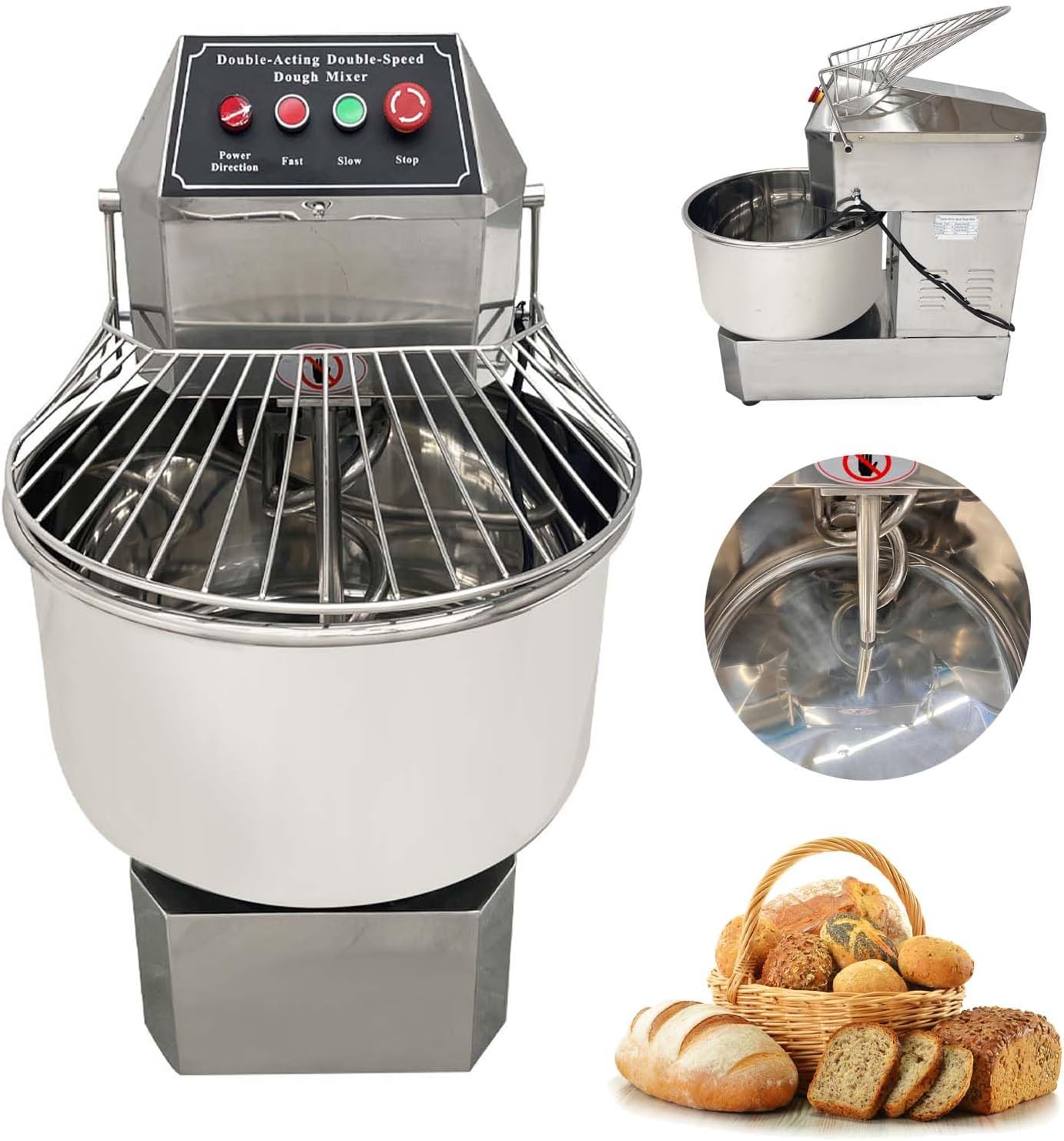
This BREVELTION commercial dough mixer is built for high-volume dough work, combining a 40 QT 304 stainless steel bowl with an 1800W copper motor and a dual-action mixing system that rotates the spiral hook and bowl simultaneously. It offers two speeds—low for gentle mixing and high for tougher doughs—with a gear-driven transmission that reduces slippage and improves durability compared with belt-only designs. The machine includes a safety cover that cuts power when opened and a knob control for simple operation. In practice it handles large batches consistently, speeds up dough development, and keeps mixing uniform across the batch, which is useful in bakeries and pizzerias where repeatable results matter. Limitations are its fixed bowl (not removable) and substantial footprint and weight that require a dedicated workspace and likely professional installation or moving assistance. Maintenance is straightforward thanks to stainless components, though its size and weight make it less convenient for occasional or small-scale home use.
Best for: Bakeries, pizzerias, and commercial kitchens that prioritize consistent, high-volume dough production and long-running reliability.
Less Ideal for: Casual home bakers or small kitchens with limited space and infrequent large-batch needs should consider smaller, more portable machines instead.
- Large 40 QT 304 food-grade stainless steel bowl suitable for single large batches
- Powerful 1800W pure copper motor for consistent kneading of dense doughs
- Dual-action mixing (hook and bowl rotate) for more uniform gluten development
- Gear-driven dual-speed gearbox reduces belt slippage and improves long-term reliability
- Safety cover with automatic shut-off for safer operation in busy kitchens
- Bowl is fixed and cannot be removed, which can complicate thorough cleaning and loading
- Very heavy and large, requiring a dedicated stable location and likely professional handling for installation
Verdict: Choose this mixer when you need a rugged, high-capacity machine that delivers repeatable, commercial-grade dough mixing for busy bakery or pizzeria environments.
Garvee Commercial Dough Mixer 10.5QT

| Capacity | 10.5 quarts |
|---|---|
| Wattage | 650 |
| Voltage | 110 |
| Number of Speeds | 2 |
This Garvee 10.5 QT commercial dough mixer is built for routine bakery and pizzeria tasks, offering a 650W motor and dual-rotation spiral design that turns both the hook and bowl for more even gluten development. It is typically used for mixing and kneading large batches of bread, pizza and pastry dough; the 10.5-quart bowl claims to handle up to about 11 pounds of dough and the 60-minute timer and simple knob controls let you run consistent cycles without babysitting. Notable features include a food-grade stainless steel bowl and hook, a transparent safety shield that forces the unit off when open, overload protection and nonslip feet for stable operation. The mixer is straightforward to clean because key food-contact parts are stainless steel and the removable bowl makes loading and unloading easier. Expect a heavy, commercial footprint and a two-speed control that favors basic mixing tasks over fine speed variability, so it is best where reliable, repeatable dough production matters more than variable-speed precision.
Best for: Bakers and small commercial kitchens that need a durable, no-nonsense mixer to produce consistent batches of bread and pizza dough without complex speed controls.
Less Ideal for: Home bakers who need a compact, lightweight countertop machine or users who require many variable speeds for delicate batters and specialty preparations.
- Dual-rotation spiral hook and bowl for more uniform mixing and faster gluten development
- Food-grade stainless steel bowl and hook are removable for easier cleaning
- Built-in 60-minute timer and simple knob controls for repeatable mixing cycles
- Safety shield with auto shutoff and overload protection improves operator safety
- Only two speeds limit fine control for delicate mixing or specialty recipes
- Large, heavy unit requires substantial counter or floor space and is not portable
Verdict: A practical, heavy-duty 10.5-quart mixer made to deliver consistent, high-volume dough mixing for small commercial bakeries and pizzerias.
BOSBAK 15QT Commercial Stand Mixer

| Capacity | 15 quarts |
|---|---|
| Wattage | 600 watts |
| Number of Speeds | 3 |
| Voltage | 110 volts |
| Noise Level | 76 db |
The BOSBAK 15QT Commercial Stand Mixer is a heavy-duty planetary mixer built for bakery and pizzeria tasks that need frequent, larger batches. It uses a 600W motor and three speed settings to handle dough, batters, and whipping with included dough hook, flat beater, and wire whip, while a stainless steel 15-quart bowl and bowl lock keep ingredients secure during mixing. Practical features for a commercial kitchen include a timer with end-of-cycle alert, a metal bowl lift for easy loading and cleaning, a splash guard to reduce mess, and safety systems such as overload protection and an automatic stop when the guard opens. The unit is fairly loud at 76 dB and is heavy, so it is best installed on a dedicated counter; it can mix up to roughly 5 lbs of dough per batch, which suits small-to-medium production runs. For budget-focused buyers seeking a factory-quality commercial mixer for bread and general bakery tasks, it offers core functionality without extras like multiple speed ranges or specialized spiral action for very heavy doughs.
Best for: Bakers and small commercial kitchens that need a durable, no-frills mixer to produce regular 3–5 lb dough batches and mixed batters without a large capital outlay.
Less Ideal for: High-volume bakeries or pizza shops that require very large single-batch dough capacities or spiral mixers optimized for heavy bread dough development should look at larger, purpose-built machines.
- Commercial-grade 15‑quart stainless steel bowl suited for batch baking
- Includes dough hook, flat beater, and wire whip for versatile mixing tasks
- Timer with audible end-of-cycle alert and metal bowl lift for convenient operation
- Safety-focused features including overload protection, splash guard, and auto stop when guard opens
- Only three speed settings limit fine control for very delicate or extremely heavy doughs
- 600W motor handles moderate loads but is not as powerful as larger commercial spiral mixers
Verdict: A practical, budget-friendly commercial planetary mixer that delivers reliable 15‑quart batch mixing for small bakeries and kitchens.
Waring Luna Stand Mixer WSM7L
| Capacity | 7 quarts |
|---|---|
| Motor | 1/2 HP |
| Number of Speeds | 11 |
| Wattage | 350 watts |
| Voltage | 120 volts |
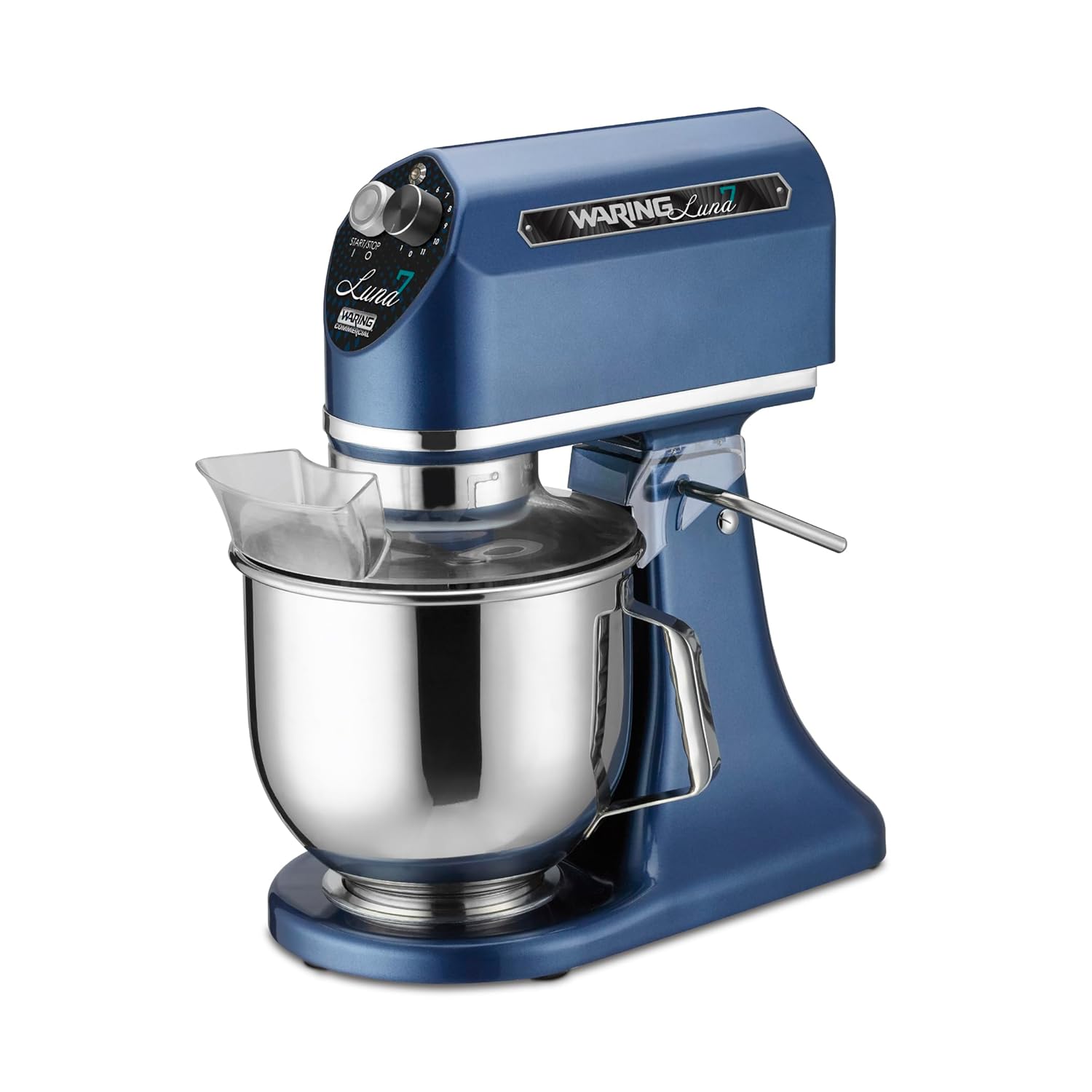
The Waring Luna WSM7L is a compact commercial planetary mixer built to handle everyday bakery tasks like mixing batters and kneading moderate doughs. It pairs a 1/2 horsepower gear-driven induction motor with a permanently lubricated transmission and thermal overload protection, so it can run repeated batches without frequent maintenance. Controls are simple: a front-mounted knob gives 11 variable speeds and a tilt-head makes bowl access and attachment changes fast. The included stainless steel bowl, whisk, paddle and dough hook cover common mixing needs, and the clear splash guard with feed chute keeps additions tidy during operation. For bread-focused use the mixer handles typical doughs well, but the manufacturer warns against very heavy pasta-style or extremely dense doughs that can strain the unit. The countertop footprint and NSF/ETL listings suit busy kitchens that need a reliable, serviceable machine rather than a heavy industrial model, and the two-year motor coverage adds reassurance for frequent commercial use.
Best for: Buyers who prioritize a dependable, serviceable commercial mixer for regular bread and bakery prep in restaurants, catering, or small bakery settings.
Less Ideal for: Large-scale bakeries or operations that regularly mix very heavy or high-volume doughs should choose a higher-capacity industrial mixer designed for continuous heavy loads.
- Robust 1/2 HP gear-driven induction motor for sustained commercial use
- Variable 11-speed control for gentle folding to thorough mixing
- Durable stainless steel 7-quart bowl with common attachments included
- Tilt-head design and clear splash guard speed setup and ingredient additions
- Thermal overload protection and permanently lubricated transmission reduce maintenance
- Not intended for very dense or heavy pasta-style doughs which may overload the controls
Verdict: Choose the Waring Luna WSM7L when you need a compact, reliable commercial stand mixer that handles everyday bread and bakery tasks with proven motor durability.
VEVOR Commercial Mixer 30Qt

| Capacity | 28.5 liters |
|---|---|
| Wattage | 1100 watts |
| Number of Speeds | 3 |
| Noise Level | 70 db |
| Voltage | 110 volts |
The VEVOR Commercial Mixer 30Qt is a floor-standing mixer built to handle large-batch dough and general commercial mixing tasks. It uses a gear-driven 1100W motor and three fixed speeds (130, 193, 458 rpm) to knead heavy dough, mix batters, and whip creams; a lever-style bowl lifter and a safety guard with automatic shutoff improve operator safety and convenience. The package includes a dough hook, flat beater, and wire whisk so you can switch between dough, batter, and aerating tasks without buying extras, and the stainless-steel bowl and attachments detach for cleaning. Practical features for a busy kitchen include a 0–30 minute timer and knob controls that are simple to use. Expect industrial weight and footprint, a measured noise level around 70 dB, and a straightforward, utilitarian design rather than refined consumer styling. This is a workhorse for high-volume kitchens but may be overkill for occasional home bakers and requires adequate floor space and handling when servicing or moving.
Best for: A buyer who needs a proven, high-capacity mixer for daily production—ideal for small bakeries, pizzerias, and restaurants prioritizing reliability and visible user feedback from other buyers.
Less Ideal for: Not a good fit for occasional home bakers or kitchens with limited space where a smaller countertop model would be more practical.
- High-power 1100W gear-driven motor for consistent heavy-duty mixing.
- Large 28.5 L (30 Qt) stainless-steel bowl suited for large batches common in restaurants and bakeries.
- Includes three common commercial attachments: dough hook, flat beater, and wire whisk.
- Safety guard with automatic shutdown and lever-style bowl lifter for easier, safer operation.
- Built-in 0–30 minute timer and simple knob controls for repeatable mixing cycles.
- Bulky and heavy, requiring dedicated floor space and effort to move or service.
- Only three fixed speeds may limit fine control compared with variable-speed mixers.
Verdict: Choose this mixer if you need a robust, high-capacity machine that reliably handles large dough batches in a commercial kitchen.
ZACME 8.4QT Commercial Stand Mixer
| Capacity | 8.4 quarts |
|---|---|
| Wattage | 800 watts |
| Number of Speeds | 11 |
| Controls Type | Knob + LCD Panel |
| Noise Level | 48 db |
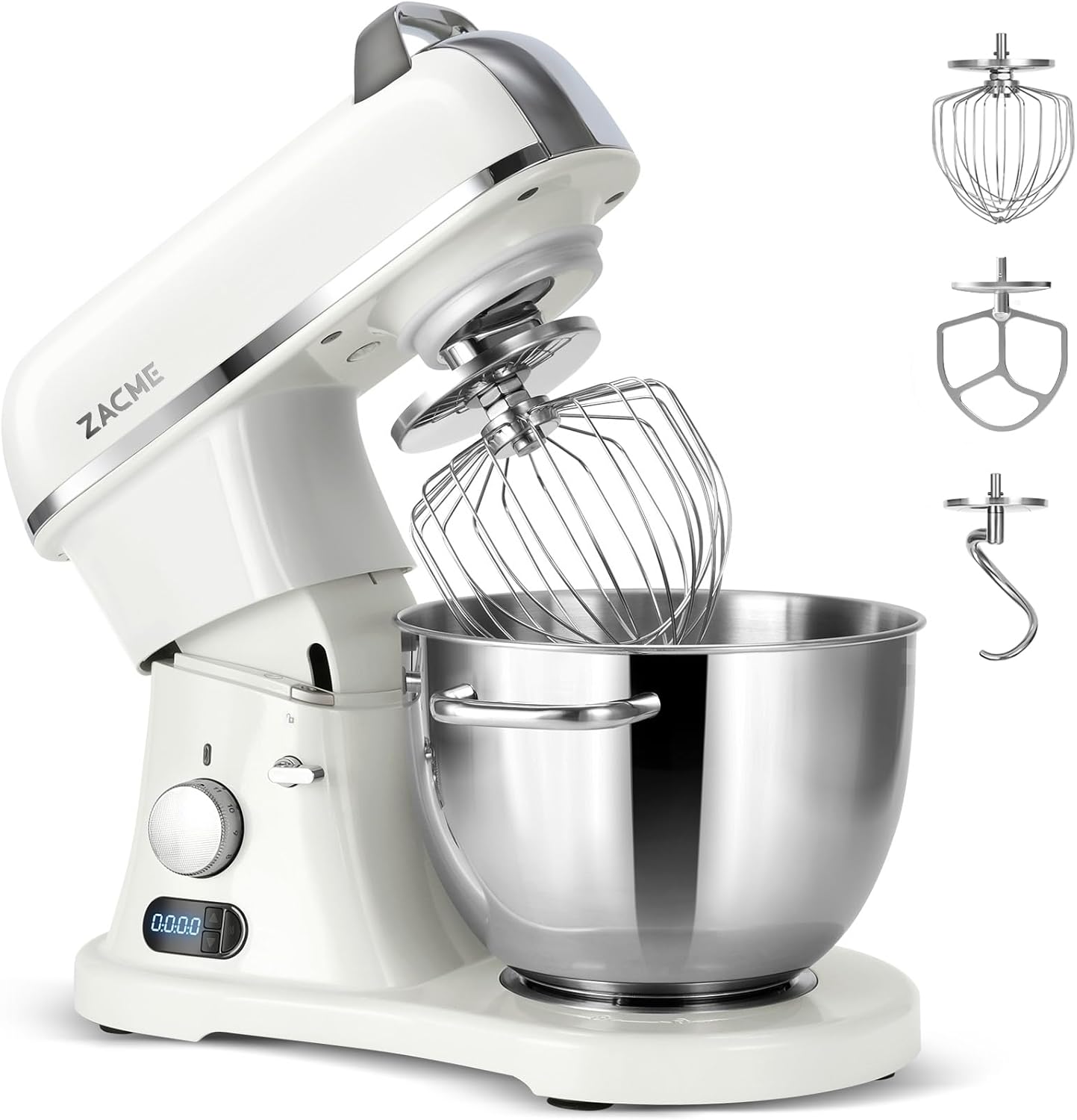
The ZACME 8.4QT Commercial Stand Mixer is built for heavy home and small commercial use, designed to handle large dough batches without constant supervision. Its 800W DC motor, metal gears, and planetary mixing deliver sustained kneading power while the tilt‑head and removable stainless bowl make loading and cleaning straightforward. The mixer includes a dough hook, flat beater, and wire whip so you can mix bread dough, cake batters, and whipped cream with the appropriate attachment. Practical touches—an LED time display with countdown, dual cooling fans that run after use, suction feet for stability, and NSF/ANSI 8-2023 compliance—make it suited to repetitive baking tasks. Noise is relatively low at the bottom speed, though it rises on high when pushing dense doughs. At 33 pounds the machine is substantial, so it stays put but is not highly portable. Overall it translates commercial construction into a kitchen-friendly package that prioritizes power, stability, and durability for frequent bread baking.
Best for: Bakers who prioritize reliable, commercial‑grade performance for frequent large‑batch bread and pastry work and want a machine that reduces hands‑on kneading and downtime.
Less Ideal for: Casual home bakers with minimal counter space or those who only make small, occasional batches should consider a smaller, lighter mixer.
- 800W DC motor with metal gears designed for sustained kneading of large dough batches
- Large 8.4‑quart stainless steel bowl suitable for batch baking and commercial tasks
- NSF/ANSI 8-2023 compliance and dual cooling fans support extended, repeated use
- LED time display with countdown and 11 speed settings for precise control
- Included stainless steel dough hook, flat beater, and wire whip are dishwasher safe
- At 33 pounds and a substantial footprint it is not easy to move or store
- Noise level increases noticeably on higher speeds when mixing dense doughs
Verdict: Choose this mixer if you need a durable, NSF‑rated machine that reliably handles large dough batches for frequent bread baking.
Choosing the Right Commercial Stand Mixer for Bread Dough: Key Factors to Consider
Motor Power and Duty Cycle
A mixer that handles bread dough needs a motor with both high continuous power and strong low-speed torque. Dough mixing is a heavy, sustained load, so motors rated for intermittent household use will overheat or stall. Look for commercial motors designed for continuous duty and thermal protection to avoid shutdowns during long kneading cycles.
Motor power directly affects the size of batches you can mix and how quickly dough comes together. Inadequate torque at low speeds can result in underdeveloped gluten, while too-small motors increase wear and maintenance frequency. For bakeries, more robust motors reduce the chance of production delays.
Bowl Capacity and Shape
Bowl capacity determines the maximum batch size you can mix without overworking the dough or creating spillover. Match capacity to your average batch and allow headroom for high-hydration doughs that expand and move more freely. Bowl shape matters as well: deeper bowls help contain flour and water during initial mixing, while a wider bowl can improve ingredient incorporation for larger batches.
Consider how bowl size affects handling and storage. Larger bowls are heavier to lift and clean, and they demand a mixer with the power to turn heavy loads. For production environments, quick-release bowls or lift-assist mechanisms save time when swapping batches.
Agitator Type and Mixing Action
The design of the agitator and the mixer's action determine how evenly the dough develops gluten. Planetary action with properly shaped dough hooks is common because it sweeps the bowl consistently. Spiral mixers are superior for certain doughs because they combine a rotating bowl with a rotating spiral hook to knead more gently while building strength, but spiral machines are a different form factor and may not suit every workflow.
Choose an agitator and action that match your dough types. Heavy, high-hydration doughs benefit from slow, high-torque kneading; lighter doughs need more gentle folding. The right combination reduces mixing time and yields a better crumb structure.
Speed Range and Control
Precise speed control is important because different stages of bread-making require distinct actions: low speeds for initial hydration and kneading, higher speeds for finishing and incorporating add-ins. Look for machines with a wide, adjustable speed range and intuitive controls so you can dial in the correct RPMs without trial and error.
Variable-speed drives that maintain torque at low speeds are especially useful for sticky or dense doughs. Mechanical switches without gradual ramping can be harsher on motors and reduce dough quality, so consider electronic controls for more delicate work.
Build Quality and Serviceability
Commercial kitchens demand equipment that lasts under heavy use. Metal housings, robust gear trains, and sealed lubrication points extend a mixer's life. Also factor in how easy it is to access wear parts like belts, gaskets, and bearings for routine maintenance. Mixers that allow quick part replacement minimize downtime and keep production steady.
Availability of spare parts and straightforward service procedures reduce the total cost of ownership. Machines that require specialized tools or factory-only servicing can add unexpected delays and expense in a busy environment.
Safety and Ease of Use
Safety features and operator ergonomics matter when mixing large batches on a daily basis. Look for reliable bowl guards, emergency-stop controls, and secure bowl locking systems to prevent accidents. Ergonomic considerations include release levers that are easy to operate when wearing gloves and bowl lift systems that reduce strain.
Simple, readable controls and clear speed markings shorten training time for staff. Machines that prioritize operator safety and comfort also reduce the chance of mistakes that can interrupt production.
Why Commercial Mixers Differ From Home Units
Commercial stand mixers are engineered for continuous or repeated heavy use, with motors, gearboxes, and cooling systems sized accordingly. They are built to tolerate the long kneading cycles and dense dough loads common in production bakeries, which household models are not designed to sustain.
Beyond raw power, commercial units often offer features that improve throughput and consistency, such as larger bowls, stronger dough hooks, better ventilation, and serviceable components. Those design choices reduce downtime and keep dough performance predictable across many batches.
- Stronger motors with higher torque at low speeds
- Larger, often stainless-steel bowls for bigger batches
- More robust gearing and commercial-grade bearings
Matching Mixer Capacity to Your Production
Estimate your peak daily loaf count and typical batch sizes before choosing capacity. A common mistake is buying a mixer that barely handles average loads, leaving no margin for busier days or special orders. Aim for a capacity that covers your busiest expected batch while accounting for dough expansion.
If you mix a variety of recipes, consider how flexible a given bowl size will be. Some bakeries use two different mixers: a large-capacity unit for bulk dough and a smaller machine for small specialty batches. Think about workflow and whether a single versatile mixer or multiple dedicated machines fits your operation.
- Calculate batch weight including flour and water to pick a bowl size
- Factor in headroom for high-hydration recipes
Spiral Versus Planetary Action for Bread Dough
Spiral mixers deliver efficient gluten development with less heat buildup because the bowl rotates while the spiral hook kneads. They excel with high-hydration or large-volume doughs where maintaining dough temperature and structure is critical. Planetary mixers are more common and versatile, offering a variety of attachments for different tasks beyond dough kneading.
If your operation focuses primarily on high-volume bread, a spiral-style machine may yield better dough structure and reduced mixing times. If you need a multipurpose machine that can whip, beat, and knead, planetary action with suitable dough hooks may be the better choice.
- Spiral: better for large-volume, high-hydration doughs
- Planetary: versatile for multiple tasks in a bakery
Maintenance Practices That Extend Mixer Life
Routine maintenance keeps a mixer working reliably. Regularly clean bowls and agitators after each batch, check seals and gaskets, and follow recommended lubrication intervals for gearboxes. Keep ventilation pathways clear to avoid overheating during long mixing sessions.
Track usage patterns and schedule preventive inspections for belts, bearings, and motor brushes if applicable. Promptly replace worn parts to avoid secondary damage to gears or housings. Clear maintenance records help predict service needs and budget for replacements.
- Clean after each mixing session to prevent buildup
- Inspect drive components on a regular schedule
- Keep spare wear parts on hand for high-use environments
Practical Tips for Kneading Better Dough
Start mixing at low speed to hydrate flour and avoid flour clouds. Gradually increase speed only after ingredients are combined. Watch the dough more than the clock; visual and tactile cues such as dough forming a smooth, elastic mass are better indicators than fixed mixing times.
Monitor dough temperature during long or high-speed kneads; excessive heat can kill yeast and change fermentation schedules. If dough warms too quickly, reduce speed or allow rest intervals. Adjust water and flour ratios as needed for different mixing efficiencies.
- Begin at low speeds and increase slowly
- Use dough temperature as a quality check
- Adapt water content for machine and batch size
How We Chose the Best Commercial Stand Mixer for Bread Dough
We focused on attributes that matter most when mixing bread dough at commercial or high-volume home-bakery scale. Key evaluation criteria included continuous-duty motor power and torque to handle dense, high-hydration doughs without overheating; bowl capacity and shape to determine batch size and mixing efficiency; planetary action and agitator design for even gluten development; speed range and low-speed torque for controlled kneading; and build quality plus serviceability for long-term reliability in a busy kitchen. We prioritized machines with robust cooling or thermal protection systems and standard parts that are easy to replace. Noise and vibration were considered where they affect operator comfort and machine longevity. Units that required specialty or proprietary components that limit service options were excluded. Our selections favor mixers that balance power, capacity, and maintainability for consistent bread dough results under commercial use.
Our full evaluation process is outlined in our review methodology.
FAQ
What motor size do I need for commercial bread dough?
Motor requirements depend on batch size and dough hydration. Small commercial batches often need motors rated for continuous duty in the range common to light commercial units, while larger production batches require higher horsepower and torque. Prioritize torque at low speeds over peak RPM ratings.
Can a planetary commercial mixer handle high-hydration doughs?
Yes, many planetary commercial mixers can handle high-hydration doughs if they have sufficient torque and the right dough hook. However, spiral mixers often manage high-hydration and large-volume doughs more gently and efficiently, so consider the style based on your dominant dough types.
How often should commercial mixers be serviced?
Service frequency depends on usage intensity. High-volume operations should perform inspections monthly and scheduled maintenance several times per year. Lighter-use environments may manage with quarterly checks. Regular cleaning after each use and prompt replacement of worn parts will reduce more extensive service needs.
Is bowl material important for bread dough mixing?
Yes. Stainless-steel bowls are preferred for durability, ease of cleaning, and resistance to corrosion. Bowl finish and shape also affect dough release and mixing efficiency. Heavier bowls help damp vibration but may be harder to handle during cleaning.
Are there safety features I should require on a commercial mixer?
Look for secure bowl guards, emergency-stop controls, and reliable bowl locking mechanisms. Overload protection and thermal cutoff features prevent motor damage. Ergonomic controls and easy-to-access release levers improve operator safety during routine use.
Final Verdict
When choosing a commercial stand mixer for bread dough, prioritize motor torque and continuous-duty design, appropriate bowl capacity, and a mixing action suited to your dough types. Consider maintainability and available service support to minimize downtime and total ownership costs. Balance capacity with workflow needs, and accept reasonable tradeoffs between versatility and dedicated dough performance. Focus on the dimensions that matter to your operation: power and torque for heavy doughs, bowl size for batch capacity, and serviceability for longevity. That approach will help you select a machine that delivers consistent dough quality and reliable production over the long term.