
Note: This article contains affiliate links. If you click on these links and make a purchase, we may earn a small commission at no extra cost to you. This helps support our research and content. Read our full affiliate disclosure here.
If you bake bread frequently or run a bakery operation, the right commercial mixer for bread can make the difference between uneven dough and consistent loaves. You need equipment that handles high hydration doughs, sustained daily use, and fast, even mixing without overheating. This guide shortlists the top commercial mixers for bread across capacities and motor sizes, focusing on machine durability, mixing performance, and serviceability. Below you will find our top picks and clear explanations of the criteria we used to evaluate them, so you can match a mixer to your production volume and recipe needs.
Top Picks at a Glance
| Best Overall The best all-around choice for most situations | LEEVOT 30QT Commercial Mixer |  |
| Best Quality Built to a higher standard if you want something more solid | Waring Luna 10-Quart Planetary Mixer |  |
| Best Budget The cheapest option that still gets the job done reliably | Generic 20Qt Commercial Mixer |  |
| Top Rated A top-rated pick with lots of positive feedback | ZACME 8.4QT Commercial Stand Mixer |  |
| Most Popular A crowd favorite that many people choose with confidence | KitchenAid Commercial 8-Quart Mixer KSMC895CU |  |
| Best Seller A high-volume bestseller chosen again and again | VEVOR Commercial Mixer 30Qt |  |
LEEVOT 30QT Commercial Mixer
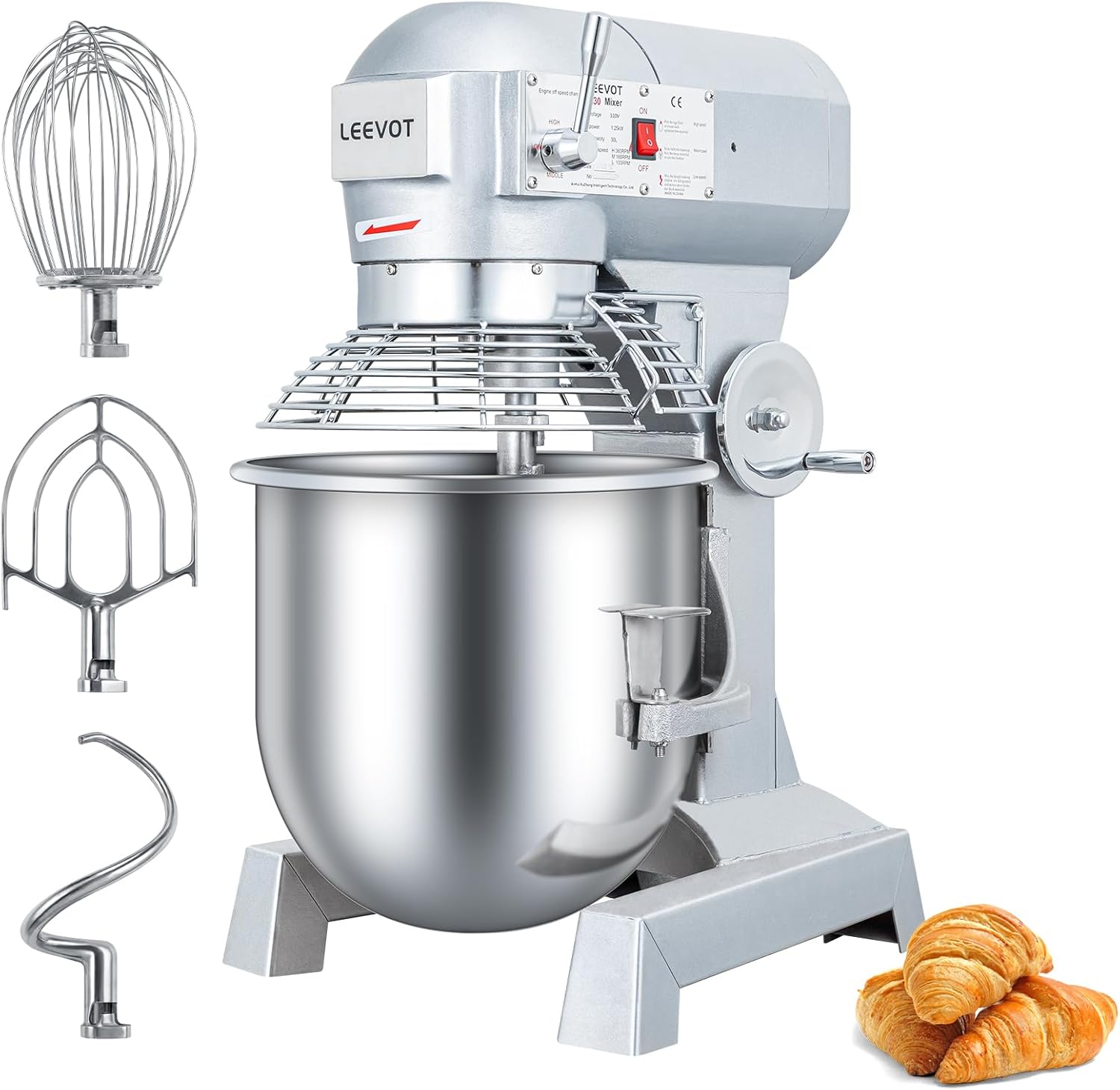
| Capacity | 30 liters |
|---|---|
| Wattage | 1250 watts |
| Voltage | 110 volts |
| Number of Speeds | 3 |
| Material | 304 Stainless Steel |
The LEEVOT 30QT Commercial Mixer is built for bakery and pizzeria environments that need to handle larger batches of dough and mixes. It pairs a 1250W motor with three preset speeds (100, 166, 360 rpm) and three interchangeable heads — dough hook, flat beater, and wire whisk — so you can mix heavy bread dough, batters, and whipped ingredients without swapping machines. The 304 food-grade stainless steel bowl and attachments are removable for easier cleaning and resist rust in a busy kitchen. Safety features include a guard that cuts power when opened and overload protection to help the machine last under repeated use. Practical downsides are the simple three-speed control, which limits fine speed tuning compared with variable-speed commercial models, and the unit is large and heavy so it needs a dedicated counter or stand. For bakeries and restaurants focused on reliable, heavy-duty mixing of large dough batches, this mixer covers the essentials with durable construction and straightforward operation.
Best for: Bakeries, pizzerias, and small commercial kitchens that need a robust, no-nonsense mixer to handle repeated large dough batches with easy cleaning and durable parts.
Less Ideal for: Home bakers with limited space or operations that require precise, continuously variable speed control should consider smaller or variable-speed machines instead.
- Large 30QT stainless steel bowl can mix big batches up to about 22 lb/12 kg of dough
- 1250W motor with overload protection for sustained commercial use
- Three included attachments (dough hook, flat beater, wire whisk) for versatile mixing tasks
- Safety guard that stops the machine when opened and removable parts for easier cleaning
- Only three fixed speeds limit fine control for delicate or specialized mixing
- Bulk and weight require a dedicated space and may need reinforced counter or stand
Verdict: A durable, high-capacity mixer that reliably handles large bread and dough batches for busy small commercial bakeries and pizzerias.
Waring Luna 10-Quart Planetary Mixer

| Capacity | 10 quarts |
|---|---|
| Motor power | 3/4 HP |
| Wattage | 450 watts |
| Number of speeds | 3 |
| Voltage | 120 volts |
The Waring Luna 10-Quart Planetary Mixer is built to handle frequent, high-volume bakery work like dough, batter and whipped creams. Its 3/4 horsepower induction motor and planetary mixing action provide consistent incorporation across the bowl while the bowl-lift design and anti-skid feet keep the mixer stable during heavy loads. The integrated 99-minute digital timer and three-speed touch controls let you set hands-free cycles for repeatable results, and included whisk, paddle and dough hook attachments cover common bakery tasks. Construction uses aluminum and stainless steel components for durability in commercial kitchens and the unit includes thermal overload protection for motor safety. Limitations are its single compact bowl size compared with larger floor models and only three speed settings, which could restrict fine speed control for some recipes, and its substantial weight and footprint require a dedicated counter space.
Best for: Bakers and small commercial kitchens that prioritize reliable, repeatable mixing performance for bread and pastry production and need a durable countertop mixer that handles daily heavy use.
Less Ideal for: Large production bakeries that need much larger batch capacities or variable-speed floor mixers with finer speed ranges and greater throughput.
- Commercial-grade 3/4 HP induction motor for consistent heavy-duty mixing.
- Integrated 99-minute digital timer enables hands-free, repeatable mixing cycles.
- Includes chef's whisk, aluminum paddle and stainless steel dough hook for common bakery tasks.
- Stainless steel 10-quart bowl and robust metal construction built for frequent commercial use.
- Bowl-lift design and anti-skid feet improve stability during high-torque operations.
- Only three speed settings limit fine incremental speed control.
- 10-quart capacity is smaller than floor mixers for very large batch production.
- Heavy and countertop-sized, requiring permanent dedicated space.
Verdict: Choose this mixer if you need a compact commercial-grade, repeatable performer for bakery tasks that offers a strong motor, timer control, and durable stainless-steel construction.
Generic 20Qt Commercial Mixer

| Capacity | 20 quarts |
|---|---|
| Wattage | 1100 watts |
| Number of Speeds | 3 |
| Voltage | 110 volts |
This commercial 20Qt stand mixer is built for high-volume kitchens and is designed to handle tasks from whipping egg whites to kneading dense bread dough. It uses a 750W motor with three fixed speeds (105, 180, 408 RPM) and a gear-driven transmission for stable operation under load. The large stainless steel bowl holds up to 6.6 lb of dough, letting bakeries and pizzerias mix larger batches at once, and the included spiral dough hook, flat beater, and wire whip cover common mixing needs. Food-contact components are stainless steel for durability and easier cleaning. Practical limits to consider are the mixer s relatively simple three-speed control and its sizable footprint and weight, which require a permanent commercial workspace and likely a dedicated power circuit. For bakeries focused on straight doughs and routine mixing, this offers straightforward, heavy-duty performance without advanced digital controls.
Best for: Small bakeries, pizzerias, and foodservice operators who need a durable, no-frills mixer that can handle frequent batch mixing on a budget.
Less Ideal for: Home bakers with limited kitchen space or shops needing precise variable-speed control and advanced timing features should consider alternatives.
- 750W motor with gear-driven transmission for steady mixing under heavy loads
- Large 20-quart stainless steel bowl supports batches up to about 6.6 lb of dough
- Three included attachments (spiral dough hook, flat beater, wire whip) cover common bakery tasks
- Food-grade stainless steel contact parts improve durability and simplify cleaning
- Only three fixed speeds limits fine control for delicate recipes
- Large size and weight require permanent workspace and may be difficult to move
Verdict: A straightforward heavy-duty 20Qt mixer that delivers reliable batch mixing for bakeries and pizzerias that prioritize capacity and durability over fancy controls.
ZACME 8.4QT Commercial Stand Mixer
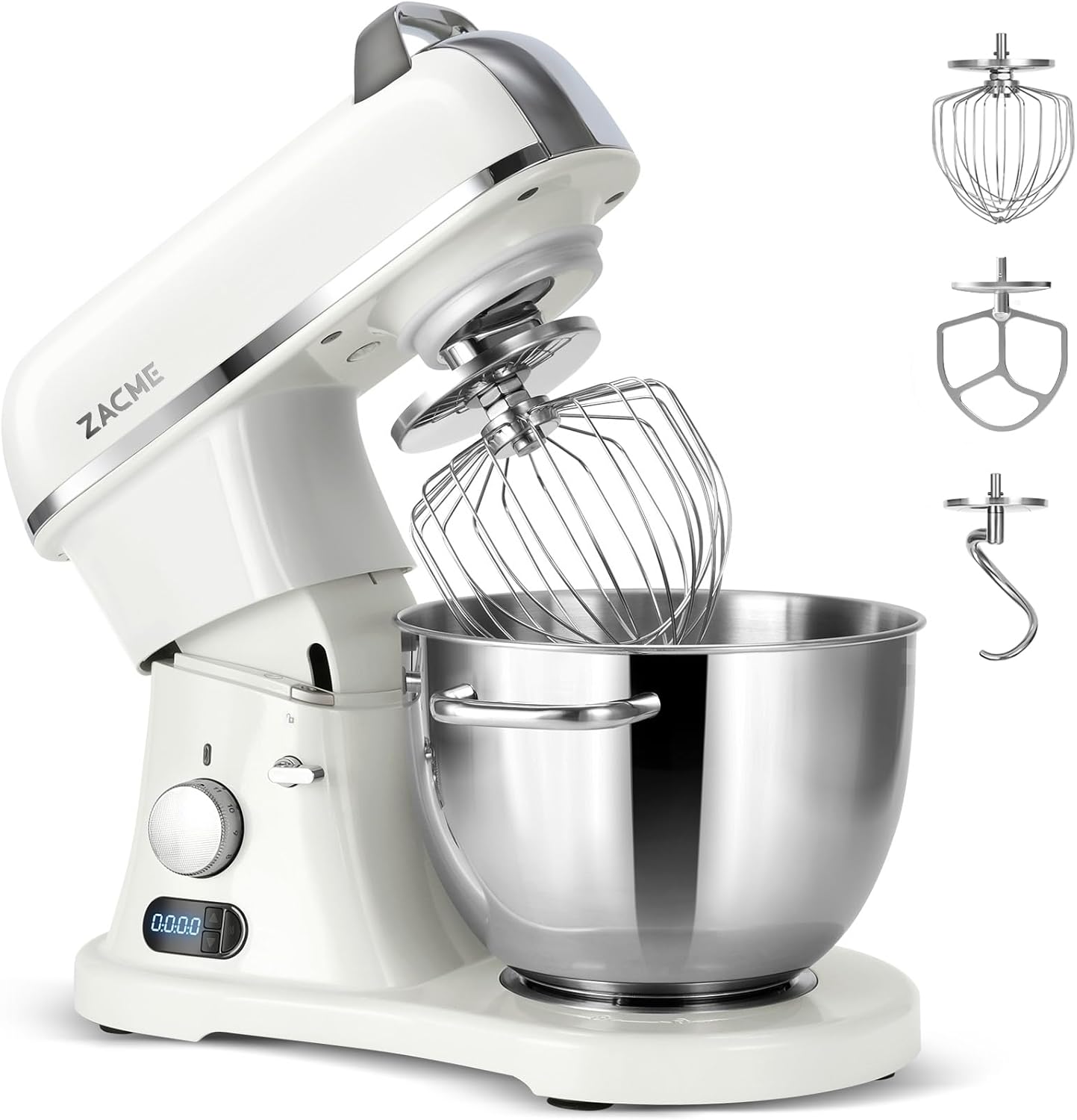
| Capacity | 8.4 quarts |
|---|---|
| Wattage | 800 watts |
| Number of Speeds | 11 |
| Noise Level | 48 db (low) |
This ZACME 8.4QT commercial stand mixer is built for frequent, heavy use in bread and pastry kitchens. Its 800W DC motor, metal gears, and planetary mixing action handle dense doughs and large batches up to about 3 kg without the need for repeated small batches. The tilt-head design and included stainless steel bowl plus dough hook, flat beater, and wire whip make swapping accessories and cleaning straightforward, while the LED display with a countdown timer helps manage longer kneading cycles. Noise levels are kept relatively low on slow speeds and dual cooling fans protect the motor during extended runs, which is useful for commercial or high-volume home baking. Practical limitations are its substantial weight and footprint, which require a stable counter or dedicated station, and the unit is a single-bowl mixer so extremely large bakery production lines would still need larger industrial machines. For reliable, repeatable kneading and mixing in bakery-focused settings this mixer offers a solid, factory-quality feel.
Best for: Bakers and small commercial kitchens that prioritize a durable, factory-quality mixer capable of reliably handling frequent bread and dough work.
Less Ideal for: Large-scale bakeries or production lines that need multi-bowl, conveyor, or industrial-capacity mixers for very high hourly throughput.
- Commercial-grade aluminum die-cast body and metal gears for long-term durability
- 800W DC motor with dual cooling allows sustained mixing of dense doughs
- Planetary mixing action ensures thorough, hands-free incorporation
- Digital LED display with timer and 11 speed settings for precise control
- NSF/ANSI 8-2023 compliance indicating commercial safety and hygiene standards
- Heavy and sizable unit that requires permanent counter space
- Single-bowl design limits throughput for very large bakery operations
Verdict: Choose this mixer when you need a robust, commercial‑grade stand mixer that reliably handles large doughs and heavy daily use.
KitchenAid Commercial 8-Quart Mixer KSMC895CU

| Capacity | 8 quarts |
|---|---|
| Wattage | 500 watts |
| Number of Speeds | 10 |
| Voltage | 120 volts |
This KitchenAid Commercial Series 8-Quart bowl-lift mixer is designed to handle large batches and heavy doughs in a professional or busy home kitchen. It uses a powerful, high-efficiency motor with PowerCore technology and an advanced motor control board to deliver steady torque while limiting heat buildup during long kneading cycles. The bowl-lift design and smooth lever keep the stainless-steel bowl stable for dense mixes, and included commercial-grade accessories — Powerknead spiral dough hook, flat beater, and stainless wire whip — let you move from bread dough to batter or whipped mixes without swapping attachments. NSF commercial certification and an extra-long, high-visibility power cord speak to its suitability for foodservice environments. Controls are manual with a 10-speed knob and soft-start to reduce splash. The mixer is heavy and built like equipment meant for continuous use, so it is less portable and takes more counter space than consumer models. It also requires a dedicated spot and may be overkill for cooks who seldom make large batches.
Best for: Bakers who make frequent large batches or run small-scale bakery or foodservice operations and want a durable, commercial-certified mixer that handles heavy dough reliably.
Less Ideal for: Casual home bakers who only make occasional small batches or need a lightweight, easily storable mixer should consider smaller consumer models instead.
- Commercial-grade motor with PowerCore technology delivers consistent power and reduced heat buildup during long kneading cycles
- 8-quart bowl and bowl-lift design handle large batches and keep the bowl stable for heavy doughs
- Includes commercial accessories (Powerknead spiral dough hook, flat beater, stainless wire whip) suitable for bread and bakery tasks
- NSF certification and extra-long commercial-grade cord indicate suitability for professional kitchens
- Large and heavy, requiring substantial counter space and a semi-permanent placement
- 500 watts and .44 HP to the bowl may still struggle with extremely dense, very large industrial loads
Verdict: Choose this KitchenAid commercial 8-quart bowl-lift mixer if you need a durable, NSF-certified machine that reliably handles large bread batches and heavy doughs.
VEVOR Commercial Mixer 30Qt

| Capacity | 28.5 liters |
|---|---|
| Wattage | 1100 watts |
| Number of Speeds | 3 |
| Noise Level | 70 db |
| Voltage | 110 volts |
This VEVOR 30Qt commercial mixer is built for heavy kitchen use and handles large batches reliably. Its 1100W motor and gear‑driven transmission deliver steady power for dough mixing, while three preset speeds (low for kneading, medium for mixing, high for whipping) cover typical bakery tasks. The included dough hook, flat beater, and wire whisk make it versatile for bread dough, fillings, and whipped ingredients, and the 30Qt stainless steel bowl accepts up to about 3.5 kg per run for larger loaves and multiple batches. Safety and convenience features include a guard that stops the machine if opened, an adjustable lever to raise and lower the bowl, and a 0–30 minute timer that automatically shuts off when finished. Expect industrial weight and footprint, and a noise level around 70 dB during operation. The machine is straightforward to clean thanks to detachable beaters and a stainless contact surface, but its commercial size and weight mean it is best suited to fixed kitchen installations rather than occasional home use.
Best for: Bakeries, pizzerias, and commercial kitchens seeking a reliable, high-capacity mixer for regular bread and dough production who prioritize safety and predictable performance.
Less Ideal for: Casual home bakers or small-scale hobbyists with limited space should choose a smaller countertop mixer instead.
- Powerful 1100W motor with gear-driven transmission for consistent mixing performance
- Three included attachments (dough hook, flat beater, wire whisk) cover common bakery tasks
- 30Qt stainless steel bowl supports large batch mixing for commercial bread production
- Safety guard and automatic shutdown when the cover is open improve operator safety
- Timer and lever-style bowl adjuster simplify multi-batch workflows
- Very heavy and large, requiring a permanent space in a commercial kitchen
- Noise level around 70 dB may be disruptive in small or quiet areas
Verdict: Choose this mixer if you need a heavy-duty, safety-minded 30Qt machine that reliably handles large batches of bread dough in a commercial kitchen.
Choosing the Right Commercial Mixer for Bread: Key Factors to Consider
Batch Capacity and Bowl Size
Batch capacity determines how many loaves you can mix per cycle. A larger bowl reduces the number of batches required for a set production goal, saving operator time and reducing per-loaf labor. However, oversized bowls can be inefficient for lower daily volumes because small batches will not load the mixer optimally, which can affect mixing action and dough development. Consider typical batch sizes for your recipes and choose a capacity that lets you mix full batches without straining the motor or overfilling the bowl.
Bowl shape and accessory options also matter. Taller bowls help develop gluten in high-hydration doughs, while wide shallow bowls can be useful for specialty mixing techniques. Verify accessory fit and whether the machine supports attachments sized for the bowl to ensure consistent results across batch sizes.
Motor Power and Continuous Duty Rating
Motor power is the main factor that controls how well a mixer handles stiff, high-hydration, or high-volume doughs. Higher horsepower and torque prevent the motor from bogging down during heavy mixing cycles. Equally important is the duty cycle or continuous-duty rating, which indicates whether the mixer can run for extended periods typical in commercial bakeries. A machine with adequate power but a low duty cycle will overheat if used continuously.
Look for clear manufacturer specifications about horsepower, torque, and recommended maximum run times. For heavier doughs and longer shifts, prioritize motors designed for continuous operation and consider soft-start features that reduce stress on components and extend motor life.
Mixing Head Type and Dough Handling
Different mixing head designs change how the dough is developed. Spiral mixers are engineered to fold and develop gluten gently while moving the bowl, which is ideal for large quantities of bread dough and preserving dough temperature. Planetary mixers provide versatility through a range of attachments but can be slower to develop gluten in very dense doughs. The choice affects both texture and mixing time.
Consider the types of bread you bake. High-hydration artisan doughs often benefit from spiral action, while versatile operations that produce a range of baked goods may prefer planetary heads for attachment flexibility. Ensure the mixer accommodates the specific hook, paddle, or whisk styles suitable for bread doughs you commonly make.
Build Quality and Gearbox Strength
Commercial mixers are tough on mechanical components because of the torque and repeated stress from mixing dense dough. Cast-iron or heavy-gauge steel frames reduce vibration and extend life, while robust gearboxes and sealed bearings minimize maintenance and prevent contaminant ingress. A stronger gearbox reduces the chance of costly failures and helps the mixer maintain consistent speed under load.
Check for serviceable gearbox designs, quality of seals, and materials used in critical load-bearing parts. Equipment with durable construction lowers long-term ownership costs and supports higher throughput with fewer interruptions.
Serviceability and Parts Availability
Downtime is expensive in commercial baking. Mixers that are easy to service, with readily available replacement parts and clear service manuals, reduce repair time. Consider how accessible routine wear items are, such as seals, belts, and bearings, and whether the mixer allows straightforward disassembly for inspection and repair.
Also evaluate the vendor or manufacturer's support footprint. Local service networks and documented maintenance schedules help keep machines running. Machines designed with modular replaceable components can be repaired faster and more cheaply than those requiring extensive disassembly.
Controls, Safety, and User Ergonomics
Control layout, variable speed options, and safety interlocks affect day-to-day usability. Variable speed enables precise dough development and reduces splatter during ingredient addition. Safety features like bowl guards, emergency stops, and interlocked lids protect operators and help maintain compliance with workplace safety standards.
Ergonomic factors such as bowl lift mechanisms, ease of loading and unloading, and noise levels influence operator fatigue and productivity. Choose equipment that aligns with your staff capabilities and workshop layout to minimize injury risk and speed routine tasks.
Choosing Capacity by Production Volume
Estimate your daily loaf count and typical batch size before selecting a mixer capacity. For low-volume bakeries that mix a few batches per day, a medium-capacity machine reduces wasted space and energy. High-volume operations need larger bowls and more powerful motors to keep up with continuous mixing schedules without overheating.
Also factor in peaks and seasonal surges. If your production varies, pick a capacity that handles peak demand comfortably rather than one sized only for average days. This prevents the need for overtime or extra shifts solely to catch up on mixing.
- Match bowl capacity to typical batch weight and loaf yield
- Plan for peak production rather than average only
- Avoid frequent half-full batches to maintain dough quality
Spiral Vs Planetary Mixers for Bread Dough
Spiral mixers are engineered for dough development. They rotate the bowl and keep the hook stationary, which produces efficient gluten development and maintains lower dough temperatures—ideal for large, high-hydration bread batches.
Planetary mixers offer attachment flexibility and are useful when you make a range of products beyond bread. They can be slower at developing dense doughs but are versatile and make sense for bakeries that need one machine for multiple tasks.
- Choose spiral for large, hydration-sensitive bread batches
- Choose planetary for multi-use environments and attachment options
Preparing Your Space and Utilities
Commercial mixers require adequate floor space, stable surfaces, and proper utility hookups. Confirm electrical supply and phase requirements before purchase because higher horsepower motors may need three-phase power. Proper ventilation and floor drainage are useful in busy bakery areas to manage flour dust and spilled water.
Consider accessibility for servicing. Position machines to allow access to the rear and underside where belts and gearboxes are often maintained. Also plan for safe ingredient staging and a clear workflow from mixing to dividing to proofing.
- Verify electrical type and amperage requirements
- Allow clearance for service access and ingredient handling
- Plan for dust control and cleaning access
Maintaining Dough Temperature
Dough temperature is a critical variable for bread quality. Mixers that generate excessive heat can accelerate fermentation or alter dough structure. Machines with efficient mixing mechanics and cooling-friendly designs help control temperature rise during mixing.
Monitor dough temperature and use water temperature adjustments as needed. Some bakeries incorporate chilled water or ice to counteract heat from vigorous mixing, especially for long mix cycles or high-hydration formulas.
- Track final dough temperature after mixing
- Use water temperature adjustments to manage heat pickup
- Prefer designs that minimize frictional heat for sensitive formulas
Routine Maintenance to Extend Life
Establish a routine maintenance schedule focused on lubrication, seal inspection, and gearbox checks. Regular cleaning prevents flour buildup that can abrade seals and bearings. Replace wearable parts proactively based on hours of operation rather than waiting for failure.
Document maintenance intervals and train staff on basic inspections. Quick daily checks catch problems early and reduce the chance of major breakdowns during busy periods.
- Lubricate and inspect gearboxes per manufacturer interval
- Clean bowls and guards after each shift to prevent buildup
- Replace wear items on a schedule tied to hours of operation
How We Chose the Best Commercial Mixer for Bread
We prioritized factors that matter to professional bakers and high-volume bread makers. Capacity and bowl size were primary filters because a machine must match batch sizes to avoid overworking dough or running inefficient small batches. Motor power and duty cycle came next to ensure the mixer can handle dense dough and continuous shifts without overheating. Build materials and gearbox durability were evaluated to predict long-term reliability under heavy loads. We also considered mixing head types and attachment compatibility since different doughs and techniques require hooks, paddles, or spiral-style action. Serviceability and parts availability were included to reduce downtime in commercial settings. Machines were excluded if they were designed primarily for household use, lacked commercial-duty motors, or did not offer documented continuous-duty ratings. The resulting shortlist reflects gear suited for sustained bread production with a balance of capacity, power, and maintainability.
Our full evaluation process is outlined in our review methodology.
FAQ
What mixer capacity do I need for a small bakery?
For a small bakery, choose a mixer with a bowl size that fits your typical batch weight so you can mix full batches without overfilling. Many small bakeries find medium-capacity units provide a good balance between batch efficiency and footprint.
Can a planetary mixer handle heavy bread dough?
Planetary mixers can handle some heavy doughs but often require longer mix times and may struggle with very dense, high-hydration formulations. For frequent heavy bread doughs, a spiral mixer is usually a better mechanical choice.
How important is the motor duty rating?
Very important. The duty rating indicates whether the motor is designed for continuous commercial use. A high duty rating reduces the risk of overheating and motor wear during long production runs.
Do commercial mixers need three-phase power?
Some higher-horsepower commercial mixers require three-phase power, while smaller units run on single-phase. Check your electrical supply and the mixer's requirements before purchasing to avoid installation issues.
How often should I service a commercial mixer?
Service frequency depends on usage, but routine inspections should be daily with more thorough maintenance monthly or quarterly. Replace wear items based on hours of operation and follow the manufacturer's recommended service schedule.
Final Verdict
Prioritize capacity, motor duty cycle, and mixing head type when choosing a commercial mixer for bread. Balance the need for large batch throughput against daily production realities and shop utilities. Durable construction and easy service access reduce downtime and ownership costs. Focus on the factors discussed here to select a machine that reliably supports your baking schedule and produces consistent dough every day.