
Note: This article contains affiliate links. If you click on these links and make a purchase, we may earn a small commission at no extra cost to you. This helps support our research and content. Read our full affiliate disclosure here.
If your heating and cooling system supports networked controls, a communicating thermostat can simplify setup, reduce installation headaches, and let the system components coordinate for better comfort. Picking the right communicating thermostat matters because these devices must match your HVAC control protocol and wiring while offering the connectivity and scheduling features you actually use. This guide shortlists the top communicating thermostats designed for whole-home integration. We evaluated each pick for compatibility, control flexibility, and installation practicality to help you choose the right option for your system. Read on for evaluation details and practical buying guidance.
Top Picks at a Glance
| Best Overall The best all-around choice for most situations | ecobee Smart Thermostat Enhanced |  |
| Best Quality Built to a higher standard if you want something more solid | ecobee Smart Thermostat Premium |  |
| Best Value The sweet spot between price and what you get | Amazon Smart Thermostat |  |
| Best Budget The cheapest option that still gets the job done reliably | Nest Thermostat E |  |
| Top Rated A top-rated pick with lots of positive feedback | Sensi Touch ST75 |  |
| Most Popular A crowd favorite that many people choose with confidence | Google Nest Thermostat |  |
| Best Seller A high-volume bestseller chosen again and again | Sensi Smart Thermostat ST55 |  |
ecobee Smart Thermostat Enhanced

| Connectivity Technology | Wi-Fi |
|---|---|
| Power Source | Corded Electric |
| Voltage | 24 volts |
| Display Type | LCD |
| Control Type | App Control |
The ecobee Smart Thermostat Enhanced is a wall-mounted, hardwired smart thermostat designed to reduce heating and cooling waste while keeping rooms comfortable. It uses built-in radar occupancy sensing and learning software to adapt schedules, preheat or precool before you arrive, and adjust based on when people are home or asleep. Setup is DIY-friendly and the box includes a power extender kit and trim plate for installs without a C wire, while the touch LCD and mobile app let you control the system remotely or with voice through Alexa, Google Assistant and Apple HomeKit. Smart features include eco+ energy optimizations, support for additional SmartSensors to balance temperature across rooms, and dual-band Wi-Fi for stable connectivity. Practical benefits are clear savings potential, reliable hardwired operation and broad HVAC compatibility for most 24 VAC systems. Expect some setup work to verify compatibility and wire connections and that advanced features require using the app and account setup to get the full energy-saving automation.
Best for: Buyers who want a reliable, feature-rich smart thermostat that saves energy and integrates with major smart home platforms while supporting DIY installation.
Less Ideal for: People who need a simple, non-connected manual thermostat or who cannot or prefer not to connect a device to Wi-Fi and cloud services.
- Built-in radar occupancy sensing for automated presence-based temperature control
- Includes Power Extender Kit and trim plate for easier DIY installation without a C wire
- Works with Alexa, Google Assistant and Apple HomeKit for voice and remote control
- Hardwired design avoids frequent battery changes and provides stable operation
- Supports additional SmartSensors to manage temperature room-by-room
- Requires checking system compatibility and correct wiring for some HVAC setups
- Advanced automation depends on app account setup and cloud connectivity
Verdict: A well-rounded, hardwired smart thermostat that combines occupancy sensing, app-driven automation and wide smart home integrations for measurable energy savings.
ecobee Smart Thermostat Premium

| Connectivity Protocol | Wi-Fi |
|---|---|
| Controller Type | Amazon Alexa, Android, Apple HomeKit, Google Assistant, iOS |
| Power Source | Battery Powered |
| Voltage | 24 volts |
| Display Type | LCD |
The ecobee Smart Thermostat Premium is a high-end communicating thermostat designed to optimize comfort and reduce energy use through smart sensors and integrations. It is typically wall-mounted and paired with the included SmartSensor to monitor specific rooms and eliminate hot or cold spots, while radar occupancy sensing and geofencing help the thermostat adapt to presence. Notable features include a built-in air quality monitor with alerts and filter reminders, dual-band Wi-Fi and app control, and on-device voice assistants for hands-free control and audio playback. The package also includes a power extender kit to help with homes that lack a C-wire, which simplifies DIY installation for many systems. Practical benefits are improved zone comfort, potential HVAC energy savings, and tighter integration with smart home platforms like Alexa, Siri, Google Assistant, and HomeKit. Limitations to consider are the requirement to verify HVAC compatibility before purchase and reliance on the ecobee ecosystem for some advanced protections and live doorbell integration.
Best for: Buyers who prioritize precise, whole-home comfort and want a thermostat that actively communicates with sensors and smart-home platforms to maximize comfort and efficiency.
Less Ideal for: People who need a simple, no-frills programmable thermostat or homes with unsupported HVAC control voltages should consider a different, simpler control option.
- Built-in Alexa and Siri voice assistants plus speaker for hands-free control and audio
- Included SmartSensor addresses room-level comfort and reduces hot or cold spots
- Air quality monitor provides alerts, improvement tips, and filter change reminders
- Radar occupancy and geofencing improve automatic comfort adjustments and security-aware features
- Power Extender Kit and trim/backplate included to simplify installation on C-wire-less systems
- Some advanced features require use of ecobee services or compatible smart home hubs
- Not compatible with line-voltage, millivolt, or certain 0-10V systems so compatibility check is necessary
Verdict: Choose the ecobee Smart Thermostat Premium if you want a communicating thermostat that combines room sensors, built-in voice, and air-quality monitoring to deliver smarter comfort and efficiency.
Amazon Smart Thermostat
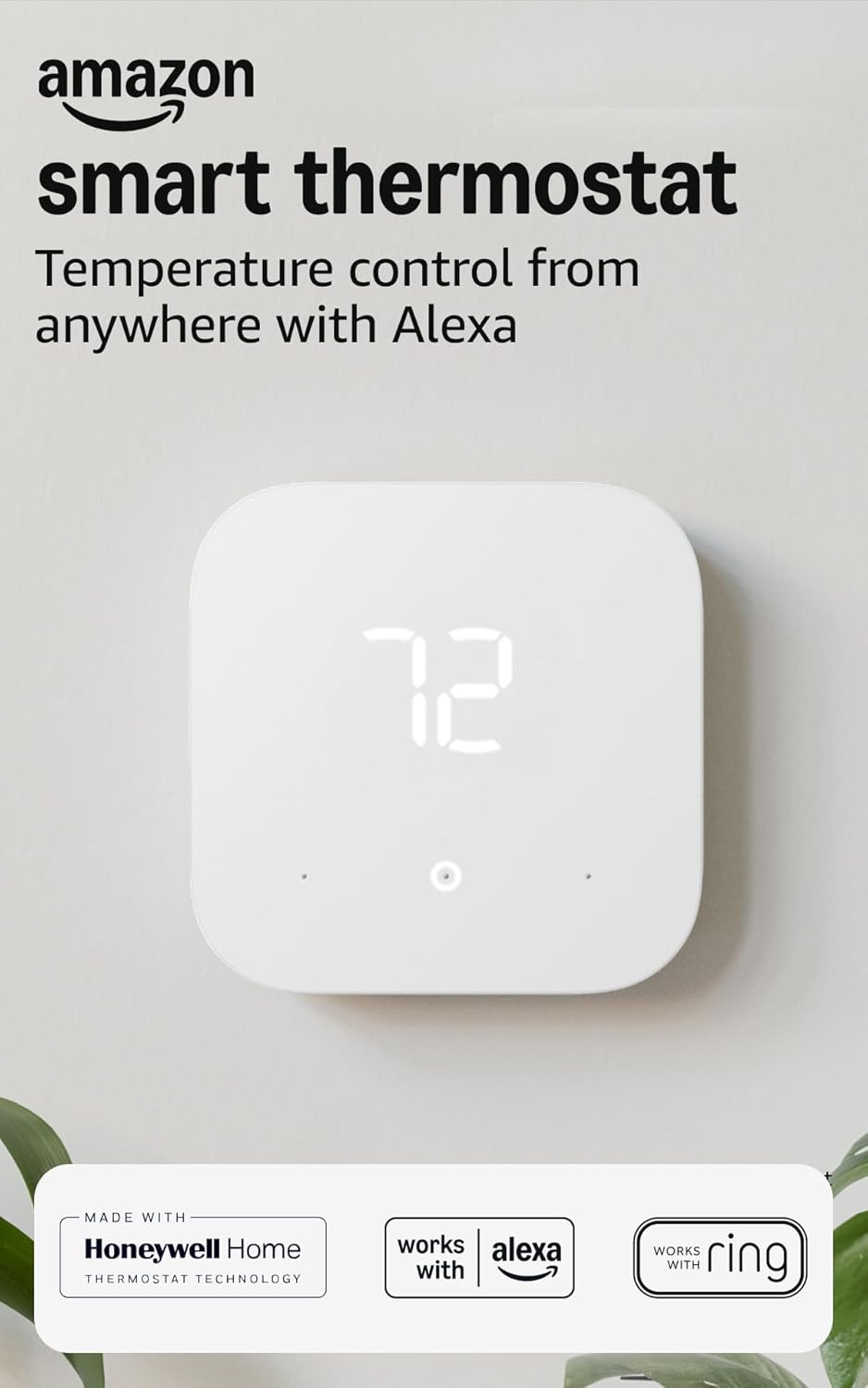
| C-wire required | Yes |
|---|---|
| Works with | Alexa and Ring |
| Manufacturer technology | Honeywell Home |
| Energy guidance | ENERGY STAR estimates and rebate info |
The Amazon Smart Thermostat is a straightforward, Alexa-first thermostat built to replace a traditional wall unit and provide remote, scheduled, and voice control of your HVAC. It installs with a required C-wire and the Alexa app walks you through setup while exposing scheduling, home/away modes, and presence-triggered adjustments when linked to compatible Alexa devices. The unit leverages Honeywell Home thermostat technology for reliable temperature sensing and pairs with Ring and other Alexa-enabled devices to create automated comfort zones or trigger routines. Key practical benefits are easy monthly scheduling, app and voice control for on-the-go adjustments, and potential energy savings via ENERGY STAR guidelines and local rebate information Amazon provides. Limitations include the dependence on Alexa for the richest integrations and the need for a C-wire, which adds installation steps for some homes, and it does not emphasize advanced HVAC diagnostics for complex systems.
Best for: Buyers who prioritize simple, voice-driven climate control and want a communicating thermostat that integrates tightly with Alexa devices for schedules, presence detection, and remote adjustments.
Less Ideal for: People who avoid voice assistants, need advanced HVAC diagnostics, or cannot provide a C-wire without additional electrical work should consider other options.
- Works with Alexa and Ring for voice control and presence-based automations
- Remote control and scheduling via the Alexa app for on-the-go adjustments
- Backed by Honeywell Home thermostat technology for reliable temperature sensing
- ENERGY STAR–oriented features and guidance for potential energy bill savings
- Requires a C-wire, which may need wiring changes in older homes
- Best features depend on using Alexa ecosystem rather than third-party assistants
Verdict: Choose this thermostat if you want a practical, Alexa-integrated smart thermostat that makes scheduling, voice control, and presence-based temperature adjustments easy.
Nest Thermostat E

| Connectivity Technology | Wi-Fi |
|---|---|
| Power Source | Battery Powered |
| Voltage | 24 volts |
| Display Type | LCD |
| Control Method | App |
The Nest Thermostat E is a budget-focused smart thermostat that replaces a traditional wall unit with a simple, app-driven controller and a frosted dial display. It learns routine temperature adjustments over several days and automatically creates a schedule, and you can change settings remotely through the Nest app or with voice commands via Google Assistant. The E supports common 24V heating and cooling systems and reports basic energy usage so you can spot savings; it also shows a Leaf icon when you choose energy-efficient temperatures. Installation is designed to be straightforward for a homeowner comfortable with basic wiring, though some older systems may need a C-wire or a professional hookup. The small polycarbonate shell and muted display are intentionally low-profile, which helps it blend into light-colored interiors but offers less visual polish than higher-end models. If you want a simple, no-frills smart thermostat that communicates with your phone and smart home, the Nest Thermostat E covers those needs without extra complexity.
Best for: Buyers looking for an affordable smart thermostat that provides remote control, basic learning schedules, and simple energy feedback without advanced display frills.
Less Ideal for: Users who want a premium screen, advanced sensors, or deep configurable HVAC features should consider higher-tier smart thermostats instead.
- Learns temperature habits and auto-schedules to reduce manual programming
- Remote app control and voice compatibility with Google Assistant
- Energy usage tracking and Leaf indicator to encourage efficient settings
- Designed for straightforward replacement of most 24V HVAC systems
- May require a C-wire or professional installation on some systems
- Simplified frosted display lacks the richer screen and controls of higher-end models
Verdict: A cost-conscious, communication-focused smart thermostat that delivers app control, voice support, and automatic scheduling for buyers who prioritize simplicity and energy feedback.
Sensi Touch ST75

| Connectivity Technology | Wi-Fi |
|---|---|
| Control Method | App, Touch, Voice |
| Screen Size | 4.3 inches |
| Specific Uses For Product | Air Conditioner, Boiler, Furnace, Heat Pump |
| Specification Met | Energy Star |
The Sensi Touch ST75 is a Wi‑Fi programmable thermostat built for everyday smart-home control and straightforward DIY installation. It uses the Sensi mobile app and voice assistants for remote temperature adjustments and supports common HVAC equipment including furnaces, heat pumps, boilers, and air conditioners. The 4.3-inch color touchscreen and touch controls make local operation simple, while features like geofencing, scheduling, usage reports, smart alerts, and filter reminders help reduce energy use and keep maintenance on track. Installation is designed for homeowners, with illuminated easy-click terminals and an included level and mounting hardware, but a common wire (C-wire) is required. The unit is Energy Star certified and pairs with major platforms such as Alexa, Google Assistant, Apple HomeKit, SmartThings, and Vera, which makes it a good fit for a connected home. Trade-offs are minimal for reliability-focused buyers, though the touchscreen and glossy plastic finish are more consumer-oriented than heavy-duty commercial hardware and a C-wire requirement means older homes may need an adapter or electrician.
Best for: Buyers who prioritize a reliable, easy-to-use smart thermostat that integrates with major smart-home ecosystems and offers clear usage reporting and alerts for maintenance.
Less Ideal for: Users seeking rugged commercial-grade hardware or those without an available C-wire who do not want to install an adapter or call an electrician.
- Color touchscreen and touch controls for intuitive local operation
- Works with major smart platforms and voice assistants for remote control
- Energy Star certification plus usage reports and scheduling for energy savings
- Easy DIY installation with illuminated terminals and included mounting hardware
- Requires a C-wire, which can complicate installation in older homes
- Glossy plastic finish and consumer-focused design may not suit heavy-duty commercial use
Verdict: Choose the Sensi Touch ST75 for a reliable, easy-to-install smart thermostat that communicates clearly with apps and voice assistants while helping save energy.
Google Nest Thermostat
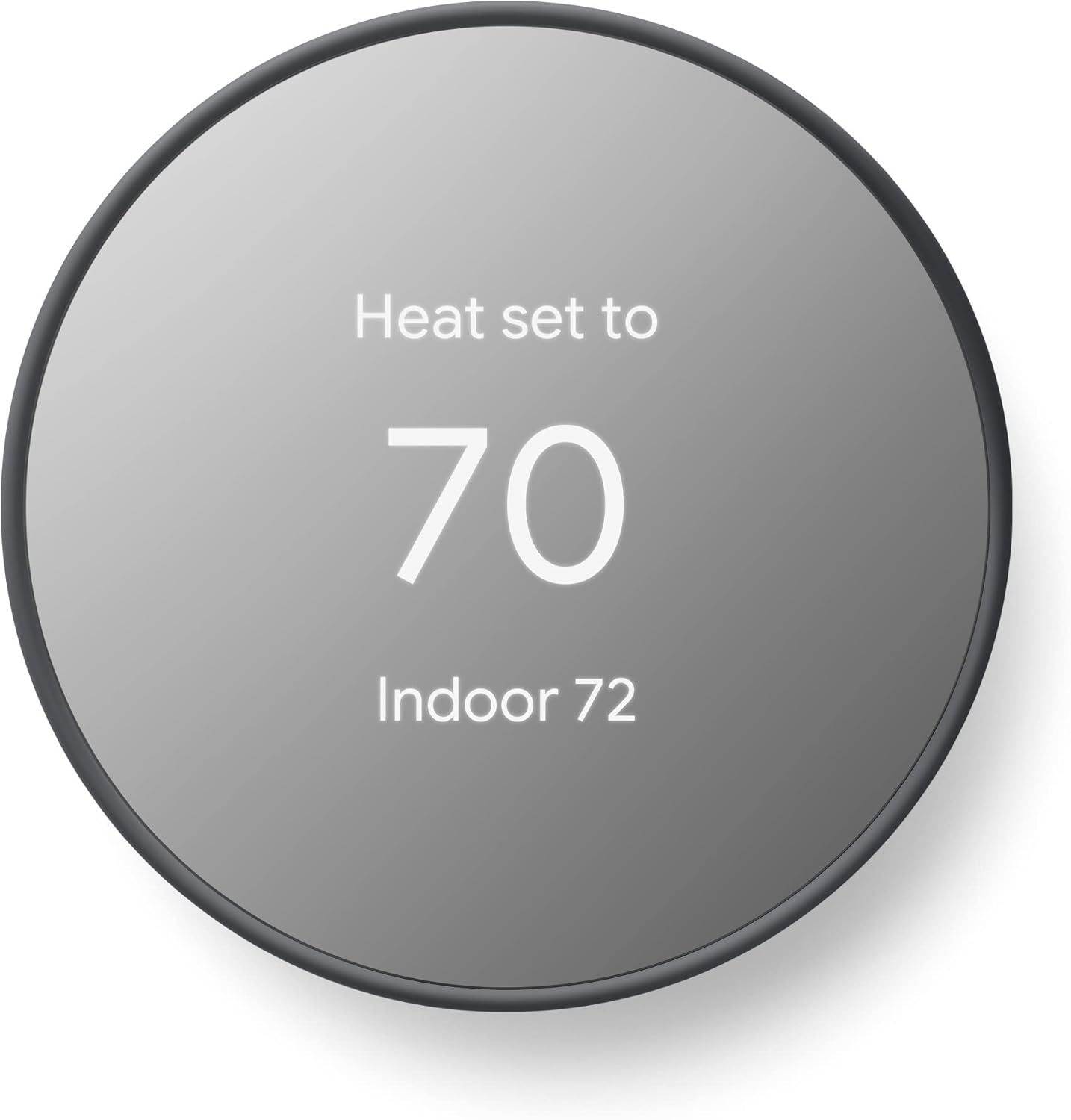
| Connectivity Technology | Bluetooth, Wi-Fi |
|---|---|
| Power Source | Battery Powered |
| Display Type | LCD |
| Control Type | Remote Control, Voice Control |
| Number of Batteries | 2 A batteries required. (included) |
The Google Nest Thermostat is a compact smart thermostat designed for everyday home heating and cooling control. It connects to your Wi‑Fi and pairs with the Google Home app so you can adjust temperature remotely, set schedules, and accept suggested schedule tweaks from Savings Finder. The unit supports voice control through Google Assistant and other Matter‑certified assistants and can run on batteries in many homes without a C wire, while also offering HVAC monitoring and alerts to help spot potential issues. Installation is intended to be user friendly and often takes about 30 minutes using the app's guided steps, and the package includes mounting screws and a steel plate. Limitations to note are compatibility gaps with some high‑voltage or unusual systems and the occasional need for a C wire or power accessory on certain setups, and advanced energy features like Nest Renew require additional Nest devices or services in supported areas. For typical homeowners looking to add a connected thermostat, it balances simplicity, smart features, and energy awareness nicely.
Best for: Buyers who want an easy to install, app‑driven thermostat that adds remote and voice control and focuses on straightforward energy savings and system monitoring.
Less Ideal for: Homes with unusual or high‑voltage HVAC systems or installations that cannot provide required wiring where a power accessory would be impractical.
- Simple app and voice control via Google Home and compatible assistants
- Programmable schedules with Savings Finder suggestions to help reduce energy use
- Designed for DIY installation with included mounting hardware and guided setup
- Battery powered operation that often works without a C wire
- Built‑in HVAC monitoring and alerts for potential system issues
- Not compatible with some high‑voltage or nonstandard HVAC systems
- Some features like Nest Renew require other Nest devices or eligibility with local utilities
Verdict: A simple, app‑centric smart thermostat that delivers easy DIY installation, remote and voice control, and practical energy‑saving features.
Sensi Smart Thermostat ST55

| Connectivity Technology | Wi-Fi |
|---|---|
| Controller Type | Amazon Alexa, Apple HomeKit, Google Assistant, SmartThings, Vera |
| Temperature Control Type | Programmable, Smart/Remote |
| Power Source | Corded Electric |
| Number of Batteries | 2 AA batteries required. (included) |
The Sensi Smart Thermostat ST55 replaces a traditional wall thermostat with a straightforward, Wi‑Fi connected controller that you can operate via the Sensi mobile app, touchscreen buttons, or voice assistants like Alexa and Google Assistant. It is designed for DIY installation with included mounting hardware, wire stickers, and step‑by‑step app guidance, and it works with common HVAC systems including furnaces, heat pumps, boilers, and air conditioners. Key features include remote access and usage reports for tracking energy, a filter change indicator, programmable schedules, and Energy Star certification for efficiency. The unit supports 2.4 GHz Wi‑Fi and provides maintenance alerts and simple touchscreen feedback without requiring a full smart‑home overhaul. Limitations to note are its basic LED screen and button control rather than a full-color touchscreen, and compatibility depends on your home wiring so some systems may still require a C‑wire or professional help for complex setups.
Best for: Buyers who want a reliable, easy‑to‑install smart thermostat that prioritizes energy savings, privacy, and straightforward app or voice control without a steep learning curve.
Less Ideal for: People seeking an advanced touchscreen thermostat with high‑end display features or those who need broad multi‑protocol smart‑home integrations beyond the listed platforms.
- Energy Star certified with remote scheduling and usage reports to help reduce HVAC energy use
- Easy DIY installation with included hardware and app guidance for most standard systems
- Works with major voice assistants and smart home platforms for convenient voice and app control
- Includes maintenance alerts and a filter indicator to simplify HVAC upkeep
- Uses a basic LED/button interface rather than a color touchscreen
- Requires 2.4 GHz Wi‑Fi and may need a C‑wire for some systems
Verdict: A dependable, Energy Star certified Wi‑Fi thermostat that makes smart HVAC control and energy reporting simple for mainstream, risk‑averse buyers.
Choosing the Right Communicating Thermostat: Key Factors to Consider
Protocol and Wiring Compatibility
Communicating thermostats must match the control protocol used by your HVAC equipment. Different manufacturers and system families use distinct digital communication standards and wiring pinouts. Choosing a thermostat that supports the same protocol prevents miscommunication, ensures full feature access, and avoids installation rework.
Before buying, verify the controller's supported protocols and the HVAC control board's terminal assignments. Mismatched wiring can lead to limited functionality or require interface modules, increasing cost and complexity.
Installer Diagnostics and Service Features
Thermostats that offer clear diagnostic readouts, event logs, and remote fault codes save time during commissioning and service calls. Installers often rely on built-in testers and live data views to confirm sensor behavior, stage transitions, and compressor/ventilation responses.
Consider devices that provide persistent logs, timestamped alerts, and easy access to system telemetry. Those features reduce truck rolls and help pinpoint intermittent issues that are otherwise hard to trace.
Connectivity and Control Options
Decide how you want to control the thermostat daily. Many communicating thermostats offer local touchscreen control, web portals, and mobile apps. Some also integrate with building automation systems via industry-standard interfaces. Reliable connectivity matters for remote adjustments, firmware updates, and gathering energy usage data.
Assess the available connection methods and their security features. Units that support both local network access and cloud services give flexibility, but local integration capabilities are crucial when privacy or institutional network policies limit cloud use.
Scheduling, Automation, and Energy Reporting
Advanced scheduling and adaptive control can improve comfort and reduce runtime without manual input. Look for thermostats that support programmable schedules, adaptive setpoints, and event-based automation tied to occupancy sensors or outdoor conditions. Energy reporting features that summarize run times and setpoint history help you evaluate results after installation.
Prefer controls that make schedule creation straightforward for occupants or facility managers, and that provide exportable logs or reports for longer-term analysis.
Installation Complexity and Mounting
Communicating thermostats vary in physical size, mounting options, and wiring requirements. Some need additional interface modules, extra power, or nonstandard mounting backplates. Consider whether the unit fits existing wiring and wall cavities and whether an adapter or adapter plate is required.
Factor in whether the device requires a common power connection, additional relays, or network termination hardware. Simpler physical installation reduces labor time and the likelihood of issues introduced during retrofit.
Security and Firmware Update Support
Networked thermostats can expose building controls to cybersecurity risks if firmware and communications are not secured. Devices with signed firmware updates, encrypted communications, and documented security practices are preferable for both homes and commercial settings.
Confirm the vendor's approach to updates and patching, how updates are delivered, and whether local-only firmware update options exist. Long-term vendor support reduces the chance that a device becomes a maintenance liability.
How Communicating Thermostats Differ From Conventional Models
Communicating thermostats exchange structured data with HVAC equipment rather than simply closing and opening relay contacts. This allows the thermostat and system controllers to share status, setpoints, diagnostics, and staged commands beyond basic heat and cool signals. The result is tighter coordination and potentially fewer override conflicts between components.
Because they rely on a communication protocol, these thermostats require matching wiring and often a digital bus connection. They can surface component faults and operating parameters that conventional thermostats cannot, which is useful for both comfort tuning and serviceability.
- Provide telemetry such as system state, fault codes, and sensor readings
- Enable coordinated control of staged compressors, economizers, and ventilation
- May require a dedicated communication network or specific wiring
Preparing for Installation
Before installing a communicating thermostat, document the existing control board labeling, photograph wiring, and confirm the system protocol. If you are replacing an older thermostat, check whether the replacement requires a common power connection or an interface module.
Plan for a commissioning period where the installer verifies protocol handshake, confirms stage sequencing, and exercises diagnostics. Allow time to update the building or home automation mapping so the new device appears correctly in any central control platform.
- Label and photograph current wiring before removal
- Confirm required power and network connections
- Schedule a commissioning session to validate function
Integration With Building Automation and Smart Home Systems
Communicating thermostats are often selected for their ability to integrate into larger automation systems. When integration is needed, verify supported interfaces such as BACnet, Modbus, or proprietary APIs and whether the vendor documents those interfaces for third-party integration.
If you depend on a central management platform, check whether the thermostat supports direct integration or needs a gateway. Also confirm how the device exposes history and alarms so facility managers can include them in monitoring dashboards.
- Confirm protocol support for your automation platform
- Check for gateways when direct integration is unavailable
- Verify alarm and history export capabilities
User Interface and Occupant Experience
The best communicating thermostats balance installer-focused diagnostics with a simple occupant interface. Occupants typically want straightforward controls for setpoints, modes, and temporary overrides without exposing advanced configuration menus.
Look for models that separate technician menus from occupant controls or that provide role-based access. Clear local displays, straightforward schedule editing, and intuitive temporary hold behavior reduce confusion and support consistent comfort outcomes.
- Role-based or split UI reduces accidental changes
- Simple temporary hold behavior prevents long-term overrides
- Readable displays and clear icons improve occupant satisfaction
Troubleshooting Common Issues
Typical issues include improper protocol handshake, missing power to the device, or incorrect mapping of control points. Start troubleshooting by confirming physical wiring and power, then review communication status indicators and logs if available.
If a communicating thermostat shows inconsistent behavior, check for firmware mismatches and verify that the HVAC control board firmware supports the thermostat series. Use installer diagnostic tools to capture event logs during a fault and reproduce the condition while observing telemetry.
- Verify power and network connection first
- Use logs to trace intermittent faults
- Confirm firmware versions on both thermostat and control board
How We Chose the Best Communicating Thermostat
We prioritized products that are purpose-built for systems using digital communicating protocols rather than conventional two-stage or conventional thermostat wiring. Key evaluation criteria included protocol and wiring compatibility, ease of integration with commonly used building management and HVAC control systems, reliability of network and local control, and the breadth of scheduling and automation features. We also considered installation complexity and diagnostic capabilities because technicians and knowledgeable homeowners value devices that reduce service time and clarify faults. Connectivity and user interface mattered for daily use; we looked for clear mobile and local controls plus secure firmware update paths. Energy management features and data reporting were evaluated for their real-world usefulness rather than novelty. Excluded were thermostats that only support standard analog or simple digital on/off controls, units without explicit communicating-protocol support, and devices lacking documented integration or diagnostic features. The resulting shortlist reflects devices that meet integration, install, and operational standards appropriate for communicating HVAC systems.
Our full evaluation process is outlined in our review methodology.
FAQ
Do communicating thermostats require special wiring?
Often yes. Many communicating thermostats use a digital bus or specific multi-pin connections rather than simple relay terminals. Verify the control board's wiring and the thermostat's required connections before purchase.
Can a communicating thermostat work without cloud connectivity?
Usually. Many communicating thermostats offer local control and integration with building automation systems independent of cloud services. However, cloud features such as remote access or over-the-air updates may be optional extras.
Will a communicating thermostat provide better energy savings?
It depends. Communicating thermostats can improve efficiency through coordinated control and smarter schedules, but actual savings depend on system tuning, occupant behavior, and whether energy-reporting features are used to guide adjustments.
Are communicating thermostats harder to install?
They can be more complex than conventional thermostats because they require correct protocol matching and sometimes additional wiring or interface modules. Planning and proper documentation reduce installation time and errors.
How important are firmware updates for these devices?
Firmware updates are important for security, protocol compatibility, and bug fixes. Choose devices with a clear update path and security practices so updates can be applied without disrupting building operations.
Final Verdict
When choosing a communicating thermostat, prioritize protocol and wiring compatibility first, then weigh installer diagnostics, reliability of connectivity, and the ease of integration with your automation platform. Expect tradeoffs between advanced data features and installation complexity; pick the option that matches the technical capacity of your maintenance team and the integration needs of the site. Focus on long-term support and security posture as much as day-to-day usability. A well-matched communicating thermostat delivers cleaner diagnostics, simpler commissioning, and smoother system coordination that pays off in reduced service time and more consistent comfort.