
Note: This article contains affiliate links. If you click on these links and make a purchase, we may earn a small commission at no extra cost to you. This helps support our research and content. Read our full affiliate disclosure here.
If you plan to preserve fruits, make jerky, or prepare snacks at home, the right countertop food dehydrator makes the job reliable and efficient. You want consistent drying, temperature control suited to different foods, and a unit that is easy to maintain so weekly use does not become a chore. This guide covers seven shortlisted countertop food dehydrators that meet those real-world needs. Each pick was evaluated for drying consistency, temperature range, airflow design, and ease of cleaning to help you find a model that fits how you cook and store food. Read on for the factors we weighed and what to expect from top choices.
Top Picks at a Glance
| Best Overall The best all-around choice for most situations | Magic Mill Pro Food Dehydrator |  |
| Best Quality Built to a higher standard if you want something more solid | Excalibur Performance 10-Tray Dehydrator |  |
| Best Value The sweet spot between price and what you get | OSTBA Food Dehydrator GGJ-261B |  |
| Best Budget The cheapest option that still gets the job done reliably | NutriChef Food Dehydrator PKFD14BK |  |
| Top Rated A top-rated pick with lots of positive feedback | Cosori Stainless Steel Food Dehydrator |  |
| Most Popular A crowd favorite that many people choose with confidence | Elite Gourmet EFD319 Dehydrator |  |
| Best Seller A high-volume bestseller chosen again and again | Cosori Stainless Steel Dehydrator P501 |  |
Magic Mill Pro Food Dehydrator

| Wattage | 600 |
|---|---|
| Voltage | 120 |
| Number of Trays | 7 |
| Material | Stainless Steel |
The Magic Mill Pro is a heavy-duty countertop dehydrator aimed at users who want reliable, repeatable results across multiple batches. Its full-stainless steel interior, exterior, and seven stainless trays make it feel sturdier than plastic alternatives and easier to keep sanitary. A 600W rear-mounted fan and rear heating deliver even airflow so trays do not need rotation, and temperature adjusts in 1°F increments from 95°F to 176°F for delicate herbs up to jerky. The digital controls include a 48-hour timer with auto-shutoff and a keep-warm mode that holds low heat for up to 24 hours, which is convenient for long recipes or staging batches. Included mesh screens and a fruit roll tray expand what you can dry without extra purchases. Trade-offs are its larger footprint and heavier stainless construction compared with compact plastic models, and the higher power means it will run warmer and draw more electricity during long cycles. For anyone prioritizing build quality and consistent drying across many trays, it is a practical, capable choice.
Best for: Buyers who want a durable, high-capacity countertop dehydrator for frequent multi-batch drying and who value precise temperature control and even airflow.
Less Ideal for: People who need a very compact, lightweight, or low-power appliance for occasional small batches should consider smaller or lower-watt models instead.
- Full stainless steel interior, exterior, and trays for durability and easy cleaning
- Rear-mounted 600W fan and heating system that promotes even drying without rotating trays
- Digital temperature control in 1°F increments from 95°F to 176°F for precise results
- 48-hour timer with auto-shutoff plus a 24-hour keep-warm mode for long recipes
- Includes seven full-size trays plus mesh screens and a fruit roll tray for versatility
- Larger and heavier than compact plastic dehydrators, taking more counter space
- Higher power draw due to 600W motor may use more electricity during extended cycles
Verdict: Choose this dehydrator if you want a durable, seven-tray stainless-steel unit that delivers precise, even drying for regular multi-batch use.
Excalibur Performance 10-Tray Dehydrator

| Wattage | 800 watts |
|---|---|
| Voltage | 120 |
| Number of Trays | 10 |
| Temperature Range | 85°F to 165°F |
The Excalibur Performance 10-Tray is built for serious dehydrating projects, offering 16 square feet of drying space across ten stainless steel trays and a clear top-view glass door so you can monitor progress without opening the unit. It uses Excalibur's Hyperwave Pulse and horizontal air flow to circulate warm air for even drying without rotating trays, and the LED control panel lets you set temperatures from 85°F to 165°F and run cycles up to 80 hours, including two-phase drying programs and an auto shutoff with progress bar. In practice this means you can dry large batches of fruit, herbs, jerky and pet treats with consistent results and minimal babysitting. The stainless steel trays and roomy interior make it durable and easy to load, while the hideaway door and included preservation guide add convenience. Downsides are its substantial footprint and weight for countertop use and the power draw typical of a high-capacity unit, which make it best suited to dedicated kitchen space rather than occasional small-batch needs.
Best for: Home cooks and food preservers who regularly dehydrate large quantities and want precise temperature control and even results for jerky, fruit, herbs, and similar projects.
Less Ideal for: Anyone who only plans occasional small-batch drying or needs a very compact, lightweight unit for limited counter space should consider smaller models instead.
- Large 10-tray capacity provides 16 square feet of drying area for big batches
- Adjustable thermostat (85°F–165°F) and LED controls with two-phase programming and progress bar
- Stainless steel trays and glass door for durability and easy monitoring
- Patented Hyperwave Pulse and horizontal air flow for more even drying without rotating trays
- Relatively heavy and sizable for countertop storage or small kitchens
- Higher wattage and long run times increase energy use compared with compact units
Verdict: Choose this Excalibur if you need a high-capacity, performance-focused dehydrator that delivers even, programmable drying for large batches.
OSTBA Food Dehydrator GGJ-261B
| Wattage | 240 watts |
|---|---|
| Voltage | 120 volts |
| Number of Trays | 5 |
| Temperature Range | 95℉ to 160℉ |
| Operating Frequency | 60 hertz |
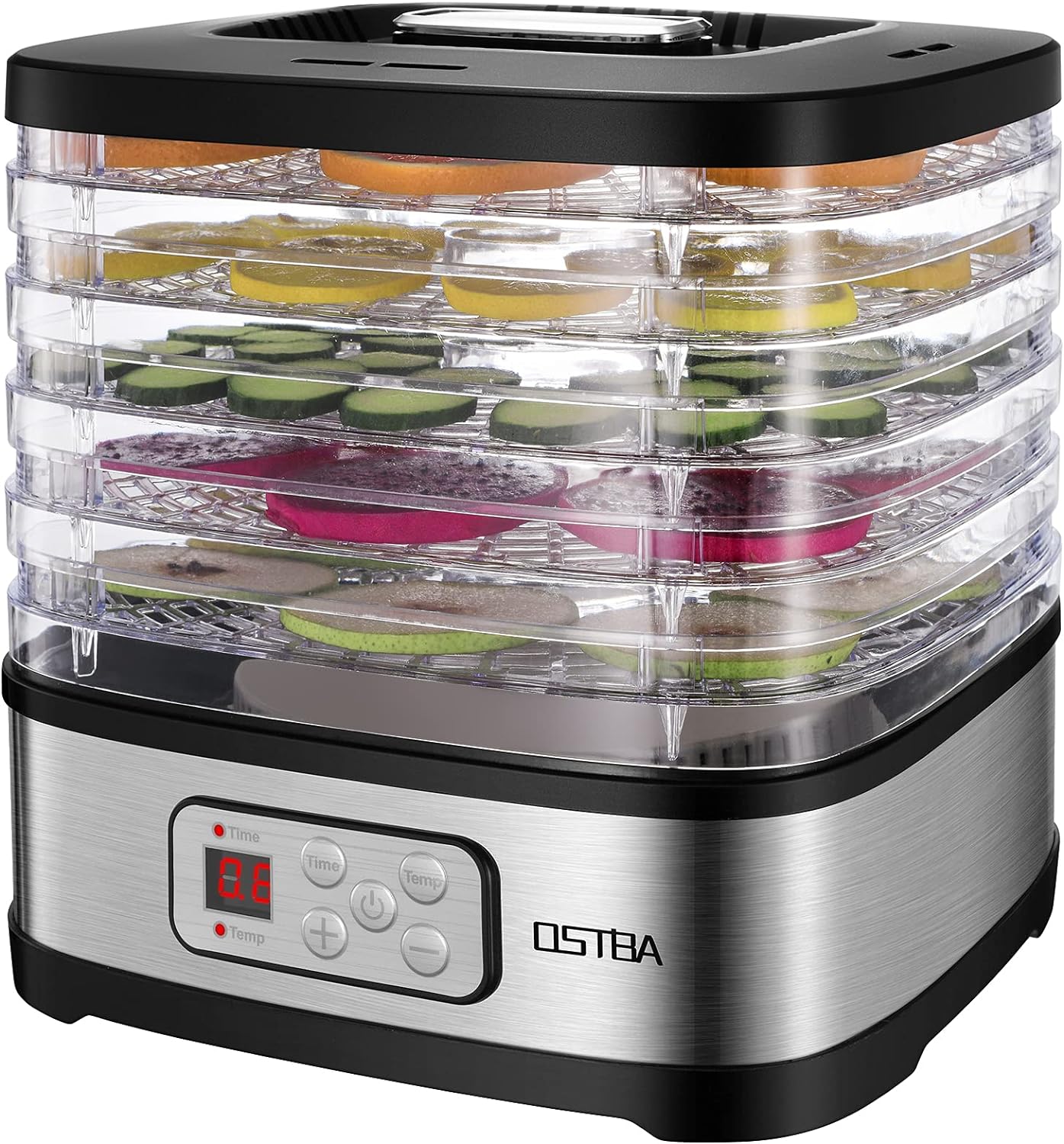
This OSTBA dehydrator is a space-conscious, user-friendly unit built for everyday home drying. It uses a digital LED control panel to set temperatures between 95 and 160°F and a 1–72 hour timer, so you can dehydrate everything from fruit leather to beef jerky and pet treats without constant monitoring. The 360° airflow design helps promote even drying across the five stacked BPA-free trays, and the clear front window makes it easy to check progress. Trays are dishwasher-safe, and the stainless steel and plastic housing wipes clean quickly. At 240 watts it runs quietly and is compact enough to live on a countertop or be stored in a cabinet when not in use. Limitations are predictable for its size: tray capacity is modest compared with larger multi-tier units, and those needing commercial throughput will find the drying area limited. For routine home use, however, it balances control, convenience, and easy cleanup well.
Best for: Buyers who want a practical, compact dehydrator for regular home use and value precise temperature control, easy cleanup, and space-saving storage.
Less Ideal for: Not a good choice for users who need large-scale or commercial drying capacity or who prioritize an all-stainless professional build for heavy duty use.
- Digital LED controls and responsive touchscreen for precise temperature and timer settings
- Wide 95–160°F temperature range and 72-hour timer for flexible recipes from herbs to jerky
- 360° airflow promotes more even drying across stacked trays
- Five BPA-free trays that are dishwasher safe for easier cleanup
- Compact, lightweight design that fits on most countertops and stores easily
- Modest drying capacity compared to larger or commercial dehydrators
- Plastic housing may not feel as rugged as full stainless steel pro units
Verdict: A compact, easy-to-use countertop dehydrator that delivers precise temperature control and convenient cleanup for everyday home drying needs.
NutriChef Food Dehydrator PKFD14BK

| Wattage | 300 watts |
|---|---|
| Voltage | 220 volts |
| Number of Trays | 5 |
| Temperature Range | 180 °F |
| Material | Stainless Steel |
This NutriChef countertop dehydrator is a straightforward, budget-oriented unit for making jerky, dried fruit, herbs, and vegetable chips at home. It uses a single one-press control and runs up to a 180°F maximum with a 300-watt motor and high heat circulation designed to move warm air through all five stackable trays for even drying. The stainless steel body and removable trays make it easy to wipe down, and the compact round footprint fits on a small counter or in cupboard storage. It is best suited to small batches because the control is simple rather than programmable, so you monitor time and dryness manually rather than relying on timers or preset modes. The unit is lightweight and portable, but it operates on 220 volts, so check compatibility with your outlets. For buyers wanting a no-frills, low-cost way to preserve produce and make snacks, this model covers the basics reliably, while more advanced users may miss digital controls and precise timers for repeatable results.
Best for: Buyers on a tight budget who want a basic, easy-to-use dehydrator for small-batch snacks and home food preservation rather than advanced programmable features.
Less Ideal for: People who need precise temperature control, repeatable presets, or large-capacity commercial drying should choose a more advanced or larger dehydrator.
- Five stackable removable trays increase capacity and are easy to clean.
- Stainless steel construction for a more durable, food-safe exterior.
- Simple one-button operation makes the unit easy to use for beginners.
- High heat circulation and 300W power help promote even dehydration across trays.
- No digital timer or adjustable temperature settings beyond the stated maximum, requiring manual monitoring.
- Listed voltage is 220 volts which may limit use without the proper outlet or adapter.
Verdict: A no-frills, affordable five-tray dehydrator that reliably handles basic home dehydration tasks for budget-minded buyers.
Cosori Stainless Steel Food Dehydrator

| Wattage | 600 watts |
|---|---|
| Voltage | 120 volts |
| Number of Trays | 6 |
| Temperature Range | 95-165 F °F |
The Cosori Stainless Steel Food Dehydrator is a countertop unit designed to handle large batches with six stainless steel trays and a rear-mounted fan for horizontal airflow. It is used for drying fruit, herbs, jerky, and fruit rolls; the digital control panel sets temperatures from 95 to 165 F and a timer up to 48 hours so you can run long dehydration cycles without constant monitoring. The 600 W motor and upgraded airflow aim to speed and even out drying across trays, while the brushless motor keeps noise under 48 dB so it can run overnight. Included accessories such as a mesh screen and fruit roll sheet plus a 50-recipe booklet make getting started simple, and most removable parts are dishwasher-safe for easy cleanup. Important limitations are its countertop footprint and weight, which make it less portable than small units, and it uses a rear fan design so single-tray rotation is not available for some specialty layouts. For buyers wanting a robust, quiet machine for regular batch dehydration, this model delivers predictable, repeatable results.
Best for: Buyers who prioritize a reliable, high-capacity countertop dehydrator for frequent batch drying and want precise temperature and long-timer control with quiet operation.
Less Ideal for: People who need a lightweight, highly portable dehydrator for occasional single-tray use or who require a rotating-tray design for specific recipes.
- Six stainless steel trays provide large drying capacity for batch cooking
- Digital temperature control from 95–165 F with 1-degree precision and a 48-hour timer for precise, unattended runs
- 600 W motor with rear horizontal airflow promotes even drying across trays
- Brushless motor designed for quiet operation under 48 dB
- Most trays and accessories are dishwasher-safe and include a recipe book to help get started
- Relatively large and heavier than compact dehydrators, limiting portability
- No rotating tray mechanism for some specialty drying patterns
Verdict: A heavy-duty, quiet six-tray dehydrator that delivers consistent, precise batch drying for cooks who need reliable, repeatable results.
Elite Gourmet EFD319 Dehydrator

| Wattage | 350 watts |
|---|---|
| Voltage | 120 volts |
| Number of Trays | 5 |
| Temperature Range | 95°F–158°F |
The Elite Gourmet EFD319 is a straightforward countertop dehydrator aimed at home cooks who want an easy way to make fruit chips, jerky, herbs, and pet treats. It uses a 350W heating system and a base-mounted fan to push warm air across five clear, BPA-free trays so foods dry evenly without rotating trays. The temperature dial covers a wide range (95°F–158°F), letting you select gentler settings for herbs and fruit or higher temps for meat. Trays stack to different heights to accept thicker cuts, and the transparent lid helps you check progress without opening the unit. Cleanup is simple because the trays and lid are removable and top-rack dishwasher safe. The unit is compact for small kitchens and is ETL listed for safe 120V home use. Limitations include a modest maximum temperature compared with some high-end models and a simple mechanical dial rather than a digital timer, so you need to watch run times or use an external timer for long batches.
Best for: Buyers seeking a reliable, compact countertop dehydrator that produces consistent results and values visible trays and adjustable temperature over advanced digital controls.
Less Ideal for: People who need heavy-duty commercial throughput, precise digital controls, or higher wattage for very large jerky batches should consider larger or pro-grade units instead.
- Five clear, BPA-free stackable trays provide visible drying area and adjustable height for larger pieces
- Adjustable temperature dial spanning 95°F–158°F covers a broad range of foods from herbs to jerky
- Base-mounted fan with horizontal airflow promotes even drying across all trays
- Removable trays and lid are top-rack dishwasher safe for easier cleanup
- Mechanical dial lacks a built-in digital timer or precise temperature display
- Maximum listed temperature and power are modest compared with higher-end dehydrators
Verdict: A compact, easy-to-use dehydrator that delivers even, visible drying across five trays and flexible temperature control for home snack and jerky makers.
Cosori Stainless Steel Dehydrator P501
| Wattage | 480 watts |
|---|---|
| Voltage | 110 volts |
| Number of Trays | 5 |
| Temperature Range | 95-176 F |
| Operating Frequency | 60 hertz |
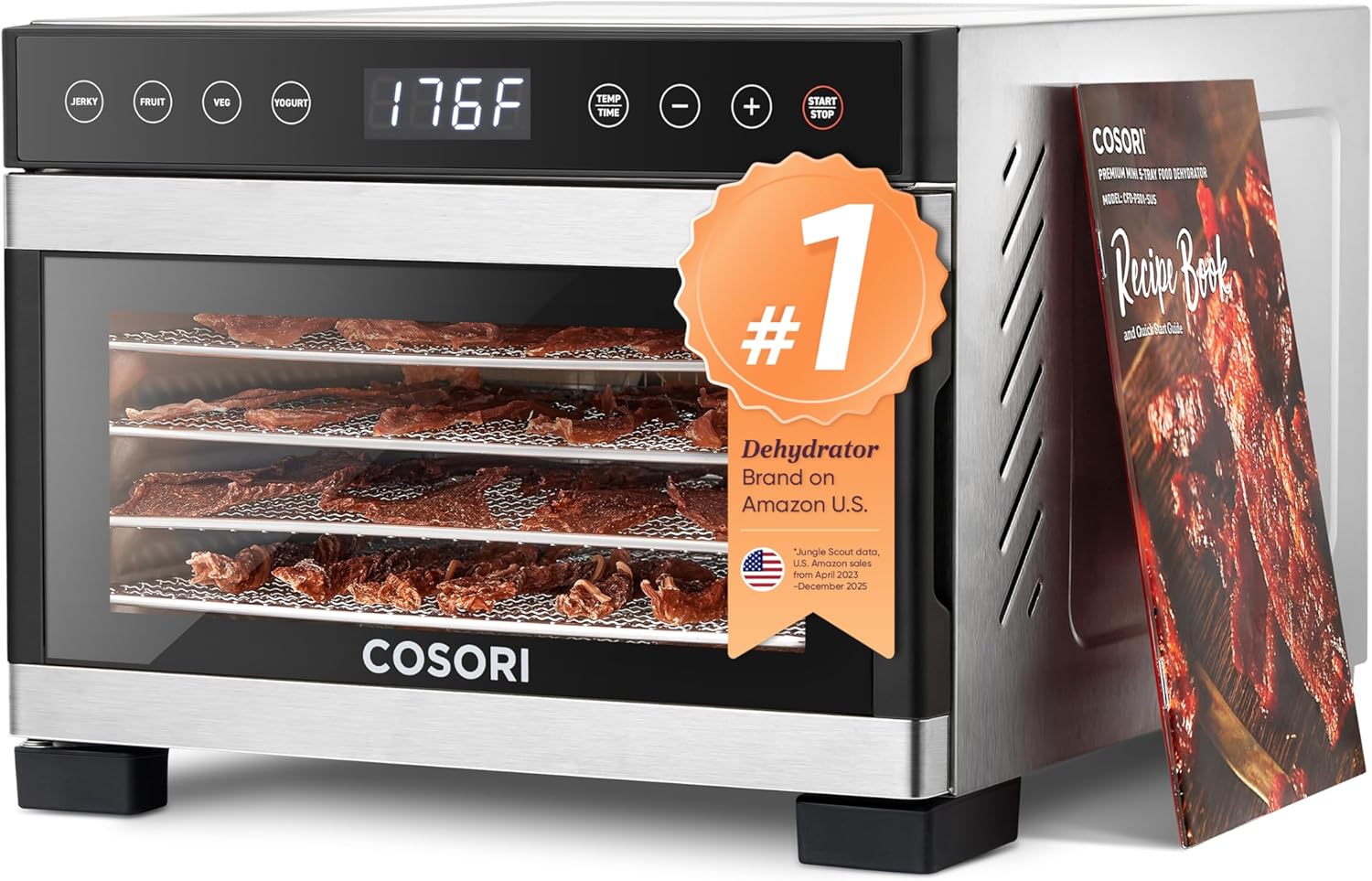
The Cosori P501 is a compact countertop dehydrator built around a rear-mounted fan and five stainless steel trays that give about 3.1 sq ft of drying surface. You set temperature in 1°F increments from 95 to 176°F and choose one of four presets for jerky, fruit, vegetables, or yogurt, then use the 48-hour timer for longer batches. The stainless interior and trays mean food does not touch plastic, and the horizontal airflow design promotes even drying across all levels so you rarely need to rotate trays during a run. At 480 watts it heats steadily without overpowering a kitchen circuit, and the included mesh screen and fruit-roll sheet expand what you can dry without mess. The machine is fairly compact for a five-tray unit but still large enough for multi-batch jerky and fruit leather. If you want touchscreen smart features or a very small two-tray footprint this is larger and more appliance-like, and the unit is not silent during long runs because the rear fan is audible. For buyers who want reliable, safe dehydration with easy temperature control and stainless construction, the P501 covers the essentials well.
Best for: Buyers who prioritize safe, consistent results and prefer a straightforward, durable countertop dehydrator with stainless-steel contact surfaces and reliable temperature control.
Less Ideal for: If you need the smallest possible machine for occasional snacks, want app connectivity, or need a whisper-quiet unit for placement in living spaces, look at smaller or feature-different models instead.
- Five stainless steel trays and stainless interior avoid plastic contact with food
- Precise temperature control from 95 to 176°F adjustable in 1°F increments
- Rear horizontal airflow for more even drying across trays
- Includes useful accessories: mesh screen, fruit roll sheet, and recipe book
- Fan produces noticeable noise during long dehydration cycles
- Lacks smart/Wi‑Fi features or app control
Verdict: A sturdy, stainless-steel countertop dehydrator that gives risk-averse buyers precise temperature control and even drying for consistent, food-safe results.
Choosing the Right Countertop Food Dehydrator: Key Factors to Consider
Drying Consistency
Even drying across all trays matters because uneven heat or airflow causes spoilage, chewy centers, or over-dried edges. Look for units with a proven method of distributing warm air—either through a rear or top-mounted fan with ducting or a circulating system that prevents hotspots.
Consistency affects yield and food safety. If you plan to dehydrate meats or thick slices, reliable temperature stability and uniform airflow reduce the need to rotate trays or reprocess partially dried pieces.
Temperature Range and Control
A broad, accurate temperature range lets you handle different foods safely and retain flavor. Low-temperature settings are useful for herbs and delicate fruits, while higher, steady temperatures are necessary for jerky and other protein-rich items.
Precise controls or a clear thermostat reduce guesswork during long cycles. Models with digital timers and thermostats are more convenient for multi-day processes and help prevent accidental overheating or under-drying.
Airflow Architecture
How the dehydrator moves air determines drying time and uniformity. Countertop designs use different approaches such as top-down, rear-blown, or horizontal circulation. Each affects how you load trays and whether foods need to be rotated.
Consider how easy it will be to access trays, whether the airflow requires rearranging pieces mid-run, and whether the design minimizes cross-contamination between flavors when you dry savory and sweet items in the same batch.
Tray Capacity and Flexibility
Capacity matters if you plan to process harvest-sized batches or make snacks for a family. More trays increase throughput but can also lengthen drying time if the fan and heat source are not scaled accordingly.
Flexible tray options, such as stackable trays, mesh inserts, or adjustable spacing, let you handle different thicknesses and types of food without compromising airflow. Removable or dishwasher-safe trays simplify cleanup after large runs.
Ease Of Cleaning And Maintenance
Food contact surfaces should be easy to access and clean to avoid flavor carryover and bacterial buildup. Removable trays, nonstick finishes, and parts that tolerate warm water or dishwasher cleaning reduce maintenance time.
Also consider how the unit handles crumbs, sticky sugars, and oils. Designs that minimize hidden crevices and provide clear disassembly instructions will extend the machine's usable life and keep dried foods tasting fresh.
Power Use And Runtime Costs
Dehydrating often runs for many hours, so energy efficiency affects ongoing operating costs and heat output in your kitchen. Look for models with efficient heating elements, thermostats that maintain setpoints without cycling excessively, and fan motors designed for continuous duty.
Also evaluate run lengths typical for the foods you intend to dehydrate. Longer cycles for thick or dense foods multiply any efficiency differences, making this factor important for frequent users.
How Much Capacity Do You Actually Need
Capacity on countertop dehydrators is usually expressed in the number of trays or total square inches of drying area. Think about the volume you want to process per session. For occasional snacking or small-batch herb drying, a compact unit with fewer trays is more energy-efficient and easier to store.
If you harvest produce or plan to make multiple batches for storage, choose a model with more trays or the ability to expand. Keep in mind that stacking more trays can increase drying times unless the fan and heating system are designed to compensate.
- Small units: ideal for herbs, apple chips, and occasional snacks
- Medium units: accommodate weekly batches and small harvests
- Large units: suited for serious home preservation or frequent use
Loading Best Practices To Improve Results
Slice foods uniformly to promote even moisture loss. Thinner, consistent slices shorten drying time and reduce the chance that pieces at the center of a tray remain damp. Arrange pieces in a single layer without overcrowding, leaving a small gap for airflow between items.
Rotate trays if the dehydrator design creates mild air distribution differences between positions. For high-sugar or sticky items, use mesh liners or parchment to prevent dripping and lessen cleaning effort.
- Aim for uniform thickness across slices
- Avoid overlapping to maintain airflow
- Use liners for sticky or small pieces to prevent fall-through
Food Safety And Storage After Drying
Correct endpoint moisture is critical for safe storage. Foods that are not dried sufficiently can spoil in storage. Use recommended temperature and time guidelines for meats, and consider a brief oven or smoke treatment if required by safe-preservation protocols.
Once dry, cool foods completely before sealing. Store in airtight containers in a cool, dark place and check periodically for signs of residual moisture. For long-term storage, vacuum sealing or desiccant packs help preserve texture and flavor.
- Verify dryness with a test piece before storing
- Cool fully to room temperature to avoid condensation
- Use airtight packaging and low humidity storage
Noise, Placement, And Kitchen Impact
Countertop dehydrators run for extended periods, so consider noise level and where you will place the unit. Units with larger fans may be quieter at the same airflow rate because they can move more air at lower speeds. Place the dehydrator on a heat-resistant surface with adequate ventilation space around it.
Also consider heat output. In warm weather or small kitchens, a dehydrator that vents heat away from cooking areas will be more comfortable to operate for long runs.
- Allow clearance for ventilation
- Choose a sturdy, level surface to prevent vibration
- Expect some background noise during long cycles
Special Uses: Jerky, Fruit Leather, And Herbs
Different foods require different approaches. Jerky needs higher, steady temperatures and careful hygiene when handling raw meat. Fruit leather benefits from low, steady heat and a smooth, nonstick drying surface to produce an even sheet.
For herbs and delicate flowers, use lower temperatures and shorter cycles to preserve essential oils and flavor. Some models include accessory trays or sheets specifically intended for these uses.
- Jerky: prioritize accurate higher-temperature control
- Fruit leather: use nonstick sheets for even surfaces
- Herbs: low temperature preserves aroma and color
How We Chose the Best Countertop Food Dehydrator
We limited our list to countertop food dehydrators designed for household use and excluded commercial-grade or countertop units that require permanent installation. Our editorial filters prioritized machines with consistent temperature control, sensible airflow design, and enough capacity for typical home batches. We also weighed energy efficiency and runtime stability because long drying cycles amplify differences in power use and temperature drift. Practical usability features were part of the selection: removable trays or racks for cleaning, clear control interfaces, and safety features such as auto-shutoff or overheat protection. Build quality and warranty coverage were considered as signals of durability for frequent home use. We excluded units lacking basic temperature range or with consumer complaints about inconsistent drying. The final picks represent a balance of drying performance, user convenience, and operational efficiency suitable for most home dehydrating needs.
Our full evaluation process is outlined in our review methodology.
FAQ
How long does it take to dehydrate typical fruits and vegetables?
Times vary by thickness and water content, but most sliced fruits and vegetables dry between 6 and 14 hours at moderate temperatures. Thinner slices and lower humidity shorten the time, while dense or high-water items take longer.
Can I dehydrate raw meat safely at home with a countertop unit?
Yes, but safety depends on reaching and holding appropriate temperatures for the recommended time. Use established guidelines for jerky, ensure even heating, and follow good hygiene when handling raw meat to reduce risk.
Do tray materials affect flavor transfer between batches?
Tray material and whether you use liners influence flavor carryover. Nonporous, easy-to-clean trays or disposable liners reduce residual tastes when alternating sweet and savory batches. Thorough cleaning between flavors is recommended.
Is it necessary to rotate trays during a drying cycle?
Rotation depends on the dehydrator's airflow design. Some designs provide very uniform air distribution and do not require rotation, while other stack-style units benefit from rotating trays to even out any position-related differences.
How should I store dehydrated foods for the longest shelf life?
Store fully cooled, dry foods in airtight containers in a cool, dark place. For long-term storage, remove as much air as possible with vacuum sealing and consider using desiccants in the container to control humidity.
Final Verdict
Pick the countertop food dehydrator that matches how much you plan to process and the types of foods you will dry most often. Prioritize consistent drying and accurate temperature control for safety and best texture. If you expect to use the unit frequently, also weigh airflow design, tray flexibility, and ease of cleaning because those factors determine how convenient the machine is to operate over time. Balance capacity against drying times and energy use to find the right compromise between throughput and efficiency. With the right priorities in place, you can choose a model that reliably preserves flavor, texture, and nutrients for home snacks and long-term storage.