
Note: This article contains affiliate links. If you click on these links and make a purchase, we may earn a small commission at no extra cost to you. This helps support our research and content. Read our full affiliate disclosure here.
If you bake bread, pizza, or enriched doughs regularly, the right countertop mixer for dough can save hours of effort and deliver more consistent results. Choosing a model suited to heavy dough tasks matters because dough demands higher torque, steady mixing speeds, and roomy bowls that let gluten develop without splattering. This guide shortlists seven top countertop mixers built to handle dough work and explains the practical factors that separate steady, long-lasting mixers from underpowered machines. We'll focus on motor and gearbox capability, bowl capacity and shape, attachment design, and everyday usability so you can pick a mixer that fits your baking workload and kitchen setup. Read on for our evaluation criteria and what to expect from the top picks.
Top Picks at a Glance
| Best Overall The best all-around choice for most situations | Cuisinart Stand Mixer SM-50BC |  |
| Best Quality Built to a higher standard if you want something more solid | KitchenAid Artisan 5-Quart Mixer |  |
| Best Value The sweet spot between price and what you get | Hamilton Beach 4-Quart Stand Mixer |  |
| Best Budget The cheapest option that still gets the job done reliably | Max Life Stand Mixer ML-6638 |  |
| Top Rated A top-rated pick with lots of positive feedback | KitchenAid Classic Series K45SS |  |
| Most Popular A crowd favorite that many people choose with confidence | DASH Everyday Stand Mixer |  |
| Best Seller A high-volume bestseller chosen again and again | Kitchen in the box 3.2QT Stand Mixer | 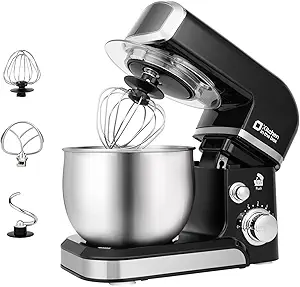 |
Cuisinart Stand Mixer SM-50BC
| Capacity | 5.5 quarts |
|---|---|
| Wattage | 500 watts |
| Number of Speeds | 12 |
| Controls Type | Knob |
| Voltage | 110 volts |
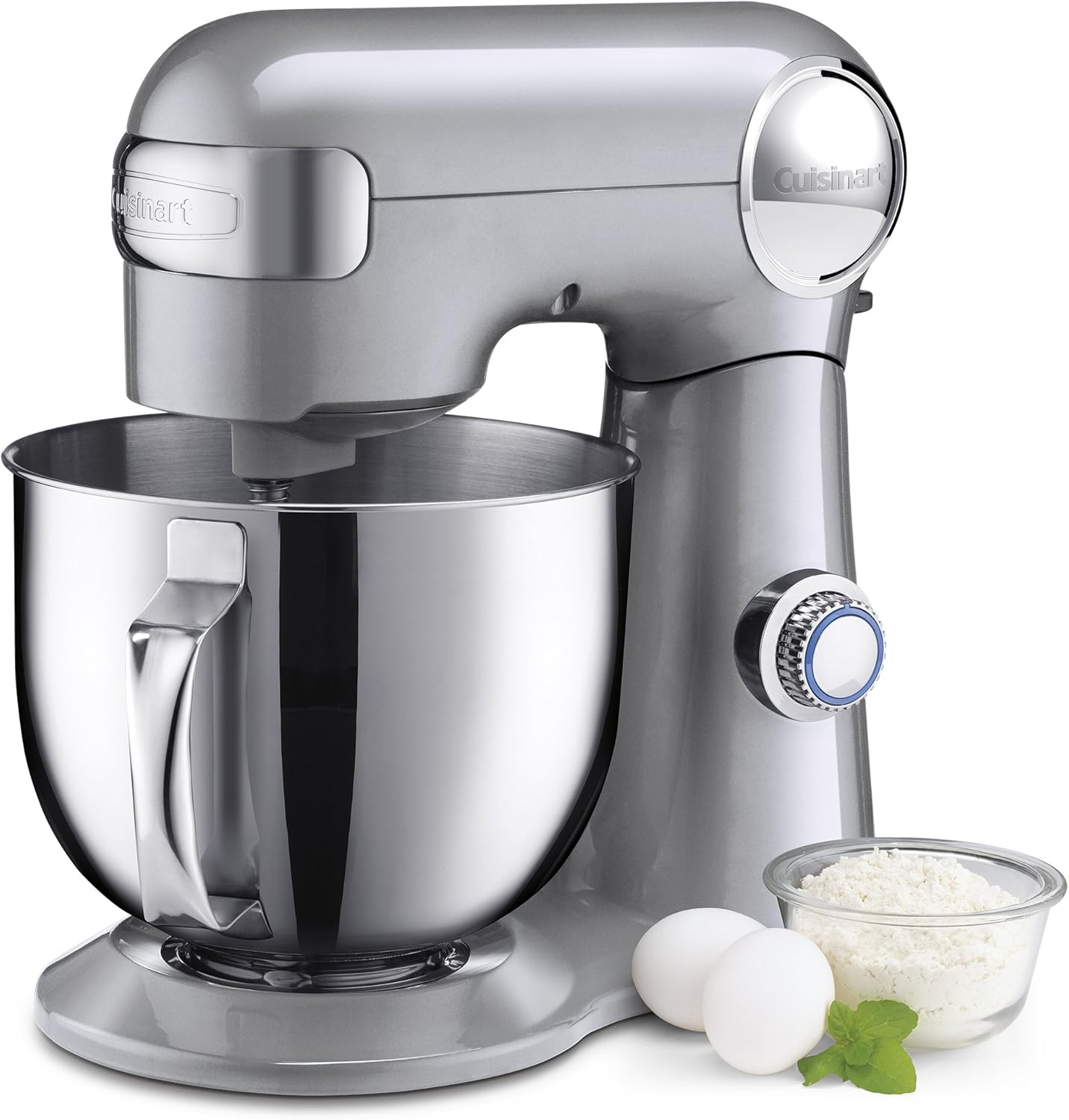
The Cuisinart SM-50BC is a mid-size stand mixer built around a 500-watt motor and a 5.5-quart stainless steel bowl, designed to handle everyday mixing, whipping, and dough tasks. Its tilt-back head gives easy access to the bowl and attachments, and the package includes a chef's whisk, flat paddle, dough hook, and a splash guard with pour spout so you can move from batter to bread dough without extra purchases. The 12-speed knob control provides fine speed increments for delicate whipping and slow kneading, and the metal die-cast construction feels solid on the counter. For dough work the 500-watt motor is capable of mixing typical bread and pizza doughs, though very large or very stiff batches may push it toward its limits compared with heavier-duty commercial models. Accessories and the bowl are dishwasher-safe, which keeps cleanup simple. Optional factory-quality attachments are available for pasta, grinder, and frozen dessert making if you want to expand functionality later. This mixer balances power, capacity, and useful features for regular home baking, especially for cooks who make loaves and pizza dough a few times a week.
Best for: Home bakers who want a robust, mid-size mixer that handles regular bread, pizza, and batter tasks without the expense of a professional machine.
Less Ideal for: People who regularly mix very large commercial-style dough batches or need a heavy-duty, high-torque machine for dense artisan breads.
- 500-watt motor provides solid power for everyday mixing and most doughs
- 5.5-quart stainless steel bowl fits medium-size batches for home baking
- Tilt-back head and included whisk, paddle, and dough hook make attachment changes and bowl access easy
- 12 discrete speed settings let you fine-tune mixing from slow kneading to high-speed whipping
- Dishwasher-safe bowl and accessories simplify cleanup
- Motor may struggle with very large or extremely stiff dough batches compared with heavier-duty models
- Not the lightest option at 17 pounds, so moving or storing it can be awkward
Verdict: A well-rounded mid-size mixer that delivers enough power and capacity for most home dough and baking needs while offering convenient features and upgradeable attachments.
KitchenAid Artisan 5-Quart Mixer

| Capacity | 5 quarts |
|---|---|
| Wattage | 325 watts |
| Number of Speeds | 10 |
| Voltage | 120 volts |
The KitchenAid Artisan 5-Quart Tilt-Head Stand Mixer is a heavy-duty countertop mixer built for everyday baking and dough work. It uses a metal, gear-driven motor and ten-speed control to handle tasks from stirring and whipping to kneading bread dough, and the tilt-head design makes attaching accessories and adding ingredients straightforward. The included stainless steel 5-quart bowl and dough hook, flat beater, and 6-wire whip let you mix large batches—KitchenAid claims up to nine dozen cookies per batch with the flat beater—while the pouring shield helps reduce mess. Its metal construction and multiple hub-powered attachments (sold separately) extend the machine's versatility beyond standard mixing. The mixer is substantial and stable during heavy kneading, but its tilt-head layout can limit access when using very large bowls or very stiff doughs compared with bowl-lift designs. Noise and power are appropriate for home and small-batch prosumers rather than commercial bakeries.
Best for: Bakers who need a reliable, durable home mixer that can handle frequent dough-making and large batches while offering expandability through optional attachments.
Less Ideal for: Users seeking a commercial or bakery-grade machine for continuous heavy use or those who prefer a bowl-lift mixer layout for maximum stability with extremely stiff doughs.
- Durable metal construction built for frequent mixing and kneading
- 5-quart stainless steel bowl handles large batches for breads and cookies
- Ten speed settings for precise control from stirring to whipping
- Includes dough hook, flat beater, whisk, and pouring shield for mess reduction
- Compatible with a wide range of optional hub-powered attachments
- Tilt-head design can be less convenient for very heavy doughs compared with bowl-lift mixers
- Relatively heavy and large, which may be cumbersome to move or store
Verdict: A dependable, high-capacity home mixer that excels at kneading and large-batch doughs while offering long-term versatility with attachments.
Hamilton Beach 4-Quart Stand Mixer

| Wattage | 300 watts |
|---|---|
| Number of Speeds | 7 |
| Capacity | 4 quarts |
| Material | Stainless Steel |
| Voltage | 110 |
This Hamilton Beach stand mixer is a straightforward, workmanlike machine for home bakers who need a reliable countertop mixer for dough and batters. The 300-watt motor and planetary mixing action provide even bowl coverage across the 4-quart stainless steel bowl, and the included dough hook and flat beater handle kneading and thicker mixes without manual effort. Seven speeds plus a slow first speed help reduce splatter and give control when adding ingredients, and the mixing guide on the housing makes speed selection easy. The splash guard and dishwasher-safe attachments simplify cleanup, and the built-in carry handle makes lifting and storing the head convenient. It is not a commercial-grade appliance, so very heavy, large batches or continuous professional use may push the motor; also the motor power and 4-quart capacity limit how much high-hydration dough you can mix at once. For everyday home baking of breads, cookies, and cakes it delivers solid performance at a modest power level.
Best for: Home bakers who want a practical, no-frills mixer that handles everyday doughs, cookies, and cake batters without unnecessary complexity.
Less Ideal for: Professional bakers or anyone who needs to mix very large batches or heavy, high-hydration doughs regularly should consider a higher-power, larger-capacity machine.
- Planetary mixing action for even coverage of the 4-quart bowl
- Includes dough hook, flat beater, and whisk for common baking tasks
- Seven speeds with a slow first speed to reduce splatter and improve control
- Dishwasher-safe stainless steel bowl and attachments for easier cleanup
- Built-in handle on the mixer head for easier lifting and storage
- 300-watt motor is modest and may struggle with very large or heavy commercial loads
- 4-quart capacity limits batch size for high-volume baking projects
Verdict: A reliable, compact stand mixer that delivers even mixing and useful attachments for everyday home dough and baking tasks.
Max Life Stand Mixer ML-6638

| Wattage | 150 watts |
|---|---|
| Number of Speeds | 5 |
| Capacity | 3.2 quarts |
| Voltage | 120 |
The Max Life ML-6638 is a straightforward countertop stand mixer aimed at home bakers who need a capable, no-frills machine for mixing, beating, and light to medium doughs. It uses a 150W motor and five speed settings to handle batters, cookie doughs, and small yeast doughs, and the 3.2-quart stainless steel bowl gives enough capacity for most family recipes. The unit includes detachable beaters and dough hooks with a beater ejection button for easier swapping and cleaning, and many removable components are dishwasher safe. An efficient cooling system and ETL safety certification add some durability and peace of mind. Limitations include the relatively modest motor power compared with heavy-duty mixers, so very stiff or large bread doughs may require shorter batches or more manual kneading. Controls are simple push-button style, which keeps operation intuitive but lacks precise speed tailoring for advanced techniques.
Best for: Bakers on a budget who want a simple, reliable countertop mixer for everyday batters, cookies, and small-to-medium bread doughs without paying for heavy-duty commercial power.
Less Ideal for: Serious home bakers who regularly mix very large batches of stiff bread dough or need professional-level power and extended continuous kneading performance.
- Compact 3.2‑quart stainless steel bowl suitable for family-size recipes
- Five adjustable speeds for common mixing, beating, and kneading tasks
- Detachable beaters and dough hooks with ejection button for easier cleaning and accessory changes
- Dishwasher-safe components simplify cleanup
- ETL safety certification and cooling system for more reliable operation
- 150W motor is modest and may struggle with very heavy or high-volume bread doughs
- Push-button controls lack fine-grain speed adjustment for delicate tasks
Verdict: A budget-friendly stand mixer that delivers sensible mixing power and easy cleanup for everyday home baking needs.
KitchenAid Classic Series K45SS
| Capacity | 4.5 quarts |
|---|---|
| Number of Speeds | 10 |
| Wattage | 275 watts |
| Included Components | (1) Bowl, (1) Flat Beater, (1) Dough Hook, (1) 6-Wire Whip |
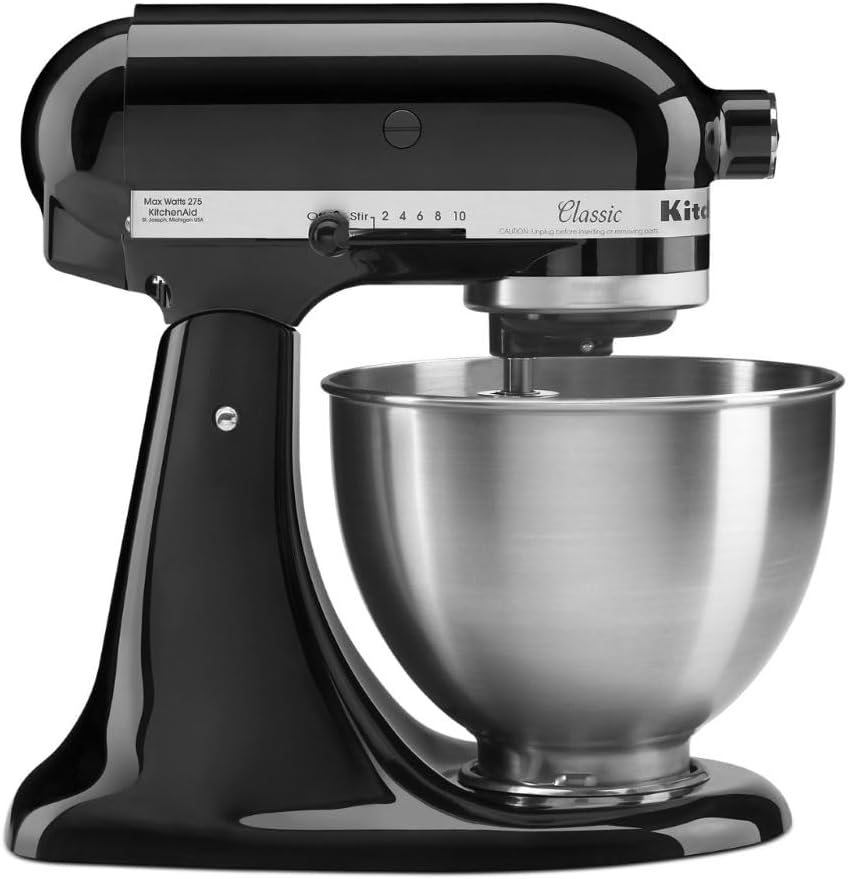
The KitchenAid Classic Series K45SS is a straightforward tilt-head stand mixer built for regular home baking and dough work. Its 4.5-quart stainless steel bowl and included flat beater, dough hook, and wire whip handle most batch sizes up to about eight dozen cookies, while the 10-speed control gives fine-grained mixing from stir to whip. The metal construction and 59 touchpoints around the bowl promote steady, consistent mixing and the power hub accepts optional attachments for grinders, pasta makers, and more. In practice the tilt-head makes adding ingredients and changing tools quick, and the 275-watt motor is capable of kneading typical bread and pizza dough without fuss. Limitations compared with larger, heavier-duty models are apparent for very high-volume or commercial baking and for extremely dense mixes where a heavier motor would shorten mixing time. For home bakers who want a durable, no-frills mixer that handles dough reliably, this model delivers dependable everyday performance.
Best for: Home bakers who prioritize a reliable, well-built mixer for everyday doughs and standard baking tasks and who value a durable machine that will last through frequent use.
Less Ideal for: Commercial bakers or heavy-volume users who need a higher-capacity, heavier-duty motor and faster kneading for large or very dense batches.
- Durable metal construction for long-term, steady use
- 4.5-quart stainless steel bowl suitable for typical home batches
- Ten speeds provide precise control from stirring to whipping
- Includes flat beater, dough hook, and 6-wire whip for common tasks
- Power hub accepts optional attachments to expand functionality
- 275-watt motor can be slower with very dense or high-volume dough
- Tilt-head design offers slightly less bowl capacity and stability than some bowl-lift commercial models
Verdict: A dependable, metal-built tilt-head mixer that reliably handles typical home doughs and everyday baking tasks.
DASH Everyday Stand Mixer

| Wattage | 250 |
|---|---|
| Number of Speeds | 6 |
| Capacity | 3 liters |
| Controls Type | Knob |
| Voltage | 110 |
The Dash Everyday Stand Mixer is a small, user-friendly countertop mixer designed for frequent home baking and light dough work. Its tilt-head design makes adding ingredients and swapping the included dough hooks and beaters straightforward, while the 3-quart stainless steel bowl locks in place for steady operation. The 250W motor with six speed settings handles everything from gentle stirring and whipping to kneading small batches of dough, and the lightweight construction and compact footprint suit small kitchens or limited counter space. Attachments and the bowl are dishwasher safe, which simplifies cleanup after cookies, frosting, or bread rolls. Because the mixer is compact and under 5 pounds, it is not intended for heavy professional use or very large dough batches, and heavier kneading tasks will take longer than on full-size mixers. For home bakers who value a space-saving, easy-to-use machine for everyday recipes, the Dash delivers reliable basic performance without extra complexity.
Best for: Home bakers who need a reliable, compact mixer for everyday recipes and occasional small-batch doughs, and who prioritize countertop space and easy cleanup over heavy-duty power.
Less Ideal for: Users who regularly make large loaves, frequent heavy-duty kneading, or commercial quantities should consider a full-size, higher-power mixer instead.
- Compact, space-saving tilt-head design fits most countertops
- Six speed settings give control for whipping, beating, and gentle kneading
- Includes dough hooks and beaters so it is ready for baking tasks out of the box
- 3-quart stainless steel bowl and attachments are dishwasher safe for easy cleanup
- Lightweight and portable for occasional repositioning or storage
- 250W motor limits performance on large or very heavy dough batches
- Smaller 3-quart bowl restricts batch size for bread and pizza doughs
Verdict: Choose the Dash Everyday Stand Mixer when you want a compact, easy-to-use countertop machine that handles everyday baking and small dough batches without taking up much space.
Kitchen in the box 3.2QT Stand Mixer

| Capacity | 3.2 QT |
|---|---|
| Power | 300 watts |
| Number of Speeds | 6 |
| Included Components | Whisk, Beater, Dough Hook |
This Kitchen in the box stand mixer is designed for small-batch dough and everyday mixing tasks in tight kitchens. The 3.2 QT stainless steel bowl and tilt-head make it straightforward to add ingredients and swap the aluminum dough hook, flat beater, or stainless-steel whisk. Planetary mixing and six speed settings cover everything from stirring and whipping to kneading light bread dough, while four suction feet help keep the unit steady during use. At 300 watts it handles typical home recipes for one to two people, and the transparent splash guard reduces mess. The mixer is lightweight and compact for easy storage, and the accessories are dishwasher-safe for simple cleanup. Limitations are its small bowl and modest motor power, which mean it is not suited for large batches or heavy, frequent bread kneading; the higher initial torque on the lowest setting also calls for cautious starts. For everyday bakers who work in small quantities this is a space-saving, practical machine, but pros and heavy bakers should choose a larger-capacity, higher-power model.
Best for: Buyers who prioritize a compact, reliable countertop mixer for occasional dough and everyday baking in small kitchens or for one to two people.
Less Ideal for: Those who regularly bake large batches, make frequent artisan bread, or need a heavy-duty mixer for dense dough should look at larger, higher-power models.
- Compact, lightweight design saves counter and storage space
- Includes stainless steel bowl plus dough hook, flat beater, and whisk for common mixing tasks
- Six speed settings and planetary rotation provide versatile mixing from stirring to light dough kneading
- Dishwasher-safe accessories and a splash guard make cleanup easier
- 3.2 QT bowl and 300W motor are undersized for large batches or heavy frequent bread dough
- Higher initial torque at low gear requires careful starting to avoid splatter or strain
Verdict: A compact, user-friendly mini stand mixer that reliably handles small-batch dough and everyday mixing in tight kitchens.
Choosing the Right Countertop Mixer for Dough: Key Factors to Consider
Motor Torque and Thermal Management
A mixer that can knead dough needs more continuous torque than one used mainly for whipping. Look for motors rated for sustained low-speed torque rather than just high peak wattage. Thermal protection or cooling features are important so the mixer can handle multiple dough batches without tripping a thermal cutoff.
If you bake large batches or dense doughs with high hydration, the motor must maintain torque at low speeds. Overheating can damage internal windings or trigger shutoffs mid-knead, so models with robust cooling, serviceable brushes, or purpose-built direct-drive gearboxes are preferable for regular dough work.
Bowl Capacity and Geometry
Bowl size determines how much dough you can mix at once. Choose a capacity that fits your typical batch—smaller home loaves require less volume, while family-sized or multiple-loaf batches need larger bowls. A deeper, narrower bowl can help with gluten development for smaller batches, while a wider bowl gives room for higher hydration doughs and easier ingredient incorporation.
Also consider bowl shape and the mixer head clearance. A bowl that crowd ingredients or forces frequent scraping will slow workflow. Removable bowls with secure locking and easy lift or tilt mechanisms make loading and unloading dough simpler.
Attachment Design and Compatibility
The dough hook is the primary attachment for kneading. Its shape, reach, and rotation path determine how effectively the mixer folds and stretches dough. Spiral or hook designs that reach most of the bowl reduce dead spots and shorten kneading time.
Check how attachments lock into the drive and whether they are easy to attach and remove, especially when coated with sticky dough. Durable attachment materials and a secure hub reduce wobble and wear over time.
Stability and Build Quality
Kneading exerts lateral forces, so a stable base and low center of gravity reduce movement during operation. Heavier, well-built mixers with non-slip feet resist walking on the countertop, which improves mixing consistency and safety.
Internal gearbox construction, metal gears versus plastic, and the overall chassis material affect long-term reliability. If you plan frequent dough-making, prioritize machines with proven mechanical robustness and accessible parts for maintenance.
Cleaning and Maintenance
Dough is sticky and can jam crevices, so mixers that disassemble easily and have smooth, accessible surfaces simplify cleanup. Dishwasher-safe bowls and attachments save time, but consider how seals, vents, and hub areas are reached for cleaning.
Regular maintenance, such as checking seals and greasing accessible gear housings where recommended, extends service life. Models designed for straightforward user maintenance reduce the risk of damage from improper cleaning procedures.
How Bowl Size Matches Typical Baking Workloads
Choosing bowl capacity should start from the kinds of recipes you make most often. If you bake single loaves or small batches, a 4- to 5-quart bowl may be sufficient. For larger family batches, multiple loaves, or pizza dough, aim for 6 quarts or more so the dough has room to develop without overflowing.
Also consider bowl geometry. Narrow, deep bowls help smaller quantities develop gluten more effectively, while wider bowls accommodate large, high-hydration doughs with less splatter.
- Small batches: easier handling, less power needed
- Large batches: require higher torque and more bowl volume
- High-hydration doughs need extra bowl width to prevent splatter
Speed Controls and Kneading Profiles
Precise low-speed control matters for kneading. A smooth, variable-speed dial or stepped speeds tuned for dough help you avoid overworking. Mixers that offer a slow start reduce flour clouding and keep ingredients from flinging out of the bowl.
Some mixers include pulse or soft-start features that improve how ingredients come together. Consider models where the slowest speeds provide consistent torque rather than just a low RPM with weak power.
- Soft-start reduces ingredient scatter
- Consistent low-speed torque shortens knead time
- Variable speeds assist with different dough types
Attachment Care and Best Practices for Dough
Keep dough hooks and other attachments free of dried dough by cleaning promptly after use. Using a bench scraper to remove most dough before washing prevents buildup in attachment joints and hub areas. If attachments are coated, avoid abrasive cleaners that could damage the finish.
When switching between heavy dough and lighter tasks, ensure attachments are fully seated and the hub is free of debris. Proper attachment care reduces wobble and stress on the motor and gearbox.
- Scrape off excess dough before washing
- Inspect hub and attachment mounts regularly
- Use recommended cleaning methods to protect coatings
Kitchen Footprint and Storage Considerations
Countertop mixers for dough can be bulky. Think about where you will store it and whether you need a lift or tilt-head design for easier access. Some mixers are heavier and stay on the counter, while others are lighter but may not handle heavy dough as well.
If you have limited counter space, measure cabinet or shelf dimensions to ensure safe storage. Consider whether the mixer can be partially disassembled for compact storage without risking damage to controls or finish.
- Tilt-head versus bowl-lift affects counter height requirements
- Heavy-duty mixers are often too heavy for frequent stowing
- Plan storage space that protects attachments and bowl
Noise and Vibration Management
Mixers with stronger motors and metal gearboxes tend to be louder, but good damping and sound insulation improve the user experience. If noise level matters in your household, look for mixers with thoughtful vibration control and non-slip feet.
Excessive vibration can lead to countertop movement and uneven kneading. Machines that remain steady at low speeds offer better control and reduce the chance of the mixer walking during operation.
- Look for anti-vibration feet and heavy bases
- Metal gears may be louder but more durable
- Steady operation improves knead consistency
How We Chose the Best Countertop Mixer for Dough
We prioritized features and performance characteristics that directly affect dough mixing and long-term reliability. Key evaluation criteria included sustained motor torque and thermal management to ensure the mixer can knead heavy doughs without overheating, plus gearbox durability and transmission design because these determine how long a unit will hold up under frequent dough work. Bowl capacity and shape were assessed to match batch sizes from small loaves to multiple-pound doughs while allowing proper ingredient incorporation. Attachment and hub design was considered to ensure the dough hook delivers efficient mixing and is easy to install and remove. Ease of cleaning and accessibility of crevices mattered for sticky dough cleanup, and we looked for stable base and anti-vibration features because dough mixing generates lateral forces. We excluded models primarily intended for light mixing, whipping, or compact countertop convenience that lack the torque or build to knead dense doughs. The selections emphasize machines engineered for repetitive dough tasks, practical user controls, and serviceability.
Our full evaluation process is outlined in our review methodology.
FAQ
What bowl size is best for making two loaves of bread?
For two standard loaves you should aim for at least a 5.5- to 6-quart bowl. That capacity gives enough room for dough expansion and mixing without overfilling, especially for higher-hydration recipes.
Can I use a countertop mixer designed for cakes to knead bread dough?
You can knead small amounts of dough on lighter cake-focused mixers, but they often lack sustained low-speed torque and durable gearing needed for frequent or heavy doughs. For regular bread baking, choose a model specified for dough work.
How do I tell if a mixer has enough torque for heavy doughs?
Check whether the manufacturer emphasizes sustained low-speed torque, gearbox type, and thermal protection. Features like metal gears, direct-drive mechanisms, and documented kneading performance are indicators a mixer is built for heavy dough.
Are larger bowls always better for dough?
Larger bowls allow bigger batches but can be harder to handle and may need more powerful motors to mix effectively. Match bowl size to your usual batch size so the mixer runs efficiently and you do not waste space or power.
How should I maintain my mixer after kneading sticky dough?
Remove the bowl and attachments promptly, scrape off excess dough, and wash with warm, soapy water. Inspect the hub area for trapped dough and clean as recommended by the manufacturer to prevent buildup that can impede attachment fit or motor cooling.
Final Verdict
When selecting a countertop mixer for dough, prioritize sustained motor torque and a bowl capacity that matches the batches you make most often. Durable attachment design, stable construction, and accessible cleaning features reduce friction in everyday use and prolong service life. Weigh the tradeoff between footprint and power: heavier, well-built mixers handle large doughs more reliably but require permanent counter space. Choose the machine whose torque, bowl geometry, and durability align with your baking volume to get dependable kneading and consistent results.