
Note: This article contains affiliate links. If you click on these links and make a purchase, we may earn a small commission at no extra cost to you. This helps support our research and content. Read our full affiliate disclosure here.
Storing wine in a garage presents different challenges than keeping bottles in a kitchen or cellar. You need a countertop wine cooler built to manage wider ambient swings, vibration from tools or vehicles, and limited space. This guide collects the top shortlisted countertop wine coolers for garages and explains the practical tradeoffs you should weigh. We evaluate each pick on temperature performance, insulation and vibration resistance, usable capacity and layout, and how easy the unit is to maintain. Read on to find the compact cooler that fits your garage routines and protects your bottles through seasonal temperature changes.
Top Picks at a Glance
| Best Overall The best all-around choice for most situations | NewAir 6-Bottle Wine Fridge |  |
| Best Quality Built to a higher standard if you want something more solid | Wine Enthusiast 6-Bottle Countertop Cooler |  |
| Best Value The sweet spot between price and what you get | BLACK+DECKER 8-Bottle Wine Cellar BD60026 |  |
| Best Budget The cheapest option that still gets the job done reliably | EUHOMY 18L Wine Fridge |  |
| Top Rated A top-rated pick with lots of positive feedback | Cuisinart 8-Bottle Wine Cellar CWC-800CEN |  |
| Most Popular A crowd favorite that many people choose with confidence | Antarctic Star 0.9 Cu. Ft. Wine Cooler |  |
| Best Seller A high-volume bestseller chosen again and again | EUHOMY Wine Cooler BR001-110 |  |
NewAir 6-Bottle Wine Fridge

| Cooling Method | Thermoelectric |
|---|---|
| Capacity | 0.7 cubic feet |
| Number Of Shelves | 3 |
| Voltage | 120 volts |
This NewAir 6-bottle countertop wine fridge packs precise, low-vibration thermoelectric cooling into a very small footprint for kitchens, offices, or garages with moderate ambient temperatures. It uses a digital control panel to set temperature, three removable wire racks that cradle standard Bordeaux bottles, and a double-pane mirrored glass door that improves insulation while showing off bottles. The thermoelectric system keeps vibration and noise down compared with compressor units, which helps protect delicate aging notes but also means it is best used in environments where ambient heat is not excessive. Installation is plug-and-play and the unit is light enough to move between countertop, shelf, or bar-cart positions. Important limitations are its tiny 0.7 cubic foot capacity—only six bottles—and the thermoelectric cooling method, which cannot cool as aggressively as compressor fridges in hot garages or direct sunlight. For balanced buyers who want a quiet, display-ready small cooler for everyday bottles, this is a convenient, easy-to-place option.
Best for: Buyers who want a quiet, display-ready countertop wine cooler for a small personal collection or everyday bottles and who value easy placement and low vibration.
Less Ideal for: Those who need to store larger collections, want fast deep cooling in hot garages, or require robust temperature performance in unconditioned spaces should look at compressor-based larger units.
- Compact countertop footprint fits tight spaces and moves easily
- Thermoelectric cooling keeps vibration and noise low for delicate wines
- Double-pane mirrored glass door improves insulation and presentation
- Digital touchscreen control for straightforward temperature adjustment
- 0.7 cu ft capacity limits storage to six standard bottles
- Thermoelectric cooling is less effective than compressors in hot ambient conditions
Verdict: A quiet, easy-to-place six-bottle countertop cooler that works well for small collections kept in moderate-temperature garage or indoor spaces.
Wine Enthusiast 6-Bottle Countertop Cooler

| Capacity | 6-Bottle |
|---|---|
| Cooling Method | Thermoelectric |
| Shelves | 3 wood shelves |
| Installation Type | Countertop |
| Energy Rating | Energy Star |
This Wine Enthusiast 6-bottle countertop cooler is built for small collections that need consistent, quiet temperature control. It uses thermoelectric (solid-state) cooling and a digital touchscreen with LED readout to set and monitor storage temperatures for reds, whites, or rosés, and is designed to sit on a counter or bar. The unit has three wood shelves and three door shelves that keep bottles organized while the glass door and metallic finish give it a clean, modern look. Because it is thermoelectric rather than compressor-driven it runs quietly and is more energy-efficient, but it works best in moderate ambient conditions and may struggle to reach the lowest setpoints if the room is warmer than recommended. The cooler is freestanding only and needs clearance for airflow, so it is not suitable for built-in installation. For someone who wants a compact, low-noise cooler to protect a handful of bottles, this is a practical, space-saving option; buyers who need heavy-duty cellar temperatures or built-in undercounter fitment should look elsewhere.
Best for: Buyers who prioritize quiet, energy-efficient countertop cooling for a small, curated wine selection and want straightforward digital temperature control.
Less Ideal for: Not a good fit for collectors needing built-in or undercounter installation or for users who require very low cellar temperatures in warm environments.
- Compact footprint fits on counters or small bars
- Digital touchscreen and LED display for precise temperature setting
- Thermoelectric solid-state cooling provides quiet, vibration-free operation
- Three wood shelves plus door shelves keep bottles organized and accessible
- Energy Star rated for efficient everyday use
- Thermoelectric cooling is less effective than a compressor in hot ambient rooms
Verdict: A compact, quiet, and energy-efficient countertop cooler that reliably stores a small wine collection with precise digital temperature control.
BLACK+DECKER 8-Bottle Wine Cellar BD60026
| Capacity | 0.88 cubic feet / 8 Bottles |
|---|---|
| Cooling Method | Thermoelectric |
| Temperature Range | 46°F – 65°F |
| Number of Racks | 3 |
| Power | 120 volts |
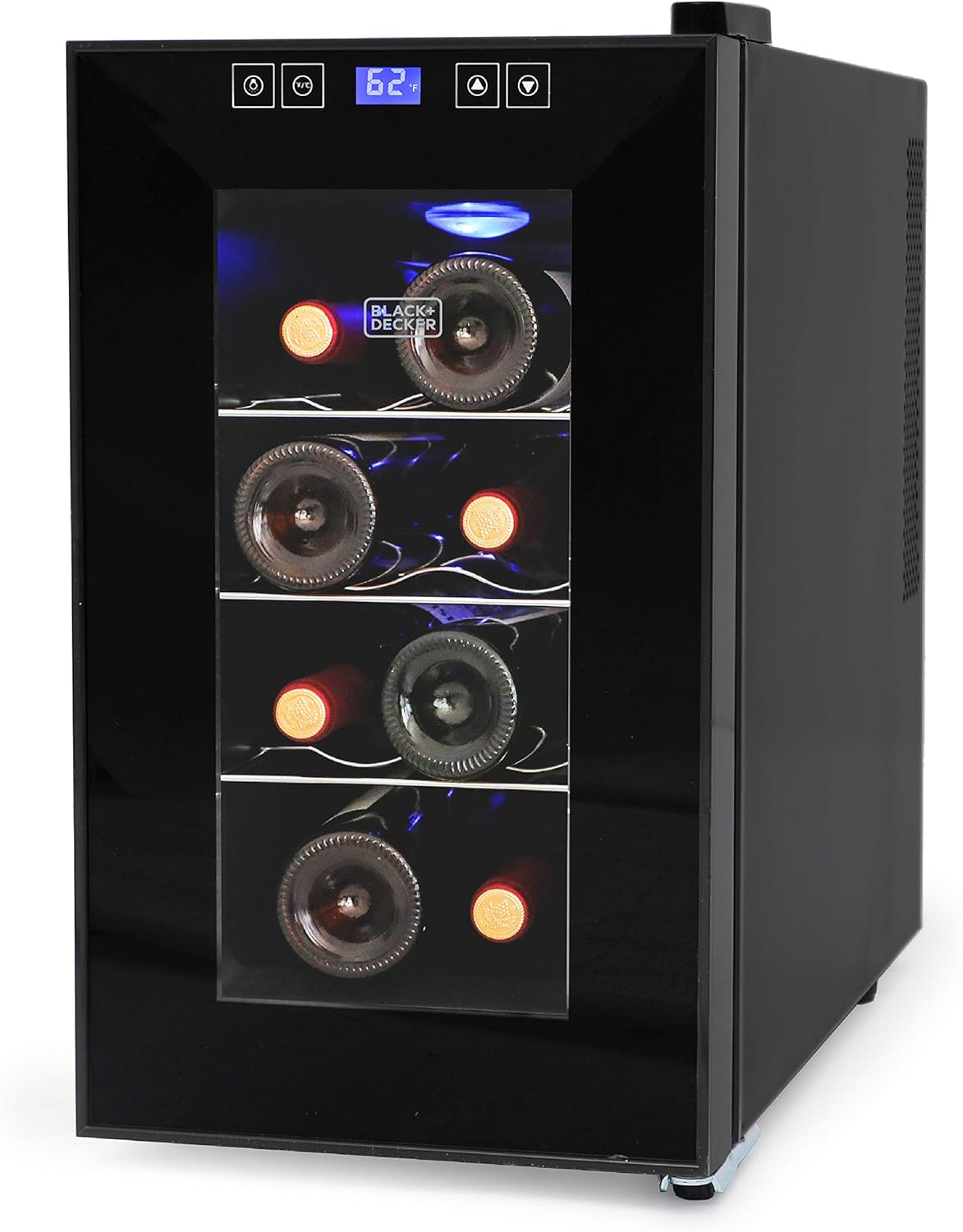
The BLACK+DECKER 8-Bottle Wine Cellar is a countertop thermoelectric cooler designed to keep wine at stable serving or short-term storage temperatures between 46 and 65°F. It uses a quiet thermoelectric system with low vibration and an electronic LED readout so you can set and monitor temperature easily, and the triple-pane clear glass door helps preserve the internal climate. The unit includes three removable chrome slide-out racks and an interior light for display, plus adjustable leveling legs and a recessed handle for a tidy countertop fit. Practical benefits include energy-efficient operation, minimal vibration that is kinder to wine sediment, and a small footprint that works in offices, bars, or kitchens. Limitations are inherent to its cooling method and size: thermoelectric units do not chill as aggressively as compressor fridges, so it is best for short- to medium-term storage and serving rather than long-term cellar aging, and the eight-bottle capacity restricts how many bottles you can store at once.
Best for: Buyers who want a compact, low-noise wine cooler for everyday serving and short-term storage and who prioritize a small footprint and simple digital controls.
Less Ideal for: Collectors needing long-term aging at very specific low temperatures or anyone who wants to store large numbers of bottles should consider larger compressor-based wine fridges.
- Compact footprint fits on counters or in small entertainment spaces
- Quiet thermoelectric cooling with low vibration preserves wine sediment
- Triple-pane glass door helps maintain stable internal temperature
- Electronic temperature control with LED display for simple monitoring
- Thermoelectric cooling is less powerful than compressor systems for rapid or very low-temperature chilling
- Only three slide-out racks limit capacity to standard bottle sizes
Verdict: A compact, quiet countertop cooler that is ideal for everyday serving and short-term storage of up to eight bottles.
EUHOMY 18L Wine Fridge
| Capacity | 18 liters |
|---|---|
| Cooling Method | Compressor |
| Temperature Range | 40°F to 61°F |
| Number Of Shelves | 1 |
| Installation Type | Countertop |
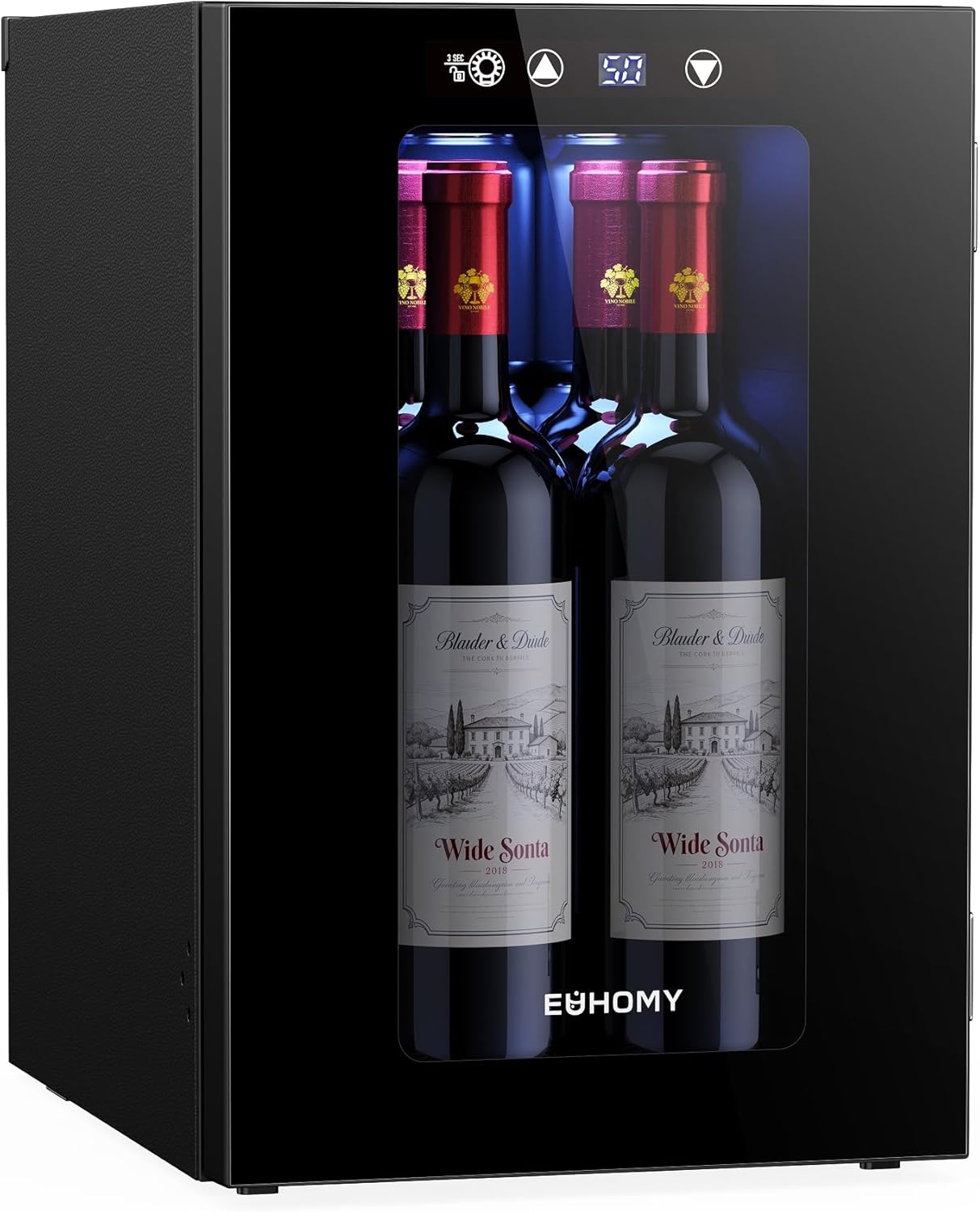
The EUHOMY 18L Wine Fridge is a small compressor-cooled cooler designed for countertop or freestanding use to store a handful of bottles and cans. It offers a digital touchscreen that sets temperatures between 40°F and 61°F, a double-pane glass door with LED interior lighting, and one removable shelf so you can fit bottles or stacks of cans. The compressor system provides steady cooling and the manufacturer states quiet operation around 38 dB, which helps the unit sit beside a bar, office, or kitchen without creating a constant noise nuisance. Practical benefits include the ability to keep red, white, sparkling wine, or beer at ready-to-serve temperatures and the compact footprint that fits tight spaces. Limitations to expect are the very small 18 L capacity that only holds about four 750 ml bottles or up to two dozen cans when arranged differently, manual defrosting, and a single door orientation without reversible mounting, so placement options are somewhat constrained.
Best for: Buyers who want a reliable, compact cooler to keep a small selection of wines or beverages at controlled serving temperatures without complicated setup or large space requirements.
Less Ideal for: Those who need to store larger collections, organize many bottle sizes, or require a built-in undercounter installation should look at larger-capacity or different-format coolers.
- Digital touchscreen with adjustable 40°F–61°F temperature range for precise control
- Compressor cooling for consistent, dependable chilling compared with thermoelectric units
- Compact countertop form that fits small kitchens, dorms, or home bars
- Double-pane glass door with LED lighting showcases contents while blocking UV rays
- Very limited 18 L capacity suitable for only a few bottles or a small can stash
- Manual defrost requires occasional maintenance and can be inconvenient
Verdict: A compact, compressor-cooled countertop wine fridge that delivers quiet, accurate temperature control for buyers who need dependable short-term storage for a few bottles.
Cuisinart 8-Bottle Wine Cellar CWC-800CEN
| Cooling Method | Thermoelectric |
|---|---|
| Number Of Shelves | 8 |
| Capacity | 6 liters |
| Power Source | Electric |
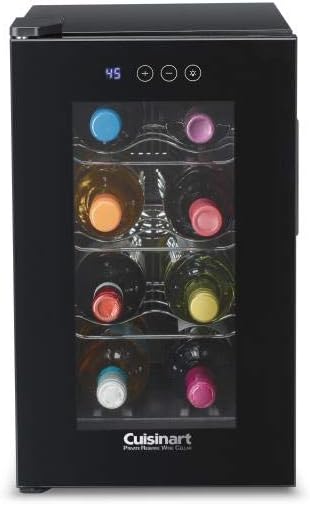
The Cuisinart 8-Bottle Private Reserve Wine Cellar is a small freestanding cooler designed to keep a selection of reds, whites, or sparkling wines at controlled serving temperatures. It uses a thermoelectric cooling system, which runs quietly and is more energy efficient than compressor units, and a touchscreen control with LED readout lets you set temperatures from 39°F to 68°F. Inside, contoured chrome racks and soft interior lighting make bottle access and display simple, and the unit ships with three removable racks to organize various bottle shapes. Typical use is for short- to medium-term storage and serving in an apartment, kitchen, or home bar where vibration-free, quiet operation matters. Limitations include the small 8-bottle capacity and thermoelectric cooling, which performs best in moderate ambient temperatures and is not suited for long-term cellar aging or very warm rooms. For buyers prioritizing quiet performance and a compact footprint, this is a practical countertop or freestanding option; buyers needing larger capacity or cooler performance for hot spaces should look at compressor-based models instead.
Best for: Buyers who want a quiet, energy-conscious small wine cooler to keep a few bottles at serving temperature and prefer a compact freestanding unit for a kitchen, office, or home bar.
Less Ideal for: Collectors who need long-term proper cellar conditions, those with larger collections, or people who will place the cooler in consistently hot rooms.
- Quiet thermoelectric cooling with low vibration suitable for delicate wines
- Touchscreen controls and LED display for easy temperature setting
- Soft interior lighting and contoured chrome racks for neat presentation and access
- Compact freestanding design fits small kitchens, apartments, or bars
- Only holds up to eight bottles, limiting larger collections
- Thermoelectric cooling is less effective than compressor units in very warm ambient temperatures
Verdict: Choose this Cuisinart if you want a quiet, compact 8-bottle cooler that maintains serving temperatures with energy-efficient thermoelectric performance.
Antarctic Star 0.9 Cu. Ft. Wine Cooler

| Capacity | 0.9 cubic feet |
|---|---|
| Refrigerator Net Capacity | 0.6 cubic feet |
| Temperature Range | 40-61 °F |
| Cooling Method | Compressor |
| Defrost System Type | Manual Defrost |
This Antarctic Star countertop wine cooler is a small compressor-driven fridge designed for keeping a couple of bottles or a handful of cans chilled on a counter, dorm, or office. It holds about 0.9 cu. ft. with horizontal racking that fits two standard wine bottles plus several cans, and the compressor cooling keeps temperatures steady across the advertised 40 to 61°F range. The reinforced, airtight glass door and soft blue LED interior light make it easy to see contents and help maintain humidity, while manual defrost and a compact footprint mean simple setup and placement. In real use the unit runs quietly with little vibration, so it will not disturb sediments in wine or be noisy in small rooms. Expect the limitations of very small capacity and manual defrosting, so this is best for short-term storage and display rather than larger collections or long-term aging management.
Best for: Buyers who want a compact, reliable countertop cooler to keep a few bottles or cans chilled and prefer a steady compressor-driven temperature with minimal noise.
Less Ideal for: Not a good fit for collectors needing long-term multi-bottle storage, large-capacity cooling, or fully automatic maintenance features.
- Compressor cooling keeps temperature steady across 40–61°F
- Compact countertop form fits small spaces like dorms, offices, or bars
- Quiet operation with low vibration suitable for wine storage
- Airtight glass door and LED interior light for visibility and humidity control
- Very limited capacity suitable for just a couple of bottles or a small number of cans
- Manual defrost requires occasional maintenance
Verdict: A quiet, compressor countertop cooler that reliably chills a couple of bottles or cans without taking much space.
EUHOMY Wine Cooler BR001-110

| Capacity | 3.2 cubic feet |
|---|---|
| Bottle capacity | Up to 25 standard 750ml bottles |
| Temperature range | 41°F to 64°F |
| Cooling method | Compressor |
| Door orientation | Reversible |
This EUHOMY wine cooler is a compact freestanding unit aimed at steady, long-term beverage storage. It uses a compressor cooling system with a 41 to 64°F temperature range controlled by a digital touchscreen, so you can keep reds, whites, and sparkling bottles at appropriate serving temperatures. The interior offers four chrome full-width racks, a flat shelf and a bottom compartment to fit up to 25 standard 750ml bottles and to reconfigure storage as needed. The double-layer thermopane glass door reduces temperature swings and blocks UV light, and soft LED lighting helps with visibility without harsh heat. Practical touches include adjustable leveling legs, a built-in handle and a reversible door for flexible placement under counters or freestanding in a bar or office. Expect manual defrosting and typical small-fridge energy use; for buyers prioritizing quiet, vibration-free operation the compressor is described as high-performance and low-vibration but compressor units can still be noisier than thermoelectric models. The unit is supported by a one-year warranty and arrives with a user manual for setup and operation.
Best for: Buyers who want a compact, reliable freestanding cooler for steady storage of a small to medium wine collection and value precise temperature control and flexible placement.
Less Ideal for: Those seeking a zero-maintenance built-in cellar replacement, ultra-low energy operation, or very large bottle capacity should consider larger or different-style units.
- Compressor cooling with a wide 41–64°F range for storing different wine styles
- Double-pane glass door that insulates and blocks UV to protect wine quality
- Adjustable shelves and mix of racks allow flexible storage up to 25 standard bottles
- Digital touchscreen control and internal LED lighting simplify temperature monitoring and viewing
- Reversible door and leveling legs make placement under counters or freestanding easier
- Manual defrost requires occasional user maintenance
- Annual energy consumption is relatively high compared with the smallest thermoelectric units
Verdict: A compact, compressor-cooled freestanding wine cooler that delivers precise temperature control and flexible storage for a small commercial or bar setting.
Choosing the Right Countertop Wine Cooler for Garages: Key Factors to Consider
Temperature Stability
Stable internal temperature is essential when the cooler is located in a garage. Ambient temperatures in garages can swing widely day to night and across seasons, so a cooler that can maintain a steady setpoint prevents premature aging and protects flavor.
Look for a unit with a reliable thermostat, precise digital controls, and an effective cooling system rated to operate in warmer ambient conditions. Inconsistent cooling is one of the biggest risks to wine stored outside a conditioned room.
Insulation and Door Sealing
Good insulation reduces the work the compressor must do when the garage gets hot, improving temperature hold and reducing runtime. A well-sealed door prevents warm air infiltration and condensation, which can create humidity swings that damage labels and corks.
Consider thicker cabinet walls, double-pane or tempered glass with low-e coatings, and tightly sealing gaskets. These features help the cooler maintain set temperatures more consistently in non-ideal locations.
Vibration Resistance
Mechanical vibration from compressors, garage tools, or nearby vehicles can disturb wine sediments and accelerate chemical reactions. Vibration-resistant design helps preserve wine integrity, especially for older or unfiltered bottles.
Look for units with compressor isolation mounts, internal shelves that cradle bottles securely, or thermoelectric cooling options that have no moving compressor. Reduced vibration matters most if you keep delicate or cellar-age wines.
Capacity and Bottle Layout
Countertop coolers vary widely in how many bottles they actually hold and how they arrange those bottles. Pay attention to usable capacity for the bottle shapes you own—standard Bordeaux, Burgundy, and sparkling bottles have different widths and neck lengths.
Adjustable or removable shelving and staggered tray designs increase flexibility. For garage placement, compact footprint plus smart internal layout often trumps raw maximum bottle count.
Operating Range and Durability
A cooler rated for wider operating ambient ranges is better suited to garages that get hot in summer and cold in winter. Durable exterior finishes and corrosion-resistant components resist dust, humidity changes, and occasional exposure to workshop grime.
Check manufacturer specifications for minimum and maximum ambient operating temperatures, and choose heavier-duty finishes and components if the unit will sit near work areas or be exposed to intermittent splashes or dirt.
Serviceability and Maintenance
Garages are often farther from living areas, so easy-to-access maintenance points matter. Removable filters, accessible condensers, and straightforward door gasket replacement reduce the hassle of upkeep.
Regular maintenance keeps cooling efficiency high and reduces the risk of early failure. Also consider how easy it is to relocate or reinstall the unit if your garage layout changes.
Thermoelectric Vs Compressor Cooling in Garages
Thermoelectric coolers use a solid-state heat pump that produces less vibration and is quieter than compressor-driven units. They work well in stable, moderately warm environments but often struggle to maintain set temperatures when the ambient air is significantly hotter than the target内部.
Compressor-based cooling offers stronger performance and can hold lower temperatures even when the ambient is high, but compressors produce vibration and run more frequently in hot garages. For garages with high summer temperatures, compressor units rated for wider ambient ranges are generally more reliable for long-term wine storage.
- Thermoelectric: low vibration, quieter, limited cooling capacity in hot ambients
- Compressor: stronger cooling power, better for hot garages, more vibration and runtime
Placement and Ventilation Considerations
Countertop coolers need adequate clearance for airflow. In a garage, that means leaving space behind and above the unit, avoiding enclosed cabinets unless the unit is specified for built-in use. Proper ventilation prevents heat buildup around the compressor and improves efficiency.
Avoid placing the cooler directly next to heat sources such as ovens, direct sunlight, or near heavy machinery that produces heat. Keep the unit on a stable, level surface to reduce vibration transfer and maintain door sealing.
- Allow manufacturer-recommended clearance on all sides
- Keep away from direct sunlight and heat-producing equipment
- Place on a stable surface to minimize vibration transfer
Managing Humidity and Condensation
Garages can swing between dry and humid conditions. While wine benefits from some humidity to keep corks from drying, excessive condensation inside or on the door can damage labels and encourage mold. Look for coolers with humidity-tolerant interiors and good door seals.
If condensation is a concern, monitor the cooler during initial use and adjust setpoints or add small desiccant packs in non-contact areas. Regularly check and clean door gaskets to ensure a tight seal.
- Inspect seals periodically for mold or wear
- Use humidity monitoring if you have delicate bottles
- Wipe away condensation promptly to protect labels
Noise, Vibration, and Nearby Activities
Evaluate how much noise and vibration will matter in your garage setup. If you use the garage as a workshop or spend time nearby, quieter operation and low-vibration designs matter more. If the cooler sits in a rarely used corner, you can prioritize raw cooling capacity.
Isolating pads or a small vibration-damping mat can reduce transmission to workbenches or shelving. Also consider door latch designs and shelving that prevent bottles from knocking during compressor cycles.
- Place on anti-vibration pads for compressor units
- Choose cradled shelving to secure bottles
- Consider quieter units if you work near the cooler
Power and Energy Use in Variable Temperatures
Running a cooler in a warm garage will increase its energy draw as the compressor works harder to maintain set temperatures. Energy-efficient compressors, thicker insulation, and programmable thermostats reduce runtime and electricity use.
If power consumption is a concern, favor units with better insulation and efficient compressors, and avoid overcooling. Some coolers offer eco modes or timers that limit runtime during the hottest part of the day.
- Look for efficient compressors and good insulation
- Use eco or timed modes if available
- Avoid setting cooler lower than necessary for storage
How We Chose the Best Countertop Wine Cooler for Garages
We focused on attributes that matter when a wine cooler will live in a garage environment rather than a climate-controlled room. Primary evaluation criteria included temperature stability under higher ambient temps, insulation and sealing quality to hold setpoints, vibration isolation to protect sediments in older wines, and usable internal layout for standard bottle sizes. We also considered energy efficiency in warmer conditions and serviceability for units that may be located away from living spaces. Our selection excluded units intended only for indoor, climate-controlled cellar use or models without reliable temperature control in ambient temperatures above typical room values. We favored coolers whose specifications showed consistent cooling capacity, robust insulation, and design features that reduce compressor vibration transfer. Units were filtered for compact, countertop sizes appropriate for garage countertops, shelves, or workbenches. Finally, we prioritized models with straightforward controls and accessible filters or condensers for easier upkeep in garage settings.
Our full evaluation process is outlined in our review methodology.
FAQ
Can a countertop wine cooler in a garage protect wine from high summer temperatures?
Often, yes if the cooler is rated for higher ambient temperatures. Choose a unit with solid cooling capacity and good insulation. In very hot garages, additional shading or ventilation may be necessary to keep the cooler within its operating range.
Is thermoelectric cooling a good choice for a garage location?
Thermoelectric models are quieter and produce less vibration, which is beneficial, but they typically have less cooling power. They work best in moderately warm garages; for consistently hot environments, a compressor-based unit is usually more effective.
How much clearance does a countertop wine cooler need in a garage?
Clearance needs vary by model, but you should allow manufacturer-recommended space behind and above the unit for airflow. In general, keep at least a few inches on all sides and avoid enclosing the cooler in a tight cabinet.
Will compressor vibration damage stored wine over time?
Continuous vibration can disturb sediments and accelerate chemical change, especially in older wines. Look for models with vibration-dampening features or shelf designs that cradle bottles, and place the unit on a stable surface to minimize transmitted vibration.
How should I handle condensation inside the cooler in a humid garage?
Monitor the cooler after installation and wipe away any condensation promptly. Ensure door gaskets are clean and sealing properly. If condensation persists, consider a dehumidifying solution in the garage or adjust the cooler temperature slightly.
Final Verdict
When choosing a countertop wine cooler for a garage, prioritize temperature stability, insulation, and vibration resistance. These factors determine how well the unit protects bottles through wide ambient swings and nearby activity. Capacity and layout matter too, but for garage placement the ability to maintain setpoints and minimize vibration are the key tradeoffs. Decide whether you need the stronger cooling power of a compressor model or the lower vibration of thermoelectric designs, balance energy use and maintenance needs, and choose a compact unit whose operating range matches your garage conditions. That approach will help you keep bottles in good condition without overpaying for features you do not need.