
Note: This article contains affiliate links. If you click on these links and make a purchase, we may earn a small commission at no extra cost to you. This helps support our research and content. Read our full affiliate disclosure here.
A crawl space dehumidifier is the most effective tool for controlling humidity under your house and preventing moisture-related damage. Too much moisture in a crawl space accelerates wood rot, triggers mold and mildew, and can raise indoor humidity on upper floors. Choosing the right unit matters because under-sizing leaves you battling high humidity and over-sizing wastes energy and short-cycles equipment. This guide covers seven shortlisted crawl space dehumidifiers that meet common homeowner needs. We evaluate capacity, energy use, drainage options, and durability so you can pick a unit that fits your crawl space size and installation constraints. Read on for practical guidance before the product list.
Top Picks at a Glance
| Best Overall The best all-around choice for most situations | Airecoler GT-X5 Dehumidifier |  |
| Best Quality Built to a higher standard if you want something more solid | Moiswell Defender M145 |  |
| Best Value The sweet spot between price and what you get | DECIUU 100-Pint Dehumidifier |  |
| Best Budget The cheapest option that still gets the job done reliably | YTE PRO 34Pint Dehumidifier DH1800S |  |
| Top Rated A top-rated pick with lots of positive feedback | AEOCKY RHEA 80-Pint Dehumidifier |  |
| Most Popular A crowd favorite that many people choose with confidence | Waykar 34 Pint Dehumidifier |  |
| Best Seller A high-volume bestseller chosen again and again | BEDRED CT11 Dehumidifier |  |
Airecoler GT-X5 Dehumidifier

| Capacity | 125 pints |
|---|---|
| Dehumidification Capacity | 59 liters_per_day |
| Wattage | 830 watts |
| Air Flow Capacity | 265 cfm |
| Voltage | 115 volts |
The Airecoler GT-X5 is a compact commercial dehumidifier built to handle very wet crawl spaces and basements by removing up to 125 pints per day (max) and about 60 pints AHAM. It is typically used in low-clearance areas where space is tight, and its small footprint plus suspension-friendly form factor make placement flexible. Notable features include adjustable humidity control, continuous drain with the included hose, an auto defrost function for cooler environments, an automatic restart after power loss, and a 24-hour timer for scheduled operation. The metal cabinet and washable reusable filter suit frequent, heavy-duty use and the unit runs at 830 watts with 265 cfm airflow for faster drying of large areas. Expect sensible energy performance from the R32-based system and straightforward set-and-forget operation, though this is a commercial-style machine so it is louder and heavier than household consumer dehumidifiers and requires a proper drain or pump solution for unattended continuous draining. The five-year covered support adds confidence for long-term projects.
Best for: Buyers who need a robust, compact solution to control severe humidity in crawl spaces or damp basements and prioritize fast moisture removal and durable construction for long-term use.
Less Ideal for: People who need a quiet, lightweight consumer dehumidifier for occasional home use or who cannot provide a drain/pump for continuous water removal should consider smaller residential models instead.
- High removal capacity suitable for very wet crawl spaces and basements (125 pints max, 60 pints AHAM)
- Compact footprint and suspension-friendly design for tight, low-clearance locations
- Continuous drain capability with included drain hose for unattended operation
- Auto defrost, auto restart, and timer improve reliability in varied conditions
- Washable reusable filter and metal cabinet built for heavy-duty use
- Commercial power and airflow mean higher noise and heavier weight compared with consumer models
- Requires a reliable drain or pump setup for continuous, unattended removal
Verdict: Choose the GT-X5 when you need a durable, high-capacity dehumidifier that fits tight crawl spaces and removes moisture quickly for long-term humidity control.
Moiswell Defender M145

| Capacity | 155 pints |
|---|---|
| Air Flow Capacity | 265 cfm |
| Wattage | 860 watts |
| Dehumidification Capacity | 49.83 pints_per_day |
| Upper Temperature Rating | 95 °F |
The Moiswell Defender M145 is a compact commercial dehumidifier built to remove large volumes of moisture from crawl spaces, basements, and other low-clearance areas. It delivers up to 155 pints capacity (70 pints/day at AHAM) with a 265 CFM airflow and includes features such as automatic gravity drain via the supplied hose, auto defrost, auto restart after power loss, and adjustable humidity control. In typical use you set the target humidity and the unit cycles on and off to maintain it while the 24-hour timer and continuous drain option reduce manual maintenance. Its horizontal, low-profile design and relatively light weight make it practical to place between joists or in tight basements, and ENERGY STAR testing indicates reasonable operating efficiency for continuous use. Important limitations are that it requires a suitable gravity drain or separate condensate management if a pump is not fitted, and the unit is large and industrial in capability so it can be noisier and heavier than consumer room dehumidifiers. For performance-focused buyers needing robust, continuous moisture removal in confined or commercial spaces, this model is a strong option.
Best for: Buyers who prioritize high-performance moisture removal in crawl spaces, basements, or commercial spaces and need a compact, continuous-use unit capable of heavy-duty dehumidification.
Less Ideal for: People looking for a quiet, lightweight household dehumidifier for single rooms or those who cannot provide a gravity drain or external pump should consider smaller consumer models instead.
- High maximum moisture removal capacity up to 155 pints for fast drying of very damp spaces
- 265 CFM airflow suited for forced circulation in crawl spaces and basements
- Built-in automatic features including gravity drain, auto defrost, auto restart, and adjustable humidity control reduce hands-on maintenance
- Horizontal compact design fits low-clearance crawl spaces and supports ducting for directed airflow
- ENERGY STAR tested for dependable performance with improved energy efficiency
- No built-in pump for active uphill drainage so vertical discharge requires buying an optional pump or routing for gravity drain
- Industrial-sized unit can be louder and bulkier than consumer room dehumidifiers
- Tank volume and high-capacity operation imply significant condensate handling needs during continuous use
Verdict: Choose the Defender M145 when you need a compact, commercial-grade dehumidifier that delivers high-volume, continuous moisture removal for crawl spaces and large damp areas.
DECIUU 100-Pint Dehumidifier

| Capacity | 100 pints |
|---|---|
| Floor Area | 5000 square_feet |
| Tank Volume | 1.45 gallons |
| Wattage | 300 watts |
| Air Flow Capacity | 9396 cubic_feet_per_hour |
This DECIUU unit is a purpose-built, high-capacity dehumidifier for large damp spaces such as basements, garages, and crawl spaces. It removes up to 100 pints per day under high-humidity conditions and is designed to manage whole-home humidity up to 5,000 square feet. Daily use centers on setting a target humidity (35%–80% RH) and letting the intelligent control and auto-defrost manage operation; the unit also supports continuous drainage via the included drain hose or a garden hose connection to avoid frequent emptying. Practical touches include three fan speeds, a washable filter, 360-degree swivel casters and a hidden handle for moving between spaces, and a 5.5 L internal tank when tank collection is preferred. The ENERGY STAR Most Efficient 2024 designation suggests efficient long-run operation for continuous use, but the unit is still a sizable appliance and requires an available 120 V outlet and room to clear airflow. For crawl spaces you may need to route drainage and ensure adequate clearance for intake and exhaust to get rated performance.
Best for: Buyers who prioritize efficient, low-maintenance humidity control for large damp areas and want a unit that can run continuously with flexible drainage and easy mobility.
Less Ideal for: People needing a compact or lightweight unit for small rooms or those who cannot provide a dedicated drainage path or clearance for airflow should consider smaller, more portable models.
- High dehumidification capacity up to 100 pints per day for large or very damp spaces
- Three drainage options including continuous hose and garden-hose connection to minimize manual emptying
- ENERGY STAR Most Efficient 2024 rating indicates lower energy use for continuous operation
- Washable filter and smooth swivel casters simplify maintenance and moving between locations
- Physically large and relatively heavy, so installation in tight crawl spaces may be awkward
- Performance rating is given at high-temp/high-humidity conditions and will be lower in cooler or moderate environments
Verdict: Choose this DECIUU dehumidifier when you need robust, energy-efficient moisture control for large crawl spaces or basements with the convenience of multiple drainage options.
YTE PRO 34Pint Dehumidifier DH1800S

| Floor Area | 2500 square_feet |
|---|---|
| Capacity | 2 liters |
| Operation Mode | Automatic |
The YTE PRO 34Pint DH1800S is a portable compressor dehumidifier intended to remove moisture from large spaces such as basements and crawl spaces. It uses a high-efficiency compressor and a high-sensitivity humidity sensor to pull moisture and display current humidity on a front-facing LED. Users can run it in auto, continuous, or precise humidity modes and choose between two fan speeds or set the 24-hour timer for scheduled runs. Water is collected in a 2 liter tank with automatic shutoff and full-tank alert, or you can attach the included 6.56 ft drain hose for continuous drainage. The unit is on casters and has a hidden handle for moving around, and an auto-defrost feature helps it cope with cooler environments. Noise is rated near 40 dB, which is relatively quiet for overnight operation. Expect solid dehumidification for enclosed crawl spaces, but note the 2L tank means frequent checks unless you use the hose and that a compressor model will draw more power than desiccant units in very low temperatures.
Best for: Buyers who need an affordable compressor dehumidifier to control humidity in damp crawl spaces or basements and value straightforward controls, a front display, and the option for continuous drainage.
Less Ideal for: Those who need a unit specifically optimized for freezing or sub-freezing temperatures or who prefer ultra-low power draw solutions for off-grid locations should look elsewhere.
- High-efficiency compressor suitable for large areas up to 2,500 sq ft
- Front LED humidity display with high-sensitivity sensor for easy monitoring
- Includes 6.56 ft drain hose for continuous unattended drainage
- Auto-defrost and washable filter reduce maintenance and extend operating range
- Quiet operation around 40 dB and caster wheels for easy placement and transport
- 2 liter reservoir is small for long unattended runs without the drain hose
- Compressor units are less efficient in very cold, unconditioned spaces
Verdict: If you want a budget-friendly compressor dehumidifier for crawl spaces and basements that offers a clear front humidity display and optional continuous drainage, this unit delivers practical, easy-to-use moisture control.
AEOCKY RHEA 80-Pint Dehumidifier
| Capacity | 80 pints per day |
|---|---|
| Tank Volume | 1.45 gallons |
| Wattage | 280 watts |
| Operation Mode | Auto, Constant Humidity, Continuous, Smart Drying, Sleep |
| Air Flow Capacity | 9006 cubic feet per hour |
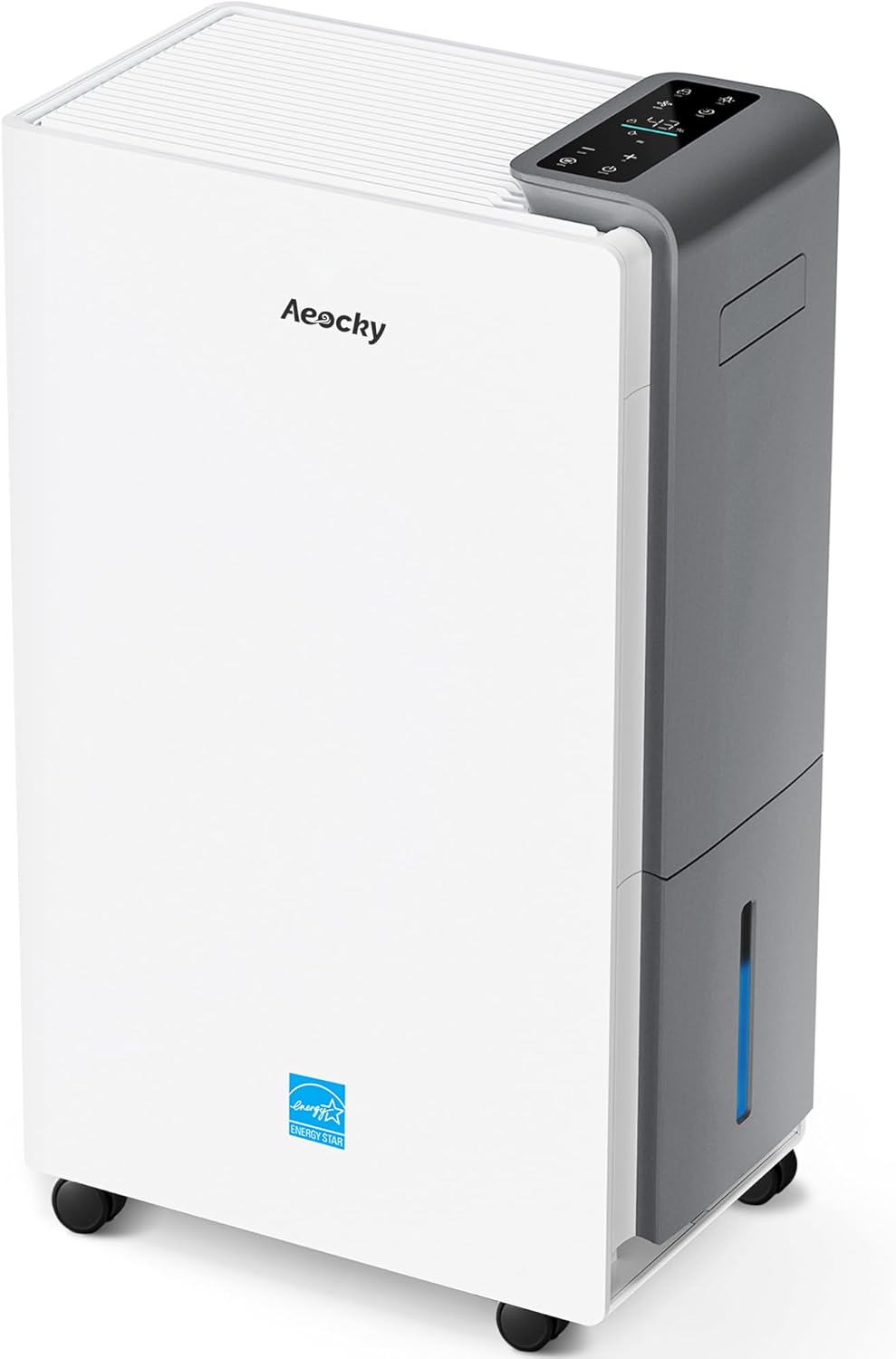
The AEOCKY RHEA-001 is a high-capacity compressor dehumidifier designed to remove large volumes of moisture from homes and basements. It is intended for continuous household use and can handle humid spaces up to the brand's stated 5500 sq.ft coverage, with an 80 pint/day dehumidification rating and a 1.45 gallon collection tank. Key conveniences include multiple operation modes (Auto, Constant Humidity, Continuous, Smart Drying, Sleep), an adjustable humidistat with millisecond-level sensing, a drain hose and garden-hose adapter for continuous draining, and a child lock and timer for hands-off operation. The unit emphasizes energy efficiency with an ENERGY STAR Most Efficient 2025 certification and claims reduced compressor cycling for longer component life. On the downside, large-capacity compressor dehumidifiers still produce noticeable noise at higher settings and require space and a drain route in crawl spaces; the single listed fan speed may limit fine control of airflow compared with multi-speed models. For crawl space use the included drain fittings and low-temperature defrost capability are practical, but installation location and noise should be considered.
Best for: Buyers who prioritize long-term, dependable moisture removal in problem crawl spaces and want a high-capacity, energy-efficient unit that can run continuously with automatic humidity control.
Less Ideal for: Those who need an ultra-compact, whisper-quiet or battery-powered solution for very tight or un-drained crawl spaces should consider smaller desiccant or portable models instead.
- High dehumidification capacity of up to 80 pints per day suitable for very damp areas
- ENERGY STAR Most Efficient 2025 rating for lower energy consumption during continuous operation
- Multiple operation modes and a precise humidistat for automated humidity control
- Includes drain hose and garden-hose adapter for continuous drainage without emptying the tank
- Low-temperature defrost sensors and design maintain performance in cooler spaces
- Only one listed fan speed which can limit fine airflow/noise control
- Relatively large unit that needs a drain and placement planning in tight crawl spaces
- Compressor-style dehumidifiers produce more noise than small desiccant or thermoelectric units at high output
Verdict: If you need a reliable, high-capacity dehumidifier for a damp crawl space that minimizes energy use while allowing continuous drainage, the AEOCKY RHEA is a strong choice.
Waykar 34 Pint Dehumidifier
| Capacity | 34 pints |
|---|---|
| Floor Area | 2000 square_feet |
| Tank Volume | 0.66 gallons |
| Wattage | 230 watts |
| Air Flow Capacity | 62 cfm |
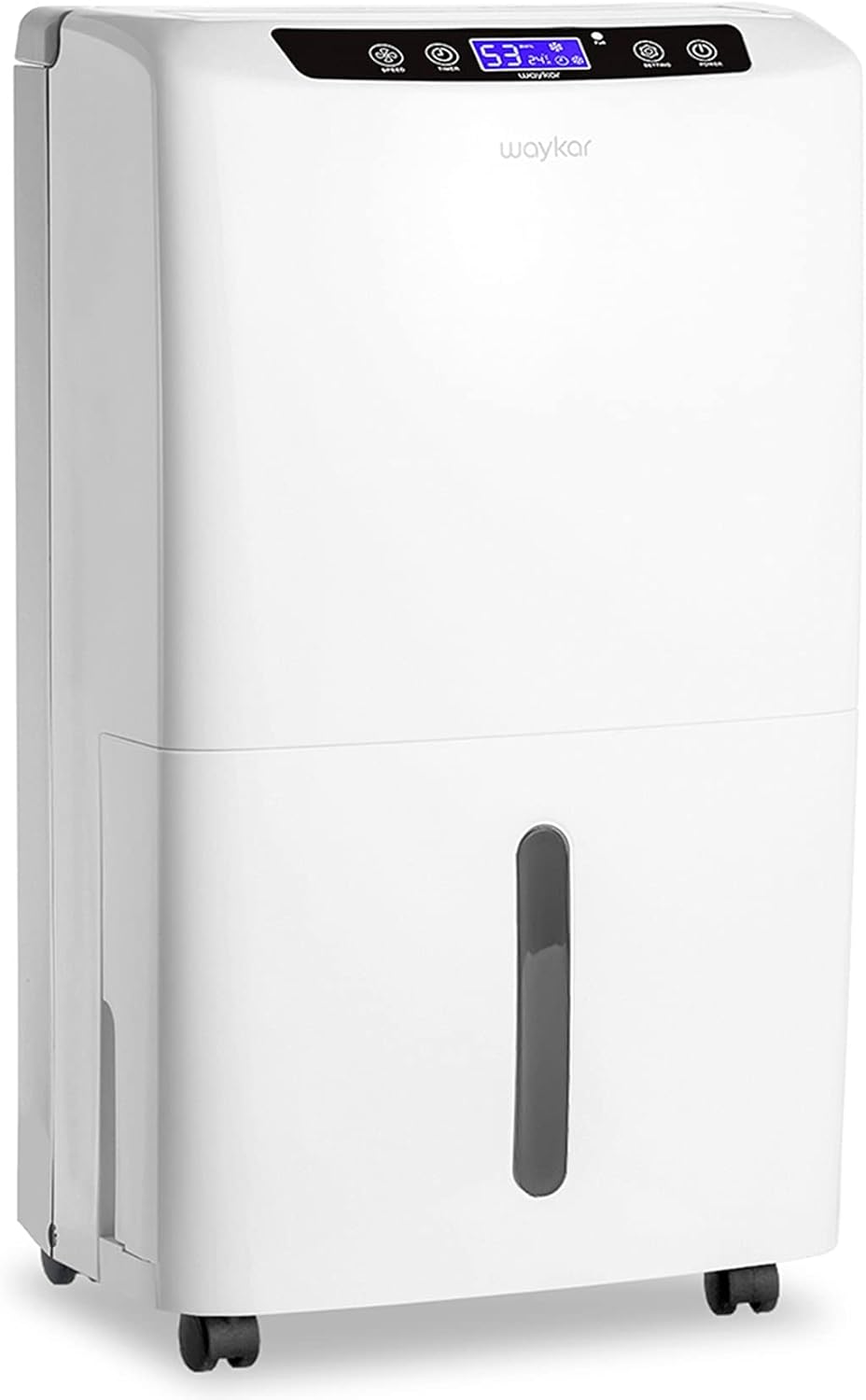
The Waykar 34 Pint Dehumidifier is a mid‑size portable unit intended to remove excess moisture from basements, crawl spaces, and large rooms. It delivers up to 34 pints per day under test conditions and offers Auto and Continuous modes plus two fan speeds so you can balance drying power and noise. Practical features include a removable 0.66 gallon tank with full‑tank shutoff, an included drain hose for continuous drain, a 24‑hour timer, and automatic defrost and overload protection for reliable low‑temperature operation. Energy Star certification and a reported optimized compressor point to reasonable energy use for extended runs. On the downside it is a heavier residential unit and its tank requires regular emptying unless you set up continuous drainage; the airflow is focused with a manual 90° swing rather than a motorized oscillation. For crawl spaces it provides a wider humidity set range (30%–80%) that lets you target deeper drying when needed.
Best for: Buyers who rely on other owners and reviews to validate durability and want a proven, Energy Star dehumidifier that can run continuously in damp basements or crawl spaces.
Less Ideal for: People needing a lightweight, ultra‑compact unit for occasional spot use or those who cannot install a continuous drain for unattended operation.
- Removes up to 34 pints per day suitable for large rooms and basements.
- Includes continuous drain hose plus removable tank for flexible water management.
- Energy Star certified for more efficient long‑term operation.
- Auto defrost and overload protection maintain reliable performance in cooler or continuous‑use conditions.
- Wide 30%–80% humidity set range for deeper drying when required.
- Relatively heavy for a portable unit, which can make moving into tight crawl spaces awkward.
- Tank is small for a 34‑pint unit, so continuous drainage is needed for unattended long runs.
- Airflow direction is manual 90° swing rather than automated oscillation.
Verdict: A reliable, Energy Star 34‑pint unit with continuous‑drain capability and deep humidity control that is well suited to damp crawl spaces and basements backed by strong user feedback.
BEDRED CT11 Dehumidifier

| Floor Area | 1000 square_feet |
|---|---|
| Tank Volume | 95 fluid ounces |
| Capacity | 5.9 pounds |
| Operation Mode | Intermittent |
| Other Special Features of the Product | 7 Color Ambient Light, Automatic Shutoff, Sleep Mode |
The BEDRED CT11 is a compact thermoelectric dehumidifier intended to reduce humidity in small spaces such as bedrooms, bathrooms, and modest basements up to about 1000 sq ft. It uses semiconductor cooling rather than a compressor, so it runs quietly and is simple to operate with an intermittent operation mode and an automatic shutoff when the 95 oz tank fills. Sleep Mode turns off the lights and lowers noise for overnight use, and the seven-color ambient light gives an optional mood-lighting feature. Practical benefits include easy emptying from the included tank, portability thanks to a lightweight design, and low sound levels that suit living spaces. Important limitations are inherent to semiconductor units: lower capacity compared with compressor dehumidifiers, reduced performance in very cold or very damp basements, and a smaller tank that requires more frequent emptying in high-humidity conditions.
Best for: Buyers who prioritize quiet, low-maintenance dehumidification and want a compact unit that is easy to move and run in living spaces or small basements without frequent intervention.
Less Ideal for: People needing heavy-duty moisture control for large, cold, or very damp basements should choose a higher-capacity compressor dehumidifier instead.
- Quiet thermoelectric operation suitable for bedrooms and living rooms
- Automatic shutoff protects against overfill and simplifies unattended use
- 95 oz removable tank for straightforward water removal
- Sleep Mode and ambient light options for low‑noise nighttime use
- Compact and lightweight for easy placement or moving between rooms
- Semiconductor cooling gives lower moisture removal capacity than compressor models
- Performance drops in cold basement conditions and very high humidity areas
Verdict: Choose the BEDRED CT11 if you want a quiet, portable dehumidifier with auto‑shutoff and sleep‑friendly operation for small basements or living spaces.
Choosing the Right Crawl Space Dehumidifier: Key Factors to Consider
Capacity and Moisture Removal Rate
A dehumidifier's capacity, typically rated in pints per day under given conditions, determines whether it can handle the expected moisture load in your crawl space. A unit with insufficient removal capability will run constantly and still fail to hold humidity at safe levels, while a properly sized unit reaches setpoint and cycles efficiently.
When evaluating capacity, estimate the crawl space volume and consider factors that increase moisture load such as poor ventilation, ground moisture, and water intrusion. Also account for seasonal variations: colder air holds less moisture, so removal rates can change with temperature. Choose a unit rated to remove enough moisture at the lower end of expected temperatures, or size up slightly to provide reliable control without excessive cycling.
Energy Use and Operating Cost
Crawl space dehumidifiers often run for long periods, so energy efficiency directly affects operating expense and system sustainability. Look at power draw at typical operating conditions and any efficiency ratings or energy-saving modes that reduce runtime when humidity is under control.
Consider features that lower energy use, such as variable-speed fans, built-in humidistats with precise control, or programmable schedules. Higher initial cost for a more efficient unit can be offset by lower monthly utility bills, especially in damp climates where dehumidification is needed year-round.
Drainage and Condensate Management
Reliable drainage is essential for unattended operation in crawl spaces. Units that collect condensate in internal pans require frequent emptying unless they offer a continuous gravity drain or an integrated condensate pump. Gravity drain options need a drain point lower than the dehumidifier; pump-assisted drainage provides more installation flexibility and allows discharge to a higher sink or exterior point.
Also check drain connection compatibility with common hose sizes and whether the unit includes safety features such as float switches or automatic shutoff to prevent overflow. A well-designed drainage system reduces maintenance and prevents secondary water damage from failed condensate collection.
Durability and Corrosion Resistance
Crawl spaces expose equipment to dust, dirt, and elevated humidity that can quickly degrade components. Corrosion-resistant coils, coated cabinets, and sealed electrical compartments extend service life. Durable compressors, rugged fan assemblies, and accessible but protected controls also help a unit survive frequent operation cycles.
Inspect the build approach for maintenance-friendly features like replaceable air filters behind protected panels and easily accessible condensate fittings. Units with more robust materials and protective finishes typically require fewer repairs and provide reliable performance in harsh under-floor environments.
Installation Flexibility and Footprint
Crawl spaces vary widely in clearance, access, and layout. A unit's physical footprint, vertical clearance needs, and mounting or floor-placement options will determine whether it fits comfortably and operates effectively. Slim or compact models may be necessary for low-clearance locations, while models with integrated mounting brackets or ducting options offer more flexible placement.
Consider service access for filter changes and condensate lines when planning installation. Also confirm electrical requirements and whether the unit needs a dedicated circuit or specific outlet type. Ease of installation reduces labor cost and the risk of improper placement that can impair performance.
Controls and Monitoring
Precise humidity control matters because crawl spaces require stable relative humidity to prevent mold and material deterioration. Built-in humidistats, digital displays, and selectable humidity setpoints let you match operation to seasonal needs. Remote monitoring or alarm outputs can be helpful where regular access to the crawl space is difficult.
Consider user-friendly controls and indicator lights for fault conditions like full tanks or blocked condensate lines. Some units include automatic restart after power loss, which is valuable in areas with intermittent power and ensures continuous protection without manual intervention.
Sizing Your Crawl Space
Measure the crawl space volume by multiplying length, width, and average height. Use that volume together with local climate humidity trends to estimate the dehumidification rate required. For spaces with active water intrusion or very damp soil, plan for a higher removal rate than for mostly dry, ventilated crawl spaces.
Factor in seasonal temperature because many dehumidifiers perform differently at lower temperatures. If your crawl space runs cool, select equipment that maintains adequate removal rates at those temperatures or consider placement strategies that keep the unit in a slightly warmer microclimate.
- Calculate cubic footage to determine baseline capacity needs
- Add margin for water intrusion or high ground moisture
- Check performance specs at lower temperatures if crawl space is cold
Drainage Solutions and Placement Tips
Plan drainage before choosing a unit. Gravity drains are simple and reliable when a lower floor drain or exterior outlet is available. Where gravity drain is not possible, choose a unit with an integrated condensate pump or plan to install an external pump for dependable removal.
Place the dehumidifier on a stable platform to keep it level and protect it from pooling water. Aim for an accessible location for servicing while positioning the unit so airflow is unobstructed and incoming moisture sources are addressed.
- Use pump-assisted models when no lower drain exists
- Keep the unit off bare soil with a platform or board
- Avoid blocking intake and exhaust with insulation or debris
Maintenance Best Practices
Routine maintenance keeps performance steady and prevents premature failure. Clean or replace air filters regularly and inspect the condensate path for clogs. Periodically check coils and fan housing for dust buildup which reduces airflow and efficiency.
Inspect seals, power connections, and any external hoses annually. In damp climates, perform a winter and summer inspection because conditions and performance needs can change with season. Address rust or corrosion early to avoid more extensive repairs.
- Inspect and clean filters every 1 to 3 months depending on dirt load
- Verify condensate tubing is clear and secure
- Schedule seasonal checks for corrosion and electrical connections
Managing Cold-Weather Performance
Many crawl spaces drop below standard test temperatures in winter, which can reduce dehumidifier performance or risk coil freeze. Look for units with low-temperature operation features such as automatic defrost, heaters, or controls that allow operation down to the expected minimum crawl space temperature.
If your crawl space regularly falls near freezing, consider positioning the unit in a slightly warmer zone or using supplemental heat to maintain an operational temperature range. Proper insulation and vapor barriers on the ground can also reduce load and help avoid freeze events.
- Select models with defrost or low-temp ratings for cold crawl spaces
- Improve insulation and ground vapor barriers to lower load
- Avoid running units at temperatures below the manufacturer's recommended range
Safety and Code Considerations
Confirm local building codes for electrical work in crawl spaces and whether a licensed electrician is required for hardwiring or outlet installation. Use GFCI-protected circuits where mandated and ensure wiring is protected from pests and moisture.
Consider accessibility for emergency shutoff and comply with clearance requirements from combustibles. Ensure condensate discharge does not create a hazard or violate local drainage rules.
- Follow local code for wiring and GFCI protection
- Protect electrical connections from moisture and pests
- Route condensate to approved drainage points
How We Chose the Best Crawl Space Dehumidifier
We selected crawl space dehumidifiers by applying practical, home-focused filters that reflect typical installation constraints and long-term ownership needs. Capacity and moisture removal rate were primary considerations because a unit must be able to control humidity for the specific cubic footage and typical moisture load in a crawl space. Energy efficiency and power draw were included next to estimate operating cost over seasons where dehumidification runs continuously. Durability and corrosion resistance were weighed heavily because crawl spaces are harsh environments where components and controls need protection from dust and occasional splash. Drainage and condensate management options were evaluated to ensure reliable unattended operation, including gravity drain, pump-assisted, and integrated hose options. Ease of installation and maintenance were considered so that homeowners can service filters and access controls without major disruption. We excluded units intended only for living spaces, temporary jobsite models, and any appliances lacking clear continuous-drain or pump options. The final selection prioritizes continuous operation capability, realistic removal rates for crawl-space volumes, rugged construction, and manageable energy consumption.
Our full evaluation process is outlined in our review methodology.
FAQ
How often should I run a crawl space dehumidifier?
Often it runs continuously until the set humidity is reached, then cycles on demand. Frequency depends on moisture load and insulation. In damp climates continuous operation during wetter months is common, while milder periods may only need intermittent cycles.
Can I install a dehumidifier in a low-clearance crawl space?
Yes, but choose a compact or slim model and confirm service access for filters and drain fittings. You may need to place the unit on its side if the manufacturer permits or install a shallow platform to provide clearance for hoses.
Is a condensate pump necessary?
A condensate pump is necessary when you cannot route a gravity drain to a lower discharge point. Pumps add installation flexibility and allow discharge to higher sinks or outside, but they require periodic checks and may need power protection.
What humidity level should I set for a crawl space?
Usually 45 percent relative humidity or lower is recommended to prevent mold and protect building materials. Targeting a range between 30 and 50 percent balances moisture control with energy use, but specifics depend on local climate and building materials.
Will a dehumidifier stop mold if I already have growth?
A dehumidifier helps stop further growth by lowering humidity, but it will not remove existing mold contamination. Address visible mold with proper remediation and fix the underlying moisture source; the dehumidifier can then maintain conditions that discourage recurrence.
Final Verdict
Selecting the right crawl space dehumidifier hinges on matching capacity to space volume and moisture load, ensuring dependable condensate management, and choosing a unit built for a harsh under-floor environment. Balance energy efficiency against required removal rate so the unit can run when needed without excessive operating cost. Prioritize reliable drainage, corrosion-resistant construction, and installation flexibility to fit your crawl space constraints. With those tradeoffs in mind, you can choose a dehumidifier that protects structural materials and reduces mold risk while keeping long-term maintenance manageable.