
Note: This article contains affiliate links. If you click on these links and make a purchase, we may earn a small commission at no extra cost to you. This helps support our research and content. Read our full affiliate disclosure here.
If you need reliable moisture control in small spaces, the right compact dehumidifier makes a noticeable difference. Compact units are designed for bedrooms, bathrooms, closets, and small basements where floor space is limited and excessive humidity can cause mold, musty odors, or damage to fabrics and electronics. In this guide we shortlisted top compact dehumidifiers that balance extraction performance, run-time convenience, and energy use. Below you will find concise product picks that suit different small-room needs plus clear criteria to help you pick the best unit for your space and routine.
Top Picks at a Glance
| Best Overall The best all-around choice for most situations | BEDRED CT11 Dehumidifier |  |
| Best Value The sweet spot between price and what you get | CLEVAST CL-DH04 30 oz Dehumidifier |  |
| Best Budget The cheapest option that still gets the job done reliably | Eva-Dry Mini Dehumidifier E-333 |  |
| Top Rated A top-rated pick with lots of positive feedback | KeepGlad RX02-B Dehumidifier |  |
| Most Popular A crowd favorite that many people choose with confidence | TABYIK 35oz Dehumidifier DH-CS01 |  |
| Best Seller A high-volume bestseller chosen again and again | ToLife Dehumidifier TZ-C2 |  |
BEDRED CT11 Dehumidifier

| Floor Area | 1000 square_feet |
|---|---|
| Tank Volume | 95 fluid ounces |
| Capacity | 5.9 pounds |
| Operation Mode | Intermittent |
| Other Special Features of the Product | 7 Color Ambient Light, Automatic Shutoff, Sleep Mode |
The BEDRED CT11 is a compact thermoelectric dehumidifier intended to reduce humidity in small spaces such as bedrooms, bathrooms, and modest basements up to about 1000 sq ft. It uses semiconductor cooling rather than a compressor, so it runs quietly and is simple to operate with an intermittent operation mode and an automatic shutoff when the 95 oz tank fills. Sleep Mode turns off the lights and lowers noise for overnight use, and the seven-color ambient light gives an optional mood-lighting feature. Practical benefits include easy emptying from the included tank, portability thanks to a lightweight design, and low sound levels that suit living spaces. Important limitations are inherent to semiconductor units: lower capacity compared with compressor dehumidifiers, reduced performance in very cold or very damp basements, and a smaller tank that requires more frequent emptying in high-humidity conditions.
Best for: Buyers who prioritize quiet, low-maintenance dehumidification and want a compact unit that is easy to move and run in living spaces or small basements without frequent intervention.
Less Ideal for: People needing heavy-duty moisture control for large, cold, or very damp basements should choose a higher-capacity compressor dehumidifier instead.
- Quiet thermoelectric operation suitable for bedrooms and living rooms
- Automatic shutoff protects against overfill and simplifies unattended use
- 95 oz removable tank for straightforward water removal
- Sleep Mode and ambient light options for low‑noise nighttime use
- Compact and lightweight for easy placement or moving between rooms
- Semiconductor cooling gives lower moisture removal capacity than compressor models
- Performance drops in cold basement conditions and very high humidity areas
Verdict: Choose the BEDRED CT11 if you want a quiet, portable dehumidifier with auto‑shutoff and sleep‑friendly operation for small basements or living spaces.
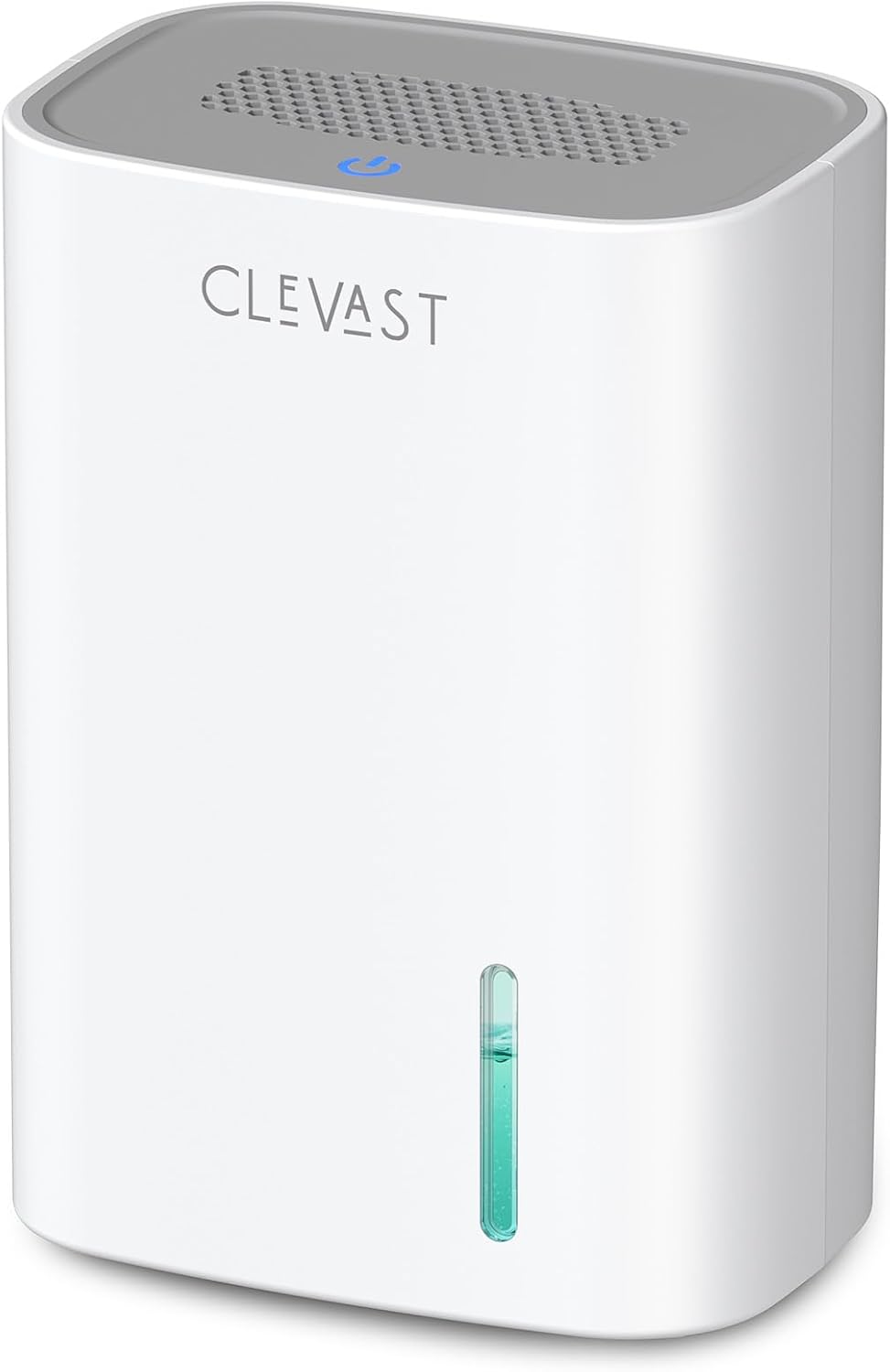
CLEVAST CL-DH04 30 oz Dehumidifier
| Capacity | 30 fluid ounces |
|---|---|
| Floor Area | 285 square_feet |
| Wattage | 27 watts |
| Dehumidification Capacity | 0.3 liters_per_day |
| Number of Speeds | 2 |
The CLEVAST CL-DH04 is a tabletop dehumidifier built for small, enclosed spaces like bedrooms, bathrooms, closets, RVs, and offices. It uses semiconductor condensation (no chemical refrigerants) and offers two modes: high-efficiency for stronger moisture removal and a quiet mode rated around 24 dB for night use. The unit holds 30 ounces in an internal tank and has an automatic shut-off and indicator to prevent overflow. At about 27 watts and roughly 0.55 kWh per day, it is energy efficient for continuous or nightly operation. Practical design touches include a built-in carry handle, one-button control, and guidance to keep intake and outlet clear for best performance. Limitations are its small dehumidification capacity—best performance is reported within 68°F–86°F (20°C–30°C) and in fully closed small rooms—so it will not substitute for a room-sized refrigerant dehumidifier in larger or cold spaces. Expect modest daily water collection in realistic home conditions rather than industrial-level drying.
Best for: Buyers who prioritize compact, low-noise, energy-efficient moisture control for single rooms, rentals, or mobile spaces and want a simple plug-and-play unit that is easy to move and operate.
Less Ideal for: People needing to dehumidify large rooms, basements, or cold environments, or those who require high daily water removal for severe dampness should consider a larger refrigerant dehumidifier.
- Compact, portable design with built-in handle for easy moving between rooms
- Very quiet operation (about 24 dB) suitable for bedroom or nursery use
- Uses semiconductor condensation so no chemical refrigerants are required
- Automatic shut-off and full-tank indicator reduce overflow risk and simplify unattended use
- Low power draw (~27 W, ~0.55 kWh/day) for economical continuous operation
- Low dehumidification capacity; designed for small, enclosed spaces and limited daily water removal
- Performance drops significantly outside the recommended 68°F–86°F temperature range
- Small internal tank requires more frequent emptying in persistently humid conditions
Verdict: Choose the CLEVAST CL-DH04 when you need a quiet, energy-efficient, easy-to-move dehumidifier for a single small room or mobile space.
Eva-Dry Mini Dehumidifier E-333

| Floor Area | 333 square_feet |
|---|---|
| Capacity | 6 ounces |
| Dehumidification Capacity | 0.38 pints_per_day |
| Operation Mode | Continuous |
| Wattage | 22.5 |
The Eva-Dry E-333 is a tiny, rechargeable silica-gel dehumidifier made for closets, cabinets, cars, bathrooms and other small spaces. It uses crystallized silica beads to absorb up to about 4 to 6 ounces of moisture and signals when it needs recharging by changing bead color from orange to green. Because it is fully cordless and contains no liquid reservoir, there are no leaks or spills and it can be hung or placed discretely. The unit is intended for intermittent use in tight areas rather than whole rooms and will need periodic recharging (roughly every 20 to 30 days under typical conditions). Key practical benefits are its portability, long service life without batteries or cords, and simple visual recharge indicator. Limitations include modest moisture capacity and low daily extraction rate, so it will not replace an electric compressor or larger desiccant dehumidifier in high-humidity or larger spaces.
Best for: Buyers seeking an inexpensive, low-maintenance way to control dampness in single small spaces who prioritize cordless convenience and long-term reusable operation.
Less Ideal for: People needing fast, continuous dehumidification for whole rooms, basements, or very humid climates should choose a powered dehumidifier with higher extraction rates.
- Cordless, rechargeable silica-gel design requires no batteries or continuous power.
- Small and lightweight for use in closets, cars, cabinets, gun safes and other tight spots.
- Visual moisture indicator shows when recharging is needed.
- Leakproof solid desiccant operation eliminates spill risk.
- Renewable beads claimed to last many recharge cycles, reducing waste over time.
- Very limited daily extraction rate and small moisture capacity, not suitable for large or very damp areas.
- Requires periodic recharging rather than continuous active drying.
- No adjustable settings or active fan, so performance depends on passive absorption and ambient airflow.
Verdict: A very affordable, fully cordless silica-gel unit that keeps single small spaces dry without batteries or hoses.
KeepGlad RX02-B Dehumidifier

| Capacity | 98 fluid ounces |
|---|---|
| Floor Area | 1000 square_feet |
| Wattage | 90 watts |
| Number of Speeds | 3 |
| Dehumidification Capacity | 2.5 pints_per_day |
The KeepGlad RX02-B is a compact, countertop-style dehumidifier intended for use in bathrooms, bedrooms, laundry rooms or small basements up to about 1,000 sq ft. It uses a dual semiconductor design and a 90 W compressor to pull moisture into a 98 oz removable tank or into a continuous drain hose, and the digital display reports real-time humidity so you can set target levels and a 4/8/12 hour timer. Practical touches include a washable air filter, three fan speeds for quieter or faster operation, an auto shutoff when the tank is full, and a small ambient light with a sleep mode that turns lights off for night use. The unit is relatively quiet in low-speed sleep mode and portable thanks to a built-in handle, but its daily dehumidification rate is modest, so it is best for damp small spaces rather than large, very wet basements. If you need simple humidity control in a compact package with convenient draining and easy maintenance, this model is a straightforward choice.
Best for: Buyers who prioritize a reliable, low-maintenance compact dehumidifier for bedrooms, bathrooms, or laundry areas and want straightforward controls and continuous-drain convenience.
Less Ideal for: People who need high-capacity moisture removal for large basements or very damp spaces should choose a larger, more powerful model instead.
- Compact footprint suitable for small rooms and tight spaces
- Digital humidity display with timer and precise monitoring
- Washable filter and continuous drain option reduce maintenance
- Three fan speeds including a quiet sleep mode for bedroom use
- Auto shutoff prevents overflow and adds safety
- Low dehumidification capacity compared with larger household units
- Designed for small to moderate dampness rather than heavy-duty water removal
Verdict: A compact, easy-to-maintain dehumidifier that reliably controls humidity in small rooms with the convenience of continuous drain and digital controls.
TABYIK 35oz Dehumidifier DH-CS01

| Tank Volume | 1000 ml |
|---|---|
| Wattage | 40 watts |
| Operation Mode | Continuous |
| Dehumidification Capacity | 0.45 liters_per_day |
| Floor Area | 280 square_feet |
The TABYIK 35oz (1,000 ml) dehumidifier is a small Peltier-style unit intended for bedrooms, bathrooms, RVs, and closets where space and noise matter. It runs continuously on a single speed and can collect up to roughly 16 oz (0.45 liters) per day under warm, high-humidity conditions, while drawing about 40 watts. Setup is simple: plug in, press the single button, and the transparent tank with a pull‑out groove makes emptying and cleaning straightforward. Useful extras include a 7-color night light with an off option and an auto shut-off that stops the unit and flashes a red light when the tank reaches capacity. Practical benefits are low energy use, very quiet operation (about 28 dB) for undisturbed sleep, and easy portability thanks to the built‑in handle. Limitations are the modest daily dehumidification rate and single speed, so it is intended for small, moderately damp spaces rather than basements or whole rooms with heavy moisture problems.
Best for: Buyers seeking a quiet, low-energy dehumidifier for small, moderately damp spaces who value simple operation and visible tank monitoring backed by many user reviews.
Less Ideal for: People needing rapid moisture removal for basements, large open rooms, or heavy condensation problems should choose a larger compressor dehumidifier instead.
- Compact and lightweight for easy placement and transport
- Quiet operation (~28 dB) suitable for bedrooms and offices
- Transparent 1,000 ml tank with easy pull‑out groove for simple emptying and cleaning
- Auto shut-off and visual alert when tank is nearly full
- Low dehumidification capacity (about 0.45 L/day) not suited for very damp or large spaces
- Single-speed operation limits control over performance and noise
- Peltier-style system is less powerful than compressor units in similar-sized rooms
Verdict: A very quiet, energy-efficient compact dehumidifier that works well for small rooms where gentle moisture control and simple operation are the priority.
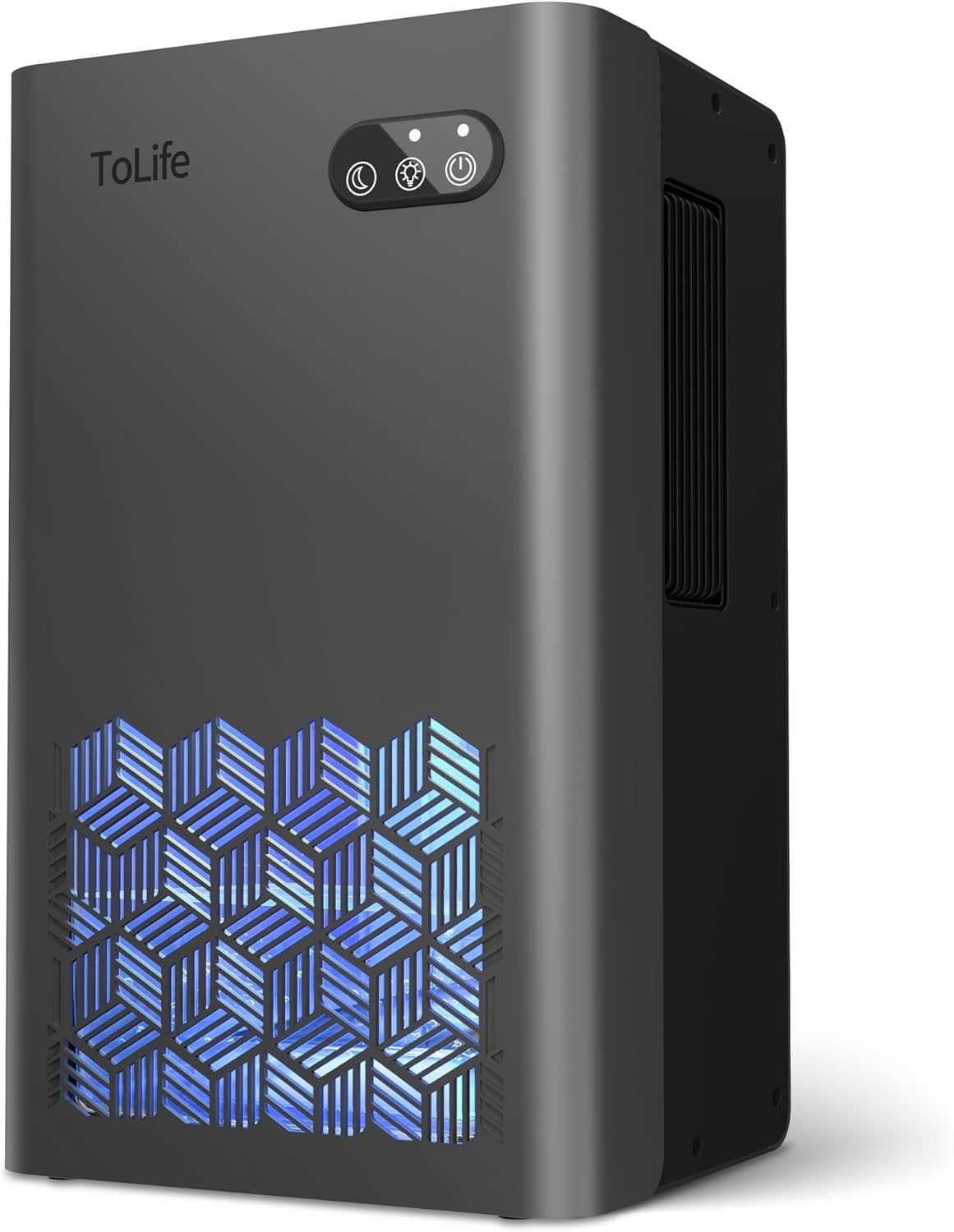
ToLife Dehumidifier TZ-C2
| Floor Area | 1000 |
|---|---|
| Tank Volume | 95 fluid ounces |
| Number of Speeds | 2 |
| Wattage | 93 watts |
| Voltage | 220 volts |
The ToLife TZ-C2 uses semiconductor condensation technology to quietly pull moisture from the air and deposit it into a removable 95 oz tank, making it a straightforward option for damp rooms. It offers two operating modes: a higher-power setting for faster moisture removal and a low-speed sleep mode that runs under 30 dB for overnight use. A seven-color LED can act as a night light and the unit includes automatic shutoff when the tank is full or removed, plus handles for easy moving between rooms. Practical benefits include simple setup, low noise, and a compact footprint that fits in basements, bathrooms, or bedrooms. Limitations are its modest rated dehumidification capacity and stated coverage, which means it will be most effective in smaller basement zones or for spot treatments rather than drying a large, very damp basement quickly. Also this model runs on 220 volts, so electrical compatibility should be confirmed for your location.
Best for: Buyers who need an affordable, portable dehumidifier for spot dehumidifying small basement areas, bathrooms, or bedrooms and who prioritize low noise and easy portability.
Less Ideal for: People looking to dry large, very damp basements or whole-house coverage should consider a higher-capacity compressor dehumidifier instead.
- Large removable 95 oz water tank reduces how often you need to empty it
- Quiet sleep mode under 30 dB suitable for nighttime operation
- Portable design with handles for moving between rooms
- Automatic shutoff prevents overflow when the tank is full
- Dehumidification capacity is modest and may be slow in very damp or large basements
- Requires 220 volt power which may not match all household outlets
Verdict: A compact, budget-friendly portable dehumidifier that is best for quiet, small-area moisture control and occasional basement spot treatments.
Choosing the Right Compact Dehumidifier: Key Factors to Consider
Extraction Capacity Vs Room Size
Extraction capacity determines how quickly a compact dehumidifier can reduce humidity to your desired level. For small rooms, capacity often ranges lower than whole-house units, so matching the unit's rated extraction to the actual square footage and typical ceiling height is essential.
Undersizing leads to long run times and constant cycling, which increases energy use and wear. Oversizing for a small room can cause short cycling and uneven humidity control. Evaluate specification sheets for extraction at realistic temperatures rather than only at ideal test conditions.
Energy Efficiency and Operating Cost
Energy efficiency impacts monthly operating cost, especially if the unit runs for many hours per day in damp environments. Look for compact models that report wattage at typical operating conditions and consider modes that reduce power use when a set humidity is reached.
Features like automatic shutoff, programmable timers, and low-power dehumidify modes help reduce runtime and electricity consumption. Over the course of a humid season, a more efficient compact unit can save noticeable energy without sacrificing performance.
Noise Level for Living Spaces
Noise is a central concern when placing a compact dehumidifier in a bedroom, office, or nursery. Measured decibels are a useful reference, but consider fan speed settings and acoustic design since perceived sound varies with frequency.
Quiet mode or sleep settings that lower fan speed are valuable for nighttime use. If you are sensitive to background noise, prioritize models with proven low-noise operation and easily adjustable fan controls to keep sound unobtrusive.
Tank Capacity and Drainage Options
A compact tank limits how long the unit can run unattended before needing emptying. If you want lower maintenance, choose a model with a larger tank relative to expected extraction or one that supports continuous drainage via a hose.
Consider drain height requirements and whether gravity drainage is feasible from your placement. Automatic shutoff when the tank is full is important to prevent spills. Some compact designs include easy-access trays or filters to simplify routine cleaning and reduce the chance of mold growth inside the unit.
Size, Weight, and Placement Flexibility
Compact dehumidifiers are chosen for space-limited locations, so physical footprint and weight matter for placement and portability. Slim profiles fit narrow shelves and closets while low weight makes seasonal relocation easier.
Check clearance recommendations for intake and exhaust, and ensure the unit fits intended locations without blocking airflow. Portability features such as handles and caster wheels improve convenience if you plan to move the unit between rooms.
Controls, Humidity Accuracy, and Maintenance
Usable controls and accurate humidity sensing determine how reliably a compact unit maintains comfort and protects belongings. Digital humidistats and clear setpoint displays help you maintain target relative humidity without constant babysitting.
Filter accessibility and washable filter options reduce upkeep time and cost. Also look for visible tank-full indicators and simple error codes so you can diagnose common issues quickly without referencing complex manuals.
Where Compact Dehumidifiers Work Best
Compact dehumidifiers excel in enclosed, moderately sized spaces where humidity is localized rather than widespread. Typical use cases include bedrooms with damp windows, bathrooms without sufficient ventilation, laundry rooms, closets storing textiles, and small basements with occasional moisture.
Because they are designed for smaller volumes of air, these units perform most efficiently when the room is reasonably sealed and airflow is not obstructed. If you expect persistent, high-volume moisture sources such as frequent wet laundry drying indoors, consider whether continuous drainage is available to avoid frequent tank emptying.
- Ideal for rooms up to the manufacturer recommended square footage
- Best in spaces with limited ventilation or localized humidity
- Not intended as whole-house solutions
Placement Tips to Maximize Performance
Place the unit where air can circulate freely around the intake and exhaust. Avoid tucking a compact dehumidifier into a corner or directly against furniture, which restricts airflow and reduces extraction efficiency.
Elevating the unit slightly off the floor can help if the area collects cool, damp air near the ground. Keep the unit on a stable, level surface and ensure the drain hose, if used, slopes downward continuously for reliable gravity drainage.
- Leave recommended clearance on all sides per the manual
- Avoid enclosed cabinets unless you provide ventilation
- Position near the moisture source for faster humidity reduction
Quiet Operation Strategies
If noise matters, choose operation modes that lower fan speed or schedule dehumidification during daytime. Many compact units include a sleep or quiet mode that prioritizes reduced sound over maximum extraction.
You can also reduce perceived noise by placing the unit on a rubber mat to dampen vibrations and avoiding direct placement on hollow shelving or loose floorboards. Regular filter cleaning maintains airflow, which can let the unit achieve desired humidity at lower fan speeds.
- Use sleep modes for overnight operation
- Maintain filters to prevent increased fan noise
- Place on vibration-dampening surface
Maintenance and Longevity
Routine maintenance extends the life of a compact dehumidifier and keeps performance steady. Empty or connect the drain regularly, clean or replace filters per the schedule, and inspect the tank and hose for mold or buildup.
Store the unit upright and dry during off-season months. If your unit will be idle for extended periods, run a short cycle to dry internal components before storing. Addressing minor issues early, like noisy bearings or cracked hose fittings, prevents larger failures.
- Empty or set up continuous drainage to prevent overflow
- Clean filters monthly in dusty environments
- Perform a quick operational check after storage
Humidity Targets and Health Considerations
Aim for indoor relative humidity between roughly 40 and 50 percent to reduce mold risk while avoiding overly dry air. Compact dehumidifiers with accurate humidistats make it easier to stay in this range without over-dehumidifying.
Excessive humidity contributes to dust mite proliferation and mold. Managing humidity also reduces musty odors and helps protect wooden furniture and stored textiles. If occupants have respiratory sensitivities, steady control near the recommended range is especially helpful.
- Target 40 to 50 percent relative humidity for general comfort
- Reduce humidity further only for specific storage needs
- Monitor with a separate hygrometer if precise control is required
How We Chose the Best Compact Dehumidifier
We focused on real-world factors that matter most for small-room moisture control. Core evaluation criteria included extraction capacity at room temperatures typical of indoor living spaces, energy efficiency during continuous and intermittent use, and noise output since many compact units operate in bedrooms and living areas. We also assessed tank capacity and drainage options to match user maintenance preferences, plus size and weight for portability and placement flexibility. Usability features such as simple controls, humidity setpoint accuracy, and filter access for cleaning were considered because they affect daily operation. We excluded larger whole-house or commercial models and units that require permanent plumbing beyond standard gravity or hose drain compatibility. We prioritized compact designs intended for small rooms rather than scaled-down versions of high-capacity units. Final selections balance extraction per footprint, low operational cost, and quiet, convenient operation.
Our full evaluation process is outlined in our review methodology.
FAQ
How do I choose the right capacity for a compact dehumidifier?
Match the unit's recommended square footage or extraction rate to your room size and expected moisture load. For small rooms, prioritize steady extraction at typical indoor temperatures rather than peak lab-rated numbers.
Can a compact dehumidifier run continuously?
Many compact units support continuous operation, especially when connected to a drain hose. Continuous use is fine if the unit is rated for it, but check energy use and ensure proper maintenance to avoid premature wear.
Is continuous drainage necessary for compact units?
Continuous drainage is not always necessary but reduces maintenance by eliminating frequent tank emptying. It is especially useful in very damp rooms or when you want unattended operation for long periods.
How loud are compact dehumidifiers at night?
Noise varies by model and fan speed. Many compact units offer quiet or sleep modes that lower noise for nighttime use, but actual perception depends on distance and room acoustics.
How often should I clean the filter and tank?
Clean washable filters monthly in dusty conditions and inspect the tank every few weeks for residue or mold. Replace disposable filters per the manufacturer schedule.
Will a compact dehumidifier lower condensation on windows?
Yes. By reducing indoor humidity, a compact dehumidifier can significantly reduce window condensation in small rooms, provided the unit is sized and placed appropriately.
Final Verdict
Choose a compact dehumidifier by prioritizing the extraction rate that fits your room and the energy efficiency that matches your expected runtime. If you need overnight quiet, prioritize low-noise operation and a reliable humidistat. For low-maintenance use, prefer larger tanks or continuous drainage options. Balancing these tradeoffs—capacity, noise, energy use, and maintenance—will help you select a compact unit that keeps small rooms comfortable and protected from moisture without unnecessary cost or fuss.