
Note: This article contains affiliate links. If you click on these links and make a purchase, we may earn a small commission at no extra cost to you. This helps support our research and content. Read our full affiliate disclosure here.
A basement can quickly become a source of excess humidity, musty odors, and mold risk without dependable moisture control. A dehumidifier for basement with drain hose provides continuous drainage, so you do not have to empty collection buckets and can run the unit for longer stretches. Choosing the right model matters because basements vary in size, airflow, and temperature. This guide shortlists seven top options suited to basement use and continuous-drain setups. We evaluated extraction capacity, hose and pump options, controls, low-temperature operation, and ease of maintenance. Read on for concise buying guidance and the tradeoffs to consider before you install a continuous-drain dehumidifier in your basement.
Top Picks at a Glance
| Best Overall The best all-around choice for most situations | AEOCKY RHEA 80-Pint Dehumidifier |  |
| Best Quality Built to a higher standard if you want something more solid | Gasbye DryPrime-50 Dehumidifier |  |
| Best Value The sweet spot between price and what you get | HUMILABS 21-Pint Dehumidifier |  |
| Best Budget The cheapest option that still gets the job done reliably | BEDRED CT11 Dehumidifier |  |
| Top Rated A top-rated pick with lots of positive feedback | yaufey 31-Pint Dehumidifier |  |
| Most Popular A crowd favorite that many people choose with confidence | Waykar 80-Pint Dehumidifier JD025CE-80 |  |
| Best Seller A high-volume bestseller chosen again and again | ToLife Dehumidifier TZ-C2 |  |
AEOCKY RHEA 80-Pint Dehumidifier
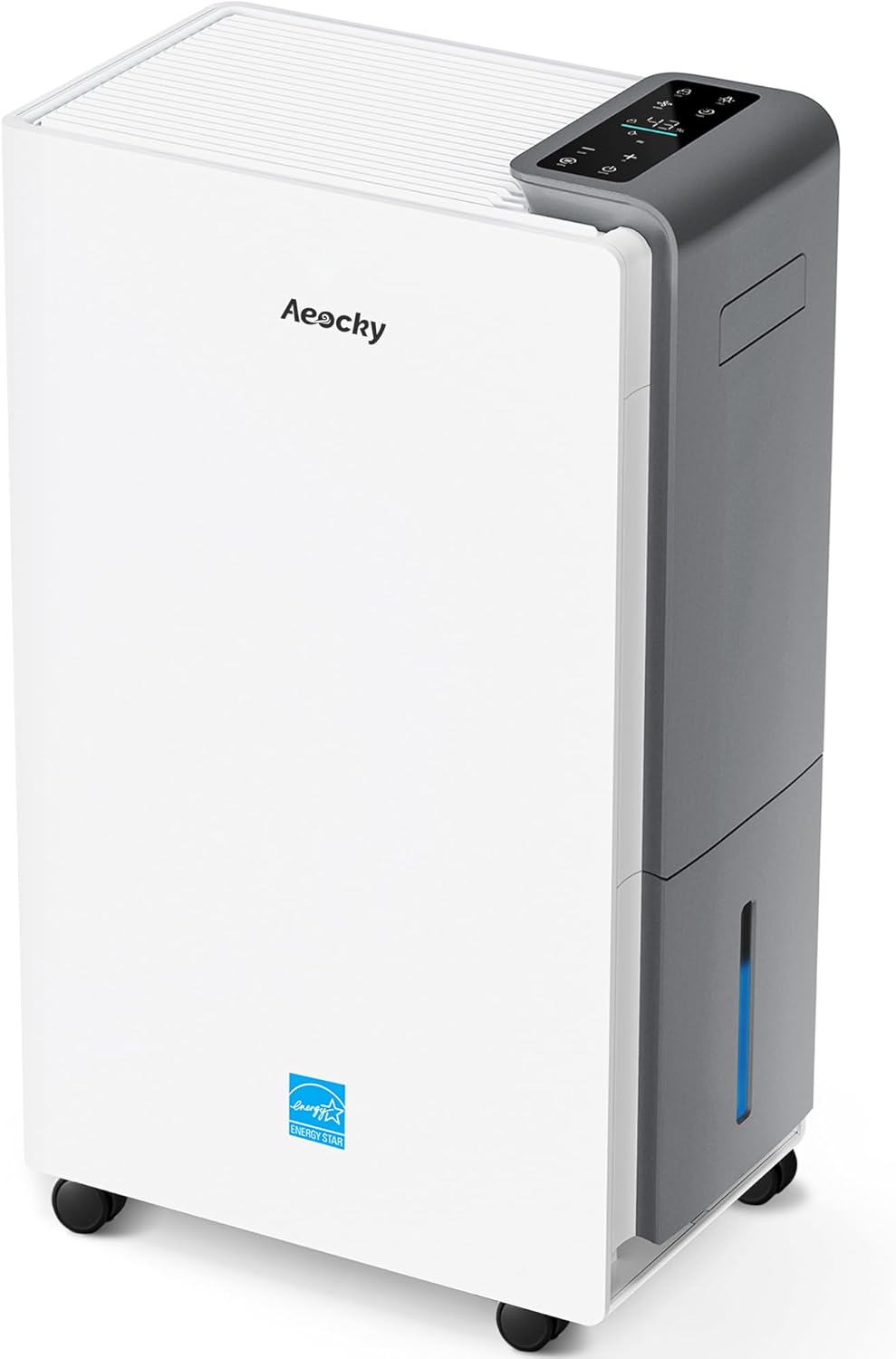
| Capacity | 80 pints per day |
|---|---|
| Tank Volume | 1.45 gallons |
| Wattage | 280 watts |
| Operation Mode | Auto, Constant Humidity, Continuous, Smart Drying, Sleep Mode |
| Air Flow Capacity | 9006 cubic feet per hour |
The AEOCKY RHEA is a high-capacity compressor dehumidifier targeted at whole-basement use and other large, damp areas. It removes up to 80 pints per day and supports Auto, Constant Humidity, Continuous, Smart Drying, and Sleep modes so you can set a target humidity or run continuous drainage. Practical features for basement owners include a 1.45 gallon tank plus a supplied drain hose and garden-hose adapter for unattended drainage, and a smart humidity control that aims to keep levels stable. The unit emphasizes energy efficiency with an ENERGY STAR Most Efficient 2025 qualification and claims improved low-temperature defrost performance so it keeps working in cool basements. Noise is comparatively low for its class, and the 280 W power draw keeps operating costs reasonable. Limitations are typical for big compressor dehumidifiers: it is relatively tall and built of metal, so it is less portable than small units, and it requires a floor drain or routed hose for truly hands-off operation for long runs. For balanced buyers who want efficient, durable basement dehumidification with a drain option, the RHEA delivers strong day-to-day performance.
Best for: Buyers who want a reliable, energy-efficient whole-basement dehumidifier that can run continuously with a drain hose and stay effective in cooler conditions.
Less Ideal for: People who need a lightweight, highly portable dehumidifier for small rooms or those who cannot route a drain hose for continuous drainage.
- High dehumidification capacity rated at 80 pints per day for large or very damp basements
- ENERGY STAR Most Efficient 2025 rating for lower energy use compared with non-certified models
- Includes drain hose and garden-hose adapter for continuous unattended drainage
- Multiple operating modes and precise humidity control for steady basement humidity management
- Designed defrost sensor and low-temperature capability to run reliably in cool basement conditions
- Large compressor-style unit is less portable than compact desiccant or thermoelectric models
- Requires a drain or routing for truly continuous operation to avoid emptying the tank
- Only a single fan speed is listed which may limit fine-grained airflow control
Verdict: Choose the RHEA if you need a powerful, ENERGY STAR Most Efficient 2025 dehumidifier that handles large basements and supports continuous drainage for low-maintenance operation.
Gasbye DryPrime-50 Dehumidifier
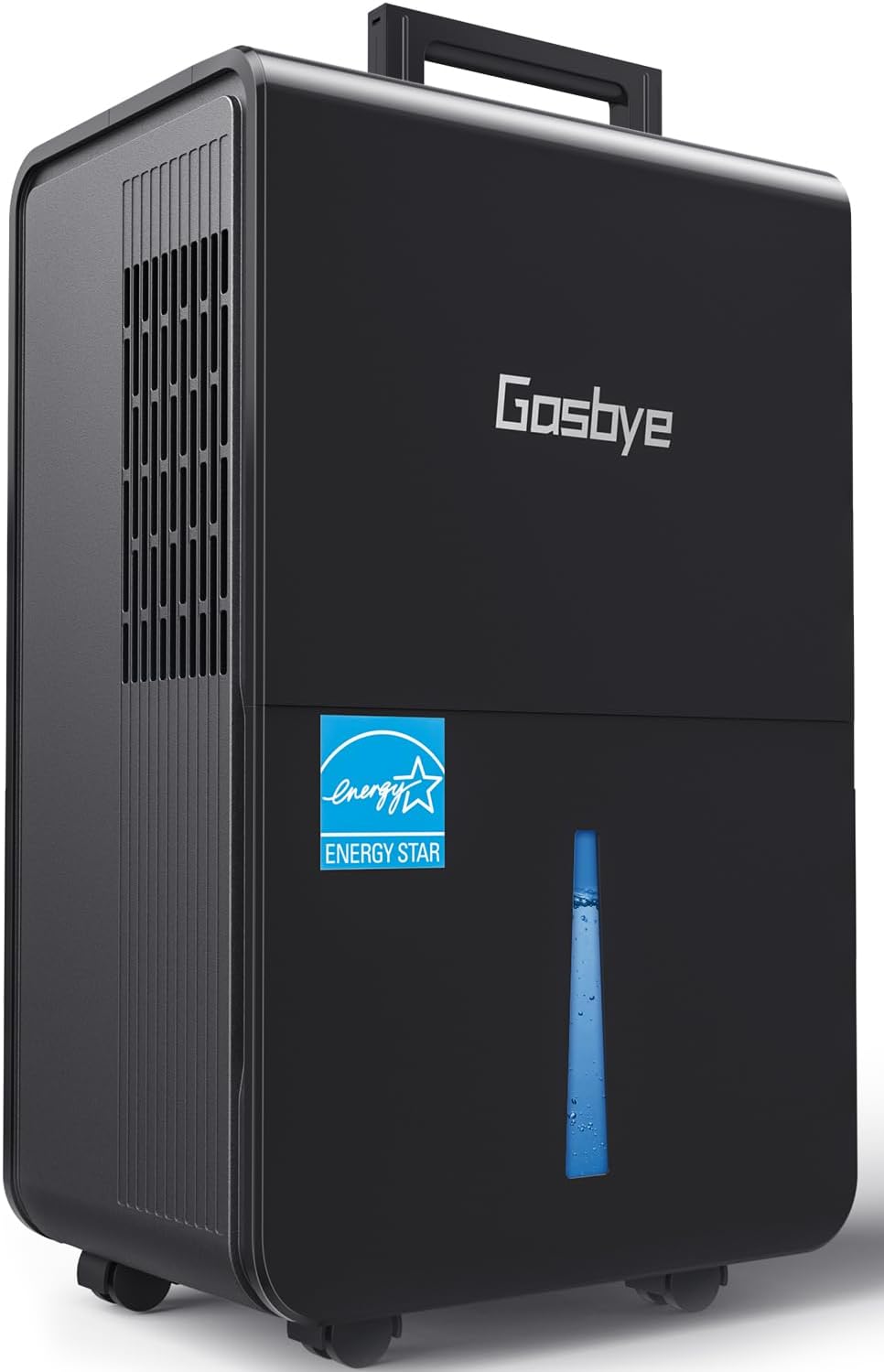
| Capacity | 115 pints |
|---|---|
| Tank Volume | 1.72 gallons |
| Wattage | 500 watts |
| Air Flow Capacity | 12600 cubic_feet_per_hour |
| Operation Mode | Normal, Turbo, Comfort, Continuous |
The Gasbye DryPrime-50 is a heavy-duty compressor dehumidifier built for basements and other large rooms where continuous moisture removal is needed. It uses a reinforced copper coil and a 500 W compressor to deliver up to 115 pints/day at 86°F/80% RH (lower capacities at cooler or drier conditions), and it runs at about 45 dB so it is noticeable but not intrusive in open spaces. Controls include smart humidity targeting with auto shut-off and auto restart after power loss, plus four operation modes for normal, turbo, comfort, and continuous use. For drainage you get three practical choices: a 1.7 gallon tank, a 5-foot direct drain hose, or a threaded 3/4-inch garden-hose connection for longer gravity drain runs, which is especially useful in basements. The unit is Energy Star certified for better efficiency, but it is relatively heavy and intended for larger areas rather than small bedrooms. If you need robust, continuous dehumidification for a basement with easy permanent drain hookup, this model delivers reliable performance and durable construction.
Best for: Buyers who prioritize sustained, high-capacity moisture removal in basements or large open spaces and want a unit that supports permanent drain installation and durable construction.
Less Ideal for: People seeking a lightweight, ultra-quiet dehumidifier for small bedrooms or occasional spot use should consider smaller, lower-capacity models instead.
- High maximum dehumidification capacity with lab-tested performance figures for different temperature/RH conditions
- Three drainage methods including threaded 3/4-inch outlet for permanent gravity or hose hookup
- Energy Star certification for improved energy efficiency in long runtime applications
- Durable build with reinforced copper tubing intended to improve longevity
- Smart humidity control with auto shut-off and auto-restart after power loss
- Relatively heavy and bulky compared with compact units, so less convenient to move
- Noise level around 45 dB can be audible in smaller or quieter rooms
Verdict: If you need dependable, high-capacity basement dehumidification with a true permanent drain option and durable compressor-based construction, this unit is a strong choice.
HUMILABS 21-Pint Dehumidifier

| Capacity | 21 pints |
|---|---|
| Coverage | Up to 1,600 sq.ft |
| Wattage | 240 watts |
| Tank Volume | 0.37 gallons |
| Noise Level | 37 dB (Sleep Mode) |
This HUMILABS 21-pint dehumidifier removes up to 21 pints per day and is built for continuous use in damp basements, bathrooms, laundry areas, and larger rooms. It offers three modes — Sleep, Dry, and Auto — so you can choose ultra-quiet night operation, faster drying for laundry, or automatic humidity control between 30% and 80% RH. Practical features include a 1.7 L translucent tank with full-tank auto shutoff, an included drain hose for continuous drainage, a top LED touch panel, child lock, auto-restart, and washable filter for easy maintenance. Mobility is simple thanks to hidden handle and swivel caster wheels. The unit runs on 240 watts and uses low-global-warming R290 refrigerant for more efficient dehumidification. Trade-offs are typical for compact 21-pint machines: it is suited for moderate dampness but may require longer runtime in very wet basements compared with larger-capacity commercial units, and the small tank means continuous drainage is the preferred setup for unattended operation.
Best for: Buyers who want a practical, easy-to-maintain dehumidifier for basements or large rooms and prefer quiet night operation and continuous drainage options.
Less Ideal for: Homes with severe flooding or very high humidity that need industrial or high-capacity commercial dehumidification should consider larger-capacity models instead.
- Removes up to 21 pints per day suitable for rooms up to 1,600 sq ft
- Includes drain hose and supports continuous drainage for unattended use
- Very quiet Sleep Mode down to 37 dB for overnight operation
- Top LED touch panel, child lock, and auto-restart add convenience and safety
- Washable filter and removable wheels simplify maintenance and mobility
- 21‑pint capacity can be slow in very wet basements compared with larger units
- Tank volume is small, so continuous drain is recommended for long unattended runs
Verdict: A quiet, feature-packed 21‑pint unit with continuous drain and easy maintenance that fits basements and large rooms where practical, unattended moisture control is the priority.
BEDRED CT11 Dehumidifier

| Floor Area | 1000 square_feet |
|---|---|
| Tank Volume | 95 fluid ounces |
| Capacity | 5.9 pounds |
| Operation Mode | Intermittent |
| Other Special Features of the Product | 7 Color Ambient Light, Automatic Shutoff, Sleep Mode |
The BEDRED CT11 is a compact thermoelectric dehumidifier intended to reduce humidity in small spaces such as bedrooms, bathrooms, and modest basements up to about 1000 sq ft. It uses semiconductor cooling rather than a compressor, so it runs quietly and is simple to operate with an intermittent operation mode and an automatic shutoff when the 95 oz tank fills. Sleep Mode turns off the lights and lowers noise for overnight use, and the seven-color ambient light gives an optional mood-lighting feature. Practical benefits include easy emptying from the included tank, portability thanks to a lightweight design, and low sound levels that suit living spaces. Important limitations are inherent to semiconductor units: lower capacity compared with compressor dehumidifiers, reduced performance in very cold or very damp basements, and a smaller tank that requires more frequent emptying in high-humidity conditions.
Best for: Buyers who prioritize quiet, low-maintenance dehumidification and want a compact unit that is easy to move and run in living spaces or small basements without frequent intervention.
Less Ideal for: People needing heavy-duty moisture control for large, cold, or very damp basements should choose a higher-capacity compressor dehumidifier instead.
- Quiet thermoelectric operation suitable for bedrooms and living rooms
- Automatic shutoff protects against overfill and simplifies unattended use
- 95 oz removable tank for straightforward water removal
- Sleep Mode and ambient light options for low‑noise nighttime use
- Compact and lightweight for easy placement or moving between rooms
- Semiconductor cooling gives lower moisture removal capacity than compressor models
- Performance drops in cold basement conditions and very high humidity areas
Verdict: Choose the BEDRED CT11 if you want a quiet, portable dehumidifier with auto‑shutoff and sleep‑friendly operation for small basements or living spaces.
yaufey 31-Pint Dehumidifier
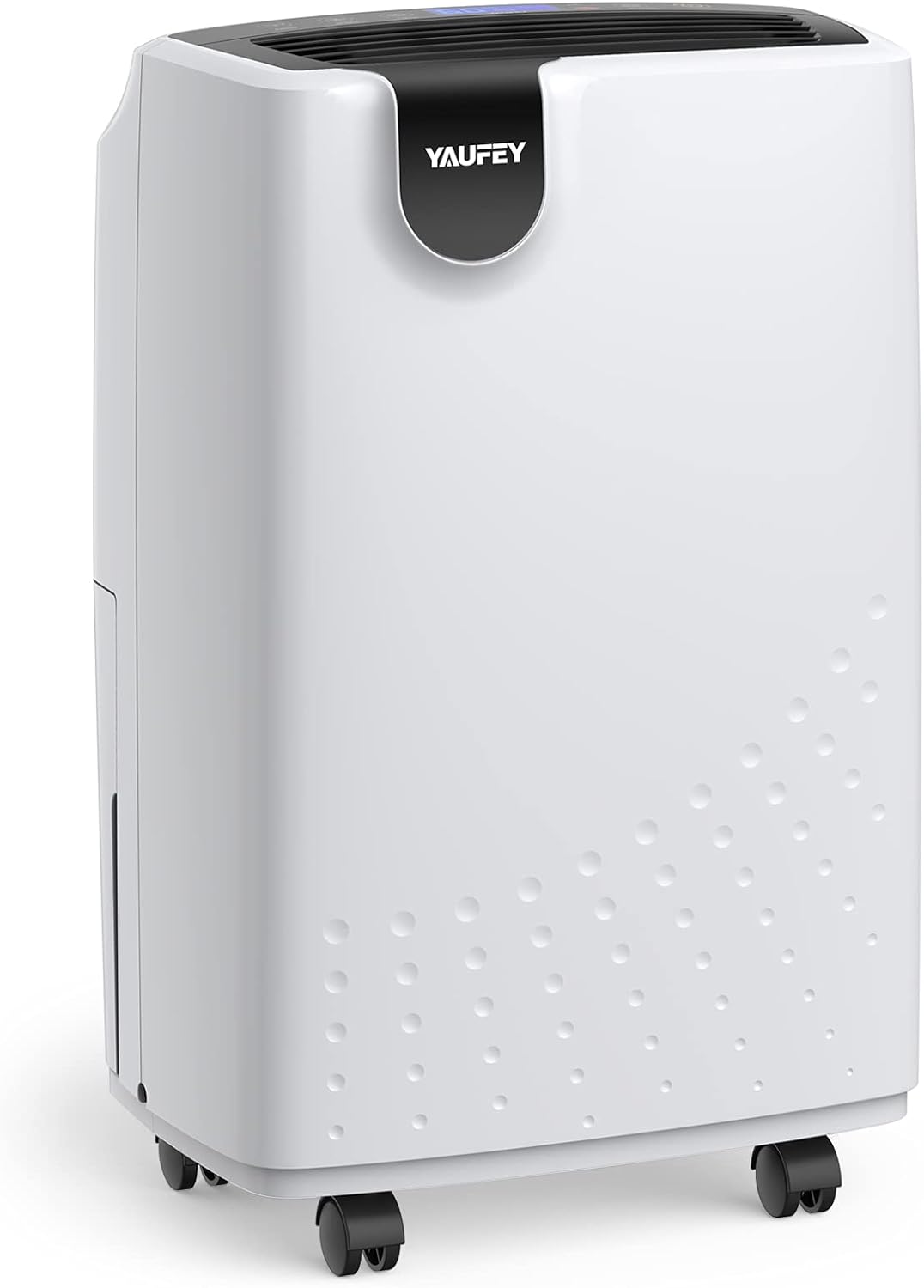
| Capacity | 31 pints_per_day |
|---|---|
| Floor Area | 2500 square_feet |
| Tank Volume | 0.48 gallons |
| Wattage | 230 watts |
| Air Flow Capacity | 64.7 cfm |
The yaufey 31‑Pint dehumidifier is a compact, user-friendly unit made for basements and medium-sized rooms where persistent moisture is a concern. It removes up to 31 pints per day (rated at 95°F/90% RH) and offers two fan speeds plus a 24‑hour timer so you can run it continuously or on a schedule. Practical features include a 0.48‑gallon removable tank with an included 6.56‑ft drain hose for gravity-fed continuous draining, an auto shutoff when the tank is full, and an auto‑defrost function for cooler spaces. The washable filter, ergonomic handle and caster wheels make maintenance and repositioning straightforward. At 230 watts and with an airflow rating of 64.7 cfm, it balances energy use and performance for typical basement conditions. Limitations to note are the relatively small tank (so gravity drain is recommended for long unattended runs) and the 31‑pint capacity which is sized for medium areas rather than very large or extremely damp basements. For steady, reliable dehumidification in a single basement zone this model covers the basics without unnecessary complexity.
Best for: Buyers who prioritize dependable, no‑frills moisture control for a single basement or medium room and want a unit that is easy to set up and maintain.
Less Ideal for: Homes with very large basements, multiple damp zones, or commercial drying needs should consider higher‑capacity or whole‑house systems instead.
- Continuous drain option with included 6.56 ft hose for unattended operation
- Two fan speeds and 24‑hour timer let you tailor runtime and conserve energy
- Washable, removable filter simplifies maintenance
- Wheels and an ergonomic handle make it easy to move between rooms
- Small 0.48‑gallon tank means relying on the drain hose for long unattended runs
- 31‑pint rating is modest for very large or extremely damp basements
Verdict: A straightforward, portable dehumidifier with a gravity‑drain hose that delivers reliable moisture control for a single basement or medium‑sized room.
Waykar 80-Pint Dehumidifier JD025CE-80

| Dehumidification Capacity | 80 pints_per_day |
|---|---|
| Tank Volume | 2.5 gallons |
| Wattage | 270 watts |
| Air Flow Capacity | 165 cfm |
| Operation Mode | Continuous |
The Waykar 80-Pint Dehumidifier is built to handle large, damp areas such as basements by extracting up to 80 pints per day and offering both tank and continuous drain options. It is commonly used running continuously or on a timed schedule to bring basement humidity down to a selected setpoint between 30% and 80% relative humidity, and the 90° auto-swing helps spread airflow for more even drying. Practical features include an included drain hose and connector for gravity drainage, a washable removable filter, automatic defrost and overload protection for low-temperature reliability, and an Energy Star rating to keep running costs lower than noncertified units. At roughly 42 dB it is quieter than many similarly sized machines, making it reasonable for finished basements or nearby living areas. The unit is relatively heavy and targeted at larger spaces, so it is less convenient to move frequently, and the 1.14 gallon tank means emptying is still needed if you do not use continuous drainage. For buyers focused on dependable basement performance and energy efficiency, this model delivers strong moisture removal with sensible protections for extended operation.
Best for: Homeowners who need a reliable, high-capacity dehumidifier to control moisture in large basements and prefer proven features and energy efficiency over portability.
Less Ideal for: People looking for a lightweight, highly portable unit for small rooms or occasional use should consider smaller, easier-to-move models instead.
- High dehumidification capacity rated at 80 pints per day for large basements
- ENERGY STAR certification for better energy efficiency during extended use
- Multiple drainage options with included drain hose for continuous gravity drain
- Auto-defrost and overload protection improve reliability in cool basement conditions
- 90° auto-swing airflow and washable filter help distribute air and simplify maintenance
- Relatively heavy and sized for large spaces, so not ideal for frequent transport
- Water tank is modest at 1.14 gallons if continuous drainage is not used
Verdict: A powerful, Energy Star certified 80‑pint unit that reliably handles large basement humidity with continuous drain and protective auto-defrost features.
ToLife Dehumidifier TZ-C2
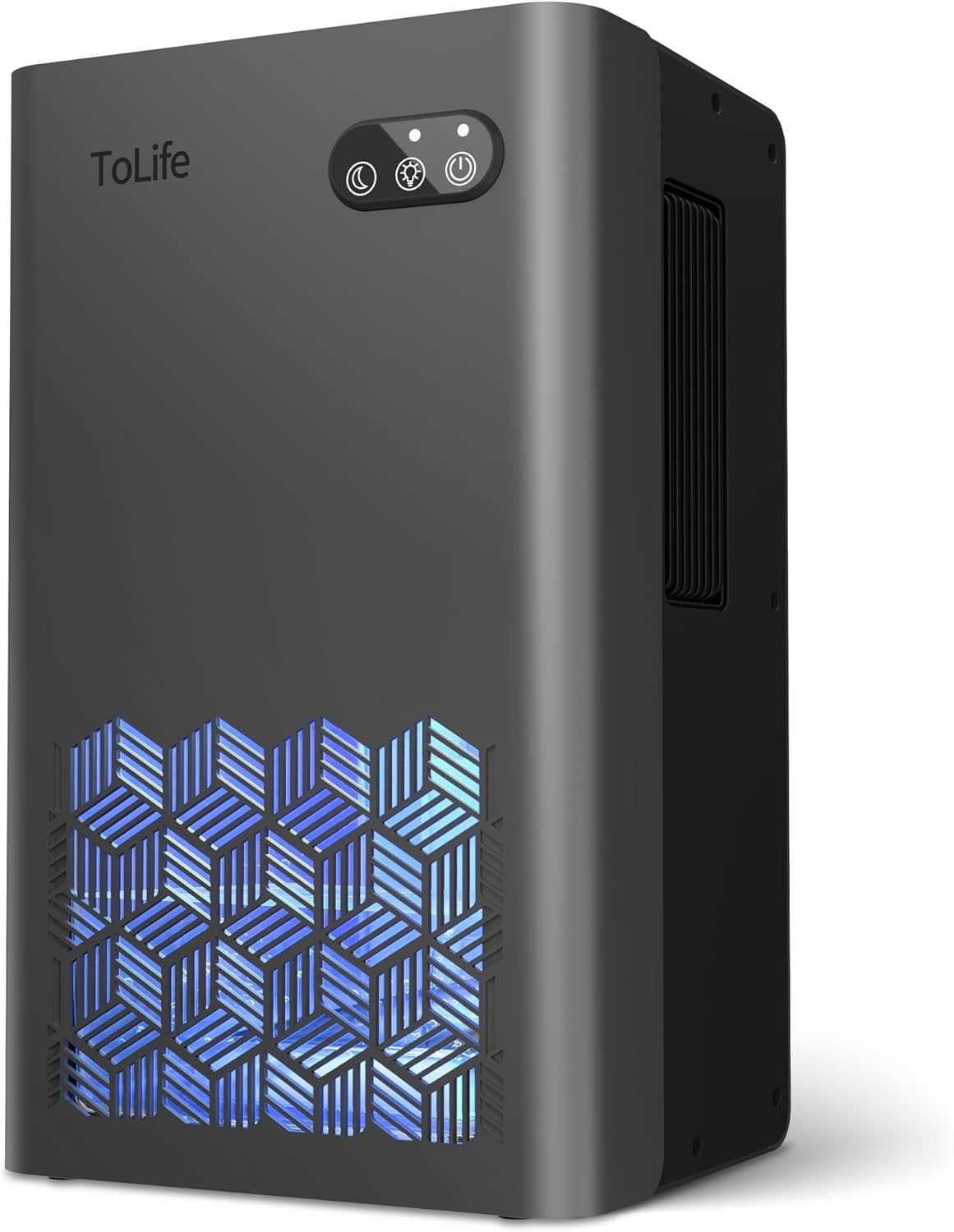
| Floor Area | 1000 |
|---|---|
| Tank Volume | 95 fluid ounces |
| Number of Speeds | 2 |
| Wattage | 93 watts |
| Voltage | 220 volts |
The ToLife TZ-C2 uses semiconductor condensation technology to quietly pull moisture from the air and deposit it into a removable 95 oz tank, making it a straightforward option for damp rooms. It offers two operating modes: a higher-power setting for faster moisture removal and a low-speed sleep mode that runs under 30 dB for overnight use. A seven-color LED can act as a night light and the unit includes automatic shutoff when the tank is full or removed, plus handles for easy moving between rooms. Practical benefits include simple setup, low noise, and a compact footprint that fits in basements, bathrooms, or bedrooms. Limitations are its modest rated dehumidification capacity and stated coverage, which means it will be most effective in smaller basement zones or for spot treatments rather than drying a large, very damp basement quickly. Also this model runs on 220 volts, so electrical compatibility should be confirmed for your location.
Best for: Buyers who need an affordable, portable dehumidifier for spot dehumidifying small basement areas, bathrooms, or bedrooms and who prioritize low noise and easy portability.
Less Ideal for: People looking to dry large, very damp basements or whole-house coverage should consider a higher-capacity compressor dehumidifier instead.
- Large removable 95 oz water tank reduces how often you need to empty it
- Quiet sleep mode under 30 dB suitable for nighttime operation
- Portable design with handles for moving between rooms
- Automatic shutoff prevents overflow when the tank is full
- Dehumidification capacity is modest and may be slow in very damp or large basements
- Requires 220 volt power which may not match all household outlets
Verdict: A compact, budget-friendly portable dehumidifier that is best for quiet, small-area moisture control and occasional basement spot treatments.
Choosing the Right Dehumidifier for Basement with Drain Hose: Key Factors to Consider
Extraction Capacity Vs. Basement Size
Extraction capacity indicates how much water a unit can remove in 24 hours, typically listed in pints per day. Match capacity to your basement square footage and ceiling height so the dehumidifier can maintain target humidity without running constantly.
Undersized units will run continuously and may never reach the setpoint, while oversized units may short-cycle and waste energy if airflow and placement are poor. Consider the worst-case wet conditions—after heavy rain or during humid summer months—when estimating the capacity you need.
Continuous Drain Options and Routing
A continuous drain setup removes the need to empty a collection bucket, which is essential for basements that are used regularly or are hard to access. Some units offer gravity drain connections while others include an internal condensate pump for uphill or distant discharge.
Think about how you will route the hose to a nearby floor drain, utility sink, condensate line, or sump pump. Gravity drains are simplest but require the dehumidifier to be located above the drain outlet. Pumps add flexibility but require more maintenance and may add noise or failure points.
Low-Temperature Operation and Frost Control
Basements are often cooler than living spaces, especially in winter or in partially finished areas. Many dehumidifiers lose efficiency as temperatures drop, and some will frost up and cycle off. Look for models designed to operate at lower temperatures with automatic defrost or built-in controls that prevent ice buildup.
Reliable low-temperature performance ensures the unit will remove moisture year-round rather than only during warm months. This factor affects both moisture control and long-term durability of the compressor system.
Energy Use During Continuous Operation
Basement dehumidifiers often run for long periods, so energy consumption becomes a major ongoing cost. Check energy efficiency ratings or power draw at typical operating conditions. Features like variable-speed fans, auto-humidistat controls, and timers let the unit run only as needed and reduce electricity use.
Balancing a slightly higher upfront capacity with better efficiency can save more energy over the unit's life than simply buying the highest-capacity model available.
Installation Practicalities and Hose Fitment
Consider how the drain hose connects and whether the unit uses standard hose fittings. A tight, leak-free connection is essential to prevent basement water damage. Also consider the physical footprint and whether you will need a riser, platform, or specific clearance to route the hose.
If the model includes a pump, think about electrical access and whether the pump's discharge height meets your routing needs. Some basements may require longer hoses or adapter fittings to reach a safe drain point.
Noise, Vibration, and Placement Flexibility
Basements are frequently used as living areas, home offices, or laundry rooms. Noise and vibration matter when the unit runs continuously. Look for units with insulated cabinets, rubber feet, or soft-start fans to minimize disturbance.
Placement can mitigate sound: locate the dehumidifier away from seating areas and on a solid, level surface to reduce vibration. Portable aesthetic and caster design also affect how easily you can move the unit for seasonal use or cleaning.
How Continuous Drain Works in a Basement
Continuous-drain dehumidifiers either rely on gravity to route condensate downhill or include a condensate pump that forces water uphill or across longer distances. Gravity systems are low maintenance but depend on drain location and elevation, while pump-equipped models provide flexible placement but add mechanical complexity.
- Gravity drain: simple, fewer failure points, requires drain below the unit
- Built-in pump: allows placement anywhere, requires power and occasional maintenance
- Hose fittings: confirm diameter and secure clamping to avoid leaks
Placing the Dehumidifier for Best Results
Positioning affects airflow, extraction efficiency, and the success of the continuous-drain connection. Place the unit centrally in the damp area or where the humidity problem is worst, with at least a foot of clearance around intake and outlet vents. Keep the hose run as direct as possible, avoiding high loops that can trap water or create siphoning issues.
- Avoid corners and tight shelving that restrict airflow
- Elevate the unit if needed to reach a gravity drain, using a stable platform
- Route the hose with a steady downhill pitch for gravity drains
Dealing with Low Temperatures and Frosting
If your basement dips near freezing, frost can form on the evaporator coil and reduce performance. Choose units with automatic defrost cycles, frost sensors, or specialized low-temp modes. When frost forms frequently, consider running the unit intermittently with a fan or pairing it with a small heater in the coldest months.
- Automatic defrost: prevents long shutdowns in cold conditions
- Low-temp rated models maintain extraction below standard cutoffs
- Check for clear instructions on winter operation in the manual
Installing a Drain Line Safely
Use a hose rated for condensate and secure connections with hose clamps to prevent leaks. For gravity drains, verify the discharge point remains free-flowing and that it does not backflow into the unit. For pumped systems, test the pump under load to confirm it will push water to the intended discharge height and distance.
- Use smooth, kink-resistant hose and avoid sharp bends
- Install check valves or air gaps where local code requires them
- Keep the end of the hose clear of standing water or obstructions
Routine Maintenance Tips for Continuous-Drain Units
Even with continuous drainage, the unit still needs periodic upkeep. Clean or replace air filters regularly, inspect the drain connection for clogs, and check the pump operation if present. Scheduling seasonal checks prevents surprises and keeps extraction performance steady over time.
- Clean intake and discharge grilles monthly in dusty basements
- Flush or inspect drain hoses quarterly to remove sediment
- Test pump operation before humid seasons to ensure readiness
How We Chose the Best Dehumidifier for Basement with Drain Hose
We focused on the real-world needs of basement moisture control and selected models that consistently meet those demands. Primary evaluation criteria included extraction capacity at typical basement temperatures, drain system options and reliability, and low-temperature performance for cool or partially conditioned basements. We also considered energy efficiency during continuous operation, ease of installation and maintenance for a basement setting, and noise levels since many basements double as living or work spaces. We excluded units intended only for small closets or transient use and any designs that lack a continuous-drain option. Units were judged on spec sheet performance and practical design features that affect baseline performance in basements, such as frost management and built-in pumps. This approach prioritizes durability and consistent moisture removal over one-off high-capacity claims that do not translate to cooler, lower-temperature basements.
Our full evaluation process is outlined in our review methodology.
FAQ
Can I use any hose for continuous drainage?
Use a hose rated for condensate and the correct diameter for the unit's outlet. Avoid garden hoses that kink easily, and secure connections with clamps. If the run is long or includes elevation gain, use a pump-equipped unit or verify that the hose and fittings are compatible with the pump.
Will a dehumidifier work in a very cold basement?
It depends on the model. Many dehumidifiers lose efficiency as temperatures fall and may frost up. Choose a model rated for low-temperature operation or with automatic defrost if your basement regularly drops below typical room temperatures.
How often do I need to clean the filter on a basement dehumidifier?
Filter-cleaning frequency depends on dust levels but plan to check it monthly in a dusty or unfinished basement. A clogged filter reduces airflow and extraction efficiency, and simple cleaning with a vacuum or wash can restore performance.
Do I need a pump for my basement drain line?
A pump is necessary only if you cannot route the hose by gravity to an appropriate drain or if the discharge point is above the dehumidifier. Pumps add flexibility but introduce an extra maintenance item and require power.
Is continuous drainage safe for long unattended runs?
Continuous drainage is generally safe when hoses are properly secured and routed. Regular inspections for blockages, kinks, or frozen lines reduce the risk of leaks. Consider adding a water-sensing alarm near the unit if you will be away for long periods.
Final Verdict
Prioritize extraction capacity and drain reliability when choosing a dehumidifier for basement with drain hose. Match the unit to your basement size and typical low temperatures, and select a drain approach that fits your layout—gravity for simplicity, or a pump for placement flexibility. Balance energy efficiency and noise against performance so the unit can run effectively without becoming a nuisance. With the right combination of capacity, frost control, and a secure continuous-drain setup, you can maintain a drier, healthier basement year-round.