
Note: This article contains affiliate links. If you click on these links and make a purchase, we may earn a small commission at no extra cost to you. This helps support our research and content. Read our full affiliate disclosure here.
A dehumidifier for garages keeps humidity in check to prevent rust, mold, and musty odors that damage tools, supplies, and stored items. Choosing the right unit matters because garages vary in size, insulation, and how often the door opens. The right dehumidifier will balance moisture removal capacity, durability, and easy maintenance so you get reliable protection without constant intervention. This guide shortlists the top options for garage use and evaluates them by capacity, durability, and ease of upkeep. Read on to see which models match your garage size and usage pattern.
Top Picks at a Glance
| Best Overall The best all-around choice for most situations | AEOCKY LEO-Lite 74 Pint Dehumidifier |  |
| Best Quality Built to a higher standard if you want something more solid | ALORAIR Storm 80X |  |
| Best Value The sweet spot between price and what you get | DGVAM V1 Dehumidifier |  |
| Best Budget The cheapest option that still gets the job done reliably | ToLife Dehumidifier TZ-C2 |  |
| Top Rated A top-rated pick with lots of positive feedback | hOmeLabs 50 Pint Dehumidifier | 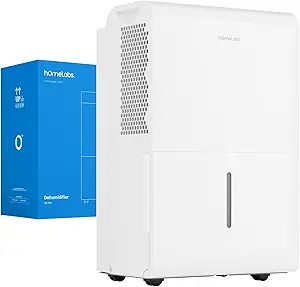 |
| Most Popular A crowd favorite that many people choose with confidence | BEDRED CT11 Dehumidifier |  |
| Best Seller A high-volume bestseller chosen again and again | OWAAE Dehumidifier TZ-C4S |  |
AEOCKY LEO-Lite 74 Pint Dehumidifier

| Capacity | 74 pints per day |
|---|---|
| Tank Volume | 1.45 gallons |
| Floor Area | 4500 square_feet |
| Operation Mode | Auto |
| Other Special Features of the Product | Timer |
The AEOCKY LEO-Lite is a high-capacity compressor dehumidifier built for large, damp spaces like basements. It removes up to 74 pints per day under peak conditions and uses a rotary compressor and a 3+2 evaporator/condenser layout to prioritize efficiency while keeping noise low. Controls include an intelligent humidistat with fast humidity sensing, an auto mode and timer, plus power-off memory for automatic recovery after outages. A 1.45 gallon tank and included drain hose let you choose between emptying the tank or continuous drainage. The unit meets ENERGY STAR Version 6.0 efficiency standards, so it runs more economically than many older basement models and includes an auto-defrost system to keep working in cooler basement temperatures. It is fairly quiet at low speed and is aimed at continuous or near-continuous operation for moisture control. Trade-offs are its single-speed fan control and relatively large footprint compared with tiny portable units, so it is best where sustained extraction and energy savings outweigh simple portability.
Best for: Buyers who want an efficient, high-capacity dehumidifier to control persistent basement humidity and reduce energy use over long runtimes.
Less Ideal for: If you need a lightweight, highly portable unit for small rooms or infrequent use, a compact low-capacity dehumidifier is a better fit.
- High dehumidification capacity rated at 74 pints per day for heavy basement humidity
- ENERGY STAR Version 6.0 rating for improved seasonal energy efficiency
- Auto-defrost keeps the unit operating in cool basement temperatures
- Included drain hose plus 1.45 gallon tank enables continuous drain or manual emptying
- Quiet operation for its class thanks to rotary compressor and low fan noise
- Single speed setting limits fine-grained control of airflow and sound
- Relatively large and heavier than compact room dehumidifiers
Verdict: Choose the LEO-Lite when you need a quiet, energy-efficient, high-capacity dehumidifier built to run continuously in a basement.
ALORAIR Storm 80X

| Capacity | 170 pints |
|---|---|
| Air Flow Capacity | 200 cfm |
| Wattage | 607 watts |
| Dehumidification Capacity | 21.25 gallons_per_day |
The ALORAIR Storm 80X is a compact commercial LGR dehumidifier built for heavy moisture loads and repeated jobsite use. It delivers up to 170 pints per day at saturation (80 PPD AHAM) driven by a 200 CFM airflow and includes a built-in condensate pump with a 19.6 ft hose for hands-off drainage. The rotomolded housing and retractable handle with wheels make it easy to move around a garage or workshop while resisting dents and impacts. Controls are straightforward with automatic defrost, auto on/off, memory restart, and automatic power recovery for unattended drying. Its COP rating indicates relatively efficient operation for a unit in this capacity, but it still draws significant power and is aimed at performance over quiet operation. The Storm 80X is excellent for rapid drying after water intrusion or for persistent damp garages, but its industrial focus means it is larger and louder than consumer home units and may be overkill for small spaces or occasional use.
Best for: Buyers who prioritize fast, reliable moisture removal in garages and workshops and need a rugged, jobsite-capable dehumidifier that can run continuously with pump drainage.
Less Ideal for: Those who need a quiet, low-power unit for occasional use in small or finished garage spaces should consider smaller consumer models instead.
- High dehumidification: up to 170 pints per day (saturation) and 80 PPD AHAM for fast moisture removal
- Built-in condensate pump with 19.6 ft hose and 19.6 ft vertical lift for convenient continuous drainage
- Durable rotomolded housing resists impacts and warping on jobsite or garage floors
- Compact, portable package with retractable handle and wheels for easy repositioning
- Automatic defrost and auto recovery features allow reliable unattended operation in variable conditions
- This commercial-capacity unit consumes substantial power compared with consumer dehumidifiers
- Larger and louder than residential units, which may be disruptive in finished garages
Verdict: A rugged, high-capacity dehumidifier built to clear heavy moisture loads quickly in garages and workshop environments.
DGVAM V1 Dehumidifier

| Dehumidification Capacity | 45 pints_per_day |
|---|---|
| Floor Area | 4500 square_feet |
| Capacity | 1.72 gallons |
| Operation Mode | Automatic |
The DGVAM V1 is a portable compressor dehumidifier aimed at large rooms, basements, and garages where persistent damp is a problem. It removes moisture at a rated 45 pints per day in typical operation (advertised up to 80 pints/day in peak conditions) and offers automatic humidity control so it can run hands-free to maintain a target level. Practical features include a 1.72 gallon collection tank with full-alert plus a continuous drain hose option for long unattended runs, auto defrost for cooler spaces, and multiple modes including high-power and ventilation. Controls are straightforward, there is a child lock and 24-hour timer, and the unit is designed for low-noise operation around 40 dB for nighttime use. Trade-offs are typical of compressor dehumidifiers: it is heavier than small room units and needs access to power and occasional filter cleaning, and real-world water removal will vary with temperature and humidity. For garage or basement use it delivers strong moisture control with convenient continuous-drain capability.
Best for: Someone optimizing a garage or basement for dry, usable space who wants robust, mostly hands-off moisture control with the option for continuous drainage.
Less Ideal for: Buyers who need an ultra-lightweight or battery-powered solution for small rooms or occasional spot use should consider smaller portable dehumidifiers instead.
- Continuous drain hose plus removable 1.72 gallon tank for flexible unattended operation
- Automatic humidity control for hands-free, set-and-forget dehumidifying
- Auto defrost and power-off memory allow reliable year-round and restart performance
- Multiple operating modes including high-power and ventilation to match conditions
- Relatively quiet operation around 40 dB suitable for nearby living spaces
- Real-world pint removal depends on temperature and humidity and may be lower than peak advertised figures
- Unit is relatively heavy for a portable appliance and requires power access for continuous use
Verdict: Choose this unit if you need a durable, hands-off dehumidifier for garages or basements with continuous-drain capability and automatic humidity control.
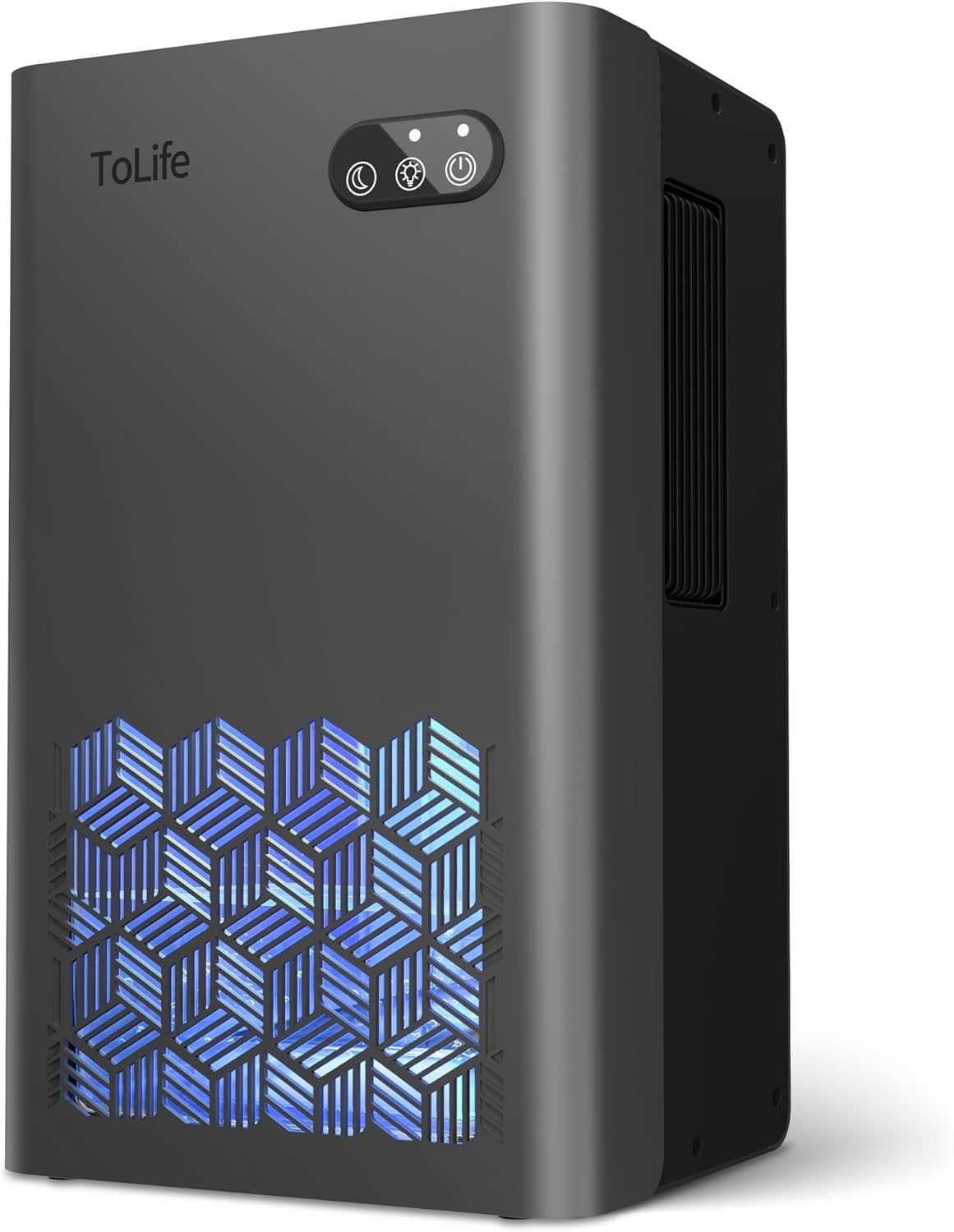
ToLife Dehumidifier TZ-C2
| Floor Area | 1000 |
|---|---|
| Tank Volume | 95 fluid ounces |
| Number of Speeds | 2 |
| Wattage | 93 watts |
| Voltage | 220 volts |
The ToLife TZ-C2 uses semiconductor condensation technology to quietly pull moisture from the air and deposit it into a removable 95 oz tank, making it a straightforward option for damp rooms. It offers two operating modes: a higher-power setting for faster moisture removal and a low-speed sleep mode that runs under 30 dB for overnight use. A seven-color LED can act as a night light and the unit includes automatic shutoff when the tank is full or removed, plus handles for easy moving between rooms. Practical benefits include simple setup, low noise, and a compact footprint that fits in basements, bathrooms, or bedrooms. Limitations are its modest rated dehumidification capacity and stated coverage, which means it will be most effective in smaller basement zones or for spot treatments rather than drying a large, very damp basement quickly. Also this model runs on 220 volts, so electrical compatibility should be confirmed for your location.
Best for: Buyers who need an affordable, portable dehumidifier for spot dehumidifying small basement areas, bathrooms, or bedrooms and who prioritize low noise and easy portability.
Less Ideal for: People looking to dry large, very damp basements or whole-house coverage should consider a higher-capacity compressor dehumidifier instead.
- Large removable 95 oz water tank reduces how often you need to empty it
- Quiet sleep mode under 30 dB suitable for nighttime operation
- Portable design with handles for moving between rooms
- Automatic shutoff prevents overflow when the tank is full
- Dehumidification capacity is modest and may be slow in very damp or large basements
- Requires 220 volt power which may not match all household outlets
Verdict: A compact, budget-friendly portable dehumidifier that is best for quiet, small-area moisture control and occasional basement spot treatments.
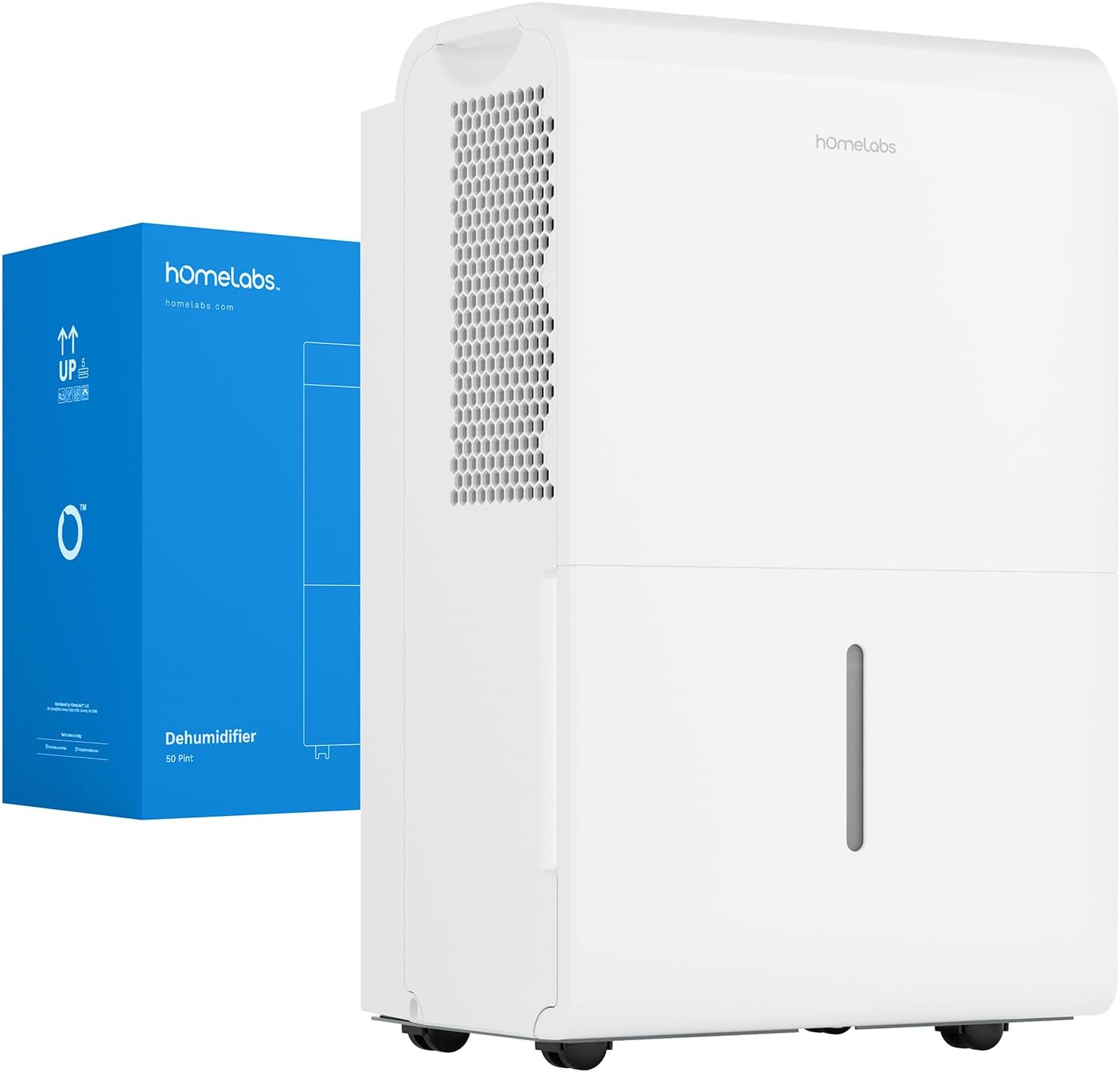
hOmeLabs 50 Pint Dehumidifier
| Dehumidification Capacity | 50 pints_per_day |
|---|---|
| Floor Area | 7000 square_feet |
| Wattage | 322 watts |
| Air Flow Capacity | 165 cfm |
| Capacity | 1.6 gallons |
This hOmeLabs 50 Pint dehumidifier is built to remove moisture from very large areas and offers practical controls for hands‑off operation. It is rated to handle up to 7,000 sq ft and pulls up to 50 pints per day under standard test conditions, with higher capacity possible in hotter, more humid conditions. Typical use is continuous moisture control in basements, garages, or large open rooms using either the internal tank or a continuous drain outlet for unattended operation. Notable features include Wi‑Fi remote control, a touch control panel, automatic restart and defrost, washable filter, and two speed settings that balance airflow and noise. The unit is reasonably efficient for its class at 322 watts and provides a quiet fan and caster wheels for easy repositioning. Expect reliable basic performance and straightforward maintenance, but note the tank is moderate in size so continuous drainage is recommended for heavy daily loads and the unit is fairly heavy to move without using the wheels.
Best for: Buyers who prioritize a dependable, always‑on solution for tackling high humidity in large garages or similar large spaces and who value remote control and easy continuous drainage.
Less Ideal for: People who need a very lightweight or compact unit for small closets or infrequent, portable spot use should consider smaller models instead.
- Rated to dehumidify large spaces up to 7,000 sq ft and remove 50 pints/day
- Wi‑Fi control lets you monitor and change settings remotely
- Continuous drainage option for unattended heavy‑use operation
- Automatic defrost, restart, and auto shutoff simplify maintenance
- Washable filter and caster wheels for easy upkeep and mobility
- Moderate internal tank size means frequent emptying without a drain hose
- Unit is relatively heavy, making manual lifting awkward despite wheels
Verdict: A robust, Wi‑Fi‑enabled dehumidifier made to reliably control humidity across large garages when continuous drainage and remote control matter most.
BEDRED CT11 Dehumidifier

| Floor Area | 1000 square_feet |
|---|---|
| Tank Volume | 95 fluid ounces |
| Capacity | 5.9 pounds |
| Operation Mode | Intermittent |
| Other Special Features of the Product | 7 Color Ambient Light, Automatic Shutoff, Sleep Mode |
The BEDRED CT11 is a compact thermoelectric dehumidifier intended to reduce humidity in small spaces such as bedrooms, bathrooms, and modest basements up to about 1000 sq ft. It uses semiconductor cooling rather than a compressor, so it runs quietly and is simple to operate with an intermittent operation mode and an automatic shutoff when the 95 oz tank fills. Sleep Mode turns off the lights and lowers noise for overnight use, and the seven-color ambient light gives an optional mood-lighting feature. Practical benefits include easy emptying from the included tank, portability thanks to a lightweight design, and low sound levels that suit living spaces. Important limitations are inherent to semiconductor units: lower capacity compared with compressor dehumidifiers, reduced performance in very cold or very damp basements, and a smaller tank that requires more frequent emptying in high-humidity conditions.
Best for: Buyers who prioritize quiet, low-maintenance dehumidification and want a compact unit that is easy to move and run in living spaces or small basements without frequent intervention.
Less Ideal for: People needing heavy-duty moisture control for large, cold, or very damp basements should choose a higher-capacity compressor dehumidifier instead.
- Quiet thermoelectric operation suitable for bedrooms and living rooms
- Automatic shutoff protects against overfill and simplifies unattended use
- 95 oz removable tank for straightforward water removal
- Sleep Mode and ambient light options for low‑noise nighttime use
- Compact and lightweight for easy placement or moving between rooms
- Semiconductor cooling gives lower moisture removal capacity than compressor models
- Performance drops in cold basement conditions and very high humidity areas
Verdict: Choose the BEDRED CT11 if you want a quiet, portable dehumidifier with auto‑shutoff and sleep‑friendly operation for small basements or living spaces.
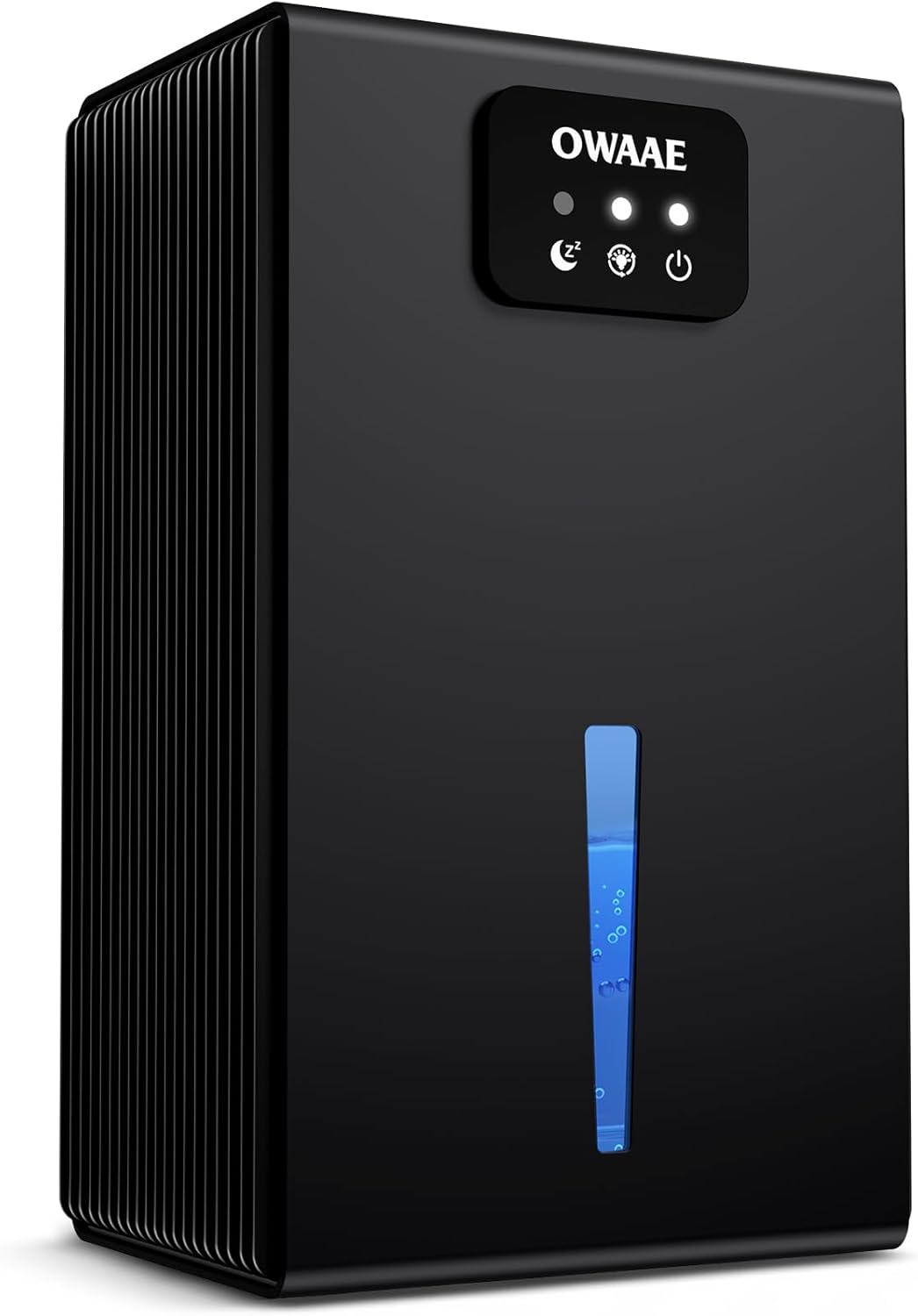
OWAAE Dehumidifier TZ-C4S
| Capacity | 95 fluid ounces |
|---|---|
| Tank Volume | 95 |
| Floor Area | 1000 |
| Operation Mode | Comfort |
This OWAAE TZ-C4S is a compact portable dehumidifier intended for enclosed spaces such as garages, bathrooms, closets, and RVs where humidity builds up. It pulls moisture into a removable 95 oz tank and stops automatically when the tank is full or not seated, which reduces the risk of spills. The unit has a low-noise sleep mode under 30 dB for quiet operation and a built-in handle for easy placement. A seven-color LED provides ambient lighting, and the unit is described as suitable for areas up to about 1000 square feet, making it a fit for single-car garages or sections of larger garages. Practical strengths are its simple controls, portability, and automatic shutoff safety, but buyers should note this is a small-capacity, portable machine rather than a commercial or whole-garage dehumidifier, so it will require regular emptying during very damp conditions and may be slower to lower humidity in large open garage spaces.
Best for: Buyers who want a low-noise, easy-to-use portable dehumidifier that adds safety features like auto shutoff and is intended to control damp spots in a garage without complex setup.
Less Ideal for: People needing rapid dehumidification for a whole large garage, workshop, or consistently very wet spaces should choose a larger-capacity, commercial-style unit instead.
- Large removable 95 oz water tank with automatic shutoff to prevent spills
- Ultra-quiet sleep mode under 30 dB suitable for overnight operation
- Compact, lightweight design with built-in handle for easy placement and portability
- Built to cover up to roughly 1000 sq ft, suitable for small garages or localized damp areas
- Not a heavy-duty or whole-garage commercial dehumidifier, so performance in very large or open garages may be limited
- Small tank requires frequent emptying in persistently high-humidity conditions
Verdict: Choose this unit if you want a portable, quiet dehumidifier with automatic shutoff for controlling damp zones in a garage without installing a larger system.
Choosing the Right Dehumidifier for Garages: Key Factors to Consider
Capacity Rated for Garage Size
Dehumidifier capacity is usually stated in pints removed per day and is the single most important spec for garage use. Garages are often larger and less insulated than bedrooms, so choose a unit rated for the square footage and expected humidity levels. A small-capacity unit will run constantly and struggle to reach target humidity, while an adequately rated model will cycle less and deliver steady protection.
Also account for seasonal variation. In humid climates or during summer months, a higher-capacity unit prevents excessive runtime and reduces the chance of mold or condensation on tools and stored materials.
Durability And Dust Resistance
Garages expose appliances to dust, dirt, and wider temperature swings, so construction quality matters. Look for units with protective grills, washable filters, and corrosion-resistant coils or coatings. A rugged cabinet and stable feet or casters help the unit survive bumps and occasional rough handling.
Durable components reduce the need for repairs and extend service life. Consider units with easily replaceable filters and accessible panels so you can perform routine cleaning without special tools.
Drainage Options And Maintenance
How a dehumidifier handles collected water affects how hands-off it can be. For garages, continuous drain capability via a hose is often preferable so you do not have to empty a bucket regularly. If a pump is included, it enables uphill discharge to a sink or floor drain. For gravity-only drains, verify the access to a low drain point in your garage layout.
Maintenance also includes how easy it is to clean the water bucket and filters. Units with clear water-level indicators and removable trays simplify upkeep, which matters when the unit operates frequently.
Energy Use And Runtime
Because garage dehumidifiers may run for extended periods, energy consumption becomes a practical concern. Check energy efficiency metrics and features like automatic shutoff, timers, or humidistats that prevent needless operation. An efficient unit with accurate humidity sensing reaches setpoints faster and cycles less, lowering operating cost over time.
Consider units with adjustable fan speeds so you can trade off faster moisture removal for quieter, more efficient operation when necessary.
Noise And Placement Flexibility
Noise matters if your garage doubles as a workshop, home gym, or adjacent living space. Look for models with lower operating decibel ratings or selectable low-noise modes. Placement flexibility such as caster wheels, handles, and the option to wall-mount or position near a drain expands where you can put the unit without obstructing workflow.
Also think about airflow clearance. Proper placement away from walls and stored items improves efficiency and reduces bounce-back humidity.
Temperature Range And Cold-Climate Performance
Garages can get cold in winter, and some dehumidifiers stop dehumidifying efficiently or risk coil freezing at low ambient temperatures. If your garage is unheated, prioritize units rated for low-temperature operation or those with auto-defrost. Reliable cold-weather performance prevents ice buildup that can damage the unit or stop moisture removal when you need it most.
If you only use the garage seasonally, a model that handles a wide temperature range still offers better long-term value and reduces the likelihood of service issues.
Sizing Your Garage
Measure the floor area and consider ceiling height to estimate the air volume you need to dehumidify. Standard capacity charts assume 8-foot ceilings; if your garage has higher ceilings or mezzanines, increase the capacity accordingly. Also factor in how often the garage door is opened and whether the space is insulated, because uninsulated spaces invite more humid air and require more capacity.
A practical approach is to match capacity to both square footage and expected humidity level. For rarely used or lightly insulated garages, choose the next size up from what small-room charts recommend.
- Confirm actual usable floor space before sizing
- Add capacity for high ceilings or attached storage lofts
- Increase capacity for frequent door openings or uninsulated walls
Placement And Drainage Best Practices
Place the dehumidifier where airflow is unobstructed and where it can draw in the most humid air. Avoid tucking the unit tightly against stored items or walls. If you plan to use continuous drainage, position the unit near a low drain point or plan for a discharge hose route that maintains a downward slope.
For units with internal pumps, ensure the pump elevation and discharge path are compatible with your garage layout. If using a bucket-only unit, position it where emptying is convenient and where accidental spills will not cause damage.
- Allow several inches of clearance on intake and exhaust sides
- Use a hose with a secure connection for continuous drain
- Elevate electrical cords to avoid water contact
Maintenance Routine For Garage Use
Set a simple maintenance schedule to keep the unit operating reliably. Check and clean washable filters every 1 to 3 months depending on dust levels. Inspect the condensate path for blockages and clean the water bucket and tray to prevent biofilm buildup. If the unit has a pump, test the pump periodically to ensure it runs and discharges properly.
Record operating hours or use the unit's runtime indicator to plan preventative service. Routine maintenance reduces performance degradation and prolongs the dehumidifier's useful life in a dusty garage environment.
- Clean filters monthly in high-dust garages
- Flush or sanitize reservoirs seasonally
- Inspect hoses and fittings for wear or leaks
When To Choose A Portable Unit Versus A Fixed Setup
Portable dehumidifiers give flexibility to move the unit to problem areas, which is useful if you sometimes use a garage as a workshop and sometimes for storage. They are also simpler to install and can be used in other parts of the house if needed. Fixed setups, such as permanently plumbed units or larger capacity models with dedicated drainage, are better when you need continuous, hands-off operation for an entire garage.
Consider how often you will need to reposition the unit and whether you can route a permanent drain. Portables are ideal for occasional use or targeted moisture control, while fixed installations suit continuous protection for an always-occupied or high-value storage area.
- Portables: flexibility and no permanent plumbing
- Fixed/plumbed: continuous drainage and hands-off operation
- Match the choice to how you use the garage most often
Protecting Stored Items And Workshop Tools
Target a relative humidity range that prevents rust and mold without over-drying sensitive materials. Many garages benefit from a setpoint in the 40 to 50 percent range. Use the dehumidifier's humidistat and consider a separate humidity monitor to verify conditions in different parts of the garage.
Store vulnerable items off concrete floors and away from exterior walls when possible. A dehumidifier reduces ambient moisture, but proper storage and occasional inspections are still necessary to protect tools and materials.
- Aim for 40 to 50 percent relative humidity
- Use a second hygrometer to confirm conditions
- Elevate sensitive items and avoid direct floor contact
How We Chose the Best Dehumidifier for Garages
We focused on features and performance that matter for garages rather than living spaces. Selection prioritized continuous moisture removal capacity rated for larger, unfinished spaces, durability of components for dusty and variable-temperature environments, and user-friendly maintenance for regular condensate handling. Energy efficiency and runtime were weighted because many garage units run for long stretches and should not drive up utility use. Noise and mounting or placement flexibility were considered to ensure the unit fits typical garage workflows and does not interfere with work. We excluded units designed only for closets or small rooms and products intended strictly for portable indoor living spaces. Final selections reflect units that meet capacity, durability, maintenance, and efficiency thresholds appropriate for garage conditions.
Our full evaluation process is outlined in our review methodology.
FAQ
What dehumidifier capacity do I need for a two-car garage?
Capacity depends on square footage, ceiling height, insulation, and local humidity. For a typical two-car garage, choose a unit rated for larger rooms or small basements and consider upsizing if the space is uninsulated or frequently open to outside air.
Can I run a garage dehumidifier year-round?
Often yes, but winter operation depends on the unit's low-temperature rating. Choose a model with auto-defrost or cold-climate capability if your garage gets near freezing. Otherwise, seasonal operation during warmer months may suffice.
Is continuous drain necessary for garage use?
Continuous drain is highly convenient for garages because it avoids frequent bucket emptying, especially in humid climates. If you have a nearby drain or can route a hose downhill, continuous drainage reduces maintenance.
How noisy are garage dehumidifiers compared with home models?
Garage-oriented units can be similar in noise to home models but may prioritize airflow and capacity over whisper-quiet operation. Look for selectable fan speeds or low-noise modes if the garage doubles as a workspace.
Will a dehumidifier prevent rust entirely?
A dehumidifier reduces ambient moisture and lowers the risk of rust, but it does not guarantee complete prevention. Proper storage, humidity monitoring, and keeping metal items clean and dry all help reduce corrosion risk.
Final Verdict
For garage applications, prioritize a dehumidifier with the right capacity for your space, durable construction that tolerates dust and temperature swings, and a drainage solution that fits your layout. Balance energy efficiency and noise against the need for continuous operation. If your garage is unheated, ensure the unit supports low-temperature operation or has an auto-defrost feature. Choose a model that aligns with how you use the garage and you will minimize moisture-related damage while keeping maintenance manageable.