
Note: This article contains affiliate links. If you click on these links and make a purchase, we may earn a small commission at no extra cost to you. This helps support our research and content. Read our full affiliate disclosure here.
Humidity and condensation are constant challenges on boats. Excess moisture can damage woodwork, corrode fittings, and encourage musty odors and mold in enclosed cabins. Selecting the right dehumidifier for a boat cabin helps protect finishes and stored gear while keeping the interior comfortable. This guide highlights seven shortlisted dehumidifiers suited to marine cabins and small enclosed spaces. We focused on models that balance moisture removal, low power consumption, quiet operation, and easy upkeep. Read on to see the practical criteria used to evaluate these choices and find the option that fits your cabin size and cruising routine.
Top Picks at a Glance
| Best Overall The best all-around choice for most situations | Ivation Small Thermo-Electric Dehumidifier IVADM10 |  |
| Best Quality Built to a higher standard if you want something more solid | Davis Air-Dryr 1000 |  |
| Best Value The sweet spot between price and what you get | DampRid Refillable Moisture Absorber 11 oz |  |
| Best Budget The cheapest option that still gets the job done reliably | STAR BRITE No Damp Moisture Absorber 12 oz |  |
| Top Rated A top-rated pick with lots of positive feedback | Davis Air-Dryr 500 |  |
| Most Popular A crowd favorite that many people choose with confidence | Pro Breeze PB-02 Mini Dehumidifier |  |
| Best Seller A high-volume bestseller chosen again and again | BEDRED CT11 Dehumidifier |  |
Ivation Small Thermo-Electric Dehumidifier IVADM10

| Dehumidification Capacity | 6 pints_per_day |
|---|---|
| Tank Volume | 17 fluid ounces |
| Wattage | 13.5 watts |
| Floor Area | 1100 square_feet |
| Operation Mode | Continuous |
The Ivation IVADM10 is a tiny thermo-electric dehumidifier that uses Peltier technology to quietly pull moisture from confined spaces. It is intended for small rooms and enclosures up to about 1,100 cubic feet and is often used in boat cabins, RVs, closets, and small basements. The unit collects water in a removable 17-ounce tank and turns off automatically when the reservoir is full, with an LED indicator to show tank status. Its washable air filter and lack of compressor mean very low noise and simple maintenance, and the included DC adapter and low wattage keep power use minimal in boats or off-grid setups. Expect modest daily extraction—specs list roughly 6 pints per day under ideal conditions but real-world output in warm, humid conditions will be closer to a few ounces to a pint daily in a small cabin. The small tank requires periodic emptying and the Peltier design is less effective than compressor units in cooler temperatures, so it is best as spot moisture control rather than whole-boat dehumidification.
Best for: Boat owners wanting a compact, low-noise solution to control dampness in a single cabin or small enclosed space where power is limited and quiet operation matters.
Less Ideal for: Do not choose this for drying large cabins, entire boats, or cold storage areas where a higher-capacity compressor dehumidifier is required.
- Whisper-quiet Peltier operation suitable for sleeping areas
- Very compact and lightweight for tight boat cabin spaces
- Removable 17 oz tank with auto shutoff and LED tank-full indicator
- Low power consumption with included DC adapter for limited-power environments
- Washable air filter for easy maintenance
- Small water tank means frequent emptying on very humid days
- Peltier technology is less effective in cool ambient temperatures compared with compressor models
Verdict: A tiny, ultra-quiet Peltier dehumidifier that fits boat cabins and other small spaces where low noise and low power draw are the top priorities.
Davis Air-Dryr 1000

| Floor Area | 1000 square_feet |
|---|---|
| Capacity | 1 g |
| Other Special Features | Overheat Protection, Safe for Marine Use |
The Davis Air-Dryr 1000 is a small, silent convection dryer that steadily moves cool, moist air through a low-wattage heater to keep interior surfaces dry and prevent condensation. It is intended for continuous, unattended operation in tight, lightly ventilated spaces such as boat cabins, RVs, or storage areas and uses roughly the power of a 100-watt light bulb. Notable features include an internal thermal cut-off for safety and a design that promotes air circulation rather than active moisture collection, so it suspends moisture in the air for exhaust via ventilation instead of storing water. That makes it energy efficient and simple to run 24/7, but it will not lower relative humidity like a mechanical dehumidifier with a condensate tank or compressor; performance depends on ventilation to remove humid air. The unit is lightweight and marine-safe, so it is easy to install or move, and its quiet operation suits living spaces. If you need continuous condensation control in a boat cabin without heavy power draw, this unit is practical; if you need rapid humidity reduction or water removal, a true dehumidifier is a better choice.
Best for: Buyers who prioritize low power use and quiet, continuous condensation prevention in small enclosed spaces like boat cabins and want a simple, marine-safe device rather than a moisture-collection dehumidifier.
Less Ideal for: Those who need fast humidity reduction or active water removal from the air should choose a compressor or desiccant dehumidifier instead.
- Very low power consumption comparable to a 100-watt bulb
- Designed for continuous silent operation suitable for cabins and small living spaces
- Thermal cut-off adds safety if airflow is blocked
- Lightweight and portable for use in boats, RVs, or storage areas
- Does not remove or collect water, so it cannot lower humidity quickly
- Effectiveness depends on available ventilation to exhaust moist air
Verdict: Choose the Davis Air-Dryr 1000 when you need a quiet, low-power, marine-safe solution to prevent condensation in a small boat cabin rather than rapid removal of humidity.
DampRid Refillable Moisture Absorber 11 oz

| Floor Area | 250 square_feet |
|---|---|
| Tank Volume | 11 fluid ounces |
| Operation Mode | Continuous |
| Unit Count | 66 Ounce |
These DampRid refillable cups work as a passive dehumidifier that needs no power, making them useful in small damp spaces. The 11-ounce cups use moisture-absorbing crystals you refill after the reservoir fills, and the manufacturer says each cup can last up to about 45 days depending on conditions. In practice they are simple to place in cabins, closets, bathrooms, or under sinks where condensation and stale smells build up. The decorative outer shell hides the crystals and the clear inner reservoir makes it easy to tell when to empty and refill. Because they do not require electricity there is no fan noise and no drainage hoses, but their capacity is limited to small areas and they perform more slowly than powered dehumidifiers. They are best for spot control and odor reduction rather than lowering whole-cabin humidity quickly. For routine maintenance you will need replacement crystals and occasional emptying of captured liquid, and the product cautions against contact with leather or metal surfaces.
Best for: A practical buyer who needs quiet, low-maintenance humidity control for small enclosed areas like a boat cabin, closet, or locker and prefers a refillable, non-electric solution.
Less Ideal for: Not a good choice for crews who need to dehumidify large cabins, whole boats, or rapidly remove heavy condensation where an electric dehumidifier is required.
- Requires no electricity so it is quiet and safe for enclosed spaces
- Refillable design and clear reservoir make it easy to monitor and maintain
- Decorative outer cup blends into cabins, closets, and small rooms
- Advertised longer life per fill compared with the smaller 10.5 oz cups
- Limited moisture-collection capacity makes it unsuitable for large or very humid spaces
- Slower to reduce humidity than an electric dehumidifier and requires regular refills
Verdict: Choose these refillable DampRid cups when you want a quiet, electricity-free way to control spot moisture and musty odors in a small boat cabin.
STAR BRITE No Damp Moisture Absorber 12 oz

| Capacity | 340 ml |
|---|---|
| Tank Volume | 12 fluid ounces |
| Floor Area | 100 square_feet |
| Operation Mode | Continuous |
The STAR BRITE No Damp Moisture Absorber is a simple, battery‑free moisture control solution for small enclosed spaces like boat cabins, RV heads, closets and storage compartments. It uses moisture‑absorbing crystals that draw humidity out of the air and deposit the collected liquid into a 12‑ounce container, which you empty or replace when full. Its continuous operation and compact, refillable design make it easy to hang or set inside tight areas where a plug‑in dehumidifier is impractical. Because it does not require power it is quiet and low maintenance, and it helps reduce musty odors and the risk of mildew or corrosion on stored gear. Limitations are its modest capacity and limited coverage area, so it is best for small cabins or lockers rather than whole cabins on larger boats, and the disposable nature of spent crystals means ongoing refill purchases for long‑term storage use.
Best for: Buyers wanting a low‑cost, low‑effort way to control humidity in small boat cabins, lockers, or heads during storage and short trips.
Less Ideal for: People who need whole‑cabin dehumidification for larger boats or continuous climate control should choose a powered dehumidifier instead.
- Works without power so it is safe and silent in boats and enclosed spaces
- Compact and portable for hanging or placing in lockers, heads, and small cabins
- Collects liquid in a container for easy disposal, reducing spill risk
- Helps prevent musty odors, mildew smells, and moisture damage to stored gear
- Designed for small spaces only and will not handle large cabin areas effectively
- Requires periodic replacement or refilling of crystals for continued protection
Verdict: A cheap, maintenance‑light, non‑electric option that keeps small boat cabins and lockers dry and odor‑free.
Davis Air-Dryr 500
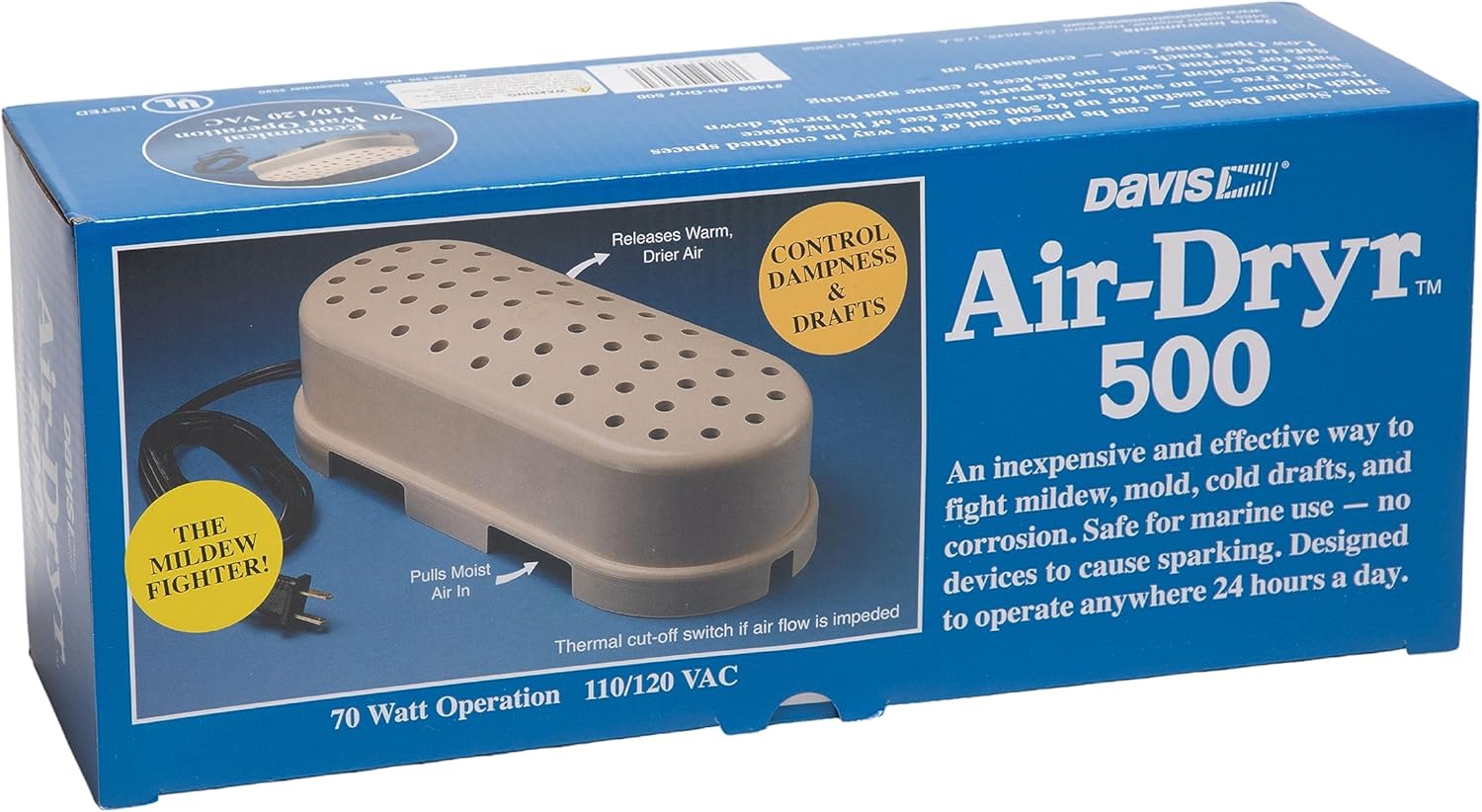
| Floor Area | 500 square_feet |
|---|---|
| Capacity | 1 g |
| Operation Mode | Continuous |
| Other Special Features | Quiet Operation, Low Maintenance, Energy Efficient, Safety Features |
The Davis Air-Dryr 500 is a slim, lightweight continuous air dryer built for low-maintenance, around-the-clock moisture control in confined spaces such as boat cabins and RVs. It moves a high volume of air through a non-electric desiccant medium, so there are no thermostats, fans, or sparking components—making it safe for marine use and suitable for permanent installation. It is quiet in operation, energy efficient to run continuously, and includes a thermal cutoff to prevent overheating if vents are blocked. Typical use is wall- or shelf-mounted near wet areas where it passively dries the air while using very little power. The unit holds about 1 gallon capacity and is made of durable polycarbonate plastic with a built-in handle for repositioning. Limitations are its modest capacity and coverage (rated for about 500 sq ft) and the need to empty collected moisture manually; it is not a high-capacity compressor dehumidifier and will be slower in very humid climates or larger cabins.
Best for: Buyers who prioritize a reliable, low-maintenance dehumidifier for a boat cabin or small enclosed space and want a unit that can run continuously without complex controls.
Less Ideal for: Those needing fast moisture removal for large cabins, whole boats, or very humid climates should choose a higher-capacity compressor dehumidifier instead.
- Designed for continuous 24/7 operation with low running cost
- Quiet and safe for marine use with no sparking components
- Thermal cutoff protects against overheating if vents are blocked
- Slim, durable polycarbonate housing fits in confined spaces
- Small 1 gallon capacity requires frequent emptying in very damp conditions
- Not suited for rapid dehumidification of large interiors or extremely humid environments
Verdict: A dependable, low-maintenance continuous air dryer built for quiet, safe 24/7 moisture control in small boat cabins.
Pro Breeze PB-02 Mini Dehumidifier

| Floor Area | 215 square_feet |
|---|---|
| Capacity | 16 fluid ounces |
| Tank Volume | 17 fluid ounces |
| Wattage | 21 watts |
| Dehumidification Capacity | 0.25 liters_per_day |
The Pro Breeze PB-02 is a lightweight, portable mini dehumidifier that uses Peltier (thermoelectric) technology to quietly pull moisture from small spaces such as a boat cabin, bathroom, or closet. It collects up to roughly 9 ounces (about 0.25 liters) per day into a 16–17 ounce tank and has an auto-shutoff and LED indicator when the reservoir is full. With continuous operation, low power consumption (around 21–23 watts) and whisper-quiet performance, it is suitable for overnight or continuous use without adding significant noise or electrical load. Its small footprint and included power adaptor make it easy to position in tight cabin corners or lockers. Limitations are the modest daily extraction rate and the need to empty the small tank frequently in persistently damp conditions, and like most thermoelectric units it will not operate well in cold environments below about 41°F. For light condensation control and maintaining comfort in a single cabin space, it is convenient; for heavy dampness, a larger compressor-style unit will be necessary.
Best for: Boat owners seeking a low-noise, low-power way to reduce light condensation and maintain comfort in a single cabin or small enclosed compartment.
Less Ideal for: Those needing to control heavy dampness, large cabins, or whole-boat moisture should choose a higher-capacity compressor dehumidifier or continuous-drain solution.
- Ultra-quiet Peltier operation suitable for overnight use
- Low power draw (about 21–23 watts) minimizes electrical load on boats
- Compact and lightweight for easy placement in tight cabin spaces
- Auto shut-off with LED indicator prevents overflow
- Small daily extraction rate (about 0.25 liters/day) requires frequent emptying in very damp conditions
- Does not operate effectively below ~41°F, limiting use in cold environments
Verdict: A compact, whisper-quiet, low-power dehumidifier that is well suited to controlling mild condensation in a single boat cabin.
BEDRED CT11 Dehumidifier

| Floor Area | 1000 square_feet |
|---|---|
| Tank Volume | 95 fluid ounces |
| Capacity | 5.9 pounds |
| Operation Mode | Intermittent |
| Other Special Features of the Product | 7 Color Ambient Light, Automatic Shutoff, Sleep Mode |
The BEDRED CT11 is a compact thermoelectric dehumidifier intended to reduce humidity in small spaces such as bedrooms, bathrooms, and modest basements up to about 1000 sq ft. It uses semiconductor cooling rather than a compressor, so it runs quietly and is simple to operate with an intermittent operation mode and an automatic shutoff when the 95 oz tank fills. Sleep Mode turns off the lights and lowers noise for overnight use, and the seven-color ambient light gives an optional mood-lighting feature. Practical benefits include easy emptying from the included tank, portability thanks to a lightweight design, and low sound levels that suit living spaces. Important limitations are inherent to semiconductor units: lower capacity compared with compressor dehumidifiers, reduced performance in very cold or very damp basements, and a smaller tank that requires more frequent emptying in high-humidity conditions.
Best for: Buyers who prioritize quiet, low-maintenance dehumidification and want a compact unit that is easy to move and run in living spaces or small basements without frequent intervention.
Less Ideal for: People needing heavy-duty moisture control for large, cold, or very damp basements should choose a higher-capacity compressor dehumidifier instead.
- Quiet thermoelectric operation suitable for bedrooms and living rooms
- Automatic shutoff protects against overfill and simplifies unattended use
- 95 oz removable tank for straightforward water removal
- Sleep Mode and ambient light options for low‑noise nighttime use
- Compact and lightweight for easy placement or moving between rooms
- Semiconductor cooling gives lower moisture removal capacity than compressor models
- Performance drops in cold basement conditions and very high humidity areas
Verdict: Choose the BEDRED CT11 if you want a quiet, portable dehumidifier with auto‑shutoff and sleep‑friendly operation for small basements or living spaces.
Choosing the Right Dehumidifier for Boat Cabin: Key Factors to Consider
Cabin Size and Placement
Knowing the internal volume of your cabin is the first step. A small day-cabin or cuddy cabin needs a much lower moisture removal capacity than a larger salon or pilothouse. Place the unit where airflow is least obstructed and where condensate can be routed conveniently to a drain or collection container.
Placement affects circulation and condensation control. A unit tucked behind cushions or inside a locker will underperform. Consider whether the dehumidifier will run continuously during overnight stays or only intermittently after heavy use, and choose a capacity and placement that matches that duty cycle.
Power Source and Consumption
Boaters often operate on limited electrical budgets, so a dehumidifier's wattage and ability to run on lower-voltage systems matter. Verify whether the unit operates on standard AC shore power, can be adapted to inverter power, or offers a 12 V option. Lower power draw reduces strain on batteries and generators during off-grid cruising.
Also consider duty cycle: some units run intermittently and draw bursts of power when the compressor cycles or when a heating element engages for desiccant regeneration. Review expected runtime and whether the boat's charging system can sustain continuous operation during wet seasons.
Moisture Removal Method
Dehumidifiers remove moisture either with refrigerant compression, desiccant materials, or Peltier (thermoelectric) systems. Refrigerant compressors remove larger volumes of water and are efficient for warmer conditions, while desiccant systems perform better at lower temperatures and in cooler cabins. Peltier units are compact and quiet but typically have much lower capacity.
Choose the method that matches your climate and typical cabin temperatures. For temperate or warm conditions, compressor units give faster dehumidification. For cool, unheated cabins or winter storage, desiccant systems or units rated for low ambient temperatures maintain effectiveness.
Drainage and Reservoir Options
Marine users need flexible drainage. Some dehumidifiers offer a built-in tank that must be emptied regularly, others have continuous drain ports to route water overboard or into bilge pumps. Continuous drainage reduces the need for frequent maintenance but requires a safe, gravity-fed routing or a condensate pump.
If you plan to leave a unit running unattended, prioritize models with reliable auto-shutoff and a continuous drain option. Also check the reservoir capacity if you expect intermittent use without a permanent drain line.
Durability and Corrosion Protection
Salt-laden air speeds up corrosion, so materials and coatings matter. Units with stainless-steel screws, plastic housings, or corrosion-resistant coatings on coils and internal components last longer in marine environments. Sealed electronics and protected control panels reduce failure risk from humid, salty air.
Consider also the ease of replacing vulnerable parts and whether components like filters or desiccant packs are serviceable without specialized tools.
Noise and User Comfort
Noise becomes a bigger issue in small cabins where there is little acoustic buffering. Check manufacturer noise ratings and prefer models with low decibel output or variable-speed fans that can be run quietly overnight. Fan noise, compressor hum, or periodic condensate pump cycles all affect comfort.
Also evaluate how vibration is isolated. A unit that transmits vibration to cabinetry or bunks will be more noticeable. Rubber mounts or a compact, balanced fan assembly reduce transmitted noise.
Choosing Between Compressor, Desiccant, and Thermoelectric Types
Each dehumidifier technology has strengths and limitations when used aboard. Compressor-based units remove the most water per hour and are efficient in warmer conditions, but their compressors can be louder and may struggle at low ambient temperatures. Desiccant units perform well in cooler cabins and are generally lighter and less prone to freezing, though they can require more power during regeneration cycles.
Thermoelectric or Peltier-style units are compact and quiet with no moving refrigerant, making them appealing for very small cabins or intermittent use, but they have much lower capacity and are best for light-duty moisture control or supplemental use.
- Compressor: high throughput, best for warm conditions
- Desiccant: effective in cool environments, lighter weight
- Thermoelectric: quiet and compact, low capacity
Mounting, Ventilation, and Airflow Tips
Secure mounting keeps the unit stable during motion and reduces noise. If possible, mount on a flat surface with vibration-damping pads and allow a few inches of clearance for inlet and outlet airflow. Strong airflow across the cabin helps the dehumidifier circulate drier air into pockets where condensation forms.
Avoid blocking vents with cushions or sails and consider small, low-power fans to distribute conditioned air from the dehumidifier to areas that tend to collect moisture, such as lockers or under-berth spaces.
- Allow clearance for inlet and outlet
- Use anti-vibration pads for mounting
- Add low-power fans to improve circulation
Safe Routing for Continuous Drainage
Continuous drainage is often the most convenient option for extended use. Plan a gravity-fed drain line that exits through a scupper or dedicated hull fitting. If gravity drainage is not possible, a small condensate pump can move water to a suitable discharge point, but ensure the pump and hose routing are secure against movement and chafe.
Use flexible, marine-grade hose and secure fittings to prevent leaks. Check drainage routes regularly for blockages and winterize or remove hoses if the boat will be stored in freezing conditions.
- Prefer gravity-fed drains where possible
- Use marine-grade hose and secure fittings
- Consider a condensate pump if necessary
Operating Strategies for Cruising and Storage
For active cruising, run the dehumidifier during damp weather or overnight to keep condensation from developing on cold surfaces. During storage, a continuous low-level run or a timer-based schedule reduces the chance of mold and mildew forming while minimizing power draw.
If leaving the boat unattended, set a safe humidity target and ensure continuous drainage or a large enough reservoir to avoid overflow. Also check that the unit's power source and any in-line fuses or breakers are rated for extended operation.
- Run during damp weather and overnight
- Use timers in storage to save power
- Ensure safe unattended operation with drainage
Maintenance Routines to Extend Service Life
Regular maintenance preserves performance and prevents failures. Clean or replace air filters as recommended, flush or empty condensate trays, and inspect coils for salt buildup. Wipe down external surfaces and check seals to prevent salt spray from corroding controls and fasteners.
Schedule a deeper inspection seasonally, focusing on electrical connections, fan bearings, and any sacrificial anodes or coatings. Keeping spare filters and service parts on board reduces downtime if a component needs replacing away from a service facility.
- Clean filters and condensate trays regularly
- Inspect coils and electronics for salt corrosion
- Carry spare consumables and basic spare parts
How We Chose the Best Dehumidifier for Boat Cabin
We focused on practical, marine-relevant performance and avoided features that only apply to large residential units. Selection prioritized devices that can operate safely in a damp, salt-air environment and that work efficiently on limited onboard power sources. Key evaluation criteria included moisture removal rate relative to typical small cabin volumes, power consumption and compatibility with 12 V or low-wattage shore/generator power, continuous drainage or condensate storage options, corrosion-resistant materials and coatings, and ease of maintenance including filter access and desiccant replacement or coil cleaning. Noise level during operation was also considered because prolonged use in a small cabin can affect comfort and sleep. We excluded units designed exclusively for full-time whole-house dehumidification or those that need heavy-duty electrical infrastructure. We also filtered out models lacking basic moisture control features such as adjustable humidity setpoints or automatic shutoff to avoid recommending underspecified equipment. The final shortlist balances moisture control, energy efficiency, durability in marine conditions, and user-friendly servicing.
Our full evaluation process is outlined in our review methodology.
FAQ
What humidity level should I aim for inside a boat cabin?
Aim for a relative humidity between 45 and 55 percent to minimize condensation and discourage mold growth. The ideal setting depends on temperature and ventilation, but staying in this range balances comfort and protection for woodwork and fabrics.
Can I run a dehumidifier on battery power while anchored?
You can run some low-wattage units from battery power if your charging system or generator can replenish the draw. Check the unit's power consumption and calculate expected runtime based on your battery bank and charging profile before relying on battery-only operation.
Will a small thermoelectric unit protect my boat during long-term storage?
Thermoelectric units help control minor humidity but have limited capacity. For long-term storage in damp climates, choose a higher-capacity desiccant or compressor unit or use multiple small units to ensure sufficient moisture removal.
Do I need to winterize a dehumidifier on a boat?
Yes. If temperatures will fall below the operating range of the unit, drain and store it in a dry place or use a model rated for low ambient temperatures. Protect hoses and pumps from freezing and follow the manufacturer's storage recommendations.
How often should I empty the water reservoir?
Reservoir emptying frequency depends on cabin humidity and unit capacity. In damp conditions, expect daily or every-few-days emptying for small tanks. If you need less frequent service, choose a continuous-drain setup or a larger reservoir.
Final Verdict
Selecting a dehumidifier for a boat cabin requires balancing moisture-removal capacity, power use, and marine durability. Prioritize a unit whose removal rate matches your cabin volume, that can operate on your available electrical system, and that offers reliable drainage for unattended use. Accept tradeoffs between noise, capacity, and low-temperature performance. Choose the features that align with how you use the boat—continuous protection during storage versus intermittent use while cruising—and plan for simple maintenance to keep the unit working effectively over time.