
Note: This article contains affiliate links. If you click on these links and make a purchase, we may earn a small commission at no extra cost to you. This helps support our research and content. Read our full affiliate disclosure here.
Boat interiors are uniquely vulnerable to moisture, salt air, and condensation that accelerate mildew, corrosion, and soft‑trim damage. Choosing the right dehumidifier for boat use matters because space, power availability, and marine environments change which features actually protect your vessel. This guide shortlists the top compact and marine-suitable dehumidifiers for boat environments and explains the practical tradeoffs. We evaluate units for moisture removal, energy draw, and fit in tight spaces so you can pick a unit that keeps cabins dry without straining shore or onboard power. Read on for the criteria we used and what to expect from the best options.
Top Picks at a Glance
| Best Overall The best all-around choice for most situations | SEEKR Stor-Dry 9406 Warm Air Circulator |  |
| Best Quality Built to a higher standard if you want something more solid | ALORAIR Storm 80X Dehumidifier |  |
| Best Value The sweet spot between price and what you get | Better Boat Moisture Absorber 4-Pack |  |
| Best Budget The cheapest option that still gets the job done reliably | Better Boat Hanging Dehumidifier Bags |  |
| Top Rated A top-rated pick with lots of positive feedback | ECOR PRO EPD50-PRO 50 Pint |  |
| Most Popular A crowd favorite that many people choose with confidence | TABYIK 35oz Dehumidifier DH-CS01 |  |
| Best Seller A high-volume bestseller chosen again and again | BEDRED CT11 Dehumidifier |  |
SEEKR Stor-Dry 9406 Warm Air Circulator
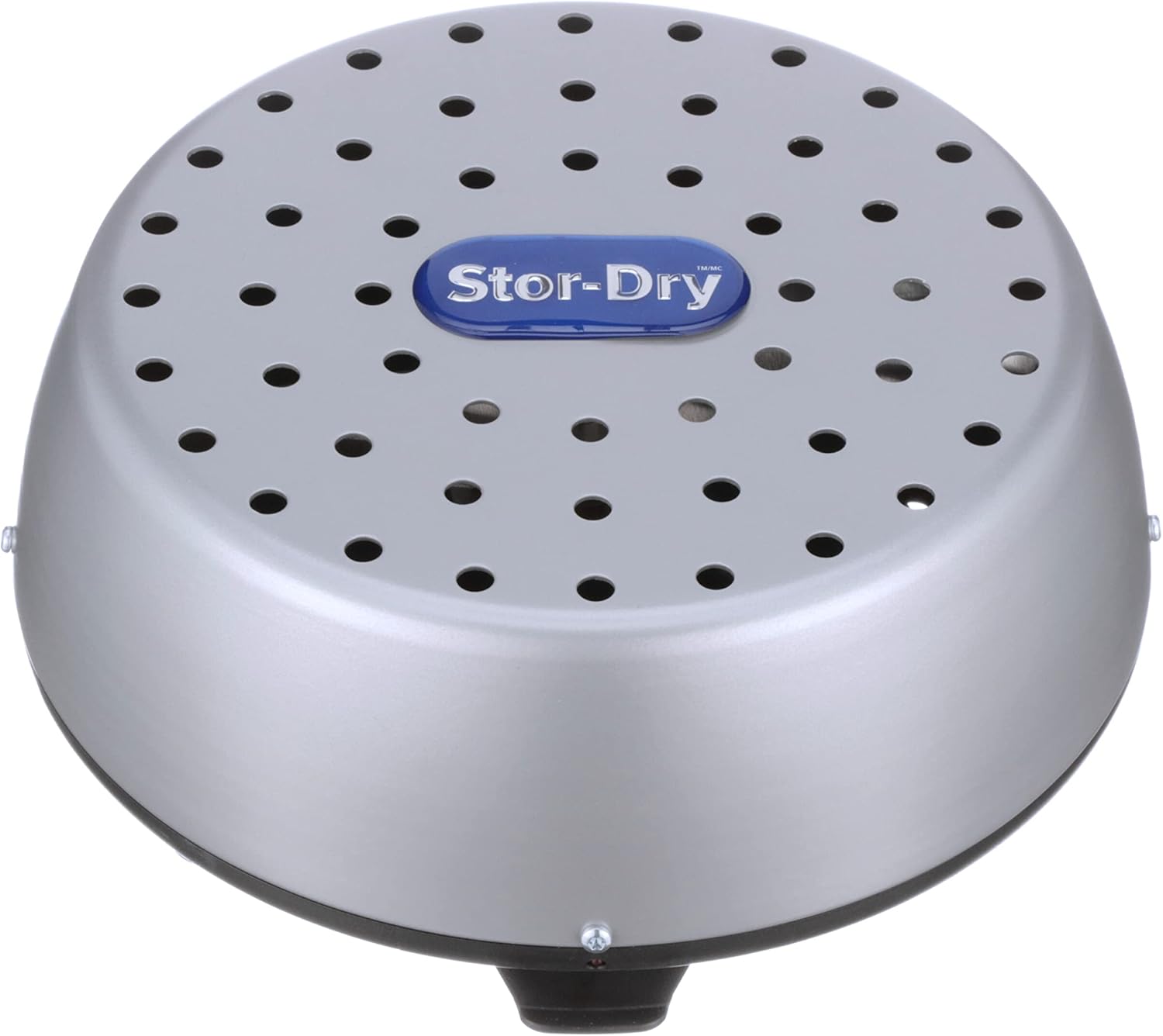
| Capacity | 1000 cubic feet |
|---|---|
| Air Flow Capacity | 1000 cubic_feet_per_hour |
| Wattage | 70 watts |
| Operation Mode | Continuous |
| Voltage | 110 |
The SEEKR Stor-Dry 9406 is a compact, corrosion-resistant warm air circulator built to run continuously in small, enclosed spaces such as boat compartments, RVs, closets, attics, and basements. It uses a low 70 watt draw and produces air movement rated for about 1000 cubic feet per hour, providing gentle warm-air circulation to discourage moisture buildup without a water reservoir. The unit is constructed from aluminum for durability in damp environments and is quiet enough for long-term unattended use. Setup is simple — plug it into 120V AC and let it operate continuously to maintain airflow during storage months. Limitations are its single-speed operation and lack of a built-in thermostat or humidistat, so it cannot regulate temperature or run only when humidity is high; it is a circulation device rather than an active dehumidifier that removes water. For buyers who want a low-energy, maintenance-free method to keep air moving and reduce condensation risk, the Stor-Dry is a practical choice.
Best for: Buyers who want a low-energy, low-maintenance way to keep air moving in stored boats or RVs to reduce condensation and protect interiors during off-season storage.
Less Ideal for: People who need an appliance that actively extracts moisture or automatically controls humidity or temperature should choose a true dehumidifier or a unit with built-in sensors.
- Low continuous power draw (70 watts) suitable for long-term operation
- Corrosion-resistant aluminum construction for marine and RV environments
- Quiet internal blower allows unattended use during storage
- Compact footprint fits into tight compartments, closets, or attics
- Plug-and-play 120V AC operation with no water reservoir to empty
- Single-speed unit with no thermostat or humidistat for automatic control
- Does not remove moisture like an active dehumidifier; only circulates warm air
- Limited to about 1000 cu ft per hour airflow, which may be insufficient for larger spaces
Verdict: Choose the Stor-Dry if you want a compact, energy-efficient circulator to keep air moving in boats or RVs during storage without maintenance.
ALORAIR Storm 80X Dehumidifier

| Capacity | 170 pints |
|---|---|
| Air Flow Capacity | 200 cfm |
| Wattage | 607 watts |
| Dehumidification Capacity | 21.25 gallons_per_day |
| Floor Area | 2100 square_feet |
The ALORAIR Storm 80X is a compact industrial LGR dehumidifier built to pull large amounts of water from the air while remaining portable enough to move around a boat interior. It delivers up to 170 pints per day at saturation and about 80 PPD under AHAM conditions using a 200 CFM blower, which speeds drying in cabins, bilges, and closed compartments. The rotomolded housing resists dents and moisture damage that commonly occur in marine environments, and the built-in condensate pump plus 19.6 ft hose let you route discharge above deck or to a bilge pump connection without constant emptying. Controls are straightforward with auto on/off, memory restart, and automatic defrost so it can run unattended in cooler spaces without frosting up. Expect a fairly heavy, workmanlike unit that uses substantial power but delivers commercial-grade drying performance; it is meant for serious moisture problems rather than casual humidity control aboard small pleasure craft.
Best for: Boat owners who need fast, reliable drying for major moisture problems, flood recovery, or post-storm remediation and prioritize performance over compact consumer convenience.
Less Ideal for: Owners of very small recreational boats or users seeking a quiet, lightweight unit for minor day-to-day humidity control should consider smaller consumer dehumidifiers instead.
- High drying capacity up to 170 PPD (saturation) and 80 PPD AHAM for rapid moisture removal.
- Built-in condensate pump with 19.6 ft hose and 19.6 ft vertical lift for flexible drain routing on boats.
- Durable rotomolded housing resists impacts, corrosion, and warping in damp marine spaces.
- Automatic defrost and memory restart allow extended unattended operation in cooler compartments.
- Relatively high power draw and industrial focus make it heavier and louder than consumer units.
- Size and weight limit use to larger boats or for shore-side drying rather than small cabin-only installations.
Verdict: If you need industrial-strength, pump-equipped drying for serious moisture or flood cleanup aboard a boat, the Storm 80X delivers the fastest, most robust performance.
Better Boat Moisture Absorber 4-Pack
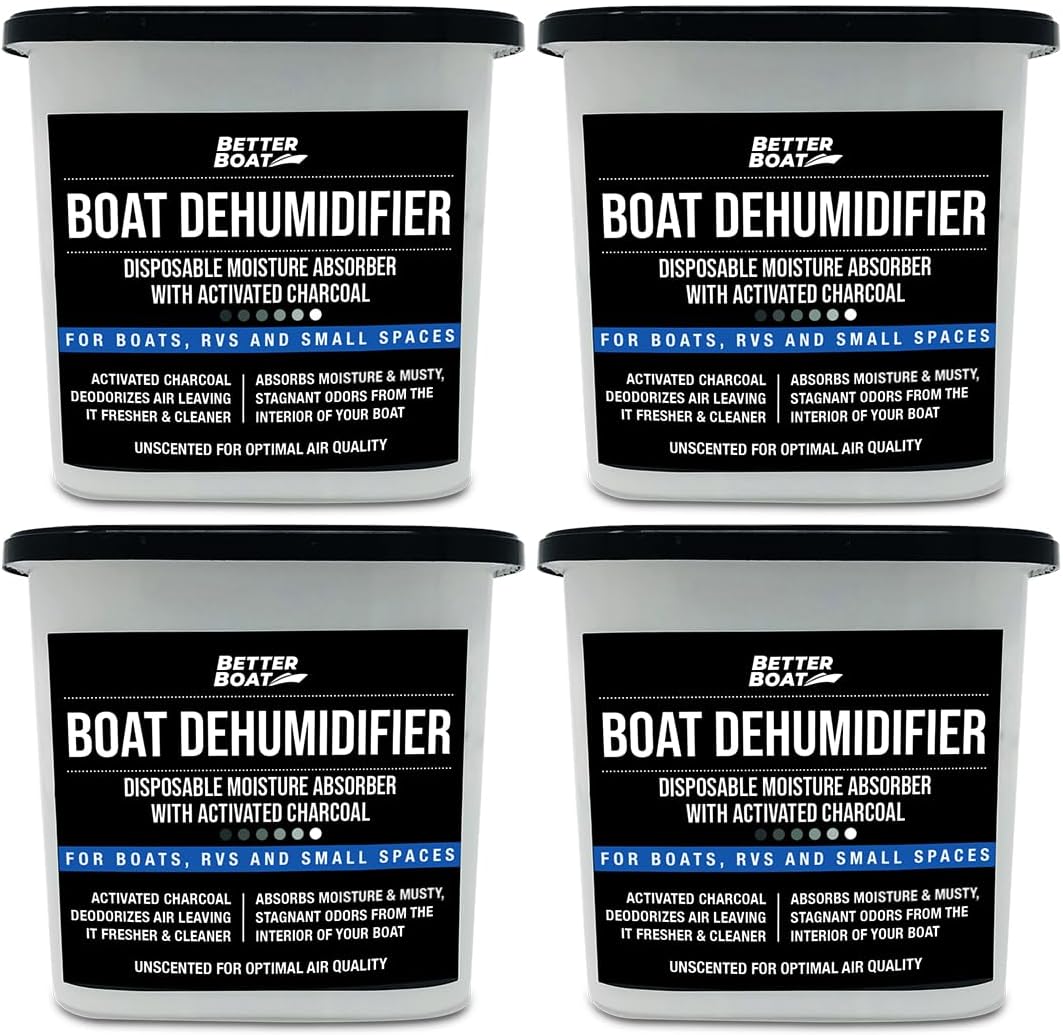
| Floor Area | 300 square_feet |
|---|---|
| Capacity | 18 fluid ounces |
| Tank Volume | 18 fluid ounces |
| Operation Mode | Passive |
These Better Boat moisture absorber buckets are single-use passive dehumidifiers designed for small, enclosed spaces commonly found on boats. You set them on a flat surface, remove the foil seal, and the calcium chloride crystals pull moisture from the air and clump into a semi-transparent bucket so you can see saturation and know when to replace it. The added activated charcoal helps reduce musty, damp odors beyond what plain desiccant crystals do, and the snap-on lid with mesh screen makes the bucket reasonably spill resistant during movement. Each bucket is rated for roughly 250 to 300 square feet and is meant to last about 30 to 60 days depending on humidity, so multiple units are practical for cabins, lockers, and storage compartments. Limitations are that these are passive and disposable, so they do not offer adjustable humidity control, continuous drainage, or long-term cost savings compared with a small electric dehumidifier or refillable system.
Best for: A practical buyer who wants a low-effort, no-power solution to control humidity and odors in boat cabins, lockers, or other small enclosed spaces and prefers easy visual replacement cues.
Less Ideal for: Those seeking precise humidity control, long-term cost efficiency, or a continuous electric dehumidifier solution should consider powered or refillable systems instead.
- Activated charcoal reduces musty odors as well as moisture
- Semi-transparent bucket shows when crystals have solidified
- Snap-on lid and mesh screen reduce spill risk in moving boats and RVs
- Simple set-and-forget passive operation with no power required
- Disposable single-use design requires periodic replacement
- No adjustable humidity control or continuous drainage option
Verdict: A simple, no-power moisture and odor control bucket that is convenient for seasonal boat use and small enclosed spaces.
Better Boat Hanging Dehumidifier Bags

| Included Components | 4 Moisture absorber Dehumidifier Bags |
|---|---|
| Material | Plastic, Activated Charcoal |
| Tank Volume | 8 fluid ounces |
| Floor Area | 84 square_inches |
These disposable hanging dehumidifier bags use moisture-absorbing pellets and activated charcoal to capture water and neutralize musty smells without fans or power. Hang a bag in a cabin locker, under a berth, in a closet or a small head and the pellets gradually solidify captured moisture into a gel inside the bag so there is no dripping; the charcoal helps reduce odors rather than masking them. They are simple to use—no assembly, charging or refills—so they are convenient for seasonal storage or short trips where you need passive humidity control. Because they are single-use and sized for small areas, they will not replace an electric dehumidifier for large, continuously damp spaces or long-term moisture problems, and you will need to replace them periodically. For boat owners who want an inexpensive, maintenance-free way to control humidity in confined areas, these work well; for comprehensive moisture control on a larger boat consider a powered solution.
Best for: Boat owners looking for a low-cost, no-maintenance way to control dampness and odors in small enclosed spaces like lockers, heads, and under-berths.
Less Ideal for: Owners who need continuous, whole-boat humidity control or a reusable/power-driven dehumidifier for larger cabins should choose a powered unit instead.
- Works without power or installation so it is truly passive
- Activated charcoal reduces musty odors instead of masking them
- Disposable, no refilling or draining required
- Compact hanging design fits lockers, closets, and small cabins
- Single-use bags require regular replacement for ongoing humidity control
- Sized for small areas and not effective as a whole-boat dehumidifier
Verdict: A budget-friendly, maintenance-free option to quickly reduce dampness and musty smells in small boat spaces.
ECOR PRO EPD50-PRO 50 Pint

| Capacity | 50 pints_per_day |
|---|---|
| Floor Area | 1000 square_feet |
| Wattage | 550 watts |
| Air Flow Capacity | 85 cfm |
| Operation Mode | Continuous |
The ECOR PRO EPD50-PRO is a compact desiccant dehumidifier built for continuous, unattended operation in harsh or damp environments. It uses a desiccant wheel system to extract moisture and vents only vapors, so there is no tank to empty and no drain hoses to install, which simplifies installation aboard boats. The stainless steel housing resists corrosion in wet or salty air and the unit is rated to operate from very low temperatures up to 104°F, making it suitable for unheated bilges, cabins, and storage areas. It runs quietly enough for continuous use and delivers up to 50 pints per day with an 85 CFM airflow, so it can keep small compartments noticeably drier without constant supervision. Trade-offs are that a desiccant unit consumes power continuously (listed at 550 watts) and does not collect liquid water for easy measurement, and any installation that requires wall or ceiling mounting may need planning or professional help. For boat owners wanting a reliable, low-maintenance corrosion-resistant solution, this model is a practical choice.
Best for: Boat owners or fleet managers who prioritize durable, low-maintenance moisture control and need a unit that can run continuously in corrosive or unheated marine spaces.
Less Ideal for: People who need a lightweight, battery-capable unit or who prefer visible water collection for easy monitoring should consider other styles.
- Stainless steel construction resists corrosion in marine or damp environments
- Desiccant system produces vapor rather than liquid so no tank emptying or drain hoses required
- Continuous self-regulating operation supports unattended use
- Operates across a wide temperature range suitable for cold bilges and unheated spaces
- Compact and portable design allows wall or ceiling mounting to save floor space
- Higher continuous power draw compared with refrigerant dehumidifiers
- Does not collect liquid water for quick on-hand capacity checks
- May require professional installation or mounting in some boat configurations
Verdict: Choose the EPD50-PRO when you need a corrosion-resistant, always-on dehumidifier that minimizes maintenance aboard boats.
TABYIK 35oz Dehumidifier DH-CS01

| Tank Volume | 1000 ml |
|---|---|
| Dehumidification Capacity | 0.45 liters_per_day |
| Wattage | 40 watts |
| Operation Mode | Continuous |
| Undisturbed Sleep | 28 dB |
The TABYIK 35oz (1000 ml) Peltier dehumidifier is a small, portable unit built for tight, humid spaces and runs continuously until its tank fills. It pulls up to about 16 oz (450 ml) per day under warm, very humid test conditions while using modest power, and the transparent 35 oz tank makes it easy to monitor and empty. Operation is simple with a one-button control, an auto shutoff that activates when the tank nears full, and a seven-color light with its own on/off control for low‑light environments. Noise is low at roughly 28 dB so it will not add noticeable sound in confined areas. For boat use the unit's compact footprint and built-in handle make placement convenient in cabins, lockers, or head compartments, and the continuous mode helps manage humidity between sailings. Limitations are typical for Peltier units: dehumidification rate is modest compared with compressor models and performance drops at lower temperatures, so it is best for small enclosed spaces rather than large wet bilges or cold engine rooms.
Best for: Boat owners who need a low-noise, low-power way to control humidity in small enclosed areas like cabins, closets, or heads and who prioritize easy monitoring and portability.
Less Ideal for: Boat owners who need rapid moisture removal in large or very wet spaces such as bilges or unheated storage compartments should choose a higher-capacity compressor dehumidifier or dedicated bilge drying solution.
- Compact and portable with built-in handle for easy placement in small spaces
- Transparent 35 oz tank with groove design makes emptying and cleaning straightforward
- Very quiet operation (~28 dB) suitable for sleeping cabins
- Auto shutoff protects against overfill and notifies with a flashing light
- Low power consumption, suitable for limited onboard electrical resources
- Limited dehumidification capacity (about 16 oz / 450 ml per day) compared with compressor units
- Performance decreases in cooler temperatures, reducing effectiveness in unheated spaces
- Single speed control limits tuning for different humidity conditions
Verdict: A compact, quiet, low‑power dehumidifier ideal for controlling humidity in small boat cabins and lockers where space and noise matter.
BEDRED CT11 Dehumidifier

| Floor Area | 1000 square_feet |
|---|---|
| Tank Volume | 95 fluid ounces |
| Capacity | 5.9 pounds |
| Operation Mode | Intermittent |
| Other Special Features of the Product | 7 Color Ambient Light, Automatic Shutoff, Sleep Mode |
The BEDRED CT11 is a compact thermoelectric dehumidifier intended to reduce humidity in small spaces such as bedrooms, bathrooms, and modest basements up to about 1000 sq ft. It uses semiconductor cooling rather than a compressor, so it runs quietly and is simple to operate with an intermittent operation mode and an automatic shutoff when the 95 oz tank fills. Sleep Mode turns off the lights and lowers noise for overnight use, and the seven-color ambient light gives an optional mood-lighting feature. Practical benefits include easy emptying from the included tank, portability thanks to a lightweight design, and low sound levels that suit living spaces. Important limitations are inherent to semiconductor units: lower capacity compared with compressor dehumidifiers, reduced performance in very cold or very damp basements, and a smaller tank that requires more frequent emptying in high-humidity conditions.
Best for: Buyers who prioritize quiet, low-maintenance dehumidification and want a compact unit that is easy to move and run in living spaces or small basements without frequent intervention.
Less Ideal for: People needing heavy-duty moisture control for large, cold, or very damp basements should choose a higher-capacity compressor dehumidifier instead.
- Quiet thermoelectric operation suitable for bedrooms and living rooms
- Automatic shutoff protects against overfill and simplifies unattended use
- 95 oz removable tank for straightforward water removal
- Sleep Mode and ambient light options for low‑noise nighttime use
- Compact and lightweight for easy placement or moving between rooms
- Semiconductor cooling gives lower moisture removal capacity than compressor models
- Performance drops in cold basement conditions and very high humidity areas
Verdict: Choose the BEDRED CT11 if you want a quiet, portable dehumidifier with auto‑shutoff and sleep‑friendly operation for small basements or living spaces.
Choosing the Right Dehumidifier for Boat: Key Factors to Consider
Moisture Removal Rate (Pints Per Day or Liters)
How quickly a dehumidifier removes water from the air determines whether it can keep a cabin at safe humidity levels during damp weather and in closed spaces. Boats often trap moisture in tight compartments and between cushions, so a unit rated to handle the correct volume for your cabin is essential. Consider the cubic footage of sleeping areas, lockers, and engine compartments when matching capacity.
A higher removal rate shortens the time the air spends above safe humidity, which reduces mold and mildew growth. However, in small cabins an oversized unit can cycle frequently and waste energy, so balance capacity with typical on-boat conditions.
Power Consumption and Current Draw
Boats commonly run on limited shore power, small generators, or battery/inverter systems, so the dehumidifier's wattage and startup current matter for practicality. Lower continuous power draw and modest surge current help avoid tripping breakers or excessive battery drain when running overnight. Check both running watts and startup characteristics when assessing whether a unit will operate reliably on your boat's electrical setup.
Energy-efficient operation also lowers long-term load on batteries and shore connections. Some units offer eco or low-power modes that reduce draw while still controlling humidity enough to prevent mildew.
Footprint, Weight, and Mounting Flexibility
Space is limited on most boats and many boaters need a unit that fits under bunks, in a locker, or can be hung out of the way. Compact footprint and light weight make installation and relocation easier. Look for models with built-in mounting points, wall or bulkhead brackets, and options to orient the unit for vertical or horizontal placement.
A slimmer unit that can be secured will also reduce rattling and movement in rough seas. Consider access for maintenance and filter cleaning when planning where to place the unit.
Corrosion Resistance and Materials
Marine environments expose equipment to salty air and higher humidity that can corrode metals and electrical contacts. Units built with corrosion-resistant coatings, stainless fasteners, or plastic housings generally last longer in these conditions. Internal components that are easily accessible for drying or rinsing after exposure are also a plus.
Avoid units with exposed bare metal or complex assemblies that trap salt and moisture. Corrosion resistance reduces maintenance needs and lowers the risk of electrical failures over time.
Drainage and Condensate Handling
How a dehumidifier handles condensate is critical on a boat. Options include removable collection buckets, gravity-drain outlets for permanent hoses, or built-in condensate pumps that can push water to a sink or overboard through safe plumbing. A manual bucket requires regular emptying but is simple; a pump or continuous drain reduces maintenance but needs secure hose routing and a reliable discharge point.
Consider how you will route water in a wet environment without causing spills or backflow. A built-in pump or a convenient hose outlet lets you place the unit in confined or lower locations without manual dumping.
Noise Level and Fan Speed Control
Noise can be disruptive in a small boat cabin, especially at night. Units with low decibel ratings or adjustable fan speeds allow quieter operation during sleeping hours while still reducing moisture. Fan speed control also helps tune extraction versus energy use, letting you run a quiet trickle in occupied cabins or boost extraction when airing out wet gear.
Pay attention to how manufacturers rate noise and whether the unit includes vibration-dampening feet or mounting brackets that reduce transferred sound to the hull.
Sizing a Dehumidifier to Your Boat
Estimate the total enclosed volume you need to protect, including sleeping cabins, heads, and storage lockers. Multiply cabin square footage by estimated headroom to get cubic feet, then match that to a unit's removal rate for damp marine conditions rather than dry basement specs.
For smaller dayboats and sailboats, compact units with modest removal rates often suffice if you run them continuously when the boat is closed up. For larger cruising boats or those in consistently humid climates, choose a unit with higher extraction and consider multiple smaller units to cover different compartments.
- Measure interior volumes rather than relying on general boat length for accuracy.
- Plan for continual operation during wet seasons rather than occasional use.
Power Options and Running From Different Sources
Decide whether you will primarily run the dehumidifier from shore power, a generator, or an inverter/battery bank. Each source imposes different limits on continuous wattage and allowable surge current.
If running from battery/inverter, prefer units with lower continuous draw and avoid those with large startup surges. Consider timers or humidity controllers that cycle the unit to preserve battery life while maintaining safe humidity levels.
- Check both running watts and startup current when planning installation.
- Use timed runs or hygrostat control to reduce energy use when shore power is not available.
Installation Tips for Tight Marine Spaces
Secure the unit so it cannot shift in rough seas. Use vibration-dampening mounts and ensure hoses or power cords are fastened away from moving gear. Leave enough clearance for air intake and maintenance access.
If using a hose for continuous drain, route it to a safe condensate destination and include a check valve or drip loop to prevent backflow. For units with buckets, position them where emptying is convenient and water cannot spill into living areas.
- Avoid installing the unit where salt spray or bilge water can directly reach it.
- Label power circuits and switches so the unit can be turned off easily during maintenance.
Maintenance and Seasonal Storage
Regular maintenance preserves performance and prevents mold growth inside the unit. Clean or replace filters as recommended, and inspect condensate trays and hoses for blockages. Dry the unit thoroughly before long-term storage.
Store the dehumidifier in a dry, ventilated area and run a short cycle after storage to ensure seals and pump components remain functional. For winterizing, remove and dry hoses and check for any corrosion that needs attention before redeploying.
- Flush or dry condensate lines to prevent algae and odors.
- Check seals and electrical connections periodically for corrosion.
Using Dehumidifiers With Onboard Electronics and Fabrics
Controlling humidity reduces corrosion risk to electronics and helps preserve cushions, wood trim, and canvas. Aim for a stable relative humidity in the cabin that balances comfort and material preservation rather than driving RH to very low levels, which can dry out wood.
Place units so airflow reaches damp fabrics and hidden cavities where mold likes to start. Periodically inspect soft goods and storage areas to ensure the dehumidifier is preventing condensation in those spots.
- Avoid overly dry conditions that can damage wood or adhesives.
- Direct airflow to areas behind lockers, under berths, and inside hanging lockers for best effect.
How We Chose the Best Dehumidifier for Boat
We prioritized units and features that matter specifically for boat use rather than general household performance. Our selection filters favored compact footprint and flexible installation so a unit can fit lockers, hanging spaces, or under bunks. Moisture removal capacity was evaluated relative to typical cabin volumes and humid conditions a boat faces. Energy efficiency and low current draw were essential because many boats run dehumidifiers from shore power, small inverters, or battery systems. Corrosion resistance and water-handling options were considered, including condensate pump compatibility and how condensate is collected or drained. We excluded large home basement dehumidifiers and units that require three-prong dedicated circuits or heavy ventilation. Also removed models with documented susceptibility to salt-air corrosion or those that lack straightforward maintenance access. In short, we selected compact, marine-friendly dehumidifiers that balance extraction rate, low power use, and installation flexibility for real-world boat cabins, lockers, and bilge-adjacent spaces.
Our full evaluation process is outlined in our review methodology.
FAQ
Can I run a dehumidifier for boat from a small inverter?
Often you can, but it depends on the unit's running watts and startup surge. Low-wattage models with modest startup current are best for small inverters. Use a dedicated battery bank or timer to avoid excessive cycling and battery drain.
Is a condensate pump necessary on a boat?
A pump is useful if you need to move condensate to a higher discharge point or overboard through a hose. For low installations with a convenient gravity drain, a pump is not required. Consider pump reliability and routing before choosing that option.
How often should I empty the bucket or check drains?
Frequency depends on humidity and unit capacity, but check collection buckets and drains at least weekly during humid periods. For continuous drain setups, inspect hoses monthly for blockages or algae buildup.
Will a dehumidifier prevent salt corrosion?
A dehumidifier reduces relative humidity and condensation that accelerate corrosion but does not remove salt residue from surfaces. Regular cleaning and use of corrosion-resistant materials remain important alongside humidity control.
Can I leave a dehumidifier running unattended while away?
Many boaters run units continuously when away, provided the unit is secured, has a reliable drain or pump, and the power source is stable. Use timers or remote monitoring when relying on battery or limited generator power to avoid unexpected failures.
Final Verdict
For boat owners, the right dehumidifier balances extraction capacity with low power draw, compact installation, and marine durability. Prioritize units that match your cabin volume, fit where you can mount them securely, and offer convenient drainage for your boat's layout. Expect tradeoffs between speed of moisture removal and energy consumption; choose a solution that keeps humidity in a safe range without overstressing your electrical system. Focus on practical features like corrosion resistance, flexible mounting, and clear maintenance access when deciding. With those priorities in mind, you can confidently select a dehumidifier that protects interiors, extends gear life, and reduces mildew and corrosion risk aboard your boat.