
Note: This article contains affiliate links. If you click on these links and make a purchase, we may earn a small commission at no extra cost to you. This helps support our research and content. Read our full affiliate disclosure here.
Window condensation is more than a nuisance; persistent moisture can damage sills, paint, and finishes and encourage mold growth. Choosing the right dehumidifier for condensation on windows helps you control indoor humidity where it matters most, reduce visible fogging, and protect surfaces without overcooling or making the room unpleasantly noisy. This guide shortlists seven top-performing dehumidifiers selected for their ability to reduce surface condensation, fit common room sizes, and operate with manageable noise and maintenance requirements. Below you will find practical evaluation criteria, clear buying factors, and straightforward advice to help you pick a unit that keeps windows clearer and helps safeguard your home. Read on for the details that matter before you buy.
Top Picks at a Glance
| Best Overall The best all-around choice for most situations | VEAGASO VG380 Dehumidifier |  |
| Best Quality Built to a higher standard if you want something more solid | ALORAIR Storm 80X |  |
| Best Value The sweet spot between price and what you get | Waykar 34 Pint Dehumidifier |  |
| Best Budget The cheapest option that still gets the job done reliably | Eva-Dry Mini Dehumidifier E-333 |  |
| Top Rated A top-rated pick with lots of positive feedback | KNKA 80-Pint Dehumidifier PD30MA-20 |  |
| Most Popular A crowd favorite that many people choose with confidence | TABYIK 35OZ Dehumidifier DH-CS01 |  |
| Best Seller A high-volume bestseller chosen again and again | BEDRED CT11 Dehumidifier |  |
VEAGASO VG380 Dehumidifier

| Capacity | 34 pints_per_day |
|---|---|
| Tank Volume | 2 liters |
| Wattage | 230 watts |
| Operation Mode | Continuous, Dry, Dehumidify |
| Voltage | 120 volts |
The VEAGASO VG380 is a compressor dehumidifier meant to remove up to 34 pints per day for larger spaces such as basements and living areas. It offers three operating modes — target-humidity (DEHU), high-intensity dry for laundry, and continuous run — selectable on a touch LED panel that also shows real-time humidity and supports a 1–24 hour timer. Practical features include a 0.53 gallon tank with full-auto shutoff plus an included drain hose for unattended continuous draining, washable filter, child lock, and power-failure memory so settings resume after outages. Noise is kept low (around 35–40 dB) so it can run overnight without being obtrusive. The unit includes auto-defrost to operate down to roughly 41°F, which helps in cool basements. Limitations to consider: the stated airflow and dehumidification specs are typical lab numbers and actual water removal depends on room conditions, and the 0.53 gallon tank will require frequent emptying in very humid climates unless you use the continuous drain option.
Best for: Buyers who want a quiet, versatile unit to control condensation and dampness across larger rooms or basements and prefer easy controls with options for continuous drainage and laundry drying.
Less Ideal for: If you need whole-house dehumidification or minimal maintenance in extreme humidity without plumbing a drain, choose a larger-capacity or hard‑plumbed commercial solution instead.
- High dehumidification capacity rated at 34 pints per day suitable for damp basements and large rooms
- Three modes (target-humidity, dry, continuous) for everyday use, laundry drying, or nonstop moisture removal
- Includes continuous drain hose plus auto shutoff and full-tank alert for low-maintenance operation
- Quiet operation around 35–40 dB so it can run overnight in bedrooms or living areas
- Auto-defrost and power-failure memory make it reliable in cool or unattended spaces
- Relatively small built-in tank (0.53 gallon) that fills quickly in very humid conditions without continuous drain
- Actual moisture removal depends on ambient temperature and humidity so performance can vary from rated capacity
Verdict: A quiet, feature-rich 34‑pint unit built to control basement and window condensation with flexible continuous-drain and targeted modes for everyday use.
ALORAIR Storm 80X

| Capacity | 170 pints |
|---|---|
| Air Flow | 200 cfm |
| Wattage | 607 watts |
| Coverage | up to 2,100 square_feet |
| Dehumidification Capacity | 21.25 gallons_per_day |
The ALORAIR Storm 80X is a rugged LGR-style commercial dehumidifier built to remove large volumes of moisture and keep enclosed spaces dry. It is typically used for water damage restoration, basements, and other high-humidity environments where condensation and saturation occur. The unit delivers up to 170 pints per day at saturation and 80 PPD under AHAM conditions, driven by a 200 CFM airflow and a 607 W power draw, so it clears moisture quickly in areas up to about 2,100 sq ft. Practical features include a built-in condensate pump with a 19.6 ft lift and included drain hose for unattended continuous drainage, automatic defrost to maintain performance at low temps, and a rotomolded impact-resistant housing that stands up to jobsite abuse. It is compact for its capacity, has wheels and a retractable handle for transport, and offers memory restart and auto on/off for simple operation. Expect a heavier, louder machine than consumer units and higher energy use when running at peak capacity, but for persistent window condensation and saturated rooms this model focuses on reliable, high-throughput drying.
Best for: Buyers who prioritize rapid, professional-grade moisture removal for persistent condensation, restoration jobs, or large damp areas and need a durable, portable unit they can move between sites.
Less Ideal for: People who only need occasional dehumidification for small rooms or who need an ultra-quiet, lightweight home unit should consider consumer-grade models instead.
- High moisture removal rate up to 170 PPD at saturation for fast drying
- Built-in condensate pump with long vertical lift and included drain hose for continuous unattended drainage
- Automatic defrost and memory restart support reliable operation in varying temperatures
- Durable rotomolded housing with wheels and retractable handle for on-site mobility
- Designed for commercial use so it is heavier and louder than residential dehumidifiers
- Higher power draw during heavy-duty operation compared with small home units
Verdict: Choose the Storm 80X when you need a tough, high-capacity unit that rapidly eliminates heavy condensation and supports continuous pump drainage for restoration and large-space drying.
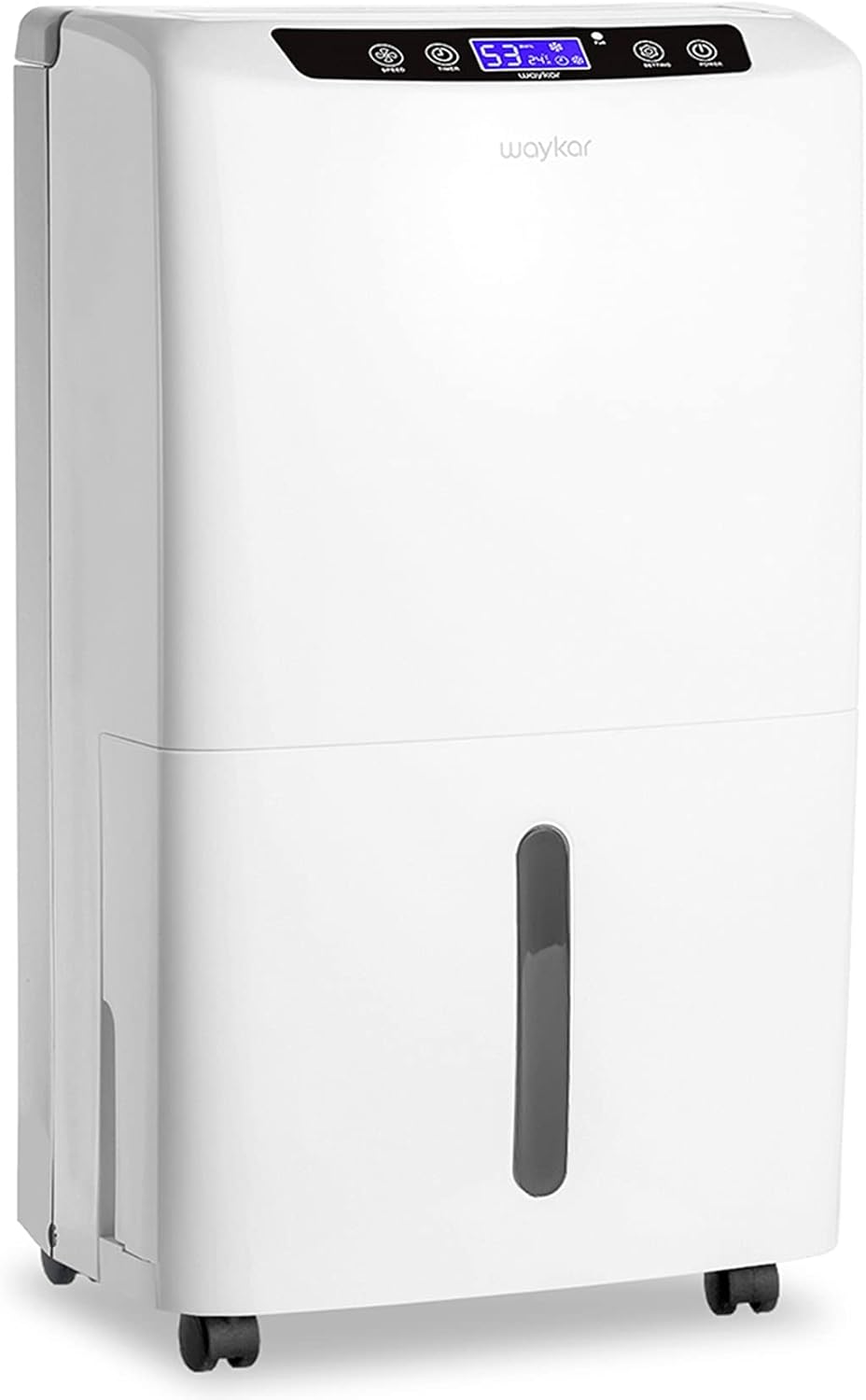
Waykar 34 Pint Dehumidifier
| Capacity | 34 pints per day |
|---|---|
| Floor Area | 2000 square_feet |
| Tank Volume | 0.66 gallons |
| Wattage | 230 watts |
| Air Flow Capacity | 62 cfm |
The Waykar 34 Pint Dehumidifier is a mid-size, Energy Star certified unit intended to pull excess moisture from basements, large rooms, and whole-home areas up to about 2,000 square feet. It removes up to 34 pints per day under rated conditions and offers Auto and Continuous operation plus a 30%–80% adjustable humidity setpoint so you can target lower levels to reduce window condensation. Two fan speeds and a 90° manual airflow direction let you focus drying where condensation forms most, while a 24-hour timer and smart sensors handle runtime and auto-defrost to keep it running in cool conditions. Water can be collected in the 0.66 gallon removable tank or drained continuously with the included hose for unattended operation. Practical conveniences include a washable filter, ergonomic handle, and overload protection; the unit is relatively noisy compared with ultra-quiet bedroom models and its tank size means more frequent emptying if you are not using the continuous drain option. For condensation on windows, the focused airflow, low setpoint capability, and continuous drainage make it a useful, energy-efficient choice for long runs in cool, damp spaces.
Best for: Buyers who want an efficient, controllable dehumidifier to actively reduce window condensation across larger rooms and basements and who prioritize energy savings and unattended continuous drainage.
Less Ideal for: Those who need an ultra-quiet unit for night-time bedroom use or who prefer a larger internal reservoir and less frequent maintenance without a drain hose.
- Energy Star certified for better real-world efficiency
- Adjustable 30%–80% humidity range for deeper drying to combat window condensation
- Dual drainage: removable 0.66 gal tank or included hose for continuous unattended drainage
- Auto-defrost and overload protection for reliable operation in cooler spaces
- Manual 90° airflow and two fan speeds to direct drying where needed
- Relatively small tank requires using the drain hose for long unattended runs
- Noise level is higher than ultra-quiet models during high-speed operation
Verdict: Choose this Energy Star 34-pint dehumidifier when you need targeted, energy-efficient moisture removal to cut window condensation in large rooms and basements while running unattended via continuous drainage.
Eva-Dry Mini Dehumidifier E-333

| Floor Area | 333 square_feet |
|---|---|
| Capacity | 6 ounces |
| Dehumidification Capacity | 0.38 pints_per_day |
| Operation Mode | Continuous |
| Wattage | 22.5 |
The Eva-Dry E-333 is a compact, wireless silica-gel dehumidifier made for small enclosed areas like closets, bathrooms, cars, and window sills that suffer from condensation. It uses crystallized silica beads that absorb up to about 4 to 6 ounces of moisture and signals when they need recharging by changing bead color from orange to green, so you do not manage a water tank. The unit is cordless and renewable, intended to be recharged rather than replaced, which keeps ongoing costs low and makes it easy to place directly on a windowsill or hang nearby where condensation forms. Because it is passive gel-based it does not actively dry large volumes of air and its stated removal rate is very low, so it works best as a spot solution to reduce surface moisture and odors rather than as a room dehumidifier. Practical benefits are zero-drip operation, portability, and long usable life without batteries, while limitations are modest capacity and slow moisture removal compared with electric dehumidifiers.
Best for: Buyers who want an inexpensive, low-maintenance way to reduce surface condensation in small, enclosed areas and prefer a cordless, renewable solution over an electrical dehumidifier.
Less Ideal for: Do not choose this if you need to remove large amounts of moisture from a room, treat persistent dampness throughout open spaces, or want automatic continuous dehumidification without recharging.
- Cordless, rechargeable silica-gel design requires no batteries or continuous power
- Color-changing indicator shows when beads need recharging for straightforward maintenance
- Compact and lightweight for placement on windowsills, in closets, cars, or gun safes
- Leak-free operation with no water tank to empty or spill
- Very limited moisture removal rate, not suitable for drying whole rooms
- Requires periodic recharging of beads rather than continuous automatic operation
Verdict: A very affordable, cordless spot dehumidifier that quietly reduces window and small-space condensation without cords or tanks.
KNKA 80-Pint Dehumidifier PD30MA-20

| Capacity | 80 pints per day |
|---|---|
| Tank Volume | 1.45 gallons |
| Wattage | 360 watts |
| Floor Area | 4500 square_feet |
| Operation Mode | AUTO, DRY, SETTING |
The KNKA PD30MA-20 is a performance-focused dehumidifier built for large, damp spaces such as basements. Its high-efficiency compressor can remove up to 80 pints per day under extreme conditions and about 56 pints in typical basement conditions, while an internal 1.45 gallon tank plus a supplied 6.56 ft drain hose enable continuous drainage to avoid frequent emptying. Controls include AUTO, DRY, and a SETTING mode for 30%–80% RH, and the digital display with a color-changing humidity indicator makes it easy to monitor conditions at a glance. The unit is designed to run quietly (40–45 dB), has a washable filter, casters for moving between rooms, cord storage, a 12-hour timer, and a child lock for steady, unattended operation. Expect good energy efficiency thanks to ENERGY STAR certification and a 360 watt power draw, but note that humidity readings come from the air inlet and may differ slightly from a separate hygrometer; the unit also needs upright siting for 24 hours before first use. For heavy-duty basement dehumidification this model balances strong capacity with thoughtful usability features.
Best for: Buyers who need powerful, reliable moisture removal in large basements or very damp rooms and prioritize steady performance and easy continuous drainage.
Less Ideal for: People seeking a compact or ultra-light unit for small rooms or occasional use should consider lower-capacity, more portable models instead.
- High maximum dehumidification capacity up to 80 pints per day for large, very humid spaces
- Includes 6.56 ft drain hose and built-in tank for continuous drainage to reduce manual emptying
- ENERGY STAR certified and uses a high-efficiency compressor for lower operating costs relative to output
- Quiet operation (40–45 dB) and caster wheels make it suitable for basements and living spaces
- Digital display with real-time humidity readout and color indicator simplifies monitoring and control
- Humidity reading is measured at the air inlet and may not match a separate room hygrometer
- Requires upright placement for 24 hours before first use to avoid operational issues
Verdict: Choose this KNKA if you need a strong, ENERGY STAR certified dehumidifier that can handle large basements with continuous-drain capability and quiet operation.
TABYIK 35OZ Dehumidifier DH-CS01

| Applicable Area | 280 Sq.Ft |
|---|---|
| Tank Volume | 1000 ml |
| Wattage | 40 watts |
| Dehumidification Capacity | 0.45 liters_per_day |
| Number of Speeds | 1 |
This TABYIK 35OZ dehumidifier is a small, portable Peltier unit made for bedrooms, bathrooms, closets and RVs where condensation or dampness is localized. It runs continuously on a single-speed setting, pulls moisture into a visible 1000 ml (35 oz) tank and automatically shuts off when the tank nears full while flashing an alert light. The unit advertises up to 16 oz (0.45 liters) collected per day under warm, very humid conditions and operates quietly at about 28 dB, so it can sit near windows or sleeping areas without noticeable noise. A multi-color night light with an on/off control is included and the back air intake filter is removable for periodic cleaning. Because it uses a thermoelectric (Peltier) system and a single speed, its extraction rate is modest compared with compressor dehumidifiers and it works best in small, warm spaces with RH above about 45 percent; performance will fall in cool rooms. The simple one-button control and built-in handle make placement and day-to-day use straightforward, but buyers looking to remove heavy condensation from large rooms or basements will need a higher-capacity compressor model.
Best for: Buyers who prioritize quiet, low-energy solutions for small-scale condensation problems on windows, and who value clear tank monitoring and simple one-button operation guided by other users' experiences.
Less Ideal for: Rooms with heavy condensation, multiple damp windows, or whole-room humidity control needs where a higher-capacity compressor dehumidifier is required.
- Compact and portable so you can place it near condensation-prone windows or in tight spaces.
- Low noise operation (~28 dB) suitable for bedrooms and sleeping areas.
- Auto shutoff with tank-full alert prevents overflows and makes unattended use safer.
- Visible 35 oz (1000 ml) tank and built-in handle make emptying and checking water level easy.
- Very low power draw compared with compressor dehumidifiers, reducing operating cost for small-space use.
- Modest dehumidification capacity (about 16 oz/0.45 L per day) limits effectiveness on heavy window condensation or larger rooms.
- Single-speed Peltier system loses efficiency in cooler temperatures and high-volume moisture situations.
Verdict: A very quiet, low-power portable dehumidifier that is a practical pick for treating light window condensation in small, warm rooms.
BEDRED CT11 Dehumidifier

| Floor Area | 1000 square_feet |
|---|---|
| Tank Volume | 95 fluid ounces |
| Capacity | 5.9 pounds |
| Operation Mode | Intermittent |
| Other Special Features of the Product | 7 Color Ambient Light, Automatic Shutoff, Sleep Mode |
The BEDRED CT11 is a compact thermoelectric dehumidifier intended to reduce humidity in small spaces such as bedrooms, bathrooms, and modest basements up to about 1000 sq ft. It uses semiconductor cooling rather than a compressor, so it runs quietly and is simple to operate with an intermittent operation mode and an automatic shutoff when the 95 oz tank fills. Sleep Mode turns off the lights and lowers noise for overnight use, and the seven-color ambient light gives an optional mood-lighting feature. Practical benefits include easy emptying from the included tank, portability thanks to a lightweight design, and low sound levels that suit living spaces. Important limitations are inherent to semiconductor units: lower capacity compared with compressor dehumidifiers, reduced performance in very cold or very damp basements, and a smaller tank that requires more frequent emptying in high-humidity conditions.
Best for: Buyers who prioritize quiet, low-maintenance dehumidification and want a compact unit that is easy to move and run in living spaces or small basements without frequent intervention.
Less Ideal for: People needing heavy-duty moisture control for large, cold, or very damp basements should choose a higher-capacity compressor dehumidifier instead.
- Quiet thermoelectric operation suitable for bedrooms and living rooms
- Automatic shutoff protects against overfill and simplifies unattended use
- 95 oz removable tank for straightforward water removal
- Sleep Mode and ambient light options for low‑noise nighttime use
- Compact and lightweight for easy placement or moving between rooms
- Semiconductor cooling gives lower moisture removal capacity than compressor models
- Performance drops in cold basement conditions and very high humidity areas
Verdict: Choose the BEDRED CT11 if you want a quiet, portable dehumidifier with auto‑shutoff and sleep‑friendly operation for small basements or living spaces.
Choosing the Right Dehumidifier for Condensation on Windows: Key Factors to Consider
Extraction Capacity and Moisture Removal Rate
Extraction capacity determines how quickly a dehumidifier lowers indoor humidity and reduces condensation on window surfaces. A unit rated for a higher pints-per-day or liters-per-day will remove moisture faster, which matters in rooms with frequent occupant activity or in climates with high indoor moisture loads.
Match the stated removal rate to the typical humidity sources in the room. Kitchens, bathrooms, and rooms with many plants or aquariums produce more moisture and benefit from higher-capacity units. Also consider that published removal rates are often measured at specific temperatures and relative humidity levels; performance can drop in cooler rooms, so choose a model with adequate margin for the conditions where your windows collect condensation.
Room Size and Coverage Pattern
A dehumidifier must handle the volume of air where window condensation appears. Room size guidance from manufacturers helps you choose a unit with the right airflow and capacity for bedrooms, living rooms, or enclosed sunrooms.
Beyond overall room square footage, think about air circulation patterns. If windows are in exterior walls with limited airflow, placing the unit closer to the problem area or choosing a model with stronger circulation will improve results. Consider doorways and open-plan layouts too, since a single unit may struggle to control humidity evenly across large connected spaces.
Noise Level During Occupied Hours
Noise matters if the dehumidifier will run while you sleep, work, or spend leisure time near the windows. Look for published decibel ratings and user reports about whether the fan is unobtrusive at low and medium settings.
Some units offer sleep modes or quieter low-speed settings that still remove moisture effectively over longer periods. If you need to place the unit in a bedroom or office close to windows, prioritize models with lower operational noise so the device does not create a new comfort issue while solving condensation.
Control Options and Humidity Accuracy
Accurate humidity control helps you target the relative humidity that prevents condensation without over-drying the room. Digital hygrometers and precise setpoint control let the unit cycle efficiently around the chosen RH level, which reduces runtime and energy use.
Look for straightforward controls or smart features that maintain specific RH percentages. Some units include timers, auto-defrost for cooler rooms, or continuous drain options that affect how the appliance behaves in daily use. Reliable sensor accuracy reduces unnecessary cycling and keeps window surfaces drier more consistently.
Drainage, Water Tank Size, and Maintenance
How a dehumidifier handles collected water affects convenience and uninterrupted performance. Larger tanks mean less frequent emptying, while continuous drain options can eliminate manual draining if you can route a hose to a sink.
Also consider filter access and cleaning frequency. Removable, washable filters are easier and cheaper to maintain. Check whether routine maintenance tasks such as cleaning coils or replacing filters are simple to perform without special tools, because neglecting upkeep will reduce extraction efficiency and could worsen condensation over time.
Placement Flexibility and Physical Footprint
Where you can place a dehumidifier often dictates how well it reduces condensation on windows. Compact models fit on windowsills or narrow ledges and can be positioned close to problem areas. Larger units may provide more capacity but can be harder to move and situate near the condensation source.
Consider caster wheels, handle design, and overall height when you need to place the unit under or beside a window. Clearance for intake and exhaust is also important; placing the unit too close to curtains or furniture can impede airflow and reduce effectiveness.
Why Window Condensation Happens
Condensation forms when warm, moisture-laden indoor air contacts a colder surface such as a windowpane. The surface temperature of the glass falls below the air's dew point, causing water vapor to condense into liquid. This is a physical process driven by indoor humidity and surface temperatures rather than a defect in the window itself.
Addressing window condensation requires reducing the indoor air's absolute moisture content or raising the glass surface temperature. A dehumidifier tackles the former by extracting moisture from the air, lowering the dew point and reducing the likelihood of visible fogging on glass surfaces.
- High indoor humidity and cold exterior temperatures increase condensation risk.
- Poor ventilation traps moisture and exacerbates window fogging.
- Single-pane and poorly insulated windows show condensation sooner because the glass gets colder.
Best Locations to Place a Dehumidifier for Windows
Placement affects how effectively a dehumidifier reduces condensation. Aim to position the unit so air circulates between the room and the window surface. If the window is in a corner or behind furniture, move the dehumidifier closer or open a pathway for airflow.
Use the dehumidifier in the room where condensation appears most often rather than relying on a single central unit to manage multiple distant problem windows. For windows on exterior walls, placing the unit on the same wall or within a few feet of the window usually yields the best results.
- Place the intake side facing room air and the exhaust away from the window to avoid blowing humid air onto cold glass.
- Avoid obstructing intake and exhaust vents with curtains or furniture.
- If condensation forms overnight, run the unit on a low quiet setting while you sleep to gradually lower humidity.
Dehumidifier Features That Make Condensation Control Easier
Certain features improve day-to-day handling of condensation issues. Built-in hygrometers, adjustable setpoints, and auto mode help maintain a steady relative humidity that limits surface fogging. Continuous drain or pump-out options reduce the need for frequent emptying when the unit runs often.
Auto-defrost is valuable for cooler rooms where the coils can ice at low temperatures, which would otherwise reduce extraction effectiveness and require a manual defrost cycle. Also consider timers and programmable schedules so the device runs during peak moisture production or overnight periods when condensation is most likely.
- Digital humidity readouts and precise setpoints enable targeted control.
- Auto-defrost maintains performance in cool rooms.
- Continuous drain options lower maintenance interruptions.
Managing Energy Use While Reducing Condensation
Dehumidifiers consume electricity while they run, so balancing runtime and extraction rate is important for efficient operation. Choose a unit sized for the room so it does not run continuously trying to do the work of a larger machine. Using lower fan speeds for longer periods is often more energy-efficient than repeatedly running on high.
Programmable schedules, humidity-based auto modes, and proper seal improvements around windows can reduce the workload on the dehumidifier. Sealing drafts and improving window insulation lowers the heat transfer that contributes to condensation, allowing your dehumidifier to maintain results with less energy.
- Match capacity to room size to avoid excessive runtime.
- Use lower fan settings for sustained, quieter moisture control.
- Combine dehumidification with simple air-sealing to improve efficiency.
Seasonal Use and Cooler Room Performance
Performance varies with temperature. Many refrigeration-style dehumidifiers are less effective at low ambient temperatures because coils can approach freezing and extraction rates drop. If your windows collect condensation primarily in cool months, pick a unit with an effective low-temperature operating range or auto-defrost capability.
For spaces that stay near or below typical refrigeration dehumidifier thresholds, consider running the unit only when indoor temperatures allow efficient operation or supplementing with gentle window heating or increased air circulation to reduce surface chill. This approach helps keep glass above the dew point without forcing a dehumidifier to operate in inefficient conditions.
- Check low-temperature performance for rooms that are cool most of the time.
- Auto-defrost keeps extraction steady in cooler conditions.
- Supplemental ventilation or mild window heating can reduce reliance on dehumidification.
How We Chose the Best Dehumidifier for Condensation on Windows
We focused on equipment that reliably reduces surface condensation on windows and performs well in typical home environments. Our selection filters prioritized measured moisture removal relative to room size, quiet operation during occupied hours, and controls that let you target relative humidity without excessive cycling. We also considered ease of maintenance, including accessible filters and drain options, plus the physical footprint to ensure placement near problem windows is practical. Durability and safety features were included as gatekeeping criteria so that units with flimsy controls, poor condensate handling, or inadequate electrical safeguards were excluded. We did not include specialty commercial dehumidifiers, units intended solely for basements with dedicated drainage plumbing, or devices with poor user feedback on long-term reliability. The result is a list of compact to medium home dehumidifiers that balance extraction rate, noise, maintenance burden, and placement flexibility for treating condensation on windows.
Our full evaluation process is outlined in our review methodology.
FAQ
Will a dehumidifier stop window condensation completely?
Often a dehumidifier significantly reduces or eliminates condensation by lowering indoor humidity, but complete elimination depends on factors like extreme temperature differentials, poor window insulation, and ongoing moisture sources. Addressing ventilation and insulation along with dehumidification gives the best results.
How big a dehumidifier do I need for a bedroom with condensation?
Size depends on the room's square footage and moisture load. For typical bedrooms, choose a unit rated for the room size with modest margin for higher moisture sources. If condensation is severe, a higher-capacity model or closer placement to the window may be necessary.
Can I run a dehumidifier all night to prevent morning fogging?
Yes. Running on a quiet or low setting overnight is a common approach to lower humidity slowly and reduce morning condensation. Use sleep modes or lower fan speeds to balance noise and energy use while maintaining steady moisture removal.
Is continuous drain necessary for condensation control?
Continuous drain is convenient when a unit runs frequently and produces significant condensate, because it removes the need to empty the tank. It is not strictly necessary but improves usability in problem areas where daily drainage would be inconvenient.
Will a dehumidifier warm the room and affect condensation?
Dehumidifiers release some heat as they operate, which can slightly raise room temperature and help reduce window surface chill. However, the primary effect on condensation comes from lowering humidity; the small temperature gain alone is usually not enough to stop condensation if humidity remains high.
Final Verdict
When choosing a dehumidifier for condensation on windows, prioritize a unit with sufficient moisture removal capacity for the room, quiet operation for occupied spaces, and controls that let you set and maintain a stable relative humidity. Consider placement flexibility and drainage options so the unit can run consistently near the problem windows with minimal hassle. Balance extraction rate against noise and maintenance: a slightly larger capacity that runs quietly at low speed is often preferable to a smaller unit that needs constant high-speed operation. Focus on matching capacity to room size, ensuring accurate humidity control, and planning for easy drainage to keep windows clear and protect surrounding materials.