
Note: This article contains affiliate links. If you click on these links and make a purchase, we may earn a small commission at no extra cost to you. This helps support our research and content. Read our full affiliate disclosure here.
If you see water gathering on windows, wet spots on walls, or persistent damp smells, a dehumidifier for condensation can make a visible difference in comfort and home care. Choosing the right unit matters because extraction capacity, run-time controls, and airflow placement determine whether the machine actually prevents recurring moisture problems or just moves humidity around. This guide shortlists seven practical options that suit common condensation scenarios in basements, bathrooms, and older homes. We evaluated models for capacity, handling low-temperature conditions, noise, and ease of maintenance so you can quickly find a unit that fits your space and routine. Read on to see which features to prioritize for lasting condensation control.
Top Picks at a Glance
| Best Overall The best all-around choice for most situations | Midea Cube 20-Pint Dehumidifier |  |
| Best Quality Built to a higher standard if you want something more solid | Frigidaire 50 Pint Dehumidifier FHDD5034Y1 |  |
| Best Value The sweet spot between price and what you get | VEAGASO VG380 34-Pint Dehumidifier |  |
| Best Budget The cheapest option that still gets the job done reliably | TABYIK 35OZ Dehumidifier DH-CS01 |  |
| Top Rated A top-rated pick with lots of positive feedback | hOmeLabs 50 Pint Dehumidifier HME1004 |  |
| Most Popular A crowd favorite that many people choose with confidence | BEDRED CT11 Dehumidifier |  |
| Best Seller A high-volume bestseller chosen again and again | ToLife Dehumidifier TZ-C2 |  |
Midea Cube 20-Pint Dehumidifier

| Capacity | 20 pints |
|---|---|
| Tank Volume | 3.2 gallons |
| Floor Area | 1500 square_feet |
| Number of Speeds | 3 |
| Wattage | 214 watts |
The Midea Cube 20‑pint dehumidifier uses an extendable lift-and-twist design so you can run it in a compact nested mode or extend the tank for much longer unattended operation, which is handy in basements or damp rooms where condensation is a recurring problem. It offers three fan speeds, multi-directional air intake, and an auto-defrost feature so it keeps working in cooler spaces without freezing collected water. Smart features include Wi‑Fi control via an app plus Alexa and Google Assistant compatibility, letting you monitor humidity and water level remotely and set schedules. The unit supports continuous drain with the included hose for long runtime and has a washable air filter to reduce maintenance costs. Trade-offs are that it is designed for smaller areas up to about 1,500 square feet and its 214 W power draw and 20‑pint capacity mean very wet, large basements may need a higher‑capacity model or longer runtime.
Best for: Buyers who want a flexible, tech-friendly dehumidifier for rooms or small basements that balances runtime, convenience, and easy maintenance.
Less Ideal for: Homes with very large or severely waterlogged basements that need higher daily extraction rates or industrial‑scale drainage solutions.
- Extendable lift-and-twist tank provides up to three times the runtime of conventional small dehumidifiers
- Wi‑Fi app control with Alexa and Google Assistant for remote monitoring and scheduling
- Includes continuous drain hose option for unattended, long-term operation
- Auto-defrost and auto-restart protect operation in cooler spaces and after power outages
- Washable air filter reduces ongoing filter replacement costs
- 20‑pint capacity and 214 W power are smaller than roomier commercial units, limiting performance in very wet large basements
Verdict: Choose the Midea Cube 20‑pint if you want a compact, extendable dehumidifier with smart controls and continuous drain that makes managing condensation in small basements easy and low‑maintenance.
Frigidaire 50 Pint Dehumidifier FHDD5034Y1

| Capacity | 50 pints |
|---|---|
| Tank Volume | 2.7 gallons |
| Air Flow Capacity | 235 cfm |
| Wattage | 470 watts |
| Voltage | 115 volts |
This Frigidaire 50‑pint dehumidifier is built to remove substantial moisture from large areas while offering user-friendly controls and maintenance. It pulls up to 50 pints per day and moves air at about 235 CFM, so it is suitable for basements, garages, or damp rooms where condensation and persistent humidity are a problem. The unit includes a washable filter, a front-loading tank with splash guard and carry handle for easy emptying, plus continuous drain capability for unattended operation. Programmable humidity control and three fan speeds let you prioritize faster drying or quieter running, and built‑in Wi‑Fi adds remote monitoring and adjustments. At roughly 470 watts it delivers strong dehumidification but will use noticeable power during heavy-duty runs, and its footprint and weight make it less convenient to move frequently. Expect solid condensation control in larger residential spaces, with the usual trade-off of higher energy draw and a bulkier form factor compared with compact models.
Best for: Buyers who need strong, reliable moisture removal for large or problem rooms and want programmable controls and remote monitoring to manage condensation without constant supervision.
Less Ideal for: People seeking a lightweight, ultra‑portable dehumidifier for small rooms or occasional use should consider smaller, lower‑wattage models instead.
- High dehumidification capacity suitable for large rooms and basements (50 pints/day).
- Continuous drain option for unattended, long‑term condensation control.
- Washable air filter and front-loading tank make routine maintenance straightforward.
- Programmable humidity control, three fan speeds, and Wi‑Fi allow flexible, remote operation.
- Relatively high power draw at 470 watts during heavy operation.
- Bulkier and heavier than smaller units, making frequent relocation more difficult.
Verdict: A powerful 50‑pint unit with programmable controls and continuous drain that quickly tackles condensation in large residential spaces.
VEAGASO VG380 34-Pint Dehumidifier

| Capacity | 34 pints/day |
|---|---|
| Coverage Area | 2500 square feet |
| Tank Volume | 0.53 gallon |
| Wattage | 230 watts |
| Noise Level | ≤40 dB |
The VEAGASO VG380 is a compressor dehumidifier aimed at heavy‑duty home use, pulling up to 34 pints per day and covering rooms up to about 2,500 sq ft. It offers three operating modes — automatic humidity control (DEHU), a higher‑power DRY mode for indoor laundry, and a continuous mode for persistently damp basements — all set from a bright LED touch panel that also shows current humidity. Practical features include a 0.53 gallon removable tank with auto‑shutoff and a supplied drain hose for unattended continuous drainage, power‑loss memory to restore settings after outages, and an auto‑defrost system that enables operation down to roughly 41°F. The unit emphasizes quiet operation (around 35–40 dB) and portability with recessed handles and swivel casters, making it easy to move between rooms. Tradeoffs are typical for compressor models: the tank is modest relative to its extraction rate so continuous drain is advisable for very humid climates, and the unit is heavier than small desiccant models. For reducing condensation and keeping basements or laundry rooms dry it delivers strong, reliable performance.
Best for: Buyers who prioritize steady, room‑scale condensation control in basements, laundry rooms, or large living spaces and want straightforward automated humidity control with the option for continuous drainage.
Less Ideal for: People who need an ultra‑lightweight or infrequently used travel solution, or those who prefer a very large internal tank to avoid any plumbing for continuous drain.
- High dehumidification capacity up to 34 pints per day suitable for large, damp spaces
- Three modes (DEHU, DRY, CONT) let you target humidity, speed up clothes drying, or run continuously
- Continuous drain option with supplied hose for hands‑free operation
- Quiet compressor operation around 35–40 dB for bedroom or overnight use
- Auto‑defrost and power‑failure memory allow reliable use in cool basements and after outages
- Relatively small built‑in tank (0.53 gallon) that may require daily emptying unless using continuous drain
- Compressor dehumidifiers are heavier and bulkier than small portable desiccant units
Verdict: A robust compressor dehumidifier built to remove heavy condensation in basements and large rooms while running quietly and supporting continuous drain for unattended protection.
TABYIK 35OZ Dehumidifier DH-CS01

| Tank Volume | 1000 ml |
|---|---|
| Wattage | 40 watts |
| Dehumidification Capacity | 0.45 liters_per_day |
| Floor Area | 280 square_feet |
| Number of Speeds | 1 |
The TABYIK 35OZ DH-CS01 is a small, portable Peltier dehumidifier built for bedrooms, bathrooms, closets and RVs. It runs continuously and extracts up to about 16 oz (450 ml) per day in warm, humid conditions while drawing roughly 40 watts, so it is inexpensive to operate compared with compressor units. Operation is simple: one button starts the unit, a transparent 35 oz (1000 ml) tank lets you watch collection levels, and the unit auto-shuts off and flashes a red light when the reservoir is nearly full. The unit is notably quiet at about 28 dB and includes a multi-color mood light that can be turned off. Practical downsides are its low daily extraction compared with full-size dehumidifiers and its single-speed Peltier design, meaning it is best for mild condensation and small spaces rather than damp basements or large rooms. It is lightweight and easy to move and maintain, but buyers needing rapid drying or higher-capacity moisture control should choose a compressor model instead.
Best for: Buyers on a tight budget who need a quiet, energy-efficient way to reduce light condensation in small rooms, bathrooms, closets or RVs and prefer a simple plug-and-play device.
Less Ideal for: People dealing with severe dampness, larger rooms, basements, or mold problems who require high-capacity, fast dehumidification.
- Low power draw (40 watts) for economical continuous operation
- Quiet operation around 28 dB suitable for bedrooms and offices
- Auto shut-off when tank is nearly full for safe unattended use
- Transparent 35 oz tank with built-in handle makes emptying and cleaning easy
- Compact, lightweight design that is easy to move and place in small spaces
- Peltier technology yields a low dehumidification rate (~0.45 L/day), not suitable for very damp areas
- Single-speed operation limits control over extraction rate and noise vs output
Verdict: A low-cost, ultra-quiet small-room dehumidifier that saves energy and handles light condensation effectively.
hOmeLabs 50 Pint Dehumidifier HME1004

| Dehumidification Capacity | 50 pints_per_day |
|---|---|
| Maximum Capacity (seasonal) | 120 pints |
| Floor Area | 7500 square_feet |
| Air Flow Capacity | 135 cfm |
| Number of Speeds | 3 |
This hOmeLabs unit is a large-capacity portable dehumidifier designed to handle damp, condensation-prone areas in homes and basements. It removes up to 50 pints per day (with a higher seasonal maximum listed) and offers a built-in pump for continuous drainage, which eliminates frequent emptying of the tank. The digital control panel and preset Comfort and Turbo modes make it straightforward to set a target humidity, and Wi‑Fi control lets you monitor and adjust settings remotely. Practical features include a washable filter, full-bucket indicator, caster wheels for moving between rooms, cable storage, and a 24-hour timer. Noise is generally reasonable for a unit this size, and the auto shutoff/restart and power delay protect operation after outages. The trade-offs are its physical footprint and weight compared with small-room units and the need for a drain or hose routing when using the pump continuously. For condensation control this model brings reliable moisture removal and automated drainage, which reduces maintenance and keeps surfaces drier over time.
Best for: Buyers who prioritize dependable moisture removal and want automated drainage to reduce hands-on maintenance in condensation-prone spaces.
Less Ideal for: Those needing a compact, ultra-light unit for a single small room or users who cannot route a drain for continuous pump use should consider smaller or different designs.
- Built-in pump supports continuous drainage to avoid frequent bucket emptying
- Wi‑Fi enabled remote control for adjusting settings offsite
- Digital controls with preset Comfort and Turbo modes simplify operation
- Washable, removable filter and full-bucket indicator for easy maintenance
- Caster wheels and cable storage make the unit reasonably portable and tidy to store
- Large physical footprint and weight compared with small-room dehumidifiers
- Continuous pump operation requires routing a drain or hose and access to drainage
Verdict: Choose this model when you need robust, low‑maintenance condensation control with reliable moisture removal and an integrated pump for continuous drainage.
BEDRED CT11 Dehumidifier

| Floor Area | 1000 square_feet |
|---|---|
| Tank Volume | 95 fluid ounces |
| Capacity | 5.9 pounds |
| Operation Mode | Intermittent |
| Other Special Features of the Product | 7 Color Ambient Light, Automatic Shutoff, Sleep Mode |
The BEDRED CT11 is a compact thermoelectric dehumidifier intended to reduce humidity in small spaces such as bedrooms, bathrooms, and modest basements up to about 1000 sq ft. It uses semiconductor cooling rather than a compressor, so it runs quietly and is simple to operate with an intermittent operation mode and an automatic shutoff when the 95 oz tank fills. Sleep Mode turns off the lights and lowers noise for overnight use, and the seven-color ambient light gives an optional mood-lighting feature. Practical benefits include easy emptying from the included tank, portability thanks to a lightweight design, and low sound levels that suit living spaces. Important limitations are inherent to semiconductor units: lower capacity compared with compressor dehumidifiers, reduced performance in very cold or very damp basements, and a smaller tank that requires more frequent emptying in high-humidity conditions.
Best for: Buyers who prioritize quiet, low-maintenance dehumidification and want a compact unit that is easy to move and run in living spaces or small basements without frequent intervention.
Less Ideal for: People needing heavy-duty moisture control for large, cold, or very damp basements should choose a higher-capacity compressor dehumidifier instead.
- Quiet thermoelectric operation suitable for bedrooms and living rooms
- Automatic shutoff protects against overfill and simplifies unattended use
- 95 oz removable tank for straightforward water removal
- Sleep Mode and ambient light options for low‑noise nighttime use
- Compact and lightweight for easy placement or moving between rooms
- Semiconductor cooling gives lower moisture removal capacity than compressor models
- Performance drops in cold basement conditions and very high humidity areas
Verdict: Choose the BEDRED CT11 if you want a quiet, portable dehumidifier with auto‑shutoff and sleep‑friendly operation for small basements or living spaces.
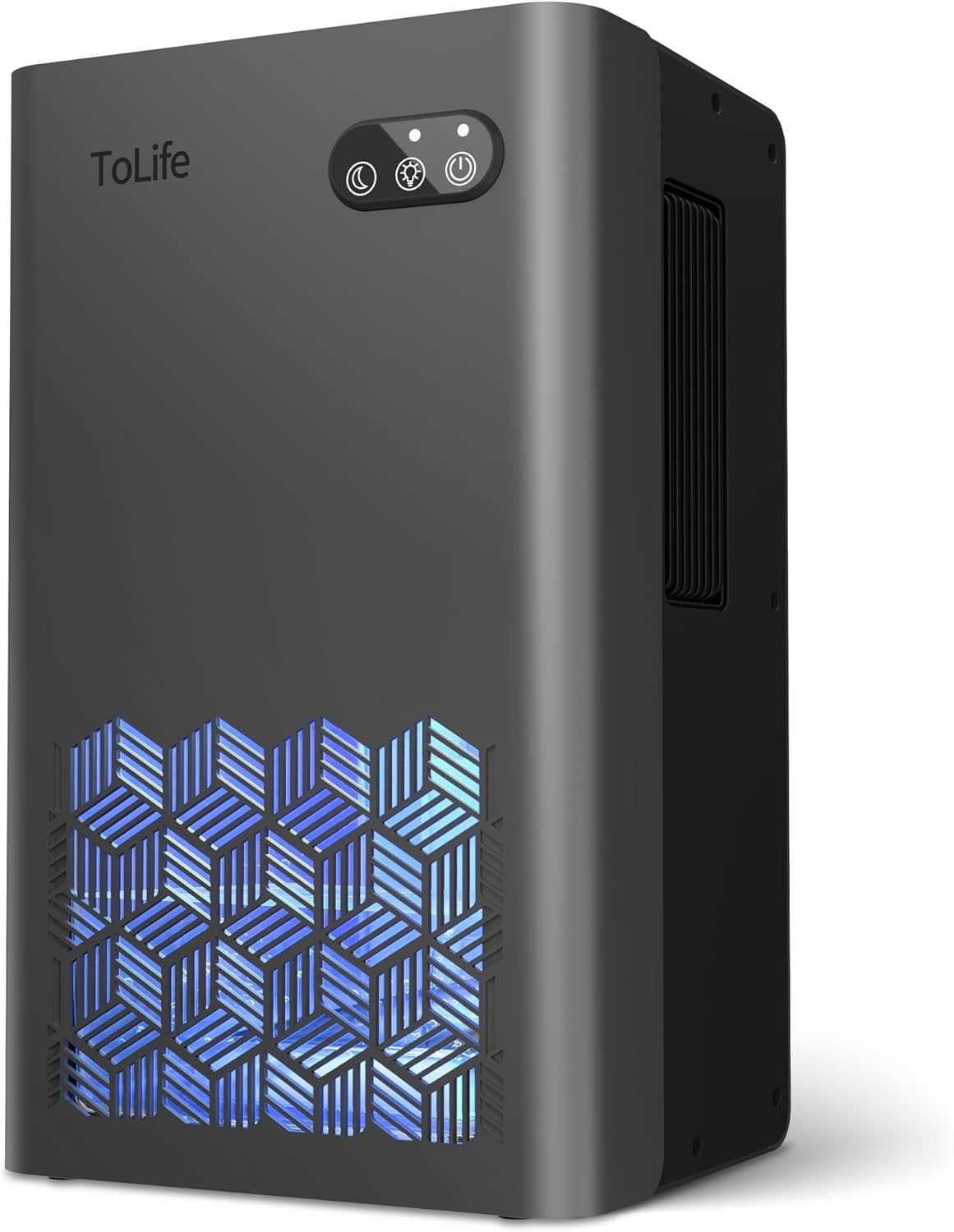
ToLife Dehumidifier TZ-C2
| Floor Area | 1000 |
|---|---|
| Tank Volume | 95 fluid ounces |
| Number of Speeds | 2 |
| Wattage | 93 watts |
| Voltage | 220 volts |
The ToLife TZ-C2 uses semiconductor condensation technology to quietly pull moisture from the air and deposit it into a removable 95 oz tank, making it a straightforward option for damp rooms. It offers two operating modes: a higher-power setting for faster moisture removal and a low-speed sleep mode that runs under 30 dB for overnight use. A seven-color LED can act as a night light and the unit includes automatic shutoff when the tank is full or removed, plus handles for easy moving between rooms. Practical benefits include simple setup, low noise, and a compact footprint that fits in basements, bathrooms, or bedrooms. Limitations are its modest rated dehumidification capacity and stated coverage, which means it will be most effective in smaller basement zones or for spot treatments rather than drying a large, very damp basement quickly. Also this model runs on 220 volts, so electrical compatibility should be confirmed for your location.
Best for: Buyers who need an affordable, portable dehumidifier for spot dehumidifying small basement areas, bathrooms, or bedrooms and who prioritize low noise and easy portability.
Less Ideal for: People looking to dry large, very damp basements or whole-house coverage should consider a higher-capacity compressor dehumidifier instead.
- Large removable 95 oz water tank reduces how often you need to empty it
- Quiet sleep mode under 30 dB suitable for nighttime operation
- Portable design with handles for moving between rooms
- Automatic shutoff prevents overflow when the tank is full
- Dehumidification capacity is modest and may be slow in very damp or large basements
- Requires 220 volt power which may not match all household outlets
Verdict: A compact, budget-friendly portable dehumidifier that is best for quiet, small-area moisture control and occasional basement spot treatments.
Choosing the Right Dehumidifier for Condensation: Key Factors to Consider
Extraction Capacity And Room Size
Extraction capacity matters because it determines how quickly a dehumidifier reduces excess moisture that causes condensation. Match a unit's rated pints-per-day to the square footage and typical moisture load of the problem room. A small bedroom with light condensation needs far less extraction than a basement or bathroom that regularly produces moisture from showers or laundry.
Undersized units run constantly and struggle to lower relative humidity below the threshold where condensation forms. Oversized units can short-cycle in small spaces, which can reduce efficiency and increase wear. Consider the manufacturer's coverage guidance as a starting point, and err on the higher side for areas that are poorly insulated or prone to cold surfaces.
Performance At Low Temperatures
Condensation often appears when warm, humid air meets cold surfaces, so a model's low-temperature performance is crucial. Many compressors lose efficiency below about 60°F and can freeze up, so check whether the unit has defrost features or is rated for cooler spaces.
If you plan to run the dehumidifier in an unheated basement, a garage, or during cold months, choose equipment designed to maintain extraction in cooler conditions or look for alternatives that use desiccant technology. Low-temperature capability reduces the chance the device will stop extracting when you most need it.
Drainage Options And Continuous Operation
Frequent emptying defeats the convenience of a dehumidifier. Units with a large removable tank are fine for intermittent use, but for ongoing condensation problems, continuous drainage via a gravity or pump-enabled hose is far more practical.
Gravity drain setups require an outlet below the unit, while pump-assisted options let you route water upward to a sink or out a window. Consider the logistics of placing the unit and whether you can set up a permanent drain line to avoid daily maintenance.
Noise And Placement
Noise matters because condensation issues often overlap with living and sleeping spaces. Look for published decibel numbers at typical fan speeds and pay attention to fan design; units with variable-speed fans can run quieter while still removing moisture.
Think about where the unit will sit relative to bedrooms or entertainment areas. Some buyers prioritize quieter operation over maximum extraction if they need overnight use. Also consider airflow direction — units that pull air from the back and exhaust from the top require clearance to avoid recirculating damp air.
Energy Efficiency And Runtime Cost
Dehumidifiers may run for long stretches in condensation-prone spaces, so power consumption affects operating cost and practicality. Check the energy use at typical operating conditions and whether the unit supports auto mode, which cycles the compressor based on a set humidity target.
Features like variable-speed fans, energy-saving modes, or built-in humidistats reduce wasted run time. Investing in a more efficient unit can lower electricity use over months of continuous or frequent operation.
Maintenance And Filter Access
Regular upkeep keeps a dehumidifier working reliably. Easy access to the water tank and washable filters simplifies routine cleaning that prevents mold growth inside the unit and maintains airflow.
Look for straightforward filter removal without tools, and parts that are user-replaceable. Models with clear indicators for tank full, filter clean, or defrost status make maintenance less guesswork and help prolong the machine's useful life.
Where Condensation Forms And Why It Matters
Condensation appears when warm, humid air contacts a cooler surface and the local air temperature drops below its dew point. In homes, this commonly occurs on single-pane windows, cold exterior walls, inside basements, and around poorly ventilated bathrooms. Persistent condensation can lead to peeling paint, damaged window frames, and mold growth if left unchecked.
- Windows and doors with poor insulation are typical hotspots.
- Bathrooms and kitchens create transient humidity spikes that can become chronic without ventilation.
- Basements and crawlspaces often stay cool and humid, creating conditions that favor condensation.
Placement Tips For Maximum Effect
Where you place the unit determines how effectively it prevents condensation. Position the dehumidifier where it can intercept humid air before it reaches cold surfaces — for example, between a damp appliance area and exterior walls or near a window that frequently beads with water.
Give the unit clearance on all sides so intake and exhaust are unobstructed. Place it on a level surface and, for gravity drainage, ensure the outlet is lower than the collection point. If you have multiple condensation hotspots, move the unit to the most problematic zone or consider more than one unit for larger basements.
- Avoid corners that trap moisture and restrict airflow.
- Keep at least several inches of clearance around intake and exhaust grilles.
- Use continuous drainage when treating rooms that produce steady moisture.
Using Controls And Humidistats Effectively
Modern dehumidifiers include humidity setpoints and timers that prevent over-dehumidifying and reduce energy use. For condensation control, set the humidistat to a level that prevents water from forming on surfaces, typically around 45 to 50 percent relative humidity depending on temperature and comfort preferences.
Use auto modes that vary compressor activity with demand instead of running at full power continuously. Timers and delayed-start features are useful for targeting high-risk periods, such as overnight or after showering, while preserving energy during low-risk hours.
- Start with a modest humidity target and adjust after observing surface dampness.
- Use lower fan speeds overnight to minimize noise but allow longer run times.
- Combine timed operation with continuous drainage for hands-off performance.
When To Consider A Secondary Solution
A dehumidifier addresses airborne moisture but may not solve underlying causes such as poor insulation, thermal bridging, or insufficient ventilation. If condensation persists despite active dehumidification, investigate draft sealing, adding insulation to cold surfaces, or improving air circulation around windows and exterior walls.
In some cases, targeted fixes like upgrading weatherstripping, insulating a cold wall, or installing a bathroom exhaust fan deliver a permanent reduction in condensation risk. Treat the dehumidifier as part of a layered approach to humidity management rather than a standalone fix.
- Insulation and ventilation reduce the load on any dehumidifier.
- Address building envelope problems to stop chronic condensation.
- Use a dehumidifier alongside source-control measures for best results.
How We Chose the Best Dehumidifier for Condensation
We focused on real-world condensation control, prioritizing technical specs and usability features that determine success in damp-prone rooms. Key evaluation criteria included sustained extraction rate at typical indoor temperatures, performance near or below 60°F where condensation often occurs, and tank or drainage options for unattended operation. Noise and fan design were assessed because many condensation problems occur in living areas or bedrooms. We also considered energy efficiency for continuous or overnight use, and user maintenance tasks like filter access and tank cleaning. Units that were too small for the intended room size, lacked low-temperature performance data, or required frequent manual emptying without practical hose drainage were excluded. We did not include units with unclear capacity ratings or that focused solely on transient humidity spikes rather than ongoing condensation mitigation. The final selections emphasize balanced performance: strong extraction where it matters, simple setup, and manageable upkeep for everyday use.
Our full evaluation process is outlined in our review methodology.
FAQ
Will a dehumidifier stop condensation on windows?
Often it will reduce or prevent window condensation by lowering indoor relative humidity. Success depends on room temperature, window insulation, and how quickly the unit can lower humidity relative to moisture sources.
Can I run a dehumidifier in an unheated basement?
You can, but check the unit's low-temperature rating and defrost capability. Some compressor-based units lose efficiency or freeze below certain temperatures, so choose a model designed for cooler environments if the space is routinely cold.
How do I set the humidistat to prevent condensation?
A typical target for preventing condensation is 45 to 50 percent relative humidity, adjusted for room temperature. Monitor surfaces after a few days and lower the setpoint if beads of water continue to form.
Is continuous drainage necessary for condensation-prone areas?
For ongoing moisture production, continuous drainage is highly recommended. It eliminates frequent tank emptying and lets the unit run as needed to keep humidity at the chosen setpoint.
Will a dehumidifier fix mold caused by condensation?
A dehumidifier helps prevent further mold growth by reducing humidity, but existing mold should be cleaned and the source addressed. If mold is extensive, remediation and fixing the moisture cause are required.
Final Verdict
A dehumidifier for condensation is most effective when matched to the room size, low-temperature conditions, and drainage logistics of the space you need to protect. Prioritize sustained extraction at the temperatures you expect, practical drainage for continuous operation, and noise levels that suit occupied rooms. Treat the unit as one part of a broader moisture-control plan that includes insulation and ventilation improvements. When you balance those tradeoffs, you can pick a model that reliably reduces surface dampness and limits long-term damage. Focus first on capacity and low-temperature performance, then fine-tune your choice based on drainage and day-to-day maintenance needs.