
Note: This article contains affiliate links. If you click on these links and make a purchase, we may earn a small commission at no extra cost to you. This helps support our research and content. Read our full affiliate disclosure here.
If you need reliable humidity control in a medium-sized living space, a properly sized dehumidifier makes a big difference. For a 500 square foot area, the right unit removes excess moisture, helps prevent mold and mildew, and improves overall comfort without running constantly. This guide presents five shortlisted dehumidifiers suited to that footprint, chosen for real-world performance, energy use, and ease of maintenance. Below you will find concise product summaries followed by practical buying guidance and the criteria we used to evaluate each option.
Top Picks at a Glance
| Best Quality Built to a higher standard if you want something more solid | CRO DECOR 22-Pint Dehumidifier |  |
| Best Value The sweet spot between price and what you get | EasyAcc KW-CS05 Dehumidifier |  |
| Top Rated A top-rated pick with lots of positive feedback | CLEVAST EF8974 Dehumidifier |  |
| Most Popular A crowd favorite that many people choose with confidence | Levoair Mini Dehumidifier |  |
| Best Seller A high-volume bestseller chosen again and again | ToLife C2 Dehumidifier |  |
CRO DECOR 22-Pint Dehumidifier

| Dehumidification Capacity | 22 pints/day |
|---|---|
| Floor Area | 500 square_feet |
| Tank Volume | 5.5 liters |
| Number of Speeds | 2 |
| Operation Mode | Standard (5 modes) |
This slim CRO DECOR dehumidifier targets small to midsize rooms and uses semiconductor technology to extract up to 22 pints of moisture per day, making it useful for basements, bathrooms, bedrooms, and laundry drying. Its ultra-thin design reduces floor footprint and houses a 1.45 gallon (5.5 L) removable tank plus a 47 inch drain hose option for continuous drainage, so you can choose between manual emptying with auto shutoff or unattended operation. The touch control panel offers 5 modes including dehumidify and clothes drying, two fan speeds, a 24-hour timer, and a three-color humidity indicator for quick feedback. Built-in safety features such as child lock, auto-defrost, and ETL/DOE certification add reliability, and a dustproof filter cover is intended to lower cleaning frequency. Expect modest performance compared with compressor models in very cold rooms since this is semiconductor-based, and the 22-pint rating is measured at 65°F/60% RH, so real-world output will vary with temperature and humidity.
Best for: Buyers who prioritize a compact, easy-to-operate dehumidifier for a single room up to roughly 500 sq ft and value convenience features like touch controls, continuous drain option, and visible humidity feedback.
Less Ideal for: People needing heavy-duty moisture removal in very cold or large spaces should look at higher-capacity compressor dehumidifiers instead.
- Compact ultra-thin footprint saves floor space in small rooms
- 22 pints per day capacity suitable for up to 500 sq ft under standard test conditions
- Dual drainage: removable 1.45 gallon tank with auto shutoff or 47" hose for continuous drain
- Touch controls with 5 modes, 2 speeds, 24-hour timer, and visible humidity indicator
- Safety features include child lock, auto-defrost, and ETL/DOE certification
- Semiconductor refrigeration generally removes less moisture in cool environments compared with compressor units
- Limited to two fan speeds which reduces control granularity for precise humidity management
Verdict: Choose this slim 22-pint unit when you need a space-saving, user-friendly dehumidifier with continuous drain and simple humidity tracking for a single 500 sq ft room.
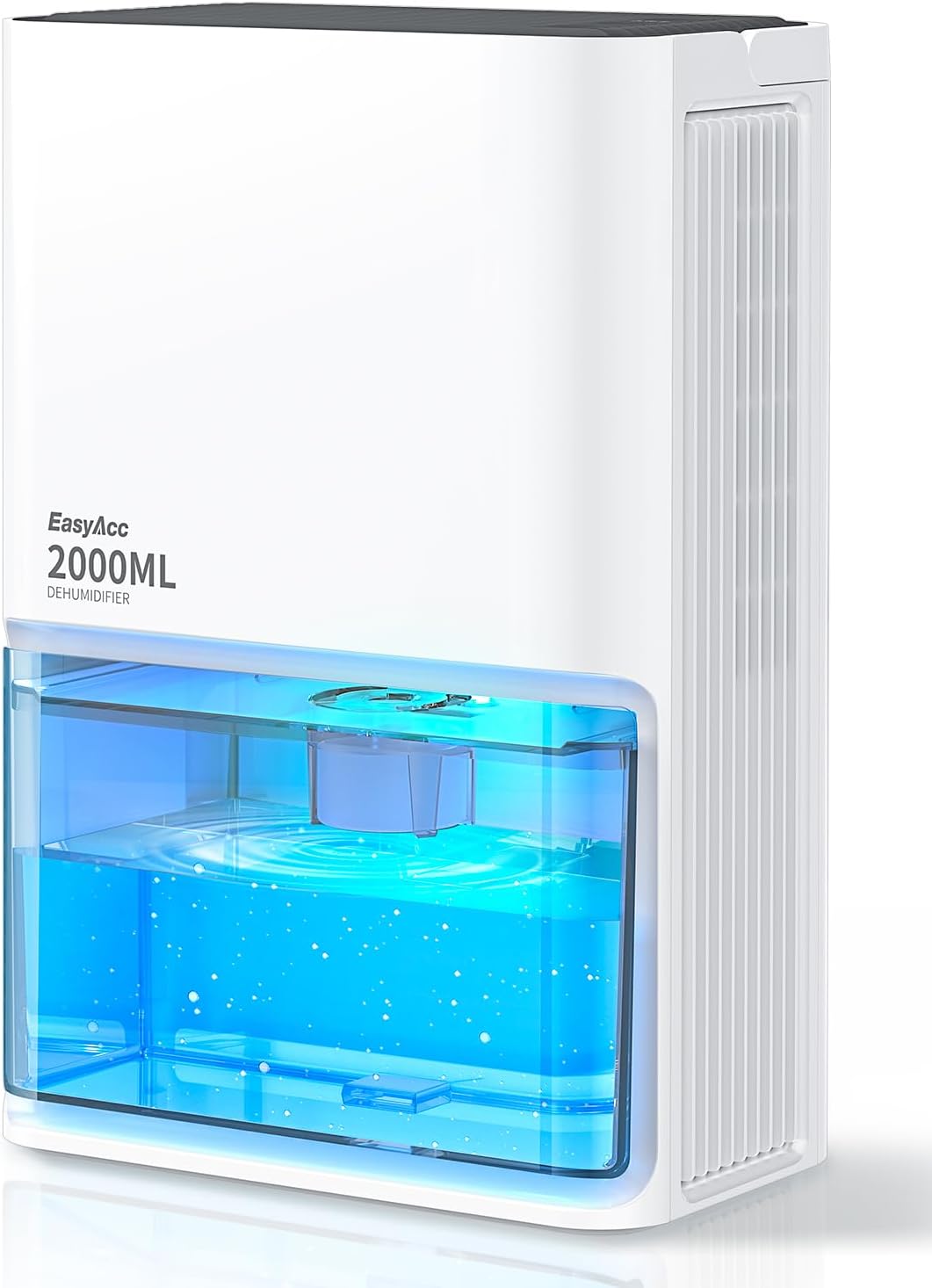
EasyAcc KW-CS05 Dehumidifier
| Floor Area | 500 square_feet |
|---|---|
| Tank Volume | 68 fluid ounces |
| Dehumidification Capacity | 0.65 liters_per_day |
| Wattage | 50 watts |
| Number of Speeds | 3 |
The EasyAcc KW-CS05 is a small, energy-efficient thermoelectric dehumidifier aimed at reducing moisture in rooms up to roughly 500 square feet. It uses semiconductor condensers (no refrigerant compressor), offers three fan/mode settings including a quiet sleep mode under 28 dB, and collects moisture into a 68 oz (2 liter) removable tank with automatic shutoff when full. Practical touches include a portable handle, an auto-defrost function to keep the unit working in cooler conditions, and a multicolor LED night-light with lockable color options. At 50 watts it runs cheaply compared with compressor units, but the thermoelectric design limits daily extraction to about 0.65 liters per day, so it is best for mildly damp spaces rather than heavy condensation or very humid climates. The unit is compact and quiet for bedrooms, bathrooms, or RVs, but will not match the extraction speed of larger refrigerant dehumidifiers for basements or whole-house needs.
Best for: Buyers who want a compact, low-energy dehumidifier to control mild dampness in a single room, bedroom, bathroom, or RV and prioritize quiet operation and portability.
Less Ideal for: People needing fast, heavy-duty moisture removal for basements, whole-home coverage, or consistently high-humidity climates should choose a larger compressor dehumidifier instead.
- Low power draw (50W) for inexpensive continuous use
- Quiet sleep mode under 28 dB suitable for bedrooms
- Auto-defrost and auto shutoff protect operation and simplify maintenance
- Large 68 oz removable tank and portable handle for easy emptying and placement
- Low daily dehumidification rate (0.65 L/day) limits performance in very humid or large damp areas
- Thermoelectric design generally less effective than compressor dehumidifiers for heavy-duty moisture removal
Verdict: A quiet, low-energy choice for keeping mild dampness under control in a single room up to about 500 sq ft.
CLEVAST EF8974 Dehumidifier

| Floor Area | 500 square_feet |
|---|---|
| Capacity | 68 fluid ounces |
| Dehumidification Capacity | 0.7 liters_per_day |
| Wattage | 72 watts |
| Number of Speeds | 2 |
The CLEVAST EF8974 is a small, user-friendly dehumidifier aimed at bedrooms, bathrooms, closets and RVs up to about 500 square feet. It uses dual semiconductor technology and a brushless DC motor to extract up to 0.7 liters (about 23 oz) per day under test conditions, while offering both a removable 68 oz tank and an included drain hose for continuous operation. The touch panel and real-time humidity display let you set a target between 40% and 90% RH and the unit will maintain it automatically, and a sleep mode drops sound below 30 dB and turns off lights for overnight use. Practical extras include a washable air filter, UV-C and negative ion functions, a carry handle for portability, and a timer for 8/16/24-hour cycles. Expect modest daily extraction rates—this is intended for small, enclosed spaces rather than damp basements—and humidity readings can vary by a few percent depending on sensor placement and airflow.
Best for: Buyers who prioritize a dependable, low-noise dehumidifier for small to medium rooms and value simple automatic humidity control and flexible drainage options.
Less Ideal for: People needing heavy-duty moisture removal for very damp or large spaces should choose a higher-capacity compressor dehumidifier instead.
- Two drainage options: large 68 oz removable tank or included drain hose for continuous use
- Quiet brushless DC motor with sleep mode producing under 30 dB for bedroom use
- Real-time humidity display and adjustable setpoint from 40% to 90% RH for automatic control
- Washable filter plus UV-C and negative ion features to help maintain fresher air
- Compact, lightweight design with carry handle for easy room-to-room portability
- Low maximum daily dehumidification rate makes it unsuitable for very damp spaces or large basements
- Humidity sensor accuracy may vary by about ±5% depending on placement
Verdict: A reliable, quiet small-room dehumidifier with large tank and continuous drain options that is ideal for maintaining set humidity levels in spaces up to 500 sq ft.
Levoair Mini Dehumidifier

| Capacity | 2 liters |
|---|---|
| Tank Volume | 2 liters |
| Wattage | 48 watts |
| Floor Area | 650 square_feet |
| Operation Mode | Continuous |
The Levoair Mini Dehumidifier is a lightweight, portable unit that uses semiconductor (Peltier) cooling to remove moisture from small, enclosed spaces. It is typically used in bedrooms, bathrooms, closets, RVs, and basements to reduce humidity and protect against dampness. The unit includes a 68 oz (2 L) water tank and a 5 ft drain hose for continuous drainage so you can run it without frequent emptying, and it offers an auto shutoff and a red full-tank indicator for safe operation. With a rated daily removal of about 1 L per day under moderate conditions and low power draw (48 W), it runs quietly under 40 dB, which makes it suitable for overnight use. Practical limitations are its reliance on temperature and relative humidity for effective performance (recommended above about 59°F and 40% RH) and reduced effectiveness in colder rooms, plus modest daily capacity that may be too low for very damp large basements. Build quality is basic plastic, but the unit's portability and continuous-drain feature make it a convenient fixed-or-moveable solution for single rooms and small spaces.
Best for: Buyers who want a quiet, portable dehumidifier for a single room, closet, RV, or small basement and value low noise plus the convenience of continuous drain operation.
Less Ideal for: People needing to dehumidify very large or consistently wet basements or whole-floor spaces where higher-capacity compressor units are required.
- Includes 5 ft drain hose for continuous unattended drainage
- Quiet Peltier operation under 40 dB suitable for bedrooms or RVs
- Portable and lightweight with a lift handle for easy repositioning
- Auto shutoff and full-tank indicator prevent overflow and protect the unit
- Modest dehumidification capacity best suited to small, not very damp spaces
- Performance drops at temperatures below about 59°F where Peltier units are less effective
Verdict: A quiet, portable 2‑liter Peltier dehumidifier with a continuous drain hose that is a practical, low-noise choice for single rooms up to about 650 sq ft.
ToLife C2 Dehumidifier

| Tank Volume | 95 fluid ounces |
|---|---|
| Number of Speeds | 2 |
| Wattage | 93 watts |
| Floor Area | 1000 square_feet |
| Operation Mode | Comfort |
The ToLife C2 is a small, portable dehumidifier meant to lower humidity in bedrooms, bathrooms, closets, and similar rooms. It uses semiconductor condensation technology to quietly pull moisture from the air and holds up to 95 ounces of water in a removable tank with an automatic shutoff to prevent overflow. Users can switch between a higher-power mode for faster dehumidification and a low-speed sleep mode that runs quietly under 30 dB, and the unit offers a seven-color ambient light that can be locked for use as a night light. It runs on 93 watts and is rated to cover about 1000 square feet, though real-world effectiveness will be strongest in smaller rooms because its listed dehumidification capacity is modest. The unit is lightweight and easy to move, and the tank removal and auto-stop feature reduce maintenance worry. Limitations include a relatively low daily extraction rate and the semiconductor approach, which is less effective in very damp or cold environments compared with compressor models.
Best for: A cautious buyer who values quiet, low-maintenance humidity control for bedrooms or small rooms and wants a portable, easy-to-use unit with safety shutoff and night-light options.
Less Ideal for: Not a good choice for very damp basements or large open areas that need aggressive moisture removal or for users who need maximum daily extraction in cold spaces.
- Quiet operation with a dedicated sleep mode suitable for bedrooms
- Removable 95 oz tank with automatic shutoff to prevent overflow
- Two speed modes for faster or quieter dehumidification
- Lightweight and portable so it is easy to move between rooms
- Seven-color ambient light that can be locked for night light use
- Relatively low dehumidification capacity compared with compressor units
- Semiconductor condensation tech performs worse in very damp or cold conditions
- Rated coverage may be optimistic for continuous heavy humidity control
Verdict: Choose the ToLife C2 if you want a quiet, portable, low-maintenance dehumidifier with a large removable tank and automatic shutoff for small rooms and bedrooms.
Choosing the Right Dehumidifier for 500 Sq Ft: Key Factors to Consider
Extraction Capacity Versus Real Conditions
Rated extraction is often given in pints or liters per day at a specific temperature and relative humidity. What matters for a 500 square foot space is the expected moisture removal under realistic indoor conditions, typically moderate temperatures and 45 to 65 percent relative humidity. A unit that lists very high extraction at warm, high-humidity lab conditions may perform much less in a cool basement or conditioned living area.
Look for specifications or manufacturer guidance that show extraction at a range of temps and humidity levels, or independent measurements when available. If those are missing, choose a model with some margin above the minimum needed so it can keep up during wetter periods without running continuously.
Energy Use and Operating Cost
Dehumidifiers run for extended periods in humid climates, so energy consumption directly affects operating cost and environmental impact. Energy efficiency is influenced by compressor quality, control logic like auto-humidistat cycling, and features such as low-power or eco modes.
Compare wattage during typical operation and whether the unit modulates power rather than running at a fixed high output. Also consider whether the unit qualifies for local energy-efficiency programs or certifications, and whether it supports continuous drainage to avoid frequent manual emptying that can interrupt efficient operation.
Noise Level and Placement
Noise matters when a dehumidifier will operate in living spaces, bedrooms, or home offices. Manufacturers may report decibel levels, but perceived loudness depends on fan design, compressor cycling, and where the unit is placed in the room.
Plan placement away from seating and sleeping areas when possible, and check for multiple fan speeds so you can run a quieter low setting overnight. If you need very low noise, prioritize units with lower reported dB or documented quiet modes rather than relying on highest-extraction numbers alone.
Drainage Options and Tank Capacity
A 500 sq ft unit should have a drainage solution that matches how you intend to use it. Larger internal tanks reduce the frequency of emptying but add weight to move the unit. Continuous drainage using a hose is convenient for longer runs or unattended operation and is preferable for basements or utility rooms.
Consider whether the unit has a gravity-drain outlet or a built-in pump for upward discharge. If you plan to use a pump, verify the vertical lift rating. Also check for accessible reservoir designs and clear level indicators so maintenance is straightforward.
Controls, Sensors, and Automation
Effective humidity control depends on accurate sensors and usable controls. Look for a unit with an adjustable humidistat, reliable humidity readout, and straightforward programming for target humidity and timers. Some models include adaptive modes that cycle to maintain setpoints while conserving energy.
Smart features and remote control can be useful, but prioritize sensor accuracy and simple, repeatable behavior. A confusing control layout or unreliable humidity sensing can result in over- or under-dehumidification regardless of the unit's nominal capacity.
Maintenance and Filter Access
Regular maintenance affects long-term performance. Easy-to-remove washable filters, accessible coils for cleaning, and straightforward tank removal reduce hassle and keep extraction rates high over time. Consider how often the filter needs cleaning and whether replacement filters are user-friendly.
Also inspect for serviceability features such as removable panels for coil access or clear instructions for defrosting in cooler environments. Units that make routine tasks quick are more likely to deliver consistent results.
Sizing Tips for a 500 Square Foot Area
Square footage gives a useful baseline, but effective sizing also depends on ceiling height, room layout, and moisture sources. A tightly sealed 500 square foot room with standard ceilings will need less extraction than a high-ceilinged open area or a space with frequent moisture input such as laundry or a crawlspace.
When in doubt, choose a unit with a modest buffer above the minimum recommended extraction for 500 square feet so it can respond to occasional spikes in humidity without running constantly. Also consider multiple smaller units for split spaces instead of a single central unit if airflow is restricted.
- Account for high-moisture activities nearby such as showering or drying laundry
- Measure ceiling height and adjust capacity estimates for tall rooms
- Consider air circulation patterns rather than relying on square footage alone
Placement and Airflow Best Practices
For best performance, place the dehumidifier where it has unobstructed airflow on the intake and exhaust sides. Avoid corners or tight alcoves that restrict circulation. If the room is open to adjacent areas, position the unit where it can draw air from the most humid zones.
Elevating the unit a few inches off the floor can help in basements prone to splashes or water on the floor, but ensure the chosen surface is stable. Keep at least a foot of clearance around vents and avoid blocking the air path with furniture.
- Place near primary moisture source when possible
- Keep intake and exhaust clear of walls and furniture
- Avoid locations where air is stagnant or heavily restricted
Dealing with Cooler Temperatures
Dehumidifiers that rely on refrigeration become less efficient at lower ambient temperatures and can collect frost on the coils. If you plan to run a unit in a cooler basement or garage, look for models with an auto-defrost function or heater-assisted operation to maintain extraction without frequent coil frosting.
Alternatively, choose units specified to operate at the expected low-end temperature. Running a warm-room-only unit in a cold environment can lead to reduced performance and increased wear.
- Check the operating temperature range before placing in cool areas
- Prefer auto-defrost for unattended basement use
- Monitor performance during seasonal temperature swings
Noise Management Strategies
If the dehumidifier will operate near sleeping or living spaces, run it on the lowest effective fan speed during night hours. Many units have multiple fan settings or sleep modes that reduce noise while maintaining a modest extraction rate.
Consider combining a quieter unit with better placement and airflow to reduce runtime at higher fan speeds. Noise damping solutions such as placing the unit on a vibration-absorbing pad can also help reduce transmitted sound to the floor or structure.
- Use low fan speeds overnight
- Place on non-resonant surfaces or vibration pads
- Avoid putting against thin walls or shared surfaces
Long-Term Upkeep and Seasonal Storage
Regular cleaning and seasonal checks extend the life of a dehumidifier and preserve extraction performance. Clean or replace filters on the schedule recommended by the manufacturer, flush or sanitize reservoirs periodically, and inspect coils for dust or buildup before high-use seasons.
If you store the unit for part of the year, dry it thoroughly and leave panels open briefly to prevent mold growth inside. Store in a dry, frost-free area to avoid damage to seals and electrical components.
- Schedule quarterly filter and coil checks in humid climates
- Sanitize tanks periodically to prevent odors
- Dry completely before storing for extended periods
How We Chose the Best Dehumidifier for 500 Sq Ft
We selected units that reliably cover roughly 500 square feet in typical home environments, focusing on usable extraction at realistic indoor conditions rather than peak lab numbers. Key technical filters included rated extraction capacity at common indoor humidity and temperature ranges, continuous drainage options and reservoir size, and documented energy efficiency or energy-saving modes. We also screened for practical usability: noise levels during typical operation, filter access and cleaning, and the presence of controls or sensors that support automatic humidity management. Excluded were units whose specifications list extraction at unrealistic test conditions or that are clearly undersized for the 500 sq ft target. We prioritized devices that balance steady moisture removal with reasonable power draw and manageable maintenance demands. Durability indicators such as build quality and warranty coverage were considered when available, as were safety features like auto-shutoff and frost protection. The result is a mix of units suited to living rooms, basements, and open-plan areas where consistent mid-level dehumidification is needed.
Our full evaluation process is outlined in our review methodology.
FAQ
How much extraction do I need for 500 sq ft?
Extraction needs vary with humidity sources and room height, but a unit rated for mid-level extraction for a 500 sq ft area is usually sufficient. If the space has frequent moisture or poor ventilation, choose a model with higher extraction capacity or a buffer above the minimum.
Can I use a dehumidifier in a basement that gets cool?
Yes, but refrigeration-style dehumidifiers lose efficiency and can frost at low temperatures. Look for models with auto-defrost or specified low-temperature operation, or consider using the unit only when ambient temperatures are within the recommended range.
Is continuous drainage necessary for a 500 sq ft room?
Continuous drainage is convenient if you want unattended operation or the space produces lots of moisture. For lighter use, a larger tank may suffice, but continuous drainage reduces the need for frequent emptying and helps maintain steady performance.
How noisy will a unit be in a living area?
Noise varies by fan speed and compressor design. Many units offer quieter modes for nighttime use. If noise is a primary concern, prioritize models with lower reported dB and multiple fan speeds rather than highest extraction figures alone.
What maintenance keeps a dehumidifier working well?
Regularly clean or replace the air filter, empty and sanitize the tank as needed, and check coils for dust buildup. Make sure drainage fittings remain clear and test auto-defrost cycles in cooler months to ensure reliable operation.
Final Verdict
For a 500 square foot area, prioritize a unit that delivers steady extraction at realistic indoor temperatures while controlling energy use and noise. Pay attention to drainage options and ease of maintenance so the unit can run reliably without frequent manual intervention. Balance extraction capacity with measured efficiency and sensor-driven controls to avoid oversizing. Choosing based on these criteria will help you find a dehumidifier that keeps humidity in check, reduces the risk of mold, and fits your daily use patterns with minimal fuss.