
Note: This article contains affiliate links. If you click on these links and make a purchase, we may earn a small commission at no extra cost to you. This helps support our research and content. Read our full affiliate disclosure here.
If asthma or allergy symptoms flare at home, controlling indoor humidity can make a measurable difference. A dehumidifier for asthma helps lower moisture that encourages dust mites, mold, and musty odors, all common triggers for respiratory irritation. Choosing the right unit matters because capacity, humidity-control accuracy, and quiet operation affect both effectiveness and daily comfort. This guide presents seven shortlisted dehumidifiers selected for homeowners who need reliable moisture control to ease asthma symptoms. We evaluate each model on factors such as moisture removal rate, continuous operation options, and noise so you can pick a unit that fits the size and use pattern of your home. Read on for practical buying criteria and answers to common questions before the product list.
Top Picks at a Glance
| Best Overall The best all-around choice for most situations | Midea 22 Pint Dehumidifier |  |
| Best Quality Built to a higher standard if you want something more solid | Gasbye DryPrime-50 Dehumidifier |  |
| Best Value The sweet spot between price and what you get | LUKO 30 Pints Dehumidifier |  |
| Best Budget The cheapest option that still gets the job done reliably | TABYIK 35OZ Dehumidifier DH-CS01 |  |
| Top Rated A top-rated pick with lots of positive feedback | hOmeLabs 32-Pint Dehumidifier |  |
| Most Popular A crowd favorite that many people choose with confidence | Waykar 34 Pint Dehumidifier |  |
| Best Seller A high-volume bestseller chosen again and again | ToLife Dehumidifier TZ-C2 |  |
Midea 22 Pint Dehumidifier

| Coverage | 1500 square_feet |
|---|---|
| Dehumidification Capacity | 22 pints_per_day |
| Tank Volume | 0.8 gallons |
| Noise Level | 47 dBA |
| Wattage | 295 watts |
The Midea 22 Pint Dehumidifier removes up to 22 pints of moisture per day and is intended for living spaces such as basements, bedrooms, and laundry rooms. It offers adjustable humidity from 35% to 85%, a reusable washable filter, and both a 0.8‑gallon collection bucket or continuous drainage via a standard hose connection for unattended operation. Smart features include Wi‑Fi control through a mobile app and voice control compatibility with Alexa and Google Assistant, letting you check and change settings remotely. Practical design touches include 360° rotating wheels and a handle for easy placement, a programmable timer, auto restart after power loss, and an auto defrost function for reliability in cooler rooms. The unit runs quietly at about 47 dBA and is Energy Star certified for lower energy use. Limitations are its 22‑pint capacity, which is modest for very damp or large basements, and a two‑speed fan rather than fully variable airflow, so recovery in extremely humid conditions will be slower than higher‑capacity models.
Best for: Buyers who want a balanced, easy‑to‑use dehumidifier with smart controls and quiet operation for typical home spaces like basements, bedrooms, or laundry rooms.
Less Ideal for: Homes with very large, moisture‑heavy basements or finished cellars that need higher daily extraction rates should consider larger capacity units.
- Removes up to 22 pints per day suitable for typical basements and medium rooms
- Wi‑Fi and voice assistant control for remote monitoring and adjustment
- Energy Star certified for improved energy efficiency
- Quiet operation (~47 dBA) that is suitable for bedrooms or living areas
- Reusable washable air filter and continuous drain option for low maintenance
- 22‑pint capacity may be undersized for very large or extremely damp basements
- Only two fan speeds limits fine control of airflow and drying rate
Verdict: A well‑rounded, energy‑efficient 22‑pint dehumidifier with smart controls and quiet operation ideal for typical home spaces and asthma‑sensitive environments.
Gasbye DryPrime-50 Dehumidifier
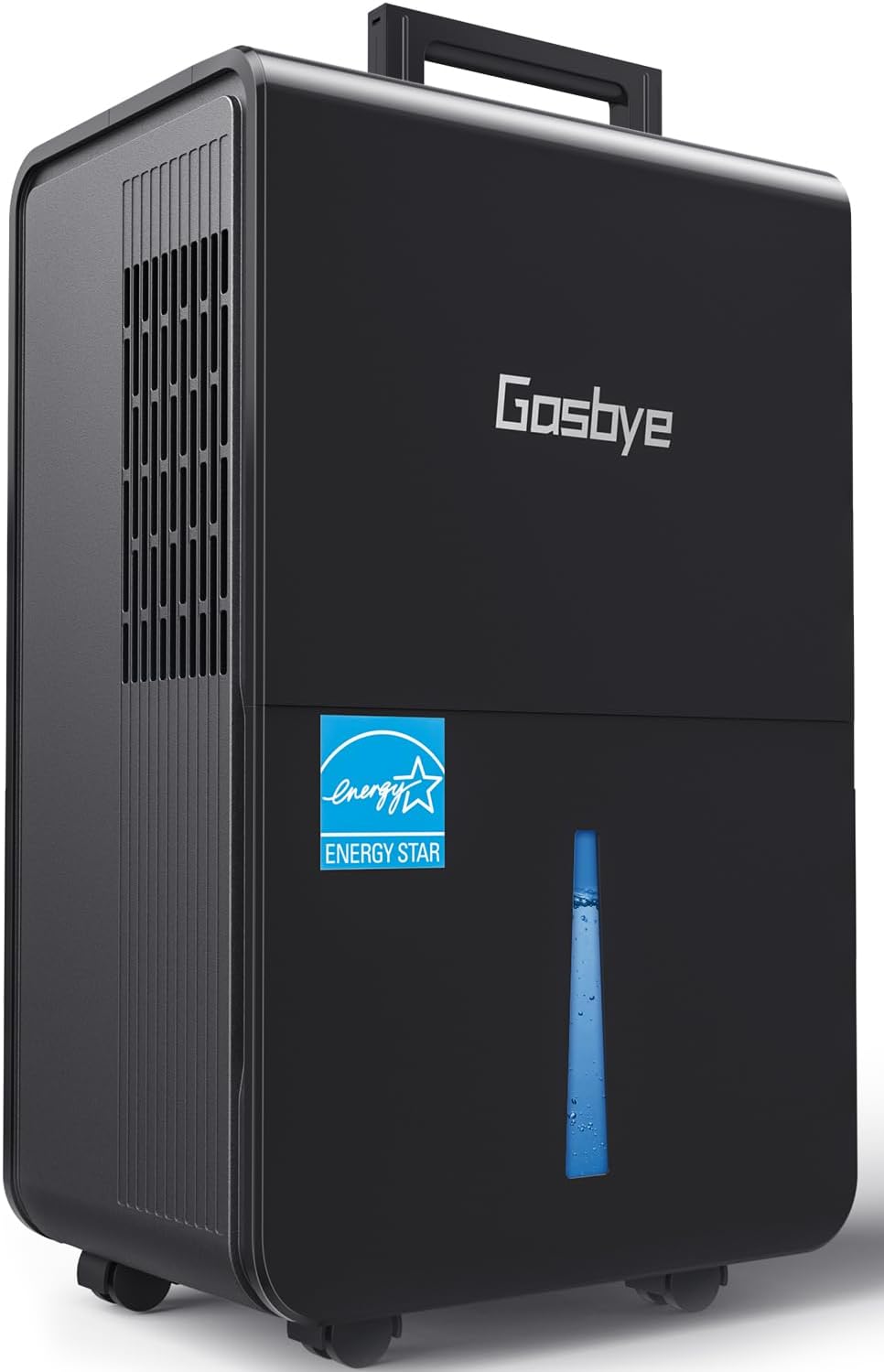
| Capacity | 115 pints |
|---|---|
| Tank Volume | 1.72 gallons |
| Wattage | 500 watts |
| Air Flow Capacity | 12600 cubic_feet_per_hour |
| Operation Mode | Normal, Turbo, Comfort, Continuous |
The Gasbye DryPrime-50 is a heavy-duty compressor dehumidifier built to pull substantial moisture from large spaces such as basements, garages, and living rooms. It reports up to 115 pints/day at very high temperature and humidity conditions and more conservative capacities at typical indoor conditions, and its reinforced five-tier copper coil and 43-pound build aim for durability. You get an Energy Star certified motor for better efficiency, a 1.7 gallon removable tank plus two continuous-drain options including a threaded garden-hose outlet, and an auto shutoff/restart cycle that keeps the unit running to restore set humidity after outages. Noise is moderate at about 45 dB, which is reasonable for open areas but may be noticeable in small rooms. Controls are straightforward with four operating modes and adjustable humidity control, but the unit has a single fan speed and is physically larger and heavier than compact models. For allergy and asthma concerns, the DryPrime reduces ambient humidity effectively, which helps limit dust mite growth and mold, though it does not include a dedicated HEPA or activated-carbon air cleaning system.
Best for: Buyers who prioritize fast, reliable moisture removal in large, damp spaces and want a durable, energy-efficient compressor unit that can run continuously without frequent emptying.
Less Ideal for: People seeking a lightweight, ultra-quiet bedroom dehumidifier or those who want combined dehumidification plus medical-grade air filtration in one appliance should look elsewhere.
- High dehumidification capacity at typical indoor conditions for large rooms and basements
- Energy Star certification for improved energy efficiency
- Three drainage methods including tank, direct drain hose, and garden-hose outlet for continuous operation
- Sturdy build with reinforced copper tubing intended for longer service life
- Auto shutoff and auto-restart preserve settings after power interruptions
- Relatively heavy and bulky compared with compact models, limiting placement options
- Operates at around 45 dB which can be noticeable in small or quiet bedrooms
- No integrated air filtration like HEPA for direct particle removal
Verdict: If you need strong, reliable humidity control for large rooms and basements to help reduce mold and dust-mite triggers, the Gasbye DryPrime-50 delivers robust, energy-efficient performance.
LUKO 30 Pints Dehumidifier

| Capacity | 30 pints_per_day |
|---|---|
| Tank Volume | 0.53 gallons |
| Wattage | 270 watts |
| Operation Mode | Continuous Dehumidify, Auto Dehumidify, Dry Clothes, Sleep |
| Air Flow Capacity | 4237.76 cubic_feet_per_hour |
The LUKO 30‑pint dehumidifier removes up to 30 pints of moisture per day and is built for homes, basements, and laundry areas where humidity and mold risk are concerns. It offers adjustable humidity from 30 to 80 percent via an LED control panel with a three‑color humidity indicator and an auto setting that holds the selected level. Practical touches include a 68 oz detachable tank plus a 3.3 ft drain hose for continuous drainage, two fan speeds, a laundry dry mode, washable filter, auto defrost, and quiet sleep operation. Mobility is easy thanks to rotatable wheels and handles. Limitations are its modest water capacity and single‑room focus—it is best for spot control rather than whole‑house dehumidification, and performance falls off at very low temperatures near its 95°F upper rating for optimal capacity. For asthma management it helps reduce airborne moisture that can worsen mold and dust mite growth, but effective allergen control also requires regular filter cleaning and whole‑room ventilation strategies.
Best for: A practical buyer who wants a straightforward, movable dehumidifier to lower indoor humidity, prevent mold, and help control allergens in basements, bedrooms, or laundry areas without extra setup or complexity.
Less Ideal for: People seeking whole‑house dehumidification or long continuous operation without access to a drain line should look at higher‑capacity or hard‑plumbed systems instead.
- Removes up to 30 pints per day for effective spot dehumidification in damp rooms
- Detachable 68 oz tank plus included drain hose supports manual or continuous drainage
- Digital LED panel with adjustable humidity and a three-color indicator for quick status checks
- Laundry dry mode and two fan speeds for versatile household use
- Washable filter and auto defrost simplify maintenance and year‑round operation
- Designed for single‑room use so it may not replace whole‑house systems
- Limited tank capacity requires periodic emptying when not using the continuous drain
Verdict: If you need an easy‑to‑move, no‑friction unit to cut humidity and reduce mold risk in single rooms, this 30‑pint LUKO is a practical, user‑friendly choice.
TABYIK 35OZ Dehumidifier DH-CS01

| Tank Volume | 1000 ml |
|---|---|
| Dehumidification Capacity | 0.45 liters_per_day |
| Floor Area | 280 square_feet |
| Wattage | 40 watts |
| Number of Speeds | 1 |
The TABYIK 35OZ Dehumidifier (DH-CS01) is a compact, low-energy Peltier unit built for bedrooms, bathrooms, closets and small RVs. It runs continuously with a single-speed fan, pulls up to about 16 oz (450 ml) of water per day under warm, very humid conditions, and stores collected water in a transparent 1000 ml tank with an auto shutoff that stops operation when the tank is nearly full. The unit is very quiet at around 28 dB and includes a seven-color ambient light that can be turned off for sleep. Setup and maintenance are straightforward: plug in, press the single button to start, and periodically remove and clean the rear air intake filter and empty the tank. Trade-offs are typical for thermoelectric dehumidifiers — it is intended for small spaces and mild dampness rather than heavy basement moisture, and the single fan speed limits fine-grained humidity control. For budget-conscious buyers wanting a low-noise, portable option to reduce bedroom humidity and related triggers, this is an easy, energy-frugal choice.
Best for: Buyers on a tight budget who need a quiet, portable dehumidifier for small rooms or sleeping spaces and prioritize low energy use and simplicity over heavy-duty drying performance.
Less Ideal for: People needing to remove large amounts of moisture from basements, laundry rooms, or multiple large rooms should choose a higher-capacity compressor dehumidifier instead.
- Quiet operation around 28 dB suitable for bedrooms and offices
- Transparent 1000 ml (35 oz) tank with easy-remove groove for pouring and cleaning
- Low power consumption (under 1 kWh per day) for economical continuous use
- Auto shutoff protects against overflow and notifies with a flashing light
- Small, portable footprint with built-in handle for moving between rooms
- Low maximum dehumidification rate (about 16 oz/450 ml per day) makes it unsuitable for very damp or large areas
- Single-speed operation offers limited humidity control options
Verdict: A very affordable, ultra-quiet portable dehumidifier that is ideal for reducing mild bedroom humidity and asthma triggers in small spaces.
hOmeLabs 32-Pint Dehumidifier

| Dehumidification Capacity | 35 pints_per_day |
|---|---|
| Capacity | 1.8 gallons |
| Tank Volume | 1.6 gallons |
| Number of Speeds | 2 |
| Floor Area | 4500 square_feet |
This hOmeLabs unit is a straightforward, room‑scale dehumidifier built for large spaces like basements and open living areas. It removes up to 32 pints per day under typical conditions (and higher at very warm, humid extremes), and offers both a removable 1.6 gallon water tank with auto shutoff and a continuous drain outlet for hands‑free operation. The machine includes washable filter media, two fan speeds plus a TURBO mode for faster moisture removal, and smart features such as Wi‑Fi control and voice assistant compatibility so you can monitor and change humidity from your phone. Mobility is simple thanks to built‑in casters and a handle, and safety conveniences include automatic defrost and auto restart after power interruptions. Expect practical, reliable performance for basement humidity control, though it is a single‑hose portable unit so performance will vary with room layout and extreme cold conditions can reduce extraction rates. For buyers who want easy setup, remote control, and reliable daily dehumidification, this model covers the essentials without complex installation.
Best for: Buyers who want a reliable, easy‑to‑use dehumidifier for a basement or large room and value remote control, straightforward maintenance, and portability.
Less Ideal for: People seeking a hard‑plumbed or whole‑house solution or those who need maximum extraction in consistently cold spaces should consider other types of systems.
- Removes up to 32 pints per day with higher capacity at very high temperature and humidity
- Wi‑Fi control and compatibility with Alexa and Google Assistant for remote monitoring and adjustments
- Continuous drain option plus a removable tank with auto shutoff reduces manual emptying
- Washable air filter and caster wheels make maintenance and relocation simple
- Performance drops in cold environments since rated capacity is specified at warmer test conditions
- Only two fan speeds may limit fine control of noise versus extraction rate
Verdict: A portable, Wi‑Fi enabled dehumidifier that delivers dependable moisture removal and easy maintenance for large basements and open rooms.
Waykar 34 Pint Dehumidifier
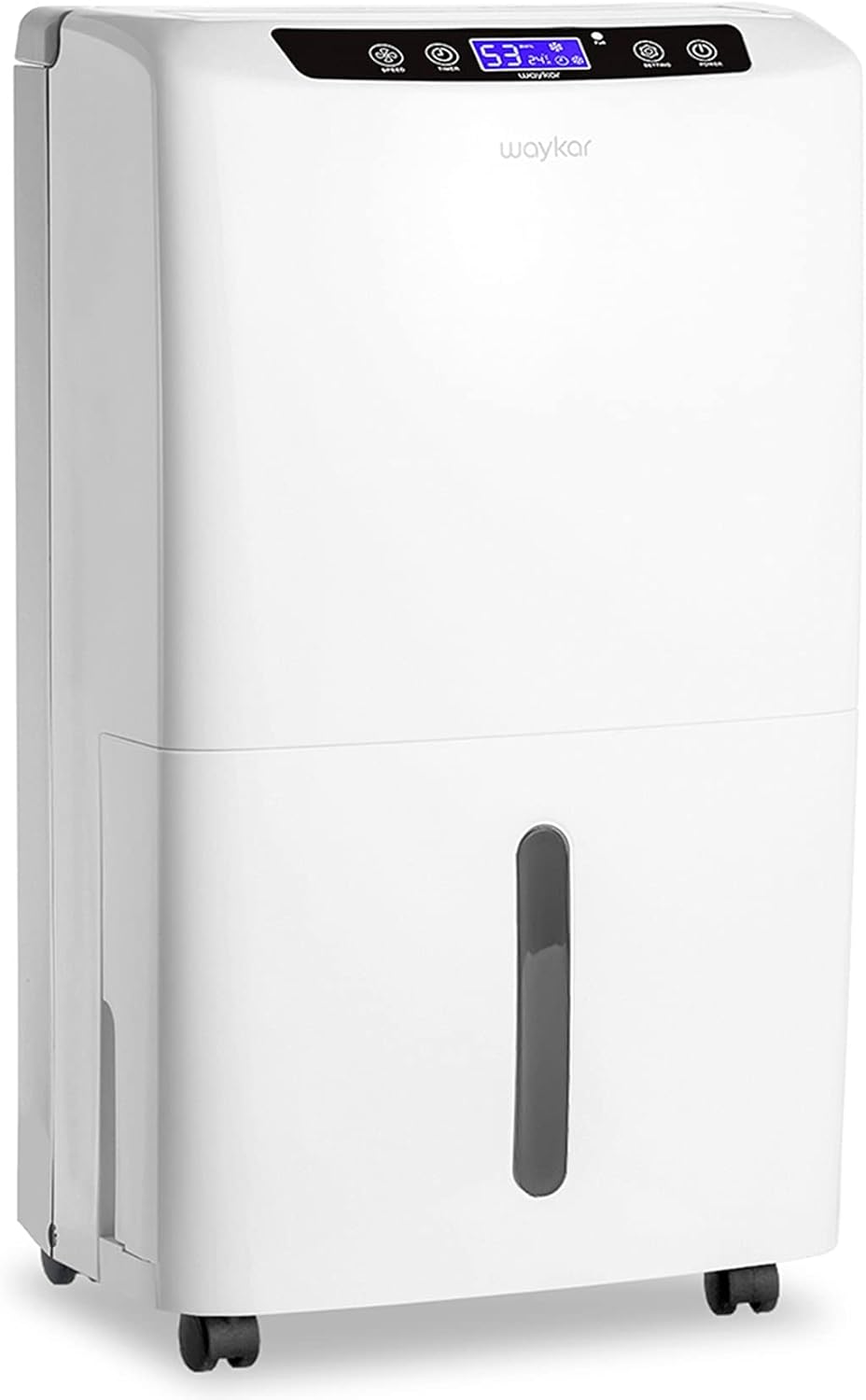
| Capacity | 34 pints per day |
|---|---|
| Floor Area | 2000 square_feet |
| Tank Volume | 0.66 gallons |
| Wattage | 230 watts |
| Air Flow Capacity | 62 cfm |
The Waykar 34 Pint Dehumidifier is a high-capacity portable unit intended for whole rooms, basements, and similar residential spaces. It pulls up to 34 pints per day and offers auto and continuous modes so you can set a target humidity and let the unit maintain it, or connect the included hose for unattended, continuous drainage. Practical features include a removable 0.66 gallon tank with full-tank shutoff, a washable filter, two fan speeds, and a 24-hour timer for scheduled runs. Energy Star certification and a 230W compressor mean it balances dehumidification performance with reasonable energy use during extended operation. The unit also includes automatic defrost and overload protection for reliable use in cooler spaces, and its 90-degree manual airflow adjustment helps direct dry air where needed. Trade-offs are its moderate tank size that requires emptying unless you use continuous drain and typical noise for a compressor dehumidifier, so bedroom users may notice it on higher fan settings.
Best for: Buyers who want a reliable, high-capacity dehumidifier to control moisture across large rooms or basements and who prioritize proven performance and energy efficiency.
Less Ideal for: People seeking a near-silent bedside unit or an integrated air purifier for particle removal should consider quieter or combo filtration models instead.
- High 34-pint daily dehumidification capacity suitable for basements and large rooms
- Energy Star certified for better real-world efficiency during continuous use
- Dual drainage: removable 0.66 gal tank plus included drain hose for unattended operation
- Automatic defrost and overload protection improve reliability in cooler or continuous-use conditions
- Washable filter and removable tank simplify routine maintenance
- 0.66 gallon tank is relatively small so frequent emptying is needed without continuous drain
- No built-in HEPA or advanced air filtration for allergy-specific particle removal
Verdict: A strong, Energy Star rated 34-pint option for buyers who need effective, reliable moisture control in basements and large rooms.
ToLife Dehumidifier TZ-C2
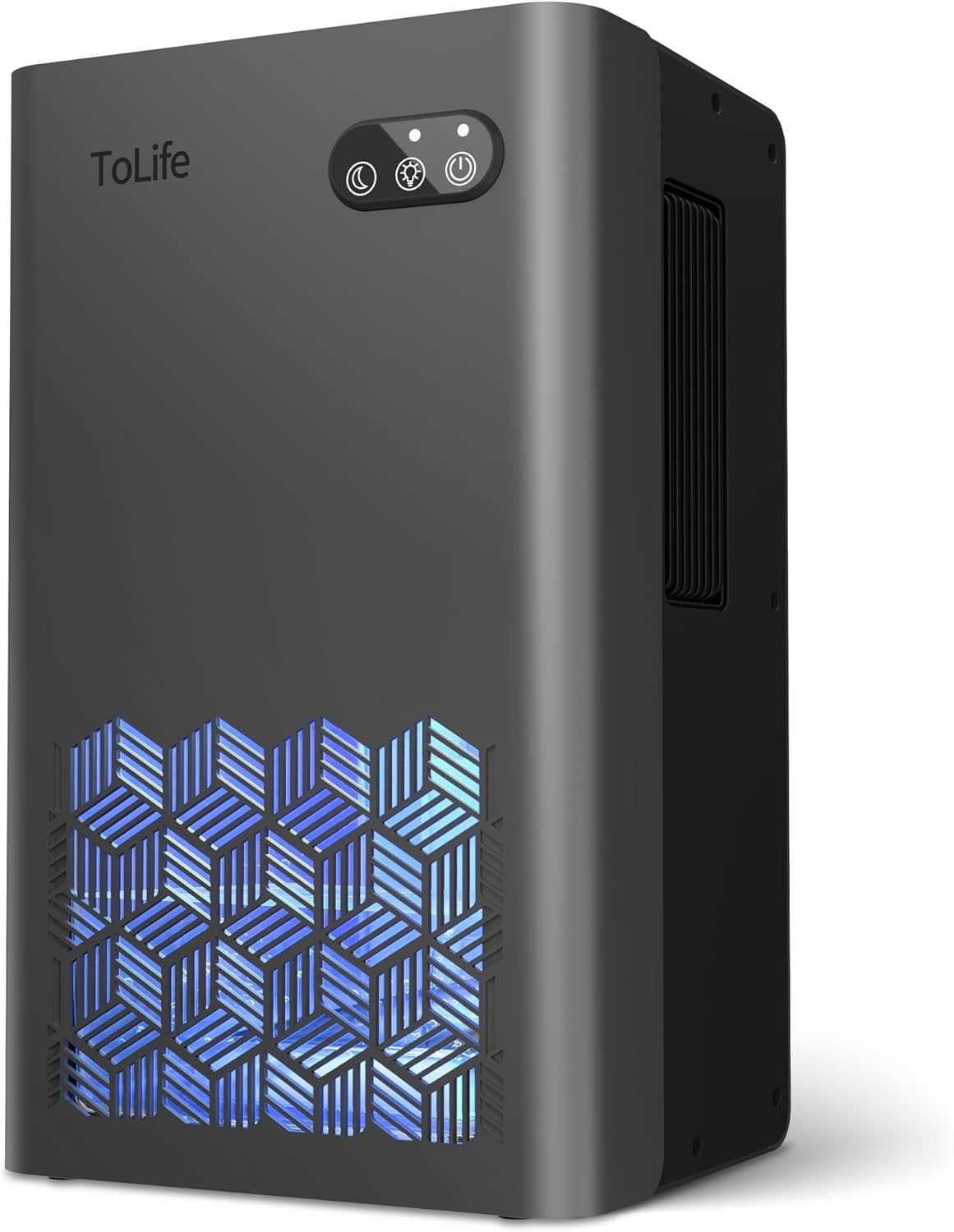
| Floor Area | 1000 |
|---|---|
| Tank Volume | 95 fluid ounces |
| Number of Speeds | 2 |
| Wattage | 93 watts |
| Voltage | 220 volts |
The ToLife TZ-C2 uses semiconductor condensation technology to quietly pull moisture from the air and deposit it into a removable 95 oz tank, making it a straightforward option for damp rooms. It offers two operating modes: a higher-power setting for faster moisture removal and a low-speed sleep mode that runs under 30 dB for overnight use. A seven-color LED can act as a night light and the unit includes automatic shutoff when the tank is full or removed, plus handles for easy moving between rooms. Practical benefits include simple setup, low noise, and a compact footprint that fits in basements, bathrooms, or bedrooms. Limitations are its modest rated dehumidification capacity and stated coverage, which means it will be most effective in smaller basement zones or for spot treatments rather than drying a large, very damp basement quickly. Also this model runs on 220 volts, so electrical compatibility should be confirmed for your location.
Best for: Buyers who need an affordable, portable dehumidifier for spot dehumidifying small basement areas, bathrooms, or bedrooms and who prioritize low noise and easy portability.
Less Ideal for: People looking to dry large, very damp basements or whole-house coverage should consider a higher-capacity compressor dehumidifier instead.
- Large removable 95 oz water tank reduces how often you need to empty it
- Quiet sleep mode under 30 dB suitable for nighttime operation
- Portable design with handles for moving between rooms
- Automatic shutoff prevents overflow when the tank is full
- Dehumidification capacity is modest and may be slow in very damp or large basements
- Requires 220 volt power which may not match all household outlets
Verdict: A compact, budget-friendly portable dehumidifier that is best for quiet, small-area moisture control and occasional basement spot treatments.
Choosing the Right Dehumidifier for Asthma: Key Factors to Consider
Capacity Vs Room Size
Dehumidifier capacity is expressed in pints per day and should match the size and dampness of the space. A unit rated for small rooms may keep a bedroom comfortable but will be undersized for a basement or open-plan living area. Choosing the right capacity reduces runtimes and prevents the unit from running continuously without making progress.
If you plan to run the dehumidifier in multiple rooms, consider a larger-capacity model or multiple smaller units. Over-sizing slightly can be beneficial in very humid climates because it shortens run cycles and reduces relative humidity more quickly.
Humidistat Control and Accuracy
An accurate humidistat lets you set and maintain a target relative humidity, typically between 30 and 50 percent for asthma-friendly indoor air. Poorly calibrated sensors can cause over- or under-dehumidification, which either wastes energy or fails to suppress triggers like dust mites.
Look for units with clearly labeled setpoints and simple controls. Digital displays with precise percentage readouts are generally easier to use than vague dial settings, especially if you need to monitor small changes in humidity.
Drainage Options and Continuous Operation
Emptying the water bucket multiple times per day is inconvenient and may reduce consistent use. Many modern dehumidifiers offer continuous drainage via a gravity drain hose or a pump-assisted outlet that lets condensed water flow away automatically. Pump models are useful if you need to route water upward to a sink or out a window.
Consider your placement and whether you can run a hose to a floor drain. Units with both bucket and continuous-drain flexibility deliver the most practical long-term use in basements, laundry rooms, and humid bedrooms.
Noise Level and Placement
Noise matters when operating a dehumidifier in sleeping areas or living spaces. Manufacturer dB ratings provide a baseline, but real-world perception varies with room acoustics and fan speed. Lower fan speeds typically reduce noise, but also reduce moisture-removal rate.
If you need near-silent operation for bedrooms, prioritize models with low-noise modes or sleep settings. Placement on rugs or anti-vibration pads can also reduce audible rattles and help maintain a comfortable environment for rest.
Filtration and Allergen Control
While dehumidifiers do not replace air purifiers, many include washable or replaceable filters and screens that capture larger dust and fiber particles. Filters that are easy to remove and clean help reduce airborne particulates that can worsen asthma symptoms. Some models include antimicrobial coatings to limit mold growth on filter media.
Regular filter maintenance is important; a clogged filter can reduce airflow and dehumidifying efficiency. Consider the accessibility of filters and whether replacements are available or if the unit uses durable washable screens.
Energy Efficiency and Operating Cost
A dehumidifier that runs frequently can add to household energy use. Energy-efficient models use compressors and fan designs that remove more moisture per watt. Look for units with energy-saving modes and clear energy consumption specs. Over the long term, a more efficient unit can be less expensive to operate, especially in persistently humid climates.
Also consider features that reduce runtime, such as precise humidistats and automatic shutoff, because they contribute to lower electricity use and less wear on components.
What Relative Humidity Is Best for Asthma
Keeping indoor relative humidity between about 30 and 50 percent is a common recommendation for reducing asthma triggers. Lower humidity discourages dust mites and mold growth, while avoiding overly dry air that can irritate airways. Aim for a stable target rather than frequent large swings in humidity.
Use a reliable hygrometer to verify actual conditions and set the dehumidifier humidistat accordingly. In cooler rooms, you may need to balance dehumidification against comfort because very dry air can feel cold and aggravate some respiratory conditions.
- Target 40 to 50 percent for general comfort and allergen control
- Below 30 percent can cause dryness and throat irritation
- Monitor with a separate hygrometer for accuracy
Placement Tips for Best Performance
Position the dehumidifier where airflow is unobstructed and where humidity is highest, such as basements, bathrooms, or near laundry areas. Keep at least several inches of clearance on all sides to allow intake and exhaust air to move freely. Placing a unit in the center of a room is ideal when practical.
Avoid putting the unit against walls or inside cabinets. If you use a hose for continuous drainage, route it unobstructed to a drain point and secure it to prevent kinks. For bedrooms, place the unit as close as practical to the source of dampness but out of the immediate sleeping area to reduce perceived noise.
- Allow adequate clearance for airflow
- Place near humidity sources for faster control
- Secure drainage hose to avoid spills
Maintaining Your Dehumidifier for Long-Term Effectiveness
Regular maintenance keeps performance steady and limits contaminant buildup. Empty the bucket if you do not use continuous drainage and clean or replace filters on the schedule recommended by the manufacturer. Wipe internal surfaces and inspect the coil for dust or frost in colder rooms.
In spring or after long idle periods, run the unit and check for unusual noises or odors that might indicate a clogged filter or stagnant water. Store the unit in a dry location when not in use and follow maintenance steps before reactivating it in the humid season.
- Empty or set up continuous drainage to avoid spills
- Clean washable filters and inspect for mold
- Perform a seasonal check before heavy use
Using a Dehumidifier Alongside Other Allergy Controls
A dehumidifier is one tool among several for reducing asthma triggers. Combine it with routine cleaning, vacuuming with a HEPA-capable vacuum, and washing bedding in hot water to attack dust mites and airborne particles. Address visible mold sources directly by drying and cleaning those surfaces.
Consider room air purifiers in bedrooms for particle reduction while sleeping, especially if symptoms persist despite lowering humidity. Ventilation during dryer weather can help, but avoid outdoor air exchange during high pollen or pollution events if those are triggers for you.
- Pair with HEPA vacuuming and frequent laundering
- Address visible mold and damp sources directly
- Use air purifiers in high-sensitivity spaces
When to Run Your Dehumidifier Continuously
Continuous operation makes sense in persistently damp areas such as basements, laundry rooms, or homes in humid climates. If condensation forms on windows or walls or you see mold starting to appear, running the dehumidifier continuously until humidity stabilizes is appropriate.
For bedrooms, consider a timed schedule or using continuous drainage with a pump to avoid nightly bucket-emptying. Balance continuous operation against noise and energy use by using a humidistat rather than leaving the unit on an indefinite high setting.
- Run continuously in persistently damp spaces
- Use humidistat control to avoid over-dehumidifying
- Employ continuous drainage to remove the need for emptying
How We Chose the Best Dehumidifier for Asthma
We focused on capabilities that matter specifically for people managing asthma and respiratory sensitivities. Primary evaluation criteria included moisture removal performance at normal indoor temperatures, the quality and accuracy of built-in humidistats, and continuous drainage options that support long runtimes without frequent emptying. We also weighed noise output for bedroom or living-room use, and filtration or washable screens that reduce airborne particulates. Energy efficiency and simple controls were considered because a unit that runs efficiently and is easy to set up is more likely to be used consistently. Excluded from consideration were units intended only for outdoor or construction use, models with unsupported or overly complex smart integrations, and products that lack clear humidity control or drainage options. We prioritized units whose specifications match typical home environments and whose features reduce the practical friction of long-term operation. The resulting shortlist balances measurable dehumidification, low operational disturbance, and straightforward maintenance.
Our full evaluation process is outlined in our review methodology.
FAQ
Will a dehumidifier cure mold problems in my home?
A dehumidifier reduces moisture that supports mold growth but does not remove established infestations. For visible mold, you should dry and clean affected areas and address the source of moisture in addition to using a dehumidifier.
Can a dehumidifier make asthma worse by drying the air too much?
It can if humidity is driven too low. Most recommendations for asthma-friendly indoor air target roughly 30 to 50 percent relative humidity. Use the humidistat to avoid sustained readings below about 30 percent.
Is continuous drainage necessary for asthma-friendly use?
Continuous drainage is not strictly necessary but is very convenient in high-moisture areas. It prevents frequent emptying of the bucket and helps ensure the unit runs as needed without interruption.
How loud are typical home dehumidifiers at night?
Noise varies by model and fan speed, but many home dehumidifiers provide quiet or sleep modes intended for night use. Check dB ratings and consider placing the unit farther from sleeping areas if noise is a concern.
Should I run a dehumidifier all year?
That depends on climate and indoor conditions. In many climates seasonal use is sufficient, while persistently humid regions may require year-round operation. Monitor indoor humidity to determine the appropriate schedule.
Final Verdict
When choosing a dehumidifier for asthma, prioritize accurate humidity control, sufficient capacity for the intended room, low noise for living and sleeping areas, and convenient drainage to ensure consistent use. Balance energy efficiency and filter maintenance needs against how often the unit will run. Focusing on these tradeoffs will help you pick a unit that actually gets used and reduces triggers like mold and dust mites. Aim for a model that matches your room size and offers straightforward controls so you can maintain a stable, breathing-friendly indoor environment.