
Note: This article contains affiliate links. If you click on these links and make a purchase, we may earn a small commission at no extra cost to you. This helps support our research and content. Read our full affiliate disclosure here.
A damp cellar can damage stored items, encourage mold growth, and make stairwells and floors unsafe. Picking the right dehumidifier for a cellar matters because basements and cellars have different volume, ventilation, and temperature profiles than aboveground rooms. You need a unit sized for the space, with the capacity to remove moisture at lower temperatures and the controls to maintain a steady relative humidity. This guide shortlists the top dehumidifiers for cellar situations and explains why each type made the cut. We evaluated capacity, cold-temperature performance, energy use, drainage options, and ease of upkeep to help you pick a durable solution. Read on for the top picks and the practical factors to weigh before you buy.
Top Picks at a Glance
| Best Overall The best all-around choice for most situations | yaufey 80-Pint Dehumidifier |  |
| Best Quality Built to a higher standard if you want something more solid | AprilAire E080 80‑Pint Dehumidifier |  |
| Best Value The sweet spot between price and what you get | DGVAM V1 Dehumidifier |  |
| Best Budget The cheapest option that still gets the job done reliably | BeOkay DH-A2 Dehumidifier |  |
| Top Rated A top-rated pick with lots of positive feedback | hOmeLabs 50 Pint Dehumidifier | 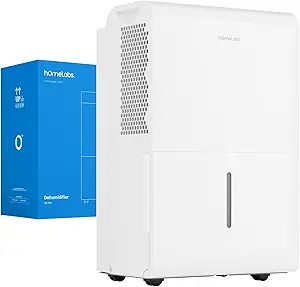 |
| Most Popular A crowd favorite that many people choose with confidence | BEDRED CT11 Dehumidifier |  |
| Best Seller A high-volume bestseller chosen again and again | ToLife Dehumidifier TZ-C2 |  |
yaufey 80-Pint Dehumidifier

| Capacity | 80 pints/day |
|---|---|
| Tank Volume | 1.06 gallons |
| Wattage | 275 watts |
| Air Flow Capacity | 106 cfm |
| Number of Speeds | 3 |
This yaufey 80-pint dehumidifier is built to remove moisture from large areas such as cellars, basements, and big living spaces; it claims up to 80 pints/day in very humid conditions and about 60 pints/day in warm, damp environments. Setup is straightforward: place it near a drain or use the included 3.28 ft hose for continuous drainage, or rely on the 1.06 gallon tank with auto shutoff. The unit offers four preset modes (Sleep, Living, Basement, Continuous), three fan speeds, and an LED touch panel for simple control, while smart sensors keep humidity tightly regulated between 30% and 80%. Energy Star certification and a 275 W rating mean it is relatively efficient for its capacity. Practical benefits include quiet operation, auto-restart after power loss, and a visible tank for quick checks. Limitations to consider are the 1.06 gallon tank which will need frequent emptying if continuous drain is not used, and the unit is fairly heavy for occasional repositioning. For cellar use the continuous drain option and Basement mode are the most useful features.
Best for: Buyers who want a powerful, energy-efficient dehumidifier for a cellar or large basement and prefer easy continuous-drain operation with straightforward controls.
Less Ideal for: People who need a very lightweight, frequently portable unit or who cannot arrange a continuous drain should consider smaller or differently configured models.
- High dehumidification capacity suitable for large basements and cellars
- ENERGY STAR certified for better energy efficiency at this capacity
- Two drainage options: visible 1.06 gallon tank plus continuous drain hose
- Simple touch controls with presets and precise humidity sensing
- Quiet operation and auto-restart for unattended use
- Relatively small water tank for an 80-pint unit if continuous drain is not used
- At about 30 pounds, less convenient to move between locations
Verdict: A high-capacity, Energy Star certified dehumidifier that is best for cellars and basements when you can use continuous drainage for hassle-free operation.
AprilAire E080 80‑Pint Dehumidifier
| Capacity | 80 pints per day |
|---|---|
| Area Coverage | Up to 4,400 sq ft |
| Air Flow | 185 cfm |
| Wattage | 612 watts |
| Voltage | 120 V |
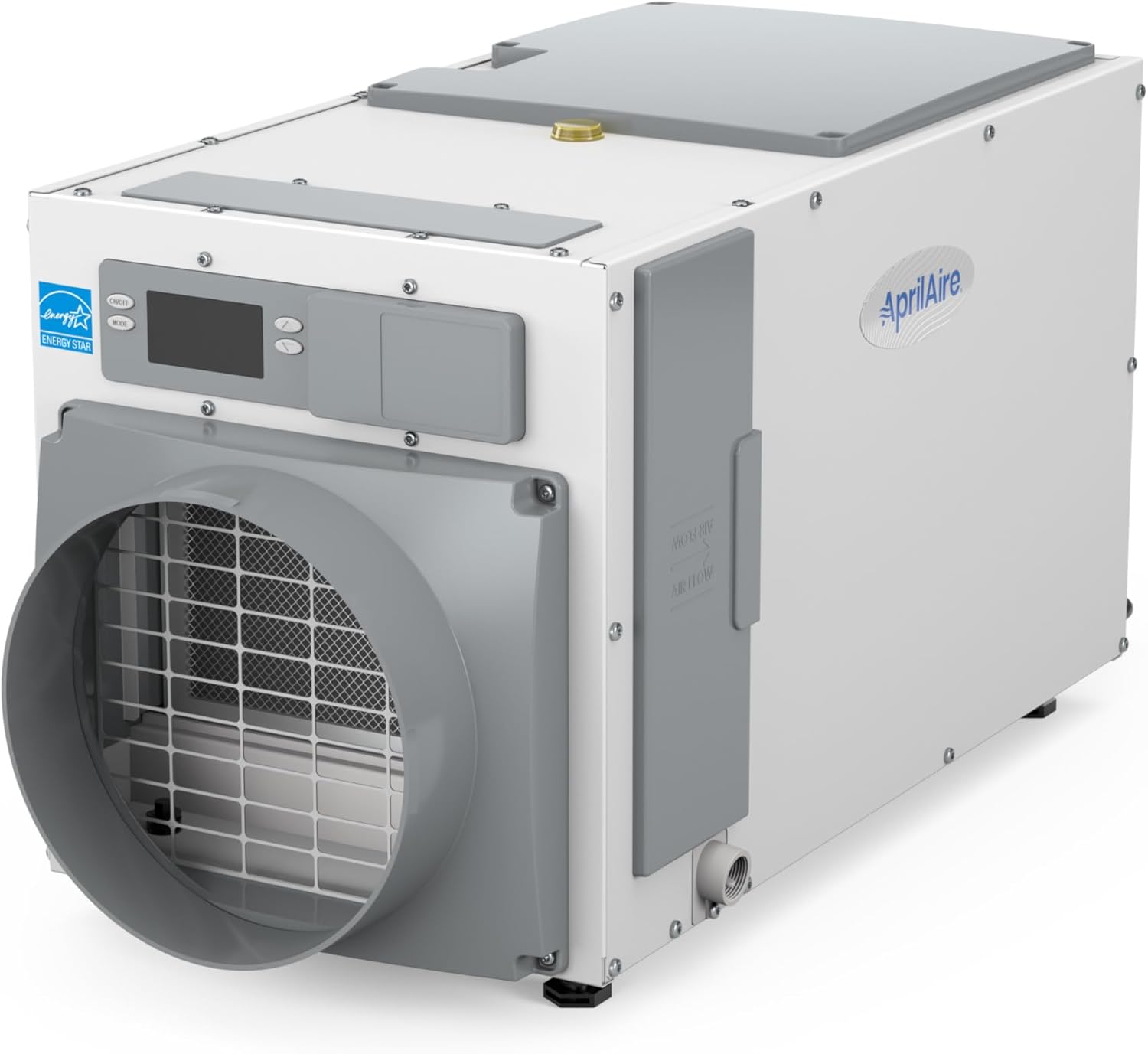
The AprilAire E080 is a heavy-duty, performance-focused dehumidifier meant for basements and sealed crawl spaces and sized for whole-house use up to roughly 4,400 square feet. It uses automatic humidity sensing to run only when relative humidity exceeds the set point, and it moves air at about 185 CFM while removing up to 80 pints (12 gallons) per day. Built with corrosion-resistant aluminum coils and a washable MERV 8 filter, the unit is set up for continuous draining or gravity drain to avoid emptying trays and includes top or front control mounting for flexible installation. At 612 watts and ENERGY STAR Most Efficient certification, it balances strong moisture removal with relatively efficient operation for its capacity. The unit is single-speed, so it lacks variable airflow control, and its size and weight mean installation and placement require planning. It runs on standard 120 VAC and is optimized for North American power. For cellar use the E080 delivers the high-capacity, reliable moisture removal that prevents mold and wood damage, provided you can accommodate a dedicated circuit and permanent drain or ducting.
Best for: Buyers who prioritize fast, reliable moisture removal for damp cellars or whole-house coverage and want a durable, low-maintenance unit that can be installed with permanent drainage.
Less Ideal for: Not a great choice for renters or users who need a lightweight portable unit or who cannot provide a permanent drain or dedicated power circuit.
- High dehumidification capacity up to 80 pints per day suitable for large basements and whole-house applications
- Automatic humidity sensing with adjustable set point for hands-off operation
- ENERGY STAR Most Efficient rating offering better energy use for its output
- Continuous drain option and no removable water tray reduce maintenance and hassle
- Corrosion-resistant aluminum coils and washable MERV 8 filter for durability and lower upkeep
- Single-speed blower limits fine control over airflow and noise versus multi-speed units
- Relatively large and heavy which makes placement and initial installation more involved
Verdict: Choose the AprilAire E080 when you need high-capacity, energy-efficient dehumidification to protect a cellar or whole house from persistent dampness.
DGVAM V1 Dehumidifier

| Floor Area | 4500 square_feet |
|---|---|
| Capacity | 1.72 gallons |
| Dehumidification Capacity | 45 pints_per_day |
| Operation Mode | Automatic |
The DGVAM V1 is a large-room compressor dehumidifier intended for damp basements, garages, and wide open spaces. It claims up to 80 pints per day peak removal (regular 18–45 pints/day) and is designed for continuous operation with a 1.72-gallon tank plus an included drain hose for unattended drainage. Controls include automatic humidity sensing, timer, child lock, and multiple operating modes including continuous dehumidify and ventilation, plus auto-defrost for cooler basements. In use you would place it near the dampest area, set the target humidity, and either empty the tank or run the drain hose for hands-free operation; the unit also offers power-off memory so settings persist after outages. Practical benefits are strong moisture removal capacity for large cellars, quiet operation suitable for nighttime use, and low maintenance with a washable filter. Expect typical compressor dehumidifier limitations such as notable weight for moving between floors and the need to route a drain for continuous unattended operation in finished cellars.
Best for: Buyers who prioritize efficient, hands-free moisture control in cellars and large rooms and want a durable compressor unit they can set and forget for long runs.
Less Ideal for: People who need an ultra-light or frequently moved unit for small rooms or who cannot run a continuous drain line should consider smaller, portable models instead.
- High wet-room capacity suitable for large basements and up to 4500 sq ft coverage
- Includes drain hose plus removable 1.72 gallon tank for flexible drainage options
- Automatic humidity control with timer and power-off memory for hands-free operation
- Auto-defrost and continuous mode allow year-round use in cooler basement conditions
- Removable washable filter reduces upkeep and operating costs
- Unit is relatively heavy which makes frequent relocation awkward
- Capacity numbers list a broad range so real-world output depends on temperature and humidity conditions
Verdict: If you need robust, continuous moisture removal for a cellar or large basement, the DGVAM V1 delivers hands-free performance with drain-hose capability and smart humidity control.
BeOkay DH-A2 Dehumidifier

| Capacity | 1657 ml |
|---|---|
| Floor Area | 230 square_feet |
| Number of Speeds | 3 |
| Wattage | 28 watts |
| Dehumidification Capacity | 0.3 liters_per_day |
The BeOkay DH-A2 is a small-capacity home dehumidifier intended to quietly remove moisture from confined spaces. It uses a semiconductor dehumidification system and offers three operating modes (sleep, normal, performance), five timer settings and a 10-color night light, while the 1657 ml removable tank and automatic shutoff reduce the need for frequent emptying and prevent overflow. With a rated power draw of 28 watts and a low-noise sleep mode under 40 dB, it is energy-efficient and unobtrusive for continuous use in a cellar corner or small storage room. The unit's defrost and auto-stop safety features help it handle cooler or marginal conditions, but its listed dehumidification rate is modest, so it works best for ongoing humidity control rather than rapid drying after heavy water intrusion. Expect limited capacity for larger or very damp cellars and plan on emptying the tank or using a drainage solution for extended runs.
Best for: Buyers on a tight budget who need an inexpensive, energy-efficient unit to maintain moderate humidity in a small cellar or storage room without loud operation.
Less Ideal for: Not suitable for larger cellars or spaces with heavy moisture problems where higher-capacity or commercial dehumidifiers are required.
- Large 1657 ml removable tank reduces how often you need to empty it
- Three modes including a quiet sleep mode for low-noise overnight operation
- Low power draw (28 watts) suitable for continuous running
- Auto shutoff and defrost features protect the unit and prevent overflow
- Low listed dehumidification capacity (0.3 liters/day) limits performance in very damp or large cellars
- Small unit is intended for gradual humidity control rather than fast drying after flooding
Verdict: A low-cost, low-power dehumidifier that keeps small cellars at bay from mild humidity with quiet, hands-off operation.
hOmeLabs 50 Pint Dehumidifier
| Dehumidification Capacity | 50 pints per day |
|---|---|
| Floor Area | 7000 square_feet |
| Tank Volume | 1.6 gallons |
| Wattage | 322 watts |
| Air Flow Capacity | 165 cfm |
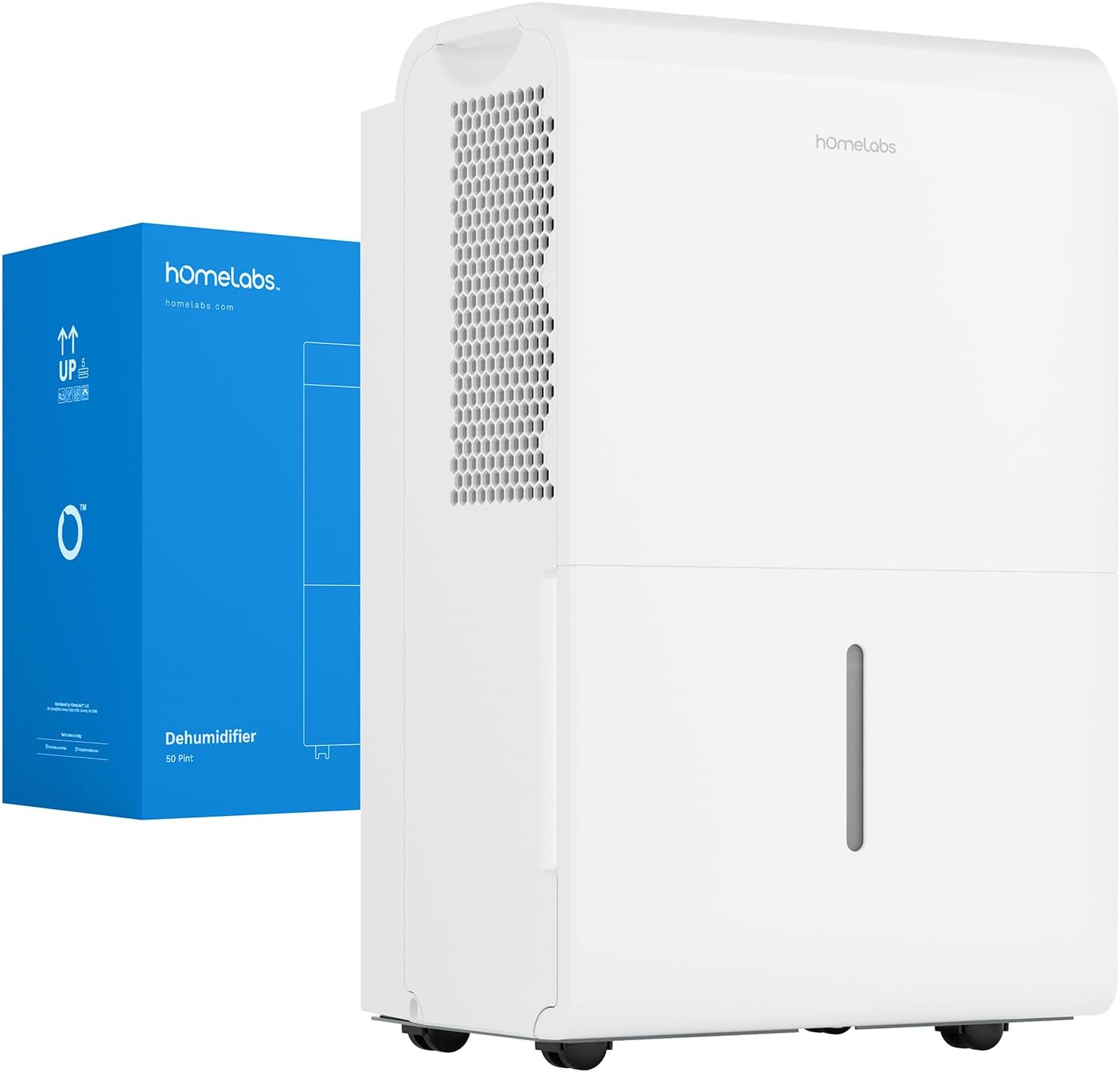
This hOmeLabs dehumidifier is built to move moisture from large areas and offers a familiar, practical feature set for cellar use. It removes up to 50 pints per day (rated at 80°F/60% RH) and can handle much higher output in extreme conditions, while Wi‑Fi control lets you monitor and adjust settings remotely. The unit includes continuous drain capability, a removable washable filter, two fan speeds, and an auto shutoff when the 1.6 gallon tank is full, plus wheels and handles for portability. Its touch panel and timer simplify routine operation and the washable filter helps keep maintenance straightforward. Expect straightforward performance and reliable humidity control, but note the 322 watt power draw and the sizable weight typical of high-capacity units, which affects placement and moving. Noise and runtime will vary with Turbo mode and ambient conditions, and a drain hose is required for unattended continuous operation.
Best for: Buyers who prioritize dependable humidity reduction in large, damp spaces and want the convenience of remote monitoring and continuous drainage for set‑and‑forget cellar operation.
Less Ideal for: People needing a lightweight, ultra-quiet dehumidifier for a small room or those who cannot accommodate a dedicated drain hose for continuous operation.
- Rated to remove 50 pints per day at standard conditions with higher capacity at extreme humidity
- Wi‑Fi remote control for monitoring and changing settings offsite
- Continuous drain option plus automatic shutoff when the tank is full
- Removable washable filter and caster wheels for easier maintenance and placement
- Relatively high power draw at 322 watts compared with small-room units
- Heavy and bulky which can make positioning in tight cellar spaces more difficult
Verdict: A robust, Wi‑Fi‑enabled 50‑pint unit that reliably dries large cellars and supports continuous unattended drainage for maintenance‑minded owners.
BEDRED CT11 Dehumidifier

| Floor Area | 1000 square_feet |
|---|---|
| Tank Volume | 95 fluid ounces |
| Capacity | 5.9 pounds |
| Operation Mode | Intermittent |
| Other Special Features of the Product | 7 Color Ambient Light, Automatic Shutoff, Sleep Mode |
The BEDRED CT11 is a compact thermoelectric dehumidifier intended to reduce humidity in small spaces such as bedrooms, bathrooms, and modest basements up to about 1000 sq ft. It uses semiconductor cooling rather than a compressor, so it runs quietly and is simple to operate with an intermittent operation mode and an automatic shutoff when the 95 oz tank fills. Sleep Mode turns off the lights and lowers noise for overnight use, and the seven-color ambient light gives an optional mood-lighting feature. Practical benefits include easy emptying from the included tank, portability thanks to a lightweight design, and low sound levels that suit living spaces. Important limitations are inherent to semiconductor units: lower capacity compared with compressor dehumidifiers, reduced performance in very cold or very damp basements, and a smaller tank that requires more frequent emptying in high-humidity conditions.
Best for: Buyers who prioritize quiet, low-maintenance dehumidification and want a compact unit that is easy to move and run in living spaces or small basements without frequent intervention.
Less Ideal for: People needing heavy-duty moisture control for large, cold, or very damp basements should choose a higher-capacity compressor dehumidifier instead.
- Quiet thermoelectric operation suitable for bedrooms and living rooms
- Automatic shutoff protects against overfill and simplifies unattended use
- 95 oz removable tank for straightforward water removal
- Sleep Mode and ambient light options for low‑noise nighttime use
- Compact and lightweight for easy placement or moving between rooms
- Semiconductor cooling gives lower moisture removal capacity than compressor models
- Performance drops in cold basement conditions and very high humidity areas
Verdict: Choose the BEDRED CT11 if you want a quiet, portable dehumidifier with auto‑shutoff and sleep‑friendly operation for small basements or living spaces.
ToLife Dehumidifier TZ-C2
| Floor Area | 1000 |
|---|---|
| Tank Volume | 95 fluid ounces |
| Number of Speeds | 2 |
| Wattage | 93 watts |
| Voltage | 220 volts |
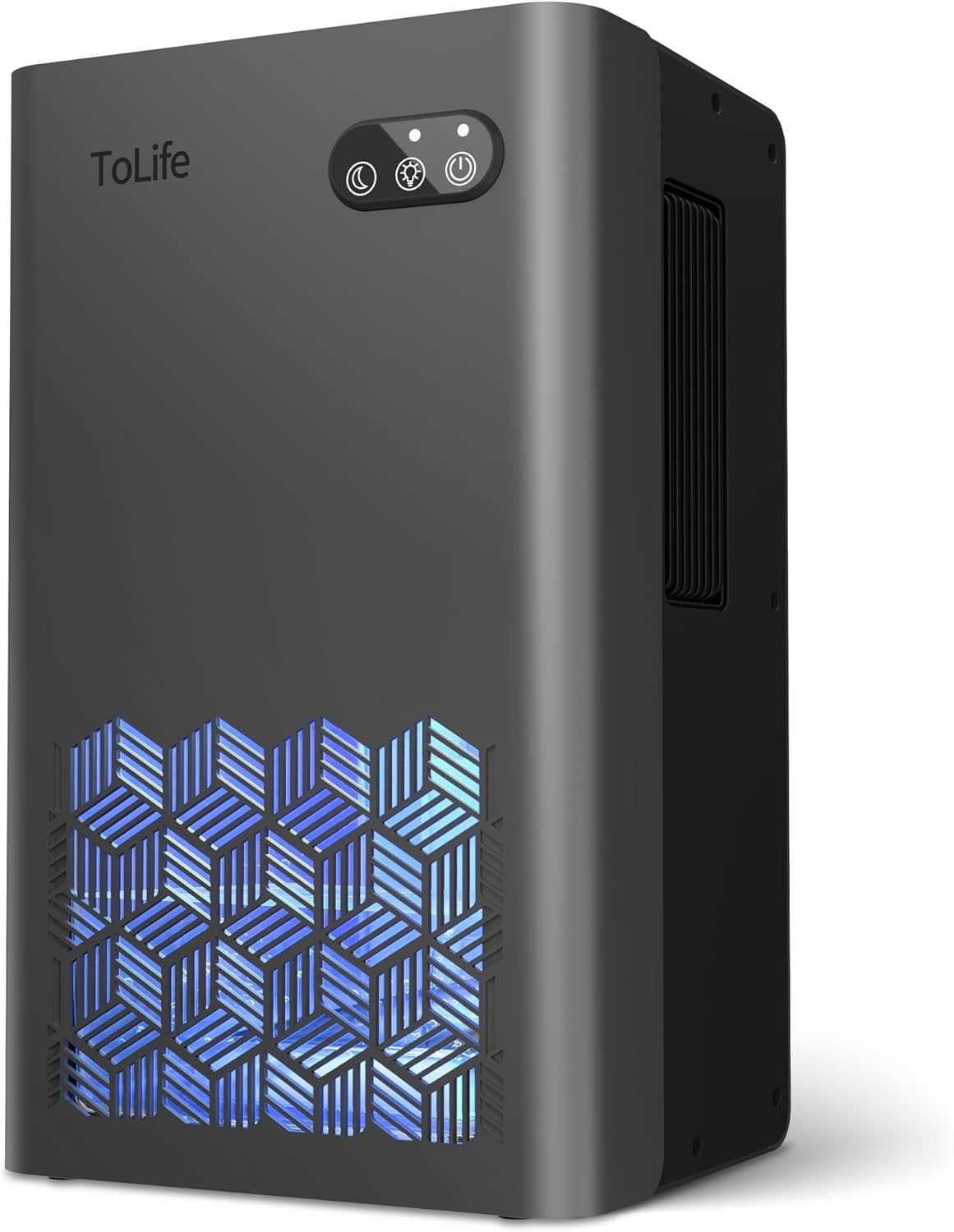
The ToLife TZ-C2 uses semiconductor condensation technology to quietly pull moisture from the air and deposit it into a removable 95 oz tank, making it a straightforward option for damp rooms. It offers two operating modes: a higher-power setting for faster moisture removal and a low-speed sleep mode that runs under 30 dB for overnight use. A seven-color LED can act as a night light and the unit includes automatic shutoff when the tank is full or removed, plus handles for easy moving between rooms. Practical benefits include simple setup, low noise, and a compact footprint that fits in basements, bathrooms, or bedrooms. Limitations are its modest rated dehumidification capacity and stated coverage, which means it will be most effective in smaller basement zones or for spot treatments rather than drying a large, very damp basement quickly. Also this model runs on 220 volts, so electrical compatibility should be confirmed for your location.
Best for: Buyers who need an affordable, portable dehumidifier for spot dehumidifying small basement areas, bathrooms, or bedrooms and who prioritize low noise and easy portability.
Less Ideal for: People looking to dry large, very damp basements or whole-house coverage should consider a higher-capacity compressor dehumidifier instead.
- Large removable 95 oz water tank reduces how often you need to empty it
- Quiet sleep mode under 30 dB suitable for nighttime operation
- Portable design with handles for moving between rooms
- Automatic shutoff prevents overflow when the tank is full
- Dehumidification capacity is modest and may be slow in very damp or large basements
- Requires 220 volt power which may not match all household outlets
Verdict: A compact, budget-friendly portable dehumidifier that is best for quiet, small-area moisture control and occasional basement spot treatments.
Choosing the Right Dehumidifier for Cellar: Key Factors to Consider
Capacity Relative to Cellar Size
Cellars vary widely in cubic footage and ceiling height, so capacity must match the actual volume rather than just floor area. A unit rated for higher pints per day will remove moisture faster in a large, open cellar, while a smaller unit may run constantly without making a meaningful dent in humidity.
Choosing a dehumidifier sized for the space reduces runtime and wear while delivering stable relative humidity. Also consider how much stored material or exposed soil is in the cellar, since packed boxes, cardboard, and damp masonry can add to the moisture load.
Cold-Temperature Operation
Many cellars and basements run cooler than typical living areas, which affects dehumidifier performance. Refrigerant-based units can lose efficiency below certain temperatures and may cycle on defrost modes; units designed with low-temperature operation or specialized defrost control maintain extraction rates in cooler conditions.
If your cellar regularly drops into the 40s Fahrenheit or lower, prioritize models tested for low-temperature extraction or consider desiccant-style systems for persistent cold environments. Reliable cold operation prevents cycles of dampness and refreezing that can damage stored items and the unit itself.
Drainage Options and Ease of Installation
For long-term cellar use you want a dependable drainage setup. Large-capacity models with a condensate pump or a continuous hose connection avoid frequent emptying and allow fully unattended operation. Gravity drain works when the appliance can sit above a floor drain; otherwise a pump is often necessary.
Evaluate how the unit fits into your cellar layout. A pump adds convenience but increases complexity and potential maintenance. Hose routing must be planned to avoid kinks and ensure a smooth fall to the drain point.
Energy Use and Long-Term Running Cost
Dehumidifiers often run for extended periods in cellars, so operating efficiency directly impacts utility bills. Look for units with high extraction-per-watt performance and features like adjustable humidistats and timers to reduce runtime. Energy-efficient models may cost more up front but can save money over time when humidity control is continuous.
Consider how the unit cycles and whether it maintains set humidity without short-cycling. Frequent start-stop behavior can drive up energy use and wear compared with steady, efficient operation.
Durability and Resistance to Corrosion
Cellars are inherently humid environments where metal parts, drain fittings, and coils are at risk of corrosion. Units with corrosion-resistant coatings, stainless or treated drain components, and robust casings last longer and require less repair. Accessible, washable filters and serviceable components simplify upkeep.
Durability also covers mechanical elements like fans and pumps. A rugged build reduces the chance of failure in continuous-use scenarios and makes long-term ownership less of a headache.
Noise, Controls, and Placement
Noise can be a significant factor because cellars are often adjacent to living spaces, workshops, or bedrooms. Quieter fans and vibration-damping feet reduce disturbance. Precise controls, including a reliable humidistat, multiple fan speeds, and programmable timers, let you tune operation to balance comfort, runtime, and noise.
Physical size and weight affect how easily you can reposition the unit for seasonal use or cleaning. Consider clearance for airflow and how noise transmits through floors, doors, and ducts when choosing placement.
Sizing Your Dehumidifier for Typical Cellar Layouts
Estimate the cellar's cubic feet by measuring length, width, and ceiling height to pick a unit with adequate extraction capacity. Manufacturers often list capacity in pints per day at specific conditions; choose a higher-capacity unit for taller ceilings, open rooms, or areas with exposed masonry or standing water issues.
Also factor in how often doors are opened, whether stairwells provide drafts, and whether you store moisture-absorbing materials. If you plan to use the unit in multiple rooms or occasionally run it in connected spaces, size up slightly to maintain consistent humidity.
- Measure cubic footage, not just floor area
- Increase capacity for exposed soil, masonry, or frequent air exchange
- Account for seasonal humidity swings and occasional high-load events
Installation Tips for Reliable, Unattended Operation
Place the unit centrally for even airflow or near the highest moisture source when continual central placement is impractical. Allow clearance around intake and exhaust to prevent recirculation of moist air. If a gravity drain is not feasible, route a drain hose to the nearest floor drain or install a condensate pump for uphill discharge.
Seal gaps in foundation walls and improve minimal air sealing to reduce the moisture load the dehumidifier must handle. Periodically check hose connections and condensate fittings for clogs and ensure any external pump has a serviceable access point.
- Keep clearances for airflow and service access
- Use a condensate pump if no gravity drain is available
- Check hoses and fittings regularly for blockages
Maintaining Performance Through Seasonal Changes
Cellar humidity and temperature change with seasons. In spring and fall, rising ambient humidity increases the extraction workload. Use the humidistat to set a target relative humidity—commonly 45 to 55 percent for cellars—and adjust as conditions change. Regular filter cleaning and coil inspections keep airflow steady and extraction efficient.
If the cellar gets very cold in winter, monitor the unit for frost or defrost cycling. Some models have automatic defrost features; follow the manufacturer maintenance guidance to avoid ice buildup on coils that reduces performance.
- Set humidistat to 45–55 percent as a starting point
- Clean filters monthly during heavy use periods
- Monitor for frost in cold months and ensure defrost features work
When to Consider a Commercial or Whole-Home Option
Large cellars used for storage, wine, or mechanical systems may need commercial-grade or whole-home dehumidification. These systems offer higher continuous extraction, more rugged components, and integration into existing drainage or HVAC systems. Evaluate whether a portable unit can keep up with the load before committing to a larger installation.
Commercial and integrated systems typically require professional installation and may include dedicated condensate plumbing or remote condensate pumps. For non-commercial homeowners, weigh the higher upfront complexity against the convenience of true hands-off operation and longevity.
- Consider commercial units for very large or high-load cellars
- Professional installation may be required for integrated systems
- Compare long-term maintenance needs before upgrading
Safety and Health Considerations
Maintaining proper humidity reduces mold growth and dust mite proliferation, improving indoor air quality. Ensure the dehumidifier is positioned to prevent pooling around electrical outlets and that condensate is routed away from foundations and finished areas. Keep the unit on a stable, level surface to avoid tipping and vibration transfer.
If your cellar stores food, wine, or delicate materials, monitor humidity and temperature together to prevent unwanted drying or spoilage. Regularly inspect the area for signs of mold or persistent moisture and address structural leaks or poor drainage in addition to using a dehumidifier.
- Route condensate safely away from living spaces
- Keep unit level and stable to prevent vibration and tipping
- Check stored items for mold and address structural leaks
How We Chose the Best Dehumidifier for Cellar
We focused on features and performance that matter in cellar conditions rather than general-purpose specs. Key evaluation criteria included moisture removal capacity at lower temperatures, because many cellars sit below typical indoor room temperatures and some compressors lose efficiency. Energy efficiency and running cost were tracked to measure ongoing utility impact for continuous or frequent use. We evaluated drainage and installation flexibility, prioritizing models that offer gravity, pump, and continuous-hose options for long-term unattended operation. Build quality, including corrosion-resistant materials and accessible filters, was considered to reduce maintenance in damp environments. Noise level and control precision were also scored since cellars are often adjacent to living spaces or used for work and storage. We excluded units designed only for small closets or transient spot drying because they lack the sustained capacity and cold-weather performance cellar applications require. Models without clear cold-temperature or continuous-drain capabilities were not considered. The result is a short list emphasizing capacity, low-temperature operation, practical drainage, durability, and operating cost.
Our full evaluation process is outlined in our review methodology.
FAQ
What humidity level should I aim for in a cellar?
Aim for about 45 to 55 percent relative humidity in most cellars. This range limits mold growth while avoiding excessive drying of stored items. Specific needs vary with stored materials, so adjust slightly if you keep wine or sensitive goods.
Can a standard home dehumidifier work in a cold cellar?
Standard refrigerant dehumidifiers may lose efficiency as temperatures drop and can cycle into defrost mode. Choose a model rated for low-temperature operation or consider desiccant units if the cellar regularly stays near freezing.
How often should I drain the dehumidifier in a cellar?
Drain frequency depends on capacity and moisture load. For continuous operation, use a continuous-drain setup with a gravity line or condensate pump to avoid daily emptying. Otherwise, check and empty the water tank as needed, often every few days under heavy load.
Is it better to run a dehumidifier continuously in the cellar?
Continuous running is common in damp cellars to maintain steady humidity, but efficient units with proper sizing and a reliable humidistat can cycle less often. Using timers and setting the humidistat prevents unnecessary runtime while keeping conditions stable.
Will a dehumidifier prevent mold on its own?
A dehumidifier lowers ambient moisture and reduces mold risk but does not fix structural leaks or poor ventilation. Combine dehumidification with sealing, improved drainage, and cleaning to address the root causes of mold.
Final Verdict
Choose a dehumidifier for a cellar by prioritizing capacity, cold-temperature extraction, and a drainage arrangement that supports unattended operation. Energy efficiency and durable, corrosion-resistant construction reduce long-term costs and service needs. Balance noise and placement so the unit performs effectively without creating new issues for adjacent living spaces. Focus on a model sized for your cellar volume and moisture load, and plan installation so condensate is reliably removed. With the right fit and basic maintenance, a cellar dehumidifier will stabilize humidity, protect stored items, and cut mold risk over the long term.