
Note: This article contains affiliate links. If you click on these links and make a purchase, we may earn a small commission at no extra cost to you. This helps support our research and content. Read our full affiliate disclosure here.
Closets are small, often poorly ventilated spaces where moisture can accumulate and damage garments, shoes, and linens. A compact dehumidifier for closets helps stabilize humidity, cut down on musty odors, and limit mold or mildew that can stain fabrics or harm stored items. Choosing the right unit matters because closet volumes and ventilation vary, and a unit that is too large or too loud will underperform for daily living spaces. This guide shortlists the top compact dehumidifiers suited for closet use and evaluates each on moisture removal, noise, run time, and ease of maintenance. Use the summaries and scorecard metrics below to narrow choices based on closet size, noise sensitivity, and long-term upkeep. Next up: the picks and what makes each style fit specific closet setups.
Top Picks at a Glance
| Best Overall The best all-around choice for most situations | TABYIK 35OZ Dehumidifier DH-CS01 |  |
| Best Quality Built to a higher standard if you want something more solid | Tenergy Sorbi 1000ml Dehumidifier |  |
| Best Value The sweet spot between price and what you get | Eva-Dry E-333 Mini Dehumidifier |  |
| Best Budget The cheapest option that still gets the job done reliably | RAINFLOW Dehumidifier Bags 4-Pack |  |
| Top Rated A top-rated pick with lots of positive feedback | DampRid Hanging Moisture Absorber 16 oz |  |
| Most Popular A crowd favorite that many people choose with confidence | DampRid Hanging Moisture Absorber 16 oz |  |
| Best Seller A high-volume bestseller chosen again and again | BEDRED CT11 Dehumidifier |  |
TABYIK 35OZ Dehumidifier DH-CS01

| Tank Volume | 1000 ml |
|---|---|
| Dehumidification Capacity | 0.45 liters_per_day |
| Wattage | 40 watts |
| Noise Level | 28 dB |
This compact TABYIK dehumidifier uses a Peltier cold‑plate design to pull moisture from the air and store it in a 35 oz (1000 ml) transparent tank, making it suitable for small spaces like closets, bathrooms, RVs, and bedrooms. It runs continuously at a low power draw (about 40 watts) and can collect up to roughly 16 oz (450 ml) per day under warm, humid conditions; a built‑in auto shutoff stops operation when the tank reaches about 700–800 ml and a red light flashes to alert you. The unit is single‑speed and very quiet at around 28 dB, so it can run without disturbing sleep or stored items. A removable tank with a groove for easy handling and a back carry handle make emptying and moving the unit straightforward, and the top multicolor light can be turned off. Important limitations are modest daily dehumidification compared with compressor models and a recommended operating temperature range that favors warmer, higher humidity environments, so it works best as a localized dryer for small, damp spaces rather than large or very cold rooms.
Best for: Buyers who want a simple, portable dehumidifier to control dampness in small enclosed spaces and prioritize quiet, low‑maintenance operation.
Less Ideal for: Not a good choice for drying large rooms, basements, or very cold spaces where higher extraction rates and compressor technology are needed.
- Large transparent 35 oz water tank that is easy to remove and clean
- Very quiet operation (~28 dB) suitable for closets and bedrooms
- Low power consumption (around 40 W) for continuous use
- Auto shutoff at near‑full tank prevents overflow and notifies you with a light
- Peltier-style dehumidification yields a low daily extraction rate compared with compressor units
- Single speed limits control for faster drying when needed
- Performance drops in cool or low-humidity conditions due to operating range
Verdict: A compact, quiet, low‑power dehumidifier ideal for keeping closets and other small spaces dry and odor‑free.
Tenergy Sorbi 1000ml Dehumidifier

| Tank Capacity | 1000 ml |
|---|---|
| Dehumidification Capacity | 0.75 liters_per_day |
| Air Flow Capacity | 22 cfm |
| Wattage | 45 watts |
| Filter | H13 HEPA filter |
The Tenergy Sorbi pairs a small-capacity dehumidifier with true H13 HEPA filtration to remove both moisture and airborne particulates in compact rooms. It uses Peltier technology to quietly extract up to 750 ml (0.75 L) of moisture per day while collecting condensate in a removable 1,000 ml tank, and it can also run its purifier and dehumidifier functions simultaneously. Controls are simple touch buttons with low and high fan settings, an LED water-full indicator, and automatic shutoff for safety. Practical benefits include very low noise output suitable for closets or bathrooms, a true HEPA filter that reduces particulates while dehumidifying, and a lightweight portable design that is easy to move and empty. Limitations are the modest daily dehumidification rate and single-speed fan design, which mean it is best for small, slightly damp spaces rather than large or very wet rooms, and the filter will need periodic replacement for continued purification performance.
Best for: Buyers who need a quiet, portable unit to control mild moisture and improve air quality in small enclosed spaces like closets or small bathrooms and who prioritize low noise and filtration over high extraction rate.
Less Ideal for: People who need fast moisture removal in large or heavily damp rooms or who require adjustable multi-speed performance should look for a higher-capacity compressor dehumidifier.
- True H13 HEPA filter captures fine particulates while dehumidifying
- Very quiet operation (approx. 35–42 dB) suitable for small enclosed spaces
- 1,000 ml removable tank with water-full indicator and auto shutoff for low-maintenance use
- Portable and lightweight design for easy placement in closets, bathrooms, or small offices
- Low dehumidification capacity (about 0.75 L/day) makes it unsuitable for large or very damp areas
- Single fan speed limits control granularity over airflow and drying speed
Verdict: A quiet, portable combo dehumidifier and HEPA air purifier ideal for controlling mild moisture and improving air quality in closets and other small spaces.
Eva-Dry E-333 Mini Dehumidifier

| Capacity | 6 ounces |
|---|---|
| Floor Area | 333 square_feet |
| Dehumidification Capacity | 0.38 pints_per_day |
| Operation Mode | Continuous |
| Wattage | 22.5 |
The Eva-Dry E-333 is a small, cordless dehumidifier designed for confined spaces such as closets, cabinets, cars and gun safes. It uses crystallized silica gel beads to absorb up to about 4 to 6 ounces of moisture and indicates when it needs recharging by changing bead color. Because it requires no power or batteries during normal operation, you can hang it or place it where outlets are not available and avoid spills or condensate tanks. Practical features include a hanging hook and a renewable design intended to be recharged and reused for years, making it a low-maintenance option for preventing musty smells and protecting clothes or equipment. The unit is meant for very small volumes — its listed coverage and daily capacity are modest — so it is best for single closets or small enclosed spaces rather than whole rooms. Recharging is required periodically which adds a small upkeep step compared with plug-in electric dehumidifiers.
Best for: Buyers looking to keep a single closet, small storage space, or vehicle dry without installing a powered unit and who prioritize low maintenance and portability.
Less Ideal for: People who need continuous high-capacity moisture removal for whole rooms, basements, or damp areas that require automatic draining or active refrigeration.
- Completely cordless operation for placement where outlets are unavailable
- Rechargeable silica gel beads provide leak-free moisture absorption
- Compact shape with hanging hook fits closets, cabinets, cars, and safes
- Long service life when recharged properly, designed for repeated reuse
- Very limited absorption rate and capacity, not suitable for larger rooms
- Requires periodic recharging of the silica beads rather than automatic drain
Verdict: A cordless, recharge-and-reuse mini dehumidifier that is a simple, low-maintenance solution for keeping individual closets and small enclosed spaces dry.
RAINFLOW Dehumidifier Bags 4-Pack
| Unit Count | 4 Count |
|---|---|
| Number of Packs | 4 |
| Life Expectancy | 3 months |
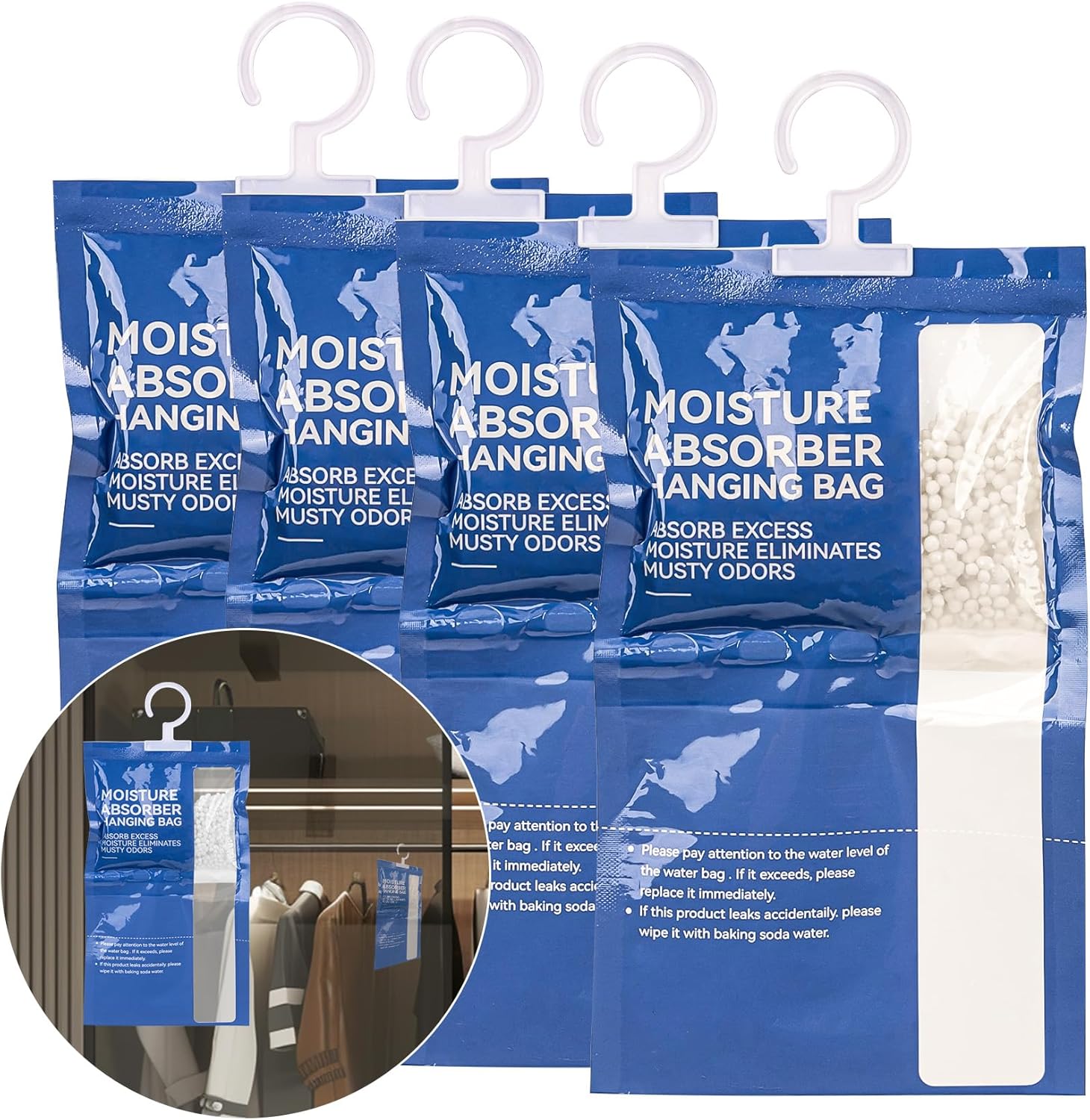
These RAINFLOW hanging dehumidifier bags use calcium chloride granules to pull moisture from the air and collect liquid in a clear pouch, offering a simple, maintenance-light way to reduce humidity in closets, bathrooms, RVs, and other small enclosed spaces. Installation is straightforward: hang the bag where dampness or odors appear and monitor the visible water level to know when it is spent. Because they require no power, they are quiet and portable, making them a useful alternative to small electric dehumidifiers for seasonal storage, travel, or areas without outlets. Each bag has a quoted life expectancy of about three months, so routine replacement is required and ongoing cost should be considered compared with a reusable electric unit. They are compact and mess-resistant when used as directed, but they do produce liquid that must be disposed of and should be kept away from children and pets.
Best for: Buyers wanting an inexpensive, no-power solution to control moisture in small enclosed spaces like closets or RV storage who prioritize simplicity and portability over a long-term electric unit.
Less Ideal for: People needing continuous, long-term dehumidification for large rooms or whole-home solutions should choose an electric dehumidifier instead.
- Works without electricity so it is quiet and portable
- Transparent collection pouch makes performance easy to monitor
- Compact hanging design fits closets, bathrooms, RVs, and storage spaces
- Simple setup with no installation or tools required
- Consumable product that requires replacement roughly every three months
- Creates liquid byproduct that must be disposed of safely
Verdict: An affordable, no-electric hanging moisture absorber that fits closets and small spaces for quick, temporary humidity control.
DampRid Hanging Moisture Absorber 16 oz

| Pack count | 3 Pack |
|---|---|
| Capacity per bag | 16 oz. |
| Duration | Up to 60 days (varies with conditions) |
DampRid Fresh Scent hanging moisture absorbers are disposable bags of moisture-trapping crystals designed to reduce dampness and musty odors in small spaces like closets. You hang the bag, shake it to activate the time-release fragrance, and the crystals attract moisture into the bottom reservoir until the liquid reaches a replacement line. The product claims 14% more absorbing power than the 14-ounce variant and can last up to 60 days depending on humidity and temperature. In practice these are low-effort: no power or installation, and the clear reservoir makes it easy to see when to replace. They are best for ongoing humidity control in enclosed spaces where a small, passive solution is preferred. Limitations are that performance depends on room humidity and size, they eventually need replacement, and scented formulas may not suit sensitive users; they are not a substitute for an electric dehumidifier in very damp or large areas.
Best for: Buyers who want a reliable, low-maintenance way to control minor humidity and musty odors in closets or small storage areas without running electricity or doing regular monitoring.
Less Ideal for: People dealing with persistent high humidity, condensation, or large damp spaces who need active dehumidification and moisture removal capacity.
- Works without power or installation so it is safe for closets and small spaces
- Visible reservoir makes it easy to tell when the unit is spent
- Time-release fragrance helps mask or eliminate musty odors
- Long lifespan per unit—can last up to about 60 days in typical closet conditions
- Effectiveness is limited by room size and high humidity levels where an electric dehumidifier would perform better
- Scented formula may bother fragrance-sensitive users
Verdict: A simple, dependable no-power solution for keeping closets and small storage spaces free of excess moisture and musty odors.
DampRid Hanging Moisture Absorber 16 oz

| Capacity | 16 ounces |
|---|---|
| Unit Count | 3 |
| Operation Mode | Continuous |
| Dehumidification Capacity | 0.47 liters_per_day |
| Floor Area | 60 square_inches |
DampRid Hanging Moisture Absorbers use a no-power, moisture-attracting formula in a hanging bag to remove excess humidity and the musty odors that come with it. You hang the 16-ounce bag inside a closet, laundry room, or small storage area and the crystals absorb moisture into a visible liquid reservoir; when the liquid reaches the replacement line you discard the bag. The product includes a time-release lavender vanilla fragrance that helps mask and eliminate stale smells while the absorber works, and the manufacturer rates each bag to last up to about 60 days depending on conditions. Because it needs no electricity and is compact, it is quick to deploy in tight spaces or closets where running a dehumidifier is impractical. The main limitations are that it is disposable rather than refillable and its effectiveness depends on ambient humidity and airflow, so very large or poorly ventilated closets may need a larger-capacity solution or more frequent changes.
Best for: Buyers who want a low-effort, no-electricity way to control dampness and musty smells in closets or small storage areas and value visible, easy-to-check operation backed by many user reviews.
Less Ideal for: People needing continuous dehumidification for large rooms, basements, or areas with high humidity should choose an active or higher-capacity dehumidifier instead.
- Works without electricity so it can be used in closets and small spaces
- Visible liquid reservoir makes it easy to tell when to replace the bag
- Included lavender vanilla fragrance reduces musty odors while absorbing moisture
- Compact hanging design installs quickly and does not take floor space
- Disposable design creates recurring replacement needs
- Performance varies with room humidity and airflow, so results are slower in very damp or stagnant spaces
Verdict: A simple, effective disposable moisture absorber that eliminates closet dampness and musty odors without electricity, ideal for small spaces.
BEDRED CT11 Dehumidifier

| Floor Area | 1000 square_feet |
|---|---|
| Tank Volume | 95 fluid ounces |
| Capacity | 5.9 pounds |
| Operation Mode | Intermittent |
| Other Special Features of the Product | 7 Color Ambient Light, Automatic Shutoff, Sleep Mode |
The BEDRED CT11 is a compact thermoelectric dehumidifier intended to reduce humidity in small spaces such as bedrooms, bathrooms, and modest basements up to about 1000 sq ft. It uses semiconductor cooling rather than a compressor, so it runs quietly and is simple to operate with an intermittent operation mode and an automatic shutoff when the 95 oz tank fills. Sleep Mode turns off the lights and lowers noise for overnight use, and the seven-color ambient light gives an optional mood-lighting feature. Practical benefits include easy emptying from the included tank, portability thanks to a lightweight design, and low sound levels that suit living spaces. Important limitations are inherent to semiconductor units: lower capacity compared with compressor dehumidifiers, reduced performance in very cold or very damp basements, and a smaller tank that requires more frequent emptying in high-humidity conditions.
Best for: Buyers who prioritize quiet, low-maintenance dehumidification and want a compact unit that is easy to move and run in living spaces or small basements without frequent intervention.
Less Ideal for: People needing heavy-duty moisture control for large, cold, or very damp basements should choose a higher-capacity compressor dehumidifier instead.
- Quiet thermoelectric operation suitable for bedrooms and living rooms
- Automatic shutoff protects against overfill and simplifies unattended use
- 95 oz removable tank for straightforward water removal
- Sleep Mode and ambient light options for low‑noise nighttime use
- Compact and lightweight for easy placement or moving between rooms
- Semiconductor cooling gives lower moisture removal capacity than compressor models
- Performance drops in cold basement conditions and very high humidity areas
Verdict: Choose the BEDRED CT11 if you want a quiet, portable dehumidifier with auto‑shutoff and sleep‑friendly operation for small basements or living spaces.
Choosing the Right Dehumidifier for Closets: Key Factors to Consider
Closet Size and Air Volume
Closet size determines how much moisture the dehumidifier must remove and how quickly it can lower relative humidity. Small reach-in closets need only modest extraction rates, while walk-in closets or those with built-in shelving and boxes trap more humid air and require higher capacity. Assess the closet cubic footage rather than just floor area to account for stacked storage and high shelving.
Matching capacity to volume prevents short-cycling and reduces wear. A unit rated for larger spaces will often run less frequently to maintain target humidity, but oversized units can be bulkier and harder to position in tight closets. Choose a size that balances extraction capability with a compact footprint for shelf or floor placement.
Placement and Mounting Options
Where you can place the dehumidifier affects performance and usability. Floor placement is simplest, but shelves, wall mounts, or hanging options let you keep the unit away from shoes or stored items and improve airflow. Some models are designed for vertical placement with front-facing intakes, while others work best with clearance on all sides.
Consider clearance requirements and whether the closet has a raised floor or platform. Units that allow continuous draining via a hose are helpful if the closet has a floor drain or nearby plumbing. For closets without that option, a unit with an accessible, easy-to-remove water tank makes routine emptying less of a hassle.
Noise and Vibration
Closets are often adjacent to bedrooms or living areas, so low operational noise is important. Look for models with low decibel ratings and vibration-dampening designs. Fans and compressors are primary noise sources, and quieter units typically use lower-speed fans or improved insulation.
Vibration can transmit through shelving and building framing, amplifying perceived sound. Rubber feet, anti-vibration mounts, or internal dampers reduce this effect. If you store delicate fabrics or track-sensitive items, quieter operation preserves the closet environment without waking household members.
Drainage, Tank Access, and Maintenance
Maintenance burden is a practical concern for closet appliances. Models that provide easy tank removal, clear fill windows, or continuous drainage options reduce the time you spend on upkeep. A full-tank auto shutoff prevents spills but should be paired with an easy-to-empty reservoir to avoid awkward reaches inside cramped closets.
Filter access and washable filters simplify long-term care, and units with accessible coils or panels make occasional cleaning straightforward. Consider how often you can reasonably empty a tank and whether a gravity drain or small hose can be routed out of the closet for hands-off operation.
Power Draw and Run Cost
Closet dehumidifiers often run intermittently for long stretches. Units with lower wattage or smart humidity control reduce energy usage over time. Look for models that cycle efficiently and include humidistats so they run only as needed rather than continuously.
While energy labels for small appliances vary, comparing rated wattage and automatic control features gives a practical sense of expected operating cost. For spaces where the unit runs frequently, incremental savings on electricity add up and reduce the need to replace older, less efficient equipment prematurely.
Control Features and Automation
Built-in features such as adjustable humidistats, timers, and continuous drain options affect convenience and performance. A reliable humidistat lets you target a specific relative humidity to protect fabrics without overdrying. Timers can be useful if you only need dehumidification during certain hours, such as overnight or during humid seasons.
Some units offer simple LED indicators for tank full or filter status, while others provide more advanced controls. Choose the level of automation that fits your willingness to interact with the device and the constraints of the closet layout.
Best Closet Placement Practices
Proper placement improves airflow and helps the dehumidifier work efficiently. Position the unit where it has clearance on intake and exhaust sides and avoid blocking vents with boxes or hanging clothes. If placing on a shelf, ensure the shelf can support the unit and that there is at least a couple inches of space around the sides.
If continuous drainage is available, route a small hose toward a nearby drain or out of the closet through a discreet gap to avoid frequent tank emptying. For closets without drainage, pick a model with an easy-to-access tank and a secure carry handle to simplify maintenance.
- Keep intake and exhaust unobstructed for best airflow
- Place unit away from direct contact with clothing and shoes
- Use rubber feet or padding to reduce vibration transfer
Dehumidifier Types Suitable for Closets
There are two common approaches that work well in closets: compact compressor-based units and desiccant units. Compressor models are efficient at moderate temperatures and remove water by condensing it on cold coils. They are typically more energy efficient when ambient temperatures are above the dew point for the unit.
Desiccant units use moisture-absorbing material and are better at lower temperatures and in very small, enclosed spaces because they can reach lower humidity levels without relying on coil condensation. They may generate a little heat during operation, which can be useful in very cold closets but could be undesirable near heat-sensitive items.
- Compressor units: efficient in typical household closets
- Desiccant units: better for colder or very tight spaces
- Choose based on closet temperature and desired humidity target
When to Use Continuous Drain Vs. Tank Mode
Continuous drain keeps the unit running without interruption, ideal for closets with persistent humidity or where emptying the tank is inconvenient. If your closet has access to a nearby drain or you can discreetly route a hose out, continuous drain reduces maintenance.
Tank mode is fine for intermittent use or smaller closets where the unit only runs occasionally. Ensure the tank is easy to remove and that the full-tank auto shutoff is reliable to prevent spills in confined spaces.
- Continuous drain for long-term unattended operation
- Tank mode for occasional use and spaces without drainage
- Confirm hose routing before relying on continuous drain
Seasonal Use and Storage Tips
Closet humidity fluctuates with seasons. In humid months you may run the dehumidifier daily; in dry months it might only be needed occasionally. Store the unit in a dry place when not in use and empty and dry the tank and accessible compartments to prevent mold growth during storage.
If you expect low use for extended periods, run the unit briefly before storing to ensure internal components are dry. Keep the user manual and any spare filters in a labeled bag so maintenance is easier when you bring the unit back into service.
- Empty and dry tank before long-term storage
- Run briefly before putting into service after storage
- Keep spare filters and manual accessible for seasonal maintenance
Managing Odors and Fabric Care
A dehumidifier reduces conditions that encourage musty smells, but it does not replace proper fabric care. Wash or air out garments before storing to remove odors and oils that can trap moisture. Use breathable storage containers rather than sealed plastic if you expect intermittent airflow.
For persistent odors, combine dehumidification with activated charcoal sachets or moisture-absorbing packets placed near but not blocking the unit. Avoid placing heavily soiled items next to the intake where particles could be drawn in and contaminate internal components.
- Wash garments before long-term storage to reduce odor sources
- Use breathable containers to prevent trapped moisture
- Place odor absorbers away from the unit intake
How We Chose the Best Dehumidifier for Closets
We focused on attributes that matter for small, enclosed storage spaces and excluded larger whole-room or whole-house systems that are unsuitable for closet use. Selection prioritized units sized and specified to handle closet volumes without excessive cycling or long dry times. Key evaluation criteria included moisture extraction rate relative to closet cubic footage, quietness during operation to avoid disturbing adjacent rooms, compactness and mounting or placement flexibility for shelves or rod areas, and ease of emptying and cleaning to support regular maintenance. We also considered energy efficiency in low-load conditions and the presence of features that reduce user intervention, such as auto shutoff, full-tank alerts, continuous drain options, and simple filter access. Units were excluded if they lacked clear capacity specs for small spaces, relied solely on non-rechargeable desiccant cartridges without practical replacement paths, or had consistently poor noise or condensation management notes. The result is a list focused on practical performance, convenience, and suitability for closet environments.
Our full evaluation process is outlined in our review methodology.
FAQ
How big of a dehumidifier do I need for a walk-in closet?
It depends on the closet cubic footage and humidity level. Measure height as well as floor area and choose a unit rated for that approximate volume. For very humid conditions, a higher extraction rate prevents long run times; for mildly damp spaces a smaller unit is usually sufficient.
Can I run a closet dehumidifier continuously?
Yes, if the unit supports continuous drainage or has reliable auto shutoff features. Continuous operation makes sense in persistently humid climates, but ensure the model is rated for long duty cycles and consider energy use when running 24/7.
Will a closet dehumidifier damage delicate fabrics?
Generally no, as long as you avoid over-drying. Use the humidistat to set a moderate target humidity and keep the unit positioned so it does not blow directly on delicate textiles. Regularly check stored items for dryness and adjust settings as needed.
Is a desiccant unit better for small, cold closets?
Often yes. Desiccant units perform well at lower temperatures where compressor units lose efficiency. They can achieve lower humidity without relying on coil cooling, but they may produce some heat and use different maintenance routines than compressor models.
How often do I need to clean the dehumidifier in a closet?
Frequency depends on usage and dust levels, but a basic schedule is to rinse or check filters every one to three months and clean the tank and accessible coils or trays seasonally. More frequent checks are sensible in dusty or heavily used storage spaces.
Final Verdict
For closet use prioritize a compact unit with an appropriate moisture removal rate, low noise, and straightforward maintenance. Think about where the unit will sit, whether you can route a continuous drain, and how often you will be able to empty the tank or clean filters. Balance extraction capability against footprint and sound levels. Favor models with reliable humidistats and easy-access tanks if you want low-effort operation. With those tradeoffs in mind, you can pick a dehumidifier that protects fabrics and stored items while fitting seamlessly into your closet routine.