
Note: This article contains affiliate links. If you click on these links and make a purchase, we may earn a small commission at no extra cost to you. This helps support our research and content. Read our full affiliate disclosure here.
When a home suffers flood damage, lingering moisture drives mold, structural weakening, and odors. You need a dehumidifier that removes water fast and runs reliably in demanding conditions. This guide focuses on the top shortlisted dehumidifiers for flood damage, chosen for speed of extraction, durability, and ease of use when drying wet rooms and belongings. We evaluated units on how quickly they pull moisture, how they handle heavy-duty use, and the features that make remediation work more efficient. Read on for practical guidance to match capacity and setup to your situation before the product reviews.
Top Picks at a Glance
| Best Overall The best all-around choice for most situations | Waykar 120 Pint Dehumidifier CTH120A |  |
| Best Quality Built to a higher standard if you want something more solid | ALORAIR Storm LGR Extreme |  |
| Best Value The sweet spot between price and what you get | Gasbye DryPrime-50 Dehumidifier |  |
| Best Budget The cheapest option that still gets the job done reliably | BEDRED CT11 Dehumidifier |  |
| Top Rated A top-rated pick with lots of positive feedback | KeepGlad 80‑Pint Dehumidifier |  |
| Most Popular A crowd favorite that many people choose with confidence | Waykar 80-Pint Dehumidifier JD025CE-80 |  |
| Best Seller A high-volume bestseller chosen again and again | ToLife Dehumidifier TZ-C2 |  |
Waykar 120 Pint Dehumidifier CTH120A

| Capacity | 120 pints |
|---|---|
| Tank Volume | 1.24 gallons |
| Wattage | 470 watts |
| Air Flow Capacity | 230 cfm |
| Operation Mode | Auto Comfort, Continuous, Standard |
The Waykar 120 Pint (CTH120A) is a heavy-duty home dehumidifier built for large, damp spaces such as basements and laundry rooms. It extracts up to 120 pints per day under lab conditions and supports continuous drainage via the included hose or its 1.24 gallon removable tank, so it can run unattended during extended drying jobs. Controls include three fan speeds and an Auto Comfort mode that automatically adjusts setpoints by temperature to maintain a target humidity range, and the unit uses a washable filter for low maintenance. Practical benefits include ENERGY STAR efficiency, a relatively quiet 40 dB low setting for night use, castor wheels and a handle for moving between rooms, and frost protection that lets it operate at lower temperatures than many competitors. Trade-offs are that the tank is modest relative to its extraction rate so continuous drain is required for heavy flood-damage work, and the unit is sizable and fairly heavy compared with small household models, which matters when moving it through tight spaces.
Best for: Buyers who need a powerful, energy-efficient dehumidifier to remove large amounts of moisture from basements or whole rooms and who prioritize automated humidity control and quieter operation for extended use.
Less Ideal for: Those who only need occasional small-room dehumidification or frequent portability between distant locations should consider lighter, lower-capacity units instead.
- High rated dehumidification capacity suitable for very damp large rooms or basements
- ENERGY STAR efficiency to reduce electricity use during long run times
- Auto Comfort mode with temperature-aware humidity targets for hands-off control
- Includes drainage hose and supports continuous drainage for unattended operation
- Quiet low-speed operation around 40 dB and washable filter for easier upkeep
- 1.24 gallon tank is small relative to maximum extraction and requires continuous drain for flood-level drying
- Relatively heavy and bulky, which can make maneuvering through stairs or tight spaces more challenging
Verdict: Choose this unit when you need an energy-efficient, high-capacity dehumidifier that can run continuously to tackle large, water-damaged basements while minimizing noise.
ALORAIR Storm LGR Extreme

| Capacity | 180 pints |
|---|---|
| Air Flow Capacity | 210 cfm |
| Wattage | 646 watts |
| Operation Mode | Continuous |
| Voltage | 115 |
The ALORAIR Storm LGR Extreme is a commercial low-grain refrigerant (LGR) dehumidifier built for heavy-duty drying and flood restoration work. It delivers high airflow (210 CFM) and a rated 180 pints per day at saturation with 85 PPD under AHAM conditions, making it suitable for large, water-damaged spaces up to about 2,300 sq ft. The unit includes a built-in pump and long drain hose for automatic condensate removal, digital display, adjustable humidity control, auto-restart after power loss, and automatic defrost to keep it running in cooler conditions. Its compact, roto-molded housing and top handles make placement in basements and crawl spaces easier than larger industrial machines. Trade-offs are typical of high-capacity commercial dehumidifiers: it is heavy and made for continuous, professional use rather than light home use, and it requires standard 115V power and space for airflow clearance. For flood and restoration jobs the performance, pump drainage, and memory start features translate to less monitoring and faster drying cycles.
Best for: Someone tackling flood cleanup or professional water-damage restoration who needs a high-capacity, reliable dehumidifier that drains automatically and runs continuously with minimal supervision.
Less Ideal for: Casual homeowners looking for an occasional-use or lightweight home dehumidifier should consider smaller consumer models that are quieter and easier to move.
- Very high moisture removal capacity up to 180 pints per day at saturation for rapid drying
- Built-in condensate pump with long drain hose for unattended, elevated drainage
- High airflow (210 CFM) and adjustable humidity control for targeted drying
- Auto-restart, memory start, and automatic defrost reduce supervision during restoration jobs
- Designed for commercial restoration so it is heavy and not optimized for occasional residential use
- Single fan speed limits fine-grained control of airflow versus multi-speed models
Verdict: Choose the ALORAIR Storm LGR Extreme when you need a high-capacity, pump-equipped LGR dehumidifier that speeds up flood and water-damage drying with reliable unattended operation.
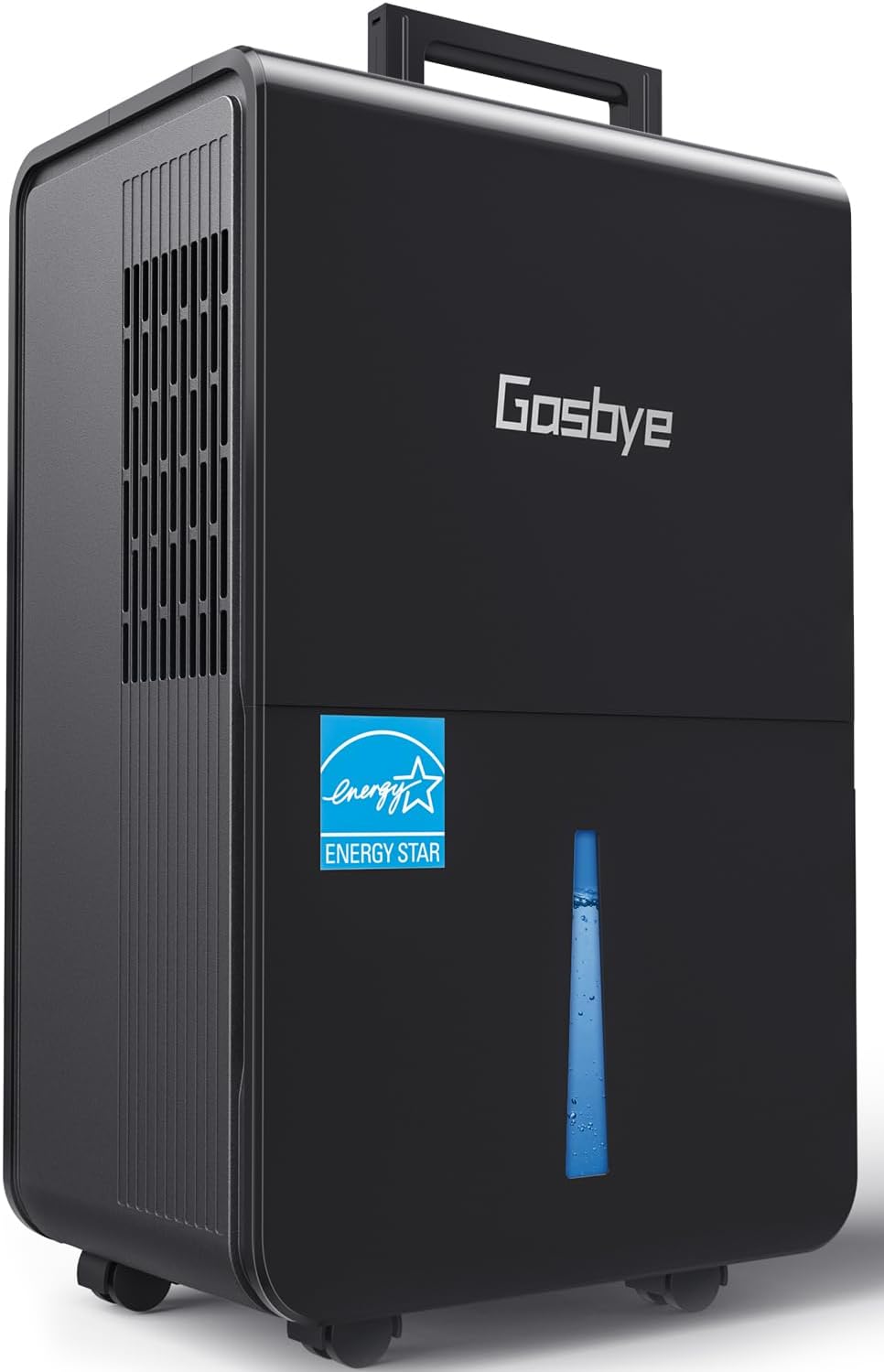
Gasbye DryPrime-50 Dehumidifier
| Capacity | 115 pints |
|---|---|
| Tank Volume | 1.72 gallons |
| Wattage | 500 watts |
| Air Flow Capacity | 12600 cubic_feet_per_hour |
| Operation Mode | Normal, Turbo, Comfort, Continuous Four Modes |
The Gasbye DryPrime-50 is a heavy-duty compressor dehumidifier built to remove lots of moisture from large spaces such as basements after flood events or in persistently damp areas. It delivers lab-tested dehumidification rates across conditions (up to 115 pints/day at 86°F/80% RH) and runs on a 500-watt compressor with a relatively quiet 45 dB sound level. Practical features include a 1.72 gallon removable tank, a 5-foot drain hose, and a threaded 3/4-inch outlet for continuous gravity drainage, plus automatic shut-off and auto-restart after power loss. The unit is Energy Star certified for improved efficiency and uses reinforced copper tubing intended to improve durability under continuous use. Trade-offs are its single fan speed and the fact that peak pint figures depend on high temperature and humidity test conditions, so real-world pints/day will vary with environment; the unit is also fairly heavy compared with smaller portable models. For flood-damage recovery this unit favors sustained, high-capacity pumping and continuous drainage over lightweight portability.
Best for: Buyers who prioritize fast, continuous moisture removal in large, wet spaces and want a durable, energy-efficient unit for recovery work rather than a lightweight portable model.
Less Ideal for: People who need a small, ultra-portable dehumidifier for bedrooms or short-term spot use should consider smaller, quieter units instead.
- High tested dehumidification capacity up to 115 pints/day under specified conditions
- Three drainage methods including threaded garden-hose outlet for continuous gravity drainage
- Energy Star certification for better energy efficiency in long runs
- Reinforced copper tubing and heavier build aimed at durability for continuous use
- Auto shut-off and auto-restart for hands-off operation during recovery work
- Single fan speed limits granular control of airflow
- Reported capacity depends on temperature and humidity so output will be lower in cooler environments
Verdict: Choose this unit when you need a durable, high-capacity dehumidifier that can run continuously and drain automatically to recover basements or large flood-affected spaces.
BEDRED CT11 Dehumidifier

| Floor Area | 1000 square_feet |
|---|---|
| Tank Volume | 95 fluid ounces |
| Capacity | 5.9 pounds |
| Operation Mode | Intermittent |
| Other Special Features of the Product | 7 Color Ambient Light, Automatic Shutoff, Sleep Mode |
The BEDRED CT11 is a compact thermoelectric dehumidifier intended to reduce humidity in small spaces such as bedrooms, bathrooms, and modest basements up to about 1000 sq ft. It uses semiconductor cooling rather than a compressor, so it runs quietly and is simple to operate with an intermittent operation mode and an automatic shutoff when the 95 oz tank fills. Sleep Mode turns off the lights and lowers noise for overnight use, and the seven-color ambient light gives an optional mood-lighting feature. Practical benefits include easy emptying from the included tank, portability thanks to a lightweight design, and low sound levels that suit living spaces. Important limitations are inherent to semiconductor units: lower capacity compared with compressor dehumidifiers, reduced performance in very cold or very damp basements, and a smaller tank that requires more frequent emptying in high-humidity conditions.
Best for: Buyers who prioritize quiet, low-maintenance dehumidification and want a compact unit that is easy to move and run in living spaces or small basements without frequent intervention.
Less Ideal for: People needing heavy-duty moisture control for large, cold, or very damp basements should choose a higher-capacity compressor dehumidifier instead.
- Quiet thermoelectric operation suitable for bedrooms and living rooms
- Automatic shutoff protects against overfill and simplifies unattended use
- 95 oz removable tank for straightforward water removal
- Sleep Mode and ambient light options for low‑noise nighttime use
- Compact and lightweight for easy placement or moving between rooms
- Semiconductor cooling gives lower moisture removal capacity than compressor models
- Performance drops in cold basement conditions and very high humidity areas
Verdict: Choose the BEDRED CT11 if you want a quiet, portable dehumidifier with auto‑shutoff and sleep‑friendly operation for small basements or living spaces.
KeepGlad 80‑Pint Dehumidifier

| Capacity | 80 pints_per_day |
|---|---|
| Tank Volume | 1.84 gallons |
| Wattage | 300 watts |
| Floor Area | 4500 square_feet |
| Voltage | 115 volts |
The KeepGlad 80‑pint dehumidifier is built for sustained operation in large, moisture-prone areas like basements and garages. It actively removes up to 80 pints per day under extreme conditions and uses multiple modes — Comfort, Dry, Turbo, Continuous and Sleep — to match different needs from steady humidity control to rapid drying. Practical features include a visible tank with full‑tank protection, continuous drain hose option, 90° adjustable airflow, washable filter, child lock and a 24‑hour timer. The unit also claims quiet operation (about 35–40 dB) and an AI-driven protection system that triggers defrost cycles and overload cutoffs to limit downtime. Energy Star 2025 certification and a 300 W rating mean it aims to balance strong performance with lower energy use. Expect a fairly large, portable cabinet with ergonomic handles and a detachable filter that requires occasional cleaning; continuous drain is most convenient for long runs. If you need a dependable, high‑output dehumidifier for a basement that runs for long stretches, this model focuses on steady removal, energy efficiency and protective safeguards to reduce failure risk.
Best for: Buyers who prioritize a durable, high‑capacity dehumidifier for large basements or storage areas and want energy-efficient continuous operation with protective safety features.
Less Ideal for: Those who need a compact, lightweight unit for small rooms or infrequent use should consider lower‑capacity, more portable models instead.
- Very high dehumidification capacity up to 80 pints per day for large or very damp basements
- ENERGY STAR 2025 certification for lower energy use compared with similar output units
- Continuous drain option and full‑tank protection reduce maintenance during long runs
- Multiple modes including Turbo and Continuous let you tailor drying speed and humidity targets
- AI protection with auto‑defrost and overload cutoff helps prevent damage during continuous operation
- Relatively large physical footprint compared with low‑capacity models
- Requires periodic filter cleaning and occasional drain management for continuous use
Verdict: If you need reliable, energy‑efficient moisture removal for a large basement, this 80‑pint KeepGlad unit is built to run continuously with protective safeguards that minimize failure risk.
Waykar 80-Pint Dehumidifier JD025CE-80

| Dehumidification Capacity | 80 pints_per_day |
|---|---|
| Tank Volume | 2.5 gallons |
| Wattage | 270 watts |
| Air Flow Capacity | 165 cfm |
| Operation Mode | Continuous |
The Waykar 80-Pint Dehumidifier is built to handle large, damp areas such as basements by extracting up to 80 pints per day and offering both tank and continuous drain options. It is commonly used running continuously or on a timed schedule to bring basement humidity down to a selected setpoint between 30% and 80% relative humidity, and the 90° auto-swing helps spread airflow for more even drying. Practical features include an included drain hose and connector for gravity drainage, a washable removable filter, automatic defrost and overload protection for low-temperature reliability, and an Energy Star rating to keep running costs lower than noncertified units. At roughly 42 dB it is quieter than many similarly sized machines, making it reasonable for finished basements or nearby living areas. The unit is relatively heavy and targeted at larger spaces, so it is less convenient to move frequently, and the 1.14 gallon tank means emptying is still needed if you do not use continuous drainage. For buyers focused on dependable basement performance and energy efficiency, this model delivers strong moisture removal with sensible protections for extended operation.
Best for: Homeowners who need a reliable, high-capacity dehumidifier to control moisture in large basements and prefer proven features and energy efficiency over portability.
Less Ideal for: People looking for a lightweight, highly portable unit for small rooms or occasional use should consider smaller, easier-to-move models instead.
- High dehumidification capacity rated at 80 pints per day for large basements
- ENERGY STAR certification for better energy efficiency during extended use
- Multiple drainage options with included drain hose for continuous gravity drain
- Auto-defrost and overload protection improve reliability in cool basement conditions
- 90° auto-swing airflow and washable filter help distribute air and simplify maintenance
- Relatively heavy and sized for large spaces, so not ideal for frequent transport
- Water tank is modest at 1.14 gallons if continuous drainage is not used
Verdict: A powerful, Energy Star certified 80‑pint unit that reliably handles large basement humidity with continuous drain and protective auto-defrost features.
ToLife Dehumidifier TZ-C2

| Floor Area | 1000 |
|---|---|
| Capacity | 95 fluid ounces |
| Number of Speeds | 2 |
| Wattage | 93 watts |
| Air Flow Capacity | 95 liters per minute |
The ToLife TZ-C2 is a compact Peltier-style dehumidifier intended to remove moisture from small rooms like bedrooms, bathrooms, closets and small basements. It uses semiconductor condensation technology, offers a high-power mode for faster moisture removal and a low-noise sleep mode under 30 dB for nighttime use. The unit has a large 95 oz removable tank with automatic shutoff when full and a handle for easy carrying between rooms. Additional conveniences include two fan speeds, a 7-color LED night-light you can lock, and claimed coverage up to 1,000 sq ft in light-humidity scenarios. Practical benefits are quiet operation, simple tank-based water removal without a hose, and straightforward controls that suit renters or people who want minimal setup. Important limitations are the Peltier system and modest airflow, which mean slower extraction than compressor dehumidifiers and reduced performance in very damp or recently flooded spaces; the unit also requires manual emptying and is optimized for smaller areas rather than whole-house or heavy water removal after flood damage.
Best for: Buyers who prioritize a quiet, easy-to-use portable unit for routine humidity control in small spaces and want a simple, low-maintenance device rather than professional-grade drying equipment.
Less Ideal for: People needing rapid high-capacity water removal after flood damage or for large, persistently damp basements should choose a compressor dehumidifier or professional drying service instead.
- 95 oz removable water tank with automatic shutoff for hands-off short-term use
- Quiet sleep mode under 30 dB suitable for bedrooms
- Portable, lightweight design with a carry handle for moving between rooms
- Two fan speeds for a balance of noise and dehumidification power
- Peltier (semi-conductor) condensation limits extraction rate compared with compressor units
- Requires manual emptying of the tank rather than continuous drainage option
- Performance will be noticeably slower in very wet rooms or after flood exposure
Verdict: A quiet, portable 95 oz tank dehumidifier best for everyday humidity control in small rooms, not for heavy-duty flood drying.
Choosing the Right Dehumidifier for Flood Damage: Key Factors to Consider
Extraction Rate (Capacity)
Extraction rate determines how quickly a dehumidifier removes moisture, usually stated as liters or pints per 24 hours. For flood damage, higher-capacity units drastically reduce drying time and lower the risk of mold and secondary damage.
Choose a unit whose published extraction rate matches the size of the flooded area and the severity of saturation. Small-room units designed for daily humidity control will take far longer and may never catch up in a flood scenario. Remember that extraction drops at lower temperatures, so select a capacity with headroom if the space is cool.
Durability and Build Quality
Flood remediation stresses equipment with extended runtimes and exposure to damp, dirty air. Look for rugged housings, corrosion-resistant finishes on metal parts, and compressors rated for continuous operation. Components that are easy to access and replace reduce downtime during repairs.
A sturdier build also improves safety when moving the unit over wet floors or hauling it between jobs. Consider models with reinforced grills, durable casters, and protective panels that guard controls and coils from accidental impact during work.
Drainage Options and Tank Capacity
During flood recovery you will want continuous drainage to avoid frequent tank emptying. Units should offer a reliable continuous-drain port with a gravity outlet or a pump-assisted option for higher placements or longer runs.
If you must rely on a tank, pick a large-capacity reservoir and one with clear level indicators and a secure, easy-to-remove design. Hose fittings should be standard and robust to avoid leaks during hours of unattended operation.
Airflow, Coverage, and Placement
Effective drying depends on moving air across wet surfaces. High airflow rates increase evaporation, so dehumidifiers with powerful fans and well-directed outlets will dry rooms faster. Consider the unit's recommended coverage area and whether it can handle the cubic footage of the affected space.
Think about placement: positioning the unit to create a drying pattern through doorways or alongside walls speeds progress. Units with adjustable louvers or multiple fan speeds provide flexibility for targeted drying in complex room layouts.
Controls, Monitoring, and Safety Features
Clear controls help you set target humidity or run continuous modes without constant supervision. Look for reliable humidity sensors, programmable timers, and simple interfaces that are usable while wearing gloves or working around wet conditions.
Safety features like auto-defrost, thermal overload protection, and tip-resistant frames are important during prolonged operation. Alarms or indicator lights for full tanks, clogs, or maintenance needs can prevent failures during critical drying windows.
Maintenance and Serviceability
Frequent use during flood recovery means parts will need cleaning and occasional replacement. Filters should be accessible and washable, and coils should be serviceable without complex disassembly. Units designed for easy access to fans, motors, and compressor components save time for technicians.
Check for straightforward drain access and standardized fittings so you can connect temporary hoses or diagnostic equipment. Availability of replacement parts and clear maintenance procedures reduce downtime and extend the useful life of the unit.
Sizing a Dehumidifier for Flood Recovery
Estimate the volume of the affected space by multiplying square footage by ceiling height; higher ceilings contain more air and take longer to dry. Then match that cubic footage to a dehumidifier capacity that accounts for how saturated materials are and how much free water remains.
For heavy flooding, choose a unit with substantially higher extraction than you would pick for normal humidity control. If the space may be cool, remember that refrigeration-style dehumidifiers extract less moisture as temperature falls, so allow extra capacity or select models rated for lower-temperature performance.
- Measure room volume, not just floor area
- Factor in wet materials that release water slowly
- Allow capacity headroom for cool environments
Placement and Airflow Strategies
Position the dehumidifier where it can pull air from the wettest area and push drier air toward surfaces that need drying. Avoid blocking intake or exhaust grills and keep doors or pathways open to create airflow paths between rooms when multiple units are used.
Use fans to augment air movement when needed. Fans boost evaporation by moving humid air away from wet surfaces so the dehumidifier can capture moisture more effectively. Coordinate fan direction with the dehumidifier's exhaust to create a consistent drying pattern.
- Keep intake at least a few feet from walls and furniture
- Use directional fans to spread airflow across soaked materials
- Close off unaffected areas to concentrate drying power
Dehumidifier Operation Best Practices During Remediation
Start drying as soon as it is safe to power equipment in the affected area. Remove standing water first with pumps or wet vacs; dehumidifiers are not designed to extract large volumes of standing water quickly. Once free water is removed, run the dehumidifier continuously with a drain hose or large tank to maintain momentum.
Monitor humidity, temperature, and drying progress regularly. Use a separate hygrometer if necessary to verify readings. Adjust fan speed, hose routing, and placement as materials dry to keep airflow focused where it is still damp.
- Pump out standing water before starting dehumidification
- Run units continuously until relative humidity stabilizes
- Reposition units as rooms dry to target remaining wet areas
When to Call a Professional
If water has penetrated structural framing, insulation, or HVAC components, or if contamination from sewage or chemicals is present, contact a remediation professional. Complex jobs may require specialized equipment such as high-capacity desiccant systems or targeted heat and ventilation strategies.
Professionals can also perform moisture mapping, document drying progress for insurance, and coordinate safe repairs to materials that retain water. For widespread or long-duration losses, their experience ensures a thorough and code-compliant recovery.
- Significant structural or insulation contamination warrants professionals
- Professionals offer moisture mapping and remediation documentation
- Consider expert help if multiple rooms or long runtimes are needed
Energy Use and Long Running Costs
High-capacity dehumidifiers consume more power but finish jobs faster. Evaluate estimated runtime and how many units you will need to judge total energy consumption for a job. Where possible, choose models with efficient compressors and variable-speed fans to moderate draw during less intensive phases.
For repeated or large-scale remediation, factor energy costs into rental or replacement decisions. Some units offer ECO or low-power modes that are useful as humidity approaches target levels and constant maximum extraction is no longer necessary.
- Balance extraction speed against expected runtime
- Use variable-speed or ECO modes to reduce draw later in the job
- Estimate total kWh for multi-day operations before committing
How We Chose the Best Dehumidifier for Flood Damage
We prioritized performance and durability because flood recovery demands high-capacity, continuous operation. Extraction capability was the primary filter, measured by liters or pints removed per 24 hours under high-humidity conditions. Next we assessed construction and serviceability, looking for robust compressors, corrosion-resistant housings, and easy-access components to tolerate frequent use and damp environments. Operational controls and usability were required criteria: clear humidity targeting, auto-defrost for cooler spaces, and continuous-drain options or large removable tanks reduce downtime during extended jobs. Portability and airflow mattered because moving a unit between rooms and positioning it for efficient airflow speeds drying. Energy efficiency and noise were considered to balance runtime cost and occupant comfort, but they were secondary to raw drying power. We excluded lightweight consumer units rated only for small rooms or short-term use, as well as products without continuous-drain capability or repeatable performance data. The resulting list reflects devices that meet heavy-use extraction targets, offer durable components and practical controls for remediation work, and provide clear service and drain options for lengthy drying jobs.
Our full evaluation process is outlined in our review methodology.
FAQ
How quickly can a dehumidifier dry a flooded room?
Drying time depends on extraction capacity, room volume, temperature, and how wet materials are. High-capacity units can reduce humidity and accelerate drying within 24 to 72 hours after standing water is removed, while smaller consumer units may take much longer.
Can a standard home dehumidifier handle flood damage?
Standard home units designed for everyday humidity control are often undersized for major flood recovery. They may work for minor seepage, but for heavy saturation you should choose a unit rated for high extraction and continuous operation or use professional equipment.
Is continuous drain necessary during flood remediation?
Continuous drain is highly recommended because it avoids interrupting the drying cycle to empty tanks. Gravity drains work if you have a lower outlet; pump-assisted drains let you route wastewater to a higher sink or outside location.
What humidity level should I aim for after a flood?
Aim to reduce relative humidity to below 50 percent and keep it stable. Moisture levels in building materials should also be monitored; surface humidity readings alone do not guarantee that framing or insulation is dry.
Will running a dehumidifier prevent mold after flooding?
Rapid and sustained drying greatly reduces the risk of mold, but it does not guarantee prevention if materials remain wet or contaminated. Combine dehumidification with removal of soaked porous materials and good airflow to limit mold growth.
Can I use a dehumidifier in unheated or cold spaces?
Many refrigeration-style dehumidifiers lose efficiency below certain temperatures and can ice up. Select units rated for lower-temperature operation or use models with auto-defrost. For very cold environments, desiccant-style systems are often more effective.
Final Verdict
For flood-damaged spaces prioritize extraction rate, durable construction, and reliable drainage options. Match capacity to room volume and saturation level, and plan for continuous operation and good airflow to speed evaporation. Balance energy use and portability against the need for fast drying, and call professionals for contamination, structural penetration, or large-scale losses. Choosing a unit with headroom in capacity and clear serviceability will give you the best chance of restoring a space quickly and safely.