
Note: This article contains affiliate links. If you click on these links and make a purchase, we may earn a small commission at no extra cost to you. This helps support our research and content. Read our full affiliate disclosure here.
If water has invaded your basement, you need equipment that removes large volumes of moisture quickly and keeps conditions dry while repairs are underway. A dehumidifier for a flooded basement is different from a unit meant for everyday humidity control: you are prioritizing extraction capacity, continuous drainage, and durability in damp conditions. This guide shortlists the top choices for that job and explains the practical tradeoffs you should weigh. Below we summarize why each shortlisted model earned a place and the evaluation criteria used so you can pick the right unit for rapid basement drying.
Top Picks at a Glance
| Best Overall The best all-around choice for most situations | AEOCKY RHEA Dehumidifier |  |
| Best Quality Built to a higher standard if you want something more solid | ALORAIR Storm LGR Extreme |  |
| Best Value The sweet spot between price and what you get | DGVAM V1 Dehumidifier |  |
| Best Budget The cheapest option that still gets the job done reliably | VEAGASO VG380 34-Pint Dehumidifier |  |
| Top Rated A top-rated pick with lots of positive feedback | KNKA 80-Pint Dehumidifier PD30MA-20 |  |
| Most Popular A crowd favorite that many people choose with confidence | Waykar 80-Pint Dehumidifier JD025CE-80 |  |
| Best Seller A high-volume bestseller chosen again and again | ToLife Dehumidifier TZ-C2 |  |
AEOCKY RHEA Dehumidifier

| Capacity | 105 pints |
|---|---|
| Tank Volume | 1.45 gallons |
| Wattage | 400 watts |
| Operation Mode | Auto, Constant Humidity, Continuous, Smart Drying, Sleep |
| Dehumidification Capacity | 100 pints_per_day |
The AEOCKY RHEA is a high‑capacity compressor dehumidifier built to remove large volumes of moisture from basements and big rooms. It advertises up to 105 pints/day peak capacity and a 1.45 gallon collection tank, and includes continuous drainage accessories so you can run it unattended for extended periods. Controls offer adjustable humidity settings, multiple operating modes including continuous and auto mode, a timer and child lock, and an intelligent humistat that aims to hold RH within a tight range. The unit is ENERGY STAR Most Efficient 2024 rated and uses a rotary compressor plus a 3+3 evaporator/condenser layout to boost extraction and efficiency. Notable real‑world benefits are strong moisture removal for flooded or persistently damp basements, an auto‑defrost system that keeps it running in cool spaces, and relatively low operating noise compared with similar capacity units. Tradeoffs are typical for this power level: the tank is modest for the maximum stated capacity so reliable long‑term use depends on using the drain hose or pump accessory, and the unit is larger and heavier than smaller home models which affects placement and portability.
Best for: Buyers who want a powerful, energy‑efficient dehumidifier to tackle flooded or persistently damp basements and prioritize continuous, unattended moisture removal.
Less Ideal for: People who need a compact, ultra‑portable unit for small rooms or occasional spot use should consider smaller, lighter models instead.
- Very high dehumidification capacity (up to 105 pints/day) for large basements and whole‑home use
- ENERGY STAR Most Efficient 2024 rating for improved energy use compared with standard models
- Auto‑defrost and a smart humidity control system that help continuous operation in cool basement conditions
- Includes drain hose and garden hose adapter for continuous drainage and hands‑off operation
- Small internal tank relative to maximum extraction rate, so continuous drainage is effectively required for heavy use
- Unit size and weight make it less convenient to move between floors or tight spaces
Verdict: Choose the RHEA when you need a heavyweight, energy‑efficient dehumidifier that can run continuously and handle flooded or very damp basements.
ALORAIR Storm LGR Extreme

| Capacity | 180 pints |
|---|---|
| Dehumidification Capacity | 85 pints_per_day |
| Air Flow Capacity | 210 cfm |
| Operation Mode | Continuous |
| Voltage | 115 volts |
The ALORAIR Storm LGR Extreme is a high-capacity commercial dehumidifier intended for heavy-duty drying and water-damage restoration in basements, crawlspaces, and job sites. It delivers up to 180 pints per day at saturation and 85 PPD AHAM while moving air at 210 CFM, so it aggressively pulls moisture from saturated environments and speeds drying. The unit includes a built-in pump and long drain hose for hands-off condensate removal and a digital display with adjustable humidity control plus auto-restart and memory start for unattended operation after power outages. Automatic defrost protects performance in cooler conditions and the compact, two-handle design helps position the unit in tight crawlspaces. Trade-offs are typical of commercial-grade LGR machines: it is heavy and sized for large areas rather than everyday home use, and its power draw and sound level reflect industrial performance rather than residential quiet operation. For flood-recovery and restorers who need rapid, reliable moisture removal, this unit is purpose-built and straightforward to operate.
Best for: Buyers focused on rapid, professional-grade drying after flood damage or for large damp basements who prioritize peak moisture removal and reliable unattended operation.
Less Ideal for: People needing a quiet, energy-frugal unit for routine household humidity control or for small rooms should consider lighter residential dehumidifiers instead.
- High dehumidification: up to 180 pints/day at saturation and 85 PPD AHAM for fast moisture removal
- Built-in pump with long drain hose and substantial vertical lift for continuous, hands-off drainage
- High airflow (210 CFM) that improves drying speed across large or saturated spaces
- Automatic defrost and auto-restart with memory make it reliable in varying site conditions
- Designed for commercial use so it is heavy and louder than typical home dehumidifiers
- Power consumption and performance are optimized for large spaces, making it overkill for small rooms
Verdict: Choose the ALORAIR Storm LGR Extreme when you need fast, reliable commercial-grade drying and built-in pump drainage for flooded basements and restoration jobs.
DGVAM V1 Dehumidifier

| Floor Area | 4500 square_feet |
|---|---|
| Dehumidification Capacity | 45 pints_per_day |
| Capacity | 1.72 gallons |
| Operation Mode | Automatic |
The DGVAM V1 is a high-capacity compressor dehumidifier built to handle damp basements and large spaces up to about 4,500 sq ft. It offers selectable operation modes and automatic humidity control so the unit adjusts fan and compressor activity to reach the set humidity without constant intervention. Practical features include a 1.72 gallon tank with full-alert plus a drain-hose connection for continuous unattended draining, auto-defrost for cooler environments, a washable filter, child lock and a 24-hour timer. The manufacturer rates peak removal at up to 80 pints per day with a more typical 18–45 pints/day range, and the unit is tuned for quieter operation around 40 dB for night use. Trade-offs are its bulk and weight compared with small-room units and the fact that a higher-capacity output will use more electricity during heavy-duty drying, so positioning and continuous drainage are recommended for long runs. For flooded basements the V1's continuous drain, auto-defrost, and high removal rate make it a practical choice for large-area moisture control.
Best for: Buyers who need fast, hands-off moisture removal in very damp or recently flooded basements and prefer a unit that can run continuously with a drain hose and automatic control.
Less Ideal for: People who need a lightweight, ultra-compact dehumidifier for a single small room or who cannot provide a drain outlet for continuous operation.
- High rated dehumidification up to 80 pints per day for rapid moisture removal
- Continuous drain hose plus removable tank for unattended operation
- Automatic humidity control with multiple modes reduces manual tuning
- Auto-defrost and washable filter support year-round basement use
- Relatively quiet operation (~40 dB) suitable for night or living areas
- Physically heavy and larger than small-room portable units
- Higher-capacity operation can increase energy use during intensive drying
Verdict: Choose the DGVAM V1 when you need a high-capacity, continuous-drain dehumidifier that can quietly handle very damp or flooded basements.
VEAGASO VG380 34-Pint Dehumidifier

| Capacity | 34 pints per day |
|---|---|
| Coverage Area | Up to 2500 square feet |
| Tank Volume | 2 liters (0.53 gallon) |
| Wattage | 230 watts |
| Voltage | 120 volts |
The VEAGASO VG380 is a compressor-based dehumidifier aimed at heavy-duty home use, especially basements and large rooms. It removes up to 34 pints per day and offers DEHU, DRY, and CONT modes so you can maintain a target humidity, speed up indoor clothes drying, or run nonstop in very damp spaces. The unit includes a 0.53 gallon tank plus a drain hose for continuous draining, an LED touch panel with adjustable humidity set points, a 1–24 hour timer, and power-failure memory so it resumes previous settings after outages. It uses an ultra-quiet compressor and reports noise below 40 dB in low mode, and has auto defrost so it can operate in cooler basement temperatures. Practical benefits include easy mobility via recessed handle and swivel casters, a washable filter, and child lock for safety. Limitations are the relatively small onboard tank compared with the daily removal rate—meaning continuous drain is often necessary in very wet conditions—and the unit is not marketed with industrial-grade pumping for locations that require raised or distant drainage paths.
Best for: Buyers who need an affordable, effective dehumidifier for damp basements or large rooms and prioritize continuous moisture removal with simple controls and quiet operation.
Less Ideal for: Homes that require industrial-strength removal, elevated or distant drain routing, or users who need a large internal tank to avoid any drain hose setup.
- High dehumidification capacity up to 34 pints per day suitable for large rooms and basements
- Three operating modes (DEHU, DRY, CONT) to match everyday, laundry, or continuous-duty needs
- Includes drain hose for continuous drainage plus auto shutoff and full-tank alert
- Power-failure memory restores settings after outages which is useful for unattended basements
- Quiet operation under 40 dB with vibration-reducing design for bedroom or living-area use
- Internal water tank is only 0.53 gallon so frequent emptying is required unless using continuous drain
- No built-in condensate pump for pumping water uphill or long-distance drainage
Verdict: A budget-friendly, compressor dehumidifier built to handle damp basements with continuous-drain capability and quiet, reliable operation.
KNKA 80-Pint Dehumidifier PD30MA-20

| Capacity | 80 pints per day |
|---|---|
| Tank Volume | 1.45 gallons |
| Wattage | 360 watts |
| Floor Area | 4500 square_feet |
| Operation Mode | AUTO, DRY, SETTING |
The KNKA PD30MA-20 is a performance-focused dehumidifier built for large, damp spaces such as basements. Its high-efficiency compressor can remove up to 80 pints per day under extreme conditions and about 56 pints in typical basement conditions, while an internal 1.45 gallon tank plus a supplied 6.56 ft drain hose enable continuous drainage to avoid frequent emptying. Controls include AUTO, DRY, and a SETTING mode for 30%–80% RH, and the digital display with a color-changing humidity indicator makes it easy to monitor conditions at a glance. The unit is designed to run quietly (40–45 dB), has a washable filter, casters for moving between rooms, cord storage, a 12-hour timer, and a child lock for steady, unattended operation. Expect good energy efficiency thanks to ENERGY STAR certification and a 360 watt power draw, but note that humidity readings come from the air inlet and may differ slightly from a separate hygrometer; the unit also needs upright siting for 24 hours before first use. For heavy-duty basement dehumidification this model balances strong capacity with thoughtful usability features.
Best for: Buyers who need powerful, reliable moisture removal in large basements or very damp rooms and prioritize steady performance and easy continuous drainage.
Less Ideal for: People seeking a compact or ultra-light unit for small rooms or occasional use should consider lower-capacity, more portable models instead.
- High maximum dehumidification capacity up to 80 pints per day for large, very humid spaces
- Includes 6.56 ft drain hose and built-in tank for continuous drainage to reduce manual emptying
- ENERGY STAR certified and uses a high-efficiency compressor for lower operating costs relative to output
- Quiet operation (40–45 dB) and caster wheels make it suitable for basements and living spaces
- Digital display with real-time humidity readout and color indicator simplifies monitoring and control
- Humidity reading is measured at the air inlet and may not match a separate room hygrometer
- Requires upright placement for 24 hours before first use to avoid operational issues
Verdict: Choose this KNKA if you need a strong, ENERGY STAR certified dehumidifier that can handle large basements with continuous-drain capability and quiet operation.
Waykar 80-Pint Dehumidifier JD025CE-80

| Dehumidification Capacity | 80 pints_per_day |
|---|---|
| Tank Volume | 2.5 gallons |
| Wattage | 270 watts |
| Air Flow Capacity | 165 cfm |
| Operation Mode | Continuous |
The Waykar 80-Pint Dehumidifier is built to handle large, damp areas such as basements by extracting up to 80 pints per day and offering both tank and continuous drain options. It is commonly used running continuously or on a timed schedule to bring basement humidity down to a selected setpoint between 30% and 80% relative humidity, and the 90° auto-swing helps spread airflow for more even drying. Practical features include an included drain hose and connector for gravity drainage, a washable removable filter, automatic defrost and overload protection for low-temperature reliability, and an Energy Star rating to keep running costs lower than noncertified units. At roughly 42 dB it is quieter than many similarly sized machines, making it reasonable for finished basements or nearby living areas. The unit is relatively heavy and targeted at larger spaces, so it is less convenient to move frequently, and the 1.14 gallon tank means emptying is still needed if you do not use continuous drainage. For buyers focused on dependable basement performance and energy efficiency, this model delivers strong moisture removal with sensible protections for extended operation.
Best for: Homeowners who need a reliable, high-capacity dehumidifier to control moisture in large basements and prefer proven features and energy efficiency over portability.
Less Ideal for: People looking for a lightweight, highly portable unit for small rooms or occasional use should consider smaller, easier-to-move models instead.
- High dehumidification capacity rated at 80 pints per day for large basements
- ENERGY STAR certification for better energy efficiency during extended use
- Multiple drainage options with included drain hose for continuous gravity drain
- Auto-defrost and overload protection improve reliability in cool basement conditions
- 90° auto-swing airflow and washable filter help distribute air and simplify maintenance
- Relatively heavy and sized for large spaces, so not ideal for frequent transport
- Water tank is modest at 1.14 gallons if continuous drainage is not used
Verdict: A powerful, Energy Star certified 80‑pint unit that reliably handles large basement humidity with continuous drain and protective auto-defrost features.
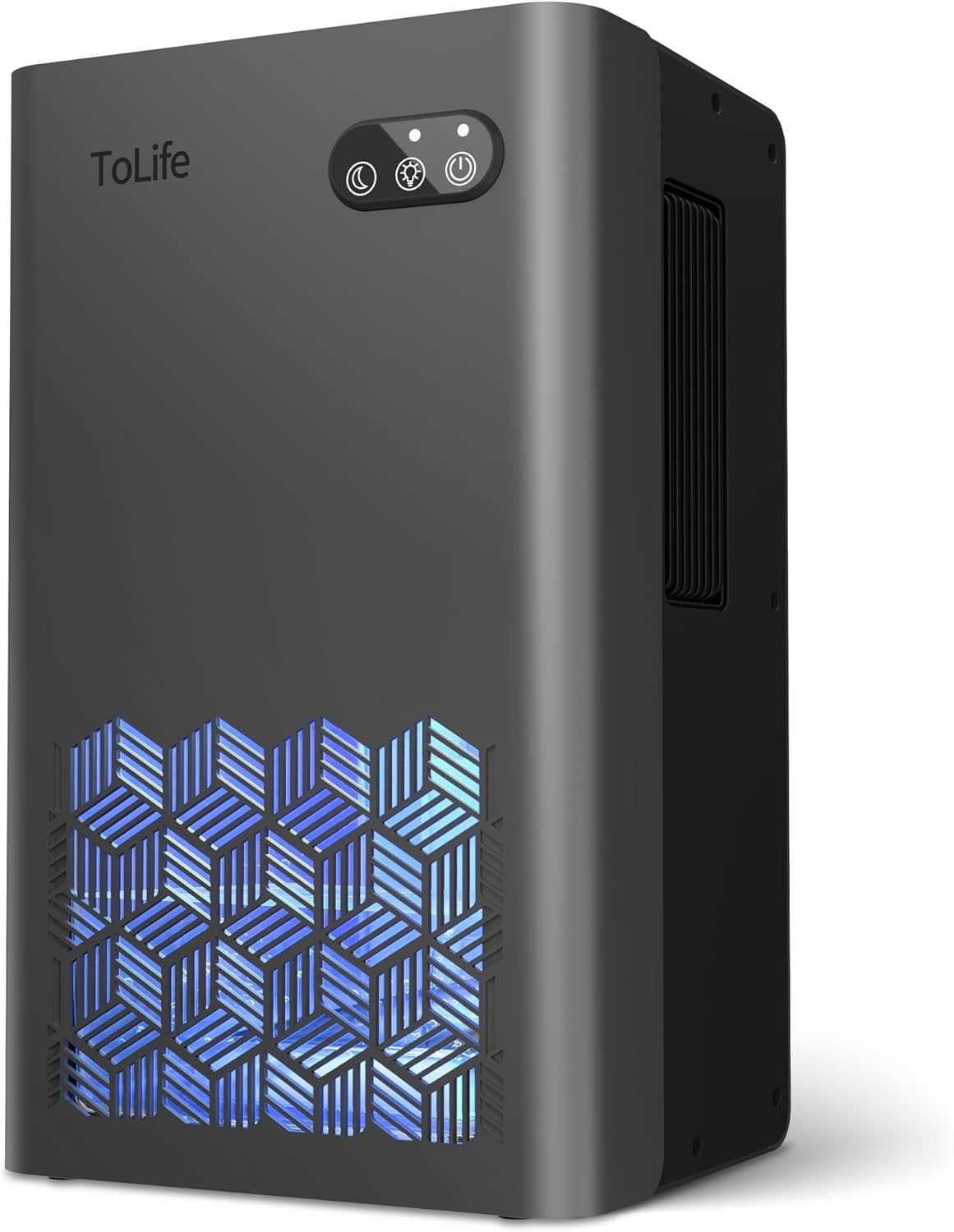
ToLife Dehumidifier TZ-C2
| Floor Area | 1000 |
|---|---|
| Tank Volume | 95 fluid ounces |
| Number of Speeds | 2 |
| Wattage | 93 watts |
| Voltage | 220 volts |
The ToLife TZ-C2 uses semiconductor condensation technology to quietly pull moisture from the air and deposit it into a removable 95 oz tank, making it a straightforward option for damp rooms. It offers two operating modes: a higher-power setting for faster moisture removal and a low-speed sleep mode that runs under 30 dB for overnight use. A seven-color LED can act as a night light and the unit includes automatic shutoff when the tank is full or removed, plus handles for easy moving between rooms. Practical benefits include simple setup, low noise, and a compact footprint that fits in basements, bathrooms, or bedrooms. Limitations are its modest rated dehumidification capacity and stated coverage, which means it will be most effective in smaller basement zones or for spot treatments rather than drying a large, very damp basement quickly. Also this model runs on 220 volts, so electrical compatibility should be confirmed for your location.
Best for: Buyers who need an affordable, portable dehumidifier for spot dehumidifying small basement areas, bathrooms, or bedrooms and who prioritize low noise and easy portability.
Less Ideal for: People looking to dry large, very damp basements or whole-house coverage should consider a higher-capacity compressor dehumidifier instead.
- Large removable 95 oz water tank reduces how often you need to empty it
- Quiet sleep mode under 30 dB suitable for nighttime operation
- Portable design with handles for moving between rooms
- Automatic shutoff prevents overflow when the tank is full
- Dehumidification capacity is modest and may be slow in very damp or large basements
- Requires 220 volt power which may not match all household outlets
Verdict: A compact, budget-friendly portable dehumidifier that is best for quiet, small-area moisture control and occasional basement spot treatments.
Choosing the Right Dehumidifier for Flooded Basement: Key Factors to Consider
Extraction Capacity
Extraction capacity is the core metric for a flooded basement. It measures how many pints or liters of water a unit can remove in 24 hours. Higher-capacity units reduce drying time and the risk of mold growth by lowering humidity more quickly.
When planning, match capacity to the size of the basement and the severity of the water intrusion. For active flooding or standing water, choose a unit rated for heavy-duty extraction rather than one intended for routine moisture control.
Continuous Drainage and Pumping
Continuous drainage lets a dehumidifier run nonstop without needing manual emptying. Look for units with gravity drain outlets that accept a hose for downhill discharge or integrated pumps that can push water upward to a sink or floor drain.
A built-in pump is especially helpful if the basement drain is above the unit or if you want unattended operation during multi-day drying. Confirm hose size and outlet placement before setup to avoid installation surprises.
Low-Temperature and Cold-Climate Performance
Basements are often cool, which can reduce a unit's performance or cause coil freezing in some models. Select a dehumidifier with designed low-temperature operation or automatic defrost so extraction continues reliably at basement temperatures.
Poor low-temp performance means slower drying and intermittent operation, which increases the time moisture lingers and raises mold risk. Verify rated performance at lower temps when your basement is near cellar conditions.
Durability and Materials
A flooded-basement environment exposes equipment to high humidity, splashes, and sometimes debris. Durable housing, corrosion-resistant components, and accessible filters extend service life in these conditions.
Also consider units with reinforced handles, casters, or lifting points for moving during cleanup. Corrosion-prone finishes or fragile plastics will show wear quickly in heavy-duty use.
Power and Energy Use
High-capacity dehumidifiers draw significant power during continuous operation. Energy-efficient compressors and smart controls lower operating cost during prolonged drying jobs.
Review wattage and whether the unit has multiple fan speeds or automatic humidity control. While energy is secondary to extraction rate in emergency drying, better efficiency reduces electrical load and runs more sustainably over many days.
Setup, Maintenance, and Serviceability
Simple setup means faster deployment when time matters. Look for clear drainage ports, standard hose fittings, and accessible access panels for cleaning coils and filters.
Routine maintenance such as filter cleaning, pump inspections, and drip pan checks should be straightforward. Units with readily available service parts and clear documentation reduce downtime during extended dehumidification work.
Sizing and Placement for Rapid Drying
Correct placement and sizing are as important as raw capacity. Position the dehumidifier where it can draw air from the wettest area and exhaust into the room to promote circulation. If the basement has multiple rooms, position the unit centrally or use multiple units for even drying.
Avoid tight corners and keep clearance around intake and exhaust to preserve airflow. If standing water is present, remove as much free water as possible with pumps or vacuums first to let the dehumidifier focus on vapor removal.
- Place the unit on a stable, elevated surface to avoid splashes.
- Keep doors open between connected spaces to improve airflow.
- Use a fan to direct humid air toward the dehumidifier if needed.
Drainage Options: Gravity Vs Pump
Gravity drain works well when the basement drain or outlet is lower than the dehumidifier. It is simple and reliable but requires the correct floor placement. Integrated pumps add flexibility and permit placement below the drain level by pumping condensate up and out.
Consider the total vertical lift and hose routing when choosing a pumped unit. Pumps introduce moving parts that require occasional maintenance, but they enable unattended operation and reduce the time you need to monitor the drying process.
- Use smooth, appropriately sized hose for longer runs to minimize clogs.
- Check pump run rates and duty cycles for continuous operation needs.
Managing Cold Basements and Coil Freeze
Automatic defrost or low-temp modes prevent coil frosting when ambient temperatures are low. Units without these features may cycle off or suffer reduced performance, prolonging the drying timeline. If your basement is below typical indoor temperatures, choose equipment rated for those conditions.
In the absence of a cold-rated unit, keep the space slightly warmer during drying or run the dehumidifier intermittently while monitoring coil condition to avoid freeze-related problems.
- Inspect coils periodically during long runs for frost buildup.
- Consider pairing with a small heat source if safe and appropriate to raise ambient temperature slightly.
Noise, Runtime, and Neighbor Considerations
High-capacity dehumidifiers can be noisy because of larger fans and compressors. While noise is secondary during emergency drying, prolonged multi-day runs near living areas or adjoining units may require consideration of sound output.
If noise is a concern, choose units with variable fan speeds or set noisy equipment to run during daytime and quieter modes overnight. Ensure continuous operation capability if you plan to leave the unit unattended for extended periods.
- Check decibel ratings when long runtimes are expected.
- Place the unit on vibration-dampening pads to reduce transmitted noise.
Handling Sediment and Debris
Floodwater often carries sediment that can clog drains or damage pumps. Use a simple pre-filter or trap at the drain outlet to catch grit before it reaches the dehumidifier pump. Cleaning the inlet filter frequently prevents reduced airflow and maintains extraction efficiency.
If water is heavily contaminated, consider a short-term approach of removing solids and running a dehumidifier only after gross contaminants are cleared to protect the unit.
- Install a coarse inline trap on gravity drains when needed.
- Inspect and clean strainers and pump inlets after each day of heavy use.
How We Chose the Best Dehumidifier for Flooded Basement
We evaluated units that are designed to move large amounts of water and remain reliable in basement conditions. Our filters focused on real-world performance specs and installation practicality. Key evaluation criteria included extraction rate at low temperatures, continuous drainage and pump options, build durability for wet environments, and serviceability for extended drying jobs. We also considered energy use in heavy-duty operation and noise levels for prolonged runs. Products were excluded if they were sized only for small rooms, lacked clear continuous-drain capability, or had construction unsuitable for heavy, repeated use in damp basements. We prioritized measured extraction capacity and dependable drainage features over consumer-oriented extras. The result is a list of units that meet the demands of large, water-logged basement spaces and long runtime scenarios.
Our full evaluation process is outlined in our review methodology.
FAQ
How long will it take to dry a flooded basement with a dehumidifier?
Drying time depends on basement size, initial water volume, unit extraction capacity, and airflow. For heavy flooding, expect multi-day operation and possibly multiple units. Removing standing water first dramatically shortens the dehumidification phase.
Can I run a dehumidifier nonstop to speed up drying?
Yes. Continuous operation is normal for flood recovery if the unit supports continuous drain or has a pump. Ensure the unit is designed for long runtimes and monitor for coil frosting or maintenance issues.
Do I need a pump with my dehumidifier for basement use?
A pump is helpful when the drain outlet is above the unit or when unattended operation is required. If you can route a gravity drain downhill, a pump may be unnecessary. Choose based on the drain layout and your need to run the unit without supervision.
Will a dehumidifier remove standing water?
Dehumidifiers remove moisture from the air and are not designed to remove significant volumes of standing water quickly. Use pumps or wet vacuums to remove bulk water first, then use a dehumidifier to remove residual moisture and speed drying.
How often should I clean the unit during a multi-day drying job?
Inspect filters, drain inlets, and pump housings daily during heavy use. Clean or replace filters as needed and remove any accumulated debris to maintain airflow and prevent pump clogs.
Final Verdict
For flooded basements, prioritize extraction capacity, continuous drainage ability, and reliable low-temperature performance. Durable construction and easy serviceability reduce the chance of downtime during multi-day drying jobs. Energy efficiency and noise matter less than a unit's ability to remove moisture quickly, but they influence comfort and operating cost over prolonged use. Choose a unit that matches the severity of the flooding and the basement layout. If drain placement is inconvenient, pick a model with a robust pump. If the space is cold, select low-temp-rated equipment. Those tradeoffs will help you finish repairs faster and reduce secondary damage from lingering moisture.