
Note: This article contains affiliate links. If you click on these links and make a purchase, we may earn a small commission at no extra cost to you. This helps support our research and content. Read our full affiliate disclosure here.
A well-controlled humidity level is one of the most important environmental factors in any indoor garden. If humidity swings too high you risk mold, bud rot, and slowed transpiration; if it runs too low plants can become stressed and reduce yields. Choosing the right dehumidifier for a grow room helps you stabilize relative humidity, protect crop quality, and reduce the need for labor-intensive ventilation overrides. This guide covers a shortlist of top dehumidifiers suitable for grow-room environments and explains the practical criteria used to evaluate them, including capacity, control precision, and how they affect daily running and maintenance. Read on for the features and decision points that matter when matching a unit to your grow room.
Top Picks at a Glance
| Best Overall The best all-around choice for most situations | AC Infinity Hydrone 7 |  |
| Best Quality Built to a higher standard if you want something more solid | AEOCKY RHEA Dehumidifier 80 Pint |  |
| Best Value The sweet spot between price and what you get | KNKA 34-Pint Dehumidifier PD22SC-12 |  |
| Best Budget The cheapest option that still gets the job done reliably | TABYIK 35oz Dehumidifier DH-CS01 |  |
| Top Rated A top-rated pick with lots of positive feedback | KNKA 80-Pint Dehumidifier PD30MA-20 |  |
| Most Popular A crowd favorite that many people choose with confidence | Pro Breeze PB-02 Mini Dehumidifier |  |
| Best Seller A high-volume bestseller chosen again and again | ToLife Dehumidifier TZ-C2 |  |
AC Infinity Hydrone 7

| Floor Area | 64 square_feet |
|---|---|
| Capacity | 2 liters |
| Number of Speeds | 10 |
| Operation Mode | Intermittent |
The AC Infinity Hydrone 7 is a compact dehumidifier made for controlled grow environments and small tents housing roughly four to six plants. It uses a PWM-controlled rotary motor to offer 10 discrete drying levels and instant on/off response, which makes it easy to dial in precise humidity reductions and respond quickly to changing conditions. Built-in AI humidity and VPD controls adjust output automatically to maintain target conditions, and the unit supports ducting through an exhaust port or a closed-loop intake for more advanced setups. Its 2 liter capacity and intermittent operation mode suit routine condensate collection or gravity/drain setups when paired with the included drain hose. Practical benefits include reliable performance in a wide temperature range and flexible installation options for tents. Limitations to note are the modest water capacity that requires regular emptying if not plumbed to a drain and the focus on small grow footprints rather than whole-room or large-scale dehumidification.
Best for: Growers running a small to medium grow tent who want precise, automated humidity and VPD control and flexibility to duct or set up a closed-loop system.
Less Ideal for: Operators managing larger rooms, commercial grows, or anyone who needs high daily extraction capacity and larger built-in water storage.
- AI-driven humidity and VPD controls for self-adjusting climate management
- PWM rotary motor with 10 drying levels for precise, rapid response
- Supports ducting and closed-loop configurations for grow tent integration
- Engineered to operate effectively across hot and cold temperature ranges
- 2 liter tank is small and will need frequent emptying unless drained
- Designed for 4–6 plant tents and not suited for larger grow rooms
Verdict: Choose the Hydrone 7 if you run a 4–6 plant grow tent and need precise, automated humidity and VPD control with flexible ducting options.
AEOCKY RHEA Dehumidifier 80 Pint
| Capacity | 80 pints_per_day |
|---|---|
| Tank Volume | 1.45 gallons |
| Wattage | 280 watts |
| Operation Mode | Auto, Constant Humidity, Continuous, Smart Drying, Sleep Mode |
| Air Flow Capacity | 9006 cubic_feet_per_hour |
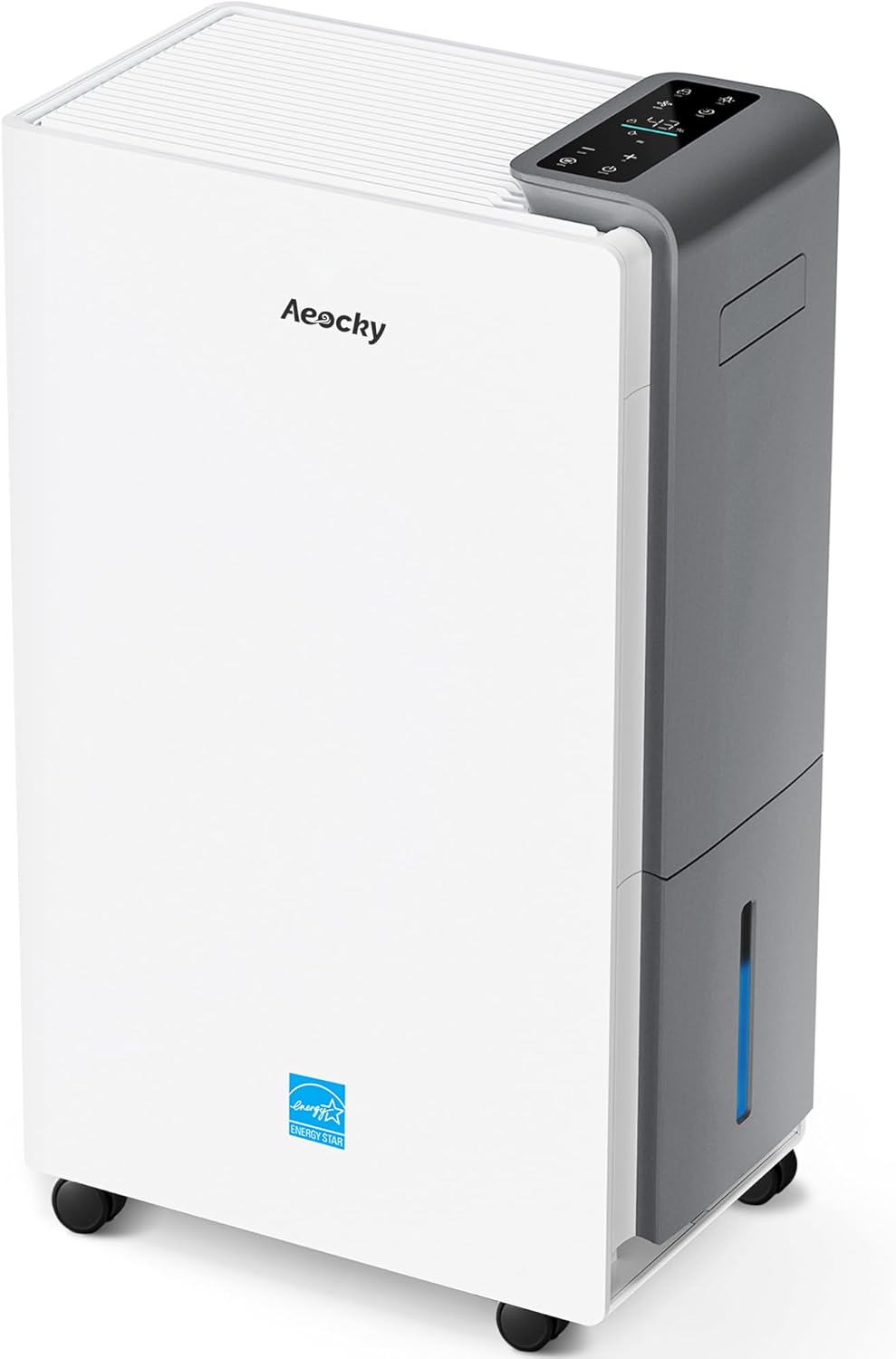
The AEOCKY RHEA is a high-capacity compressor dehumidifier built for sustained, energy-efficient moisture removal in large spaces. It runs in Auto, Constant Humidity, Continuous, Smart Drying, and Sleep modes and can handle heavy loads up to 80 pints per day while moving a large volume of air. Notable hardware includes a rotary compressor, a multi-row evaporator/condenser layout and a 1.45 gallon collection tank with included drain hose and garden-hose adapter for continuous drainage. For growers this model delivers precise humidity control thanks to its claimed millisecond-level sensing and a factory-calibrated humidity algorithm, and the ENERGY STAR Most Efficient 2025 rating indicates strong long-run operating efficiency. Practical benefits are lower energy draw relative to non-certified units, quiet baseline noise around mid-40 dB, and defrost sensor capability that keeps it running in cooler tents or rooms. Limitations include a single fan speed listing and the relatively small onboard tank compared with the daily capacity, which makes reliable continuous drainage essential in heavy-use setups, and the unit is a room appliance so tent mounting or ducting requires planning.
Best for: Buyers who prioritize high continuous dehumidification and energy efficiency for large, humid grow rooms and want a unit that can run reliably around the clock with precise humidity control.
Less Ideal for: Growers working in very small tents or micro-grow setups where a compact desiccant or low-capacity unit would be a better physical and airflow fit.
- High dehumidification capacity rated at 80 pints per day suitable for large humid spaces
- ENERGY STAR Most Efficient 2025 certification for better long‑term energy use
- Multiple operation modes including Auto and Constant Humidity for precise control
- Includes drain hose and garden-hose adapter for continuous drainage option
- Low reported noise floor (~44 dB) for less disruption in enclosed grow spaces
- Built-in water tank (1.45 gallons) is small relative to 80 pint/day capacity so continuous drain is necessary
- Only one fan speed listed which may limit fine-grained airflow control for specialized tent setups
Verdict: If you need a high-capacity, energy-efficient dehumidifier that can run continuously and keep large grow-room humidity tightly controlled, the AEOCKY RHEA is a top practical choice.
KNKA 34-Pint Dehumidifier PD22SC-12

| Capacity | 34 pints |
|---|---|
| Dehumidification Capacity | 34 pints_per_day |
| Tank Volume | 3 liters |
| Wattage | 230 watts |
| Operation Mode | Continuous, Dry, Dehumidify |
The KNKA 34-pint dehumidifier is a compact, wheeled unit built to remove up to 34 pints of moisture per day and run in three modes: automatic humidity control (DEHU), DRY for faster clothes or spot drying, and CONT for continuous operation. It is typically used in basements, laundry rooms, and other damp spaces where maintaining a target humidity matters; in a grow room it can run continuously with the included hose to avoid frequent tank emptying. Practical features include a digital display with a color LED humidity indicator, child lock, 24-hour timer, washable filter, and automatic defrost and shutoff for safety. Mobility is easy with 360-degree wheels and a soft leather handle, and the unit claims quiet operation around 37 dB so it will not overwhelm a small grow environment. Trade-offs to consider are the 34-pint capacity and 3 liter internal tank that may be small for larger or very high-humidity grow rooms, and the manufacturer notes the 34-pint rating is at high temperature and humidity conditions so actual throughput will vary. For steady, modest dehumidification needs this model offers straightforward controls and continuous-drain convenience.
Best for: Growers running small to medium sealed grow rooms who prioritize steady, quiet humidity control and simple, low-maintenance operation.
Less Ideal for: Large commercial grows or highly saturated spaces that need heavy-duty, high-capacity extraction should choose a higher-capacity compressor dehumidifier.
- Smart humidity control with auto-adjust and a digital display for easy target setting
- Three operation modes including continuous drain option with included hose
- Quiet operation around 37 dB suitable for noise-sensitive spaces
- Portable design with 360° wheels, handle, and washable filter for simple maintenance
- 34-pint capacity is limited for larger or highly humid grow rooms
- Internal 3 liter tank requires frequent emptying unless continuous drain or external tank is used
Verdict: A compact, quiet 34-pint dehumidifier that delivers convenient continuous drainage and simple smart controls for small sealed grow rooms.
TABYIK 35oz Dehumidifier DH-CS01

| Tank Volume | 1000 ml |
|---|---|
| Wattage | 40 watts |
| Dehumidification Capacity | 0.45 liters_per_day |
| Floor Area | 280 square_feet |
| Number of Speeds | 1 |
The TABYIK 35oz DH-CS01 is a small, low-power Peltier dehumidifier intended for single rooms such as bedrooms, bathrooms, closets or small enclosed grow spaces. It runs continuously on a single-speed setting and can collect up to about 16 oz (450 ml) per day under hot, very humid conditions while drawing roughly 40 watts, so it is inexpensive to run. The unit includes a 1000 ml transparent tank with an auto shutoff when the tank nears full and a handle for easy moving. A seven-color light and a low noise rating around 28 dB make it unobtrusive in quiet environments. Practical limits are its low daily extraction rate and single-speed operation, so it works best in small, fairly sealed areas or to complement ventilation rather than replace a capacity dehumidifier for larger or high-humidity grow rooms. Maintenance is straightforward: emptying and cleaning the tank and keeping the rear intake filter free of dust. For buyers prioritizing low cost, low noise, and portability in confined spaces, this unit is a convenient option.
Best for: Buyers who need an inexpensive, low-noise dehumidifier for a small, contained grow tent or micro grow space and prioritize low operating cost and portability over high extraction capacity.
Less Ideal for: Growers with larger tents, high humidity loads, or multiple plants that require precise humidity control should choose a higher-capacity, adjustable dehumidifier instead.
- Very low power draw (about 40W) for economical continuous use
- Compact and portable with built-in handle and transparent 1000 ml tank
- Auto shutoff when tank is nearly full for safe unattended operation
- Quiet operation around 28 dB suitable for noise-sensitive spaces
- Simple one-button operation and easy cleaning of the intake filter
- Maximum extraction rate is very low (~450 ml / 24 hr), not suitable for large or highly humid rooms
- Single-speed operation limits control over drying intensity
Verdict: If you want a budget-friendly, quiet portable unit for a very small, enclosed grow space, this low-power 35 oz dehumidifier is an economical choice.
KNKA 80-Pint Dehumidifier PD30MA-20

| Capacity | 80 pints per day |
|---|---|
| Tank Volume | 1.45 gallons |
| Wattage | 360 watts |
| Floor Area | 4500 square_feet |
| Operation Mode | AUTO, DRY, SETTING |
The KNKA PD30MA-20 is a performance-focused dehumidifier built for large, damp spaces such as basements. Its high-efficiency compressor can remove up to 80 pints per day under extreme conditions and about 56 pints in typical basement conditions, while an internal 1.45 gallon tank plus a supplied 6.56 ft drain hose enable continuous drainage to avoid frequent emptying. Controls include AUTO, DRY, and a SETTING mode for 30%–80% RH, and the digital display with a color-changing humidity indicator makes it easy to monitor conditions at a glance. The unit is designed to run quietly (40–45 dB), has a washable filter, casters for moving between rooms, cord storage, a 12-hour timer, and a child lock for steady, unattended operation. Expect good energy efficiency thanks to ENERGY STAR certification and a 360 watt power draw, but note that humidity readings come from the air inlet and may differ slightly from a separate hygrometer; the unit also needs upright siting for 24 hours before first use. For heavy-duty basement dehumidification this model balances strong capacity with thoughtful usability features.
Best for: Buyers who need powerful, reliable moisture removal in large basements or very damp rooms and prioritize steady performance and easy continuous drainage.
Less Ideal for: People seeking a compact or ultra-light unit for small rooms or occasional use should consider lower-capacity, more portable models instead.
- High maximum dehumidification capacity up to 80 pints per day for large, very humid spaces
- Includes 6.56 ft drain hose and built-in tank for continuous drainage to reduce manual emptying
- ENERGY STAR certified and uses a high-efficiency compressor for lower operating costs relative to output
- Quiet operation (40–45 dB) and caster wheels make it suitable for basements and living spaces
- Digital display with real-time humidity readout and color indicator simplifies monitoring and control
- Humidity reading is measured at the air inlet and may not match a separate room hygrometer
- Requires upright placement for 24 hours before first use to avoid operational issues
Verdict: Choose this KNKA if you need a strong, ENERGY STAR certified dehumidifier that can handle large basements with continuous-drain capability and quiet operation.
Pro Breeze PB-02 Mini Dehumidifier

| Floor Area | 215 square_feet |
|---|---|
| Capacity | 16 fluid ounces |
| Tank Volume | 17 fluid ounces |
| Wattage | 21 watts |
| Dehumidification Capacity | 0.25 liters_per_day |
The Pro Breeze PB-02 is a small, portable Peltier dehumidifier built for confined spaces where low noise and low energy use matter. It uses thermoelectric cooling to extract roughly 0.25 liters (about 9 ounces) of water per day into a 16–17 ounce tank and will shut off automatically when the tank is full. With a reported airflow around 21 m3/hour and continuous operation mode, it is simple to place on a shelf, in a closet, or near plants to reduce surface condensation and mild humidity issues. The unit runs on very low power and is notably quiet, so it will not disturb work areas or night-time environments. Important limitations are its modest daily extraction rate and small reservoir, so it cannot control high humidity in larger or actively humid grow rooms and is not rated for operation below about 41°F. Expect frequent emptying in continuously damp conditions and limited effectiveness where precise humidity control is required.
Best for: Buyers who prioritize quiet, low-energy moisture reduction in small enclosed spaces and want a low-risk, proven mini dehumidifier supported by user feedback.
Less Ideal for: Those running medium to large grow rooms, heavy transpiration setups, or any application that needs reliable, high-capacity humidity control should choose a larger compressor dehumidifier with greater extraction and drainage options.
- Very quiet Peltier operation suitable for noise-sensitive environments
- Low power draw for continuous use
- Auto shut-off with LED indicator prevents overflow
- Compact and lightweight for easy placement or relocation
- Very low daily extraction capacity not suitable for large or highly humid grow spaces
- Small tank requires frequent emptying during steady moisture loads
Verdict: A quiet, energy-frugal mini dehumidifier that works for small enclosures or nursery closets but is only a stopgap for true grow room humidity control.
ToLife Dehumidifier TZ-C2
| Floor Area | 1000 |
|---|---|
| Tank Volume | 95 fluid ounces |
| Number of Speeds | 2 |
| Wattage | 93 watts |
| Voltage | 220 volts |
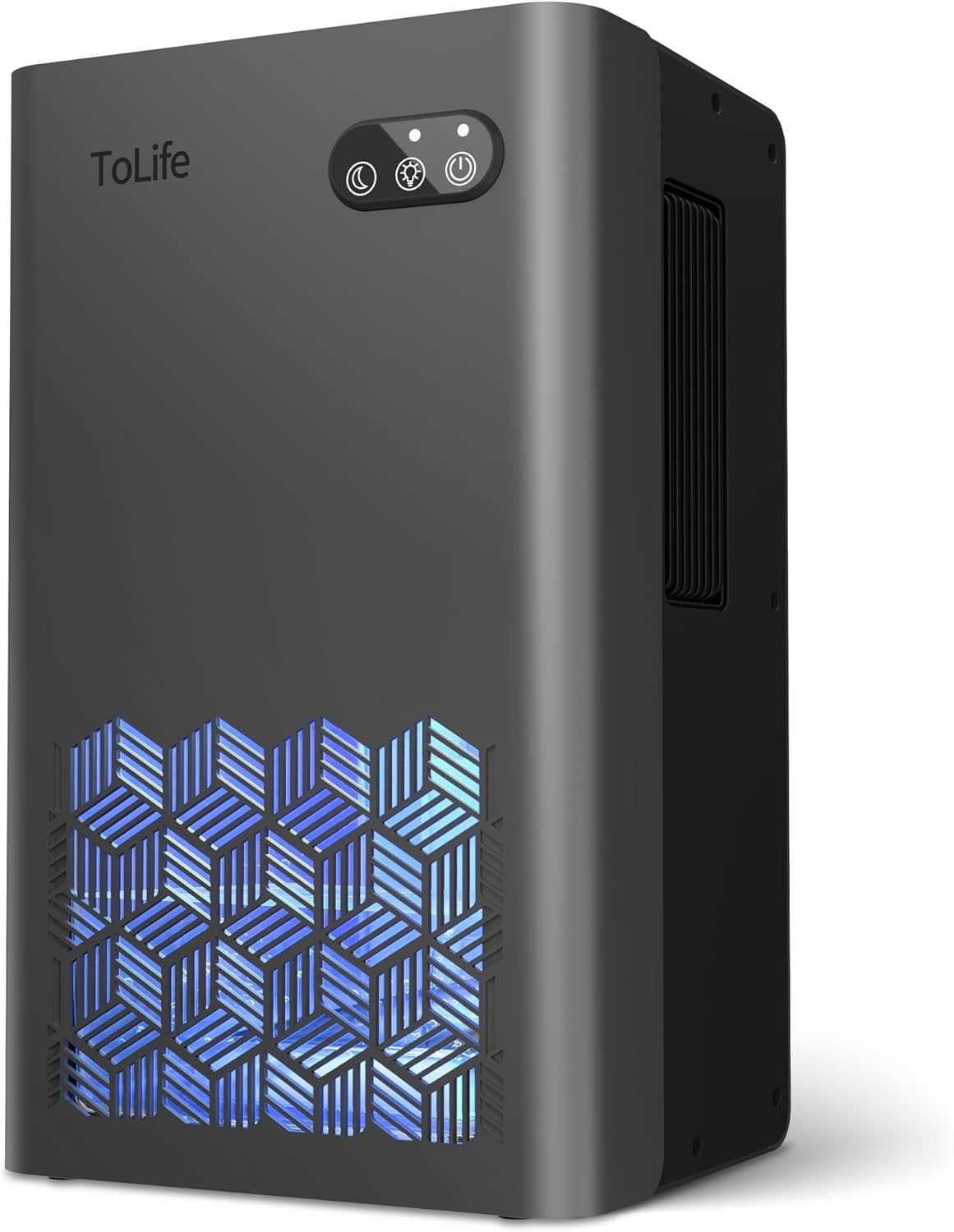
The ToLife TZ-C2 uses semiconductor condensation technology to quietly pull moisture from the air and deposit it into a removable 95 oz tank, making it a straightforward option for damp rooms. It offers two operating modes: a higher-power setting for faster moisture removal and a low-speed sleep mode that runs under 30 dB for overnight use. A seven-color LED can act as a night light and the unit includes automatic shutoff when the tank is full or removed, plus handles for easy moving between rooms. Practical benefits include simple setup, low noise, and a compact footprint that fits in basements, bathrooms, or bedrooms. Limitations are its modest rated dehumidification capacity and stated coverage, which means it will be most effective in smaller basement zones or for spot treatments rather than drying a large, very damp basement quickly. Also this model runs on 220 volts, so electrical compatibility should be confirmed for your location.
Best for: Buyers who need an affordable, portable dehumidifier for spot dehumidifying small basement areas, bathrooms, or bedrooms and who prioritize low noise and easy portability.
Less Ideal for: People looking to dry large, very damp basements or whole-house coverage should consider a higher-capacity compressor dehumidifier instead.
- Large removable 95 oz water tank reduces how often you need to empty it
- Quiet sleep mode under 30 dB suitable for nighttime operation
- Portable design with handles for moving between rooms
- Automatic shutoff prevents overflow when the tank is full
- Dehumidification capacity is modest and may be slow in very damp or large basements
- Requires 220 volt power which may not match all household outlets
Verdict: A compact, budget-friendly portable dehumidifier that is best for quiet, small-area moisture control and occasional basement spot treatments.
Choosing the Right Dehumidifier for Grow Room: Key Factors to Consider
Capacity Relative to Grow Room Size
Matching dehumidifier capacity to the grow-room volume and plant transpiration load is essential. Capacity is typically rated as pints or liters removed per day under specific temperature and humidity conditions. In grow rooms the effective moisture load is often higher than a residential room because of dense plant material and transpiration during lights-on periods.
If a unit is undersized it will run continuously without hitting setpoint, which raises energy use and shortens component life. Oversizing slightly can help in high-load scenarios but may cause short-cycling in low-load periods, which reduces dehumidification efficiency and can harm compressor longevity. Calculate room cubic feet and estimate peak transpiration to choose a capacity that handles maximum expected load while allowing modulation for lower-demand times.
Control Precision and Humidity Range
Precise, stable control prevents wide RH swings that stress plants. Look for units with adjustable humidistats or external controller compatibility and a clear, repeatable setpoint. Controls that allow 1 percent or small-step changes are useful when dialing in target RH for different growth stages.
Also consider whether the dehumidifier can maintain control at the typical temperatures in your grow room. Some units list performance only at cooler temperatures; confirm performance near your actual environmental setpoints so the unit can dehumidify effectively during both lights-on and lights-off cycles.
Condensate Handling and Plumbing Options
Grow rooms often run continuously, so manual emptying is impractical. Choose units with reliable gravity or pump-assisted drainage. Gravity drains require elevation to a drain or a low point; pump drains allow routing to a sink or remote disposal location and are useful when the unit sits below drain level.
Inspect drain port size and hose compatibility and whether the unit has an automatic pump shutoff or float switch that might trigger alarms. Continuous-drain setups reduce labor but add points of failure, so ensure hoses and fittings are secured and routed for minimal backflow risk.
Energy Use and Operating Cost
Dehumidifiers can be one of the higher energy consumers in a grow-room setup when run continuously. Evaluate wattage at typical operating conditions rather than nameplate power alone, and consider units with energy-saving modes or variable-speed compressors where available.
Factor energy cost into the total operating budget; a more efficient unit can pay back higher upfront cost in reduced electricity bills over months of heavy use. Also weigh energy use against the unit's ability to reach setpoint quickly; a more efficient dehumidifier that stabilizes RH fast may reduce total runtime.
Runtime, Defrosting, and High-Temperature Behavior
Grow rooms can present warm, humid conditions that affect compressor and coil performance. Units with reliable auto-defrost are important if the environment cycles into cooler periods or if the unit is used in side rooms with lower temperatures. Defrost logic that limits downtime and resumes dehumidification quickly keeps RH under control.
Also pay attention to recommended continuous runtime and duty-cycle specifications. Units built for continuous operation tend to have more robust components and better thermal management to handle long runtimes without overheating.
Maintenance Accessibility and Filter Care
Frequent maintenance needs or hard-to-reach filters increase labor and downtime. Look for units with tool-free filter access, washable filters, and clearly labeled service points for coil cleaning or condensate pump access. Easy access reduces the chance of neglected maintenance that degrades performance.
Consider the availability of replacement filters and the expected service interval. Units that facilitate quick routine tasks help keep the grow-room environment stable and reduce the risk of plant issues caused by blocked airflow or reduced dehumidification capacity.
Sizing the Dehumidifier for Your Grow Room
Proper sizing starts with calculating the room volume and estimating peak moisture load from plant transpiration and any water features. Use cubic feet or cubic meters to get an accurate sense of volume rather than relying on floor area alone. For heavy canopies or densely packed racks, assume a higher per-square-foot moisture contribution.
After estimating load, select a unit whose rated moisture-removal capacity covers peak conditions with some reserve. When in doubt, choose a slightly larger capacity to avoid continuous maxed-out runtime, but be mindful of short-cycling risks in low-load periods.
- Measure room height as well as floor area to compute volume.
- Estimate peak transpiration during lights-on for capacity planning.
- Allow 10 to 20 percent headroom for atypical humidity spikes.
Placement and Airflow Considerations
Position the dehumidifier where it can intake and exhaust without obstruction. Avoid tight corners or installations directly flush against walls that restrict airflow. Good circulation helps the unit read room humidity accurately and distribute drier air throughout the space.
If you use ducting or passive airflow channels, verify that the unit's fan can handle any added static pressure. Routing intake or exhaust against fans or carbon filters can create backpressure that reduces performance.
- Keep clear space of at least a foot around intake and exhaust.
- Avoid placing the unit directly under misting nozzles or near water reservoirs.
- Use room fans to promote even humidity distribution if needed.
Integrating Dehumidifiers with Environmental Controllers
Many growers use a central environmental controller to coordinate lights, fans, and humidification. Check whether the dehumidifier offers external control inputs or a dry-contact relay to accept on/off commands from controllers. Integration lets you schedule or modulate dehumidification according to growth stage or diurnal cycles.
Where direct integration is not available, consider controllers that monitor RH and switch a dedicated outlet or relay that powers the dehumidifier. Ensure safe electrical practices and that any switching devices are rated for the unit's current draw.
- Confirm compatibility with common controller relay types.
- Use a controller to avoid manual setpoint tinkering during critical growth phases.
- Prioritize units with clear external control options for automation.
Noise, Vibration, and Operational Impact
Noise and vibration can stress plants in sensitive setups and affect nearby living spaces if the grow room is in a house. Review expected decibel levels and check for vibration isolation features or mounting options. Quieter units may cost more but reduce disturbance and allow placement closer to the canopy when necessary.
If multiple units are used, stagger start times to avoid combined inrush currents and excess noise bursts. Vibration pads or rubber mounts can mitigate resonance transmitted through building structures.
- Compare published dB ratings at typical airflow settings.
- Use anti-vibration mounts to reduce structure-borne noise.
- Consider run schedule to minimize simultaneous starts.
Common Installation Pitfalls to Avoid
Avoid installing the dehumidifier in a pocket that traps humid air near plants rather than treating the whole room. Units placed too close to wet surfaces or reservoirs can short-circuit airflow measurement and lead to inconsistent RH control.
Also avoid using undersized hoses, sharp bends, or high-elevation runs without a condensate pump. Poor drain routing causes backups and frequent service calls; plan plumbing with gentle slopes and accessible check points.
- Keep hoses as short and straight as possible.
- Verify condensate pump capacity against required lift height.
- Place the unit where its sensor sees representative room air, not microclimates.
How We Chose the Best Dehumidifier for Grow Room
We selected units that are purpose-fit for indoor horticulture and practical grow-room use. Our editorial filters prioritized dehumidifiers with documented moisture-removal capacity at warm, humid setpoints, precise humidity control options, and durable construction suited to continuous or long runtime in enclosed spaces. We also considered energy use at realistic operating conditions and features that reduce labor, such as reliable auto-defrost, accessible drains, and easy-to-clean filters. Exclusions: we omitted consumer units rated only for light household duty and any unit without accessible specifications for pints or liters removed per day at elevated temperatures, or those lacking basic humidity control features. The main evaluation dimensions were capacity in pints per day at relevant temperatures, control accuracy and humidity range, runtime and maintenance burden, condensate handling options, and energy efficiency under continuous use. Those criteria reflect the real tradeoffs grow-room operators face between moisture control, running cost, and daily upkeep.
Our full evaluation process is outlined in our review methodology.
FAQ
What humidity level should I target in a grow room?
Target humidity depends on plant stage, but many growers aim for 40 to 60 percent RH overall. Seedlings often need higher humidity, while flowering typically benefits from lower RH to reduce mold risk. Adjust targets gradually and monitor plant response.
Can I use a household dehumidifier in a grow room?
Household units can work in small or lightly loaded rooms, but confirm rated capacity at your operating temperature and continuous-duty expectations. Units designed for continuous use and higher moisture removal are better for larger or heavily transpiring setups.
How often should I empty the condensate tank?
Frequency depends on unit capacity and humidity load. In many grow rooms tanks fill daily or faster. For continuous operation, setup a gravity drain or pump-assisted line to avoid daily tank emptying and reduce the risk of downtime.
Does temperature affect dehumidifier performance?
Yes. Most refrigerant dehumidifiers remove moisture more efficiently at warmer temperatures and can struggle in cooler environments without good defrost logic. Check rated performance across the temperature range you expect in the grow room.
Should I run the dehumidifier continuously?
Continuous operation is common in high-load grow rooms, especially during lights-on periods. However, aim for a unit that can modulate or be controlled by an environmental controller to avoid unnecessary runtime during lower-demand periods.
Final Verdict
Selecting the right dehumidifier for a grow room comes down to matching capacity to peak moisture load, ensuring precise control at your operating temperatures, and choosing reliable condensate handling to minimize daily labor. Energy use and maintenance accessibility are the primary ongoing costs, so weigh those against capacity and control features when choosing a unit. Prioritize a model that maintains stable humidity with minimal intervention and integrates with your environmental controls to protect yields and simplify operations.