
Note: This article contains affiliate links. If you click on these links and make a purchase, we may earn a small commission at no extra cost to you. This helps support our research and content. Read our full affiliate disclosure here.
A loft can trap moisture and develop musty odors, damaged insulation, or mold if humidity runs high. Choosing the right dehumidifier for a loft matters because these spaces have unique airflow, ceiling height, and access challenges that affect performance and maintenance. This guide shortlists the top-performing dehumidifiers for loft use and explains which models suit different loft sizes, ventilation situations, and noise tolerances. We evaluate capacity, run time, and noise so you can pick a unit that reliably controls humidity without creating new problems for living spaces below. Read on to find the best options for your loft setup and learn what to consider before you buy.
Top Picks at a Glance
| Best Overall The best all-around choice for most situations | AEOCKY RHEA 80-Pint Dehumidifier |  |
| Best Quality Built to a higher standard if you want something more solid | Frigidaire 50 Pint Dehumidifier FHDD5034Y1 |  |
| Best Value The sweet spot between price and what you get | AIRPLUS 30-Pint Dehumidifier |  |
| Best Budget The cheapest option that still gets the job done reliably | TABYIK 35oz Dehumidifier DH-CS01 |  |
| Top Rated A top-rated pick with lots of positive feedback | KNKA 80-Pint Dehumidifier PD30MA-20 |  |
| Most Popular A crowd favorite that many people choose with confidence | Waykar 34 Pint Dehumidifier |  |
| Best Seller A high-volume bestseller chosen again and again | BEDRED CT11 Dehumidifier |  |
AEOCKY RHEA 80-Pint Dehumidifier
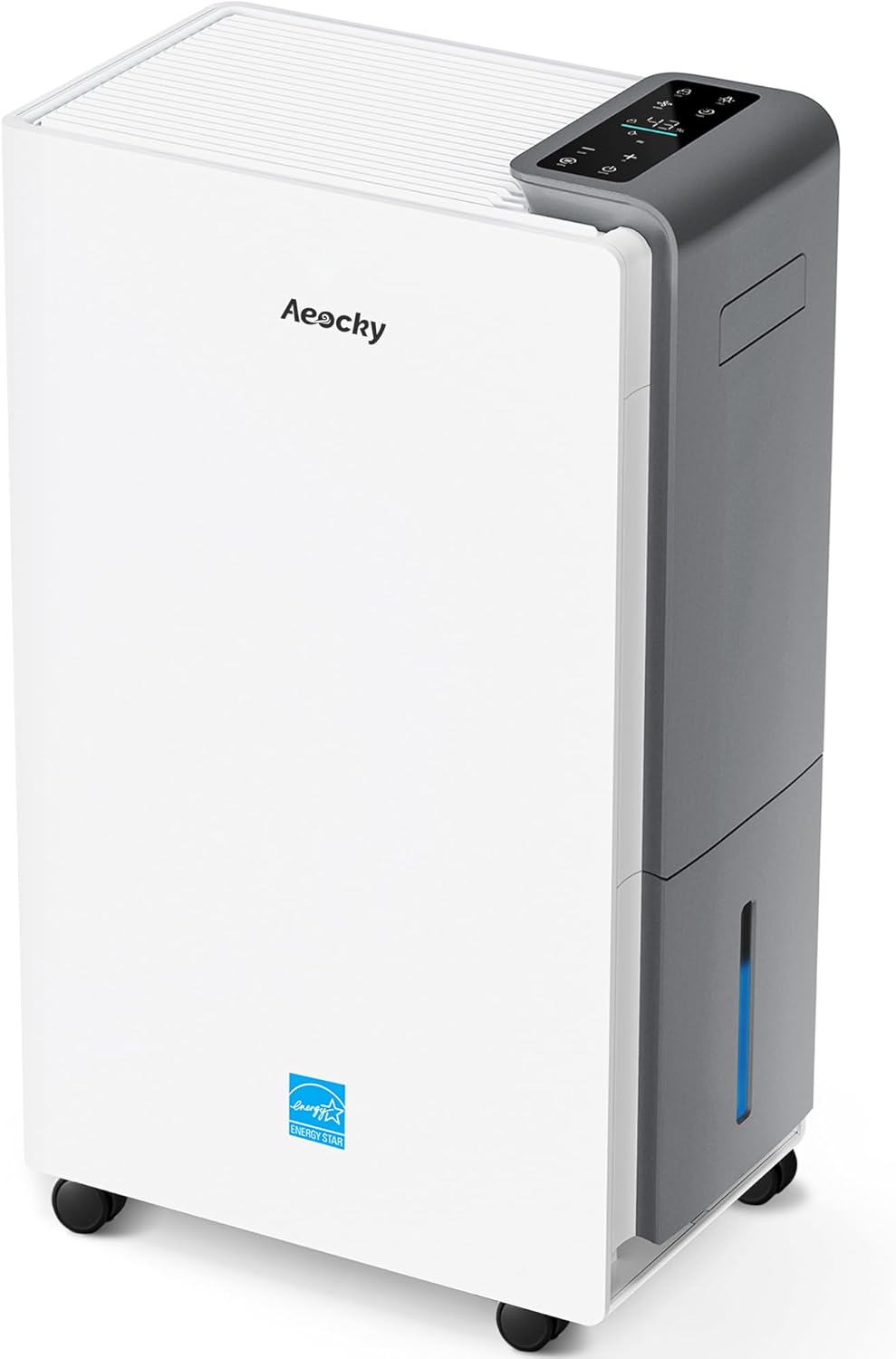
| Capacity | 80 pints/day |
|---|---|
| Tank Volume | 1.45 gallons |
| Wattage | 280 watts |
| Operation Mode | Auto, Constant Humidity, Continuous, Smart Drying, Sleep |
| Air Flow Capacity | 9006 cubic feet/hour |
The RHEA-001 is a high-capacity compressor dehumidifier built to remove up to 80 pints of moisture per day and cover very large areas; the listing cites suitability for spaces up to 5,500 sq ft and an internal 1.45 gallon tank plus continuous drain options. It offers multiple operation modes including auto, constant-humidity, continuous, smart drying and sleep, and includes a drain hose and garden-hose adapter for hands-off draining. Key engineering choices aim at efficiency and durability: a rotary compressor, 3+2 evaporator/condenser layout, copper tubing and advanced hydrophilic fins help the unit hit ENERGY STAR Most Efficient 2025 levels while claiming quieter operation around the mid-40 dB range. Practical benefits for lofts include strong airflow and fast moisture removal so rooms with high ceilings or open plans regain comfort faster, and smart humidity control keeps levels steady. Limitations to consider are the single fan speed listing despite claimed quiet operation and a relatively large tank that still favors using the drain hose for extended runs; it is also a compressor unit so performance can drop near freezing without proper defrost cycles, though this model advertises improved low-temperature performance.
Best for: Buyers who need a powerful, energy-efficient dehumidifier for large open spaces or lofts and prioritize steady humidity control with lower running costs over extended periods.
Less Ideal for: People who need ultra-compact, portable units for small rooms or who require very fine multi-speed fan control and silent operation below typical compressor noise levels should consider smaller or different technology models.
- High dehumidification capacity (80 pints/day) suitable for large or open lofts
- ENERGY STAR Most Efficient 2025 rating for strong energy efficiency
- Multiple operating modes including auto and sleep for flexible, quiet use
- Includes drain hose and garden-hose adapter for continuous drainage
- Designed components (rotary compressor, copper tubing, multi-row coils) target durability and heat-exchange efficiency
- Listing shows only one fan speed value which may limit fine-grain airflow control
- 1.45 gallon tank is relatively small for 80-pint capacity, making a continuous drain preferable for heavy use
- As a compressor unit, cold-environment performance still depends on defrost behavior despite improved sensors
Verdict: If you need fast, energy-efficient moisture removal for a large loft, the RHEA-001 delivers high capacity and verified ENERGY STAR Most Efficient 2025 performance.
Frigidaire 50 Pint Dehumidifier FHDD5034Y1

| Capacity | 50 pints |
|---|---|
| Tank Volume | 2.7 gallons |
| Air Flow Capacity | 235 cfm |
| Wattage | 470 watts |
| Voltage | 115 volts |
This Frigidaire 50‑pint dehumidifier is built to pull significant moisture from large rooms and open loft spaces while offering convenient controls. It removes up to 50 pints per day and moves air at about 235 CFM, making it suitable for damp basements, attics, and lofts where humidity and airflow needs are higher. The unit includes a washable air filter, front-loading bucket with carrying handle and splash guard, and continuous drain capability for unattended operation, plus Wi‑Fi for remote monitoring and programmable humidity control for set‑and‑forget comfort. Three fan speeds help balance performance and noise, and the 470‑watt power draw is typical for this capacity class. Tradeoffs are typical for a 50‑pint machine: it is relatively heavy and sized for large areas rather than small bedrooms, and it will cycle more frequently in very humid climates which increases energy use. For large lofts that need steady dehumidification and the option for continuous drainage, this model delivers strong, reliable moisture removal with practical controls.
Best for: Buyers who need a robust dehumidifier for large, open areas like lofts or garages and value remote control plus continuous drainage for hands‑off operation.
Less Ideal for: People who need a lightweight, ultra‑quiet unit for a small bedroom or who prioritize the lowest possible energy use in mild climates.
- High dehumidification capacity rated at 50 pints per day for large spaces
- Continuous drain option for unattended, long‑run operation
- Washable air filter and front‑loading bucket simplify maintenance
- Programmable humidity control and Wi‑Fi for remote monitoring and scheduling
- Three fan speeds let you trade noise for faster moisture removal
- Relatively heavy and physically large compared with smaller capacity units
- 470 watt draw can increase running costs in very humid conditions
Verdict: If you need powerful, continuous moisture removal for a large loft and want remote scheduling and drainage, this 50‑pint Frigidaire is a practical, high‑capacity choice.
AIRPLUS 30-Pint Dehumidifier

| Dehumidification Capacity | 30 pints_per_day |
|---|---|
| Floor Area | 2500 |
| Tank Volume | 2.6 liters |
| Number of Speeds | 3 |
| Wattage | 305 watts |
This AIRPLUS dehumidifier is built to tackle large, damp spaces like lofts or basements by extracting up to 30 pints of moisture per day and covering about 2,500 square feet. It offers flexible drainage with a 2.6 L removable tank plus an included hose for continuous automatic drain, and an auto shut-off when the tank is full. Controls provide three modes including a rain mode preset at 45% humidity, manual setpoints from 30% to 80%, and a dry mode to speed laundry drying, plus a 24-hour timer and auto-defrost for cooler conditions. The unit is relatively quiet at about 37 dB, so it can run in living spaces or sleeping areas without being intrusive. Practical touches like recessed side grips and three fan speeds make placement and daily use easier. Expect solid moisture removal and convenience for larger open-plan rooms, though the stated 30-pint capacity is under standard test conditions and real-world extraction will vary with temperature and humidity.
Best for: Buyers who want a practical, no-frills dehumidifier that reliably reduces moisture in large lofts or open-plan spaces and prefers features that simplify daily use and drainage.
Less Ideal for: People seeking integrated smart controls or app-based monitoring, or those who need a compact unit for very small rooms or travel use.
- Rated to remove up to 30 pints per day and cover up to 2,500 sq ft, suitable for large open areas
- Includes drain hose and 2.6 L tank for flexible continuous or manual drainage
- Quiet operation around 37 dB allows overnight use in living or sleeping spaces
- Multiple modes and humidity setpoints plus a 24-hour timer for tailored, energy-conscious operation
- Auto-defrost and automatic shut-off add safety and reliable performance in varied conditions
- 30-pint rating is based on standard test conditions and may be lower in cooler or less humid environments
- No indication of Wi-Fi or smart-home connectivity for remote control
Verdict: A practical, quiet 30-pint unit with flexible drainage and straightforward controls that suits large lofts needing dependable moisture control.
TABYIK 35oz Dehumidifier DH-CS01

| Tank Volume | 1000 ml |
|---|---|
| Dehumidification Capacity | 0.45 liters_per_day |
| Wattage | 40 watts |
| Number of Speeds | 1 |
| Floor Area | 280 square_feet |
The TABYIK 35oz DH-CS01 is a small Peltier dehumidifier built for bedrooms, bathrooms, closets, RVs and other compact loft areas where excess humidity is a problem. It runs continuously and collects up to about 16 oz (450 ml) per day under warm, very humid conditions while drawing roughly 40 watts, so it is inexpensive to operate compared with larger compressor units. The unit is simple to use with one-button operation, a transparent 1000 ml tank with easy-grip groove for removal, and an automatic shutoff that stops the machine and flashes a light when the tank is nearly full. A low-noise 28 dB rating and optional 7-color night light make it suitable for sleeping areas. Important limits are its modest daily dehumidification rate and single speed control, so it suits small, fairly damp spaces rather than large or very damp lofts; it also uses Peltier technology, which is less effective at low temperatures. Overall, it is a convenient, low-energy option when you need targeted moisture control in a small loft nook or bedroom.
Best for: Buyers seeking an inexpensive, low-energy dehumidifier for a small loft area, bedroom, or bathroom who prioritize quiet operation and simple plug-and-play convenience.
Less Ideal for: People needing rapid moisture removal in large lofts, basements, or very damp rooms should choose a higher-capacity compressor dehumidifier instead.
- Quiet operation around 28 dB suitable for bedrooms and loft sleeping areas
- Large transparent 35 oz (1000 ml) tank with easy-remove groove and auto shutoff
- Low power draw (approximately 40 watts) for budget-friendly running costs
- Simple one-button operation and portable handle for moving between rooms
- Limited dehumidification capacity (about 0.45 liters / 16 oz per day) not suited for very damp or large spaces
- Single speed control limits customization of airflow and drying rate
Verdict: A budget-friendly, ultra-quiet portable dehumidifier that keeps small loft spaces and bedrooms drier with very low energy use.
KNKA 80-Pint Dehumidifier PD30MA-20

| Capacity | 80 pints per day |
|---|---|
| Tank Volume | 1.45 gallons |
| Wattage | 360 watts |
| Floor Area | 4500 square_feet |
| Operation Mode | AUTO, DRY, SETTING |
The KNKA PD30MA-20 is a performance-focused dehumidifier built for large, damp spaces such as basements. Its high-efficiency compressor can remove up to 80 pints per day under extreme conditions and about 56 pints in typical basement conditions, while an internal 1.45 gallon tank plus a supplied 6.56 ft drain hose enable continuous drainage to avoid frequent emptying. Controls include AUTO, DRY, and a SETTING mode for 30%–80% RH, and the digital display with a color-changing humidity indicator makes it easy to monitor conditions at a glance. The unit is designed to run quietly (40–45 dB), has a washable filter, casters for moving between rooms, cord storage, a 12-hour timer, and a child lock for steady, unattended operation. Expect good energy efficiency thanks to ENERGY STAR certification and a 360 watt power draw, but note that humidity readings come from the air inlet and may differ slightly from a separate hygrometer; the unit also needs upright siting for 24 hours before first use. For heavy-duty basement dehumidification this model balances strong capacity with thoughtful usability features.
Best for: Buyers who need powerful, reliable moisture removal in large basements or very damp rooms and prioritize steady performance and easy continuous drainage.
Less Ideal for: People seeking a compact or ultra-light unit for small rooms or occasional use should consider lower-capacity, more portable models instead.
- High maximum dehumidification capacity up to 80 pints per day for large, very humid spaces
- Includes 6.56 ft drain hose and built-in tank for continuous drainage to reduce manual emptying
- ENERGY STAR certified and uses a high-efficiency compressor for lower operating costs relative to output
- Quiet operation (40–45 dB) and caster wheels make it suitable for basements and living spaces
- Digital display with real-time humidity readout and color indicator simplifies monitoring and control
- Humidity reading is measured at the air inlet and may not match a separate room hygrometer
- Requires upright placement for 24 hours before first use to avoid operational issues
Verdict: Choose this KNKA if you need a strong, ENERGY STAR certified dehumidifier that can handle large basements with continuous-drain capability and quiet operation.
Waykar 34 Pint Dehumidifier
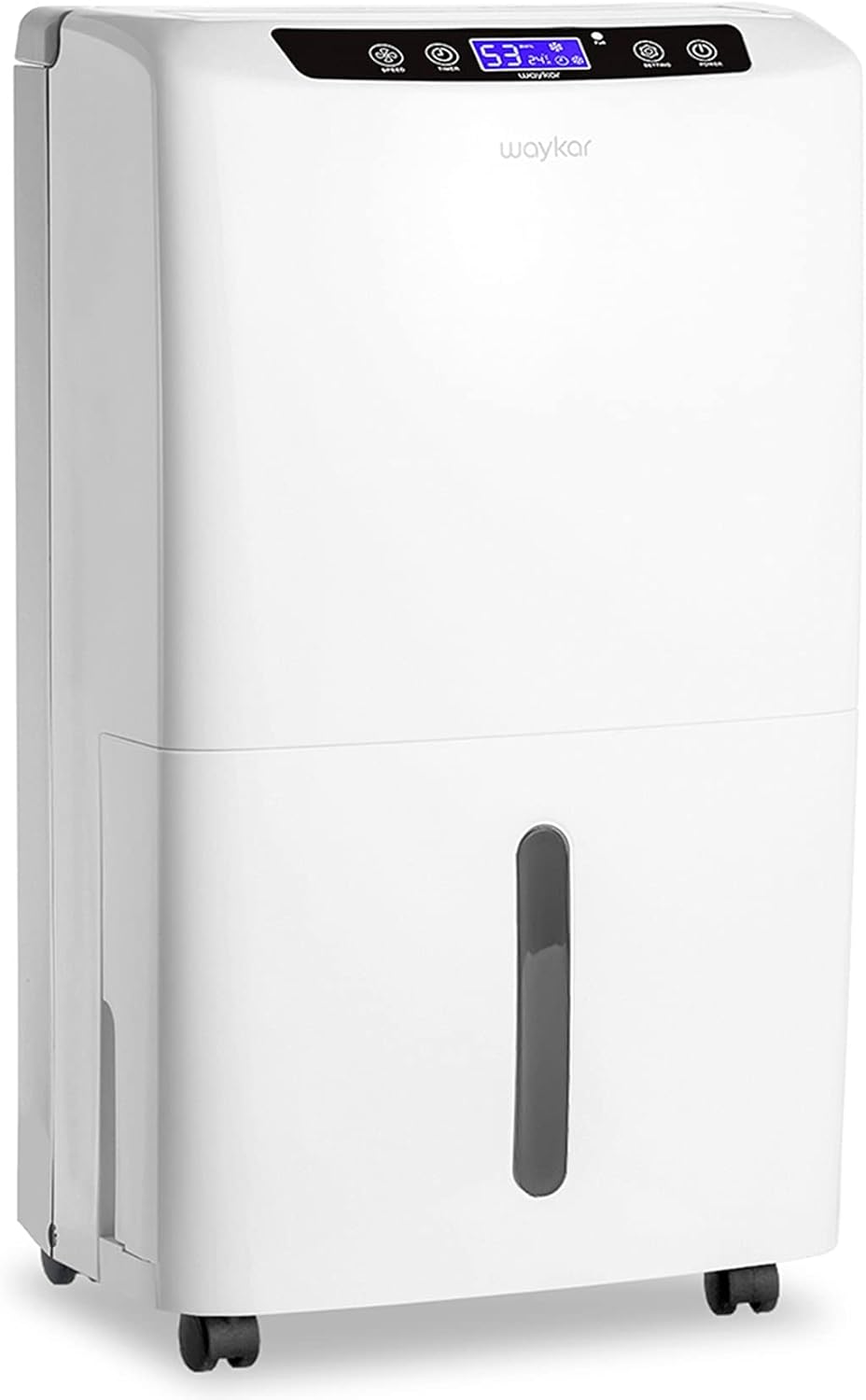
| Capacity | 34 pints per day |
|---|---|
| Floor Area | 2000 square_feet |
| Tank Volume | 0.66 gallons |
| Wattage | 230 watts |
| Air Flow Capacity | 62 cfm |
The Waykar 34 Pint Dehumidifier is a mid‑to‑high capacity unit intended to remove excess moisture in basements, lofts, and large rooms. It pulls up to 34 pints per day under standard test conditions and offers both automatic humidity control and a continuous drain option via the included hose so it can run unattended for long periods. Practical touches include two fan speeds, a 24‑hour timer, a removable 0.66 gallon tank with full‑tank shutoff and alert, a washable filter, and a manual 90° airflow adjustment to direct dry air. Energy Star certification and an AI‑style defrost/overload protection system aim to keep running costs and downtime lower than noncertified models. The unit is relatively quiet for continuous use but is not the smallest or lightest option, and emptying the tank is required unless you set up the hose. Controls are straightforward but lack advanced app connectivity. For lofts where steady moisture control and continuous drainage are priorities, this model balances capacity, energy efficiency, and useful safeguards.
Best for: Buyers who prioritize dependable, energy‑efficient moisture control for larger residential spaces and want a unit that can run continuously with the option for auto drainage and simple controls.
Less Ideal for: Buyers wanting a very compact or lightweight unit for occasional small rooms or those who need Wi‑Fi/remote app control should consider other models.
- High 34 pint/day dehumidification capacity suitable for large rooms and lofts
- ENERGY STAR certification for better real‑world energy efficiency
- Continuous drain option with included hose for unattended operation
- Smart protection with automatic defrost and overload protection to maintain performance
- Washable filter and removable tank simplify maintenance
- Tank capacity is modest so manual emptying is needed without a continuous drain setup
- Controls are basic and do not offer smart app or remote connectivity
Verdict: A high‑capacity, Energy Star dehumidifier that reliably handles large lofts and offers continuous drainage for low‑maintenance humidity control.
BEDRED CT11 Dehumidifier

| Floor Area | 1000 square_feet |
|---|---|
| Tank Volume | 95 fluid ounces |
| Capacity | 5.9 pounds |
| Operation Mode | Intermittent |
| Other Special Features of the Product | 7 Color Ambient Light, Automatic Shutoff, Sleep Mode |
The BEDRED CT11 is a compact thermoelectric dehumidifier intended to reduce humidity in small spaces such as bedrooms, bathrooms, and modest basements up to about 1000 sq ft. It uses semiconductor cooling rather than a compressor, so it runs quietly and is simple to operate with an intermittent operation mode and an automatic shutoff when the 95 oz tank fills. Sleep Mode turns off the lights and lowers noise for overnight use, and the seven-color ambient light gives an optional mood-lighting feature. Practical benefits include easy emptying from the included tank, portability thanks to a lightweight design, and low sound levels that suit living spaces. Important limitations are inherent to semiconductor units: lower capacity compared with compressor dehumidifiers, reduced performance in very cold or very damp basements, and a smaller tank that requires more frequent emptying in high-humidity conditions.
Best for: Buyers who prioritize quiet, low-maintenance dehumidification and want a compact unit that is easy to move and run in living spaces or small basements without frequent intervention.
Less Ideal for: People needing heavy-duty moisture control for large, cold, or very damp basements should choose a higher-capacity compressor dehumidifier instead.
- Quiet thermoelectric operation suitable for bedrooms and living rooms
- Automatic shutoff protects against overfill and simplifies unattended use
- 95 oz removable tank for straightforward water removal
- Sleep Mode and ambient light options for low‑noise nighttime use
- Compact and lightweight for easy placement or moving between rooms
- Semiconductor cooling gives lower moisture removal capacity than compressor models
- Performance drops in cold basement conditions and very high humidity areas
Verdict: Choose the BEDRED CT11 if you want a quiet, portable dehumidifier with auto‑shutoff and sleep‑friendly operation for small basements or living spaces.
Choosing the Right Dehumidifier for Loft: Key Factors to Consider
Capacity Relative to Loft Size
Lofts typically have higher ceilings and irregular floor plans that increase the air volume you must dehumidify. Choose a unit whose daily moisture removal rating matches the loft's usable volume, not just square footage. A unit undersized for the loft will run constantly and struggle to reach target humidity, while an oversized unit may cycle too frequently and short-cycle the compressor.
Also account for how damp the space is. A loft with active moisture sources, poor ventilation, or recent water intrusion needs a higher-capacity unit than a lightly damp storage loft. Matching capacity to both volume and baseline humidity ensures efficient, reliable control.
Noise and Location
Loft-mounted dehumidifiers often run for long stretches and can transmit sound to living spaces below. Evaluate decibel ratings at typical operating speeds and consider whether the unit must run continuously during humid seasons. Quieter models reduce disturbance, especially if the loft sits over bedrooms or shared areas.
Placement affects perceived noise: install the unit on vibration-damping feet and away from thin floor panels to reduce sound transfer. If the loft is hard to access, favor quieter models so occasional running does not become a nuisance when someone is using adjacent rooms.
Drainage Options and Accessibility
Lofts are often difficult to reach for frequent emptying, so reliable continuous drainage is a major convenience. Check whether a unit supports gravity-fed hose drainage, pump-assisted discharge, or only a removable tank. Gravity drainage requires a downhill run to a drain; pump-assisted units can move water vertically to a sink or condensate line.
Also consider tank size and ease of removal if you must empty it manually. Larger tanks lengthen time between maintenance visits, but in tight loft spaces, tank access and the ability to route a hose may be the deciding factor.
Airflow and Placement Constraints
Effective dehumidification depends on good airflow through the unit. Lofts with low clearance, angled ceilings, or obstructions may restrict intake or exhaust, reducing performance. Consider units with flexible placement options, such as top or front air intakes, and ensure you can provide several inches of clearance around the unit for proper airflow.
If the loft has poor circulation, pairing a dehumidifier with a small circulation fan can dramatically improve efficiency by moving moist air toward the intake and reducing stagnant pockets.
Energy Use and Long-Term Cost
Dehumidifiers can run many hours each day during humid months, so energy consumption directly affects operating cost. Look for units with efficient compressors, humidity-sensing controls, and auto-shutoff features that prevent unnecessary cycling. Energy-efficient units may cost more upfront but lower monthly electricity use, making them a better value in the long run.
Also check for programmable timers and humidistats so the unit runs only when needed. In a loft, running the dehumidifier to maintain a steady relative humidity often uses less energy than frequent on-off cycles caused by poor control systems.
Maintenance and Filter Access
Lofts can be dusty, so easy-to-clean air filters and straightforward access to serviceable parts matter. Units with washable filters and clear access panels reduce the effort needed to keep the unit operating efficiently. Consider whether you can reach filters and drains safely in your loft; if access is tricky, choose a model that minimizes required maintenance visits.
Also review freeze-protection features and defrost cycles if the loft experiences low temperatures, since coils can ice up and reduce performance without proper automatic defrost behavior.
Choosing Capacity for High Ceilings
Loft volumes often exceed the nominal square footage because of vaulted ceilings and open rafters. When sizing a dehumidifier, convert floor area to approximate cubic feet by multiplying by the average ceiling height, then select a unit rated to handle that volume at the loft's typical humidity level.
If you are unsure, err toward a slightly higher capacity to avoid continuous runtime, but be mindful of short-cycling. Many manufacturers publish guidelines by square footage and by moisture conditions; use those as a starting point and prioritize units with clear removal-per-day ratings.
- Estimate cubic footage to better match capacity
- Account for moisture sources such as roof leaks or damp insulation
- Prefer a larger unit for poorly ventilated or frequently wet lofts
Placement Tips to Improve Performance
Place the dehumidifier where it can draw in and expel air without obstruction. Avoid corners, tight eaves, and areas immediately adjacent to insulation that might block airflow. If possible, center the unit in the main loft volume and keep at least a few inches of clearance on all sides.
Mounting considerations matter. If floor space is limited, some units offer wall-mounting or can be placed on a stable platform. Ensure stable footing and vibration isolation to reduce noise transfer to living spaces below.
- Avoid blocking intake or exhaust grills
- Use a small circulation fan for dead-air pockets
- Consider vibration pads to reduce transferred noise
Managing Drainage in Tight Spaces
Continuous drainage eliminates the need to empty tanks in hard-to-reach lofts. If gravity drainage is not feasible due to placement, look for models with a condensate pump that can lift water to a drain or down to a utility sink. Plan the routing before installation and keep hose runs short and sloped where possible.
If you must use a tank, choose the largest practical size and verify the ease of removal and reinsertion. Also check that the unit has a reliable full-tank shutoff so you do not return to water spillage after a long absence.
- Plan hose routing before installing the unit
- Pump-equipped units allow flexible placement
- Confirm full-tank shutoff and easy tank removal
Controlling Humidity Without Overcooling
Dehumidifiers remove moisture by cooling air over coils then reheating it slightly as it exits. In cooler lofts, running a dehumidifier can lower temperatures further and increase ice risk on coils. Look for units with automatic defrost and settings that prevent frequent frosting cycles.
Use the built-in humidistat to set realistic humidity targets. For most lofts used for storage or occasional occupancy, maintaining 45 to 55 percent relative humidity protects items and reduces mold risk while avoiding excessive cooling.
- Use humidistat control to avoid unnecessary runtime
- Prefer automatic defrost in cooler lofts
- Aim for moderate relative humidity targets
Energy and Seasonal Use Strategies
Run the dehumidifier seasonally when outdoor humidity drives indoor moisture, usually in late spring through early autumn. For year-round moisture issues, consider continuous operation with a programmable schedule to balance comfort and energy use.
Use timers, lower fan speeds, and reasonable humidity setpoints to reduce electrical consumption. Regular filter cleaning and maintenance preserves efficiency and minimizes long-term operating costs.
- Operate seasonally unless moisture persists year-round
- Use timers and fan speed control to save energy
- Maintain filters to keep performance efficient
How We Chose the Best Dehumidifier for Loft
We focused on practical, loft-specific performance and durability when selecting dehumidifiers for this list. First, we prioritized moisture-removal capacity rated for the square footage and typical ceiling volumes found in lofts, since cubic footage and air exchange differ from standard rooms. We also evaluated continuous drainage options and tank capacity to reduce maintenance for hard-to-access loft locations. Noise output was a key filter because loft units often sit near living areas; quieter operation was favored for units intended to run for long periods. Durability and serviceability entered the selection: units with robust compressors or proven refrigerant systems and accessible filters scored higher. Energy efficiency and user controls were included to reflect long-run operating cost and ease of use. We excluded units designed only for small closets or for outdoor use, and we did not consider units lacking clear capacity or drainage specifications. The resulting shortlist emphasizes real-world loft use: capacity and airflow, noise, drainage options, energy draw, and maintenance practicality guided inclusion.
Our full evaluation process is outlined in our review methodology.
FAQ
How large a dehumidifier do I need for a loft?
Size by the loft's air volume and baseline moisture. Calculate approximate cubic footage, consider ceiling height and ventilation, and pick a unit rated for that volume and the loft's dampness level rather than only floor area.
Can I drain a dehumidifier into a sink from the loft?
You can if the unit has a pump capable of lifting condensate to the sink. Gravity drainage works only when the drain point is lower than the unit; otherwise, choose a pump-assisted model or route a condensate line appropriately.
Will a dehumidifier make my loft cold?
Dehumidifiers can lower perceived temperature slightly because they remove moisture and may cool air over coils. In cooler lofts, use a model with automatic defrost and moderate humidity setpoints to avoid extra cooling or coil icing.
How often do I need to clean filters in a loft setting?
In dusty lofts, check washable pre-filters every month and clean them as needed. Regular inspection preserves airflow and efficiency; frequency depends on dust levels and how many hours per day the unit runs.
Is a quiet dehumidifier necessary for a loft?
Quiet operation is important if the loft shares structure with living areas. Even modest noise can transfer through floors and disrupt bedrooms below, so consider decibel ratings and vibration isolation if noise matters.
Final Verdict
For loft applications, prioritize moisture-removal capacity matched to the loft's volume, reliable drainage options, and low noise to avoid disturbing living areas below. Balance capacity against the likelihood of continuous operation and pick a model with good airflow clearance and accessible maintenance features. Tradeoffs are typical: higher-capacity units remove moisture faster but may cost more to run, while compact units are easier to place but may struggle in very damp lofts. Make your decision based on loft size, access for emptying or routing a drain, and the importance of quiet operation. Prioritize continuous drainage or pump-assisted discharge for hard-to-reach lofts and choose energy-efficient units with humidity controls to keep long-term operating costs predictable.