
Note: This article contains affiliate links. If you click on these links and make a purchase, we may earn a small commission at no extra cost to you. This helps support our research and content. Read our full affiliate disclosure here.
If you have hardwood floors, keeping indoor humidity in a safe range matters more than it does for other floor types. Excess moisture causes cupping, warping, finish breakdown, and elevated mold risk in gaps and under furniture. A purpose-fit dehumidifier helps you control relative humidity without blasting floors with hot, drying air or uneven airflow. This guide shortlists the seven best dehumidifiers for hardwood floors, emphasizing steady moisture removal, quiet operation, and sensible airflow patterns. We evaluated units for how they protect finished wood in real homes and how they fit into common floor-care routines. Read on to see the factors we used and which features matter most for keeping hardwood stable and healthy.
Top Picks at a Glance
| Best Overall The best all-around choice for most situations | Pro Breeze 50 Pint Dehumidifier |  |
| Best Quality Built to a higher standard if you want something more solid | Frigidaire 50 Pint Dehumidifier FHDD5034Y1 |  |
| Best Value The sweet spot between price and what you get | Waykar 80-Pint Dehumidifier JD025CE-80 |  |
| Best Budget The cheapest option that still gets the job done reliably | NineSky CT2 Dehumidifier |  |
| Top Rated A top-rated pick with lots of positive feedback | hOmeLabs 32-Pint Dehumidifier |  |
| Most Popular A crowd favorite that many people choose with confidence | BEDRED CT11 Dehumidifier |  |
| Best Seller A high-volume bestseller chosen again and again | ToLife Dehumidifier TZ-C2 |  |
Pro Breeze 50 Pint Dehumidifier
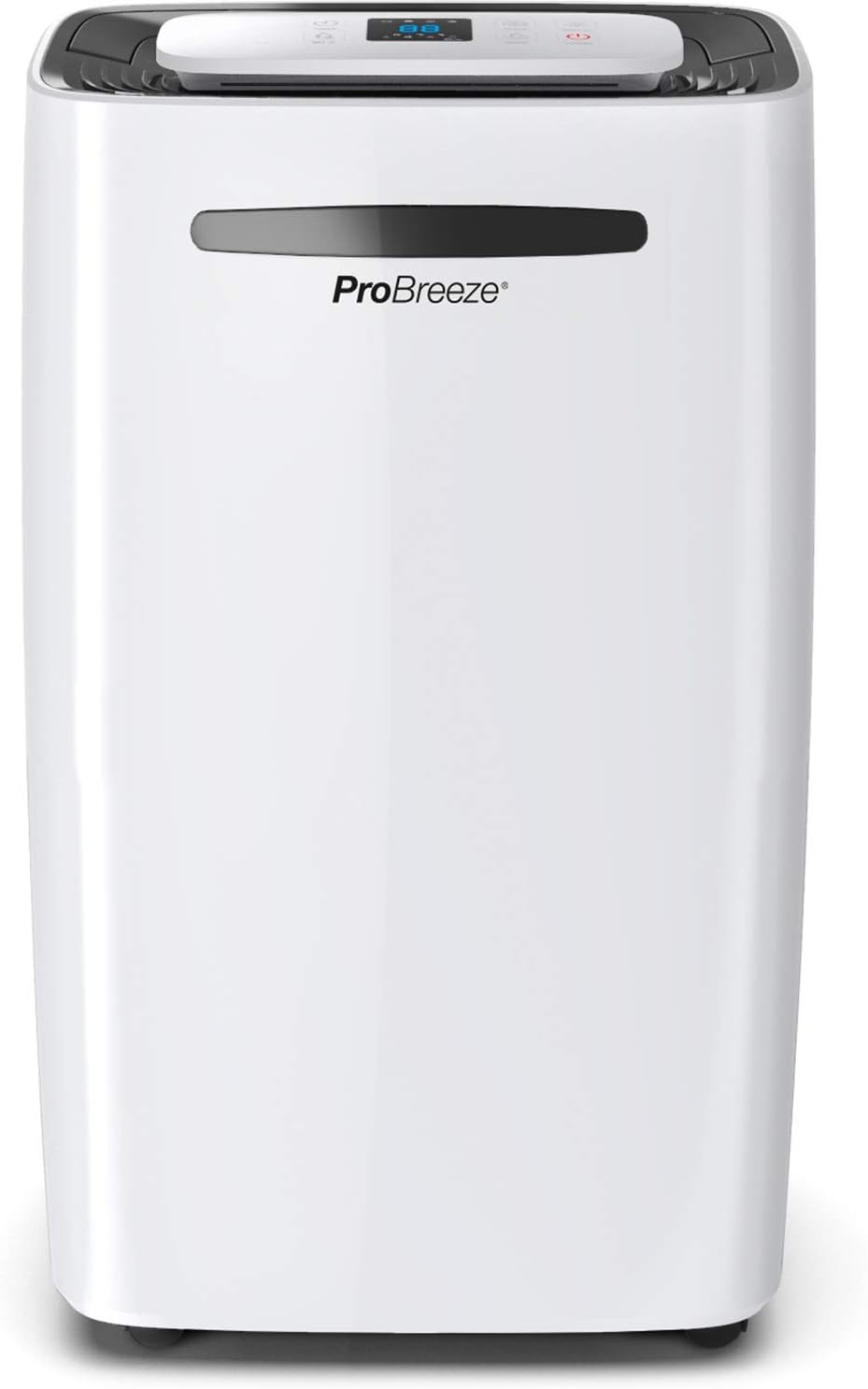
| Dehumidification Capacity | 50 pints_per_day |
|---|---|
| Tank Volume | 10 pints |
| Operation Mode | Continuous |
| Wattage | 450 watts |
| Number of Speeds | 3 |
The Pro Breeze 50 Pint Dehumidifier is a compressor-style unit designed to lower humidity in large spaces such as basements, large rooms, or homes up to roughly 3,500–4,000 sq ft. It pulls moisture from the air and collects it in a removable 9.7 pint tank or can run continuously using the included drain hose for unattended operation. Controls are digital with a built-in humidistat, 24-hour timer, three fan speeds, sleep and child-lock options, and humidity indicator lights so you can set a target and let the unit cycle on and off to meet it. Castor wheels and a carry handle make it portable despite its weight, and the defrost feature extends operation into cooler temperatures. Expect effective moisture removal in warm, damp spaces, but the unit is a typical compressor dehumidifier so it will be less efficient at very low temperatures and will require occasional tank emptying if not plumbed to a drain.
Best for: Buyers who want a powerful, user-friendly dehumidifier to protect hardwood floors and large spaces from excess moisture and who prefer set-and-forget operation with an option for continuous drainage.
Less Ideal for: People who need a lightweight, ultra-quiet unit for small rooms or those who require strong performance in near-freezing temperatures should consider other options.
- High moisture removal capacity rated up to 50 pints per day suitable for large rooms and basements
- Included continuous drain hose allows long unattended runs without emptying the tank
- Digital humidistat, timer and multiple fan speeds let you maintain a target humidity level
- Wheels and carry handle make it movable around the home despite its size
- Compressor dehumidifiers lose efficiency at low ambient temperatures, so performance drops in cold basements
- Relatively heavy for a portable unit which can make manual lifting awkward
Verdict: A robust, higher-capacity dehumidifier that reliably removes moisture from large rooms and basements and can be plumbed for continuous protection of hardwood floors.
Frigidaire 50 Pint Dehumidifier FHDD5034Y1

| Capacity | 50 pints |
|---|---|
| Tank Volume | 2.7 gallons |
| Air Flow Capacity | 235 cfm |
| Wattage | 470 watts |
| Number of Speeds | 3 |
This Frigidaire 50 pint dehumidifier is built to remove moisture from large rooms and open areas, with a rated 50 pints per day and 235 CFM airflow that helps lower humidity efficiently. It is typically used in basements, living rooms, garages or rooms with hardwood floors where maintaining safe humidity matters; the unit offers three fan speeds, custom humidity control and programmable operation so you can set target RH levels and let it run automatically. Practical features include a washable filter, front-loading 2.7 gallon tank with carrying handle and continuous drain option for extended unattended use, plus Wi‑Fi connectivity for remote monitoring and control. At 470 watts it is effective but not the most energy‑sipping option for continuous operation, and the unit is fairly heavy for moving between floors. For hardwood floors the customizable humidity control and strong extraction rate make it a reliable choice to help prevent moisture‑related warping and cupping when used with proper drainage or a hose for continuous draining.
Best for: Buyers who prioritize strong moisture removal and automated humidity control to protect hardwood floors in larger rooms or basements and who want remote monitoring for hands‑off operation.
Less Ideal for: People looking for an ultra‑light or ultra‑low‑power unit for small rooms or occasional spot use should consider smaller, more portable models instead.
- High dehumidification capacity rated at 50 pints per day suitable for large rooms
- Custom humidity control and programmable operation for maintaining target relative humidity
- Washable filter and front-loading tank simplify maintenance
- Continuous drain option and Wi‑Fi control enable extended unattended operation
- Relatively heavy to carry between rooms
- 470 watt power draw may lead to noticeable energy use during continuous operation
Verdict: Choose this Frigidaire when you need a high‑capacity, programmable dehumidifier with strong airflow and Wi‑Fi control to consistently protect hardwood floors in large rooms.
Waykar 80-Pint Dehumidifier JD025CE-80

| Dehumidification Capacity | 80 pints_per_day |
|---|---|
| Tank Volume | 2.5 gallons |
| Wattage | 270 watts |
| Air Flow Capacity | 165 cfm |
| Operation Mode | Continuous |
The Waykar 80-Pint Dehumidifier is built to handle large, damp areas such as basements by extracting up to 80 pints per day and offering both tank and continuous drain options. It is commonly used running continuously or on a timed schedule to bring basement humidity down to a selected setpoint between 30% and 80% relative humidity, and the 90° auto-swing helps spread airflow for more even drying. Practical features include an included drain hose and connector for gravity drainage, a washable removable filter, automatic defrost and overload protection for low-temperature reliability, and an Energy Star rating to keep running costs lower than noncertified units. At roughly 42 dB it is quieter than many similarly sized machines, making it reasonable for finished basements or nearby living areas. The unit is relatively heavy and targeted at larger spaces, so it is less convenient to move frequently, and the 1.14 gallon tank means emptying is still needed if you do not use continuous drainage. For buyers focused on dependable basement performance and energy efficiency, this model delivers strong moisture removal with sensible protections for extended operation.
Best for: Homeowners who need a reliable, high-capacity dehumidifier to control moisture in large basements and prefer proven features and energy efficiency over portability.
Less Ideal for: People looking for a lightweight, highly portable unit for small rooms or occasional use should consider smaller, easier-to-move models instead.
- High dehumidification capacity rated at 80 pints per day for large basements
- ENERGY STAR certification for better energy efficiency during extended use
- Multiple drainage options with included drain hose for continuous gravity drain
- Auto-defrost and overload protection improve reliability in cool basement conditions
- 90° auto-swing airflow and washable filter help distribute air and simplify maintenance
- Relatively heavy and sized for large spaces, so not ideal for frequent transport
- Water tank is modest at 1.14 gallons if continuous drainage is not used
Verdict: A powerful, Energy Star certified 80‑pint unit that reliably handles large basement humidity with continuous drain and protective auto-defrost features.
NineSky CT2 Dehumidifier
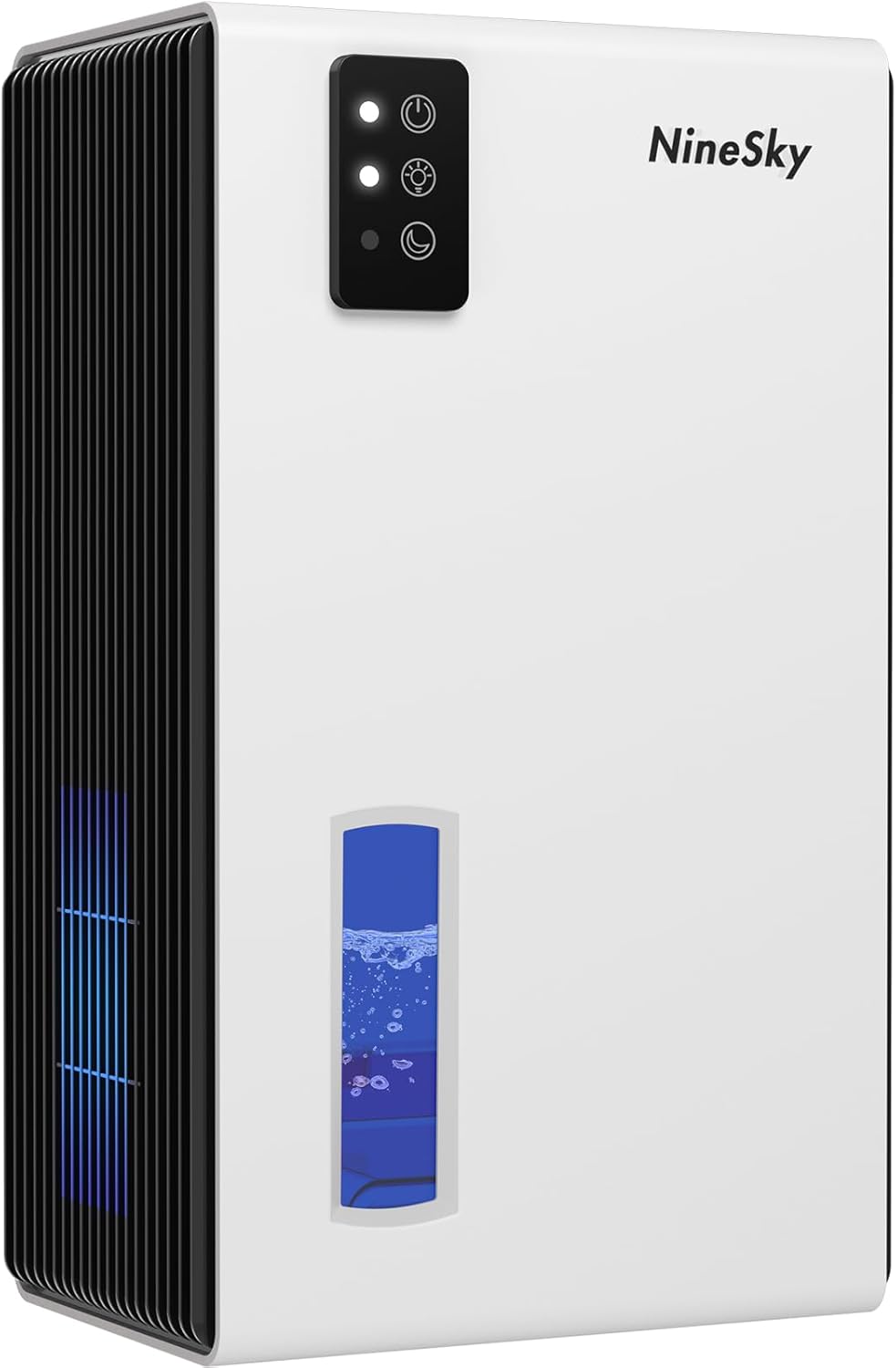
| Floor Area | 1000 square_feet |
|---|---|
| Tank Volume | 95 fluid ounces |
| Capacity | 5.9 pounds |
| Operation Mode | Automatic |
The NineSky CT2 is a compact, budget-focused dehumidifier aimed at controlling humidity in bedrooms, bathrooms, basements and similarly sized spaces. It uses semiconductor dehumidification and offers an automatic shutoff when the 95 oz tank is full or improperly seated, which helps avoid spills and makes unattended use safer. The unit has a high-speed setting for faster moisture removal and a night mode that reduces noise and turns off lights for sleeping areas. A 7-color ambient LED provides a soft night light and can be set to fixed or color-change modes. Practical benefits include a small footprint that fits near walls or on shelves and simple automatic operation for steady humidity control up to about 1,000 sq ft. Important limitations are its semiconductor technology, which is generally less efficient than compressor-based units for very large or very damp spaces, and the modest 5.9 lb daily capacity, so it will need more frequent emptying and will be slower in extreme humidity conditions.
Best for: Buyers who need an affordable, compact dehumidifier for everyday rooms and want quiet, automatic operation without complex setup.
Less Ideal for: Not a good choice for very damp basements or whole-house dehumidification where a higher-capacity compressor unit is needed.
- Automatic shutoff prevents overflows and allows safe unattended use
- Compact footprint fits in small rooms, closets, or near hardwood flooring
- Night mode and low-noise semiconductor operation make it suitable for bedrooms
- Large 95 oz tank reduces how often you need to empty it compared with very small units
- Simple controls and ambient LED provide convenient, user-friendly operation
- Semiconductor dehumidification is less energy-efficient and slower than compressor models in very humid conditions
- Daily capacity and performance are modest for very large rooms or basements
Verdict: A compact, budget-friendly dehumidifier that quietly protects hardwood floors and small rooms with easy automatic operation and a large 95 oz tank.
hOmeLabs 32-Pint Dehumidifier

| Dehumidification Capacity | 35 pints_per_day |
|---|---|
| Capacity | 1.8 gallons |
| Tank Volume | 1.6 gallons |
| Number of Speeds | 2 |
| Floor Area | 4500 square_feet |
This hOmeLabs unit is a straightforward, room‑scale dehumidifier built for large spaces like basements and open living areas. It removes up to 32 pints per day under typical conditions (and higher at very warm, humid extremes), and offers both a removable 1.6 gallon water tank with auto shutoff and a continuous drain outlet for hands‑free operation. The machine includes washable filter media, two fan speeds plus a TURBO mode for faster moisture removal, and smart features such as Wi‑Fi control and voice assistant compatibility so you can monitor and change humidity from your phone. Mobility is simple thanks to built‑in casters and a handle, and safety conveniences include automatic defrost and auto restart after power interruptions. Expect practical, reliable performance for basement humidity control, though it is a single‑hose portable unit so performance will vary with room layout and extreme cold conditions can reduce extraction rates. For buyers who want easy setup, remote control, and reliable daily dehumidification, this model covers the essentials without complex installation.
Best for: Buyers who want a reliable, easy‑to‑use dehumidifier for a basement or large room and value remote control, straightforward maintenance, and portability.
Less Ideal for: People seeking a hard‑plumbed or whole‑house solution or those who need maximum extraction in consistently cold spaces should consider other types of systems.
- Removes up to 32 pints per day with higher capacity at very high temperature and humidity
- Wi‑Fi control and compatibility with Alexa and Google Assistant for remote monitoring and adjustments
- Continuous drain option plus a removable tank with auto shutoff reduces manual emptying
- Washable air filter and caster wheels make maintenance and relocation simple
- Performance drops in cold environments since rated capacity is specified at warmer test conditions
- Only two fan speeds may limit fine control of noise versus extraction rate
Verdict: A portable, Wi‑Fi enabled dehumidifier that delivers dependable moisture removal and easy maintenance for large basements and open rooms.
BEDRED CT11 Dehumidifier

| Floor Area | 1000 square_feet |
|---|---|
| Tank Volume | 95 fluid ounces |
| Capacity | 5.9 pounds |
| Operation Mode | Intermittent |
| Other Special Features of the Product | 7 Color Ambient Light, Automatic Shutoff, Sleep Mode |
The BEDRED CT11 is a compact thermoelectric dehumidifier intended to reduce humidity in small spaces such as bedrooms, bathrooms, and modest basements up to about 1000 sq ft. It uses semiconductor cooling rather than a compressor, so it runs quietly and is simple to operate with an intermittent operation mode and an automatic shutoff when the 95 oz tank fills. Sleep Mode turns off the lights and lowers noise for overnight use, and the seven-color ambient light gives an optional mood-lighting feature. Practical benefits include easy emptying from the included tank, portability thanks to a lightweight design, and low sound levels that suit living spaces. Important limitations are inherent to semiconductor units: lower capacity compared with compressor dehumidifiers, reduced performance in very cold or very damp basements, and a smaller tank that requires more frequent emptying in high-humidity conditions.
Best for: Buyers who prioritize quiet, low-maintenance dehumidification and want a compact unit that is easy to move and run in living spaces or small basements without frequent intervention.
Less Ideal for: People needing heavy-duty moisture control for large, cold, or very damp basements should choose a higher-capacity compressor dehumidifier instead.
- Quiet thermoelectric operation suitable for bedrooms and living rooms
- Automatic shutoff protects against overfill and simplifies unattended use
- 95 oz removable tank for straightforward water removal
- Sleep Mode and ambient light options for low‑noise nighttime use
- Compact and lightweight for easy placement or moving between rooms
- Semiconductor cooling gives lower moisture removal capacity than compressor models
- Performance drops in cold basement conditions and very high humidity areas
Verdict: Choose the BEDRED CT11 if you want a quiet, portable dehumidifier with auto‑shutoff and sleep‑friendly operation for small basements or living spaces.
ToLife Dehumidifier TZ-C2

| Capacity | 95 fluid ounces |
|---|---|
| Floor Area | 1000 |
| Number of Speeds | 2 |
| Wattage | 93 watts |
| Air Flow Capacity | 95 liters per minute |
The ToLife TZ-C2 is a small, portable dehumidifier that uses thermoelectric condensation to quietly remove moisture from bedrooms, bathrooms, closets and other confined spaces. It offers two operating modes including a low-noise sleep setting and a higher-power mode for faster moisture removal, and it collects water in a removable 95 ounce tank with automatic shutoff when full. The unit also includes a seven-color ambient light you can lock for use as a night light and a carry handle for moving between rooms. Practical benefits include simple setup, quiet overnight operation under 30 dB in sleep mode, and the safety of automatic shutoff to prevent overflow. Important limitations are that the device is designed for small rooms and uses a compact thermoelectric system rather than compressor cooling, so it will be slower to dehumidify very damp spaces or maintain low humidity in large open areas and it requires manual tank emptying unless you set up continuous drainage separately.
Best for: Buyers who want a quiet, easy-to-use portable unit to control humidity in small rooms and protect sensitive flooring overnight or in limited spaces.
Less Ideal for: Homes with large, consistently damp basements or open-plan areas that need rapid moisture removal should choose a larger compressor dehumidifier instead.
- Large 95 oz removable tank with automatic shutoff for safe operation
- Quiet sleep mode suitable for overnight use (below 30 dB)
- Portable, lightweight design with handle for easy room-to-room use
- Two speed modes let you choose between quiet operation and faster dehumidifying
- Seven-color ambient light that can be locked for nightlight use
- Thermoelectric condensation system is less powerful than compressor models for very damp or large areas
- Requires periodic manual emptying of the tank unless a continuous drain option is used
- Rated coverage (1000 sq ft) may be optimistic for maintaining low humidity on hardwood in very humid conditions
Verdict: A quiet, portable option for small rooms that offers safe, overnight humidity control to help protect hardwood floors in confined spaces.
Choosing the Right Dehumidifier for Hardwood Floors: Key Factors to Consider
Humidity Setpoint Precision
Precise setpoint control matters because hardwood responds to relatively small swings in relative humidity. A dehumidifier with an accurate humidistat and small deadband prevents RH from oscillating widely, which reduces repeated expansion and contraction of boards.
Look for units that allow you to set a specific RH target or that maintain a narrow tolerance range. That level of control is especially important in mixed-use rooms where occupancy and HVAC operation cause frequent humidity shifts.
Moisture Removal at Room Temperatures
Homes with hardwood floors are typically within a moderate temperature range. Dehumidifiers vary in how effectively they remove moisture at those temperatures. A unit that lists capacity at typical indoor temperatures or performs well on low-temperature ratings will maintain control without overworking or cycling inefficiently.
Consider realistic daily moisture loads from cooking, bathing, and seasonal humidity. A dehumidifier that can handle typical household loads without running constantly will keep humidity stable while consuming less energy.
Airflow Direction and Velocity
Strong, focused airflow can dry one area and leave adjacent boards at a different moisture level, increasing differential movement and the risk of cupping. For hardwood floors, a dehumidifier that disperses air gently or directs airflow upward toward the ceiling encourages even mixing of room air and steadier moisture removal.
Consider placement options that avoid directing output across open floorboards. Units with adjustable louvers, vertical discharge, or more diffuse outlets are typically friendlier to hardwood surfaces.
Noise Level and Duty Cycle
Because maintaining a stable RH often requires running the unit for long stretches, noise becomes a practical factor. Louder machines are less likely to remain in living spaces, which can lead to moving them to less effective locations and worse humidity control.
Choose a model with a noise profile suitable for the intended room. Also evaluate how frequently the compressor cycles; smoother, longer cycles are usually better for maintaining even humidity than rapid short cycles.
Size, Placement Flexibility, and Aesthetics
The physical footprint and portability affect where you can place the dehumidifier relative to the floor area you want to protect. A bulky unit that blocks vents or sits against a baseboard can alter circulation and create microclimates.
Look for units with caster wheels or handles for easy relocation, and consider whether the height and outlet placement allow safe positioning away from direct floor contact and furniture.
Maintenance and Filter Access
Routine maintenance keeps a dehumidifier operating efficiently. Accessible filters and drain options reduce the chance of neglected filters that allow dust buildup and reduce airflow, which can force the unit to run harder and unevenly affect humidity across a room.
Evaluate how easy it is to empty a tank, connect a continuous drain, and reach the filter for cleaning. Lower maintenance friction means the unit will actually be kept in optimal condition, which benefits long-term floor health.
Where To Place a Dehumidifier Near Hardwood
Placement affects both performance and floor protection. Position the unit where it can exchange air freely without blowing directly across long runs of floorboard. Corner placement with upward discharge often yields gentle mixing without concentrated airflows.
Avoid setting the unit on top of finished flooring where condensation or drip risk exists. Use a small drip tray under the unit if the manufacturer's instructions allow, or position the dehumidifier on a thin protective mat that will not trap moisture against the floor.
- Keep intake and exhaust clear of walls and furniture by the recommended clearance.
- Place closer to the source of moisture for best results, but not directly against baseboards.
- Use continuous drain where practical to eliminate tank-emptying trips that might lead to spills.
Seasonal Use and Managing Relative Humidity
Target RH for most hardwood floors is typically in the 35 to 50 percent range, but the exact ideal depends on local climate and indoor comfort. In humid seasons you may need consistent dehumidification; in winter, heating can dry the air and require less aggressive control.
Adjust setpoints gradually during seasonal transitions to avoid sudden swings. Using a small network of accurate hygrometers around the home helps you spot microclimates where hardwood may be more vulnerable.
- Check humidity in closets and under beds where airflow is limited.
- Lower setpoints slowly when moving from humid to dry seasons to reduce stress on boards.
Continuous Drain Vs. Tank-Style Operation
For long-term humidity control on hardwood floors, continuous drain is often the most convenient option. It removes the need to empty the tank and reduces the chance of accidental spills that could damage finishes or seep into joints.
Tank-style units are fine for smaller rooms or occasional use, but they require disciplined emptying and careful handling to avoid drips. Whichever you choose, ensure the drain method suits your room layout and that hoses and fittings are routed safely away from floor seams.
- Use a gravity drain when the unit can be near a floor drain or sink.
- Consider a pump-assisted drain for basements or locations below drain level, ensuring the discharge path does not splash onto flooring.
Monitoring and Complementary Tools
Pair a dehumidifier with reliable hygrometers placed at multiple locations to monitor how evenly humidity is controlled. Small differences in RH across a room can matter for wide plank floors or areas with varied sun exposure.
In some cases, adding gentle ceiling fans or using HVAC circulation strategies can help blend air and reduce spots of higher humidity without increasing drying stress on the wood.
- Place a hygrometer near an exterior wall and another in the center of the room.
- Use circulation fans on low speed to help even out airflow when the dehumidifier is running.
Protecting Floors During Short-Term High Moisture Events
For events like heavy cooking, extended showering, or temporary high outdoor humidity, increase ventilation first and then run the dehumidifier to bring RH down steadily. Avoid immediately cranking the unit to maximum if it creates strong directional airflow across the floor.
If a spill or small water intrusion occurs, address standing water first and then use a dehumidifier in combination with fans to remove residual moisture. Rapid evaporation without proper humidity control can lead to uneven drying and stress.
- Remove standing water with absorbent towels before running a dehumidifier.
- Run the dehumidifier in a moderate, continuous mode until hygrometers show a consistent target RH.
How We Chose the Best Dehumidifier for Hardwood Floors
We prioritized units that combine accurate moisture control with gentle, floor-friendly operation. Primary evaluation criteria included humidity regulation precision, moisture-removal efficiency at typical indoor temperatures, and airflow design that avoids concentrated blasts over small floor areas. Noise level and runtime mattered because loud or constantly cycling units are unlikely to sit near living areas and therefore are less effective in continuous humidity control. Size and portability were reviewed to ensure units can be moved to problem spots and tucked away without blocking ventilation or creating localized drying. We also checked filter accessibility and serviceability to reduce dust accumulation on floors and to keep units operating efficiently. Exclusions: we excluded devices focused only on spot drying or construction-scale dehumidifiers designed for rapid flood removal; those are not suitable for long-term hardwood care. We filtered out units with poor low-temperature performance or imprecise humidistats, since hardwood benefits from steady RH control rather than on/off cycling that lets humidity drift. The final shortlist reflects equipment likely to preserve finished wood in occupied homes under normal seasonal humidity swings.
Our full evaluation process is outlined in our review methodology.
FAQ
What relative humidity should I maintain for hardwood floors?
Aim for about 35 to 50 percent RH for most hardwood installations. The exact ideal depends on species, finish, and local climate, but staying within that band reduces movement and mold risk.
Will a dehumidifier damage hardwood by drying it too fast?
A correctly sized unit set to a reasonable target will not dry floors too quickly. Rapid, localized airflow or aggressive setpoints can cause stress, so choose gentle airflow patterns and adjust the setpoint gradually.
Is continuous drain necessary for protecting hardwood?
Continuous drain is not strictly necessary but is convenient for long-term use and reduces the chance of tank spills. For consistent humidity control in occupied rooms, continuous drain simplifies maintenance.
Can I place a dehumidifier directly on hardwood?
It is best to avoid prolonged direct contact. Use a thin protective mat or place the unit where occasional drip risk is low. Ensure any drain hoses or condensate lines are routed to avoid water on the floor.
How often should I run a dehumidifier around hardwood floors?
Run the unit as needed to keep RH within your target range. In humid seasons it may run often or continuously; in dry winters it may rarely run. Monitor with hygrometers and adjust duty cycle based on measured conditions.
Final Verdict
Choose a dehumidifier that emphasizes steady humidity control, gentle airflow patterns, and practical placement options. Prioritize accurate humidistats and maintenance-friendly designs so the unit runs reliably over months and seasons without creating microclimates that stress wood. Balance moisture-removal capacity with noise and footprint to ensure the unit remains in the rooms that need protection. With the right setpoint, placement, and routine monitoring, a dehumidifier is an effective tool for preserving the condition and appearance of hardwood floors.