
Note: This article contains affiliate links. If you click on these links and make a purchase, we may earn a small commission at no extra cost to you. This helps support our research and content. Read our full affiliate disclosure here.
If you cultivate cannabis indoors, controlling humidity is one of the most important environmental tasks you manage. Too much moisture raises the risk of mold and bud rot; too little can stress plants and reduce resin production. The right dehumidifier helps you keep relative humidity in the target range for each growth stage, stabilizing your grow room so plants focus energy on yield and potency. This guide shortlists seven dehumidifiers that suit indoor cannabis cultivation setups, from small tents to larger dedicated rooms. We evaluated units for capacity, control accuracy, and reliability to help you pick a model that matches your grow size and environmental needs. Read on for the factors that matter and practical tips for placement and operation before the product list.
Top Picks at a Glance
| Best Overall The best all-around choice for most situations | MARS HYDRO MH-Dehumidifier 38‑Pint |  |
| Best Quality Built to a higher standard if you want something more solid | ALORAIR Sentinel HD55 |  |
| Best Value The sweet spot between price and what you get | KNKA 34-Pint Dehumidifier PD22SC-12 |  |
| Best Budget The cheapest option that still gets the job done reliably | BeOkay DH-A2 Dehumidifier |  |
| Top Rated A top-rated pick with lots of positive feedback | hOmeLabs 32-Pint Dehumidifier |  |
| Most Popular A crowd favorite that many people choose with confidence | TABYIK DH-CS01 35oz Dehumidifier |  |
| Best Seller A high-volume bestseller chosen again and again | BEDRED CT11 Dehumidifier |  |
MARS HYDRO MH-Dehumidifier 38‑Pint

| Dehumidification Capacity | 38 pints_per_day |
|---|---|
| Tank Volume | 2.1 liters |
| Floor Area | 215 square_feet |
| Operation Mode | Automatic |
The MARS HYDRO MH-Dehumidifier is a grow-tent oriented compressor unit that removes up to 38 pints (18 L) per day and can be vented through the included air duct to keep heat out of a grow space. It is typically placed just outside or beside small grow tents (3×3, 2×4, 4×4 ft) and controlled with the digital humidity and temperature display to set a target between 30 and 90 percent. The unit offers auto mode so it cycles on and off to hold the setpoint, an internal 2.1 L tank with full-tank auto-shutoff and drain hose option for continuous operation, and a washable dust filter for low-cost maintenance. Built-in handles and caster wheels make repositioning easy during setup. Trade-offs to expect are its compressor-style noise and the footprint for small rooms, and while it advertises energy efficiency, compressor units still use more power than small desiccant models when running heavily in humid climates.
Best for: Growers who want a purpose-built dehumidifier for small grow tents and prefer a device that can be vented outside the tent to avoid adding heat while maintaining precise humidity control.
Less Ideal for: People needing an ultra-quiet or ultra-compact dehumidifier for living spaces where compressor noise or footprint is a primary concern.
- High dehumidification capacity rated at 38 pints (18 L) per day suitable for small grow tents
- Air duct and drain hose included for external placement and continuous drainage
- Digital humidity and temperature display with adjustable setpoint and automatic mode for hands-free control
- Removable washable filter reduces ongoing filter replacement costs
- Portable design with handles and caster wheels for easy placement
- Compressor dehumidifiers produce noticeable operating noise compared with desiccant units
- 2.1 L internal tank is relatively small if not using the continuous drain option
Verdict: A high-capacity, grow-focused compressor dehumidifier with ducting and auto humidity control that keeps tent humidity stable without introducing heat into the grow space.
ALORAIR Sentinel HD55
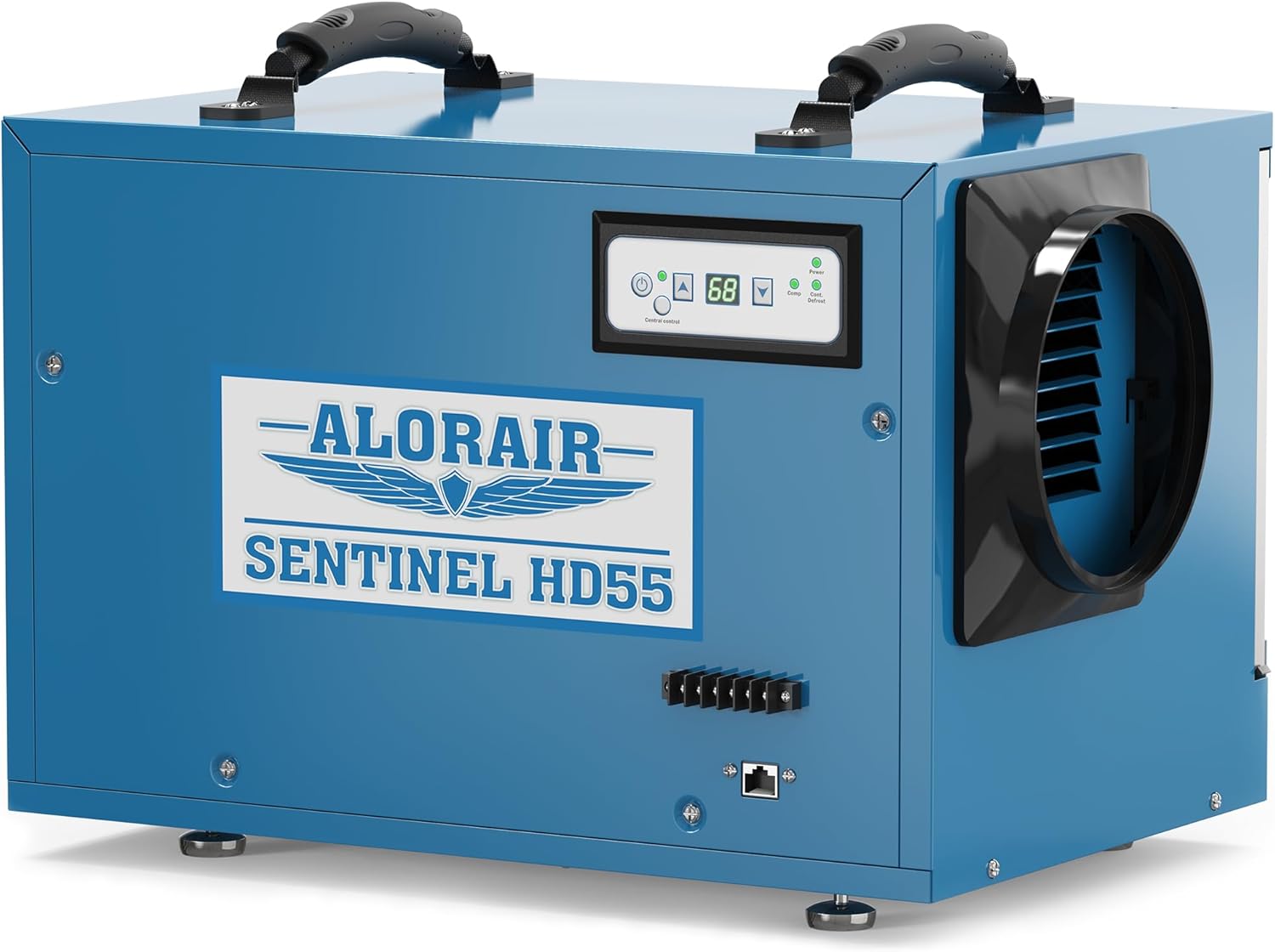
| Capacity | 113 pints |
|---|---|
| AHAM Dehumidification | 53 pints per day |
| Coverage | 1200 square_feet |
| Air Flow Capacity | 120 cfm |
| Wattage | 460 watt-hours |
The ALORAIR Sentinel HD55 is a compact, metal-bodied dehumidifier built for heavy-duty use in crawlspaces, basements, and other confined commercial areas. It removes up to 113 pints per day at saturation (53 PPD AHAM), moves air at 120 CFM, and is intended to control humidity across spaces up to about 1,200 square feet. The unit runs continuously with an automatic defrost cycle to prevent icing at low temperatures and uses a MERV-1 service filter to keep internals cleaner. It has no internal water tank and supports gravity drainage for unattended operation, which makes it suitable for running long periods. Practical benefits include a rugged housing and a compact footprint that is easy to carry between jobs, plus cETL listing and extended warranty coverage on refrigeration components. Limitations are that it is a commercial-style unit with basic filtration and no built-in pump or advanced digital controls on the base model, so you may need optional accessories for remote control, hanging, or ducting depending on installation and drainage needs.
Best for: Buyers focused on strong, consistent moisture removal who need a durable, compact commercial-style dehumidifier for crawlspaces, basements, or small grow rooms and prioritize continuous unattended operation.
Less Ideal for: People who need whisper-quiet residential units with advanced air filtration, integrated pump-driven drainage, or built-in smart controls should consider other models.
- High removal capacity up to 113 PPD at saturation for rapid humidity reduction
- Continuous operation with automatic defrost for reliable low-temperature performance
- Metal housing and compact design built for rugged, on-site use
- Gravity drain eliminates the need to empty a tank for unattended running
- cETL listed with multi-year parts coverage on refrigeration components
- Base model lacks a built-in condensate pump, requiring a gravity drain or separate pump for uphill discharge
- Filter is basic MERV-1, so it does not provide fine particulate filtration
- No advanced built-in remote or smart controls on the non-WiFi version
Verdict: Choose the Sentinel HD55 when you need a compact, commercial-grade dehumidifier that reliably removes large volumes of moisture for continuous unattended operation.
KNKA 34-Pint Dehumidifier PD22SC-12

| Dehumidification Capacity | 34 pints/day |
|---|---|
| Floor Area | 2500 square_feet |
| Tank Volume | 3 liters |
| Wattage | 230 watts |
| Number of Speeds | 2 |
This KNKA 34‑pint dehumidifier is a compact, portable unit aimed at controlling humidity in damp spaces and can work well in a small grow room or tent when sized appropriately. It offers three operating modes — automatic humidity control (DEHU), a quick DRY setting for clothes or fast moisture removal, and CONT for continuous operation — plus two fan speeds and a digital display with a color LED humidity indicator. Practical touches include a 0.79 gal internal tank with auto shutoff, an included 1 m drain hose for continuous drainage, washable filter, caster wheels, and a child lock. The unit is relatively quiet at about 37 dB so it will not overpower a small grow space. Important limitations: the 34‑pint rating is measured at high temperature and humidity (95°F/90% RH), so expect lower real‑world removal in cooler grow rooms; the built‑in tank is small so continuous drain or an external tank is recommended for unattended runs. For growers who prioritize straightforward humidity control in a compact footprint, this unit delivers practical features without complexity.
Best for: Growers who prioritize reliable, simple humidity control in a small to medium grow room and who plan to use continuous drain or occasional monitoring rather than large industrial setups.
Less Ideal for: Large commercial grows, very cool grow rooms, or setups that need high daily extraction without a permanent continuous drain or external reservoir.
- Provides multiple modes including automatic humidity control, quick dry, and continuous operation for flexible use
- Includes drain hose and supports continuous draining to avoid frequent emptying during unattended runs
- Relatively quiet operation around 37 dB, suitable for noise‑sensitive grow spaces
- Portable design with 360° wheels, handle, and washable filter for easy placement and maintenance
- 34‑pint capacity is rated at 95°F/90% RH so actual daily removal will be lower in typical grow room conditions
- Internal tank is small, making external drainage or a larger external tank necessary for extended unattended use
Verdict: A compact, quiet 34‑pint unit with smart controls and continuous drain support that fits growers needing reliable humidity management in small to medium spaces.
BeOkay DH-A2 Dehumidifier

| Floor Area | 230 square_feet |
|---|---|
| Capacity | 1657 ml |
| Number of Speeds | 3 |
| Wattage | 28 watts |
| Dehumidification Capacity | 0.3 liters_per_day |
The BeOkay DH-A2 is a small, low-power dehumidifier intended for enclosed spaces like bedrooms, bathrooms, or small grow areas up to about 230 sq ft. It uses a semiconductor refrigeration system with a 1657 ml removable tank and offers three fan/mode settings including a quiet sleep mode that keeps noise under 40 dB, plus a continuous performance mode for faster moisture removal. Practical features include auto shutoff when the tank is full or if the unit is tilted, a defrost routine to maintain operation in cooler conditions, and five timer options (24–96 hours or continuous) so you can schedule runs without constant monitoring. The RGB mood light and simple controls make it easy to operate, and the 28 W power draw keeps electricity use low. Limitations are its modest daily dehumidification rate, so it will not rapidly dry large or very humid grow rooms and is best for small tents or single-cabinet setups where gentle, continuous humidity control is acceptable.
Best for: Growers running a single small tent, cabinet, or micro-grow who need an inexpensive, low-power unit to reduce baseline humidity without high extraction rates and who prioritize quiet, low-maintenance operation.
Less Ideal for: People running multi-plant rooms, large tents, or environments with heavy humidity loads that require fast, high-capacity moisture removal should choose a higher-capacity compressor dehumidifier instead.
- Large 1657 ml removable tank reduces emptying frequency
- Low power consumption at 28 watts for economical continuous use
- Quiet sleep mode that operates under 40 dB for night use
- Auto shutoff and tilt protection prevent overflow and accidents
- Multiple timers and three operating modes allow simple scheduling
- Very low listed dehumidification capacity makes it unsuitable for quickly drying high-humidity spaces
- Designed for small areas only, so multiple units would be needed for larger grow tents
- Semiconductor-based system generally offers less extraction efficiency than compressor units
Verdict: A budget-friendly, low-power dehumidifier best used to maintain modest humidity control in single small grow tents or cabinets.
hOmeLabs 32-Pint Dehumidifier

| Dehumidification Capacity | 35 pints_per_day |
|---|---|
| Capacity | 1.8 gallons |
| Tank Volume | 1.6 gallons |
| Number of Speeds | 2 |
| Floor Area | 4500 square_feet |
This hOmeLabs unit is a straightforward, room‑scale dehumidifier built for large spaces like basements and open living areas. It removes up to 32 pints per day under typical conditions (and higher at very warm, humid extremes), and offers both a removable 1.6 gallon water tank with auto shutoff and a continuous drain outlet for hands‑free operation. The machine includes washable filter media, two fan speeds plus a TURBO mode for faster moisture removal, and smart features such as Wi‑Fi control and voice assistant compatibility so you can monitor and change humidity from your phone. Mobility is simple thanks to built‑in casters and a handle, and safety conveniences include automatic defrost and auto restart after power interruptions. Expect practical, reliable performance for basement humidity control, though it is a single‑hose portable unit so performance will vary with room layout and extreme cold conditions can reduce extraction rates. For buyers who want easy setup, remote control, and reliable daily dehumidification, this model covers the essentials without complex installation.
Best for: Buyers who want a reliable, easy‑to‑use dehumidifier for a basement or large room and value remote control, straightforward maintenance, and portability.
Less Ideal for: People seeking a hard‑plumbed or whole‑house solution or those who need maximum extraction in consistently cold spaces should consider other types of systems.
- Removes up to 32 pints per day with higher capacity at very high temperature and humidity
- Wi‑Fi control and compatibility with Alexa and Google Assistant for remote monitoring and adjustments
- Continuous drain option plus a removable tank with auto shutoff reduces manual emptying
- Washable air filter and caster wheels make maintenance and relocation simple
- Performance drops in cold environments since rated capacity is specified at warmer test conditions
- Only two fan speeds may limit fine control of noise versus extraction rate
Verdict: A portable, Wi‑Fi enabled dehumidifier that delivers dependable moisture removal and easy maintenance for large basements and open rooms.
TABYIK DH-CS01 35oz Dehumidifier

| Tank Volume | 1000 ml |
|---|---|
| Dehumidification Capacity | 0.45 liters_per_day |
| Wattage | 40 watts |
| Operation Mode | Continuous |
| Floor Area | 280 square_feet |
The TABYIK DH-CS01 is a small Peltier-style dehumidifier built for tight, humid spaces like small grow tents, closets, or bathrooms. It runs continuously on a single-speed setting and collects up to about 16 oz (450 ml) per day under warm, very humid conditions while drawing roughly 40 watts, so it can nudge down humidity in contained micro-environments rather than whole rooms. The unit is easy to use: one button starts operation and a separate light button cycles seven ambient colors, and the 35 oz transparent tank is simple to remove and empty. Safety features include automatic shutoff when the tank reaches about 700–800 ml and a flashing red light indicator. Expect near-silent operation at about 28 dB, which helps keep a stealthy grow setup quiet. Limitations are clear: it has a single speed and modest daily extraction rate, so it is best for small tents or as a supplemental device rather than primary moisture control for larger or heavily transpiring grows.
Best for: Growers running a compact tent, closet, or a single small chamber who prioritize quiet, low-power humidity control and want a simple, low-maintenance unit to reduce surface moisture.
Less Ideal for: Do not choose this if you manage multiple plants in a medium or large tent, a multi-tent room, or need rapid humidity reduction during high-transpiration stages.
- Compact footprint and built-in handle make it easy to place inside small grow tents or closets
- Very quiet operation (~28 dB) keeps noise low for discreet setups
- Transparent 35 oz tank with auto shutoff simplifies monitoring and maintenance
- Low power draw (~40 W) suitable for continuous use on small circuits
- Low dehumidification capacity (about 0.45 liters/day) limits usefulness in larger or high-transpiration grows
- Single-speed, Peltier technology performs slower than compressor units in cooler or larger spaces
Verdict: A quiet, low-power dehumidifier that works well as a simple humidity reducer for single small grow spaces but not as the main solution for larger or high-demand grows.
BEDRED CT11 Dehumidifier

| Floor Area | 1000 square_feet |
|---|---|
| Tank Volume | 95 fluid ounces |
| Capacity | 5.9 pounds |
| Operation Mode | Intermittent |
| Other Special Features of the Product | 7 Color Ambient Light, Automatic Shutoff, Sleep Mode |
The BEDRED CT11 is a compact thermoelectric dehumidifier intended to reduce humidity in small spaces such as bedrooms, bathrooms, and modest basements up to about 1000 sq ft. It uses semiconductor cooling rather than a compressor, so it runs quietly and is simple to operate with an intermittent operation mode and an automatic shutoff when the 95 oz tank fills. Sleep Mode turns off the lights and lowers noise for overnight use, and the seven-color ambient light gives an optional mood-lighting feature. Practical benefits include easy emptying from the included tank, portability thanks to a lightweight design, and low sound levels that suit living spaces. Important limitations are inherent to semiconductor units: lower capacity compared with compressor dehumidifiers, reduced performance in very cold or very damp basements, and a smaller tank that requires more frequent emptying in high-humidity conditions.
Best for: Buyers who prioritize quiet, low-maintenance dehumidification and want a compact unit that is easy to move and run in living spaces or small basements without frequent intervention.
Less Ideal for: People needing heavy-duty moisture control for large, cold, or very damp basements should choose a higher-capacity compressor dehumidifier instead.
- Quiet thermoelectric operation suitable for bedrooms and living rooms
- Automatic shutoff protects against overfill and simplifies unattended use
- 95 oz removable tank for straightforward water removal
- Sleep Mode and ambient light options for low‑noise nighttime use
- Compact and lightweight for easy placement or moving between rooms
- Semiconductor cooling gives lower moisture removal capacity than compressor models
- Performance drops in cold basement conditions and very high humidity areas
Verdict: Choose the BEDRED CT11 if you want a quiet, portable dehumidifier with auto‑shutoff and sleep‑friendly operation for small basements or living spaces.
Choosing the Right Dehumidifier for Growing Weed: Key Factors to Consider
Capacity Vs. Grow Space Size
Capacity determines how much water the unit can remove per day, and matching capacity to your grow room volume and transpiration load is essential. Plants release significant moisture during lights-on periods, so choose a unit with extra headroom rather than one that only barely meets calculated needs. Undersized dehumidifiers run constantly and struggle to hold setpoints, increasing wear and power draw.
Also consider seasonal and environmental variability. If you ventilate with humid outside air or run supplemental fogging or misting, those additions will raise load and require a higher-capacity unit. For modest tents, small-capacity units may suffice, while multi-light rooms usually need mid- to high-capacity equipment.
Dehumidification Performance at Grow Temperatures
Dehumidifier ratings are usually given at a standardized temperature, but grow rooms often run warmer than home living spaces. Performance falls off as ambient temperature changes, so check how effectively a unit removes moisture at the temperatures and humidity levels you expect. A unit that performs well at 80 F will behave differently at 65 F or 90 F.
Reliable performance across the typical temperature range for plant growth means more stable control and less manual intervention. Look for manufacturer data or independent tests showing capacity curves or performance at multiple temperatures when available.
Accuracy and Control Options
Maintaining the right relative humidity for each growth stage is critical. Dehumidifiers with precise digital humidistats and adjustable setpoints make it easier to hit target ranges for veg and flower. Coarse or slow-reacting controls can lead to swings that increase mold risk or plant stress.
Controls that accept external humidity probes or integrate with environmental controllers add flexibility for growers using multiple sensors or automation platforms. Timers, hygrostat hysteresis settings, and programmable setback features also help tailor operation to your daily light and ventilation cycles.
Condensate Management and Drainage
Continuous operation is often necessary in cultivation, so condensate handling matters. Units with built-in pumps or gravity/drain connections allow for unattended draining, which is essential if the unit is in a sealed tent or on a higher shelf. Small internal reservoirs require frequent emptying and are impractical for continuous-use scenarios.
Also consider filter access and how condensate affects maintenance. Poor drainage design can promote microbial growth or leaks. Hard plumbing options and reliable pump designs reduce maintenance and keep the grow environment clean and stable.
Durability and Serviceability
Grow rooms run equipment for long stretches, especially during flowering. Components such as compressors, fan motors, coils, and controls should be robust and serviceable. Units designed for prolonged operation use heavier-duty fans and compressors and may offer replaceable parts or clear service documentation.
Check for accessible filters and coil designs that are straightforward to clean without dismantling the unit. Corrosion-resistant coatings and protective features for electrical components increase longevity in humid environments.
Energy Use and Operating Costs
Dehumidifiers can add meaningful electrical load to a grow operation. Look at the energy consumption relative to moisture removal capacity to estimate running cost per pint or liter of water removed. Energy-efficient units reduce long-term operating expenses and lower heat output for a given dehumidification rate.
Factor in duty cycle too. A higher-capacity, more efficient unit that cycles less frequently can be cheaper to operate than a smaller, constantly running unit. Also plan for ventilation and cooling interplay, since dehumidifiers can influence indoor temperature and may increase HVAC or fan runtime.
Ideal Humidity Ranges for Each Growth Stage
Different stages of cannabis cultivation have distinct humidity targets. Seedlings and early veg benefit from higher relative humidity to support transpiration and root development, while late veg and especially flowering need progressively lower humidity to reduce mold and bud rot risk. Maintaining consistent ranges limits plant stress and helps biochemical processes that contribute to bud density and terpene retention.
- Seedlings: 65–70% RH to encourage root establishment
- Vegetative: 55–65% RH for vigorous growth
- Flowering: 40–50% RH to minimize mold and encourage resin production
- Late flower (final weeks): 40–45% RH to protect dense buds and reduce rot risk
Placement and Airflow Tips
Where you place a dehumidifier affects its efficiency and the uniformity of humidity in the canopy. Position the unit so air intake and exhaust are not obstructed and so it draws air representative of the canopy environment, not dead zones near walls or under benches. Aim for airflow that moves moisture away from dense canopy pockets where bud rot can start.
Proper circulation reduces humidity stratification. Use exhaust fans and circulation fans to move air evenly across the room and through the dehumidifier. Avoid placing the unit too close to plants; direct exhaust can dry foliage unevenly and cause microclimate pockets that complicate sensor readings.
- Keep intake clear of soil and debris
- Point exhaust to avoid concentrating dry air on one section of canopy
- Use an inline duct or flexible hose for tent setups to direct airflow where needed
Integration With Environmental Controllers
Many growers use environmental controllers that manage temperature, CO2, lights, and humidity as a system. Choose a dehumidifier that accepts basic control inputs, external humidity sensors, or an on/off trigger for automated setups. Integration enables coordinated control strategies, such as reducing dehumidification during cool dark periods or ramping up during peak transpiration.
When integrating, verify hysteresis settings and response times to prevent rapid cycling of the dehumidifier or other equipment. Some growers prefer to have the controller manage the dehumidifier directly rather than relying on the unit's internal humidistat for finer ecosystem tuning.
- Look for units with external probe compatibility
- Confirm control voltage or relay requirements for your controller
- Test combined response to avoid overlapping control actions
Maintenance Best Practices
Routine maintenance keeps performance high and reduces the chance of failures at critical times. Regularly clean or replace filters, inspect coils for dust and biofilm buildup, and ensure condensate lines are clear. In humid environments, coils can accumulate residues that reduce heat-exchange efficiency and capacity.
Schedule basic checks before flowering and more frequently if you see humidity control drift. Keep spare filters and review manufacturer guidance for seal and component inspection intervals. Properly maintaining the unit reduces downtime risk during the most sensitive crop stages.
- Clean intake filters monthly in dusty environments
- Inspect and clean coils seasonally or more often if needed
- Check pump operation and drain lines before long continuous runs
How We Chose the Best Dehumidifier for Growing Weed
We focused on features and performance that directly affect indoor cannabis cultivation. Selection began with units sized for indoor horticulture use and excluded consumer-only units intended for whole-house dehumidification that cannot target smaller grow spaces. We prioritized reliable moisture removal, precise humidity control, and components that hold up to continuous operation under warm, humid conditions. Key evaluation criteria included: capacity at elevated temperatures, humidity control accuracy and setpoint range, continuous-drain and condensate management options, energy efficiency under load, durability of refrigeration and fans for extended run times, and noise and vibration characteristics that matter in enclosed grow spaces. We also considered controls and connectivity for growers who use controllers or environmental automation. Products were excluded if they lacked clear performance data at horticultural temperatures, had poor condensate handling for continuous runs, or used components not rated for sustained operation in warm, humid environments. The resulting list represents units that balance capacity, control, and uptime for small to mid-size cultivation setups.
Our full evaluation process is outlined in our review methodology.
FAQ
What relative humidity should I target during flowering?
Flowering typically requires lower humidity than veg. Aim for about 40 to 50 percent relative humidity during most of flower, dropping slightly in the last weeks to reduce mold risk. Exact setpoints depend on cultivar and canopy density.
Can I use a small home dehumidifier in a tent?
Small consumer units can work for very small tents if their capacity exceeds the expected transpiration and ventilation load. However, many small units lack continuous-drain or pump options needed for unattended runs and may be undersized for multi-plant tents.
How often should I run the dehumidifier during lights-off periods?
It depends on your environmental setup and how humidity swings overnight. Some growers reduce dehumidification during lights-off to avoid over-drying if temperatures drop. Using a controller or external sensor helps manage night cycles without constant manual adjustment.
Does running a dehumidifier raise room temperature?
Dehumidifiers release heat as they remove moisture, so they can raise ambient temperature slightly. The net effect depends on unit efficiency and room ventilation. In tightly controlled rooms, factor this heat output into your cooling strategy.
Is an internal pump necessary for a grow dehumidifier?
Internal pumps or reliable gravity/drain options are highly recommended for unattended cultivation. Small tanks require frequent emptying and increase maintenance burden, while pumps simplify continuous operation especially when the unit sits above a drain point.
Final Verdict
Choosing the right dehumidifier for cannabis cultivation comes down to matching capacity to your room and ensuring precise, reliable humidity control. Prioritize units that maintain capacity at grow temperatures, offer tight setpoint control or external sensor compatibility, and provide practical condensate handling for continuous operation. Balance energy use and noise against run-time needs and room size. With a properly sized, well-maintained dehumidifier integrated into your environmental controls, you reduce mold risk and create steadier conditions that support healthier plants and better-quality flower.