
Note: This article contains affiliate links. If you click on these links and make a purchase, we may earn a small commission at no extra cost to you. This helps support our research and content. Read our full affiliate disclosure here.
If you store, live in, or travel with an RV, controlling indoor humidity is essential to prevent musty odors, condensation, and mold. A compact dehumidifier designed for mobile use keeps fabrics, cabinetry, and electronics dry without overtaxing limited onboard power or space. This guide presents a short list of top picks suited to RV environments, each chosen for real-world considerations such as capacity, runoff options, and ease of use in confined, sometimes-moving spaces. Below we summarize what matters when selecting a dehumidifier for RVs and explain the criteria used to shortlist these seven options, so you can pick the most practical unit for your rig and usage pattern.
Top Picks at a Glance
| Best Overall The best all-around choice for most situations | Aiusevo AS280 21-Pint Dehumidifier |  |
| Best Quality Built to a higher standard if you want something more solid | GoGuess YC3 34-Pint Dehumidifier |  |
| Best Value The sweet spot between price and what you get | TABYIK 35OZ Dehumidifier DH-CS01 |  |
| Best Budget The cheapest option that still gets the job done reliably | Camco Moisture Absorber 44280 |  |
| Top Rated A top-rated pick with lots of positive feedback | KeepGlad RX02-B Dehumidifier |  |
| Most Popular A crowd favorite that many people choose with confidence | Pro Breeze PB-02 Mini Dehumidifier |  |
| Best Seller A high-volume bestseller chosen again and again | ToLife Dehumidifier TZ-C2 |  |
Aiusevo AS280 21-Pint Dehumidifier

| Dehumidification Capacity | 21 pints_per_day |
|---|---|
| Floor Area | 1500 square_feet |
| Tank Volume | 0.52 gallons |
| Wattage | 120 watts |
| Operation Mode | Dehumidify Mode, Dry Mode, Continuous Mode |
The Aiusevo AS280 is a small, portable dehumidifier designed to manage humidity in spaces up to about 1500 sq ft and is suitable for tighter environments like RVs and small basements. It removes up to 21 pints per day (measured at lab conditions) and offers three operating modes — dehumidify with settable humidity, dry for quicker moisture removal, and continuous run — plus two fan speeds. Practical touches include a 2 liter removable tank with full-water auto shutoff, an included 3.28 ft drain hose for gravity drainage, a digital control panel with timer and child lock, and caster wheels and handles for easy moving. Energy draw is modest at 120 watts, and the unit has auto defrost and restart features for reliability. Limitations are the small tank capacity relative to its daily removal rating and the relatively compact airflow for very damp, large RVs or long-term continuous use where a pumped or higher-capacity commercial unit would be better suited.
Best for: Buyers who want a portable, user-friendly dehumidifier that can be moved around an RV or small living area and provides selectable modes and automatic humidity control for regular moisture management.
Less Ideal for: People needing a heavy-duty, pumped dehumidifier for large commercial basements, crawl spaces, or continually waterlogged areas should choose a higher-capacity model with a condensate pump.
- Removes up to 21 pints per day for faster damp control in enclosed spaces
- Three modes (Dehu, Dry, Continuous) plus two fan speeds for flexible use
- Includes 3.28 ft drain hose and automatic shutoff for hands-off continuous draining
- Compact, portable design with handles and caster wheels for easy repositioning in an RV
- Digital controls with timer and child lock simplify setting target humidity
- 2 liter water tank is small compared with the unit's daily removal capacity so using the drain hose is advisable for heavy humidity
- Not a high-capacity commercial unit so it may struggle in very large or extremely damp spaces
Verdict: A portable, easy-to-use 21-pint dehumidifier that fits RV owners who need flexible modes, continuous drain capability, and simple digital controls for everyday moisture control.
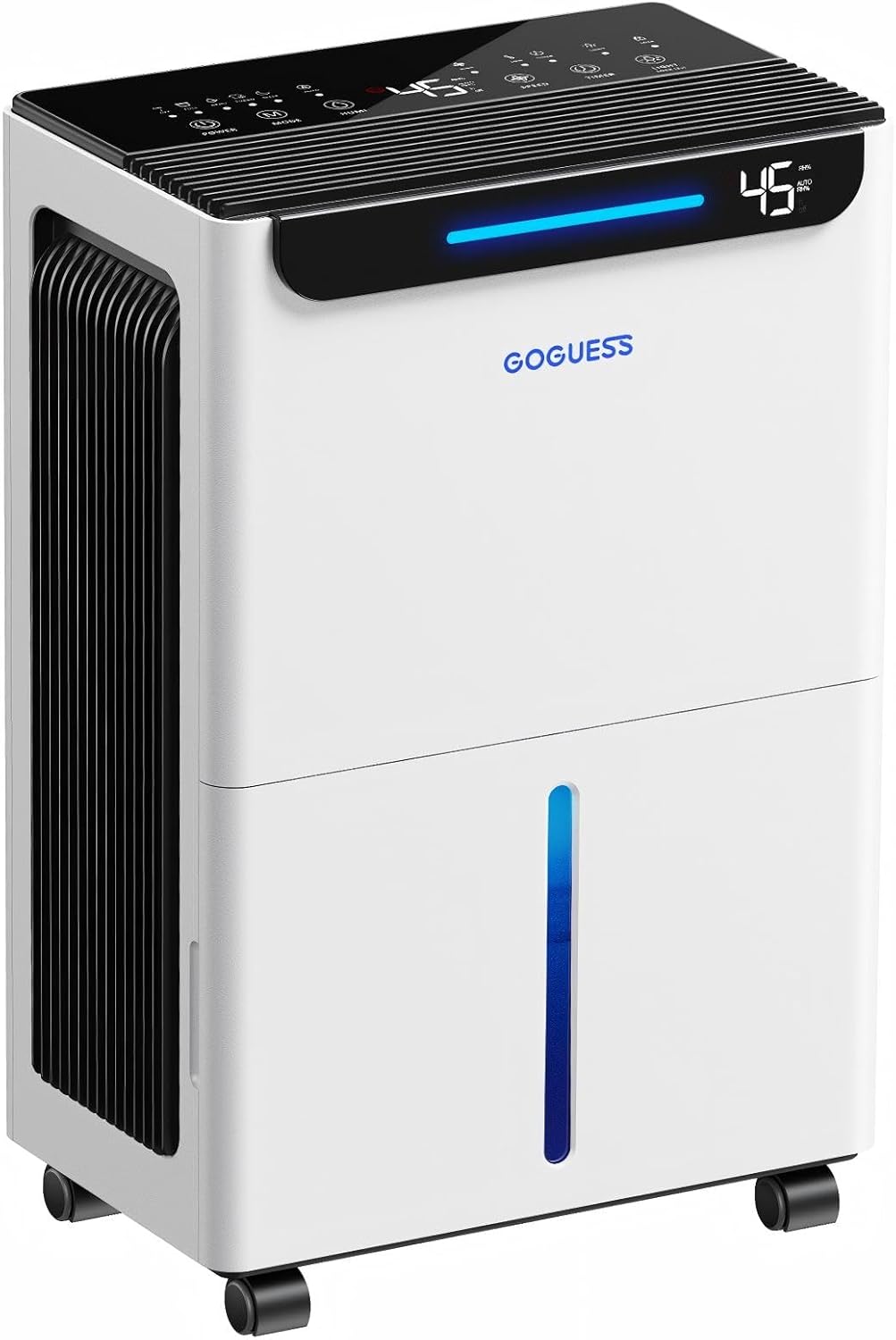
GoGuess YC3 34-Pint Dehumidifier
| Dehumidification Capacity | 34 pints_per_day |
|---|---|
| Capacity | 34 pints |
| Tank Volume | 2.3 liters |
| Number of Speeds | 3 |
| Wattage | 75 watts |
The GoGuess YC3 is a compressor dehumidifier built to remove up to 34 pints of moisture per day and manage humidity in larger spaces such as basements, garages, and RVs with high dampness. It offers three operation modes (DEHU, Turbo, Sleep), adjustable humidity from 30% to 80%, and a digital display with a color-changing humidity indicator for quick status checks. Practical features include a 2.3 L tank with automatic shutoff, a 3.28 ft drain hose for continuous drainage, a washable filter, child lock, timer, and automatic defrost and restart protections. At about 40 dB in normal use and a dedicated sleep mode that dims the display, it is reasonably quiet for overnight operation. The unit runs at 75 watts, so it provides strong moisture removal without the power draw of larger commercial units, but being a compressor model it is best used where ambient temperatures stay moderate; performance will drop in very cold environments. The YC3 is portable and user-friendly, though its size is meant for larger spaces rather than tiny cabin-only use in an RV.
Best for: Buyers who prioritize strong, fast moisture removal in larger RVs, garages, or basements and want straightforward controls and continuous-drain capability for long unattended runs.
Less Ideal for: People needing a lightweight, very low-temperature solution for cold storage or tiny RV closets should consider specialized low-temperature or desiccant dehumidifiers instead.
- High dehumidification capacity rated at 34 pints per day for rapid moisture removal
- Adjustable humidity control (30%–80%) and multiple modes for tailored operation
- Continuous drain option with included hose for unattended use
- Relatively quiet operation (~40 dB) and a sleep mode that dims the display
- Safety features including auto-defrost, auto-restart, full-tank shutoff, and child lock
- Compressor-based units lose efficiency in very low ambient temperatures and are heavier than evaporative alternatives
- Tank volume is 2.3 L, so frequent emptying is needed if continuous drainage is not used
Verdict: Choose the GoGuess YC3 if you need a robust, easy-to-use 34-pint unit that can run unattended with continuous drainage for high-moisture RV or large-space applications.
TABYIK 35OZ Dehumidifier DH-CS01

| Tank Volume | 1000 ml |
|---|---|
| Dehumidification Capacity | 0.45 liters_per_day |
| Wattage | 40 watts |
| Number of Speeds | 1 |
| Operation Mode | Continuous |
This compact TABYIK DH-CS01 is a small Peltier dehumidifier intended for enclosed small spaces and on-the-go use like RVs and bathrooms. It pulls moisture from the air and stores it in a transparent 35 oz (1000 ml) tank, with the manufacturer stating a maximum collection of about 16 oz (450 ml) per 24 hours under warm, very humid conditions. The unit uses a single-speed, continuous operation mode at low power (about 40 W), offers an auto shutoff when the tank is nearly full, and has a seven-color light with a separate control for ambient lighting. Practical benefits include very quiet operation around 28 dB, a built-in handle for portability, and a removable tank that is easy to empty and clean. Limitations are its modest daily capacity and single fan speed, so it is best for small, confined areas rather than whole RV cabins in very damp climates, and Peltier-style cooling is less effective than compressor models in cooler conditions.
Best for: Buyers who prioritize a quiet, energy-efficient, easy-to-carry dehumidifier for small enclosed spaces like RVs, bathrooms, or closets and want simple plug-and-play operation.
Less Ideal for: People needing rapid moisture removal for large or very damp spaces or those who require adjustable humidity setpoints and higher-capacity compressor models.
- Large transparent 35 oz tank that is easy to remove and clean
- Auto shutoff protects against overflow and indicates full tank with a flashing light
- Ultra-quiet 28 dB operation suitable for sleeping areas and RV use
- Low power draw (about 40 W) makes it energy efficient for continuous use
- Compact, lightweight design with a built-in handle for easy portability
- Maximum dehumidification listed is about 16 oz/day which is low compared with compressor dehumidifiers
- Only one speed setting limits control over airflow and drying rate
Verdict: A very quiet, energy‑light portable dehumidifier that is ideal for keeping small RV spaces and bathrooms mildly drier without noise or fuss.
Camco Moisture Absorber 44280

| Floor Area | 100 square_feet |
|---|---|
| Capacity | 297.67 g |
| Tank Volume | 10 liters |
| Operation Mode | Continuous |
The Camco Moisture Absorber 44280 is a simple, non-electric dehumidifier that uses moisture-absorbing media and lavender-scented beads to trap humidity and leave a light fragrance. It is intended for small, confined areas such as RV compartments, closets, bathrooms, or under sinks where you need low-effort humidity control without power. The unit claims to absorb up to three times its weight in water and is designed to be safely emptied and refilled with Camco refill bags, making it a reusable option over disposable packs. Its continuous operation mode and automatic moisture removal mean you can set it and forget it, although it requires periodic monitoring and refilling. Because it has no fan or compressor, it is quiet and maintenance is limited to replacing or refilling the media. The main limitations are slower moisture removal compared with powered dehumidifiers and limited coverage suited to small spaces, so it is not ideal as the sole solution for very damp or large areas in an RV.
Best for: Buyers looking for a low-cost, low-maintenance way to control humidity in small RV spaces who prefer a quiet, non-electric solution.
Less Ideal for: Travelers dealing with widespread dampness, leaks, or large RV interiors that need active, faster moisture removal should choose a powered dehumidifier instead.
- Works without electricity so it can be used anywhere in an RV
- Lavender-scented beads help keep small spaces smelling fresh
- Refillable design lets you reuse the container with Camco refill bags
- Absorbs a substantial amount of moisture relative to its size
- Not as fast or powerful as a powered dehumidifier for very damp spaces
- Coverage is limited to small, confined areas and not suitable for whole-RV dehumidification
Verdict: A budget-friendly, refillable moisture absorber that provides quiet, no-power humidity control for small RV spaces.
KeepGlad RX02-B Dehumidifier

| Floor Area | 1000 square_feet |
|---|---|
| Capacity | 98 fluid ounces |
| Number of Speeds | 3 |
| Wattage | 90 watts |
| Dehumidification Capacity | 2.5 pints_per_day |
The KeepGlad RX02-B is a compact, user-friendly dehumidifier aimed at controlling moisture in small enclosed spaces. It uses a dual semiconductor system and a 90W compressor-style design to remove moisture and reports a dehumidification capacity shown in product materials; controls are digital with a real-time humidity display and a programmable timer for 4, 8, or 12-hour run periods. Practical features include a washable air filter, three fan speeds, continuous drain via included hose for hands-free operation, and an auto shut-off to prevent overflow when using the internal tank. Noise is minimized in sleep mode to around 28 dB and a seven-color ambient light can be turned off for night use. For RV use the unit is portable and light enough to move, and the continuous drain option and low-noise sleep setting make it suitable for overnight operation. Important limitations are its small tank and modest daily extraction rate, so it is best for small, enclosed RV spaces rather than large, very damp areas where a higher-capacity unit would be required.
Best for: Buyers who need a reliable, low-noise dehumidifier for small enclosed spaces like RVs and prioritize easy operation and unattended continuous drainage.
Less Ideal for: Those needing to dry large RVs, damp basements, or very wet gear quickly should choose a higher-capacity commercial or whole-room dehumidifier instead.
- Compact and portable design for tight spaces
- Digital humidity display and programmable timer for targeted run times
- Continuous drain hose and auto shut-off for hands-free operation and spill prevention
- Washable air filter and three fan speeds for adjustable performance and lower maintenance
- Very quiet sleep mode suitable for overnight use in small living areas
- Modest dehumidification capacity that limits use in very damp or large spaces
- 98 oz internal tank still requires attention if not using continuous drain
Verdict: A quiet, portable dehumidifier with digital controls and continuous-drain capability that is well suited to keeping small RV interiors reliably drier.
Pro Breeze PB-02 Mini Dehumidifier

| Floor Area | 215 square_feet |
|---|---|
| Capacity | 16 fluid ounces |
| Tank Volume | 17 fluid ounces |
| Wattage | 21 watts |
| Dehumidification Capacity | 0.25 liters_per_day |
The Pro Breeze PB-02 is a lightweight, portable mini dehumidifier intended for small spaces such as bathrooms, bedrooms, closets, and RVs. It uses Peltier thermoelectric cooling to run quietly and with low power draw, extracting roughly 0.25 liters (about 9 ounces) per day into a 16–17 ounce tank; an LED indicator and automatic shutoff stop operation when the tank is full. Typical use is plug-and-play: place it where condensation or musty smells appear, empty the tank periodically, and keep intake vents clear of dust for best performance. Its low wattage and whisper-quiet operation make it suitable for overnight or continuous use in confined living spaces, and the compact housing is easy to move. Important limitations are its modest daily extraction rate and narrow optimal temperature range, so it is best for maintaining comfort and preventing light condensation rather than drying heavily water-damaged areas or large interiors.
Best for: Buyers who prioritize quiet, energy-efficient humidity control and want a compact, easy-to-move unit for small enclosed spaces like an RV or bathroom and prefer products with established customer feedback.
Less Ideal for: People who need fast moisture removal in large rooms, for flood recovery, or who require operation at very low temperatures should consider a larger compressor-based dehumidifier instead.
- Very low power consumption for continuous use
- Ultra-quiet Peltier operation suitable for sleeping or living areas
- Compact and lightweight for easy placement and transport in an RV
- Auto shutoff with LED indicator prevents overflow
- Low extraction rate not suited for large damp areas or rapid drying
- Performance drops outside its recommended temperature range
Verdict: A very quiet, low-power mini dehumidifier that fits RVs and other small spaces when modest moisture control and portability are the top priorities.
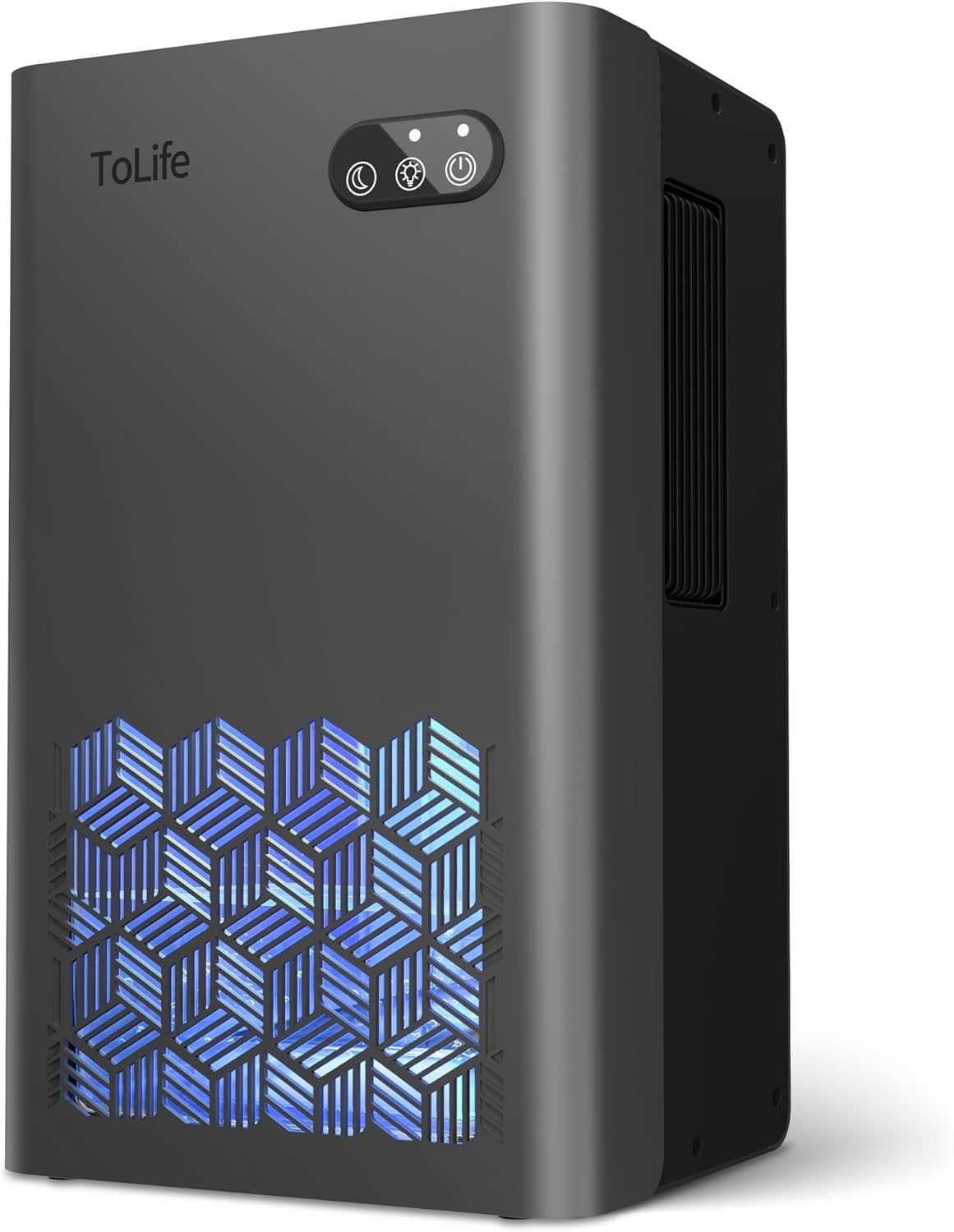
ToLife Dehumidifier TZ-C2
| Floor Area | 1000 |
|---|---|
| Tank Volume | 95 fluid ounces |
| Number of Speeds | 2 |
| Wattage | 93 watts |
| Voltage | 220 volts |
The ToLife TZ-C2 uses semiconductor condensation technology to quietly pull moisture from the air and deposit it into a removable 95 oz tank, making it a straightforward option for damp rooms. It offers two operating modes: a higher-power setting for faster moisture removal and a low-speed sleep mode that runs under 30 dB for overnight use. A seven-color LED can act as a night light and the unit includes automatic shutoff when the tank is full or removed, plus handles for easy moving between rooms. Practical benefits include simple setup, low noise, and a compact footprint that fits in basements, bathrooms, or bedrooms. Limitations are its modest rated dehumidification capacity and stated coverage, which means it will be most effective in smaller basement zones or for spot treatments rather than drying a large, very damp basement quickly. Also this model runs on 220 volts, so electrical compatibility should be confirmed for your location.
Best for: Buyers who need an affordable, portable dehumidifier for spot dehumidifying small basement areas, bathrooms, or bedrooms and who prioritize low noise and easy portability.
Less Ideal for: People looking to dry large, very damp basements or whole-house coverage should consider a higher-capacity compressor dehumidifier instead.
- Large removable 95 oz water tank reduces how often you need to empty it
- Quiet sleep mode under 30 dB suitable for nighttime operation
- Portable design with handles for moving between rooms
- Automatic shutoff prevents overflow when the tank is full
- Dehumidification capacity is modest and may be slow in very damp or large basements
- Requires 220 volt power which may not match all household outlets
Verdict: A compact, budget-friendly portable dehumidifier that is best for quiet, small-area moisture control and occasional basement spot treatments.
Choosing the Right Dehumidifier for RVs: Key Factors to Consider
Capacity and Coverage
Capacity describes how much water a dehumidifier can extract in 24 hours and should be matched to your RV's interior volume and typical humidity. Undersized units run continuously with little effect, while oversized units waste energy and may short-cycle in small spaces.
Think in terms of space and environment. A small travel trailer with lots of ventilation needs a different capacity than a closed, winterized fifth wheel. Consider seasonal extremes too; cold, damp climates produce condensation that requires steady removal even at lower air temperatures.
Power Consumption and Operating Mode
Power draw matters because many RVs run appliances on shore power, generator, or limited battery reserve. Look for units with low-watt standby modes, adjustable humidity setpoints, and eco or auto settings that reduce runtime when target humidity is reached.
Also consider whether the unit runs on standard AC only or supports DC or 12V options if you plan to operate it off batteries. Energy-efficient compressors or thermoelectric (Peltier) designs each have tradeoffs in capacity and low-temperature performance.
Drainage Options
How the unit disposes of collected water affects convenience and continuous operation. A removable tank is simple but requires regular emptying, which may be inconvenient in parks or during travel. Continuous drain capability lets you route water to a sink or external drain using a hose, enabling unattended use.
Check tank capacity relative to expected extraction rates and confirm whether the unit has an automatic shutoff when the tank is full. For extended storage or winterization, the ability to set up a continuous drain is often the most practical option.
Noise and Vibration
Noise levels are significant inside small RV cabins where appliances sit close to sleeping and living areas. Compressor-based dehumidifiers are typically louder but more powerful, while thermoelectric models are quieter but less capable at high humidity loads.
Vibration resistance is also important. Units with solid feet or mounting options reduce rattle and wear when the RV is parked in windy conditions or exposed to light movement. Look for insulated panels, rubber mounts, or quiet fan modes if you prioritize overnight comfort.
Physical Size and Portability
Available floor and storage space in an RV is limited, so footprint and weight influence where you can place and stow a dehumidifier. Lightweight, compact units are easier to move between compartments or to store during travel, but tiny units may lack needed capacity for larger rigs.
Consider handles, casters, and how the unit fits under cabinets or in closets. A low-profile design that still offers adequate tank size and hose access often provides the best balance for RV use.
Temperature Performance and Defrost
RVs experience wide temperature swings, so a dehumidifier's ability to operate in cooler conditions matters. Refrigerant-based units can lose efficiency or ice up at lower temperatures without an automatic defrost cycle, while thermoelectric units can continue functioning but with reduced capacity.
For storage during cold months or use in unheated compartments, select a unit rated for lower ambient temperatures or equipped with frost protection to avoid shutdowns and maintain consistent moisture control.
Why Humidity Is a Bigger Problem in RVs
RVs are compact, insulated enclosures that trap moisture from cooking, showering, and breathing. That moisture condenses on cold surfaces, leading to fogged windows, delaminated cabinetry, and mold growth in hidden areas. Because of tight quarters, even moderate humidity increases can become a persistent problem.
Seasonal storage and travel in damp climates amplify the risk. When an RV sits unused, humidity can rise without ventilation, so a small dehumidifier can protect interior finishes and textiles during storage without continuous human oversight.
- Condensation forms quickly on single-pane windows and cold metal surfaces
- Hidden cavities behind walls and cabinets are prone to mold and rot
- Short daily use can lead to long-term damage if moisture is not controlled
Thermoelectric Vs Compressor Units: Tradeoffs
Thermoelectric or Peltier dehumidifiers are compact, quiet, and consume less power at low loads. They are best for very small spaces or occasional use and perform consistently across a range of temperatures without risk of freezing components. Their moisture removal capacity is modest, so they suit lightweight tasks like preventing mustiness in stored trailers.
Compressor-based dehumidifiers are more effective at removing larger volumes of moisture and are better for occupied RVs, regular use, or damp climates. They draw more power and can be noisier, but they clear humidity faster. However, compressor units may require defrost functionality if you expect to run them in cool conditions.
- Thermoelectric: quiet, low power, lower capacity
- Compressor: higher capacity, higher power draw, may need defrost
Placement and Airflow Tips for Best Results
Place the dehumidifier where airflow is least restricted, not tucked into a closed cabinet. Elevating a unit slightly off the floor helps intake and reduces the risk of water damage if a leak or overflow occurs. Aim for a central location within the living area or close to the primary moisture source, such as the bathroom or kitchenette.
Keep doors and vents as you normally use them. Over-sealing the space around the unit can reduce its effectiveness. If your RV has separate zones, consider using more than one small unit or moving a portable unit between zones when humidity spikes.
- Avoid enclosed cabinets or blocked intake grills
- Elevate unit slightly for better airflow and safety
- Position near moisture sources for faster drying
Maintenance and Winter Storage
Routine maintenance keeps a dehumidifier effective and extends its service life. Empty and clean the condensate tank regularly, rinse or replace air filters per the manual, and inspect hose fittings for cracks or leaks. Clean intake grills from dust and pet hair to maintain airflow.
For winter storage, drain the unit completely and leave the tank and lid open to prevent odors. If storing in a cold environment, consider a model rated for low temperatures or remove it to a heated area. Regularly run a short maintenance cycle during extended storage to keep seals from drying out.
- Empty and rinse the tank periodically
- Check and clean filters and intake grills
- Drain and winterize before long storage periods
Power Options and Running Off-Grid
If you plan to run a dehumidifier from battery power or a small inverter, calculate runtime based on the unit's wattage and your battery bank capacity. Low-wattage thermoelectric models are easiest to run off-grid but will extract less moisture. Compressor units require larger inverters and will shorten battery life if used for long stretches.
Use adjustable humidity setpoints and auto mode to limit runtime. Pairing a dehumidifier with a small solar trickle system or running it during generator use can balance moisture control with limited power resources.
- Match unit wattage to inverter and battery capacity
- Prefer low-wattage units for extended off-grid use
- Use auto or timed operation to conserve power
How We Chose the Best Dehumidifier for RVs
We focused on practical performance measures that matter for RV owners and small, enclosed living spaces. Primary evaluation criteria included moisture removal rate relative to unit size, energy efficiency on low-watt draw, and suitability for small, mobile environments. We also prioritized drainage flexibility, including continuous drainage and condensate tank design, plus noise levels for overnight comfort. Durability and build quality were considered because RVs expose appliances to vibration and temperature swings. We excluded large home basement or industrial dehumidifiers that are physically too big or power-hungry for RV use. Units that lack basic safety features like automatic shutoff on full tank or frost protection for cooler conditions were also dropped. The remaining selections balance capacity against footprint and power, with an eye toward simple setup, stable operation while parked, and realistic energy use for battery or shore-power scenarios.
Our full evaluation process is outlined in our review methodology.
FAQ
How big of a dehumidifier do I need for my RV?
Size depends on interior volume and typical humidity. For small trailers, a compact unit with low daily extraction may suffice. Larger or frequently occupied rigs need higher-capacity units. Prioritize a balance between capacity and footprint to avoid short-cycling.
Can I run a dehumidifier on my RV battery?
You can run low-wattage units from an inverter and battery, but runtime is limited by battery capacity. Thermoelectric models draw less power and are more battery-friendly, while compressor units require a larger inverter and will deplete batteries faster.
Is continuous drain necessary for RV use?
Continuous drain is highly convenient for unattended or long-term use because it eliminates frequent tank emptying. If you rely on a tank-only unit, expect to check and empty it regularly, especially in humid conditions.
Will a dehumidifier prevent mold in an RV?
A dehumidifier reduces humidity and the conditions that favor mold growth, but it does not replace cleaning or repairs. Control moisture sources, ventilate when possible, and address leaks or insulation issues in addition to running a dehumidifier to minimize mold risk.
Do dehumidifiers work in cold storage conditions?
Many compressor dehumidifiers lose efficiency or may ice up at low temperatures unless they include defrost protection. Thermoelectric models can operate at cooler temperatures but with reduced extraction. Choose units rated for the temperature range you expect during storage.
Final Verdict
When choosing a dehumidifier for RVs, prioritize the combination of capacity, power draw, and drainage that matches how you use your rig. Small, quiet units work well for storage and light use, while higher-capacity compressor models are better for occupied or very damp rigs. Consider noise, footprint, and temperature performance as tradeoffs against moisture removal speed. Decide which factors—continuous drain, low power consumption, or high extraction rate—matter most for your situation, and pick a unit that balances those needs to keep your RV interior dry and protected with minimal hassle.