
Note: This article contains affiliate links. If you click on these links and make a purchase, we may earn a small commission at no extra cost to you. This helps support our research and content. Read our full affiliate disclosure here.
Living in a studio apartment makes humidity management both more necessary and more challenging. Too much moisture can cause musty odors, mold growth, and discomfort in a single combined living and sleeping space. Choosing the right dehumidifier for a studio apartment helps keep air drier, protects finishes and fabrics, and improves comfort without taking over your limited floor area. This guide looks at a short list of the top compact dehumidifiers suited for studio layouts. We evaluated units on real-world factors that matter for small spaces, including moisture removal capacity, footprint and placement flexibility, noise, and ease of maintenance. Read on to see which features matter most and which compact designs work best for small homes.
Top Picks at a Glance
| Best Overall The best all-around choice for most situations | Spacekey QIG-D02 Dehumidifier |  |
| Best Quality Built to a higher standard if you want something more solid | Midea 22-Pint Dehumidifier |  |
| Best Value The sweet spot between price and what you get | BEDRED CT11 Dehumidifier |  |
| Best Budget The cheapest option that still gets the job done reliably | TABYIK 35OZ Dehumidifier DH-CS01 |  |
| Top Rated A top-rated pick with lots of positive feedback | Tenergy Sorbi 1000ml Dehumidifier |  |
| Most Popular A crowd favorite that many people choose with confidence | Pro Breeze PB-02 Mini Dehumidifier |  |
| Best Seller A high-volume bestseller chosen again and again | ToLife Dehumidifier TZ-C2 |  |
Spacekey QIG-D02 Dehumidifier

| Floor Area | 1000 square_feet |
|---|---|
| Capacity | 95 fluid ounces |
| Number of Speeds | 2 |
| Wattage | 88 watts |
| Dehumidification Capacity | 40 pints_per_day |
The Spacekey QIG-D02 is a compact electric dehumidifier aimed at removing excess moisture from bedrooms, bathrooms, closets and small apartments. It uses dual semiconductor technology and is rated to remove up to 40 pints per day (manufacturer figure) while collecting water in a large 95 ounce removable tank that triggers auto shutoff when full. Controls are simple with two modes—powerful for faster extraction and a quiet night mode for sleeping—and the unit includes a seven-color ambient LED that doubles as a night light. At about 88 watts it runs with relatively low power draw, and a built-in handle makes it easy to move between rooms or into an RV. Limits to consider are its small footprint, which means it is best for studio-sized spaces rather than whole houses, and the LED feature may be distracting in strict bedroom setups unless turned off or set to a dim color. Maintenance is straightforward thanks to the removable tank and splash guard but expect regular emptying in persistently humid conditions.
Best for: Apartment dwellers or studio owners who want a low-power, portable unit to control humidity in single rooms, bathrooms, closets or an RV while keeping noise low at night.
Less Ideal for: People needing whole-home dehumidification or high-capacity continuous drainage solutions should choose a larger, commercial-grade unit instead.
- Large 95 oz removable tank with automatic shutoff reduces how often you need to empty it
- Two operating modes including a quiet night mode suitable for sleeping
- Compact, portable design with built-in handle for moving between rooms or into an RV
- Low power draw at 88 watts for energy-conscious continuous use
- Designed for small to medium spaces so it may struggle to dehumidify larger open floor plans
- Integrated 7-color LED may be distracting in bedrooms if not adjustable or turned off
Verdict: A quiet, low-power portable dehumidifier that is a practical humidity control choice for studio apartments and single rooms.
Midea 22-Pint Dehumidifier

| Capacity | 22 pints_per_day |
|---|---|
| Floor Area | 1500 square_feet |
| Tank Volume | 0.8 gallons |
| Wattage | 295 watts |
| Air Flow Capacity | 135 cfm |
The Midea 22‑Pint Dehumidifier removes up to 22 pints of moisture per day and is sized for spaces up to roughly 1,500 square feet, making it a practical choice for studio apartments that need steady humidity control. It offers adjustable humidity from 35% to 85%, two fan speeds including a turbo mode for faster dehumidification, and a programmable timer so you can run it on a schedule. The unit is Wi‑Fi enabled and works with voice assistants for remote monitoring and control, and it supports continuous drainage via a standard hose or manual tank emptying. Energy Star certification and a comparatively low 295-watt draw help keep operating costs down, while a washable reusable filter and auto defrost and auto restart features improve reliability. At 47 dBA it runs quietly enough for overnight use, though the 0.8 gallon bucket means more frequent emptying than larger models unless you use continuous drain. Mobility is straightforward thanks to four rotating wheels and integrated handles, but the capacity is modest if you have very damp conditions or larger combined spaces.
Best for: Buyers who prioritize steady, energy-efficient humidity control in a compact living space and value remote app and voice controls for hands-off operation.
Less Ideal for: People with very large or extremely damp spaces who need higher daily extraction or those who prefer a large-capacity tank to avoid using a hose.
- Removes up to 22 pints per day suitable for small to medium rooms
- Wi‑Fi and voice assistant support for remote control and monitoring
- Energy Star certified for lower energy use compared with conventional units
- Quiet operation at about 47 dBA suitable for bedrooms or studios
- Continuous drain option and washable reusable filter for easier maintenance
- 0.8 gallon tank requires frequent emptying if continuous drain is not used
- Two fan speeds limit fine-grained airflow control compared with multi-speed models
Verdict: A compact, energy-efficient dehumidifier with smart controls and quiet operation that fits studio apartments needing reliable daily moisture removal.
BEDRED CT11 Dehumidifier

| Floor Area | 1000 square_feet |
|---|---|
| Tank Volume | 95 fluid ounces |
| Capacity | 5.9 pounds |
| Operation Mode | Intermittent |
| Other Special Features of the Product | 7 Color Ambient Light, Automatic Shutoff, Sleep Mode |
The BEDRED CT11 is a compact thermoelectric dehumidifier intended to reduce humidity in small spaces such as bedrooms, bathrooms, and modest basements up to about 1000 sq ft. It uses semiconductor cooling rather than a compressor, so it runs quietly and is simple to operate with an intermittent operation mode and an automatic shutoff when the 95 oz tank fills. Sleep Mode turns off the lights and lowers noise for overnight use, and the seven-color ambient light gives an optional mood-lighting feature. Practical benefits include easy emptying from the included tank, portability thanks to a lightweight design, and low sound levels that suit living spaces. Important limitations are inherent to semiconductor units: lower capacity compared with compressor dehumidifiers, reduced performance in very cold or very damp basements, and a smaller tank that requires more frequent emptying in high-humidity conditions.
Best for: Buyers who prioritize quiet, low-maintenance dehumidification and want a compact unit that is easy to move and run in living spaces or small basements without frequent intervention.
Less Ideal for: People needing heavy-duty moisture control for large, cold, or very damp basements should choose a higher-capacity compressor dehumidifier instead.
- Quiet thermoelectric operation suitable for bedrooms and living rooms
- Automatic shutoff protects against overfill and simplifies unattended use
- 95 oz removable tank for straightforward water removal
- Sleep Mode and ambient light options for low‑noise nighttime use
- Compact and lightweight for easy placement or moving between rooms
- Semiconductor cooling gives lower moisture removal capacity than compressor models
- Performance drops in cold basement conditions and very high humidity areas
Verdict: Choose the BEDRED CT11 if you want a quiet, portable dehumidifier with auto‑shutoff and sleep‑friendly operation for small basements or living spaces.
TABYIK 35OZ Dehumidifier DH-CS01

| Tank Volume | 1000 ml |
|---|---|
| Dehumidification Capacity | 0.45 liters_per_day |
| Wattage | 40 watts |
| Floor Area | 280 square_feet |
| Number of Speeds | 1 |
The TABYIK 35OZ Dehumidifier is a small, portable Peltier unit meant to remove excess moisture from bedrooms, bathrooms, closets, RVs and studio apartments. It runs continuously at low power (about 40 watts) and can collect up to roughly 16 oz (450 ml) per day under warm, very humid conditions, storing water in a transparent 1000 ml tank that is easy to remove and pour. Operation is simple—one-button control plus a separate light button for a 7-color night/ambient light, and the unit auto shuts off when the tank nears full and flashes a red indicator. The fan and compressor-free design keeps noise down to about 28 dB, so it is suitable for sleeping areas. Because it is a Peltier device, dehumidification capacity is modest compared with compressor models, so it is best for small spaces or occasional damp spots rather than whole-apartment humidity control. Regular cleaning of the rear intake filter is recommended to maintain airflow and efficiency.
Best for: Buyers on a tight budget who need an inexpensive, low-energy solution to reduce dampness in a small studio, bedroom, bathroom, or closet and prioritize quiet, simple operation.
Less Ideal for: People who need to dehumidify larger apartments, very damp spaces, or want faster moisture removal and adjustable humidity settings.
- Compact and portable with a built-in handle for easy placement
- Very quiet operation (~28 dB) suitable for bedrooms and studio apartments
- Transparent 35 oz (1000 ml) tank with easy-grab groove for simple emptying and cleaning
- Low power draw (about 40 watts) for energy-conscious use
- Auto shut-off when the tank is nearly full for safe unattended operation
- Limited dehumidification capacity (about 0.45 L/day) compared with compressor dehumidifiers
- Single-speed operation offers no fan or moisture-level control
Verdict: A budget-friendly, ultra-quiet 35 oz dehumidifier that provides low-energy moisture control for small studio spaces and bedrooms.
Tenergy Sorbi 1000ml Dehumidifier

| Tank Capacity | 1000 ml |
|---|---|
| Dehumidification Capacity | 0.75 liters_per_day |
| Air Flow Capacity | 22 cfm |
| Wattage | 45 watts |
| Filter | H13 HEPA filter |
The Tenergy Sorbi is a small, plug-and-play Peltier dehumidifier that combines moisture removal with HEPA air filtration for studio-sized rooms. It draws up to 0.75 liters (750 ml) of moisture per day under ideal conditions into a removable 1.0 liter tank and will auto shut off when the tank is full. The unit also includes an H13 true HEPA filter and a purifier mode so you can run dehumidifying and air cleaning functions together, which helps in spaces where both dampness and dust or allergens are concerns. Controls are simple touch buttons and the fan has low and high settings; the CADR is modest at 22 CFM so it is best used in bedrooms, bathrooms, closets, or small studio apartments up to about 200 sq ft. It runs quietly and is energy efficient at a rated 45 watts, but the Peltier-style design limits daily moisture removal compared with compressor dehumidifiers and it should not be used below 50°F. Filter replacement every six months is recommended, and buyers should plan for occasional tank emptying on higher-humidity days.
Best for: Studio dwellers who prioritize a reliable, low-noise unit that both lightens humidity and reduces airborne particulates in small rooms and compact living spaces.
Less Ideal for: People needing fast, high-volume moisture removal for very damp basements or large open floor plans should choose a larger compressor dehumidifier instead.
- Integrated H13 true HEPA filter for simultaneous air cleaning and dehumidifying
- Compact, lightweight design suited for small rooms and easy to move
- Auto shutoff and water-full indicator for safe unattended operation
- Quiet operation and low power draw (45W) suitable for bedrooms and studios
- Peltier (thermoelectric) removal rate is low compared with compressor dehumidifiers
- Not rated for operation below 50°F, limiting use in cold spaces
Verdict: A compact, quiet combo dehumidifier and HEPA air purifier that reliably manages light moisture and particulates in studio apartments.
Pro Breeze PB-02 Mini Dehumidifier

| Floor Area | 215 square_feet |
|---|---|
| Capacity | 16 fluid ounces |
| Tank Volume | 17 fluid ounces |
| Wattage | 21 watts |
| Dehumidification Capacity | 0.25 liters_per_day |
The Pro Breeze PB-02 is a small, portable Peltier dehumidifier intended for bedrooms, bathrooms, closets, RVs, and studio apartments up to roughly 215 sq ft. It uses thermoelectric cooling to run quietly and efficiently, extracting about 0.25 liters (roughly 9 ounces) per day into a 16–17 ounce tank that shuts the unit off automatically when full. Typical use is simple: place it in a damp corner or near condensation sources and empty the tank when the LED indicates full. With 21 watts power draw and whisper-quiet operation, it is suitable for overnight use without adding noticeable noise or energy cost. The unit is limited by its low daily extraction rate and small tank, so it is best for light humidity control or occasional condensation rather than continuous heavy-duty dehumidification. It also requires ambient temperatures above its operating threshold to work reliably. For a small space that needs a discreet, low-energy humidity helper, this model is practical; for persistently wet environments you will need a larger, compressor-style machine.
Best for: Buyers seeking a quiet, low-energy dehumidifier to manage mild humidity or condensation in a studio apartment or other small living space and who prefer a compact, portable appliance backed by many user reviews.
Less Ideal for: People dealing with persistent high humidity, large open layouts, or water intrusion should choose a higher-capacity compressor dehumidifier instead.
- Very quiet Peltier operation suitable for bedrooms and studio apartments
- Low energy draw at about 21 watts for inexpensive continuous running
- Auto shut-off with LED indicator prevents overflow
- Compact, lightweight design is easy to move and place in tight spaces
- Very low extraction rate (about 0.25 liters or ~9 oz per day) limits use to mild humidity issues
- Small 16–17 oz tank requires frequent emptying in moderately damp conditions
- Not effective below its operating temperature range, so it will not work reliably in cold rooms
Verdict: A compact, whisper-quiet, energy-efficient choice for light humidity control in a studio apartment.
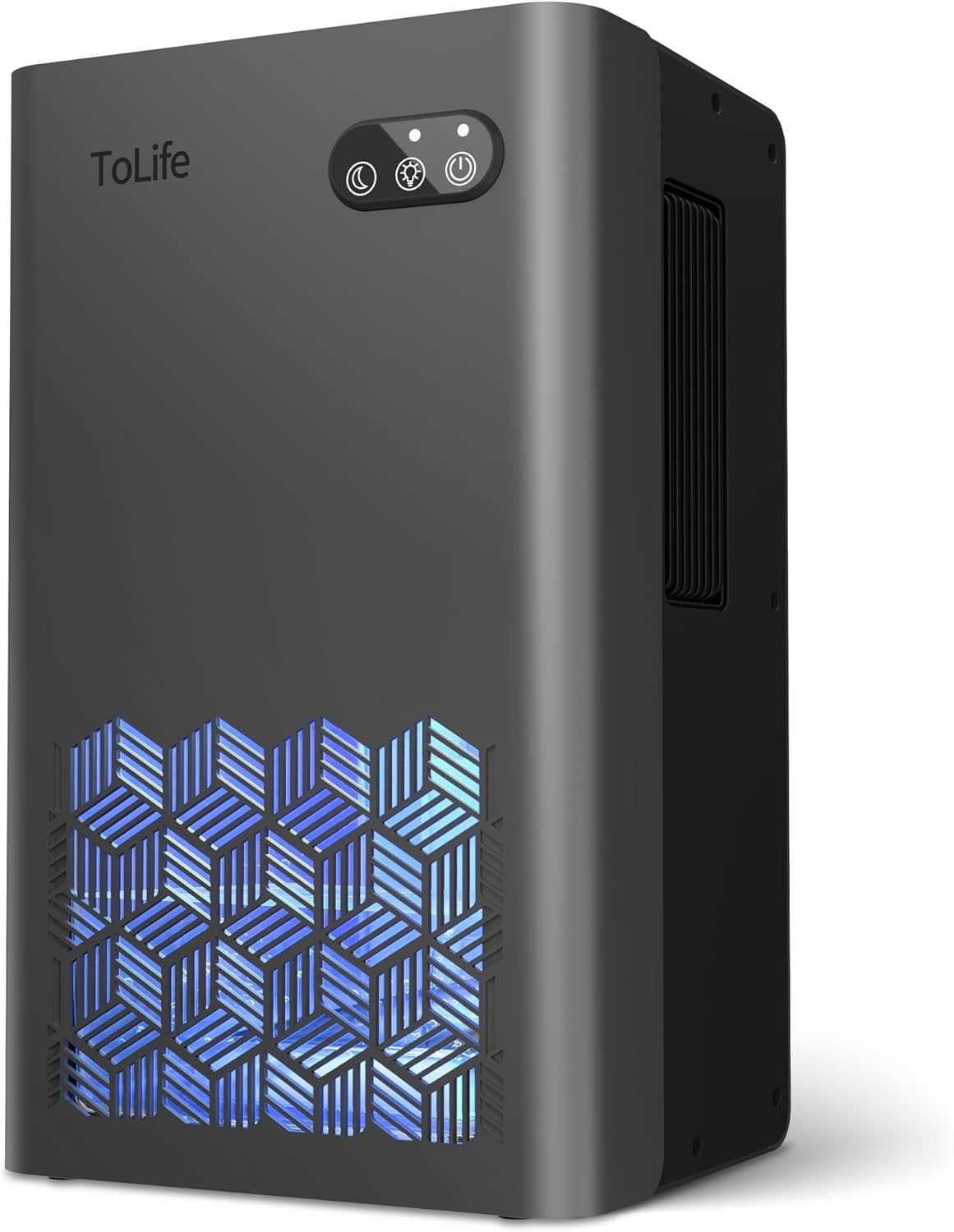
ToLife Dehumidifier TZ-C2
| Floor Area | 1000 |
|---|---|
| Tank Volume | 95 fluid ounces |
| Number of Speeds | 2 |
| Wattage | 93 watts |
| Voltage | 220 volts |
The ToLife TZ-C2 uses semiconductor condensation technology to quietly pull moisture from the air and deposit it into a removable 95 oz tank, making it a straightforward option for damp rooms. It offers two operating modes: a higher-power setting for faster moisture removal and a low-speed sleep mode that runs under 30 dB for overnight use. A seven-color LED can act as a night light and the unit includes automatic shutoff when the tank is full or removed, plus handles for easy moving between rooms. Practical benefits include simple setup, low noise, and a compact footprint that fits in basements, bathrooms, or bedrooms. Limitations are its modest rated dehumidification capacity and stated coverage, which means it will be most effective in smaller basement zones or for spot treatments rather than drying a large, very damp basement quickly. Also this model runs on 220 volts, so electrical compatibility should be confirmed for your location.
Best for: Buyers who need an affordable, portable dehumidifier for spot dehumidifying small basement areas, bathrooms, or bedrooms and who prioritize low noise and easy portability.
Less Ideal for: People looking to dry large, very damp basements or whole-house coverage should consider a higher-capacity compressor dehumidifier instead.
- Large removable 95 oz water tank reduces how often you need to empty it
- Quiet sleep mode under 30 dB suitable for nighttime operation
- Portable design with handles for moving between rooms
- Automatic shutoff prevents overflow when the tank is full
- Dehumidification capacity is modest and may be slow in very damp or large basements
- Requires 220 volt power which may not match all household outlets
Verdict: A compact, budget-friendly portable dehumidifier that is best for quiet, small-area moisture control and occasional basement spot treatments.
Choosing the Right Dehumidifier for Studio Apartment: Key Factors to Consider
Extraction Capacity (Pints Per Day)
Extraction capacity indicates how much moisture a dehumidifier can remove over a 24-hour period under standard conditions. For a studio apartment you rarely need the high capacities meant for basements, but you do want a unit that can keep pace with typical indoor humidity sources like cooking, showering, and drying clothes. Choose a capacity that matches the room size and the severity of humidity. A unit undersized for persistent dampness will run continuously and struggle to reach your target humidity, raising wear and energy use.
Also consider how extraction rates change at lower room temperatures. Many compact units list a maximum pint rating at a warm test temperature; performance will drop in cooler apartments. Aim for a model with solid mid-range performance rather than one that only shines under ideal lab conditions.
Operational Noise
Noise matters in studio apartments because the living, sleeping, and working areas are the same space. Check reported decibel levels at different fan settings and look for options with lower noise on their quiet modes. Even a compact unit can be disruptive if it runs loud during the night or while you work from home.
Consider placement too: positioning a unit slightly farther from your bed or workstation, or using a model with a directional air outlet, can reduce perceived noise. If you are highly sensitive to sound, prioritize models that emphasize whisper-quiet operation or offer night modes that lower fan speed and compressor activity.
Physical Footprint and Placement Flexibility
A studio apartment has limited floor space, so the dehumidifier's footprint and vertical profile matter. A slim or stackable design can fit beside furniture or in a closet with louvered doors. Also note clearance requirements for airflow: placing a unit flush against a wall or under a window may reduce efficiency.
Look at handle locations and caster quality if you expect to move the unit between rooms. Wall-mountable or tabletop options may be convenient for very small studios, while low-profile floor models can be easier to empty and service. Choose a form factor that fits your available space and routine.
Water Collection and Drain Options
How the unit manages condensed water affects convenience and maintenance frequency. Portable dehumidifiers typically offer a removable tank, continuous drain outlet, or pump-assisted drain. In a studio, an appropriately sized tank reduces the frequency of emptying, but a continuous drain can be ideal if you have a nearby sink or laundry drain.
Pump-equipped models let you route water vertically, which is helpful if the only drain is higher than the unit. If emptying a tank is unavoidable, choose a model with clear level indicators and an easy-to-remove, lightweight reservoir to minimize spills and hassle.
Energy Use and Running Cost
Because dehumidifiers may run for long stretches in humid conditions, electricity consumption matters for monthly bills. Compare energy use at realistic operating points rather than peak or test conditions. Look for units with auto-humidity control that cycle the compressor intelligently; this reduces runtime compared with machines that run constantly.
Smaller compressors and efficient fans often consume less power, but extremely low power can mean very slow dehumidification. Balance energy savings against the need for adequate moisture removal so the unit does not run inefficiently for longer periods.
Sizing the Dehumidifier for Your Studio
Estimate the square footage of your studio and consider typical daily moisture sources. A larger unit than strictly necessary can dehumidify faster but may cycle on and off frequently in mild conditions, which can be noisy and inefficient.
For most studios, prioritize a unit that performs well in a mid-capacity band and maintains steady humidity control rather than one with an oversized rated capacity that only performs under warm test conditions.
- Measure the main living area where moisture accumulates most
- Account for activities that add humidity: cooking, showering, indoor drying
- Expect lower extraction rates in cooler rooms
Placement Tips to Maximize Performance
Place the dehumidifier where air flows freely around the intake and exhaust. Avoid corners or tight spaces that restrict airflow, and keep the unit several inches from walls or furniture. Elevating a small unit a few inches can help intake airflow if floor space is obstructed.
Avoid placing the unit directly beneath windows where cold air can reduce efficiency, and keep it away from heat sources that might confuse the humidity control sensor.
- Leave clearance per the manufacturer recommendations
- Position near the main humidity source when possible
- Keep filters accessible for regular cleaning
Managing Noise and Night Use
If you plan to sleep or work in the same room, look for models with dedicated night modes or low-speed fan settings. Some units lower both fan speed and compressor activity to reduce noise while still maintaining a reasonable humidity level.
White noise from other sources can mask operational sound, but avoid masking loud mechanical rattles. Regular maintenance—tightening panels and cleaning filters—helps keep mechanical noise to a minimum.
- Test quieter settings during daytime to gauge nighttime comfort
- Use pads or soft feet to reduce vibration transfer to hard floors
- Schedule filter cleaning to avoid airflow restriction that increases fan noise
Seasonal Use and Storage
In many climates a dehumidifier is most useful during warm, humid months. If you only need moisture control part of the year, choose a unit that is compact to store and easy to restart. Drain and dry tanks before storage to prevent odors or mold growth inside the unit.
Consider models with simple reset and auto-restart features if you expect power interruptions. Storing units upright in a dry place and covering them lightly helps extend life between seasons.
- Empty and dry the tank thoroughly before putting the unit away
- Label cords and keep the user manual accessible for restart instructions
- Run the unit briefly after storage to ensure proper operation
Maintaining Air Quality and Preventing Mold
A dehumidifier reduces the moisture that supports mold and dust mites, but it is not a substitute for ventilation and cleaning. Regularly clean the unit's air intake and reusable filters, and address leaks or condensation sources such as plumbing or window seals.
Combine dehumidification with periodic airing out of the space and targeted cleaning of mold-prone areas to keep indoor air healthier.
- Check walls and hidden corners for early signs of mold
- Keep humidity targets steady rather than riding wide swings
- Use exhaust fans when cooking or showering to reduce load on the dehumidifier
How We Chose the Best Dehumidifier for Studio Apartment
We focused on features and performance metrics that directly affect day-to-day use in small, single-room apartments. Primary evaluation criteria included extraction capacity at room temperatures typical of apartments, operational noise at common fan speeds, unit footprint and placement options, and water management choices such as tank size and continuous-drain capability. Energy efficiency and runtime cost were also considered because continuous operation or frequent cycles can affect monthly utility bills in small spaces. Usability factors—like filter access, control clarity, and auto-defrost—were weighed for owners who may not have storage room for seasonal gear. We excluded heavy-duty or whole-house units designed for basements and large open plans, since those options are oversized for studio footprints. We also filtered out units that lacked reliable humidity control or adequate documentation about capacity and noise. The products that made the list balance compact size with meaningful moisture removal, quiet operation, and straightforward water handling for studio apartments.
Our full evaluation process is outlined in our review methodology.
FAQ
What humidity level should I aim for in a studio apartment?
Aim for relative humidity between 40 and 50 percent. That range limits mold growth and dust mite activity while still feeling comfortable. Targets below 35 percent can feel dry for some people, and levels above 60 percent raise mold risk.
Can I run a dehumidifier in a small studio all day?
Often yes, but continuous runtime depends on the unit's capacity and your humidity load. Use a model with an adjustable humidistat so the compressor cycles only when needed. Continuous operation can be acceptable if the unit is efficient and sized correctly.
Is a pump necessary for a studio dehumidifier?
A pump is not required if you can place the unit near a drain or are willing to empty the tank regularly. Pumps are useful when the only drain is above the unit or when you want hands-free continuous drainage, but they add complexity and occasional maintenance.
How often should I clean the dehumidifier filter in a studio?
Clean or check the filter every 1 to 3 months depending on dust levels and usage. More frequent cleaning is helpful if you have pets or run the unit continuously. A clogged filter reduces airflow, which lowers performance and can increase noise.
Will a dehumidifier make my studio cold?
Dehumidifiers do not actively cool like air conditioners, but they can make a room feel slightly cooler because removing moisture reduces the perceived temperature. The unit's compressor generates some heat while running, so any temperature change is usually modest.
Final Verdict
For studio apartments prioritize a compact dehumidifier that balances real extraction capacity with low noise and a small footprint. Decide which features matter most to your routine: a larger tank or continuous drain for hands-off operation, a pump for flexible drain placement, or a whisper-quiet setting for overnight use. Energy efficiency and reliable auto-humidity control reduce runtime and operating cost over time. Weigh these tradeoffs based on how often humidity spikes in your space and where you can place the unit. Choosing a model that matches your studio's layout and daily habits will deliver the best comfort and protect your living space from moisture-related problems.