
Note: This article contains affiliate links. If you click on these links and make a purchase, we may earn a small commission at no extra cost to you. This helps support our research and content. Read our full affiliate disclosure here.
If you need to control humidity on a limited budget, the right dehumidifier can protect your home from damp smells, mold, and warped wood without costing a lot. For spaces like small bedrooms, bathrooms, basements, and laundry rooms, budget models can offer meaningful moisture removal and convenient features when chosen carefully. This guidespotlights seven shortlisted dehumidifiers under $100 that perform well for compact spaces. We evaluated units on capacity, energy use, noise, and ease of upkeep so you can pick the model that best matches your room size, runtime needs, and maintenance tolerance. Read on for practical buying guidance and how each product type stacks up against typical household requirements.
Top Picks at a Glance
| Best Overall The best all-around choice for most situations | AIRPLUS 30‑Pint Dehumidifier |  |
| Best Quality Built to a higher standard if you want something more solid | EasyAcc Q22 Dehumidifier |  |
| Best Value The sweet spot between price and what you get | ubbo Z18 95oz Dehumidifier |  |
| Best Budget The cheapest option that still gets the job done reliably | AlohaAir DH001 34 oz Dehumidifier |  |
| Top Rated A top-rated pick with lots of positive feedback | BEDRED CT11 Dehumidifier |  |
| Most Popular A crowd favorite that many people choose with confidence | TABYIK 35oz Dehumidifier DH-CS01 |  |
| Best Seller A high-volume bestseller chosen again and again | ToLife Dehumidifier TZ-C2 |  |
AIRPLUS 30‑Pint Dehumidifier

| Dehumidification Capacity | 30 pints_per_day |
|---|---|
| Coverage | 2500 |
| Tank Volume | 2.6 liters |
| Number of Speeds | 3 |
| Wattage | 305 watts |
This AIRPLUS dehumidifier is a straightforward, budget-focused unit for drying large rooms and basements. It extracts up to 30 pints per day using a compressor-based system and offers three fan speeds plus modes for rainy-day automatic humidity control, manual setpoints from 30 to 80 percent, and a dry mode for speeding laundry drying. You can use a continuous-drain hose for hands-free operation or the 2.6 L tank with auto shutoff when not plumbed. Practical touches include a 24-hour timer, auto-defrost for cooler spaces, recessed grips for moving the unit, and a claimed noise level around 37 dB for quiet operation. On the downside, its stated power draw is 305 watts so running it long periods will draw noticeable electricity, and the tank is relatively small if you frequently rely on the reservoir instead of a drain hose. For buyers seeking simple humidity control for large spaces on a modest budget, this model delivers core features without complex smart integrations.
Best for: Buyers who want an affordable, no-frills dehumidifier that can handle large rooms or basements and prefer straightforward controls and a continuous-drain option.
Less Ideal for: Those who need integrated smart-home connectivity, very large commercial spaces, or a built-in large-capacity reservoir for infrequent maintenance.
- Rated to remove up to 30 pints per day for effective moisture control in larger rooms
- Covers up to 2,500 sq. ft so suitable for basements and open living areas
- Includes continuous drain hose and 2.6 L tank with automatic shutoff for flexible drainage
- Quiet operation around 37 dB for minimal disruption in bedrooms or nurseries
- Multiple modes and a 24-hour timer let you tailor humidity control and drying cycles
- 305 watt power draw can increase energy use during extended run times
- Relatively small 2.6 L tank requires frequent emptying if not using the drain hose
Verdict: A capable, budget-friendly 30‑pint dehumidifier that delivers quiet, flexible moisture control for large homes and basements.
EasyAcc Q22 Dehumidifier

| Tank Volume | 68 fluid ounces |
|---|---|
| Dehumidification Capacity | 1.33 liters_per_day |
| Number of Speeds | 2 |
| Other Special Features of the Product | Automatic Shutoff, Auto Defrost, Quiet Mode (<35 db) |
| Floor Area | 1100 square_feet |
The EasyAcc Q22 is a small, performance-focused dehumidifier aimed at bathrooms, bedrooms, closets, and RVs. It uses a semiconductor cooling system with a multi-sided intake and enhanced copper tubing to boost condensation, allowing the unit to extract up to roughly 1.3 liters (about 40 oz) per day while delivering continuous operation down to cooler temperatures thanks to an auto-defrost feature. Daily use is straightforward: set one of two fan speeds, place it on a stable surface in an enclosed small room, and empty the ample 68 oz tank every few days depending on humidity. The unit runs quietly in sleep mode (under 35 dB) and includes a seven-color LED night light you can turn off. Practical benefits include a large tank that reduces emptying frequency, automatic shutoff for safety when the tank is full or misaligned, and a compact footprint that fits countertops or RV surfaces. Limitations are its suitability only for small spaces up to about 350 sq ft and that semiconductor designs typically remove less moisture than larger compressor dehumidifiers in very damp conditions.
Best for: Buyers who prioritize stronger moisture removal in a compact, portable unit for bathrooms, bedrooms, closets, or RVs and want a larger tank and automatic safety features to minimize maintenance.
Less Ideal for: People needing whole-room or basement dehumidification or those who require the highest extraction rates available from compressor dehumidifiers should look elsewhere.
- High-capacity 68 oz water tank reduces how often you need to empty it
- Removes up to about 1.3 L (40 oz) per day for effective small-space moisture control
- Automatic shutoff and tank-detection reduce overflow risk and simplify unattended use
- Quiet sleep mode under 35 dB suitable for bedrooms and RV sleeping areas
- Designed for small spaces only and will be underpowered in larger, very damp rooms
- Semiconductor-based system generally extracts less moisture than compressor units in high-humidity conditions
Verdict: Choose the EasyAcc Q22 if you want a compact, quiet dehumidifier with a large tank and boosted moisture removal for small rooms and RVs under $100.
ubbo Z18 95oz Dehumidifier

| Floor Area | 1000 square_feet |
|---|---|
| Capacity | 95 fluid ounces |
| Dehumidification Capacity | 1.2 liters_per_day |
| Operation Mode | Automatic |
The ubbo Z18 is a small, countertop-style dehumidifier intended for bathrooms, bedrooms, closets and RVs where excess humidity is localized. It uses dual semiconductor condensers and a removable 95 oz tank to capture up to 1.2 L per day under optimal conditions, and includes an included drain hose for continuous draining to avoid frequent emptying. Controls are simple: an auto mode with timer options (8/16/24 hours), a sleep mode that drops noise to about 35 dB, and an indicator with auto shutoff and audible alerts to prevent overflow. The unit also adds a soft multicolor night light and an aroma box for light scenting. Practical buyers will appreciate the washable filter and compact footprint that fits tight spaces, plus the two-year warranty. Limitations are its modest daily capacity, which makes it suitable only for small rooms or spot use rather than whole-home dehumidification, and its performance is tied to warm, high-humidity test conditions so extraction will be lower in cooler rooms.
Best for: Buyers who need an affordable, low-maintenance dehumidifier to control humidity in single rooms, bathrooms or RVs and prefer quiet, automatic operation.
Less Ideal for: People looking to dehumidify large basements, whole houses, or very damp spaces should choose a higher-capacity compressor dehumidifier instead.
- Compact footprint fits bathrooms, bedrooms, closets and RVs
- Dual semiconductor condensers for improved extraction over single-chip units
- Includes removable 95 oz tank plus drain hose for optional continuous drain
- Quiet sleep mode (~35 dB) suitable for bedrooms
- Washable filter and timer options for low-maintenance operation
- Low dehumidification rate (1.2 L/day) limits use to small, damp areas
- Performance measured under warm, high-humidity conditions so output will fall in cooler rooms
Verdict: A compact, budget-friendly dehumidifier that quietly handles light to moderate humidity in single rooms with convenient drain and timer features.
AlohaAir DH001 34 oz Dehumidifier

| Water removal | 280 ml/day |
|---|---|
| Coverage | Up to 200 sq ft |
| Tank capacity | 1000 ml (34 oz) |
| Noise level | 35 dB |
The AlohaAir DH001 is a small, energy-efficient dehumidifier meant for bathrooms, bedrooms, closets and RVs where excess moisture is a problem. It extracts up to 280 ml of water per day and is sized for spaces up to about 200 sq ft, using under 1 kW·h per day. Setup is simple: place it away from walls for airflow, plug in, and empty the 1000 ml (34 oz) transparent tank when full; the unit will auto shut off and flash a red light to prevent spills. It runs quietly at around 35 dB and includes a seven-color night light with a separate control, which is handy in bedrooms but can be turned off. The unit is portable with a small footprint and a built-in handle, though its daily extraction rate limits it to relatively small or moderately humid rooms and it works best in the 59 to 95°F range. For buyers on a budget who need basic, low-noise dehumidification in compact spaces, this model covers the essentials without extra smart features.
Best for: Buyers seeking an affordable, no-frills dehumidifier for small rooms or transient spaces who prioritize quiet operation and simple manual use.
Less Ideal for: People needing heavy-duty moisture removal for basements, large open areas, or persistent high-humidity climates should choose a higher-capacity unit.
- Compact and lightweight for easy placement and transport
- Transparent 1000 ml tank with groove for easy removal and cleaning
- Quiet operation around 35 dB suitable for bedrooms
- Auto shutoff when the tank is full to prevent overflow
- Low daily energy use (under 1 kW·h per day)
- Maximum extraction of about 280 ml/day limits effectiveness in very damp or larger rooms
- No continuous drain option or advanced humidity controls
Verdict: AlohaAir DH001 delivers quiet, low-energy moisture control for small rooms at a budget-friendly price.
BEDRED CT11 Dehumidifier

| Floor Area | 1000 square_feet |
|---|---|
| Tank Volume | 95 fluid ounces |
| Capacity | 5.9 pounds |
| Operation Mode | Intermittent |
| Other Special Features of the Product | 7 Color Ambient Light, Automatic Shutoff, Sleep Mode |
The BEDRED CT11 is a compact thermoelectric dehumidifier intended to reduce humidity in small spaces such as bedrooms, bathrooms, and modest basements up to about 1000 sq ft. It uses semiconductor cooling rather than a compressor, so it runs quietly and is simple to operate with an intermittent operation mode and an automatic shutoff when the 95 oz tank fills. Sleep Mode turns off the lights and lowers noise for overnight use, and the seven-color ambient light gives an optional mood-lighting feature. Practical benefits include easy emptying from the included tank, portability thanks to a lightweight design, and low sound levels that suit living spaces. Important limitations are inherent to semiconductor units: lower capacity compared with compressor dehumidifiers, reduced performance in very cold or very damp basements, and a smaller tank that requires more frequent emptying in high-humidity conditions.
Best for: Buyers who prioritize quiet, low-maintenance dehumidification and want a compact unit that is easy to move and run in living spaces or small basements without frequent intervention.
Less Ideal for: People needing heavy-duty moisture control for large, cold, or very damp basements should choose a higher-capacity compressor dehumidifier instead.
- Quiet thermoelectric operation suitable for bedrooms and living rooms
- Automatic shutoff protects against overfill and simplifies unattended use
- 95 oz removable tank for straightforward water removal
- Sleep Mode and ambient light options for low‑noise nighttime use
- Compact and lightweight for easy placement or moving between rooms
- Semiconductor cooling gives lower moisture removal capacity than compressor models
- Performance drops in cold basement conditions and very high humidity areas
Verdict: Choose the BEDRED CT11 if you want a quiet, portable dehumidifier with auto‑shutoff and sleep‑friendly operation for small basements or living spaces.
TABYIK 35oz Dehumidifier DH-CS01

| Applicable area | 280 square_feet |
|---|---|
| Tank volume | 1000 ml |
| Wattage | 40 watts |
| Operation mode | Continuous |
| Dehumidification capacity | 0.45 liters_per_day |
The TABYIK 35oz DH-CS01 is a small Peltier dehumidifier aimed at bedrooms, bathrooms, closets and RVs where space is limited. It runs continuously on a single speed and collects up to about 16 oz (450 ml) per day under test conditions, sending water to a clear 1000 ml tank with a built-in handle and a groove for easy removal and cleaning. The unit claims very low energy use and operates quietly at roughly 28 dB, so it can run overnight without disturbing sleep, and a separate light button cycles seven colors or can be turned off. Safety is addressed with an auto shutoff that triggers when the tank nears full and a flashing light indicator. Expect basic performance suited to small, somewhat humid rooms rather than large damp basements; the single-speed Peltier system is simple and nearly maintenance-free but is less powerful than compressor dehumidifiers. If you need silent, portable moisture control with easy upkeep and no complex controls, this unit delivers; if you require faster extraction or multi-speed options, consider a larger compressor model instead.
Best for: Buyers who prioritize a quiet, compact, low-maintenance dehumidifier for single rooms, bathrooms, closets or RVs and want straightforward operation with visible water monitoring.
Less Ideal for: People needing rapid moisture removal for basements, large rooms, or severely damp areas should choose a higher-capacity compressor dehumidifier instead.
- Very quiet operation (~28 dB) suitable for bedrooms and overnight use
- Large 1000 ml (35 oz) transparent tank with easy‑remove groove and handle for simple emptying and cleaning
- Low power consumption, designed to use under 1 kWh per day
- Auto shutoff with visual alert when tank is nearly full
- Low dehumidification rate (about 0.45 liters/ day) makes it unsuitable for large or very damp spaces
- Single speed Peltier design provides limited extraction power compared with compressor units
Verdict: A quiet, energy-efficient small-room dehumidifier that provides easy, low-effort moisture control for bedrooms, bathrooms and RVs under $100.
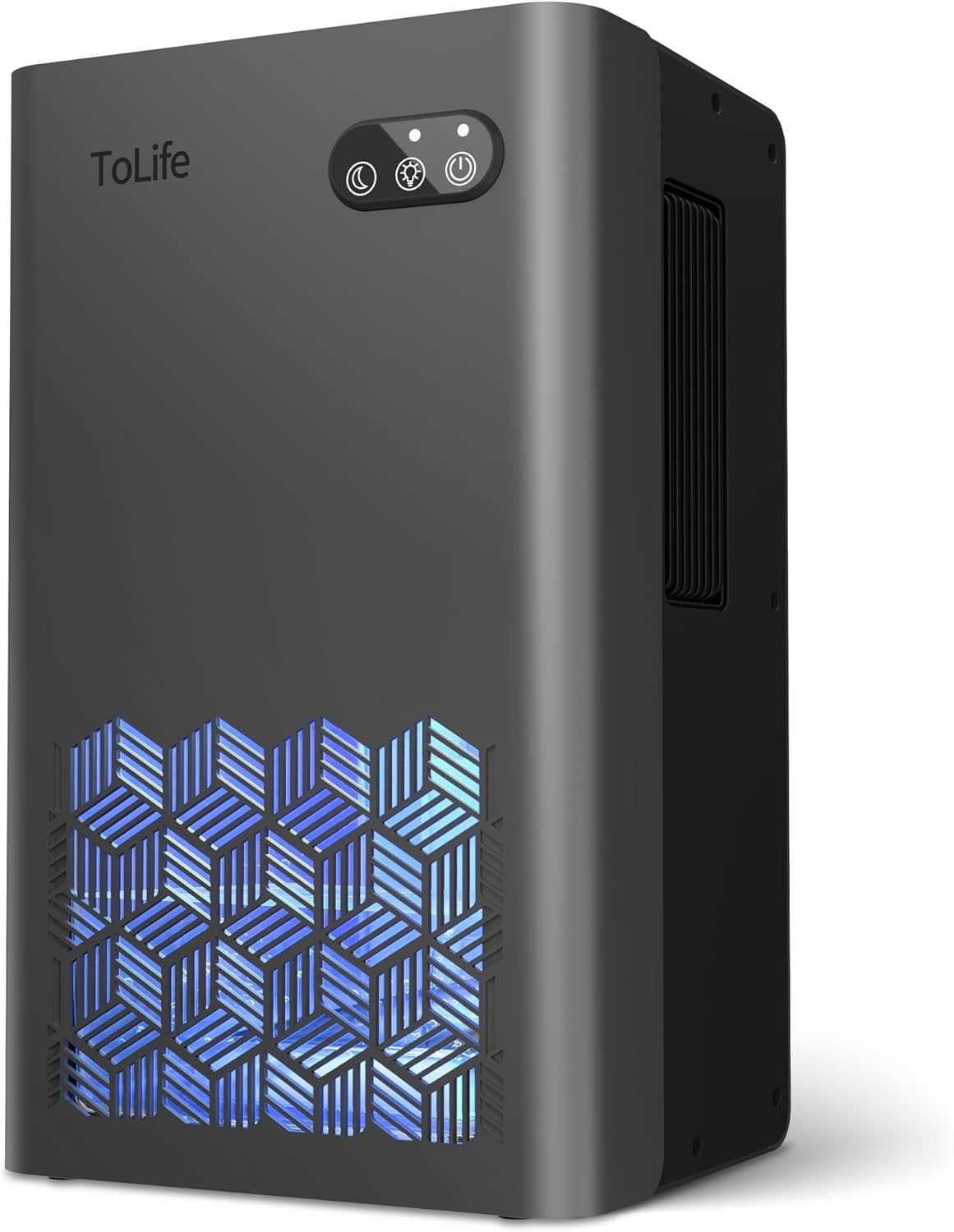
ToLife Dehumidifier TZ-C2
| Floor Area | 1000 |
|---|---|
| Tank Volume | 95 fluid ounces |
| Number of Speeds | 2 |
| Wattage | 93 watts |
| Voltage | 220 volts |
The ToLife TZ-C2 uses semiconductor condensation technology to quietly pull moisture from the air and deposit it into a removable 95 oz tank, making it a straightforward option for damp rooms. It offers two operating modes: a higher-power setting for faster moisture removal and a low-speed sleep mode that runs under 30 dB for overnight use. A seven-color LED can act as a night light and the unit includes automatic shutoff when the tank is full or removed, plus handles for easy moving between rooms. Practical benefits include simple setup, low noise, and a compact footprint that fits in basements, bathrooms, or bedrooms. Limitations are its modest rated dehumidification capacity and stated coverage, which means it will be most effective in smaller basement zones or for spot treatments rather than drying a large, very damp basement quickly. Also this model runs on 220 volts, so electrical compatibility should be confirmed for your location.
Best for: Buyers who need an affordable, portable dehumidifier for spot dehumidifying small basement areas, bathrooms, or bedrooms and who prioritize low noise and easy portability.
Less Ideal for: People looking to dry large, very damp basements or whole-house coverage should consider a higher-capacity compressor dehumidifier instead.
- Large removable 95 oz water tank reduces how often you need to empty it
- Quiet sleep mode under 30 dB suitable for nighttime operation
- Portable design with handles for moving between rooms
- Automatic shutoff prevents overflow when the tank is full
- Dehumidification capacity is modest and may be slow in very damp or large basements
- Requires 220 volt power which may not match all household outlets
Verdict: A compact, budget-friendly portable dehumidifier that is best for quiet, small-area moisture control and occasional basement spot treatments.
Choosing the Right Dehumidifier: Key Factors to Consider
Room Size and Placement
Dehumidifier capacity must match the square footage and ceiling height of the target space. Under $100 units typically suit small rooms, bathrooms, and closets; using an undersized unit in a larger basement will leave humidity high and cause the unit to run continuously.
Placement matters for circulation and access. Position the unit where air can flow freely around intake and exhaust grilles and where the water tank or drain line is easy to reach. Avoid placing the unit directly against walls or furniture, and keep it off carpeted surfaces that block airflow.
Daily Removal Capacity
Daily removal capacity describes how much water a unit can extract in 24 hours and is the core performance metric. Budget dehumidifiers often list a small-capacity figure appropriate for damp closets or single rooms. Estimate expected moisture load from sources such as cooking, showers, or damp foundations to choose a unit with adequate removal for typical conditions.
If you live in a humid climate or have persistent dampness, prioritize higher removal rates even within the budget tier because the unit will reach target humidity more quickly and cycle less, reducing wear.
Energy Consumption and Operating Cost
Initial cost is only part of the equation; electricity use over months of operation can exceed the purchase price. Look for units with clear wattage or energy consumption figures and consider models with auto-shutoff or humidistat control to limit runtime. Lower-power compressors or thermoelectric designs can save energy in small spaces but may struggle in very humid conditions.
Estimate monthly operating cost by multiplying typical daily runtime by wattage and your local electricity rate. Choosing a slightly more efficient unit that runs less often often pays off in long-term savings.
Noise and Nighttime Use
Noise level matters if the dehumidifier will operate in a bedroom or finished living area. Budget models vary widely in sound output; some use quieter thermoelectric modules while others use small compressors that are louder but more effective. Manufacturers sometimes list decibel levels, but real-world noise depends on placement and room acoustics.
Consider models with a quiet or sleep mode if you need overnight operation. Even a modest reduction in noise can make continuous use acceptable in sleeping spaces.
Water Removal Options and Maintenance
A conveniently accessible water tank and optional continuous-drain fitting make maintenance easier. Small tanks require frequent emptying, which can be a chore if the unit runs continuously. Continuous drain capability lets you route water to a floor drain or laundry sink and avoid daily emptying, but requires suitable placement and a steady downhill run.
Also consider filter access and cleaning needs. Reusable filters save money and make upkeep simple; fixed or hard-to-reach filters increase the chance of reduced performance over time from clogged intake.
Durability and Safety Features
Budget units can vary in component longevity. Look for basic safety features such as automatic shutoff when the tank is full, tip-over protection, and thermal cutouts. These features reduce the risk of leaks, motor damage, and fire hazards.
Because inexpensive dehumidifiers are more likely to be moved between rooms, favor compact, well-built housings, easy-to-lock tank lids, and clear indicator lights that show when maintenance is required.
Thermoelectric Vs Compressor Designs
Under-$100 dehumidifiers commonly use one of two technologies. Thermoelectric units use a solid-state cooling module and have no compressor; they are compact, lightweight, and generally quieter. However, thermoelectric designs usually remove less moisture per day and become less effective at lower temperatures.
Compressor-based mini dehumidifiers resemble small refrigerator systems and typically have stronger moisture removal for the same footprint, but they are heavier and can be louder. In borderline chilly spaces, compressor units usually outperform thermoelectric designs.
- Thermoelectric: Quiet, light, best for small enclosed spaces.
- Compressor: Higher removal rate, better in cooler or very humid rooms.
Estimating Runtime and Tank Frequency
Calculate how often you will need to empty the tank by comparing the unit's daily removal claim to the tank capacity. For example, a unit rated to remove 20 pints per day but with a 1-pint tank will require frequent servicing if used at high humidity levels. In real use, removal will be lower than the maximum rating, but tank size still governs emptying frequency.
If you prefer low-maintenance operation, prioritize units with larger tanks or continuous drain fittings. Also check whether the unit supports a gravity drain or requires a pump for remote drainage.
- Match tank size to expected daily removal to avoid multiple daily emptyings.
- Continuous drain reduces maintenance but needs proper placement.
Using Dehumidifiers Safely in Living Spaces
Place the dehumidifier away from direct sunlight and heat sources to avoid overheating. Ensure the cord is undamaged and routed to avoid tripping hazards. Empty tanks carefully to prevent spills, and inspect seals for leaks occasionally.
Run the unit intermittently when humidity is modest and continuously only for persistent dampness. Monitor room humidity with a standalone hygrometer if the unit lacks a reliable humidistat; maintaining relative humidity between 45 and 55 percent is a practical balance between comfort and mold prevention.
- Keep intake and exhaust unobstructed for safe and efficient operation.
- Use a hygrometer to confirm target humidity when the built-in control is basic.
Where Budget Units Excel and Where They Fall Short
Budget dehumidifiers under $100 are great for spot treatment: controlling musty odors in a single closet, protecting tools and fabrics in a small garage cabinet, or lowering humidity in a compact bathroom. Their compact size and low cost make them easy to move and replace.
They are not designed for whole-basement dehumidification or large open-plan areas. Expect slower recovery times after heavy moisture events and potentially higher long-term operating time compared with larger, higher-efficiency models. Understand these tradeoffs when deciding whether a budget unit meets your needs.
- Ideal for small, enclosed spaces and temporary use.
- Less suitable for persistent, large-area dampness or flood recovery.
Simple Controls and Useful Features
Look for clear, simple controls: an adjustable humidistat, timer, and an indicator for full tank. Some budget units include washable pre-filters, removable tanks with easy grips, and light indicators that simplify maintenance. Features like a sleep mode or low-noise setting add value for bedroom use.
Advanced digital displays and Wi-Fi connectivity are uncommon at this price and often unnecessary for straightforward moisture control. Prioritize reliable core features over bells and whistles in this price range.
- Helpful features: adjustable humidistat, full-tank auto-shutoff, continuous drain option.
- Less critical: advanced displays or remote connectivity on budget models.
How We Chose the Best Dehumidifier
We focused on dehumidifiers that deliver useful moisture reduction in small- to medium-sized spaces while staying under the $100 cap. Primary evaluation criteria emphasized actual moisture removal capacity for compact rooms, measured as pints or liters per day or equivalent performance claims; steady-state energy use to estimate running cost over time; noise levels, since many budget units are used in bedrooms and finished basements; and ease of daily upkeep, including tank access, drain options, and filter cleaning. We also considered build practicality: footprint and weight for portability, control simplicity for users who want a set-and-forget device, and safety features such as automatic shutoff and tilt protection. Units that relied solely on unclear claims without clear capacity or energy specifications were excluded, as were products with user-feedback patterns indicating repeat mechanical failures. The shortlisted models therefore represent compact, economical dehumidifiers that balance removal rate, operating cost, and low-friction maintenance.
Our full evaluation process is outlined in our review methodology.
FAQ
How large of a room can a budget dehumidifier handle?
Most units under $100 are intended for small rooms, bathrooms, or closets. They can manage single-room humidity but may struggle in large, open basements or entire apartments.
Can I leave a cheap dehumidifier running overnight in a bedroom?
Often yes, if the unit has low noise and proper safety features such as full-tank shutoff. Use a quiet mode if available and place the unit away from sleeping positions to minimize disturbance.
Is continuous drain important for a compact dehumidifier?
Continuous drain is very useful if you expect long runtimes or do not want frequent emptying. It requires a nearby drain and proper hose placement but reduces daily maintenance significantly.
Will a small dehumidifier prevent mold growth?
A correctly sized unit that maintains indoor humidity in the 45 to 55 percent range can greatly reduce mold risk. Persistent mold issues from structural moisture may need professional remediation beyond a portable unit.
Do thermoelectric dehumidifiers work in cold rooms?
Thermoelectric units lose efficiency at lower temperatures and may not perform well in unheated basements. Compressor-based units typically handle cooler environments better.
Final Verdict
For budget-conscious buyers, pick the dehumidifier that most closely matches the size of the space you want to control and the typical moisture load. Prioritize units with adequate daily removal, a tank or drainage option that fits your maintenance habits, and reasonable energy use to avoid surprises on monthly bills. Accept tradeoffs: smaller, quieter thermoelectric units are convenient for bedrooms and closets, while compact compressor models give stronger removal for damp rooms. Focus on capacity, noise, and drainage design to make a confident choice within the under-$100 range.