
Note: This article contains affiliate links. If you click on these links and make a purchase, we may earn a small commission at no extra cost to you. This helps support our research and content. Read our full affiliate disclosure here.
Picking the right dehumidifier under $50 matters when you need to control humidity in tight spaces without overspending. For small rooms, closets, bathrooms, or dorms, the right compact unit keeps fabrics, finishes, and air quality from suffering while staying easy to move and maintain. This guide shortlists six top small dehumidifiers that perform well at this price point. We focus on real-world criteria that affect day-to-day use, including removal capacity, running cost, noise, and maintenance. Read on for a concise overview of what each type delivers and which features to prioritize for your space.
Top Picks at a Glance
| Best Overall The best all-around choice for most situations | BeOkay DH-A2 Dehumidifier |  |
| Best Quality Built to a higher standard if you want something more solid | ubbo Z18 95oz Dehumidifier |  |
| Best Value The sweet spot between price and what you get | BREEZOME MCS008 60 oz Dehumidifier |  |
| Best Budget The cheapest option that still gets the job done reliably | Eva-Dry Mini Dehumidifier E-333 |  |
| Top Rated A top-rated pick with lots of positive feedback | CLEVAST CL-DH04 30 oz Dehumidifier |  |
| Most Popular A crowd favorite that many people choose with confidence | TABYIK 35oz Dehumidifier DH-CS01 |  |
BeOkay DH-A2 Dehumidifier

| Capacity | 1657 ml |
|---|---|
| Floor Area | 230 square_feet |
| Number of Speeds | 3 |
| Wattage | 28 watts |
| Tank Volume | 1657 ml |
The BeOkay DH-A2 is a small, user-friendly dehumidifier made for bedrooms, bathrooms, and other enclosed spaces up to about 230 sq ft. It uses a compact refrigeration or semiconductor dehumidifying system to collect moisture into a 1657 ml tank and offers three operating modes (sleep, normal, performance) so you can balance quiet running and faster moisture removal. Practical controls include five timer settings (24–96 hours plus continuous), an auto shutoff that stops the unit when the tank is full or if the unit tilts, and a defrost/safety routine to keep it running in cooler conditions. The unit runs at low power (28 W) and is fairly quiet in sleep mode, making it suitable for nighttime use, and the removable transparent tank makes emptying straightforward. Decorative RGB lighting with adjustable brightness is included but is not essential to performance. Expect modest daily water removal since the listed dehumidification capacity is low, so it is best for maintaining comfort in small, moderately damp rooms rather than tackling severe damp or large spaces.
Best for: Buyers who want an affordable, low-power dehumidifier to maintain comfortable humidity in small rooms and prefer quiet, simple controls with a large removable tank.
Less Ideal for: People needing high-capacity moisture removal for basements, large rooms, or chronic damp problems should choose a larger, higher-capacity unit.
- Generous 1657 ml removable water tank reduces how often you need to empty it
- Three operating modes including a quiet sleep mode suitable for bedrooms
- Five timer options for scheduled runs and an auto shutoff for overflow and tilt protection
- Low power draw at 28 watts for energy-efficient continuous use
- Low listed dehumidification capacity (0.3 liters/day) limits effectiveness in very damp or large spaces
- Not intended for heavy-duty or industrial dehumidification needs
Verdict: A compact, energy‑efficient dehumidifier that keeps small rooms comfortable with quiet operation and a large removable tank at a wallet-friendly price.
ubbo Z18 95oz Dehumidifier

| Floor Area | 1000 square_feet |
|---|---|
| Capacity | 95 fluid ounces |
| Dehumidification Capacity | 1.2 liters_per_day |
| Operation Mode | Automatic |
The ubbo Z18 is a compact, low-noise dehumidifier aimed at controlling humidity in small rooms, bathrooms, closets and RVs. It uses dual semiconductor condensers and is rated to extract up to 1.2 liters (about 40 oz) per day under test conditions, and collects moisture in a 95 oz removable tank or via the included drain hose for continuous operation. Controls include an 8/16/24 hour timer, sleep mode that lowers noise to about 35 dB, automatic shutoff with overflow protection and an aroma box and color night light for added convenience. The washable filter and small footprint make it easy to maintain and place in tight spots. Limitations to note are the modest daily extraction rate that suits only small or mildly damp spaces and the reliance on semiconductor cooling, which is less effective than compressor units in very humid or warm environments. For buyers prioritizing quiet, portable performance and easy drainage under budget constraints, the Z18 delivers sensible features in a compact package.
Best for: Buyers who need a quiet, portable dehumidifier for small rooms or occasional moisture control and who prioritize low noise and convenient drainage over high extraction rates.
Less Ideal for: Do not choose this unit for whole-room basement dehumidifying, large damp spaces, or continuous heavy-duty moisture removal needs.
- Compact footprint fits small rooms, bathrooms, closets and RVs
- Includes removable 95 oz tank plus drain hose for continuous drainage
- Very quiet sleep mode (about 35 dB) suitable for bedrooms
- Timer function and automatic shutoff with overflow protection enhance convenience
- Washable filter and simple controls make maintenance easy
- Maximum dehumidification rate (1.2 L/day) is modest and best for small or mildly damp spaces
- Semiconductor condenser design is less powerful than compressor-based units in high humidity
Verdict: A quiet, easy-to-use compact dehumidifier that provides convenient drainage and low-noise operation for small spaces under a tight budget.
BREEZOME MCS008 60 oz Dehumidifier

| Capacity | 1.8 liters |
|---|---|
| Dehumidification Capacity | 0.56 liters/day |
| Wattage | 48 watts |
| Number of Speeds | 2 |
| Floor Area | 350 square_feet |
This compact BREEZOME MCS008 uses dual semiconductor condensers to pull moisture from small spaces like bathrooms, closets and RVs and stores it in a 1.8 L (60 oz) removable tank. It runs in two fan speeds plus a quiet sleep mode and offers a 12/24/36/48-hour timer so you can limit run time and avoid wasted energy. The unit claims up to about 700 ml air flow and around 0.56 L dehumidification per day under test conditions, and it includes an auto shut-off that stops the unit and flashes a light when the tank is full. At 48 watts it is lightweight and portable with a built-in handle and a defrost function for cold conditions, and an adjustable multi-color night light if you want ambient lighting. Expect modest daily water removal compared with compressor models, so it is best for spot use and maintaining dryness in small, enclosed areas rather than whole rooms; emptying the tank periodically is still required despite the larger 1.8 L capacity.
Best for: Buyers who want an affordable, portable dehumidifier to control humidity in small, enclosed spaces and prefer low power draw and timer control over high extraction rates.
Less Ideal for: People who need rapid moisture removal for large rooms, basements, or severe damp problems should choose a higher-capacity compressor dehumidifier instead.
- Dual semiconductor condensers designed to increase small-unit moisture removal
- Large 1.8 L (60 oz) removable tank with auto shut-off to prevent overflow
- Portable, lightweight housing with built-in handle and quiet 35 dB sleep mode
- Programmable timer (12/24/36/48 hours) to limit run time and save energy
- Semiconductor dehumidification yields much lower daily extraction than compressor units, limiting use to small spaces
- Performance drops in cooler environments despite built-in defrost, so output is modest near the 30 °C rating
Verdict: A low-cost, energy-light portable dehumidifier that is practical for spot control and small spaces under tight budgets.
Eva-Dry Mini Dehumidifier E-333

| Floor Area | 333 square_feet |
|---|---|
| Capacity | 6 ounces |
| Dehumidification Capacity | 0.38 pints_per_day |
| Operation Mode | Continuous |
| Wattage | 22.5 |
The Eva-Dry E-333 is a rechargeable, wireless mini dehumidifier that uses crystallized silica gel to pull moisture from small enclosed spaces like closets, cars, bathrooms, and gun safes. It is simple to use: hang or place the unit where humidity is a problem, and the indicator beads change color to show when it needs recharging. The device is advertised to capture about 4 to 6 ounces of moisture and operate for roughly 20 to 30 days between recharges, making it useful for intermittent humidity control rather than continuous whole-room drying. Because it is cordless and contains no liquid reservoir or compressor, there are no leaks, no noise, and no electricity needed during operation. Limitations are its very low daily capacity and suitability only for small volumes of air; it will not replace an electric dehumidifier for basements or large rooms and requires periodic recharging of the silica gel media rather than emptying a tank.
Best for: Buyers who want an inexpensive, maintenance-light way to control humidity in small spaces and prefer a cordless, leak-free solution over an electric dehumidifier.
Less Ideal for: People who need to remove significant moisture from large rooms, basements, or continuously damp environments should choose a powered dehumidifier with a larger daily capacity.
- Cordless, rechargeable silica gel design requires no batteries or constant power
- Compact and lightweight for placement in closets, cars, cabinets, and safes
- Visual moisture indicator shows when recharging is needed
- No risk of leaks or spills because it does not collect liquid
- Very low dehumidification capacity, suitable only for small, enclosed spaces
- Requires periodic recharging rather than continuous electric operation
Verdict: A very affordable, cordless option for keeping small enclosed spaces dry without electricity or messy tanks.
CLEVAST CL-DH04 30 oz Dehumidifier
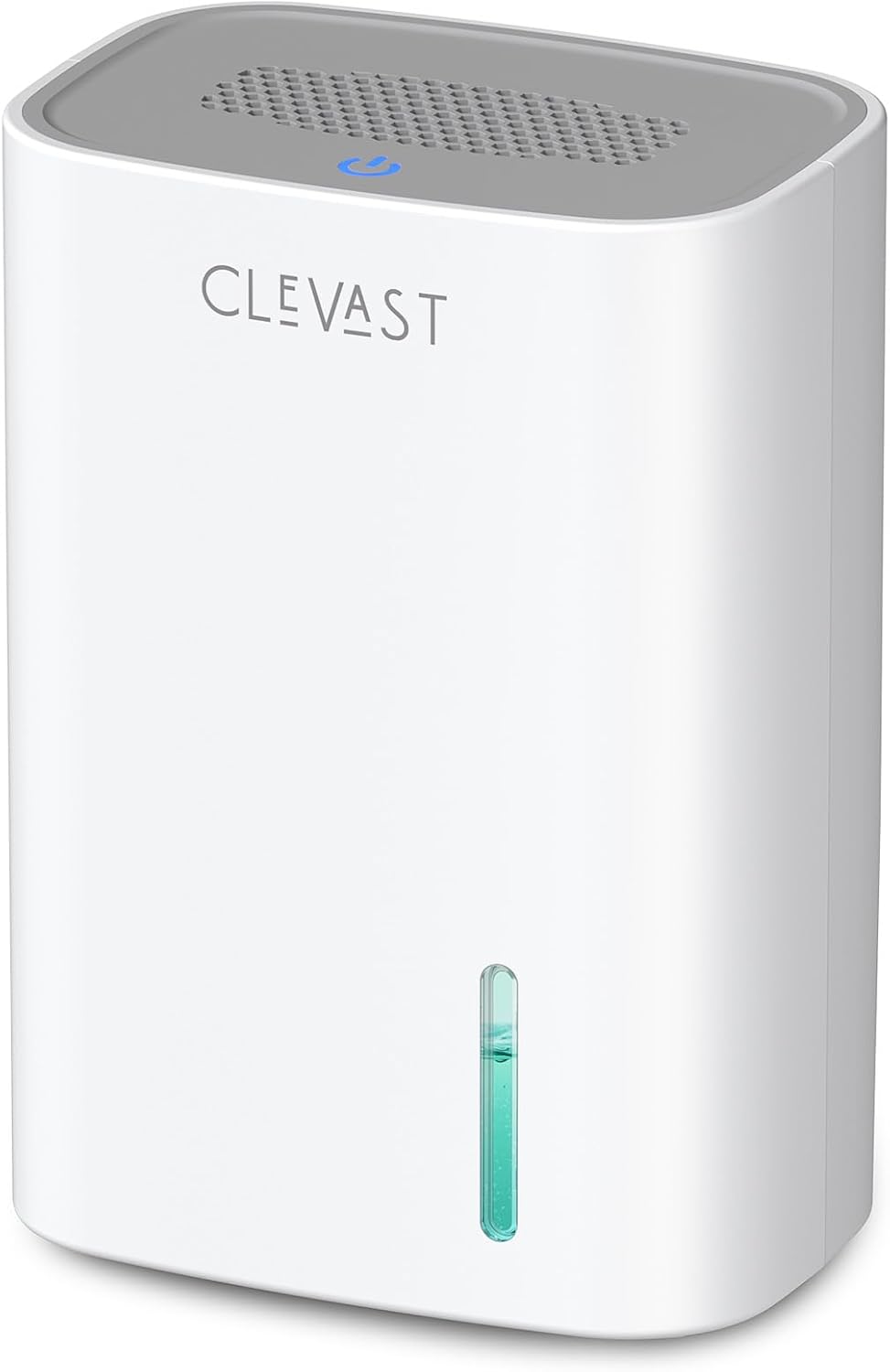
| Capacity | 30 fluid ounces |
|---|---|
| Dehumidification Capacity | 0.3 liters_per_day |
| Wattage | 27 watts |
| Number of Speeds | 2 |
| Air Flow Capacity | 2000 cubic_feet_per_hour |
The CLEVAST CL-DH04 is a small, portable dehumidifier intended for enclosed spaces like bedrooms, bathrooms, closets, and RVs. It uses semiconductor condensation rather than refrigerant, runs quietly (as low as 24 dB), and has two operating modes for either quiet nighttime use or higher-efficiency dehumidification. The 30 oz removable tank and automatic shut-off simplify maintenance and prevent overflow, while a built-in carry handle makes it easy to move between rooms. Its claimed dehumidification rate is modest — up to about 10 oz (295 ml) per day under ideal warm, humid conditions — so it is best for controlling dampness in small areas rather than drying large, very wet spaces. The unit is energy efficient at roughly 0.55 kWh per day and includes basic protections such as overheat protection and a simple one-button control scheme, but performance drops outside the recommended 68°F–86°F operating range and it can underperform in cooler rooms. For a budget under $50, it delivers quiet, low-power moisture control for small, everyday uses.
Best for: Buyers who need a dependable, low-noise dehumidifier to maintain comfort in small, enclosed spaces and prioritize straightforward, low-maintenance operation.
Less Ideal for: People needing to dry very damp rooms, basements, or large open areas should choose a higher-capacity dehumidifier instead.
- Very quiet operation down to 24 dB suitable for bedrooms and nurseries
- Energy efficient consumption at about 0.55 kWh per day
- 30 oz removable tank with automatic shut-off prevents overflow
- Lightweight and portable with a built-in carry handle for easy relocation
- Low daily dehumidification capacity (around 0.3 L/day or ~10 oz) limits use to small, mildly damp spaces
- Performance declines outside the 68°F–86°F recommended temperature range
Verdict: If you want a quiet, energy-efficient dehumidifier for a bedroom, bathroom, or RV under $50, this compact CLEVAST unit is a practical, low-maintenance choice.
TABYIK 35oz Dehumidifier DH-CS01

| Tank Volume | 1000 ml |
|---|---|
| Dehumidification Capacity | 0.45 liters_per_day |
| Wattage | 40 watts |
| Operation Mode | Continuous |
| Number of Speeds | 1 |
The TABYIK 35oz dehumidifier is a small Peltier-style unit meant to remove light dampness from bedrooms, bathrooms, closets and RVs. It runs continuously and collects up to about 16 oz (450 ml) per day under warm, humid conditions while drawing roughly 40 watts, so it is suitable for day-to-day damp-control rather than heavy basement drying. Operation is simple: a single-button control, a visible 1000 ml tank with an easy-grip groove, and an auto shut-off that stops the unit near 700–800 ml and flashes a warning light. The unit also offers a seven-color ambient light you can turn off and advertises an ultra-quiet 28 dB noise level for night use. Practical strengths are its portability, low energy draw, and straightforward maintenance (removable tank and washable intake filter). Limitations are modest extraction capacity and reliance on Peltier technology, which performs best in warmer, higher-humidity rooms and is slower than compressor models for large or very damp spaces.
Best for: Buyers who prioritize simple, proven performance and social proof from other users and need an inexpensive, low-maintenance unit for small rooms or travel use.
Less Ideal for: Do not choose this if you need fast drying for basements, whole houses, or consistently high-humidity spaces where a compressor dehumidifier is required.
- Large transparent 1000 ml tank with easy-removal groove for simple emptying and cleaning
- Very quiet operation around 28 dB suitable for bedrooms and offices
- Low power draw (~40 watts) for economical continuous use
- Auto shut-off near full tank prevents overflow and signals with a flashing light
- Low dehumidification rate (about 0.45 liters/24 hrs) so not suitable for very damp or large areas
- Single speed limits control over extraction rate and makes performance weather-dependent
Verdict: A compact, energy-frugal dehumidifier that delivers quiet, easy-to-maintain moisture control for small spaces and budget-conscious buyers.
Choosing the Right Dehumidifier: Key Factors to Consider
Moisture Removal Capacity (Pints Per Day)
A dehumidifier's stated removal capacity indicates how much water it can extract in 24 hours, and this matters more for bigger or damper rooms. Under $50 models are typically designed for small areas, so match the capacity to the space: closets and small bathrooms need far less extraction than a damp basement.
If your room is only slightly humid, a lower-capacity unit will suffice and run less often, which saves energy. For persistently damp conditions or larger single rooms, prioritize higher removal numbers within the budget and combine the dehumidifier with ventilation or source control to get the best results.
Energy Efficiency And Running Cost
Budget dehumidifiers can have surprisingly different electrical draw, and efficiency affects monthly operating expenses. Look for units with sensible wattage relative to their removal capacity; a device that removes more moisture per watt used will cost less to run over time.
Since these units may run many hours in humid weather, even modest differences in consumption add up. Favor models with intermittent or adjustable operation modes, timers, or built-in humidistats when available, because those features reduce runtime and therefore energy use.
Noise Level And Usability In Living Spaces
Noise is a practical constraint for where you can place a dehumidifier. Units under $50 are often small and use compact fans that can still be loud in quiet rooms. If you plan to run the unit in a bedroom, office, or living room, choose one with a lower reported noise level or user-friendly settings to avoid disturbance.
Assess whether the device has speed settings, a quiet mode, or a timer so it can run mainly during less sensitive hours. Also consider where the unit will sit; placing it on soft surfaces or away from sleeping areas reduces perceived noise.
Water Collection And Ease Of Maintenance
How a unit handles collected water and how easy it is to maintain are major quality-of-life issues. Common options include removable collection buckets, drain ports for continuous drainage, or small trays that must be emptied often. Under $50 models usually rely on removable tanks that should be easy to remove, empty, and reattach without spillage.
Filter access and the need for periodic cleaning matter, too. Even without replaceable filters, a design that allows wiping internal surfaces and rinsing the tank will reduce odor and mold risk. Prioritize straightforward, tool-free maintenance for day-to-day convenience.
Size, Placement, And Portability
Compact dimensions and light weight are key advantages of budget dehumidifiers. Consider where you will place the unit and whether you will move it between rooms. Smaller units fit into closets, bathrooms, and under counters more easily, while still delivering useful moisture control.
Check for integrated handles or grips and a stable base. A unit that is easy to pick up and reposition makes seasonal and situational use more practical. Bear in mind that very small units have limited capacity and may need more frequent attention.
Safety Features And Auto-Shutoff
Safety matters when running any appliance near water. Look for automatic shutoff when the tank is full, a secure tank latch to prevent leaks, and basic electrical safety certifications where applicable. These features reduce the chance of accidental spills or overheating if the unit runs unattended.
Some designs also include overflow protection or an indicator light for a full tank. Even at low price points, these simple safeguards improve reliability and help you run the unit with less oversight.
Best Rooms And Use Cases For Budget Dehumidifiers
Small, low-cost dehumidifiers are optimized for confined spaces that develop localized moisture problems. Ideal locations include bathrooms with poor ventilation, laundry rooms near drying racks, enclosed closets storing seasonal textiles, and small dorm rooms where humidity spikes can cause discomfort or mildew.
- Bathrooms and powder rooms with limited airflow
- Closets or wardrobes to prevent musty odors
- Under-sink or cabinet areas with occasional dampness
- Single small bedrooms or home office spaces where ventilation is limited
Placement Tips To Maximize Effectiveness
Placement strongly influences how quickly a compact unit will reduce humidity. Position the dehumidifier near the source of moisture but not directly against walls or fabrics; allow a few inches of clearance for air intake and exhaust. Elevating the unit a little off the floor can improve airflow and reduce dust intake.
- Avoid tight enclosures that block airflow
- Keep several feet from bed or seating areas to reduce perceived noise
- Place on a level, water-resistant surface to catch accidental drips
- Use a small hose adapter if the model supports continuous draining to avoid frequent emptying
Managing Condensation And Odor
Budget units can prevent condensation on windows and walls if sized appropriately and used with good ventilation. Empty the tank regularly and clean surfaces to prevent musty smells. If odors persist, a brief wipe with a mild vinegar solution will reduce microbial growth without harsh chemicals.
- Empty and rinse the tank at least weekly in humid climates
- Wipe intake grills to prevent dust buildup that reduces airflow
- Consider a small desiccant pack for enclosed storage spaces to supplement mechanical dehumidification
When To Combine With Other Moisture Control Steps
A dehumidifier is most effective when combined with basic source-control and ventilation. Fix leaks, run exhaust fans during showers or cooking, and dry wet items promptly. In spaces where humidity is driven by building issues, portable units help but do not replace structural fixes.
- Use exhaust fans and vents to reduce input humidity
- Avoid drying large loads of laundry indoors near the dehumidifier
- Address plumbing or roof leaks that introduce continuous moisture
How We Chose the Best Dehumidifier
We prioritized small, affordable dehumidifiers that reliably remove moisture while staying simple to use and maintain. Our selection filters favored units designed for confined spaces, with clear removal-rate specifications appropriate for bathrooms, closets, and single rooms. Practical durability and ease of upkeep were essential: models had to offer accessible water collection, straightforward controls, and basic safety features such as auto-shutoff for full tanks. Energy use and operational noise were weighted heavily because low-priced units can vary widely in those areas; efficient operation reduces monthly running costs and lower noise improves usability in living spaces. We also considered physical size and portability so the units fit where homeowners usually need them. Units lacking clear performance specs, requiring complicated maintenance, or with known safety concerns were excluded. The final picks represent compact, easy-to-service dehumidifiers that balance capacity, efficiency, and everyday convenience.
Our full evaluation process is outlined in our review methodology.
FAQ
How big of a space will an under-$50 dehumidifier cover?
Most budget dehumidifiers are sized for small rooms, closets, or bathrooms. Coverage varies by removal capacity and local humidity; expect effective control in spaces under about 150 square feet for the smallest units.
Can I leave a cheap dehumidifier running all day?
Often yes, but consider energy use and tank capacity. Continuous operation is fine if the unit has auto-shutoff or a drain option and you are comfortable with the running cost. Use timers or a humidistat to limit unnecessary runtime.
How often do I need to empty the water tank?
Frequency depends on humidity level and extraction rate. In very humid conditions you may need to empty a small tank daily, while moderate climates may allow weekly emptying. Models with larger tanks or continuous drain options reduce this chore.
Will a small dehumidifier stop mold growth?
Reducing humidity helps slow mold growth but does not remove existing mold. For prevention, keep relative humidity below about 50 percent and clean any mold-prone surfaces. Severe mold problems usually require professional remediation and source correction.
Are filter replacements required for these devices?
Many compact units use washable screens rather than replaceable filters. Regular cleaning of intake screens and the tank prevents dust buildup and odors. If a model includes a disposable filter, follow the manufacturer's interval for replacement.
Final Verdict
For small spaces and spot moisture problems, a dehumidifier under $50 can be a practical, low-cost solution. Prioritize removal capacity appropriate to the room size, low energy draw, manageable noise, and easy tank handling to minimize daily upkeep. Balance portability and runtime features against tank size and efficiency: choose a compact unit that fits the intended location, offers simple maintenance, and includes basic safety features. With that approach you can control humidity effectively without overspending or frequent intervention.