
Note: This article contains affiliate links. If you click on these links and make a purchase, we may earn a small commission at no extra cost to you. This helps support our research and content. Read our full affiliate disclosure here.
If you need continuous moisture control without frequent emptying, a dehumidifier with condensate pump can save time and prevent water damage. These units automatically lift condensate to a drain, letting you run the dehumidifier in basements, utility rooms, or other low-lying areas where gravity drainage is impractical. This guide covers seven shortlisted dehumidifiers with condensate pump that are appropriate for whole-room and basement use. We evaluated each option on drainage reliability, moisture-removal capacity, ease of installation, and everyday usability. Read on to find the features and tradeoffs that matter most for steady, low-hassle dehumidification.
Top Picks at a Glance
| Best Overall The best all-around choice for most situations | Midea 50 Pint Dehumidifier |  |
| Best Quality Built to a higher standard if you want something more solid | ALORAIR Sentinel HDi65S |  |
| Best Value The sweet spot between price and what you get | Vellgoo DryTank Dehumidifier |  |
| Best Budget The cheapest option that still gets the job done reliably | Uhome UDZ1-150P/P Dehumidifier |  |
| Top Rated A top-rated pick with lots of positive feedback | avylo 90-Pint Dehumidifier ADC018 |  |
| Most Popular A crowd favorite that many people choose with confidence | AEOCKY LEO Dehumidifier |  |
| Best Seller A high-volume bestseller chosen again and again | Shinco 150-Pint Dehumidifier SDZ1-150P-W |  |
Midea 50 Pint Dehumidifier

| Capacity | 50 pints per day |
|---|---|
| Floor Area | 4500 square_feet |
| Tank Volume | 1.6 gallons |
| Number of Speeds | 3 |
| Wattage | 470 watts |
The Midea 50 Pint Dehumidifier with Pump is a large-capacity portable unit aimed at controlling humidity in basements and big rooms up to 4,500 sq. ft. It removes up to 50 pints per day and offers adjustable humidity settings plus three fan speeds for targeted moisture control. The built-in pump enables vertical or horizontal continuous drainage so you can route water to a sink or out a window without emptying the 1.6 gallon bucket, and the washable filter helps reduce maintenance costs. Smart features include Wi‑Fi connectivity with app control and voice commands via Alexa or Google Assistant, which is useful for remote monitoring. Practical touches like a 24-hour timer, quiet low-mode operation, and four wheels for portability make it easy to move and run overnight. Important limitations are its size and weight compared with smaller home units and that effective capacity depends on room conditions and temperature. For someone needing robust, hands-off drainage and smart control in large spaces, this model delivers dependable performance.
Best for: Buyers who want a powerful, low-maintenance dehumidifier with hands-off drainage and smart controls for large basements or open living spaces.
Less Ideal for: Those needing a lightweight, compact unit for a small bedroom or for portable spot dehumidifying should consider smaller-capacity models instead.
- Built-in pump supports vertical or horizontal continuous drainage so the tank rarely needs manual emptying
- Removes up to 50 pints per day, suitable for large basements and rooms up to 4,500 sq. ft.
- Wi‑Fi and voice control allow remote monitoring and adjustments via app, including timers and humidity set points
- Washable reusable air filter reduces ongoing filter replacement costs
- Quiet low-mode operation and caster wheels make it practical for nighttime use and relocation
- Relatively large and heavy compared with smaller home dehumidifiers, which can limit placement options
- Performance can decline at colder temperatures near the unit's upper temperature rating, so very cold basements may require different solutions
Verdict: Choose this model if you need a high-capacity dehumidifier with a built-in pump and smart controls to manage humidity in large basements or open areas with minimal maintenance.
ALORAIR Sentinel HDi65S
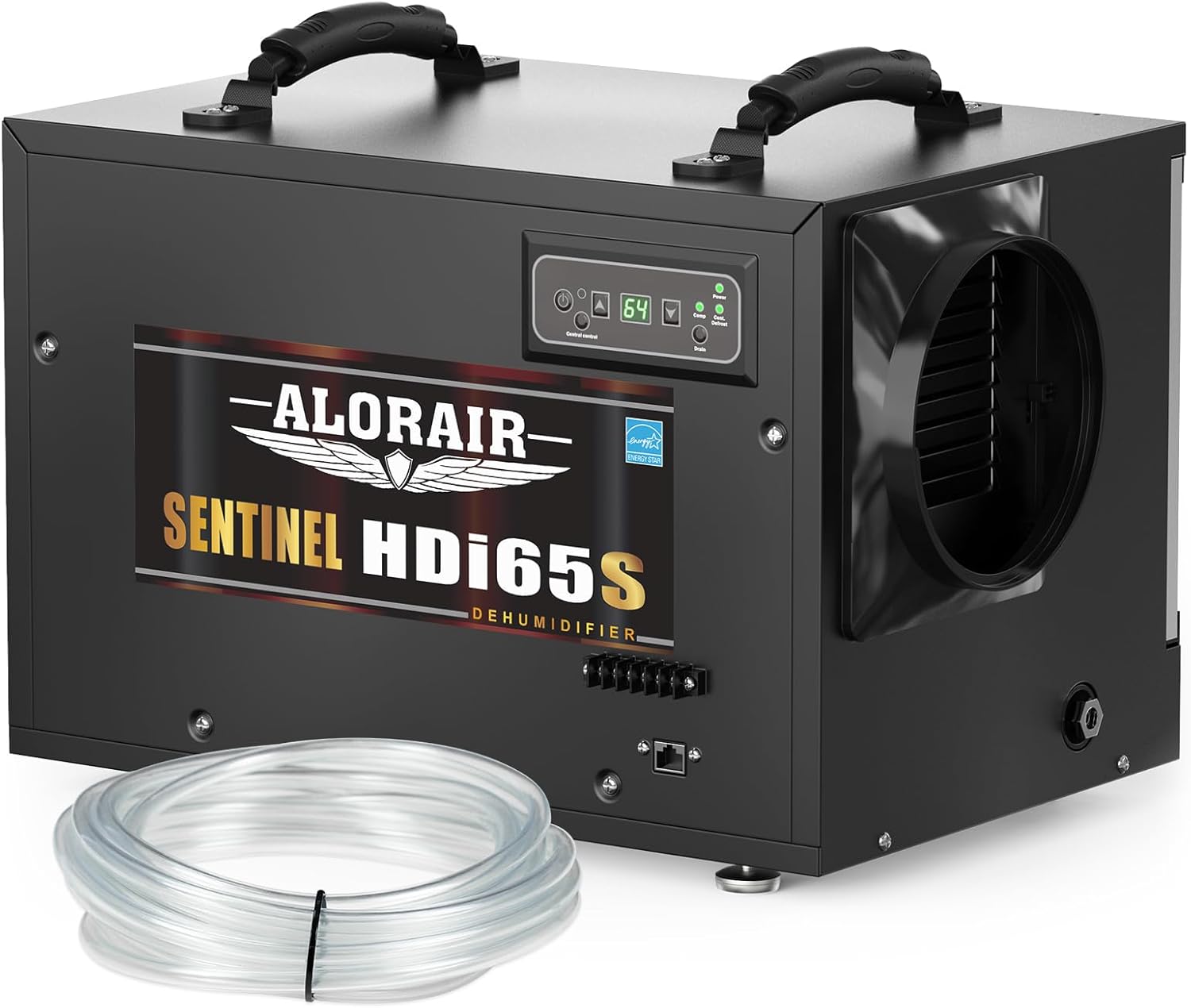
| Capacity | 120 pints |
|---|---|
| AHAM Dehumidification | 55 pints/day |
| Air Flow Capacity | 130 cfm |
| Wattage | 500 watts |
| Floor Area | 1300 square_feet |
The ALORAIR Sentinel HDi65S is a compact, heavy-duty dehumidifier designed for crawl spaces, basements, garages and light commercial spaces where continuous moisture removal is needed. It removes up to 120 pints per day at saturation (55 PPD by AHAM) and pushes air at about 130 CFM while using an integrated condensate pump that can lift condensate up to 19.6 feet, so you can route discharge to a sink or elevated drain without external plumbing. The unit includes auto-defrost for reliable low-temperature operation, washable reusable filter, adjustable humidity control and an adjustable foot and carrying handle to ease placement in tight or low-clearance areas. Built metal casing and cETL/ETL listing reflect a commercial focus and Energy Star labeling helps efficiency. Trade-offs are its industrial intent: it is heavier and larger than consumer room models and assumes professional-style installations and occasional maintenance of the pump and filter to sustain peak performance.
Best for: Buyers who prioritize continuous, high-capacity moisture removal for crawlspaces, basements or light commercial spaces and need the convenience of an integrated pump for elevated drainage.
Less Ideal for: Those who need a lightweight, quiet portable room dehumidifier for living spaces or users who prefer a simple plug-and-play consumer model without professional-style installation.
- Built-in condensate pump with up to 19.6 ft lift for flexible drainage options
- High removal capability (120 pints/day at saturation; 55 PPD AHAM) suitable for damp crawl spaces and basements
- Auto-defrost and low-temperature operation for reliable performance in cool environments
- Durable metal housing and commercial safety listing for long-term, heavy-duty use
- Heavier and more industrial than consumer portable units, which can make moving or installing it harder
- 120 pint/day rating is measured at saturation and actual AHAM performance is lower (55 PPD)
Verdict: Choose the Sentinel HDi65S when you need a compact, commercial-grade dehumidifier with a built-in pump to reliably remove large volumes of moisture from crawlspaces or basements.
Vellgoo DryTank Dehumidifier

| Dehumidification Capacity | 100 pints_per_day |
|---|---|
| Capacity | 100 pints |
| Tank Volume | 1.45 gallons |
| Wattage | 400 watts |
| Voltage | 120 volts |
The Vellgoo DryTank is a high‑capacity dehumidifier designed to handle large, damp spaces such as basements and big homes. It removes up to 100 pints per day under extreme conditions and offers an internal 1.45‑gallon tank plus three drainage choices: included gravity hose, garden‑hose adapter, or the built‑in pump that lifts water up to 16.4 feet for convenient continuous drainage. Controls include real‑time humidity readout, three operating modes, 24‑hour timer, auto defrost, auto restart, and full‑bucket alerts, and a washable filter simplifies maintenance. Energy Star Most Efficient certification and a rotary compressor promise lower energy use compared with standard units, which helps in long‑run operating cost. On the downside it is a large floor unit and requires space and a dedicated 120V outlet, and noisy compressor cycling can be expected at high extraction rates. For homeowners needing heavy moisture removal with flexible pumped drainage, the DryTank covers practical needs with energy efficiency and useful controls.
Best for: Buyers who want a practical, energy‑efficient solution for very damp areas and prioritize reliable continuous drainage and lower operating costs.
Less Ideal for: People needing a compact, ultra‑quiet bedroom dehumidifier or those with very small spaces where a lower‑capacity unit would suffice.
- High extraction rate up to 100 pints per day for rapid moisture removal
- Built‑in condensate pump with 16.4 ft lift for upward or remote drainage
- ENERGY STAR Most Efficient rating for lower energy consumption
- Multiple drainage options and included drain hose for flexible setup
- Simple controls with real‑time humidity display, timer, auto defrost, and washable filter
- Physically large unit that needs floor space and a nearby 120V outlet
- Compressor operation can be audible when running at high capacity
Verdict: If you need powerful, energy‑efficient moisture removal with a factory‑built pump for hassle‑free continuous drainage, this unit is a strong, practical choice.
Uhome UDZ1-150P/P Dehumidifier

| Dehumidification Capacity | 150 pints/day |
|---|---|
| Floor Area | 7000 square_feet |
| Tank Volume | 1.85 gallons |
| Wattage | 460 watts |
| Other Special Features of the Product | Automatic Defrost, Built-In Pump, Digital Display |
The Uhome UDZ1-150P/P is a high-capacity dehumidifier intended for very large rooms, basements, or storage areas where heavy moisture is a problem. It extracts up to 150 pints per day (rated under high temperature/humidity conditions) and offers a 7 liter removable tank plus a built-in condensate pump for automatic drainage, which removes the need to empty the bucket in many installations. Controls include a digital display with humidity set points (30%–80% in 5% steps), a 24-hour timer, child lock, and two fan speeds for basic customization. Practical benefits include automatic defrost for cool spaces, a dry-clothes function that directs airflow upward, and multiple drainage options (manual, continuous gravity, or pumped hose). Expect noticeable energy draw at higher output and a sizeable, heavy cabinet that suits permanent placement rather than frequent moves. Noise can reach around 48 dB at peak, so it is not silent but is reasonable for industrial-scale dehumidification. For buyers who need strong moisture removal plus pump drainage, this unit provides a straightforward, feature-complete solution.
Best for: Buyers on a budget who need powerful, no-fuss moisture removal and pump drainage for large basements, storage rooms, or whole lower-level spaces and prioritize function over compact size.
Less Ideal for: People who need a lightweight, ultra-quiet, or decorative unit for small bedrooms or living rooms should consider smaller, quieter models instead.
- High maximum dehumidification capacity (up to 150 pints/day) suitable for very large spaces
- Built-in condensate pump and long hose option allow automatic drainage without external plumbing
- Digital display with humidity set points, 24-hour timer, and child lock make operation simple and safe
- Auto-defrost and dry-clothes mode add useful, real-world convenience for cold spaces and laundry
- Relatively high power draw at 460 watts when running at full capacity
- Large and heavy unit is less convenient to move between rooms
- Noise level around 48 dB may be noticeable in quiet living areas
Verdict: If you need heavy-duty dehumidification with a built-in pump for hands-free drainage in large spaces, this Uhome unit delivers the essential power and features for the job.
avylo 90-Pint Dehumidifier ADC018

| Dehumidification Capacity | 90 pints_per_day |
|---|---|
| Floor Area | 4500 square_feet |
| Tank Volume | 2.11 gallons |
| Number of Speeds | 3 |
| Wattage | 235 watts |
The avylo ADC018 is a high-capacity dehumidifier engineered for basements and large rooms where continuous drainage and reliable moisture control matter. It pulls up to 90 pints per day at peak conditions and pairs a high-efficiency compressor with an optimized airflow path to hit ENERGY STAR Most Efficient 2025 standards. Daily operation is economical thanks to a strong EER and the unit offers three fan speeds, an LED humidity display, and intelligent humidity control so it runs only as long as needed. The top-mounted 2.11 gallon tank has a full-tank auto shutoff and the built-in pump supports up to 15 feet of lift plus a supplied drain hose for unattended, long-term drainage. Noise is kept relatively low with a quoted 41 dB minimum and safety features include child lock and multiple electrical protections. Expect a fairly heavy, room-sized cabinet and limited portability compared with small units, and full efficiency depends on installation near a proper drain or on uninterrupted pump operation.
Best for: Buyers who prioritize dependable, long-term moisture control in large basements or commercial-style spaces and want the convenience of an integrated pump for unattended drainage.
Less Ideal for: Those needing a lightweight, highly portable dehumidifier for small rooms, closets, or occasional spot use should consider smaller models without a pump.
- High maximum dehumidification rate suitable for large basements and open areas
- Built-in condensate pump with 15 ft lift and included drain hose for continuous unattended drainage
- ENERGY STAR Most Efficient 2025 rating for lower operating cost and good efficiency
- Top-mounted 2.11 gallon tank with full-tank reminder and auto shutoff to prevent overflow
- Quiet operation down to about 41 dB and selectable fan speeds for flexible use
- Relatively heavy and bulky compared with portable home units which affects placement and moving
- Performance is best in warm, humid conditions so output will drop in cooler rooms
Verdict: This unit is the practical choice when you need a powerful, energy-efficient dehumidifier with a built-in pump for reliable, unattended drainage in large spaces.
AEOCKY LEO Dehumidifier

| Dehumidification Capacity | 80 pints_per_day |
|---|---|
| Capacity | 80 pints |
| Tank Volume | 1.45 gallons |
| Floor Area | 4500 square_feet |
| Operation Mode | Automatic |
The AEOCKY LEO is a pump-equipped compressor dehumidifier built to handle very large, damp spaces while minimizing manual emptying. It uses a rotary compressor and an integrated upward pump with a 5 m drain hose so you can install it away from floor drains and have continuous automatic drainage. The unit targets heavy-duty scenarios, claiming up to 80 pints per day and a 1.45 gallon internal tank for short-term use, and it carries an ENERGY STAR Most Efficient 2025 designation for strong energy performance. Controls include an intelligent humidistat and timer for set-and-forget operation, and the manufacturer emphasizes low vibration and quiet operation for bedroom or basement placement. Practical benefits are the pump for flexible placement, strong dehumidification for large rooms, and energy efficiency that can lower runtime costs compared with less efficient models. Important limitations are its physical footprint and tank size relative to output, which makes relying on the pump or continuous drain advisable for very wet conditions, and typical compressor noise that is higher than small thermoelectric units.
Best for: Buyers who prioritize proven performance and social proof and want a pump-equipped unit that can reliably remove large amounts of moisture without constant emptying.
Less Ideal for: People who need a near-silent, very compact dehumidifier for a small room or occasional light use should consider smaller thermoelectric models instead.
- Integrated pump with 5 m drain hose enables upward and remote continuous drainage
- High dehumidification capacity (up to 80 pints/day) suitable for large basements and whole-floor spaces
- ENERGY STAR Most Efficient 2025 rating indicates strong energy performance
- Smart humidistat, timer, and power‑off memory allow precise, automated humidity control
- Internal tank volume (1.45 gallons) is small relative to maximum output, so pump or drain use is recommended
- Compressor-style units produce more noise than small thermoelectric dehumidifiers
- Larger footprint than compact models may limit placement in tight spaces
Verdict: If you need a pump-equipped, energy-efficient compressor dehumidifier for large, persistently damp spaces, the AEOCKY LEO delivers powerful continuous drainage and high capacity you can rely on.
Shinco 150-Pint Dehumidifier SDZ1-150P-W

| Capacity | 150 pints |
|---|---|
| Dehumidification Capacity | 70 pints_per_day |
| Tank Volume | 1.85 gallons |
| Wattage | 320 watts |
| Operation Mode | Continuous |
This Shinco dehumidifier is built for large, damp spaces and pairs a high maximum removal rate with practical conveniences. It offers up to 150 pints max capacity under extreme conditions and a rated 70 pints per day dehumidification figure for typical use, plus a 1.85 gallon removable bucket and two hose options including a long pump hose for uphill drainage. The unit includes Wi‑Fi remote control and an LED touch panel so you can check and change humidity settings from a phone, and it supports continuous drainage to avoid frequent emptying. Useful features include two fan speeds, automatic defrost and restart, child lock, a 24-hour timer, washable filter, casters for portability, and a water-full alarm. As a large-capacity machine it consumes more power than small-room models and is physically substantial, so it is best placed in basements, garages, or commercial rooms rather than bedrooms. The pump and long drainage hose are standout practical benefits for installations where gravity drainage is not available.
Best for: Buyers who want a reliable, high-capacity dehumidifier with a built-in condensate pump for basements, large rooms, or commercial spaces and who prioritize hands-off drainage and remote control.
Less Ideal for: Those seeking a compact, ultra-quiet bedroom unit or a very low-power portable dehumidifier for small rooms should consider smaller models instead.
- Very high maximum dehumidification capacity suitable for large rooms and basements.
- Built-in pump with long hose option enables uphill or remote drainage without a separate condensate container.
- Wi‑Fi control lets you monitor and change settings remotely and schedule operation.
- Energy Star certification and auto-defrost help reduce operating cost and allow reliable operation in cooler conditions.
- Portable design with casters, removable bucket, and washable filter simplifies maintenance and relocation.
- Large and relatively heavy compared with small-room dehumidifiers, so not ideal for tight spaces.
- Power draw and noise at higher throughput may be noticeable during heavy-duty operation.
Verdict: If you need a high-capacity dehumidifier with an integrated pump for hands-free uphill drainage and remote control, this Shinco model is a practical, dependable choice.
Choosing the Right Dehumidifier with Condensate Pump: Key Factors to Consider
Pump Lift and Discharge Options
How high and how far the pump can move condensate determines where you can place the dehumidifier. A stronger pump lift lets you route discharge to a sink, standpipe, or higher drain point, which is especially useful in basements or utility rooms. Check both vertical lift and recommended horizontal run distances, because both affect real-life installations.
Also consider the discharge connector type and whether the unit accepts common flexible tubing diameters. A secure, standardized fitting reduces leaks and makes it easier to replace tubing later.
Moisture Removal Capacity
Moisture removal capacity is usually expressed as pints per day under standard test conditions. For damp basements or large rooms, choose higher capacity to reach target humidity faster. Remember that performance declines at lower temperatures, so a higher-rated unit gives more effective drying in cool spaces.
Think about the typical size and humidity level of the area you intend to treat. Oversizing slightly can be beneficial if the space gets intermittently very damp or if you need faster recovery after water events.
Continuous Operation and Reservoir Design
One main reason to choose a dehumidifier with a condensate pump is to avoid manual emptying. Continuous-operation features such as reliable pump cycling, large reservoirs with overflow protection, and automatic shutoff safeguards matter because they reduce maintenance and water spill risks. Look for units explicitly rated for 24/7 operation.
Reservoir design also affects how the unit behaves if the pump fails or if tubing is blocked. A well-engineered tank minimizes overflow and includes clear access for inspection and cleaning.
Controls and Automation
Practical controls make ongoing humidity management simple. An adjustable humidistat lets the unit maintain a target relative humidity automatically. Useful extras include timers, auto-restart after power loss, and selectable fan speeds to balance noise and drying rate.
If you plan to place the dehumidifier in a location you do not visit often, features like remote control, programmable schedules, or readable status indicators help you monitor operation without direct access.
Low-Temperature Performance and Defrost
Basements and crawl spaces often run cooler than living areas. Compressor-based dehumidifiers can ice up at low temperatures, which reduces efficiency and could stop the pump from moving condensate. Units with automatic defrost or cold-climate modes maintain performance and reduce service interruptions.
Consider whether the unit will be exposed to temperatures near or below freezing. If so, pick a model with explicit low-temperature ratings or a desiccant alternative if continuous performance at very low temperatures is required.
Serviceability and Filter Access
Routine cleaning and occasional repairs are easier when the dehumidifier is simple to service. Accessible air filters that are easy to remove and wash help maintain airflow and efficiency. Clear labeling for condensate fittings, simple access to the pump compartment, and widely available replacement parts make long-term ownership less frustrating.
Also assess whether routine maintenance tasks require tools or full disassembly. Units designed with tool-free access reduce downtime and lower the chance of incorrect reassembly.
Where a Pumped Dehumidifier Makes the Biggest Difference
A dehumidifier with a condensate pump is most valuable when gravity drainage is not practical. Think finished basements with no nearby floor drain, rooms below the level of the nearest sink, or laundry rooms where a continuous drain would otherwise require frequent emptying. The pump enables truly unattended operation and prevents overflow when you cannot check the unit daily.
Beyond convenience, pumped drainage reduces the need to physically carry and dump water, which lowers the risk of slips and accidental spills. For homeowners managing humidity in rental units or infrequently accessed spaces, the reliability of the pump often outweighs a small increase in complexity.
- Enables placement away from floor drains
- Supports unattended continuous operation
- Reduces manual emptying and spill risk
Installation Tips for Reliable Pumped Drainage
Plan the discharge route before you buy tubing. Keep runs as short and as straight as possible, and avoid abrupt vertical rises followed by long horizontal stretches. Secure tubing with clamps at the unit and at any connectors to prevent pull-off when the pump runs.
Set the unit on a level, vibration-damped surface and ensure the intake and exhaust have clearance for airflow. If the discharge must pass through a wall or basement window, use appropriately sized grommets or sleeves to prevent moisture and pest intrusion.
- Use the manufacturer-recommended tubing diameter
- Avoid excessive elbows and long horizontal runs
- Check seals where tubing passes through walls
Noise, Placement, and Daily Use
Pumps add intermittent noise when cycling, and the dehumidifier fan generates continuous sound while running. Place the unit where noise will not disrupt living areas, and consider lower fan-speed settings overnight. Some models include quiet modes that reduce airflow but still control humidity effectively in small to medium spaces.
Also think about clearance for airflow and access for maintenance. Even with a pumped drain, you still need to inspect filters periodically and confirm that the tubing is intact. Position the dehumidifier so you can perform these checks without moving the appliance.
- Expect occasional pump cycling noise
- Provide access for filter checks and tubing inspection
- Use lower fan speeds in noise-sensitive areas
Common Installation Mistakes to Avoid
One frequent error is using undersized or very long tubing that overwhelms the pump. A pump rated for short vertical lifts can fail when paired with excessive run length. Another mistake is routing discharge to poorly vented cavities where leaks or drips can go unnoticed.
Also avoid placing the unit directly against walls or obstructing the intake, which reduces efficiency. Finally, do not rely solely on the reservoir for overflow protection; ensure overflow safeguards and check valves are in place so condensate cannot run back into the unit when the pump is off.
- Do not use undersized or excessively long tubing
- Avoid hidden or poorly drained discharge endpoints
- Maintain clearance around intake and exhaust
When to Consider Professional Drainage Solutions
If you need to route condensate a long distance or up multiple stories, a standalone condensate pump system or professional plumbing connection may be more reliable. Professionals can install a dedicated drain line with correct slope, trap protection, and an accessible cleanout. This is especially relevant for whole-house dehumidification or installations where building codes require certain drain configurations.
Additionally, a professional can advise on electrical needs and safe placement in damp spaces. For long-term installations, investing in a proper drain solution reduces the chance of leaks, code violations, and repeated service calls.
- Long vertical or horizontal runs may need professional planning
- Permanent installations can benefit from a dedicated drain line
- Consult a professional for electrical and code compliance
How We Chose the Best Dehumidifier with Condensate Pump
We prioritized features and specifications that directly affect day-to-day performance and long-term convenience for people who need a dehumidifier with a condensate pump. Key evaluation dimensions included pump lift and discharge flexibility, continuous-run capability and reservoir size, moisture removal rate at typical household temperatures, ease of maintenance and access to filters, and control options such as automatic humidistats and timers. We also checked build features that matter in wet or cold environments, such as defrost behavior and durable condensate fittings. We excluded units that only offer basic gravity drainage with no pump, portable dehumidifiers intended only for small closets, and products lacking clear continuous-drain specifications. We did not include models with unverified or ambiguous pump performance. The resulting selections balance reliable condensate handling with practical airflow and capacity for real-world spaces, focusing on systems that let you run the unit unattended for long periods.
Our full evaluation process is outlined in our review methodology.
FAQ
How high can a typical condensate pump lift water?
Pump lift ratings vary, but many built-in condensate pumps handle several feet of vertical rise. Check the rated vertical lift and the recommended maximum horizontal run to confirm the pump matches your planned discharge route.
Can I run a pumped dehumidifier continuously?
Many condensate-pump dehumidifiers are rated for continuous operation and designed to cycle the pump safely. Still, confirm the model's continuous-run rating and look for overflow protection to prevent issues if tubing becomes blocked.
What maintenance does the pump require?
Maintenance is usually minimal. Periodically inspect and clean the reservoir and check the tubing for clogs or kinks. Some systems have a removable pump module for easier service; follow the manufacturer's guidance for any cleaning intervals.
Is a pumped unit louder than a standard dehumidifier?
Pumped units produce similar baseline fan noise to standard models, plus intermittent noise when the pump operates. In most installations the pump cycle is brief and not excessively loud, but noise sensitivity should guide placement and fan-speed choices.
Will a pumped dehumidifier work in cold basements?
It depends on the unit. Compressor-based dehumidifiers can lose efficiency or ice up at low temperatures. Choose a model with explicit low-temperature performance or an automatic defrost feature if you expect sustained cool conditions.
Final Verdict
A dehumidifier with condensate pump is a practical choice when gravity drainage is not available or when you want truly hands-off moisture control. Prioritize pump lift and discharge flexibility, continuous-run credentials, and clear service access. Balance capacity against the typical temperature and humidity of your space to ensure steady performance. Decide based on where you will place the unit and how much unattended operation you need. When you match pump rating, reservoir design, and control features to your installation, a pumped dehumidifier delivers consistent, low-maintenance humidity control with minimal daily involvement.