
Note: This article contains affiliate links. If you click on these links and make a purchase, we may earn a small commission at no extra cost to you. This helps support our research and content. Read our full affiliate disclosure here.
A dehumidifier with continuous drain removes moisture without the hassle of frequent emptying, making it ideal for damp basements, laundry rooms, and finished crawlspaces. Choosing the right unit matters because improper capacity or a poor drain setup can leave you managing water or running the machine inefficiently. This guide covers seven top-rated dehumidifiers with continuous-drain capability that made our shortlist. We explain the important performance and installation considerations—extraction rate, drain connectivity, energy efficiency, and usability—so you can pick a model that fits the size of the space and your plumbing setup. Read on for clear, practical advice before the product list.
Top Picks at a Glance
| Best Overall The best all-around choice for most situations | yaufey 80-Pint Dehumidifier |  |
| Best Quality Built to a higher standard if you want something more solid | KNKA 80-Pint Dehumidifier PD30MA-20 |  |
| Best Value The sweet spot between price and what you get | PLUSCENT 32-Pint Dehumidifier PD10 |  |
| Best Budget The cheapest option that still gets the job done reliably | Litever Mini Dehumidifier LL-VS-DH07 |  |
| Top Rated A top-rated pick with lots of positive feedback | Waykar 34 Pint Dehumidifier |  |
| Most Popular A crowd favorite that many people choose with confidence | KNKA 34-Pint Dehumidifier |  |
| Best Seller A high-volume bestseller chosen again and again | AEOCKY BOREAS-001 Dehumidifier |  |
yaufey 80-Pint Dehumidifier

| Capacity | 80 pints/day |
|---|---|
| Floor Area | up to 5000 square feet |
| Tank Volume | 1.06 gallons |
| Wattage | 275 watts |
| Air Flow Capacity | 106 cfm |
The yaufey 80‑pint dehumidifier is built for large, damp spaces and gives you two ways to remove water: a 1.06‑gallon tank with auto shutoff and a continuous drain hose connection for hands‑free operation. It is ENERGY STAR certified and claims up to 80 pints per day in very humid conditions while offering three fan speeds and four preset modes (Sleep, Living, Basement, Continuous) to simplify everyday use. The touch LED controls and precise humidity sensing make it easy to keep humidity within a selected range, and the unit includes a visible tank indicator so you can tell at a glance when it needs emptying. Practical details such as a piston compressor, copper tubing, and hydrophilic fins point to durable, efficient cooling performance. Expect moderate noise in higher fan settings and a roughly 275‑watt draw when running; the 3.28 ft included drain hose is convenient but longer hoses may be needed for some installations. For large basements or whole rooms where continuous drainage is important, this model balances capacity, energy efficiency, and straightforward controls well.
Best for: Buyers who need a high‑capacity, energy‑efficient dehumidifier for large basements or whole rooms and value easy continuous drainage and simple preset controls.
Less Ideal for: People who need a compact, ultra‑quiet unit for small bedrooms or who require very long factory drain hoses included out of the box should consider other options.
- High dehumidification capacity up to 80 pints per day for very humid conditions
- ENERGY STAR certification for better energy efficiency compared with typical non‑certified units
- Two drainage options: visible tank with auto shutoff plus continuous drain hose for unattended use
- Multiple modes and 3 fan speeds with an LED touch panel for simple, tailored humidity control
- Built with durable components including a piston compressor and copper tubing for reliable operation
- Included drain hose is relatively short so you may need a longer garden hose for some drain setups
- 1.06‑gallon tank requires periodic emptying if not using continuous drain
Verdict: Choose this model if you want a powerful, ENERGY STAR certified dehumidifier with reliable continuous‑drain capability for large damp spaces.
KNKA 80-Pint Dehumidifier PD30MA-20

| Capacity | 80 pints per day |
|---|---|
| Tank Volume | 1.45 gallons |
| Wattage | 360 watts |
| Floor Area | 4500 square_feet |
| Operation Mode | AUTO, DRY, SETTING |
The KNKA PD30MA-20 is a performance-focused dehumidifier built for large, damp spaces such as basements. Its high-efficiency compressor can remove up to 80 pints per day under extreme conditions and about 56 pints in typical basement conditions, while an internal 1.45 gallon tank plus a supplied 6.56 ft drain hose enable continuous drainage to avoid frequent emptying. Controls include AUTO, DRY, and a SETTING mode for 30%–80% RH, and the digital display with a color-changing humidity indicator makes it easy to monitor conditions at a glance. The unit is designed to run quietly (40–45 dB), has a washable filter, casters for moving between rooms, cord storage, a 12-hour timer, and a child lock for steady, unattended operation. Expect good energy efficiency thanks to ENERGY STAR certification and a 360 watt power draw, but note that humidity readings come from the air inlet and may differ slightly from a separate hygrometer; the unit also needs upright siting for 24 hours before first use. For heavy-duty basement dehumidification this model balances strong capacity with thoughtful usability features.
Best for: Buyers who need powerful, reliable moisture removal in large basements or very damp rooms and prioritize steady performance and easy continuous drainage.
Less Ideal for: People seeking a compact or ultra-light unit for small rooms or occasional use should consider lower-capacity, more portable models instead.
- High maximum dehumidification capacity up to 80 pints per day for large, very humid spaces
- Includes 6.56 ft drain hose and built-in tank for continuous drainage to reduce manual emptying
- ENERGY STAR certified and uses a high-efficiency compressor for lower operating costs relative to output
- Quiet operation (40–45 dB) and caster wheels make it suitable for basements and living spaces
- Digital display with real-time humidity readout and color indicator simplifies monitoring and control
- Humidity reading is measured at the air inlet and may not match a separate room hygrometer
- Requires upright placement for 24 hours before first use to avoid operational issues
Verdict: Choose this KNKA if you need a strong, ENERGY STAR certified dehumidifier that can handle large basements with continuous-drain capability and quiet operation.
PLUSCENT 32-Pint Dehumidifier PD10

| Dehumidification Capacity | 32 pints_per_day |
|---|---|
| Floor Area | 2500 square_feet |
| Tank Volume | 2 liters |
| Wattage | 136 watts |
| Number of Speeds | 2 |
The PLUSCENT PD10 extracts up to 32 pints of moisture per day and is built for unattended humidity control in basements, large open rooms, and laundry areas. It offers three modes—custom dehumidify (30%–80% RH), continuous high-capacity operation, and a DRY mode for speeding laundry drying—controlled from a touch panel with a 24-hour timer and child lock. Practical features include a 2 L removable tank with auto-stop and buzzer, a supplied 39.4-inch gravity drain hose for continuous hands-free drainage, auto-restart after power loss, washable filter, and an auto-defrost cycle for cooler environments. The unit runs quietly on low speed (around 39 dB) and moves easily on caster wheels and handles. Trade-offs are typical for this class: the 2 L tank is small if you do not use continuous drain, and the listed airflow and wattage indicate it uses a compressor-style system that will draw steady power during heavy use. For buyers who want set-and-forget continuous draining and reliable moisture removal across larger rooms, the PD10 delivers a practical, feature-rich solution.
Best for: Buyers who want a practical, set-and-forget dehumidifier with continuous drain for basements, laundry, or large open rooms and who prioritize unattended operation and quiet running.
Less Ideal for: People who need fastest-possible extraction for very large or heavily water-damaged spaces or who prefer large internal tanks for frequent portable use without a drain hookup.
- Includes 39.4-inch drain hose for true continuous, hands-free drainage
- Multiple modes (custom RH, continuous, DRY) plus 24-hour timer for flexible scheduling
- Auto-restart and overflow protection keep operation reliable and low-maintenance
- Whisper-quiet operation on low speed (around 39–42 dB) suitable for bedrooms
- Washable reusable filter reduces replacement costs
- Small 2 L internal tank requires using the drain hose for extended unattended operation
- Airflow rating is modest compared with larger compressor dehumidifiers, limiting speed in very damp large spaces
Verdict: If you need a quiet, practical dehumidifier that can run continuously using a drain hose for hands-free moisture removal in basements and large rooms, the PLUSCENT PD10 is a strong choice.
Litever Mini Dehumidifier LL-VS-DH07

| Floor Area | 100 square_feet |
|---|---|
| Tank Volume | 800 ml |
| Wattage | 22 watts |
| Dehumidification Capacity | 0.3 liters_per_day |
| Other Special Features of the Product | Continuous Draining, Automatic Shutoff |
The Litever Mini LL-VS-DH07 is a small Peltier dehumidifier intended for enclosed areas like bathrooms, closets, RVs, and gun safes where continuous drainage is useful. It pulls humid air through an internal fan and condenses moisture into an 800 ml tank, and it also includes a 4-foot silicone drain hose and clips so you can run uninterrupted drainage instead of emptying the reservoir. The unit runs on a certified external power adapter that converts 120VAC to 9VDC and is rated for low power draw (about 22 watts), which keeps energy use minimal. Setup is straightforward and self-adhesive pads let you secure it in moving environments. Expect modest capacity suitable for very small rooms — performance improves at warmer, more humid conditions and drops off below about 59°F. The internal fan produces a low-level noise under typical conditions. If you need dehumidification for a small enclosed space and want the convenience of continuous drain without higher-wattage systems, this unit delivers a simple, energy-frugal solution, but it is not meant for larger rooms or heavy-duty drying.
Best for: Buyers who need an inexpensive, low-energy dehumidifier for enclosed small spaces and value the convenience of a continuous drain option.
Less Ideal for: People who need to remove large amounts of moisture from medium or large rooms or who require adjustable speed and stronger dehumidification should choose a larger, higher-capacity unit.
- Includes 4-foot silicone drain hose and routing clips for continuous, unattended drainage
- Low power consumption (around 22 watts) suitable for continuous operation
- Certified external power adapter reduces voltage on the body for safer handling
- Compact and portable with self-adhesive pads to secure in vehicles or tight spaces
- Simple automatic shutoff when the tank is full to prevent spills
- Very low daily extraction rate appropriate only for very small, enclosed areas
- Single operating speed limits control over airflow and noise
- Performance drops significantly below about 59°F or in rooms with open airflow
Verdict: A budget-friendly, low-power mini dehumidifier with a built-in continuous-drain option ideal for small enclosed spaces.
Waykar 34 Pint Dehumidifier
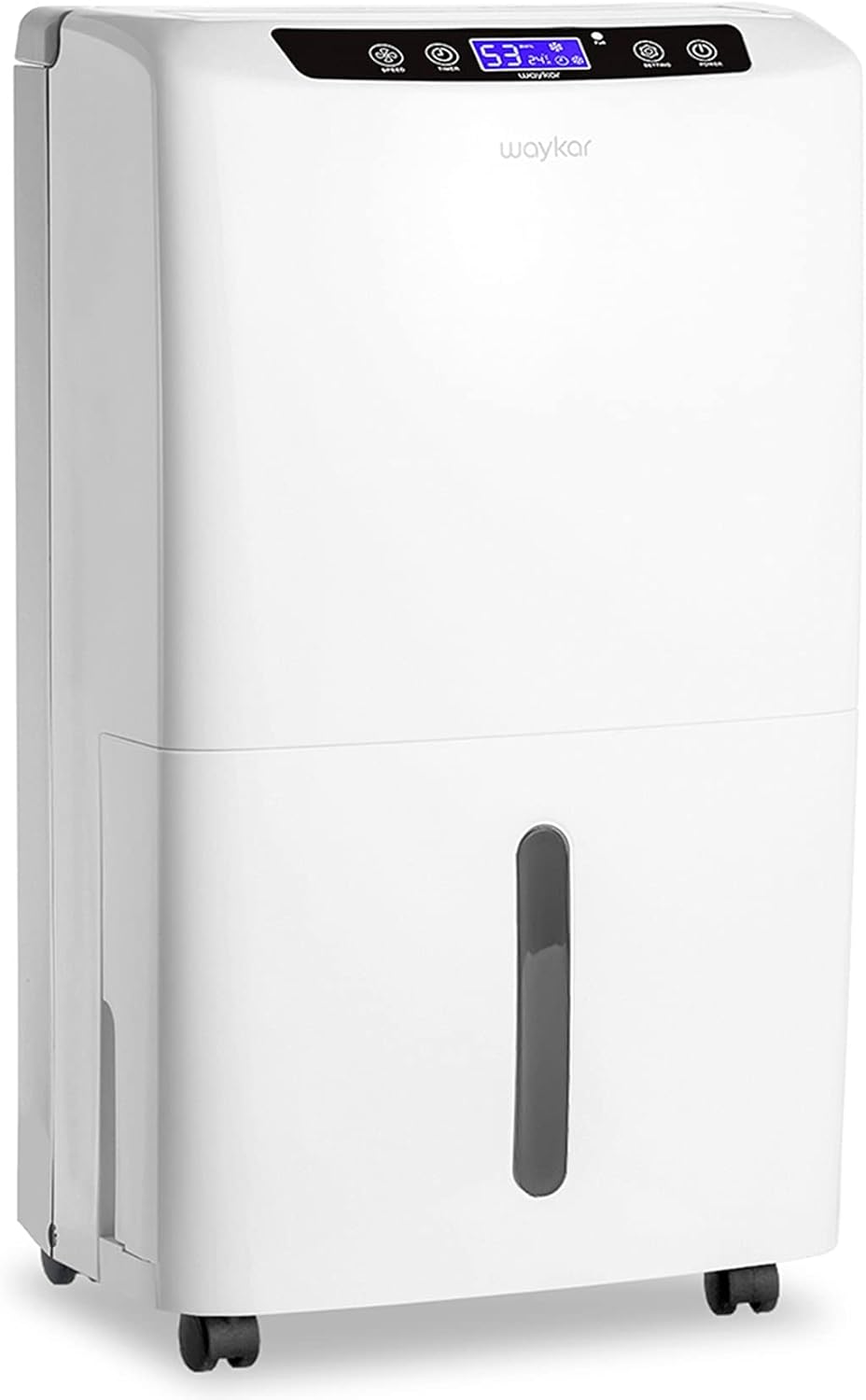
| Dehumidification Capacity | 34 pints per day |
|---|---|
| Coverage | 2000 square_feet |
| Tank Volume | 0.66 gallons |
| Wattage | 230 watts |
| Air Flow Capacity | 62 cfm |
The Waykar 34 Pint Dehumidifier is a residential unit built to remove up to 34 pints of moisture per day and serve large rooms, basements, or whole-home use up to about 2,000 square feet. It is typically used to control dampness, reduce condensation and odors, and protect stored items; you can run it in auto mode to maintain a target humidity between 30% and 80% or use continuous mode with the included drain hose for unattended operation. Notable features include ENERGY STAR certification for efficient real-world performance, an AI-driven protection system that triggers automatic defrost and overload protection, a 24-hour timer, two fan speeds, and a removable 0.66 gallon tank for manual emptying. Practical benefits include quieter operation suitable for shared spaces, targeted air delivery with a 90-degree swing, and flexible drainage options for long unattended runs. Trade-offs are its relatively modest tank size, which makes continuous drain preferable for heavy-duty or very humid environments, and the unit is heavier than some portable alternatives so placement may require effort.
Best for: Buyers who prioritize reliable, unattended moisture control in basements or large rooms and want a unit that supports continuous drainage and protective auto-defrost for long-term, low-maintenance operation.
Less Ideal for: People who need a very lightweight, highly portable dehumidifier for frequent moves between rooms or who prefer a larger built-in tank for manual-only operation.
- Continuous drain hose included for unattended, extended operation
- ENERGY STAR certified for better energy efficiency during extended use
- Wide 30%–80% humidity set range for deeper drying when needed
- Automatic defrost and overload protection to maintain reliability in cooler or continuous-use conditions
- Quiet, low-vibration design with 24-hour timer for scheduled operation
- Small 0.66 gallon removable tank requires frequent emptying if not using the hose
- Relatively heavy for a portable unit, which can make moving and placement harder
Verdict: Choose this model when you want a dependable, energy-efficient dehumidifier with continuous drain and auto-defrost for low-maintenance humidity control in basements and large rooms.
KNKA 34-Pint Dehumidifier

| Capacity | 34 pints_per_day |
|---|---|
| Floor Area | 2500 square_feet |
| Tank Volume | 3 liters |
| Wattage | 230 watts |
| Operation Mode | Continuous, Dry, Dehumidify |
The KNKA 34-pint dehumidifier is a compact, portable unit intended to remove moisture from rooms up to about 2,500 sq ft and offers three operating modes—DEHU (set humidity), DRY (clothes drying), and CONT (continuous run). It uses a built-in tank plus an included 3.28 ft drain hose for continuous drainage, and it supports an optional larger external tank for longer unattended operation. Controls are digital with an LED humidity indicator and a child lock, plus a 24-hour timer and two fan speeds to balance performance and noise. Practical benefits include 360-degree wheels and a soft leather handle for easy movement, a washable filter for lower operating cost, and automatic defrost and shutoff safety features. At 37 dB in normal operation and a sleep mode that dims the display, it is suitable for bedrooms and living spaces. Limitations to watch: the 3 liter internal tank requires frequent emptying without a drain hookup and the drain hose length is short, so continuous drainage may need repositioning or a longer hose for some installations.
Best for: Buyers who prioritize proven, user-friendly continuous-drain options and want a quiet, straightforward unit with safety features and easy mobility for basements, laundry rooms, or bedrooms.
Less Ideal for: People who need industrial-scale moisture removal for very large or commercial spaces or who want a unit with a much larger built-in reservoir for long unattended runtime.
- Removes up to 34 pints per day for effective moisture control in damp spaces
- Includes continuous drain hose and supports optional external tank for extended unattended use
- Smart digital controls with auto humidity adjustment, timer, and child lock for easy, safe operation
- Portable design with 360° wheels, handle, and washable filter simplifies placement and maintenance
- Runs quietly (around 37 dB) with sleep mode that dims lights for bedroom use
- Built-in water tank is only 3 liters so it will fill often if not using continuous drain
- Included drain hose is short and may require a longer hose or rearranged setup for gravity drainage
Verdict: Choose this KNKA unit if you need a quiet, portable home dehumidifier with a built-in continuous drain option and simple smart controls for reliable, low-effort humidity management.
AEOCKY BOREAS-001 Dehumidifier

| Dehumidification Capacity | 50 pints/day |
|---|---|
| Applicable Area | 3500 square_feet |
| Water Tank Capacity | 0.8 gallons |
| Wattage | 380 watts |
| Operation Mode | Continuous |
The BOREAS-001 is a compact compressor dehumidifier designed for home use where continuous drainage is preferred. It extracts up to 50 pints per day (tested at 95°F/95% RH) and includes a 2 m drain hose plus a 3/4-inch garden hose adapter for gravity drainage, so you can set it up for unattended operation. Controls include adjustable humidity (40%–80%), child lock, fan speeds, and a 24-hour timer, and a multicolor ambient humidity light gives a quick visual reference. The unit emphasizes quiet operation with claimed 40–43 dB noise and an auto-defrost mode for cooler basements. Its 0.8 gallon tank is small relative to its output, so continuous drain is effectively required for heavy-duty use. Practical benefits are strong extraction in a surprisingly small footprint, durable copper tubing and hydrophilic fins for longevity, and smart humidity control that maintains target levels. Expect moderately high power draw at 380 W when running continuously and frequent drainage if not using the hose; the small tank limits standalone runtime in very damp spaces.
Best for: Buyers who prioritize reliable continuous-drain operation and quiet, powerful moisture removal in bedrooms, living rooms, or basements and who want a durable, low-maintenance compressor unit.
Less Ideal for: People who need a large onboard tank for long unattended runs without drainage or who prefer an ultra-low-power desiccant style unit for very small spaces.
- High dehumidification capacity up to 50 pints/day under rated conditions
- Includes 2 m drain hose and garden hose adapter for continuous gravity drainage
- Quiet operation claimed at about 40–43 dB suitable for living spaces and bedrooms
- Auto-defrost and smart humidity control for reliable performance in cooler rooms
- Small 0.8 gallon tank fills quickly during heavy use, making continuous drainage advisable
- Consumes 380 watts during operation which can increase running costs if used 24/7
Verdict: If you need a compact yet powerful compressor dehumidifier that supports continuous gravity drain and quiet operation for everyday home use, the BOREAS-001 is a solid, low-risk choice.
Choosing the Right Dehumidifier with Continuous Drain: Key Factors to Consider
Extraction Capacity Relative to Room Size
Extraction capacity tells you how much moisture a dehumidifier removes in 24 hours. Choose a capacity rated for the square footage and ceiling height of the space you intend to dehumidify. Undersized units will run continuously yet fail to lower humidity, while oversized units can short-cycle in small rooms, reducing efficiency and comfort.
Real-world extraction varies with ambient temperature and humidity. Basements and laundry rooms are often cooler and more humid than living spaces, so prefer a unit whose rated capacity aligns with expected conditions rather than just room area. When in doubt, err on the side of higher capacity for persistently damp spaces.
Continuous Drain Type and Compatibility
Continuous drain can be gravity-fed or pump-assisted. Gravity drain requires a nearby floor drain or lower-elevation outlet; pump-assisted units let you route condensate to a higher sink or out a window. Confirm the drain connection size and whether a hose is included, and check how the unit secures the hose to prevent leaks.
Consider how the drain option fits your space. Gravity setups are simple and reliable where available. Pump models add installation flexibility but increase mechanical complexity and maintenance needs. Think about where condensate will exit the building and whether routing will require additional fittings or supports.
Energy Use and Long-Term Operating Cost
Dehumidifiers run for extended periods in damp environments, so energy efficiency affects running costs and environmental impact. Look for units with efficient compressors and thoughtful controls such as adjustable humidity setpoints and timers to avoid unnecessary runtime.
Compare energy draw at realistic operating points rather than just the nameplate wattage. Features like automatic restart after power loss and variable fan speeds can reduce energy consumption while maintaining comfort. Energy-efficient operation is particularly important if the device will run continuously through humid seasons.
Noise Level and Placement Considerations
Noise matters if the dehumidifier will operate near living spaces. Check rated decibel levels and whether the unit offers multiple fan speeds; lower-speed operation typically reduces noise. Also think about vibration isolation and stable placement to avoid rattles.
Placement affects both noise and drain routing. Position units on a level, sturdy surface with easy access to the drain connection and filter. If the machine will run in a finished space, prioritize quieter models or locate the unit where noise is less disruptive, such as a utility alcove.
Ease of Installation and Maintenance
A unit that simplifies installation and upkeep reduces the chance of improper setup or deferred maintenance. Look for clear drain fittings, accessible filters, and straightforward access panels for cleaning. Check whether common tasks such as filter washing, pump inspection, and condensate hose replacement are user-friendly.
Maintenance frequency depends on environment. Dusty or lint-prone spaces require more frequent filter cleaning. For continuous-drain setups, inspect hose connections and traps periodically to prevent clogs or backups. Simpler mechanical designs generally translate to fewer surprises over long-term use.
Build Quality and Durability for Continuous Use
Continuous-drain operation exposes a dehumidifier to extended run times and steady condensate flow, which can stress weak materials. Favor units with durable condensate channels, corrosion-resistant fittings, and robust casings. Look for sealed electrical compartments and well-supported internal components to withstand frequent cycles.
A sturdier build reduces the risk of slow leaks, cracked housings, and premature failures. Consider warranty terms and the availability of service parts as proxies for long-term reliability and support.
Planning Drain Routing Before Installation
Map the shortest, most direct route from the unit to your chosen drain point before installing. Gravity drains need a downhill slope and a lower outlet than the dehumidifier base. If the only practical exit is higher than the unit, a pump-assisted model will be required.
Account for hose length, clamps, and any bends that could collect sediment. Secure hoses so they do not sag, and use a trap or air gap where local plumbing codes require it. Planning ahead reduces the chance of water pooling or backups after the unit is operational.
- Measure the vertical drop and horizontal distance before buying hose.
- Allow gentle slope for gravity drains; avoid U-bends that trap water.
- Use hose clamps and check for kinks after routing.
Using Pump-Assist Features Safely
Pump-assisted dehumidifiers give flexibility to drain uphill, but pumps add mechanical parts that need occasional attention. Verify the pump's duty cycle specifications and whether the unit has protections against dry running or overheating.
Install the pump outlet to a secure, accessible drain point and ensure the pump discharge line is properly supported. If the pump runs frequently, factor in potential service needs and ensure electrical connections are protected from moisture.
- Confirm the pump's maximum lift rating before routing uphill.
- Provide a protected electrical outlet for pump-equipped units.
- Inspect and clean the pump path seasonally for reliability.
Placement Tips for Basements and Laundry Rooms
Place the dehumidifier where airflow is unobstructed and the unit can intake humid air efficiently. Avoid corners and close proximity to walls; most models need several inches of clearance around the cabinet to perform optimally. Elevating the unit slightly on a stable platform can make gravity drainage easier and protect against minor floor moisture.
In laundry rooms, route the condensate away from laundry tubs or appliance drains to avoid cross-contamination. Consider secondary containment for the first few weeks after installation to confirm there are no unexpected leaks.
- Keep 6 to 12 inches clearance around the unit for airflow.
- Use a drip pan or secondary catch if floor drainage is uncertain.
- Locate near a GFCI-protected outlet if in damp locations.
Filter Care and Preventing Odors
Regular filter maintenance helps maintain airflow and reduces musty smells. Washable filters should be cleaned on the schedule recommended by the manufacturer or more often in dusty environments. Replace disposable filters according to the service interval.
For long periods of inactivity, clean and dry the unit, run a short cycle with the fan to dry internal surfaces, and ensure the drain hose is clear. Consider using activated-carbon filter options if available to control odors in enclosed spaces.
- Clean washable filters every 4 to 8 weeks in dusty conditions.
- Dry internal components before off-season storage.
- Check drain lines seasonally for mold or mineral buildup.
Safety and Local Code Considerations
Some jurisdictions require an air gap, trap, or specific materials for condensate lines. Verify local plumbing codes before hardwiring a drain into household plumbing. When in doubt, consult a licensed plumber to ensure the installation meets code and prevents sanitary cross-connections.
For electrical safety, use GFCI protection in damp locations and avoid running extension cords. If the unit will be hardwired, have a qualified electrician perform the work to maintain safe operation under continuous use.
- Check local codes for condensate discharge requirements.
- Use GFCI-protected circuits in basements and laundry areas.
- Hire licensed pros for permanent plumbing or electrical modifications.
How We Chose the Best Dehumidifier with Continuous Drain
We shortlisted dehumidifiers that reliably support continuous drainage and then evaluated them against practical, measurable criteria relevant to typical home installations. Our process prioritized units that offer consistent extraction at real-world humidity levels, simple and compatible drain options, and controls that make continuous operation easy to manage. We excluded specialty commercial machines and window-style units that do not routinely support gravity or pump-assisted continuous drain setups. Key evaluation criteria included extraction capacity at common household humidity and temperature ranges, the quality and flexibility of continuous-drain options (gravity, pump, or both), energy efficiency under sustained operation, noise levels for occupied spaces, and ease of installation and maintenance. We also considered build features that affect longevity in continuous-use scenarios, such as durable condensate pathways and accessible service points. Units that required nonstandard plumbing modifications or had unreliable drain designs were not included in the final list.
Our full evaluation process is outlined in our review methodology.
FAQ
Can I run a dehumidifier continuously with a continuous drain?
Often you can run a dehumidifier continuously when it has a proper continuous-drain setup. Continuous drain prevents tank overflows and reduces manual emptying, but you should confirm the unit is designed for extended operation and follow recommended maintenance to avoid wear.
Do I need a pump for the continuous drain?
It depends on your drain location. If the drain outlet is lower than the dehumidifier, gravity is usually sufficient. If you must move condensate uphill or over a long distance, a pump-assisted unit is necessary.
How do I prevent mold or clogs in the drain hose?
Use smooth-walled hose with a consistent downward slope where possible. Flush the hose periodically with water and inspect for buildup. For pump lines, check the pump inlet screen and clean filters to reduce debris entering the hose.
Will a dehumidifier with continuous drain save energy?
Continuous drain itself does not directly save energy, but it enables longer unattended operation which can be more efficient than frequent stop-start cycles. Energy savings depend on unit efficiency, controls, and proper sizing for the space.
Can I hook the drain into household plumbing?
Often you can discharge into a household drain but local codes may require an air gap or specific fitting to prevent cross-connection. Verify plumbing regulations and, if needed, have the connection installed by a professional.
How often should I service a unit used with continuous drain?
Inspect hoses, fittings, and filters seasonally and clean as needed. Pump-assisted systems may require additional checks of the pump and float assemblies. Frequency depends on environment and runtime, with more humid or dusty locations needing more frequent attention.
Final Verdict
Prioritize the match between extraction capacity and the typical conditions of the space, and choose the continuous-drain type that fits your layout—gravity for simplicity, pump-assist for flexibility. Balance energy efficiency and noise against installation complexity and maintenance needs. If you plan for proper drain routing and routine upkeep, a dehumidifier with continuous drain can deliver low-maintenance humidity control and reliable protection against damp-related problems. Base your final pick on capacity, drain reliability, and the installation effort you are willing to accommodate.