
Note: This article contains affiliate links. If you click on these links and make a purchase, we may earn a small commission at no extra cost to you. This helps support our research and content. Read our full affiliate disclosure here.
If your basement stays damp, mold-prone, or musty, a dehumidifier with a drain hose for basement use can reduce moisture without constant bucket emptying. The right unit keeps humidity in a healthy range while running quietly and efficiently, protecting finishes, stored items, and the structure itself. This guide covers six shortlisted dehumidifiers chosen for reliable continuous drainage, sensible capacity, and ease of installation in typical basement setups. Below we summarize practical pros and cons, how each unit performs on essential criteria, and what matters when you install a continuous-drain dehumidifier in a basement.
Top Picks at a Glance
| Best Overall The best all-around choice for most situations | yaufey 120-Pint Dehumidifier JD-Q |  |
| Best Quality Built to a higher standard if you want something more solid | DECIUU 100-Pint Dehumidifier |  |
| Best Value The sweet spot between price and what you get | AEOCKY BOREAS-001 50 Pint Dehumidifier |  |
| Best Budget The cheapest option that still gets the job done reliably | KMFurnila 30Pints Dehumidifier | 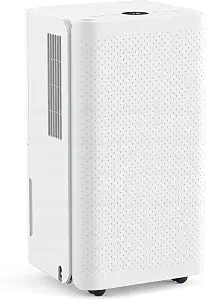 |
| Top Rated A top-rated pick with lots of positive feedback | KNKA 80-Pint Dehumidifier PD30MA-20 |  |
| Most Popular A crowd favorite that many people choose with confidence | Waykar 34 Pint Dehumidifier |  |
yaufey 120-Pint Dehumidifier JD-Q

| Capacity | 120 pints |
|---|---|
| Tank Volume | 1.06 gallons |
| Wattage | 355 watts |
| Air Flow Capacity | 106 cfm |
| Dehumidification Capacity | 15 gallons_per_day |
This Yaufey 120-pint dehumidifier is built for large, damp spaces like basements and commercial rooms and offers both a visible 1.06-gallon water tank and a continuous-drain option via the included hose. It removes up to 120 pints/day in extreme conditions and has Energy Star certification to keep energy use lower than many noncertified units. Controls are simple: an LED touch panel with four preset modes (Sleep, Living, Basement, Continuous) plus three fan speeds and a 24-hour timer for scheduled runs. The unit also includes a reusable filter, auto-defrost, memory restart, and ergonomic castors for moving between rooms. In practice it delivers strong moisture removal and sensible automation, though the small internal tank relative to its capacity means continuous drainage is effectively required for heavy use to avoid frequent emptying. Noise on low is reasonably quiet at about 55 dB but will be louder on higher fan settings. Setup is straightforward and the included drain hose and washable filter reduce ongoing costs and maintenance.
Best for: Buyers who need a powerful, energy-efficient dehumidifier for large basements or commercial rooms and prefer a model with simple preset controls and a continuous-drain option.
Less Ideal for: People looking for a compact, ultra-quiet bedroom unit or those who want a large onboard tank to avoid any drain hose setup should consider different models.
- High dehumidification capacity rated to 120 pints/day for very large spaces
- Includes continuous drain hose plus a visible 1.06-gallon tank for flexible drainage
- Energy Star certified for improved efficiency during long-run operation
- Multiple preset modes, timer, and digital touch controls simplify everyday use
- Reusable washable filter and castors make maintenance and relocation easy
- Relatively small internal tank compared with maximum capacity, so continuous drain is recommended for heavy-duty use
- Can become noticeably louder on higher fan speeds
Verdict: A robust, Energy Star certified 120-pint dehumidifier with easy continuous-drain capability that is suited for large basements and commercial spaces.
DECIUU 100-Pint Dehumidifier

| Capacity | 100 pints_per_day |
|---|---|
| Coverage | 5000 square_feet |
| Tank Volume | 1.45 gallons |
| Air Flow Capacity | 9396 cubic_feet_per_hour |
| Wattage | 300 watts |
This DECIUU dehumidifier is built for heavy-duty humidity control in basements, garages, and large damp spaces. It pulls up to 100 pints per day under high-humidity conditions and is rated to cover about 5,000 square feet, with a powerful 9396 CFM airflow rating that helps clear moisture fast. The unit offers smart humidity control with settable RH from 35%–80%, a 24-hour timer, and auto defrost for reliable operation in cooler areas. Maintenance is straightforward: a 1.45 gallon removable tank, washable filter, and three drainage options including the included 6.56 ft drain hose and garden hose adapter for continuous unattended draining. Mobility is easy thanks to 360-degree swivel casters and a hidden handle, and ENERGY STAR Most Efficient 2024 recognition helps keep runtime energy use lower. Trade-offs are the substantial physical size and 300 watt power draw during operation, which are expected for this capacity, and it is focused on residential heavy-duty use rather than compact or decorative spaces.
Best for: Buyers who need strong, rapid moisture removal for large basements or garages and prioritize continuous drainage and energy-efficient high capacity.
Less Ideal for: Those wanting a compact, lightweight unit for small rooms or occasional spot use should consider smaller, portable dehumidifiers instead.
- High 100 pint/day dehumidification capacity suitable for very damp basements and large spaces
- Three drainage options including included drain hose and garden-hose adapter for continuous unattended operation
- ENERGY STAR Most Efficient 2024 designation for comparatively lower energy use at high capacity
- Smart humidity control with adjustable RH, 24-hour timer, and auto defrost for reliable performance in varying conditions
- Removable washable filter and 360° casters make maintenance and relocation simple
- Large, heavy footprint that can be cumbersome in tight utility rooms
- Consumes around 300 watts during operation which can add to electrical load in continuous use
Verdict: If you need fast, reliable moisture removal for a large basement and want continuous drain capability with energy-efficient high-capacity performance, this DECIUU 100‑pint unit is a top practical choice.
AEOCKY BOREAS-001 50 Pint Dehumidifier

| Dehumidification Capacity | 50 pints/day |
|---|---|
| Applicable Area | 3500 square_feet |
| Tank Volume | 0.8 gallons |
| Wattage | 380 watts |
| Operating Noise (Min-Max) | 40-43 dB |
The AEOCKY BOREAS-001 is a compact compressor dehumidifier designed to handle large residential spaces while fitting into tighter footprints such as basements, bedrooms, or RVs. It extracts up to 50 pints per day (measured at 95°F/95% RH) and 38 pints/day at more typical basement conditions, with an auto-defrost system to keep it running in cooler rooms. Controls include adjustable humidity (40%–80%), fan speeds, a 24-hour timer, child lock, and a multicolor ambient humidity light for quick status. The unit ships with a 2 meter drain hose and a garden-hose adapter so you can set up continuous gravity drainage to avoid frequent emptying of the 0.8 gallon tank. Notable benefits are a relatively quiet operating range (about 40–43 dB), auto-defrost, and claimed efficiency improvements that lower energy use during continuous operation. Expect a small tank that fills quickly in very damp spaces, so plan to use the continuous drain for basements; the company emphasizes durable internal components like copper tubing and hydrophilic fins for longer life.
Best for: Buyers who want strong compressor-level moisture removal in a space-saving unit and plan to set up continuous drainage for basement or multi-room use to avoid manual emptying.
Less Ideal for: People who need large tank autonomy or pump-assisted uphill drainage without plumbing access should consider larger models with bigger tanks or integrated pumps.
- High dehumidification capacity up to 50 pints/day for a compact compressor unit
- Includes 2 m drain hose and garden-hose adapter for continuous gravity drainage
- Auto-defrost allows operation in cooler basements without frequent shutdowns
- Relatively quiet operation (~40–43 dB) suitable for living spaces and bedrooms
- Multiple controls and a timer plus child lock and ambient humidity light for easy monitoring
- Small 0.8 gallon tank will require frequent emptying if not using continuous drain
- No built-in pump for automatic uphill drainage
Verdict: Choose the BOREAS-001 when you need powerful, quiet compressor dehumidification in a compact unit and plan to use continuous gravity drainage for reliable basement performance.
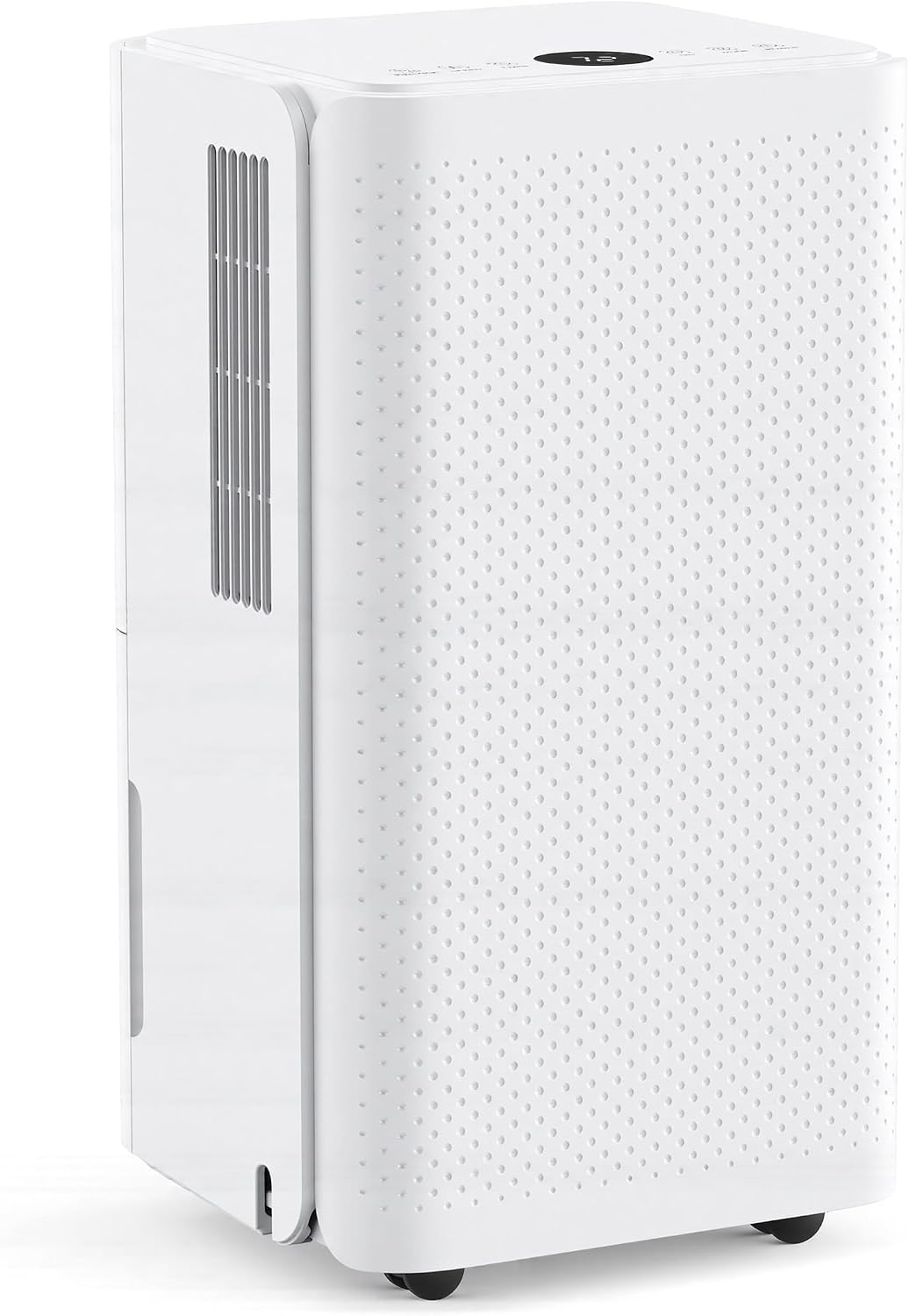
KMFurnila 30Pints Dehumidifier
| Dehumidification Capacity | 30 pints_per_day |
|---|---|
| Floor Area | 2000 square_feet |
| Tank Volume | 2 liters |
| Number of Speeds | 4 |
| Other Special Features of the Product | Automatic Defrost, Automatic Restart, Child Lock, Continuous Draining, Removable Tank |
This KMFurnila 30Pints dehumidifier is aimed at removing humidity from basements and large rooms, extracting up to 30 pints per day and serving areas up to 2,000 square feet. It offers four operation modes including Auto, Drying, Sleep, and Fan-Only, plus a smart color-coded humidity display ring that makes it easy to check conditions at a glance. For extended use you can choose continuous draining with the included drain hose or use the removable 2.0 liter tank for intermittent emptying, and caster wheels make moving it between rooms straightforward. ENERGY STAR certification and an adjustable 24-hour timer help keep running costs down, while features like automatic defrost, automatic restart, and child lock improve practical reliability. Expect relatively quiet operation under 38 dB in normal modes, but note the 2.0 L tank is modest for heavy continuous extraction so relying on the drain hose is preferable for very damp basements. Overall it balances energy efficiency and useful controls for budget-focused homeowners who need consistent basement moisture control.
Best for: Homeowners who want an affordable, energy-efficient dehumidifier to control dampness in basements or large rooms and prefer simple, reliable controls over advanced connectivity.
Less Ideal for: Users who need a very large onboard reservoir for long unattended runs without plumbing or who require integrated smart home app control and remote scheduling.
- 30 pints per day capacity suitable for spaces up to 2,000 sq ft
- Continuous drain option with removable 2.0 L tank for flexible draining
- ENERGY STAR certified for lower operating costs
- Quiet operation below 38 dB and a Sleep mode for nighttime use
- Color-coded humidity ring provides an immediate visual humidity status
- 2.0 liter tank is small for heavy-duty use when continuous drain is not connected
- No detailed smart home connectivity or app control listed
Verdict: A budget-friendly, ENERGY STAR dehumidifier with a drain-hose option and easy controls that makes basement moisture control efficient and affordable.
KNKA 80-Pint Dehumidifier PD30MA-20

| Capacity | 80 pints per day |
|---|---|
| Tank Volume | 1.45 gallons |
| Wattage | 360 watts |
| Floor Area | 4500 square_feet |
| Operation Mode | AUTO, DRY, SETTING |
The KNKA PD30MA-20 is a performance-focused dehumidifier built for large, damp spaces such as basements. Its high-efficiency compressor can remove up to 80 pints per day under extreme conditions and about 56 pints in typical basement conditions, while an internal 1.45 gallon tank plus a supplied 6.56 ft drain hose enable continuous drainage to avoid frequent emptying. Controls include AUTO, DRY, and a SETTING mode for 30%–80% RH, and the digital display with a color-changing humidity indicator makes it easy to monitor conditions at a glance. The unit is designed to run quietly (40–45 dB), has a washable filter, casters for moving between rooms, cord storage, a 12-hour timer, and a child lock for steady, unattended operation. Expect good energy efficiency thanks to ENERGY STAR certification and a 360 watt power draw, but note that humidity readings come from the air inlet and may differ slightly from a separate hygrometer; the unit also needs upright siting for 24 hours before first use. For heavy-duty basement dehumidification this model balances strong capacity with thoughtful usability features.
Best for: Buyers who need powerful, reliable moisture removal in large basements or very damp rooms and prioritize steady performance and easy continuous drainage.
Less Ideal for: People seeking a compact or ultra-light unit for small rooms or occasional use should consider lower-capacity, more portable models instead.
- High maximum dehumidification capacity up to 80 pints per day for large, very humid spaces
- Includes 6.56 ft drain hose and built-in tank for continuous drainage to reduce manual emptying
- ENERGY STAR certified and uses a high-efficiency compressor for lower operating costs relative to output
- Quiet operation (40–45 dB) and caster wheels make it suitable for basements and living spaces
- Digital display with real-time humidity readout and color indicator simplifies monitoring and control
- Humidity reading is measured at the air inlet and may not match a separate room hygrometer
- Requires upright placement for 24 hours before first use to avoid operational issues
Verdict: Choose this KNKA if you need a strong, ENERGY STAR certified dehumidifier that can handle large basements with continuous-drain capability and quiet operation.
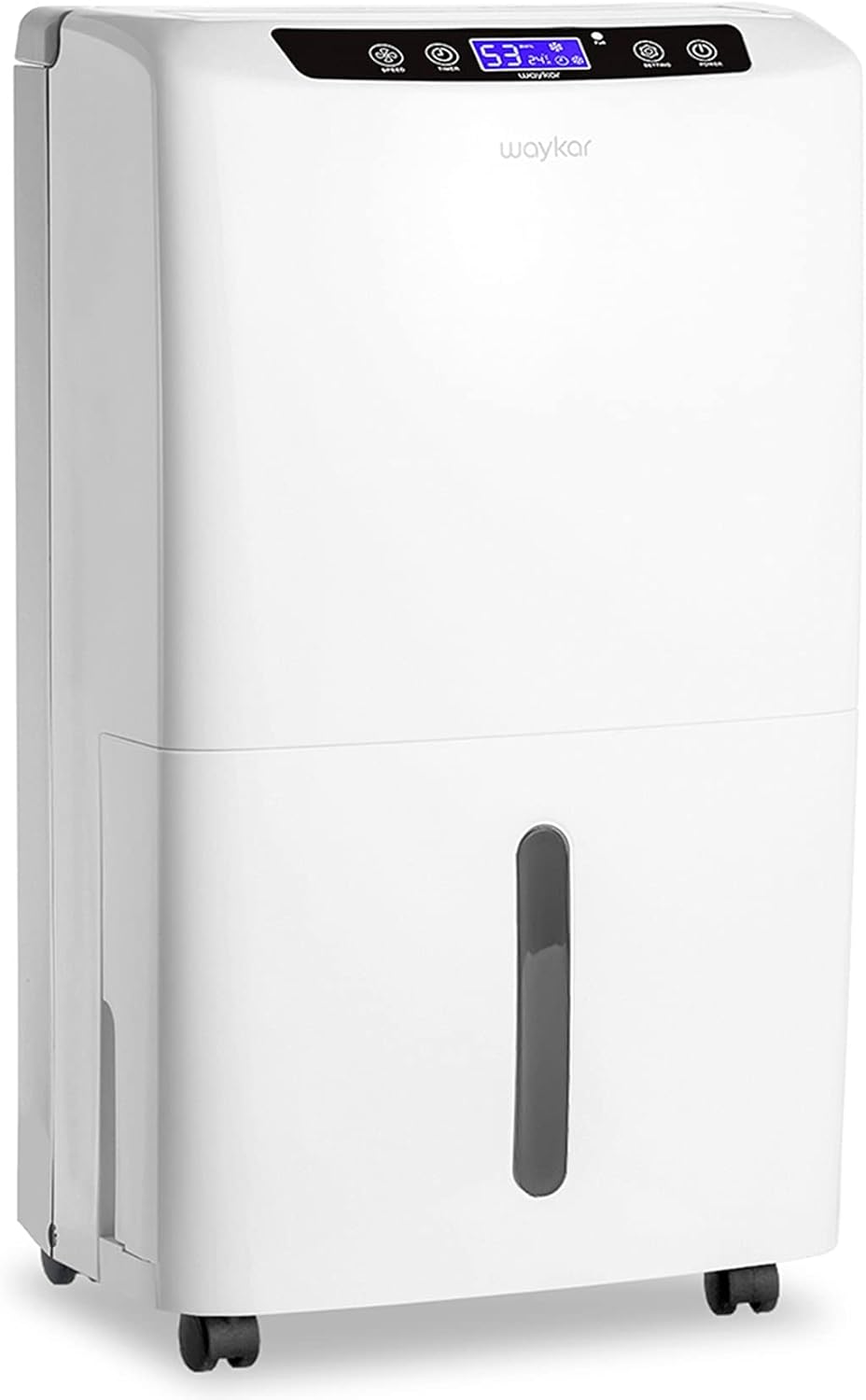
Waykar 34 Pint Dehumidifier
| Dehumidification Capacity | 34 pints per day |
|---|---|
| Floor Area | 2000 square_feet |
| Tank Volume | 0.66 gallons |
| Wattage | 230 watts |
| Air Flow Capacity | 62 cfm |
The Waykar 34 Pint Dehumidifier is a mid-size household unit meant for basements, large rooms, and whole-home use up to about 2,000 square feet. It removes up to 34 pints per day and offers both automatic humidity control and continuous drain capability via the included hose, so you can run it unattended for extended periods. Practical features include a washable detachable filter, two fan speeds, a 24-hour timer, manual 90 degree airflow adjustment, and automatic defrost and overload protection for colder spaces. Energy Star certification helps keep operating costs lower than many noncertified models, and the unit is designed for relatively quiet operation with vibration reduction. The 0.66 gallon tank is convenient for occasional emptying, but frequent heavy-duty use will benefit from the hose hookup. At 230 watts and with simple mechanical controls, it is straightforward to operate but lacks advanced app connectivity or multi-zone automation. If you need reliable humidity control for a basement and prefer visible social proof and energy efficiency, this model is a practical choice with sensible safety protections.
Best for: Buyers who prioritize proven performance and energy-efficient operation for basement or large-room humidity control and who prefer units with practical safety features and continuous drain capability.
Less Ideal for: People who want smart-home integration, very quiet ultra-low-noise operation, or a larger built-in tank for long unattended runtime without a hose hookup.
- Energy Star certified for better real-world efficiency
- Includes drain hose for continuous unattended drainage
- Smart humidity control with 30%–80% set range and auto mode
- Automatic defrost and overload protection for reliable operation in cool basements
- Washable detachable filter and 24-hour timer for low maintenance and scheduled use
- 0.66 gallon tank requires frequent emptying if not using continuous drain in high humidity
- No smart app or Wi-Fi connectivity for remote monitoring
- Only two fan speeds limit fine control of airflow and noise
Verdict: A practical, Energy Star certified 34-pint dehumidifier with included drain hose and reliable protections that makes unattended basement humidity control simple and efficient.
Choosing the Right Dehumidifier with Drain Hose for Basement: Key Factors to Consider
Water Removal Capacity
Capacity indicates how many pints or liters the dehumidifier can remove per day under standard conditions. In basements that are cooler and more humid, actual removal rates often fall below rated numbers, so choose a unit with a margin above your estimated need.
Higher capacity reduces runtime and recovery time after heavy humidity events, but larger units use more energy and may be heavier to move. Balance rated capacity with your basement size, typical humidity, and whether the unit will run continuously using a drain hose.
Drainage Method and Reliability
Continuous drainage can be handled by gravity or a built-in pump. Gravity drainage is simplest when you have a floor drain or can route the hose downhill, while pump-assisted units let you discharge upward to a sink or condensate line.
Assess hose diameter, outlet height, and the quality of the hose connection to prevent leaks and backups. Also consider whether the drain outlet has a trap or screen to reduce lint and debris buildup, which helps avoid clogs and maintenance headaches.
Performance at Lower Temperatures
Basements are often cooler than living spaces, and many dehumidifiers lose efficiency at lower temperatures or risk coil freezing. Look for models rated for lower ambient temperatures or those with auto-defrost features that prevent ice buildup on coils.
Units that maintain reasonable removal rates in the 50s Fahrenheit will perform better in unconditioned basements. Consistent performance reduces long-run energy use and prevents repeated defrost cycles that shorten component life.
Installation and Hose Routing
Practical routing matters. You need to plan where the hose will run and how it will connect to a floor drain, utility sink, or condensate line. Consider access points, the length of hose required, and whether you can maintain a steady downhill slope for gravity drainage.
Also think about how the unit will sit relative to the drain and whether elevation or a short pump is necessary. Ease of installation affects whether you can set up continuous drainage yourself or need a plumber.
Noise and Continuous Operation
Basement dehumidifiers often run for long stretches. Noise level becomes important if the basement is adjacent to living areas or used as a workspace. Check stated decibel levels and look for models with quieter fans or adjustable fan speeds.
Lower fan speeds reduce noise but also reduce dehumidification rate. Consider units with programmable humidistats and scheduling so the unit runs more aggressively when noise is less of an issue.
Maintenance and Filter Access
A continuous-drain setup still requires periodic cleaning of the unit, filters, and drain path. Easy-access filters make regular upkeep faster and help preserve airflow and efficiency.
Inspect how the drain outlet is secured and whether the manufacturer recommends routine flushing. Units that offer clear service panels and accessible coils reduce downtime and extend operating life.
Sizing a Dehumidifier for Your Basement
Estimate the square footage and the typical humidity level to choose an appropriate capacity. For damp basements that are sometimes wet, choose a higher-capacity unit than you would for a slightly musty space. Consider ceiling height and finished versus unfinished conditions since stored items and concrete surfaces both affect how much moisture is released.
If your basement is cool, select a model rated to maintain performance at lower temperatures or featuring an auto-defrost mode. When in doubt, err on the side of a larger unit with reliable continuous drainage to avoid prolonged run times and frequent saturation cycles.
- Measure the longest plausible hose run and plan for hose supports to maintain slope.
- Account for obstacles like stairs or bulkheads that may require a pump-equipped unit.
- Allow clearance for air intake and service access on at least one side of the unit.
Gravity Drain Vs Pump-Assisted Drain
Gravity drain units rely on a downhill drop to a floor drain or outside discharge. They are mechanically simpler and generally less expensive to operate because they have no pump. However, they require you to place the dehumidifier above or level with the drain outlet and ensure an uninterrupted slope.
Pump-assisted models add flexibility by allowing you to route a hose upward to a sink or condensate line. Pumps add complexity and a small chance of mechanical failure, but they solve many layout problems in basements without a conveniently located drain.
- Choose gravity drainage when a nearby floor drain sits lower than the unit.
- Choose pump-assisted drainage if you must discharge uphill or route through finished areas.
- Inspect pump noise and service access if you expect frequent use.
Hose and Drain Accessories to Consider
Not all hoses are equal. Look for properly sized hoses that match the outlet and are resistant to kinking. A firmer hose holds its shape and maintains consistent flow, while a flat or crushable hose may trap moisture and obstruct drainage.
Consider adding inline screens or simple traps to catch lint or debris before it reaches the drain. If routing through walls or floors, use appropriate grommets or fittings to prevent abrasion and leaks.
- Use hose supports or clips to maintain a steady slope over long runs.
- Install a small trap or sediment basket where lint accumulation could be an issue.
- Label and secure the hose so it is not accidentally disconnected during maintenance.
Energy Use and Runtime Management
Dehumidifiers can run for many hours daily in problem basements. Look for units with efficient compressors, variable fan speeds, and programmable humidistats to reduce energy consumption while maintaining target humidity.
Timer features and auto-shutoff settings let you avoid unnecessary operation during dry periods. Consider pairing a dehumidifier with a reliable humidistat to avoid over-dehumidifying and wasting energy.
- Use the unit's built-in humidistat to maintain a consistent target humidity.
- Lower fan speeds save energy but may run longer; schedule higher speeds for peak drying times.
- Check annual energy consumption estimates when comparing long-term operating costs.
Preventing and Managing Coil Freeze
Coil freeze happens when surface temperatures drop near or below freezing and moisture accumulates as ice. Auto-defrost cycles or models designed for lower ambient temperatures reduce the risk of freeze-related shutdowns and performance loss.
In very cool basements, you may need a unit specifically rated for low-temperature operation or accept reduced efficiency during the coldest months. Proper placement away from excessively cold drafts also helps.
- Place the dehumidifier where ambient air is representative of the space, not directly in a cold corner.
- Monitor for frequent defrost cycles, which indicate the unit is struggling at ambient temperatures.
- Clean intake filters regularly to maintain airflow and reduce freeze risk.
How We Chose the Best Dehumidifier with Drain Hose for Basement
We prioritized features that matter in basement installations where continuous drainage is a primary requirement. Our selection process focused on measurable, usage-focused criteria: moisture removal capacity at basement-relevant temperatures and humidity levels, reliability of gravity or pump-assisted drainage, ease of setup and hose routing for common basement layouts, noise levels for units that may run for long periods, and durability under continuous-use conditions. We excluded compact, low-capacity units intended only for small rooms and models without an option for continuous drainage. We also filtered out products lacking straightforward drainage fittings or those requiring specialist plumbing modifications. The final picks balance real-world water removal rates with practical installation features such as hose diameter and outlet orientation. We prioritized units with clear maintenance access and condensate management features that reduce clogging and freeze risk. The criteria here align with the scoring metrics used in the product cards and reflect what buyers actually need when eliminating basement moisture reliably.
Our full evaluation process is outlined in our review methodology.
FAQ
Can I run a continuous drain to an outside downspout?
Often you can, provided local codes and the layout allow it. The hose must have a reliable downhill slope and be secured to prevent disconnection. Avoid discharging where it can refreeze or cause water damage near foundations.
How long can a dehumidifier run continuously with a drain hose?
Most basement-capable units are designed for continuous operation. Runtime depends on ambient humidity and unit capacity. Regular maintenance of the hose and inlet filters will help ensure reliable continuous use.
Do I need a pump if my drain is only a few feet away?
If the drain is lower than the dehumidifier and you can maintain a steady slope, a pump is unnecessary. A pump is helpful when you must route the hose upward or when the available drain is higher than the unit.
Will a dehumidifier with a drain hose prevent mold?
Lowering humidity reduces the conditions mold needs to grow, but it does not eliminate mold already present on surfaces. A dehumidifier helps prevent recurrence by keeping relative humidity in a less hospitable range.
How often should I clean the drain hose and filter?
Inspect the hose and filter every few months and clean as needed. If your basement has a lot of dust or lint, check more frequently. Flushing the hose and clearing any screens prevents clogs and backups.
Final Verdict
When choosing a dehumidifier with a drain hose for basement use, prioritize reliable water removal at cooler temperatures and a drainage method that matches your layout. Balance capacity against energy use and plan hose routing before purchase. Consider noise, maintenance access, and whether a pump is necessary for uphill discharge. Focus on models that offer dependable continuous drainage and straightforward service access. That approach helps you maintain lower humidity with less fuss and reduces the chance of water damage or mold over time.