
Note: This article contains affiliate links. If you click on these links and make a purchase, we may earn a small commission at no extra cost to you. This helps support our research and content. Read our full affiliate disclosure here.
A basement that stays damp invites mold, musty odors, and damaged finishes. Choosing a powerful dehumidifier for basements matters because these spaces often need higher airflow, larger water-removal capacity, and reliable controls to hold humidity in check over long periods. This guide shortlists the top seven heavy-duty dehumidifiers for basements, focusing on models that balance extraction rate, energy use, and practical features for typical below-grade rooms. We evaluated units for capacity, durability, ease of maintenance, and cost to operate so you can pick the right option for your cellar, finished basement, or utility space. Read on to see what to expect from each style and which performance traits matter most.
Top Picks at a Glance
| Best Overall The best all-around choice for most situations | Gasbye DryPrime-50 Dehumidifier |  |
| Best Quality Built to a higher standard if you want something more solid | AprilAire E080 80-Pint Dehumidifier |  |
| Best Value The sweet spot between price and what you get | AEOCKY LEO-Lite 74 Pint Dehumidifier |  |
| Best Budget The cheapest option that still gets the job done reliably | Uthfy 55-Pint Dehumidifier |  |
| Top Rated A top-rated pick with lots of positive feedback | hOmeLabs 50 Pint Dehumidifier | 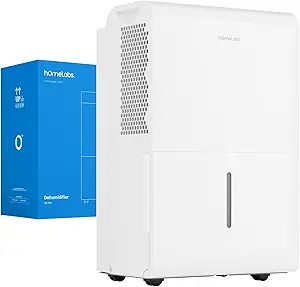 |
| Most Popular A crowd favorite that many people choose with confidence | Waykar 80-Pint Dehumidifier JD025CE-80 |  |
| Best Seller A high-volume bestseller chosen again and again | AEOCKY RHEA Dehumidifier |  |
Gasbye DryPrime-50 Dehumidifier
| Capacity | 115 pints |
|---|---|
| Tank Volume | 1.72 gallons |
| Wattage | 500 watts |
| Air Flow Capacity | 12600 cubic_feet_per_hour |
| Energy Certification | ENERGY STAR 2026 |
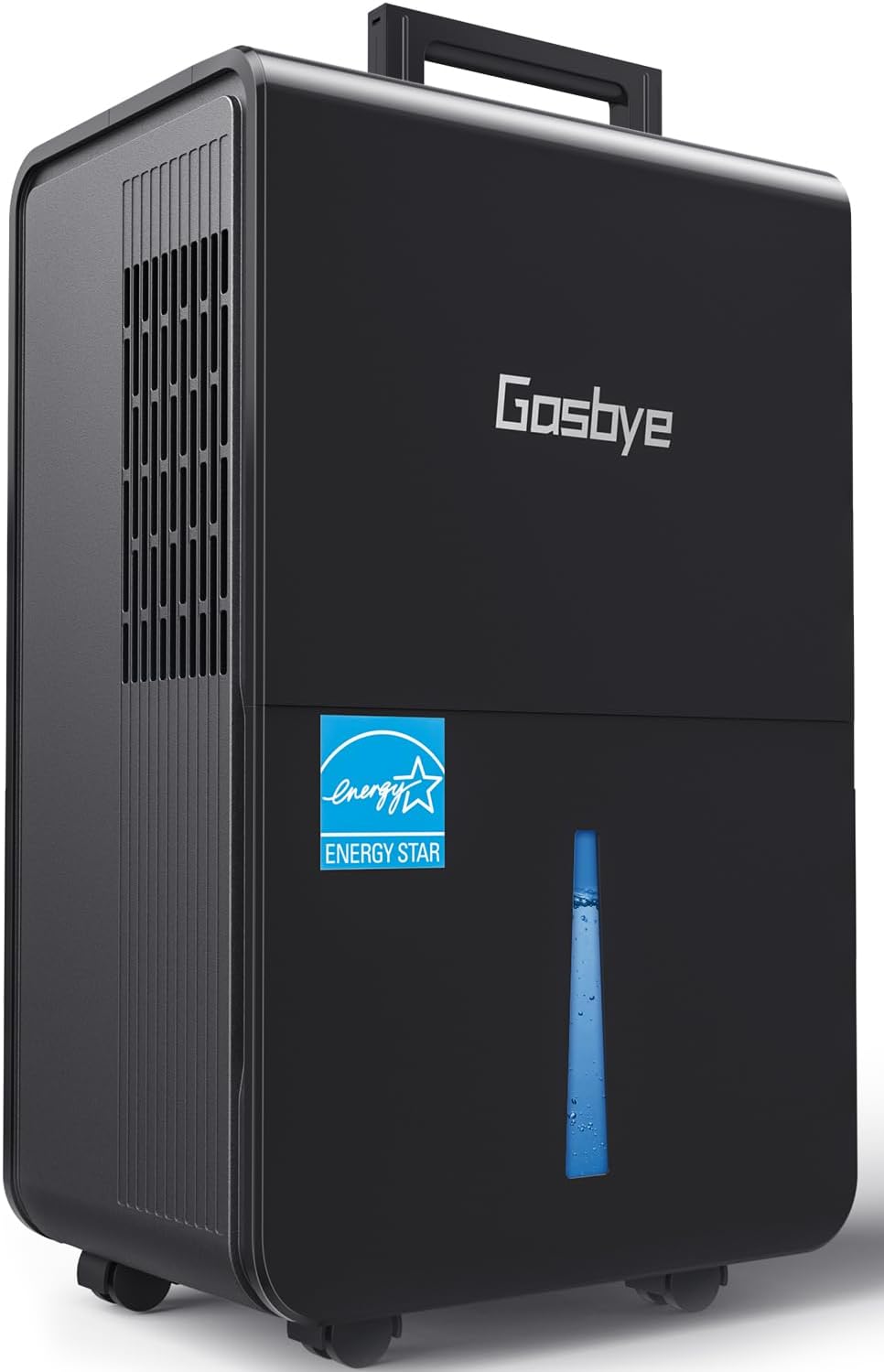
The Gasbye DryPrime-50 is a heavy-duty, compressor dehumidifier built for large rooms and basements where continuous moisture control is needed. It delivers lab-tested dehumidification at different temperature and humidity points—up to 115 pints/day at 86°F, 80% RH—and uses a 500-watt compressor with a five-tier copper coil for durability. Practical features include a 1.72 gallon removable tank, an included drain hose and a threaded outlet for garden-hose hookup, auto shut-off and auto-restart after power loss, and an adjustable humidity control with a brief fan run-after-shutdown to squeeze more moisture from the coils. The unit is Energy Star certified and runs at about 45 dB, so it moves a lot of air without being overly loud in a basement or large living area. Trade-offs are obvious: it is a heavier, compressor-style unit that emits warm exhaust and is not ideal for small bedrooms, and you should plan for regular emptying or a continuous drain setup if you run it often. For basement duty its build and drainage flexibility make it a practical, energy-aware choice.
Best for: Buyers who want a robust, energy-efficient dehumidifier for large, damp spaces and prioritize reliable continuous performance and flexible drainage for basement applications.
Less Ideal for: People needing a lightweight, ultra-quiet unit for small bedrooms or portable use should consider smaller or non-compressor alternatives.
- High certified capacity with lab-tested figures up to 115 pints/day under specified conditions
- Energy Star 2026 certification for improved energy efficiency compared with noncertified units
- Three drainage methods: removable 1.72 gal tank, included short drain hose, and threaded garden-hose outlet
- Reinforced five-tier copper coil and heavier build aimed at long-term durability
- Relatively quiet compressor operation around 45 dB suitable for basements and large rooms
- Compressor-style unit produces warm exhaust and is not ideal for small bedrooms
- Single fan speed and limited speed control compared with some competitors
- At 43 pounds it is heavier and less portable than many smaller dehumidifiers
Verdict: Choose the DryPrime-50 when you need a durable, high-capacity, energy-efficient dehumidifier built for basement-scale moisture control.
AprilAire E080 80-Pint Dehumidifier
| Capacity | 80 pints per day |
|---|---|
| Area Coverage | Up to 4,400 sq ft |
| Air Flow Capacity | 185 cfm |
| Wattage | 612 watts |
| Voltage | 120 VAC |
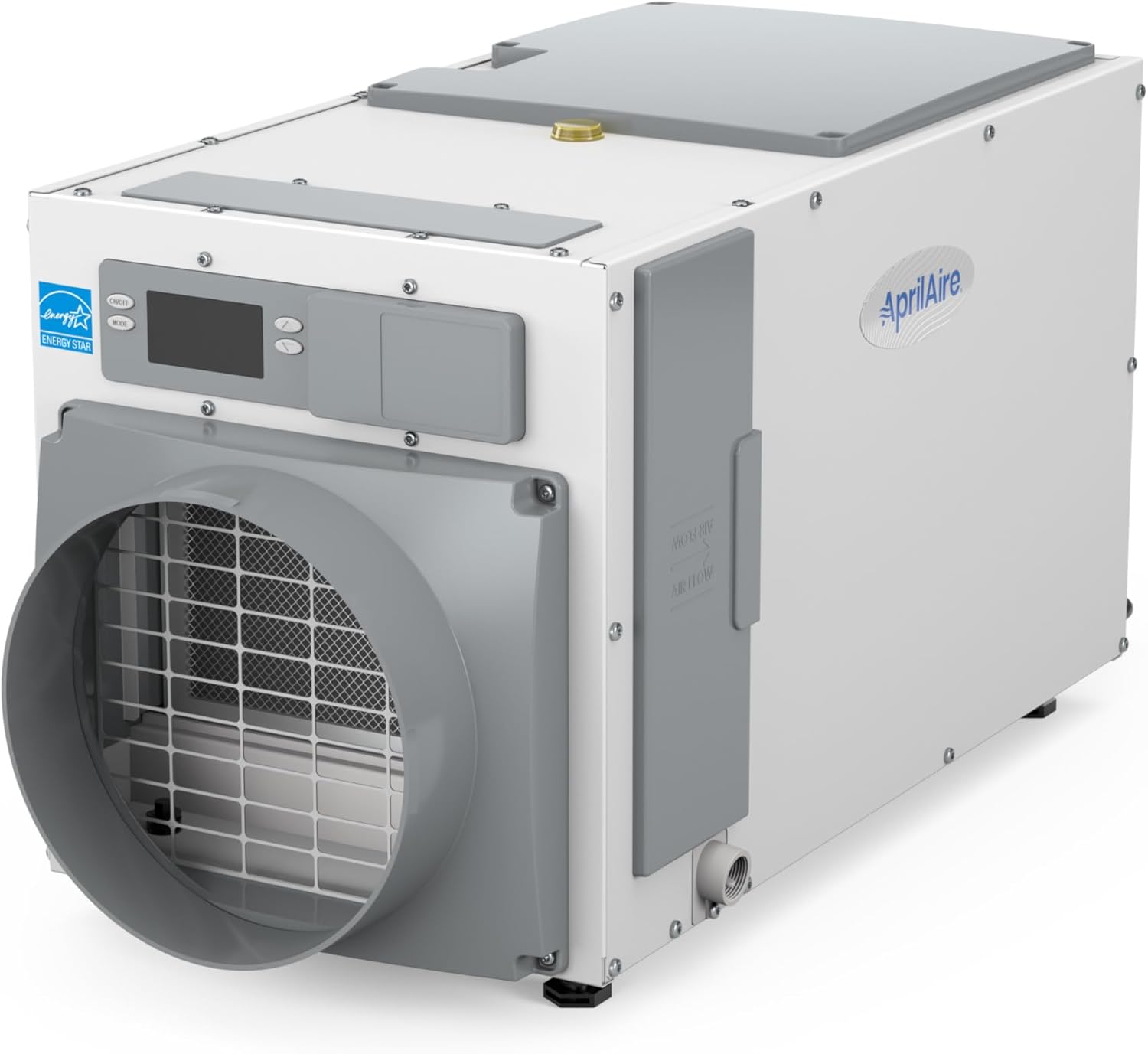
The AprilAire E080 is a commercial-grade dehumidifier designed to control high humidity in basements, crawl spaces, or whole houses up to about 4,400 sq ft by removing up to 80 pints (12 gallons) of water per day. It runs automatically based on a relative-humidity set point and offers a top- or front-mount digital control for convenient placement. Practical features include continuous draining options, a washable MERV 8 filter, corrosion-resistant aluminum coils, automatic defrost and restart, and built-in overheat protection for long runtime in cool, damp environments. At 612 watts and 185 CFM airflow, it balances strong moisture removal with energy-efficient performance and carries a five-year manufacturer warranty. The unit is single-speed and relatively heavy, so installation may require two people and planning for a drain hookup or duct collar. It is built for durability and low maintenance, but lacks multi-speed fan control and integrated casters for easy repositioning, which may matter in tighter basements.
Best for: Buyers who prioritize strong, reliable moisture removal for large or very damp basements and want a durable, low-maintenance unit that can be plumbed for permanent installation.
Less Ideal for: People who need a lightweight, portable dehumidifier for occasional spot use or who want adjustable fan speeds and caster mobility for frequent repositioning.
- High dehumidification capacity up to 80 pints per day suitable for large basements
- ENERGY STAR Most Efficient rating for lower energy use relative to output
- Automatic humidity-based operation simplifies set-and-forget use
- Continuous drain option and duct collars enable permanent installation
- Durable construction with corrosion-resistant aluminum coils and washable MERV 8 filter
- Single fan speed limits fine-tuned airflow and noise control
- Heavy cabinet and no built-in casters make moving and installation harder
- Requires a drain or floor drain placement for best continuous operation
Verdict: Choose the AprilAire E080 when you need powerful, energy-efficient continuous dehumidification for large, damp basements and want a rugged, low-maintenance unit for permanent installation.
AEOCKY LEO-Lite 74 Pint Dehumidifier

| Capacity | 74 pints per day |
|---|---|
| Tank Volume | 1.45 gallons |
| Floor Area | 4500 square_feet |
| Operation Mode | Auto |
| Other Special Features of the Product | Timer |
The AEOCKY LEO-Lite is a high-capacity compressor dehumidifier built for large, damp spaces like basements. It removes up to 74 pints per day under peak conditions and uses a rotary compressor and a 3+2 evaporator/condenser layout to prioritize efficiency while keeping noise low. Controls include an intelligent humidistat with fast humidity sensing, an auto mode and timer, plus power-off memory for automatic recovery after outages. A 1.45 gallon tank and included drain hose let you choose between emptying the tank or continuous drainage. The unit meets ENERGY STAR Version 6.0 efficiency standards, so it runs more economically than many older basement models and includes an auto-defrost system to keep working in cooler basement temperatures. It is fairly quiet at low speed and is aimed at continuous or near-continuous operation for moisture control. Trade-offs are its single-speed fan control and relatively large footprint compared with tiny portable units, so it is best where sustained extraction and energy savings outweigh simple portability.
Best for: Buyers who want an efficient, high-capacity dehumidifier to control persistent basement humidity and reduce energy use over long runtimes.
Less Ideal for: If you need a lightweight, highly portable unit for small rooms or infrequent use, a compact low-capacity dehumidifier is a better fit.
- High dehumidification capacity rated at 74 pints per day for heavy basement humidity
- ENERGY STAR Version 6.0 rating for improved seasonal energy efficiency
- Auto-defrost keeps the unit operating in cool basement temperatures
- Included drain hose plus 1.45 gallon tank enables continuous drain or manual emptying
- Quiet operation for its class thanks to rotary compressor and low fan noise
- Single speed setting limits fine-grained control of airflow and sound
- Relatively large and heavier than compact room dehumidifiers
Verdict: Choose the LEO-Lite when you need a quiet, energy-efficient, high-capacity dehumidifier built to run continuously in a basement.
Uthfy 55-Pint Dehumidifier

| Dehumidification Capacity | 55 pints_per_day |
|---|---|
| Capacity | 55 pints |
| Tank Volume | 1.2 gallons |
| Wattage | 173 watts |
| Voltage | 115 volts |
This Uthfy dehumidifier targets large, damp spaces such as basements by pulling up to 55 pints of moisture per day and circulating air with a dual-turbo system. It is typically used in basements, living areas, or laundry rooms where fast moisture removal is needed; the 1.2 gallon removable tank plus included drain hose allow either periodic emptying or continuous drainage for unattended operation. Notable features include a high-efficiency compressor, AI Cruise Control humidity management, dual-screen readouts, child lock, auto defrost, 24-hour timer, and caster wheels for repositioning. The unit emphasizes quiet operation with multi-layer sound reduction claimed down to 35 dB in sleep mode and uses R290 refrigerant for lower environmental impact. Practical benefits are strong moisture extraction for large rooms, easy continuous-drain setup, and user-friendly controls for set-and-forget humidity control. Important limitations are its footprint and weight relative to small-room units and that higher-capacity operation will consume more power than compact models despite efficiency claims.
Best for: Buyers who need a budget-conscious but powerful dehumidifier for damp basements or large rooms and want an easy continuous-drain option and quiet, automatic humidity control.
Less Ideal for: People who only need occasional moisture control in small bedrooms or apartments where a compact, ultra-light unit would be more practical.
- High extraction rate up to 55 pints per day suitable for large basements
- 1.2 gallon removable tank plus included drain hose for continuous drainage
- Quiet operation with multi-layer noise reduction and a sleep mode
- AI humidity control and dual-screen display for easy monitoring and automation
- Larger, heavier footprint compared with small-room dehumidifiers
- Higher-capacity operation can draw noticeably more power than compact units
Verdict: A high-capacity, budget-friendly dehumidifier built to remove large amounts of moisture from basements while offering continuous-drain convenience and quiet automated control.
hOmeLabs 50 Pint Dehumidifier
| Dehumidification Capacity | 50 pints_per_day |
|---|---|
| Floor Area | 7000 square_feet |
| Tank Volume | 1.6 gallons |
| Wattage | 322 watts |
| Air Flow Capacity | 165 cfm |
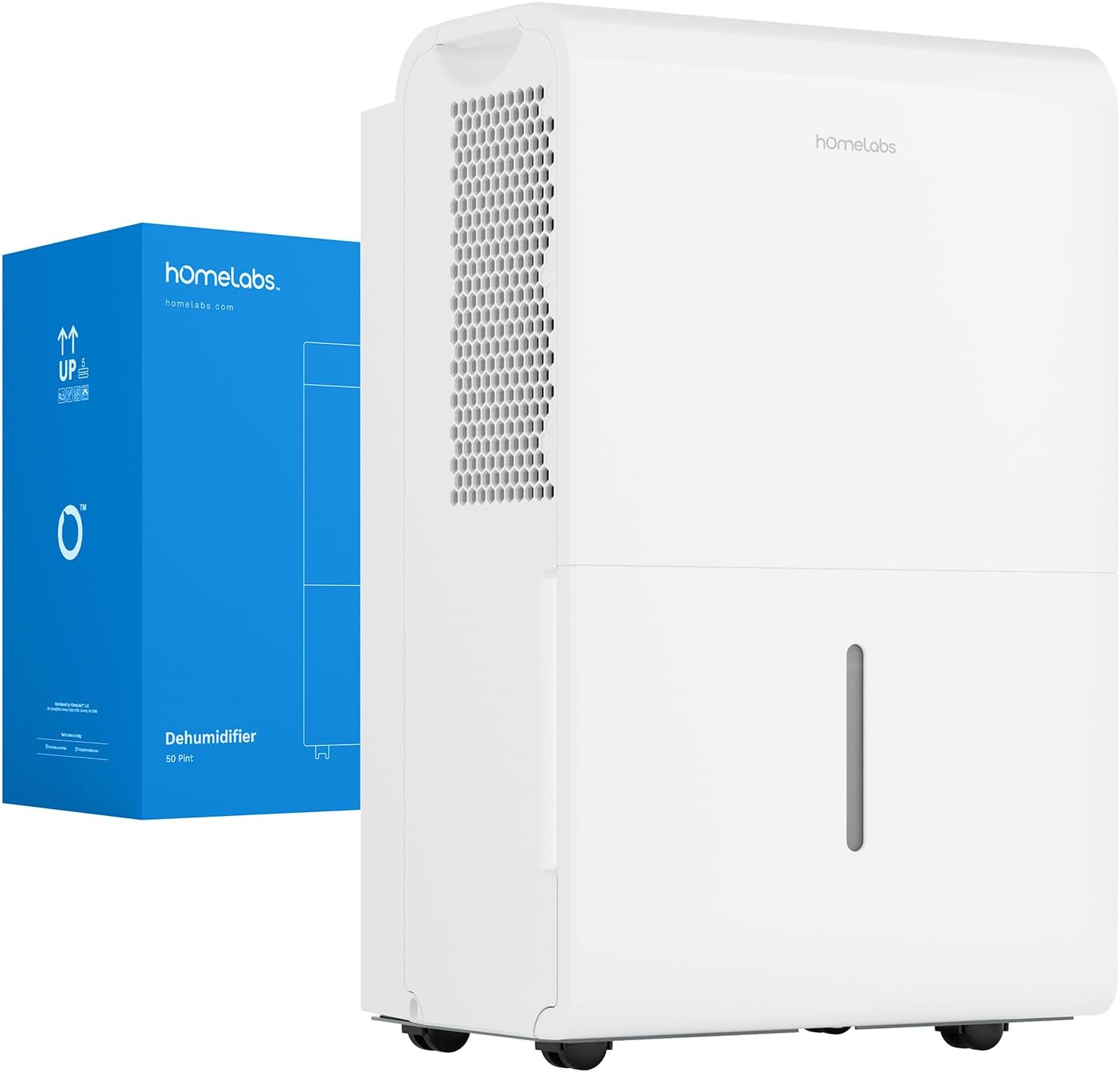
This hOmeLabs unit is a large-capacity dehumidifier intended to remove substantial moisture from big rooms and basements. It is rated to pull up to 50 pints per day at standard test conditions and is claimed to handle spaces up to 7,000 sq ft, with boosted capacity at very high temperatures and humidity. The machine includes two fan speeds, a touch control panel, washable filter, and a removable tank with automatic shutoff; there is also a hose outlet for continuous drainage. Wi‑Fi connectivity lets you adjust settings remotely, which is handy if the unit is placed in a basement you do not visit often. Practical benefits include portability via wheels and handles, an automatic defrost and restart function for colder environments, and a timer for scheduled operation. Important limits are the weight and footprint for basement placement and the need to supply a drain hose for continuous operation; performance will vary with room temperature and relative humidity, so expect lower pints-per-day in cool basements compared with the listed maximums.
Best for: Buyers who prioritize consistent, heavy-duty moisture removal for basements and large rooms and want remote control and automatic protections to minimize hands-on maintenance.
Less Ideal for: Small apartments, closets, or users needing an ultra-compact, lightweight unit where storage space and portability are the primary concerns.
- High dehumidification capacity suitable for large areas
- Wi‑Fi control for remote monitoring and adjustment
- Continuous drain option plus removable tank for flexibility
- Automatic defrost, restart, and shutoff for maintenance-free operation
- Washable filter and simple touch controls for easy upkeep
- Unit is heavy and relatively large which affects placement
- Hose for continuous draining is not included
Verdict: Choose this model if you need a reliable, high-capacity dehumidifier for basement use with remote control and automatic safeguards to reduce maintenance.
Waykar 80-Pint Dehumidifier JD025CE-80

| Dehumidification Capacity | 80 pints_per_day |
|---|---|
| Tank Volume | 2.5 gallons |
| Wattage | 270 watts |
| Air Flow Capacity | 165 cfm |
| Operation Mode | Continuous |
The Waykar 80-Pint Dehumidifier is built to handle large, damp areas such as basements by extracting up to 80 pints per day and offering both tank and continuous drain options. It is commonly used running continuously or on a timed schedule to bring basement humidity down to a selected setpoint between 30% and 80% relative humidity, and the 90° auto-swing helps spread airflow for more even drying. Practical features include an included drain hose and connector for gravity drainage, a washable removable filter, automatic defrost and overload protection for low-temperature reliability, and an Energy Star rating to keep running costs lower than noncertified units. At roughly 42 dB it is quieter than many similarly sized machines, making it reasonable for finished basements or nearby living areas. The unit is relatively heavy and targeted at larger spaces, so it is less convenient to move frequently, and the 1.14 gallon tank means emptying is still needed if you do not use continuous drainage. For buyers focused on dependable basement performance and energy efficiency, this model delivers strong moisture removal with sensible protections for extended operation.
Best for: Homeowners who need a reliable, high-capacity dehumidifier to control moisture in large basements and prefer proven features and energy efficiency over portability.
Less Ideal for: People looking for a lightweight, highly portable unit for small rooms or occasional use should consider smaller, easier-to-move models instead.
- High dehumidification capacity rated at 80 pints per day for large basements
- ENERGY STAR certification for better energy efficiency during extended use
- Multiple drainage options with included drain hose for continuous gravity drain
- Auto-defrost and overload protection improve reliability in cool basement conditions
- 90° auto-swing airflow and washable filter help distribute air and simplify maintenance
- Relatively heavy and sized for large spaces, so not ideal for frequent transport
- Water tank is modest at 1.14 gallons if continuous drainage is not used
Verdict: A powerful, Energy Star certified 80‑pint unit that reliably handles large basement humidity with continuous drain and protective auto-defrost features.
AEOCKY RHEA Dehumidifier

| Capacity | 105 pints |
|---|---|
| Dehumidification Capacity | 100 pints_per_day |
| Tank Volume | 1.45 gallons |
| Wattage | 400 watts |
| Floor Area | 6000 square_feet |
The AEOCKY RHEA is a heavy-duty compressor dehumidifier built to remove large volumes of moisture from basements and large living spaces. It is rated up to 105 pints per day under extreme lab conditions and is ENERGY STAR Most Efficient 2024 certified, which signals above-average energy performance for continuous use. Typical use cases are basement moisture control, drying out damp rooms after leaks, and steady humidity management in large homes; the unit offers adjustable humidity control, multiple operating modes (auto, constant humidity, continuous, smart drying, and sleep), a child lock, timer, and fan speed control for flexible operation. Practical benefits include a large 1.45 gallon tank, included drain hose and garden-hose adapter for continuous drainage, an auto-defrost system that helps operation in cool basements, and relatively quiet running with reported low noise around 44 dB on low. The main trade-offs are its size and weight for a basement-focused machine and the fact that the stated 105 pint/day figure is a peak performance metric rather than typical daily output in cooler conditions. Risk-averse buyers will appreciate the ENERGY STAR Most Efficient badge and ETL/RoHS mentions, which support reliability and lower operating cost over long-term continuous use.
Best for: Buyers who prioritize reliable, certified energy efficiency and need strong continuous moisture removal for basements or large spaces, and who prefer a unit with proven safety certifications and continuous-drain convenience.
Less Ideal for: Those looking for a compact, ultra-portable dehumidifier for very small rooms or infrequent spot use should consider a smaller, lighter model instead.
- Very high maximum dehumidification capacity suitable for large basements or whole-house use
- ENERGY STAR Most Efficient 2024 certification indicating strong energy performance
- Auto-defrost and multiple operating modes for reliable basement operation in cool, damp conditions
- Includes drain hose and garden-hose adapter for continuous drainage without frequent emptying
- Reportedly quiet operation at low fan speeds for overnight or living-area placement
- Peak 105 pints/day is a rated maximum under specific conditions and actual daily extraction will be lower in typical basement temperatures
- Large, heavier chassis that may be awkward to move or store compared with smaller units
Verdict: If you need a powerful, energy‑efficient dehumidifier for a damp basement, the AEOCKY RHEA delivers high continuous performance and reliable, certified efficiency.
Choosing the Right Powerful Dehumidifier for Basements: Key Factors to Consider
Extraction Capacity
Extraction capacity is the amount of water a dehumidifier can remove in 24 hours, expressed in pints or liters. For basements you should plan for higher capacities because below-grade spaces often have cooler temperatures and more persistent dampness. A unit with a higher extraction rating will dehumidify larger square footage and recover humidity faster after events like storms or laundry cycles.
Choosing appropriate capacity prevents the unit from running continuously without making progress. Undersized units can struggle, which leads to longer run times, higher energy use, and continued risk of mold growth.
Energy Efficiency and Operating Cost
Because basement units commonly run for long stretches, energy efficiency directly affects operating cost. Look for models with reasonable power draw relative to extraction output and features that reduce runtime, such as adjustable humidity setpoints, auto-defrost, and programmable timers. A more efficient unit will remove the same amount of moisture while consuming less electricity over months of use.
Also consider how control features interact with efficiency. A dehumidifier that holds steady at a target RH will avoid short-cycling or excessive fan speeds that waste power.
Drainage Options and Plumbing Compatibility
Basement installations benefit from reliable condensate handling. Units that offer gravity drain, built-in pumps, or simple fittings for a hose let you route moisture to a floor drain or sump rather than emptying a bucket. Built-in pumps are useful when the drain point is above the unit, while gravity drains are adequate when the outlet is lower.
Check that the drainage method matches your basement layout to prevent spills and reduce maintenance. Clear access to the drain connection and a way to detect clogs are also important for long-term reliability.
Noise and Fan Performance
Noise matters if the basement is adjacent to living spaces or used as a recreation area. Higher extraction often correlates with stronger fans and louder operation, so balance required capacity with acceptable sound levels. Models with multiple fan speeds, quieter low-speed modes, or decibel ratings give more control over comfort.
Consider where the unit will sit relative to rooms above and what noise the occupants will tolerate during extended runs.
Durability and Maintenance
Durable construction and easy maintenance keep long-term costs down. Look for units with corrosion-resistant coils and accessible service panels so filters and components can be cleaned or replaced. A washable filter and clear instructions for defrost cycles, pump maintenance, and parts replacement reduce the likelihood of service calls.
Reliable warranty support and straightforward diagnostics also help you keep a basement dry without frequent technician visits.
Controls and Humidity Management
Good controls let you set and maintain a target relative humidity, schedule runs, and respond to changes in conditions. Digital humidistats, adjustable RH setpoints, and simple indicator lights help you keep the space at the desired level without guesswork. Some units offer built-in timers or hysteresis settings to prevent short-cycling.
For basements that vary in temperature or occupancy, flexible controls are essential to avoid either over-drying or leaving the room too damp.
Sizing Your Basement: How Much Capacity Do You Need
Calculating the right size starts with the basement's square footage and the level of dampness. For a cool, moderately damp finished basement, aim for a higher-capacity unit than you would for an above-grade room of the same size because cooler air holds less moisture and extraction performance can drop with temperature.
If the space is prone to heavy dampness or occasional flooding, choose a model rated for commercial or heavy-duty residential use. Also factor in ceiling height and connected spaces; a tall or multi-room basement requires more capacity. When in doubt, upsize one step to ensure the unit can keep up during peak conditions.
- Measure square footage and note ceiling height.
- Classify baseline dampness: slightly musty, persistently damp, or occasional water intrusion.
- Select a unit rated for the resulting load, erring on the higher side for cool basements.
Placement and Airflow Best Practices
Position the dehumidifier where it can draw air from the most affected zones and discharge into open space. Avoid tight corners, blocked vents, or locations where furniture restricts airflow.
Elevating the unit slightly off the floor can protect it from minor standing water and improve airflow. Keep a clear perimeter around the intake and exhaust to maintain rated performance, and place it near a drain access if you plan to use continuous drainage.
- Keep at least 12 inches of clearance around the unit.
- Place near the center of the area to improve circulation in large rooms.
- Avoid installing directly against walls or under shelving that restricts exhaust.
Continuous Drain Vs Bucket: Practical Pros and Cons
A built-in bucket is fine for low-use areas but is impractical for basements that require consistent operation. Continuous-drain setups with gravity or an internal pump remove the need for frequent emptying and lower the risk of overflow. Pumps add convenience when gravity drainage is not possible but introduce additional components that may require maintenance.
Consider how often you can reasonably check a bucket and whether a routed hose to a drain or sump makes sense for your layout. Proper installation prevents leaks and ensures hands-off operation.
- Buckets require regular emptying and are best for occasional use.
- Gravity drains are simple and low-maintenance when a drain is available.
- Built-in pumps enable flexible placement but need occasional checks for pump function.
Temperature Effects and Auto-Defrost
Basements are typically cooler and that can cause coils to ice at low temperatures. Units designed for basement use often include an auto-defrost cycle to prevent ice buildup and maintain extraction efficiency. If you expect operation in cool conditions, verify the unit's rated operating temperature and that it has reliable defrosting.
A dehumidifier unable to manage coil frost will lose capacity and may cycle off, leaving humidity uncontrolled. For garages or unconditioned basements, low-temperature performance is a key selection factor.
- Check the minimum operating temperature for rated extraction.
- Look for active defrost controls or modes for cool-season operation.
- Understand the impact of defrost cycles on average daily extraction.
Managing Air Quality and Odors
Dehumidifiers reduce the moisture that fuels mold and mildew, but they do not remove odors or particulates by themselves. For finished basements where air quality matters, pair a dehumidifier with proper ventilation or an air cleaner if dust or VOCs are a concern. Some units include basic filters that capture dust and large particles, which helps keep coils cleaner and maintain airflow.
Regular cleaning of the unit and the surrounding space also reduces mustiness and prevents secondary problems. Treat the underlying source of moisture where possible to avoid relying solely on mechanical removal.
- Use washable filters to protect coils and reduce dust.
- Combine dehumidification with improved ventilation for persistent odors.
- Address leaks and water entry points rather than only drying the air.
How We Chose the Best Powerful Dehumidifier for Basements
We assembled this list by applying practical, performance-focused filters that matter for basement dehumidification. First, we prioritized units with high daily extraction capacity and sustained airflow so they can reduce humidity in larger or more persistent damp spaces. Second, energy efficiency and integrated humidity control were required to keep run costs reasonable during long operating periods. Third, durability and serviceability were considered, including robust condensate handling and accessible filters for routine upkeep. Fourth, noise output and fan speed range were evaluated because basements are often adjacent to living areas. Finally, we considered installation flexibility such as continuous drain options and built-in pumps for ease of setup. We excluded compact, low-capacity household models designed only for single small rooms, units without basic humidity control, and any devices lacking clear condensate management. The final selections reflect equipment that meets higher-capacity basement needs and the concrete performance metrics listed above.
Our full evaluation process is outlined in our review methodology.
FAQ
How often should a basement dehumidifier run?
It depends on humidity level and unit capacity. In very damp basements it may run for many hours daily until the target relative humidity is reached. An appropriately sized unit with a proper setpoint should cycle on and off rather than run continuously once conditions stabilize.
Can a dehumidifier prevent mold in a basement?
A dehumidifier reduces the moisture that allows mold to grow, which is a key preventive step. It works best when combined with fixes for the moisture source, like sealing leaks, improving drainage, or adding ventilation.
Is a pump necessary for basement drainage?
A pump is helpful if the nearest drain is above the unit's level or not easily accessible. If a gravity drain to a lower floor drain exists, a pump is not required. Pumps add convenience but require occasional checks and maintenance.
Will a dehumidifier make my basement cold?
Dehumidifiers move air and remove latent heat through condensation, which can slightly change perceived temperature but will not significantly cool a conditioned space. In unheated basements you may notice a modest temperature difference during heavy operation.
What humidity level should I aim for in a basement?
A common target is between 45 and 55 percent relative humidity. Lower targets reduce mold risk but may increase runtime and energy use. Aim for a balance that prevents condensation without over-drying materials.
Final Verdict
When choosing a powerful dehumidifier for basements, prioritize extraction capacity and reliable condensate handling first. Energy efficiency, effective low-temperature operation, and reasonable noise levels are the key tradeoffs to manage depending on how and where the unit will run. Select a unit sized for your space, place it for good airflow, and choose the drainage option that fits your layout. Focus on durability and controls to minimize maintenance and keep humidity stable over seasons.