
Note: This article contains affiliate links. If you click on these links and make a purchase, we may earn a small commission at no extra cost to you. This helps support our research and content. Read our full affiliate disclosure here.
If you bake regularly at home, the right dough mixer can make the difference between uneven loaves and reliably great results. A purpose-built dough mixer for home baker use improves mixing consistency, reduces hands-on kneading, and scales from small batches to family-size recipes. This guide shortlists the top options across practical use cases, focusing on durability, motor capability, and ease of cleanup. We evaluated units that suit frequent bakers who need dependable mixing for bread, rolls, pizza, and enriched doughs. Read on to see the selected picks and the attributes we weighed when choosing them.
Top Picks at a Glance
| Best Overall The best all-around choice for most situations | Aucma Stand Mixer SM-1518N |  |
| Best Quality Built to a higher standard if you want something more solid | Bosch Universal Plus Mixer |  |
| Best Value The sweet spot between price and what you get | CUSIMAX Stand Mixer 5-Quart |  |
| Best Budget The cheapest option that still gets the job done reliably | Vikaluz Stand Mixer HH-9512A |  |
| Top Rated A top-rated pick with lots of positive feedback | KitchenAid Classic Series 4.5 Qt Mixer |  |
| Most Popular A crowd favorite that many people choose with confidence | KitchenAid Artisan 5-Qt Stand Mixer |  |
| Best Seller A high-volume bestseller chosen again and again | Martha Stewart Tilt-Head Stand Mixer |  |
Aucma Stand Mixer SM-1518N

| Wattage | 660 watts |
|---|---|
| Capacity | 6.5 quarts |
| Number of Speeds | 6 |
| Controls Type | Knob |
| Voltage | 120 volts |
This Aucma stand mixer is designed for hands-free mixing of batters, egg whites, and dough with a 660W pure copper motor and a 6.5-quart stainless steel bowl that accommodates larger batches. The tilt-head design makes swapping the included stainless-steel whisk, beater, and dough hook straightforward, and the splash guard with an ingredient chute keeps counters cleaner during mixing. Six speed settings plus a pulse function give control from gentle folding to higher-speed whipping, while non-slip feet and a sturdy ABS housing keep the unit stable during heavy use. Accessories are dishwasher safe, which simplifies cleanup after frequent baking. Noise is listed around 76 dB, so it is not the quietest appliance but acceptable for home kitchens. The mixer is a practical choice for home bakers who need capacity for family-sized recipes, but those seeking a commercial-grade machine or quieter operation may prefer heavier-duty or noise-optimized models.
Best for: Home bakers who regularly make family-sized batches and want a capable, easy-to-use mixer with solid mixing power and straightforward controls.
Less Ideal for: Those who need a near-silent machine or a commercial-grade metal-housed mixer for heavy daily production should consider higher-end or pro-series models instead.
- Powerful 660W motor suitable for thick doughs and everyday mixing
- Large 6.5-quart stainless steel bowl for bigger batches
- Tilt-head design for easy access to the bowl and attachments
- Includes whisk, beater, dough hook and splash guard; accessories are dishwasher safe
- Non-slip feet and sturdy housing for stable operation
- Noise level around 76 dB can be noticeable during high-speed mixing
- Housing is ABS plastic rather than metal, which may feel less premium
Verdict: Aucma’s 6.5-quart, 660W stand mixer is a practical, full-size home baking workhorse for people who bake larger batches and want reliable mixing power.
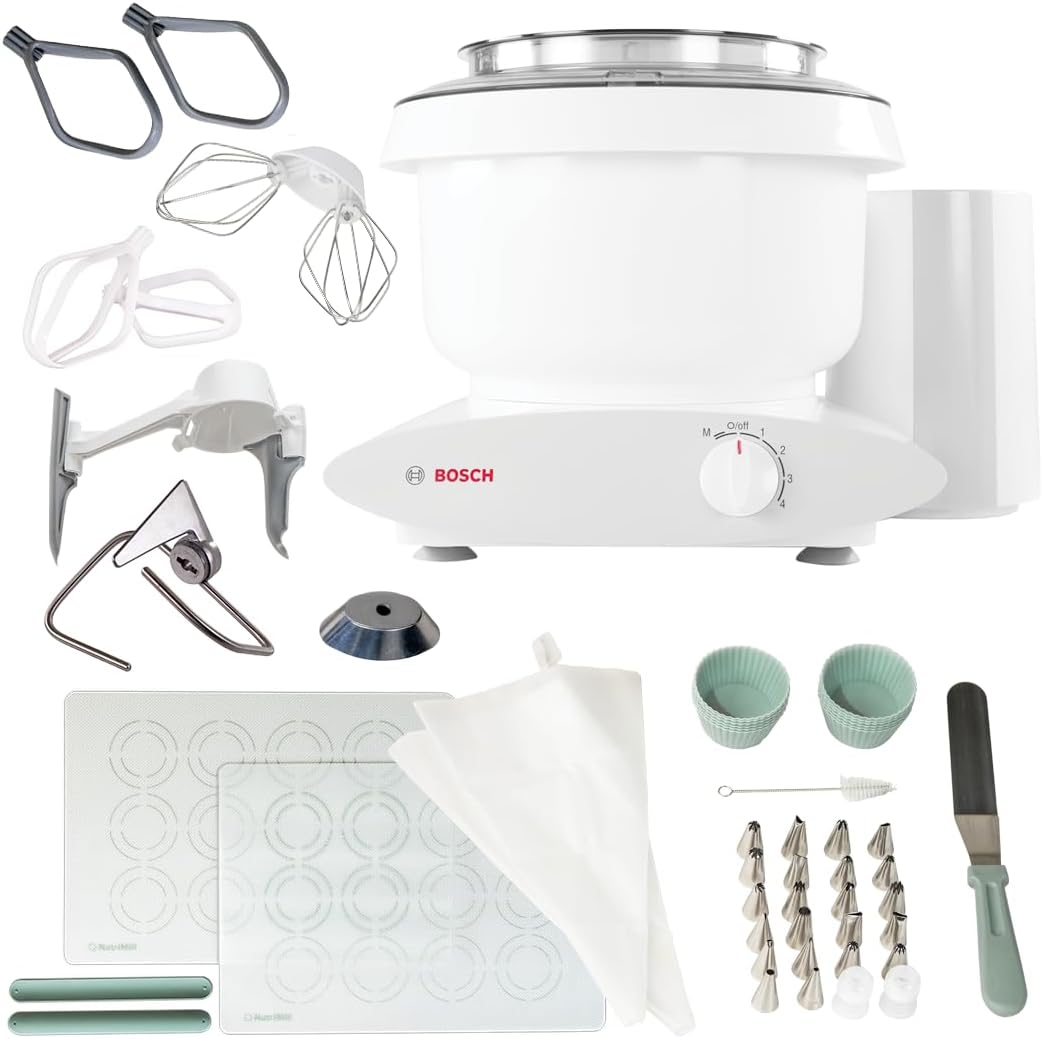
Bosch Universal Plus Mixer
| Wattage | 500 watts |
|---|---|
| Number of Speeds | 4 + Pulse |
| Capacity | 7 liters |
| Container Material | Stainless Steel |
The Bosch Universal Plus Mixer is built around a bottom-drive, high-torque 500W motor that handles dense doughs and large batches without overheating. It uses a 6.5-quart (7 liter) stainless-steel bowl and a trio of included tools—dough hook, wire whips, and paddles—so you can knead bread, whip meringue from a single egg white, and mix cookie or cake batters with confidence. Four variable speeds plus a pulse setting give control for slow kneading up to faster whipping, while suction-cup feet keep the unit steady during heavy loads. The belt-driven transmission and heavy-duty dough hook are specifically designed for long runs of kneading, and the mixer accepts a broad range of optional attachments for grinding, blending, or making ice cream. Practical touches like dishwasher-safe parts, cord storage, and a splash cover make cleanup and everyday use easier. The machine is intentionally utilitarian, so it lacks flashy digital controls and is relatively large, which may matter for limited-counter kitchens. For bakers who prioritize torque and capacity, this mixer focuses on performance over boutique styling.
Best for: Home bakers who prioritize raw mixing power and capacity for frequent bread or large-batch baking and want a durable, workhorse mixer rather than a compact or decorative unit.
Less Ideal for: Casual bakers who only make small batches or those who want compact, lightweight mixers with touch controls and built-in timers should consider smaller countertop models.
- High-torque 500W bottom-drive motor suited for heavy doughs and large batches
- Large 6.5-qt (7 L) stainless-steel bowl accommodates multiple loaves or dozens of cookies
- Included dough hook, wire whips, and paddles cover kneading, whipping, and mixing tasks
- Suction-cup feet and belt-driven transmission provide stability and durable power delivery
- Dishwasher-safe parts and cord storage simplify cleaning and storage
- Basic knob controls and no digital timer or preset programs
- Relatively large footprint that may be bulky for small kitchens
Verdict: Choose the Bosch Universal Plus when you need a high-torque, heavy-duty mixer that can reliably handle large batches and dense doughs for serious home baking.
CUSIMAX Stand Mixer 5-Quart

| Capacity | 5 liters |
|---|---|
| Wattage | 650 watts |
| Number of Speeds | 8 |
| Controls Type | Touch |
| Voltage | 120 volts |
The CUSIMAX Stand Mixer is a straightforward home baking machine built around a 650W motor, 5-quart stainless steel bowl and a tilt-head design that makes access and attachment changes easy. It is typically used for mixing batters, whipping egg whites and kneading dough thanks to the included wire whisk, dough hook and flat beater; the metal gear drive and non-slip feet aim to keep mixing consistent and stable. The digital touch controls let you choose from eight speeds and set a 15-minute timer, which helps with repeatable mixing for recipes that need precise timing. A splash guard with an ingredient port reduces mess when adding liquids, and the lifting handle on the head makes it easier to open the housing. Limitations to expect are a plastic housing rather than full metal construction and a 15-minute built-in timer that may be short for very long kneading sessions, so very heavy or professional-volume use may be better served by a heavier-duty machine.
Best for: Home bakers who want a capable, easy-to-use mixer that handles cakes, cookies and medium bread doughs reliably while prioritizing straightforward digital controls and a manageable bowl size.
Less Ideal for: Those who frequently bake large commercial batches or need a heavy-duty, all-metal professional mixer for continuous long kneading sessions should consider a more industrial model.
- Powerful 650W motor with metal gear drive for consistent mixing
- 5-quart stainless steel bowl fits typical home baking batches
- Digital touch controls with 8 speeds and a 15-minute timer for repeatable results
- Includes dough hook, flat beater and wire whisk for common tasks
- Tilt-head design and splash guard make access and ingredient additions easier
- Plastic exterior housing feels less durable than all-metal alternatives
- 15-minute timer may be insufficient for extended heavy kneading
Verdict: A user-friendly, mid-power stand mixer that gives home bakers reliable mixing performance with digital controls and a versatile set of attachments.
Vikaluz Stand Mixer HH-9512A

| Capacity | 3.2 quarts |
|---|---|
| Wattage | 250 watts |
| Number of Speeds | 5 |
| Voltage | 120 volts |
| Material | 304 Stainless Steel |
This Vikaluz stand mixer is built for at-home bakers who want a compact, budget-friendly machine that still handles common doughs and batters. It functions as a hands-free stand mixer for heavier tasks and converts to a handheld mixer for quick jobs, with a 3.2 quart stainless steel bowl and included dough hook, flat beater, and whisk. The distinctive auto-rotating 360 degree bowl combined with a side-to-side rotating beater head helps pull ingredients toward the center for more even mixing and reduces the need to scrape the bowl. Five speed settings plus a Turbo boost give usable control from slow folding to whipping, and the tilt-head design makes changing attachments straightforward. Practical touches like an anti-skid base, splash guard, and dishwasher-safe attachments keep cleanup simple. Limitations are the 250W motor and smaller 3.2 quart capacity, so very large batches or extremely heavy professional doughs will push it harder than larger, higher-power models, but for everyday bread, cookies, cakes, and whipped cream it offers strong value for the price.
Best for: Home bakers on a budget who need a compact, multipurpose mixer for everyday batches like bread, cookies, cakes, and whipped cream and who value versatility over commercial power.
Less Ideal for: Serious hobbyists or small-bakery operators who routinely mix very large batches or dense doughs should look for a heavier-duty, higher-wattage stand mixer.
- 2-in-1 design converts between stand and hand mixer for versatile use
- Auto-rotating bowl plus side-to-side beater improves mixing consistency
- Includes dough hook, flat beater, whisk, and splash guard for baking tasks
- Compact 3.2 QT stainless steel bowl fits small kitchens and daily batches
- Dishwasher-safe attachments and tilt-head make setup and cleanup easy
- 250W motor is modest and may struggle with very heavy or very large doughs
- 3.2 quart capacity limits large-batch baking for bigger families or frequent bakers
Verdict: A compact, affordable 2-in-1 mixer that delivers better-than-average mixing consistency for everyday home baking without taking up much counter space.
KitchenAid Classic Series 4.5 Qt Mixer

| Capacity | 4.5 quarts |
|---|---|
| Wattage | 275 watts |
| Number of Speeds | 10 |
| Included Components | Flat beater, Dough hook, 6-wire whip, 4.5 qt bowl |
The KitchenAid Classic Series 4.5 Quart Tilt-Head Stand Mixer is a straightforward, heavy-duty mixer designed for regular home baking. It uses a 275W direct-drive motor and 10 speed settings to handle everything from stirring and whipping to kneading dough, and the tilt-head design makes it easy to add ingredients and change attachments. The 4.5 quart stainless steel bowl accommodates large batches like multiple dozen cookies, and included tools (flat beater, dough hook, wire whip) cover most common mixing jobs. Metal construction and a removable hub for optional attachments give it a durable, long-lived feel and allow you to expand into grinders, pasta makers, and other tasks later. Practical limits are its tilt-head layout, which can be slightly less convenient for very heavy doughs than some bowl-lift designs, and the motor is adequate for home use but not intended for continuous commercial workloads. In normal home-baking use this mixer offers dependable, repeatable results and a broad ecosystem of attachments for future upgrades.
Best for: Home bakers who prioritize a durable, reliable mixer that can handle frequent household batches and be upgraded over time with attachments.
Less Ideal for: People who need a commercial-grade mixer for heavy continuous use or those who prefer a bowl-lift design for very large or dense doughs.
- Sturdy all-metal construction built for long-term home use
- 10-speed control and 275W motor handle mixing, whipping, and kneading for typical recipes
- 4.5 quart stainless steel bowl fits large home-batch baking
- Includes flat beater, dough hook, and wire whip for common tasks
- Accessory hub accepts optional attachments to expand functionality
- Tilt-head design can be less stable for very heavy, frequent commercial doughs
- Motor power is sized for home baking and not for continuous commercial use
Verdict: A dependable, metal-built stand mixer that reliably covers home baking needs and lets you add attachments as your skills grow.
KitchenAid Artisan 5-Qt Stand Mixer

| Capacity | 5 quarts |
|---|---|
| Wattage | 325 watts |
| Number of Speeds | 10 |
| Included Components | Bowl, flat beater, dough hook, 6-wire whip, pouring shield |
| Voltage | 120 volts |
The KitchenAid Artisan 5-Quart Tilt-Head Stand Mixer is a durable, all-purpose mixer designed for home bakers who make everything from cookie batches to bread dough. It uses a metal construction and a 325-watt motor to drive a standard set of accessories: a coated flat beater, coated dough hook, 6-wire whip, and a stainless steel 5-quart bowl with handle. The tilt-head design makes adding ingredients and swapping attachments straightforward, and the 10-speed knob gives precise control from gentle stirring to high-speed whipping. For dough-focused use the coated dough hook and robust bowl handle make mixing and handling heavier batches easier, and the capacity supports large single-batch recipes like multiple dozen cookies. The mixer also accepts optional hub-powered attachments for grinding or pasta making. Limitations to consider are the tilt-head form factor if you plan to mix very large, heavy loaves frequently and the 325 W motor, which while sufficient for most home baking may be slower on very dense doughs compared with higher-powered bowl-lift machines. The included pouring shield helps reduce mess during use.
Best for: Home bakers who want a reliable, versatile mixer that can handle regular batch baking and occasional heavier doughs while offering proven performance and lots of user feedback.
Less Ideal for: People who need a commercial-capacity, heavy-duty mixer for daily large-batch artisan bread production should consider a bowl-lift or higher-power commercial unit instead.
- Sturdy metal construction built for regular home use
- 5-quart stainless steel bowl handles large single batches
- 10 speed settings give fine control from stir to whip
- Includes flat beater, dough hook, whisk and pouring shield for common tasks
- Tilt-head design makes ingredient addition and accessory changes easy
- Tilt-head layout can limit capacity for very heavy, commercial-style doughs
Verdict: A time-tested, full-featured 5-quart stand mixer that gives home bakers reliable mixing performance and broad accessory support for most dough and baking tasks.
Martha Stewart Tilt-Head Stand Mixer

| Capacity | 5.3 quarts |
|---|---|
| Wattage | 660 watts |
| Number of Speeds | 12 |
| Included Components | Whisk, dough hook, flat beater with silicone edge |
The Martha Stewart Tilt-Head Stand Mixer is a countertop mixer aimed at home bakers who need a reliable machine for doughs, batters, and whipping. It pairs a 660-watt motor and 12 speed settings with a 5.3-quart stainless steel bowl and three included attachments: a dough hook for heavy mixes, a flat beater with a silicone edge for batters and mashes, and a stainless whisk for airy creams and egg whites. The tilt-head design and removable splash shield make adding ingredients and swapping attachments straightforward, while the heavy-duty base helps keep the unit stable during mixing. Practical touches like an easy-grip bowl handle and dishwasher-safe accessories simplify cleanup. Limits to consider are that tilt-head mixers can be less convenient for very large or frequent commercial batches, and the accessory set is basic compared with models that include additional specialty tools. For home baking—cookies, breads, cakes, and whipped creams—it provides solid performance and user-friendly controls at a mainstream value point.
Best for: Home bakers who want a dependable, easy-to-use mixer for everyday recipes and occasional large batches, and who prioritize straightforward setup and cleanup.
Less Ideal for: People who regularly bake professionally or need a mixer for very large commercial batches should consider heavier-duty, bowl-lift machines instead.
- 5.3-quart stainless steel bowl handles large home baking batches
- Twelve speed settings give fine control from slow kneading to high-speed whipping
- Includes three core attachments for dough, mixing, and whisking
- Tilt-head design and removable splash shield make ingredient additions and cleanup easier
- Sturdy base reduces movement during heavy mixing
- Accessory set is limited to the basics and lacks specialty tools
- Tilt-head layout may limit capacity compared with some bowl-lift commercial-style mixers
Verdict: A reliable, user-friendly stand mixer that gives home bakers the power and control needed for most doughs and batters.
Choosing the Right Dough Mixer for Home Baker: Key Factors to Consider
Motor Power and Torque
A dough mixer's motor power and delivered torque are the most important factors for handling dense bread doughs and high-hydration mixes. Higher continuous torque reduces the chance of the motor bogging down during long kneading cycles, so look for mixers with robust rated power and gear reductions suited for dough work.
In practical terms, stronger motors let you handle larger batch sizes and stiffer doughs without overheating. They also shorten kneading time, which helps preserve dough temperature and yeast activity. If you plan to make enriched or whole-grain breads, prioritize torque over nominal wattage numbers alone.
Build Quality and Drivetrain Design
The mixer's mechanical design affects reliability and how it performs under load. Metal gears, reinforced attachment points, and a stable motor mount resist wear from repeated kneading cycles. Tilt-head versus bowl-lift mechanisms each have different stress points; choose the style that provides secure locking and easy access for your workflow.
Durable materials and serviceable parts extend a mixer's usable life. Poorly designed drivetrains can slip, strip gears, or cause inconsistent mixing action, so favor mixers with straightforward maintenance paths and replaceable wear items.
Bowl Capacity and Shape
Bowl volume determines how much dough you can process in a single batch. For home bakers, common needs range from small 2-quart batches for pastries to 5-quart or larger bowls for family-size bread. Consider the typical recipes you make and whether you want headroom for rising and mixing without splatter.
The bowl shape also matters because a wider, shallower bowl can be easier to mix and scrape, while a deeper bowl keeps flour dust contained. Attachment fit and the bowl's locking mechanism influence stability during high-torque kneading.
Attachment Options and Versatility
A good dough mixer should accept a range of attachments or have a standardized hub for accessories. While the dough hook is essential, the ability to attach a paddle, whisk, or optional pasta or grinder accessories increases a mixer's usefulness beyond bread.
Consider whether the accessory mounting is secure under load and if additional tools are sold separately. Versatility helps justify a mixer as a central baking appliance rather than a single-use tool.
Ease of Cleaning and Maintenance
Frequent bakers will want mixers that are quick to clean and simple to maintain. Detachable bowls and hooks that are dishwasher-safe or easily wiped reduce post-bake effort. Fewer seams and tight crevices lower the risk of trapped dough and mold growth.
Routine maintenance items, such as greasing points or easily replaceable belts and seals, make long-term ownership less burdensome. Consider how accessible common wear parts and service guides are for home upkeep.
Noise, Vibration, and Counter Stability
Mixing dense dough can generate noticeable vibration and noise, which affects where and how often you use the appliance. Heavier mixer bases, rubber feet, and balanced motors reduce movement and table chatter. Lower noise levels improve comfort during longer kneading cycles and late-night baking.
A stable mixer also protects countertops and helps maintain consistent mixing action. If your kitchen has limited space, prioritize models designed for minimal vibration and secure mounting.
Sizing Your Mixer for Typical Home Baking
Match bowl capacity to the recipes you make most often. If you bake single loaves or small batches, a compact bowl saves counter space and uses less power. If you bake multiple loaves, larger bowls let you mix full family recipes without splitting batches.
Also plan for headroom. Dough expands during mixing and initial proofing, so a bowl that looks large enough for ingredients may still overflow when the mixer is running. Consider the usable mixing volume rather than the stated maximum capacity.
- 2–3 quart bowls: best for pastries and small test batches
- 4–6 quart bowls: versatile for most home bread baking
- 7+ quart bowls: useful for frequent big batches or batch baking
Mounting Style: Tilt-Head Versus Bowl-Lift
Tilt-head mixers offer faster access to the bowl and attachments, which is convenient for swapping tools and scraping. They are generally more compact but can place more stress on the head hinge under heavy loads.
Bowl-lift mixers use a lever to raise and lower the bowl into a fixed head, providing a very secure engagement for heavy kneading. They tend to be heavier and take up more space, but they often handle large doughs more reliably.
- Choose tilt-head for compact kitchens and occasional heavy doughs
- Choose bowl-lift for regular large-batch bread making
Practical Tips for Reducing Dough Temperature
Dough temperature affects fermentation and crumb structure. Extended mixing can raise dough temperature through friction, so use shorter mixing cycles, cool water, or intermittent mixing to control warmth. Monitor dough feel and temperature if you are trying to hit precise fermentation targets.
Some bakers pause and let dough rest between mixing intervals to avoid over-warming. If you regularly make high-hydration or enriched doughs, consider a mixer with higher torque so cycles finish faster and generate less heat overall.
- Use cool liquids to offset mixing heat
- Shorten kneading times when possible
- Let dough rest briefly between intensive mixing cycles
Maintaining Your Mixer for Longevity
Regular upkeep prevents premature wear. Clean attachments and bowls after each use and wipe the mixer housing to remove flour dust. Follow any manufacturer guidelines for greasing or belt inspection if provided.
Inspect moving parts periodically for looseness or wear. Replace attachments if they bend or the finish wears off, and ensure mounting points remain tight. Proper maintenance keeps mixing consistent and extends the machine's service life.
- Wipe down the machine after each session
- Soak and clean hooks and bowls promptly
- Check mounts and fasteners every few months
Storage and Counter Placement Considerations
Decide whether your mixer will live on the counter or be stored away. Frequent users benefit from leaving the mixer on the counter for immediate access, while occasional bakers may prefer compact, storable designs. Account for weight if you plan to move it often.
Place the mixer on a stable, level surface to minimize vibration. If your countertop is delicate, use a rubber mat to absorb movement and protect finishes.
- Countertop storage favors heavier, more stable mixers
- Lightweight mixers are easier to store but may vibrate more
- Protect counters with a mat when kneading heavy doughs
How We Chose the Best Dough Mixer for Home Baker
We selected mixers for home bakers by applying practical, bake-focused filters that reflect typical kitchen use. Primary evaluation criteria included motor power and torque because these determine a mixer's ability to handle heavy, high-hydration doughs without stalling. Build quality and drivetrain design were assessed to ensure gearing and materials can sustain repeated kneading cycles. Bowl capacity and accessory compatibility were reviewed to match common recipe sizes and allow versatility for different dough types. Ease of cleaning and maintenance was considered for everyday usability, including detachable parts and accessible crevices. Noise and vibration levels were measured qualitatively to prefer quieter, more stable mixers for home kitchens. We excluded units intended only for very light mixing or single-use novelty appliances that lack the torque or durability needed for bread dough. The winners are mixers that balanced strong motors, robust mechanical design, suitable bowl sizes, and simple upkeep for regular home-baking workloads.
Our full evaluation process is outlined in our review methodology.
FAQ
What bowl size do I need for occasional bread baking?
For occasional loaf-sized baking, a 4 to 5 quart bowl typically handles standard bread recipes comfortably. It provides room for mixing and some dough expansion without being overly bulky for storage.
Can a small mixer handle high-hydration doughs?
Small mixers can handle moderate hydration doughs, but very wet or sticky doughs require sustained torque and good attachment geometry. If you bake high-hydration loaves often, choose a mixer with stronger torque and a suitable bowl shape.
How should I clean dough hooks and bowls?
Remove hooks and bowls promptly after use and rinse to prevent dough from drying on the surfaces. Most hooks and stainless bowls can be washed by hand or placed in the dishwasher if rated safe, but always follow the care instructions for your specific unit.
Is a metal gearbox necessary for home bakers?
A metal gearbox improves durability under heavy use and reduces the chance of gear wear over time. For frequent bread bakers, a mixer with a robust drivetrain is a worthwhile investment; occasional users may find plastic gearboxes acceptable if motor loads are light.
How noisy are dough mixers during kneading?
Noise varies by motor type, enclosure, and mounting. Heavier, well-balanced mixers with insulated housings and rubber feet tend to be quieter. Expect some sound during heavy kneading, but look for models rated for lower vibration if noise is a concern.
Can I use the mixer for other baking tasks?
Yes. Most dough mixers accept multiple attachments such as paddles and whips that let you mix batters, whip creams, and perform general baking tasks. Confirm attachment compatibility and mixing speeds to ensure the unit suits versatile kitchen use.
Final Verdict
Choose a dough mixer that matches your regular baking habits rather than the largest or most powerful option on paper. Prioritize sufficient motor torque and a bowl size that fits the batches you make most often. Also weigh build quality and ease of cleaning to minimize downtime and maintenance. Balancing these tradeoffs will help you pick a durable, easy-to-use mixer that speeds prep and produces consistent dough. Focus on the criteria above to narrow choices and select the mixer that best fits your kitchen routine.