
Note: This article contains affiliate links. If you click on these links and make a purchase, we may earn a small commission at no extra cost to you. This helps support our research and content. Read our full affiliate disclosure here.
Installing a drinking under-sink water filter is one of the most effective ways to improve kitchen tap water quality without taking up counter space. Whether you want to remove chlorine taste, reduce lead and other contaminants, or get better-tasting water for coffee and cooking, the right under-sink system makes a tangible difference in daily use. This guide covers six shortlisted options that represent common approaches to under-sink filtration and performance levels. We evaluate each on measurable criteria like contaminant reduction, flow rate, and ease of installation and maintenance so you can pick the system that fits your household and water goals. Read on to compare the features that matter most before choosing the model to install under your sink.
Top Picks at a Glance
| Best Overall The best all-around choice for most situations | APEC Water ROES-50 |  |
| Best Quality Built to a higher standard if you want something more solid | Waterdrop G3P600 Tankless RO |  |
| Best Value The sweet spot between price and what you get | PUREPLUS Under Sink Filter WFS5300A |  |
| Best Budget The cheapest option that still gets the job done reliably | AQUA CREST 5KDC Under-Sink Filter |  |
| Top Rated A top-rated pick with lots of positive feedback | Waterdrop WD-10UA Under-Sink Filter | 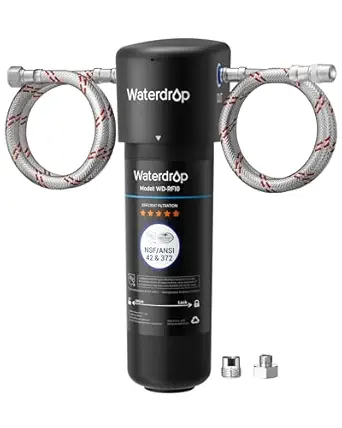 |
| Most Popular A crowd favorite that many people choose with confidence | iSpring RCC7AK-BN 75 GPD RO System |  |
APEC Water ROES-50

| Purification Method | Reverse Osmosis |
|---|---|
| Filtration Stages | 5-Stage |
| Capacity | 50 gallons per day |
| Operating Pressure Range | 40-85 psi |
| Filter Life Cycle | 6 months |
The APEC Water ROES-50 is a five-stage under-sink reverse osmosis system designed to deliver very pure drinking water at up to 50 gallons per day. It installs under the sink and includes a storage tank and dedicated faucet, with quick-connect fittings and color-coded tubing to simplify a DIY setup. The five filtration stages (pre-filters, RO membrane, and post-filter) tackle chlorine, lead, fluoride, heavy metals, TDS and many common contaminants, and the unit is WQA/NSF-certified for material and contaminant rejection standards. Typical use is daily drinking and cooking water with steady supply from the tank for consistent flow. Maintenance is straightforward: prefilters generally need changing every 6–12 months while the membrane and post-filter last longer depending on feed-water quality. Limitations are the slow instantaneous flow rate at the faucet when the tank is low and the need for periodic filter replacements and a drain line for the RO reject flow, which require some space and occasional attention. For buyers who want a reliable, high-rejection under-sink RO, the ROES-50 is a practical, proven choice.
Best for: Buyers who want consistently very low-TDS drinking water and are comfortable with a one-time under-sink installation plus routine filter maintenance.
Less Ideal for: People who need immediate high flow without a storage tank, cannot accommodate an under-sink installation, or want a zero-maintenance filter.
- High contaminant rejection with 5-stage RO including membrane for very low TDS
- Includes storage tank and dedicated faucet for steady supply
- DIY-friendly fittings and color-coded tubing simplify installation
- WQA/NSF-certified construction and materials
- Requires periodic filter and membrane replacement based on water quality
- Produces reject water and needs a drain connection and under-sink space
Verdict: A dependable, WQA/NSF-certified 5-stage RO system that delivers very low-TDS drinking water for homeowners willing to install and maintain an under-sink unit.
Waterdrop G3P600 Tankless RO
| Purification Method | Carbon Block, Reverse Osmosis |
|---|---|
| Filtration Stages | 8-stage Filtration |
| Flow Rate | 600 GPD |
| Pure to Drain Ratio | 2:1 |
| Power Source | Corded Electric |
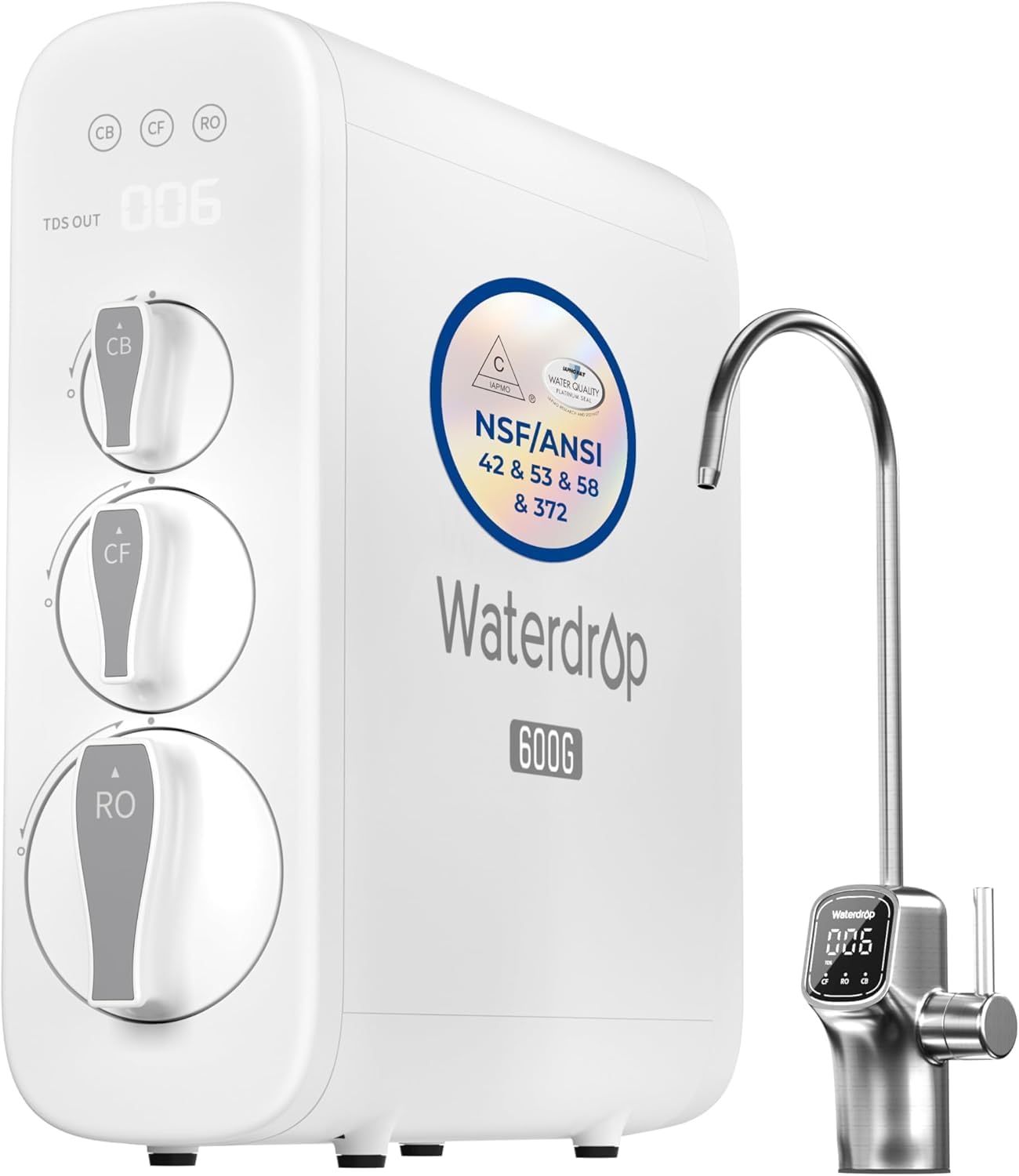
The Waterdrop G3P600 is a tankless under-sink reverse osmosis system built for fast, high-volume drinking-water delivery. It uses an 8-stage filtration train including a reverse osmosis membrane and carbon block stages to reduce TDS, heavy metals, PFAS, chlorine and other common contaminants, and it produces up to 600 gallons per day with a 2:1 pure-to-drain ratio. The unit is powered by a plug-in supply and mounts under the sink, saving counter and cabinet space compared with tanked RO setups; the smart faucet reports TDS and filter life so you can monitor performance at a glance. Filter changes are tool-free with a twist-in cartridge design, and the system includes automatic flushing to help maintain membrane freshness. Expect a steady pour—an 8 oz cup fills in about 8 seconds—but note the system requires an under-sink electrical outlet and you must drill the faucet and drain holes during installation. Overall this is a performance-focused, space-saving RO suited to households that want near-instant, high-quality drinking water without a storage tank.
Best for: Buyers who prioritize fast output and strong contaminant reduction for daily drinking water and who want a compact, high-performance under-sink RO without a storage tank.
Less Ideal for: People without convenient under-sink power or those who prefer a purely passive, non-electric water filter system or want a unit that requires no drilling during installation.
- High production capacity up to 600 GPD for fast dispensing and heavy use
- Low 2:1 pure-to-drain ratio reduces wastewater compared with traditional RO systems
- Smart display faucet shows TDS and filter life for real-time water-quality monitoring
- Tankless design frees under-sink space and offers quick, tool-free filter replacement
- 8-stage filtration targets a wide range of contaminants including PFAS and heavy metals
- Requires an under-sink electrical outlet and a hole for faucet/drain connections
- Installation requires drilling and some DIY skill or plumber assistance
Verdict: If you want tankless, high-output RO performance with real-time TDS monitoring and efficient water use, the G3P600 is a top choice.
PUREPLUS Under Sink Filter WFS5300A

| Purification Method | Activated Carbon |
|---|---|
| Maximum Flow Rate | 2.5 gpm |
| Upper Temperature Rating | 100 °F |
| Supported Water TDS Level Maximum (PPM) | 500 |
| Capacity | 22000 gallons |
The PUREPLUS WFS5300A is an under-sink activated carbon cartridge system designed to deliver long-lasting filtered water for drinking and cooking. It connects to the cold water line with quick-connect fittings and uses a 6-in-1 composite carbon block rated to 0.5 micron to cut chlorine, odor, sediment, and some heavy metals while leaving beneficial minerals intact. With a published life of 22,000 gallons (about five years) and a claimed maximum flow of 2.5 gpm at 60 psi, it is sized for households that want low-maintenance filtration without a separate tank or frequent cartridge swaps. The unit is IAPMO/NSF-certified to NSF/ANSI 42 and built from lead-free, food-grade materials, which helps with safety and regulatory peace of mind. Limitations include the inability to lower TDS or perform true reverse-osmosis-level contaminant removal, and it is intended for cold-water only, so hot-line connections or well water without pre-treatment may require additional equipment. For straightforward under-sink drinking water improvement, it is a practical, high-capacity option.
Best for: Buyers who want a low-maintenance, long-life under-sink filter that improves taste and reduces chlorine without frequent cartridge changes.
Less Ideal for: Households seeking complete dissolved solids removal or RO-level purification, or users who need a hot-water compatible system.
- Very high rated capacity of 22,000 gallons per cartridge for multi-year use
- NSF/ANSI 42 certification for chlorine and aesthetic contaminant reduction
- Quick-connect fittings simplify installation and reduce leak risk
- Food-grade, lead-free materials and multiple industry certifications
- Does not reduce total dissolved solids so it will not perform like an RO system
- Limited to cold-water connections only
Verdict: Choose the PUREPLUS WFS5300A if you want a certified, high-capacity under-sink filter that delivers years of improved-tasting cold drinking water with minimal maintenance.
AQUA CREST 5KDC Under-Sink Filter

| Purification Method | Activated Carbon |
|---|---|
| Maximum Flow Rate | 1.5 gpm |
| Filter Life Cycle | 12 months |
| Capacity | 5000 gallons |
| Micron Rating | 0.5 μm |
The AQUA CREST 5KDC is a compact under-sink direct-connect filter intended to give everyday drinking and cooking water better taste and lower common contaminants. It installs to the cold water line with the supplied push-to-connect hoses and fittings, so no drilling is required, and the unit delivers up to 1.5 gpm — fast enough to fill a cup in a few seconds. Filtration comes from a 0.5 μm coconut shell carbon block plus KDF media, which the manufacturer says reduces chlorine, VOCs, fluoride, and some heavy metals while intercepting rust and suspended solids. The cartridge is rated for about 5,000 gallons or 12 months, so yearly replacement is straightforward and keeps ongoing costs predictable. Limitations: it will not lower total dissolved solids (TDS) and it is focused on common chemical and taste contaminants rather than full disease-pathogen removal or mineral softening. For a budget-focused household looking for clear-tasting tap water without complex installation, this model is a practical choice.
Best for: Buyers wanting an affordable, easy-to-install under-sink filter that improves taste and reduces common chemical contaminants for everyday drinking and cooking water.
Less Ideal for: Homes needing RO-level TDS reduction, whole-house treatment, or certified pathogen removal should consider other systems built for those specific needs.
- High-rated coconut shell carbon block plus KDF for chlorine, taste, and VOC reduction
- Fast flow rate up to 1.5 gallons per minute for regular kitchen use
- 5,000-gallon / 12-month cartridge life keeps annual maintenance simple
- Includes hoses and push-to-connect fittings for tool-free installation
- Does not reduce total dissolved solids (TDS) or perform reverse-osmosis level purification
- Not designed to remove all pathogens or replace whole-house treatment
Verdict: A practical, budget-friendly under-sink filter that delivers faster flow and year-long cartridge life for better tasting tap water.
Waterdrop WD-10UA Under-Sink Filter

| Purification Method | Activated Carbon |
|---|---|
| Installation Type | Under Sink |
| Maximum Flow Rate | 2.5 gpm |
| Filter Life Cycle | 1 years |
| Supported Water TDS Level Maximum (PPM) | 700 |
The Waterdrop WD-10UA is an under-sink activated carbon filter built for everyday drinking-water use in homes, RVs, or offices. It connects directly to standard 3/8" or 1/2" cold-water feed lines with the supplied convertor and uses a twist-and-lock housing with push-to-connect fittings for tool-light installation and quick cartridge changes. Certified to NSF/ANSI 42 and 372, the cartridge targets chlorine, bad taste and odor, lead, and PFAS compounds while retaining beneficial minerals, and the manufacturer rates the filter life at one year or roughly 11,000 gallons under typical municipal conditions. Flow is steady for routine kitchen tasks; tested flow rates are listed around 0.75 gpm at 60 psi with an upgraded 3/8" outlet capable of higher throughput. The system is mechanical-pressure powered so it needs no electricity and the compact canister fits neatly under most cabinets. Limits to note: it is for cold municipal water only, not for well water or hot water, and it relies on a single-stage activated carbon element so it will not remove all contaminants that multi-stage or membrane systems address. For buyers who want a reliable, low-maintenance under-sink filter for safer-tasting tap water, this is a straightforward option.
Best for: Buyers who prioritize a dependable, low-maintenance under-sink filter to improve taste and reduce common contaminants from municipal tap water without electrical parts or complex installation.
Less Ideal for: Homes relying on well water, customers needing comprehensive multi-contaminant removal (including microbes), or anyone who requires hot-water filtration under the sink.
- NSF/ANSI 42 and 372 certification for chlorine and aesthetic contaminant reduction
- Twist-and-lock housing with push-to-connect fittings for fast, tool-light installation and cartridge swaps
- Long-rated service life of up to 12 months or about 11,000 gallons per cartridge
- Mechanical operation with no electricity required and compact under-sink footprint
- Compatible 3/8" outlet and 3/8"–1/2" converter for common US sink connections
- Designed only for cold municipal water so it is not suitable for well water or hot-water lines
- Single-stage activated carbon filter will not remove all dissolved solids or pathogens
Verdict: A reliable, easy-to-install under-sink carbon filter that delivers year-long service and NSF-certified improvement in taste and common chemical contaminants for municipal cold-water drinking.
iSpring RCC7AK-BN 75 GPD RO System

| Purification Method | Reverse Osmosis, Alkaline, Activated Carbon, Carbon block |
|---|---|
| Power Source | No Power Needed |
| Maximum Flow Rate | 284 liters_per_day |
| Supported Water TDS Level Maximum (PPM) | 750 |
| Filter Life Cycle | 6 months |
The iSpring RCC7AK-BN is a six-stage under-sink reverse osmosis system designed to deliver drinking-quality water without electricity. It uses sediment, carbon, RO membrane, and a final alkaline remineralization stage to reduce TDS and a long list of contaminants while restoring healthy minerals and pH for better taste. The unit includes a brushed nickel top-mounted faucet and storage tank, and its transparent first-stage housing makes it easy to visually check the sediment filter. Installation is DIY-friendly thanks to push-to-connect fittings and a convertible feed adapter for 1/2" NPT or 3/8" compression lines, plus online videos and clear instructions. Performance is strong for everyday drinking and cooking needs, and NSF/ANSI 58 certification covers the full system rather than just individual filters, which is reassuring for buyers tracking independent validation. Filter replacement cadence and the need for a dedicated under-sink tank are the practical maintenance factors to plan for, but the system runs without power and offers high contaminant removal across many regulated and unregulated compounds.
Best for: Buyers who prioritize verified contaminant removal and social proof from certifications and user feedback, and who want a long-term under-sink solution that produces remineralized drinking water without electrical power.
Less Ideal for: People who need a compact, countertop unit or want a completely maintenance-free filter with no periodic cartridge or membrane changes.
- NSF/ANSI 58 full-system certification for verified RO performance
- Six-stage filtration with alkaline remineralization for improved taste and balanced pH
- Transparent first-stage housing for easy visual monitoring of sediment
- Electricity-free operation suitable for kitchens without power at the install point
- Includes brushed nickel faucet, storage tank, and push-to-connect fittings for DIY-friendly installation
- Requires periodic filter and membrane replacements on a multi-month schedule
- Takes under-sink space for the tank and filter housings
- Installation still needs basic plumbing skills despite DIY-friendly fittings
Verdict: Choose the RCC7AK-BN when you want a certified, no-electricity under-sink RO that restores minerals for better-tasting, reliably pure drinking water.
Choosing the Right Drinking Under-Sink Water Filter: Key Factors to Consider
Filtration Performance
Filtration performance defines what contaminants the system will remove and how effectively it does so. Look for specific reduction claims or third-party certifications for contaminants you care about, such as lead, chlorine, cysts, or volatile organic compounds. Performance varies by media type: carbon blocks are strong for taste and organic chemicals, while specialty resins or membranes target metals and particulates.
Understanding the limits of the filter is important because no single under-sink cartridge removes every contaminant. Match the system to your water quality concerns using a local water quality report or home test. Higher-rated filtration often means more stages or a finer membrane, but it can also reduce flow and increase replacement frequency, so balance performance against practical household use.
Flow Rate and Daily Output
Flow rate determines how quickly filtered water is available at the dedicated faucet and whether the system can keep up with routine tasks like filling a coffee maker or glass. Flow is usually specified in gallons per minute or gallons per day; choose a system that meets your peak short-term needs while providing acceptable waiting time.
Some high-removal technologies trade flow for quality, producing slower output that may be inconvenient during frequent use. If you regularly fill pitchers or use water for cooking, prioritize higher flow or systems with storage tanks to smooth short bursts of demand. Consider how many people will be using the tap and typical usage patterns when evaluating published flow figures.
Installation Complexity
Installation complexity affects whether you can DIY or need professional help. Under-sink systems differ in mounting style, connection type, and whether they require drilling a hole in the countertop for a separate faucet. Systems with quick-connect fittings and clear instructions are easier for homeowners with basic tools.
Also factor in space under the sink and the presence of disposal or plumbing traps that can complicate placement. Some models include flexible tubing and adaptors that simplify hook-up to existing cold-water lines. If you are not comfortable with plumbing, choose a model designed for simple DIY installation or plan for a professional installation.
Filter Life and Ongoing Maintenance
Filter life affects ongoing cost and how often you must access the system. Replacement intervals are typically given in gallons or months; estimate annual usage to forecast replacement frequency. Longer-life cartridges mean less frequent service but can be more expensive to replace.
Maintenance also includes how easy it is to change filters, whether there are convenient indicators for replacement, and how readily replacement cartridges are available. Systems that require specialized tools or involve messy procedures increase the chance of user error and neglected maintenance, which can reduce effectiveness over time.
Physical Fit and Plumbing Compatibility
Under-sink space and existing plumbing dictate whether a system will fit and connect cleanly. Measure the cabinet height, depth, and available clearances around disposal units or water lines before choosing a unit. Consider mounting options: some systems attach to the cabinet wall, others sit upright on the cabinet floor.
Check connector types and whether adapters are included for common cold-water shutoff valves. If the system requires a dedicated faucet, ensure your countertop or sink has space and that drilling requirements are acceptable. Compatibility reduces the risk of improvisation that can lead to leaks or poor performance.
Materials, Durability, and Leak Protection
Build materials influence lifespan and reliability. Look for corrosion-resistant housings, quality seals, and robust fittings to minimize the risk of leaks. Systems that include pressure-relief features or secure mounting reduce stress on connections and lower the chance of failure.
Durable components decrease long-term maintenance needs and are especially important in locations with higher water pressure or where minor cabinet bumps can stress fittings. Consider models with replaceable o-rings and easily serviced housings to simplify repairs if a leak or wear occurs.
Choosing Between Multi-Stage and Single-Stage Systems
Multi-stage under-sink systems layer different media types to address a broader range of contaminants. A common configuration pairs a sediment prefilter with activated carbon and sometimes a specialized resin or membrane for metals. Multi-stage setups can deliver better overall water quality but are often larger and require more frequent or varied cartridge changes.
Single-stage filters are compact and focused, typically using a carbon block to improve taste and reduce chlorine and organic compounds. They are easier to install and maintain but may not target heavy metals or microscopic cysts. Select the architecture that matches your water profile and how much maintenance you want to perform.
- Multi-stage: broader contaminant coverage, larger footprint, more maintenance points
- Single-stage: compact, simpler upkeep, effective for taste and chlorine
Dedicated Faucet Vs Integrated Faucet Options
Most under-sink filters supply water to a dedicated faucet installed at the sink. A dedicated faucet isolates filtered water and avoids cross-contamination with the main tap, making it the most common approach for drinking water systems. This requires a hole in the sink or countertop unless your sink has an existing auxiliary hole.
Some systems are designed to connect to a designated port on a dual-function faucet or use a diverter that attaches to the main faucet. These options reduce the need for an extra fixture but can complicate operation and may allow small amounts of unfiltered water to mix during certain uses. Consider convenience versus purity when choosing faucet arrangement.
- Dedicated faucet: best isolation and convenience for drinking water
- Diverter/integration: fewer fixtures but potential for mixed flow or added complexity
Storage Tanks and Pressure Considerations
Some under-sink systems include a small storage tank to buffer filtered water supply, ensuring faster access when demand spikes. Tanks are useful for households that frequently fill pitchers or use a lot of filtered water in short intervals. The tradeoff is added cabinet space and an extra component that requires occasional maintenance.
Tankless systems rely on on-demand filtration and are quieter and more compact. They work well when steady flow rates meet household needs. Also consider local water pressure: very low incoming pressure can reduce output and may require a booster or a system with a storage tank for acceptable performance.
- Tanks: faster dispensing during bursts, larger footprint
- Tankless: compact and simple, best when pressure is adequate
Testing Water and Matching the Right System
Before selecting a system, test your water or obtain a local water quality report. Knowing whether your water has hard minerals, dissolved metals, or microbial concerns guides media selection. For example, chlorine taste and organic contaminants are well handled by activated carbon, while lead or heavy metals may require specific sorbents or filters.
If your water has unusual contaminants, consult manufacturers' published reduction data or third-party certification documents to ensure the system targets the issues you identified. Matching the system to your actual water profile reduces unnecessary expense and focuses maintenance on relevant cartridges.
- Use a lab test or municipal report for an accurate contaminant list
- Pick media types that specifically address the contaminants present
Space-Saving Installation Tips
To maximize under-sink room, choose compact housings and mount vertically on the cabinet wall when possible. Route tubing tightly and avoid long open loops that snag or trap moisture. Keep filter elements accessible for swaps by leaving clearance at the front of the cabinet or using quick-release housings.
Label shutoff valves and keep basic replacement tools and spare cartridges nearby to simplify maintenance. If cabinet height is constrained, consider low-profile or single-cartridge designs that sit horizontally or use slimline housings.
- Mount housings to the wall to free floor space
- Plan tubing paths for accessibility and minimal kinks
How We Chose the Best Drinking Under-Sink Water Filter
We prioritized products that deliver demonstrable contaminant reduction, practical flow rates for drinking and small appliance use, and straightforward installation for typical under-sink spaces. Tested or certified filtration performance against common municipal contaminants such as chlorine, lead, and volatile organic compounds was a primary filter in our selection. We also looked for systems with accessible maintenance: replacement filter availability, simple cartridge changes, and clear service intervals. Physical fit and plumbing compatibility mattered because under-sink space varies; models with adaptable fittings and compact footprints were preferred. Durability and materials were considered to ensure longevity and reduce the likelihood of leaks or premature failure. We excluded specialty whole-house systems and countertop-only units to keep the list focused on point-of-use under-sink solutions. In short, products had to meet minimum filtration claims, offer realistic daily flow, be serviceable by a DIY-minded homeowner, and fit typical kitchen plumbing constraints.
Our full evaluation process is outlined in our review methodology.
FAQ
How often should I replace under-sink filter cartridges?
Replacement intervals depend on the cartridge capacity and your household usage, but typical ranges are every 6 to 12 months for common carbon filters. Heavier contaminant loads or higher use will shorten life. Follow the manufacturer's gallon or time recommendations and monitor flow and taste for signs of replacement need.
Can I install an under-sink drinking filter myself?
Many under-sink systems are designed for DIY installation using basic tools and quick-connect fittings. Installation difficulty depends on cabinet space, existing plumbing, and whether a dedicated faucet hole is required. If you are uncomfortable with plumbing work or the installation involves complex modifications, professional installation is a prudent choice.
Will an under-sink filter remove hard water minerals?
Most under-sink drinking filters use carbon or similar media that do not soften water or remove dissolved calcium and magnesium. To address hard water, you need a water softening solution or specialized media designed for ion exchange. Choose a filter for taste and contaminants, and consider separate treatment for hardness if needed.
Do under-sink filters affect water pressure at other fixtures?
Under-sink filters typically only affect the dedicated faucet or the port they serve and should not reduce pressure at other household fixtures. However, poor installation, partial blockages, or very low incoming pressure can limit filtered output. Ensure proper connections and consider a storage tank or a system rated for your pressure conditions if you need higher flow.
How can I verify my under-sink system is working correctly?
Check for expected taste and odor improvements and monitor flow rate for gradual declines that indicate cartridge exhaustion. Inspect fittings periodically for leaks and follow any included test instructions or use basic at-home test kits to confirm reductions in targeted contaminants. Regular maintenance and timely cartridge replacement are the best indicators of continued performance.
Final Verdict
Picking the right drinking under-sink water filter comes down to matching filtration capability to your water quality, fitting the system into your available under-sink space, and choosing a maintenance cadence you will keep. Prioritize the contaminants you need to remove first, then evaluate flow requirements, installation complexity, and long-term cartridge availability. A balanced choice that meets your household's daily output needs and is easy to service will deliver the most reliable long-term value and better-tasting water.