
Note: This article contains affiliate links. If you click on these links and make a purchase, we may earn a small commission at no extra cost to you. This helps support our research and content. Read our full affiliate disclosure here.
If you want purer drinking water without under-sink installation, a reverse osmosis countertop water filter can be an effective, compact choice. These systems remove a wide range of contaminants and improve taste while staying portable and easy to maintain. Picking the right unit matters because capacity, filter life, and setup complexity affect daily convenience and long-term running costs. This guide highlights seven shortlisted countertop reverse osmosis options that balance removal performance, ease of installation, and ongoing maintenance demands. Read on to compare the key features we evaluated and find the best fit for your kitchen counter.
Top Picks at a Glance
| Best Overall The best all-around choice for most situations | Waterdrop C2SL Countertop RO |  |
| Best Quality Built to a higher standard if you want something more solid | AquaTru Carafe |  |
| Best Value The sweet spot between price and what you get | Bluevua ROPOT-Lite Countertop RO |  |
| Best Budget The cheapest option that still gets the job done reliably | CO-Z Countertop RO WFS-R040-00 |  |
| Top Rated A top-rated pick with lots of positive feedback | Aigerri Countertop RO System |  |
| Most Popular A crowd favorite that many people choose with confidence | Bluevua ROPOT Countertop RO |  |
| Best Seller A high-volume bestseller chosen again and again | DREO RO Water Filter 112 |  |
Waterdrop C2SL Countertop RO

| Purification Method | Reverse Osmosis |
|---|---|
| Filter Life Cycle | 12 months |
| Capacity | 75 gallons |
| Pure to Drain Ratio | 3:1 |
| Included Components | C2SL RO System, Replacement Filter, User Manual |
The Waterdrop C2SL is a countertop reverse osmosis system designed for easy, no-plumbing use in small households. It uses a 0.0001 μm RO membrane and a 7-stage filter stack to remove a wide range of contaminants while a mineral stage adds calcium and magnesium back for better taste. Setup is plug-and-play: fill the 108 oz feed tank, plug it in, and the unit autofills the detachable 40 oz glass pitcher. A smart display and voice alerts guide first-time rinsing, track filter life, and warn when the tank is low. The system is quiet, portable, and rated to deliver up to 528 gallons or about 12 months of filter life under typical use, with a 3:1 pure-to-drain ratio that reduces wastewater compared with cheaper RO units. It is sized for 1–2 people, so output and tank capacity limit its usefulness for larger families or heavy cooking use. Replacement filters and electric power are required, so it is less suitable where plumbing-free but maintenance-free solutions are preferred.
Best for: Buyers who want an easy, countertop RO that delivers highly purified, mineralized drinking water without installing plumbing and appreciate automated refill and filter-life alerts.
Less Ideal for: Large households or users who need high daily throughput or want a permanently plumbed under-sink system should consider higher-capacity options instead.
- High-efficiency 7-stage RO with 0.0001 μm membrane removes many contaminants
- Built-in mineral stage improves taste by adding calcium and magnesium
- Autofill detachable 40 oz glass pitcher for fridge-ready water without plumbing
- Smart display and voice alerts simplify setup and filter monitoring
- Compact, portable countertop design for easy placement and quiet operation
- Designed for 1–2 people so daily output and tank size are limited
- Requires electricity and occasional filter replacements for continued performance
Verdict: If you want a plug-in countertop RO that delivers thorough contaminant removal plus improved taste and an autofill glass pitcher, the C2SL is a compact, user-friendly choice for one- to two-person households.
AquaTru Carafe

| Purification Method | Reverse Osmosis |
|---|---|
| Power Source | Corded Electric |
| Filter Life Cycle | 6 months (pre-filter) / up to 1 year (RO) |
| Maximum Flow Rate | 0.5 gpm |
| Supported Water TDS Level Maximum (PPM) | 300 |
The AquaTru Carafe brings reverse osmosis performance to the countertop in a compact, plug-in unit that fills a removable borosilicate glass carafe. You fill the top tank with tap water, the unit runs it through a four-stage filter train including RO and carbon stages, and purified water dispenses into the glass carafe for drinking, cooking, or making beverages. Notable touches are the long filter service lives (pre-filter months, RO up to a year on this model), built-in filter indicators, and a control panel that makes operation straightforward without plumbing or drilling. The Carafe removes a broad range of contaminants that typical pitcher filters miss, including PFAS, lead, arsenic, and microplastics, and its countertop form factor is suitable for renters or anyone who wants RO-level filtration without under-sink installation. Expect a modest flow rate compared with plumbed systems and the need for periodic filter replacements, but for buyers prioritizing contaminant removal and easy setup this unit delivers high-performance purification in a small footprint.
Best for: Buyers who want near–under-sink RO-level contaminant reduction without installation and who prioritize measured contaminant removal and easy maintenance.
Less Ideal for: People who need very high throughput, hard-plumbed systems for whole-kitchen supply or who prefer a purely passive pitcher with no power requirement.
- Reverse osmosis filtration reduces a wide range of contaminants including PFAS, lead, arsenic, and microplastics
- Compact countertop design requires no plumbing or drilling and plugs into a standard outlet
- Borosilicate glass carafe keeps purified water chemical-free and is easy to remove and pour
- Long filter lifespans with built-in indicators make maintenance predictable
- Lower maximum flow rate compared with plumbed RO systems, so filling takes longer
- Requires electricity to operate, unlike passive pitcher filters
Verdict: If you want countertop reverse osmosis performance without plumbing, the AquaTru Carafe delivers strong contaminant removal in a compact, easy-to-use package.
Bluevua ROPOT-Lite Countertop RO

| Purification Method | Reverse Osmosis |
|---|---|
| Capacity | 1200 ml |
| Maximum Flow Rate | 0.26 liters per minute |
| Filter Life Cycle | 1 years |
| Material Type | Borosilicate Glass |
The Bluevua ROPOT-Lite is a countertop RO purifier designed for plug-and-play use without plumbing. You fill the top reservoir, select a dispense volume on the smart LED, and the unit runs a 5-stage process including a 0.0001 μm RO membrane and a remineralization stage before collecting water in a high-borosilicate glass carafe. It produces filtered water at an advertised 3:1 pure-to-drain ratio and reports filter life and water quality on the display, which simplifies routine upkeep. The system is sized for small households and aims for fast delivery, with typical fills taking under three minutes. Practical benefits include no installation, glass storage to avoid plastic leaching, and annual filter changes. Limitations are the modest 1.2 L capacity and flow rate (0.26 L/min), which means it is best for one or two people rather than heavy daily use, and it will generate waste water as all RO systems do despite the improved ratio. Replacement filters and occasional descaling are additional maintenance considerations.
Best for: Buyers who want a no-plumbing countertop RO that prioritizes pure, glass-stored water and easy, visible maintenance for a small household.
Less Ideal for: Large families or heavy users who need high daily output or continuous dispensing should consider larger or plumbed systems instead.
- Countertop plug-and-play design requires no plumbing or installation.
- High-borosilicate glass carafe avoids plastic storage and is easier to clean.
- Smart LED shows filter life and water quality for straightforward maintenance.
- 5-stage filtration with a 0.0001 μm RO membrane and remineralization improves purity and taste.
- Advertised 3:1 pure-to-drain ratio reduces waste compared with typical RO units.
- Small 1.2 L capacity limits how much filtered water is on hand between fills.
- Maximum flow rate of 0.26 L/min is relatively slow for filling larger containers.
- Annual filter replacements and occasional descaling add ongoing costs and attention.
Verdict: If you want a compact, installation-free RO that delivers glass-stored, remineralized water with an easy-to-read maintenance display, the ROPOT-Lite is a practical choice for one to two people.
CO-Z Countertop RO WFS-R040-00

| Purification Method | Reverse Osmosis |
|---|---|
| Capacity | 5 liters |
| Filter Life Cycle | 1 years |
| Supported Water TDS Level Maximum (PPM) | 500 |
| Pure to Drain Ratio | 4:1 |
The CO-Z countertop RO system delivers multi-stage reverse osmosis purification without any plumbing or installation, making it a straightforward add-on for apartments, offices, or RVs. It uses five filtration stages and claims NSF/ANSI 58 and 61 compliance to reduce a wide range of contaminants, while the built-in TDS meter and filter life indicator give visible feedback on water quality and maintenance needs. A 5‑liter internal tank plus a 0.4‑gallon removable pitcher lets you store and pour filtered water, and the control panel offers three preset dispense volumes or continuous dispensing for exact fills. Practical touches include a fast filter swap, automatic self-cleaning between cycles, and a 4:1 pure-to-drain ratio to limit wastewater compared with many RO units. Downsides are the countertop footprint and the need to plug it in, and total yearly output and filter lifetimes are modest versus larger under-sink systems, so heavy users may refill more often. For budget-focused buyers who want RO performance without plumbing, this is a sensible, user-friendly option.
Best for: Buyers who need true RO-quality drinking water on a tight budget and who want a plug-in, installation-free unit that is easy to monitor and maintain.
Less Ideal for: Households that consume large daily volumes or want a permanently plumbed under-sink solution should choose a higher-capacity or installed system instead.
- Complete 5-stage RO purification with claimed NSF/ANSI 58 and 61 compliance
- Built-in TDS meter and filter life indicator for simple monitoring
- No-install countertop design that plugs in and is portable
- Three preset dispense volumes plus continuous dispensing for accurate pours
- Automatic self-cleaning and fast filter replacement for easy upkeep
- Requires counter space and a power outlet so not fully passive
- Annual total filtration and filter life are lower than larger under-sink RO systems
Verdict: A budget-friendly countertop RO that delivers certified-style multi-stage purification and easy, installation-free operation for households that want true RO water without plumbing.
Aigerri Countertop RO System
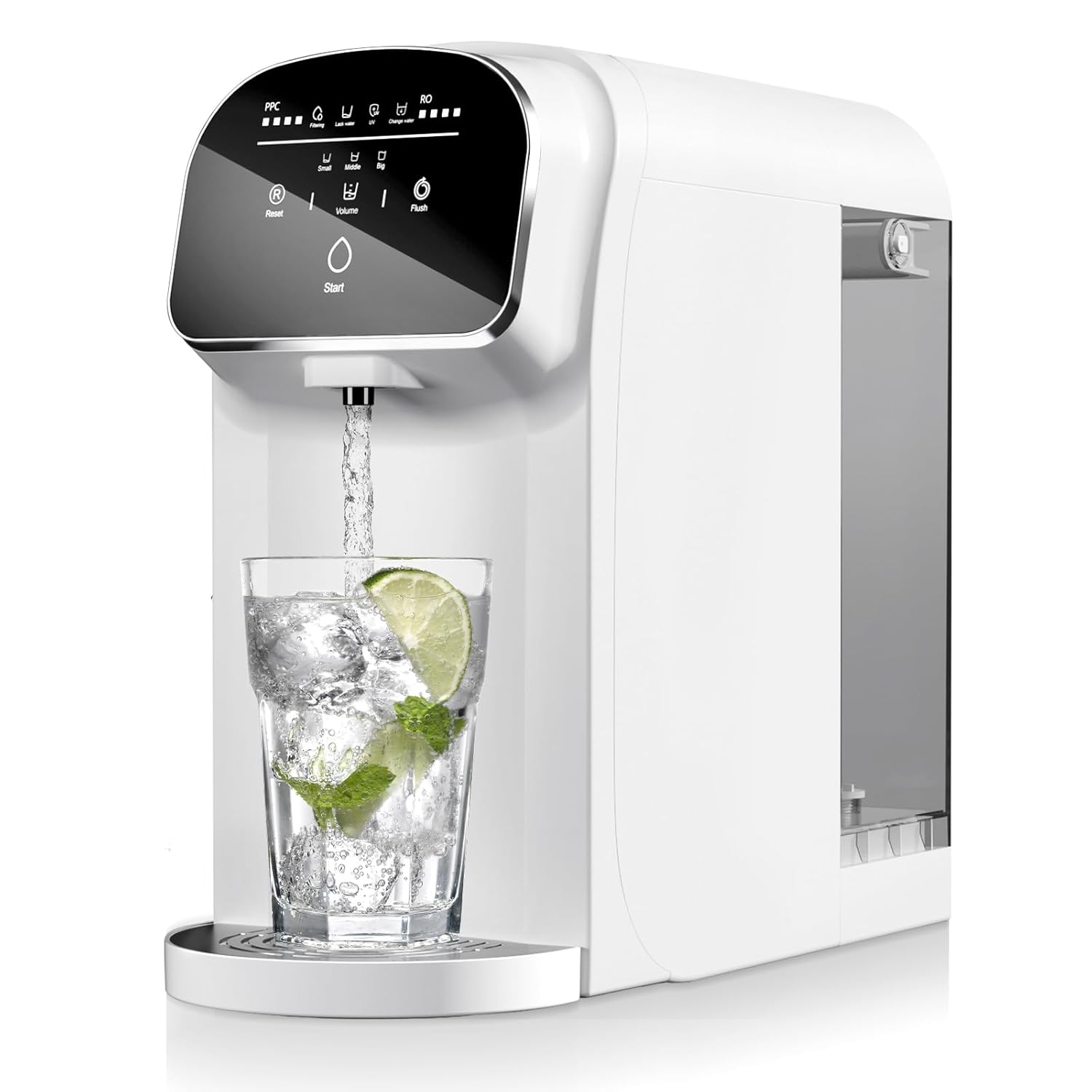
| Capacity | 5 liters |
|---|---|
| Purification Method | Reverse Osmosis |
| Other Special Features | 5-stage RO, UV, Self Cleaning, Change Filter Indicator |
| Pure-to-Drain Ratio | 5:1 |
The Aigerri Countertop RO System is a plug-and-play reverse osmosis purifier built for countertop use where installation is impractical or unwanted. You fill the 5L feed tank, plug the unit in, and the five-stage system (PPC prefilter, RO membrane and UV among others) produces purified water into a separate storage tank while the unit self-cleans between cycles. Its standout points are a high-efficiency 5:1 pure-to-drain ratio that reduces wastewater compared with typical RO units and an included UV stage for additional microbial control. Practical benefits include a sizeable daily supply from the 5L tank, easy cartridge replacement because filters ship pre-installed, and flexible placement for apartments, offices or RVs. Trade-offs are typical of countertop RO systems: it requires countertop space and periodic filter changes, and producing purified water is slower than direct-plumbed systems, so it is best for point-of-use rather than whole-house supply.
Best for: Buyers who prioritize a reliable, high-efficiency countertop RO solution that delivers consistent purified water without plumbing changes and values low wastewater and added UV protection.
Less Ideal for: Households that need large continuous volumes of purified water or want a hidden under-sink installation should consider plumbed systems instead.
- Plug-and-play countertop design requires no plumbing or professional installation
- 5-stage filtration plus UV adds both dissolved solids reduction and microbial protection
- 5:1 pure-to-drain ratio improves water efficiency versus many RO systems
- Separate purified water tank and 5L feed tank provide ready access to chilled or ambient water
- Countertop footprint and required vertical clearance limit placement in very small kitchens
- Purified water output is slower than direct-plumbed under-sink RO systems and depends on refill frequency
Verdict: Choose this countertop RO system when you want a reliable, high-efficiency plug-and-play purifier with UV protection and low wastewater for point-of-use drinking water.
Bluevua ROPOT Countertop RO
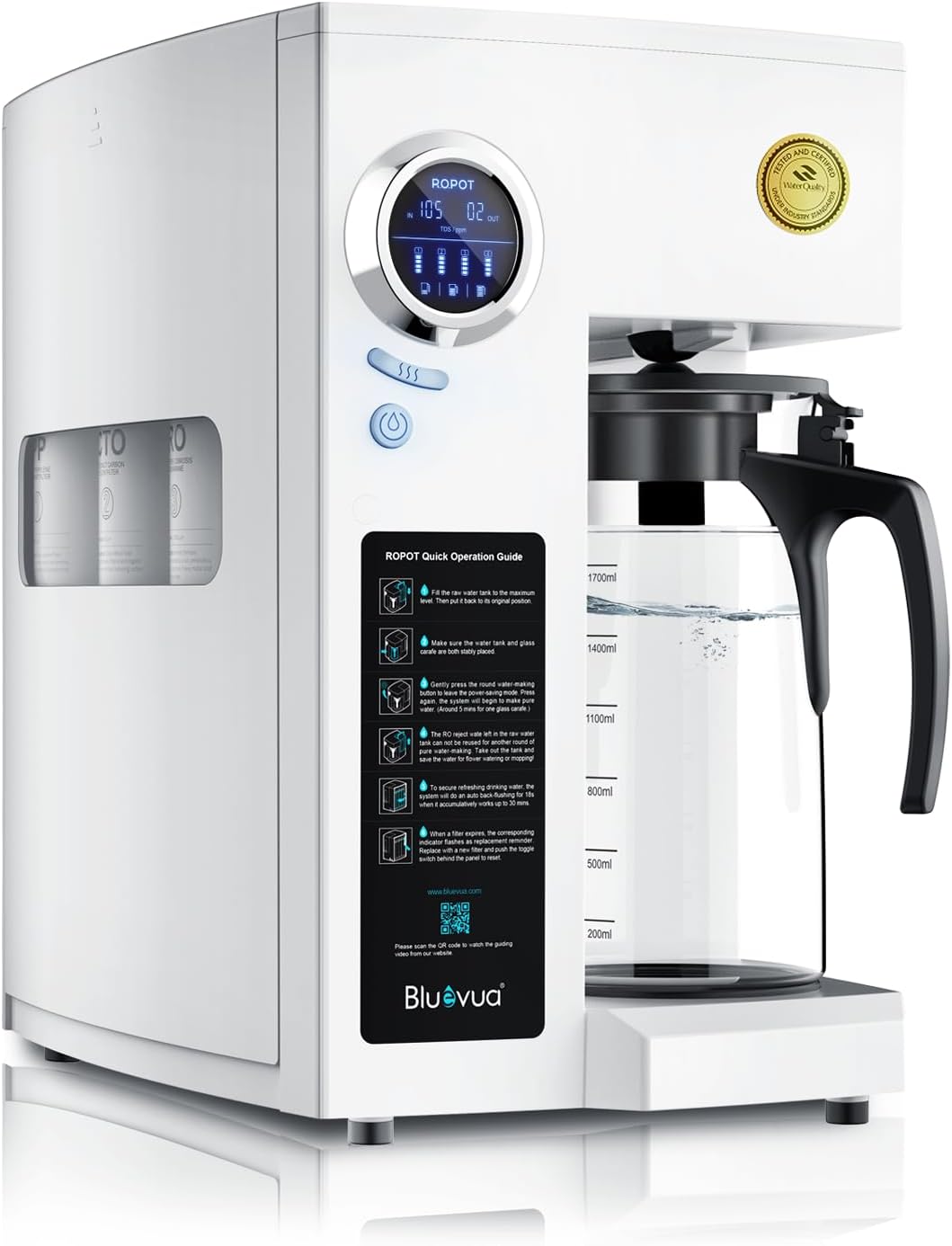
| Purification Method | Reverse Osmosis |
|---|---|
| Power Source | Corded Electric |
| Maximum Flow Rate | 0.26 liters per minute |
| Supported Water TDS Level Maximum (PPM) | 1000 |
| Filter Life Cycle | 24 months |
The Bluevua ROPOT is a plug-in countertop reverse osmosis system built to deliver bottled-quality water without installation. You fill the removable borosilicate glass carafe, start a cycle from the unit, and the system runs through a five-stage RO stack that includes remineralization to restore taste and minerals. A smart display reports TDS and filter life so you can monitor when cartridges need replacement, and the unit claims a 2:1 pure-to-drain ratio to reduce waste compared with many RO setups. The glass carafe and self-cleaning/UV options reduce chemical leaching and help keep stored water tasting fresh. Practical limits are its modest 1.7 L (1700 ml) capacity and a low maximum flow rate, so it is best for daily drinking and cooking rather than serving large groups quickly; replacement filters and occasional maintenance are required on the 12–24 month recommended schedule. For buyers who prioritize easy setup, visible water storage, and clear performance feedback, the ROPOT is a convenient countertop alternative to under-sink RO systems.
Best for: A cautious buyer who wants verified performance and social proof and prefers a no-install countertop RO that shows TDS and filter status for reassurance.
Less Ideal for: Large households or anyone needing rapid high-volume dispensing throughout the day should consider higher-capacity or under-sink systems instead.
- No-plumbing countertop design for quick setup and portability
- Borosilicate glass carafe reduces plastic contact and improves taste preservation
- Five-stage RO filtration with remineralization for low TDS and improved flavor
- Smart display shows TDS and filter life for straightforward monitoring
- Designed water-saving 2:1 pure-to-drain ratio compared with typical RO waste rates
- Small 1700 ml capacity limits how much filtered water is available between cycles
- Low maximum flow rate makes refills slower than tap or larger systems
Verdict: Buy this if you want a no-plumbing countertop RO with a glass carafe and visible TDS/filter monitoring for confident, bottled-quality drinking water.
DREO RO Water Filter 112

| Purification Method | Reverse Osmosis |
|---|---|
| Capacity | 3 liters |
| Filter Life Cycle | 6 months |
| Supported Water TDS Level Maximum (PPM) | 1200 |
| Other Special Features of the Product | Built In TDS Meter, Change Filter Indicator, Touch Control |
The DREO RO Water Filter 112 is a plug-in countertop reverse osmosis purifier designed to deliver low‑TDS drinking water without permanent installation. It uses a 7-stage RO stack with a reported 3:1 pure-to-drain ratio, a built-in TDS meter and filter life indicator so you can watch water quality and know when to replace cartridges. The unit includes an autofill 1.1L pitcher that refills automatically and a self-cleaning auto-flush feature that cycles internal tubing to reduce buildup. Setup is simple because no plumbing is required, making it useful for renters or anyone who wants RO performance without under-sink work. The system is compact for small kitchens and intended for about one to two people of daily use, and filters are twist-to-install for straightforward servicing. Expect some water waste inherent to RO and modest ongoing cost for replacement cartridges, and the 3L tank means the device is best for steady daily drinking rather than whole-house needs.
Best for: Buyers who want near–under-sink RO performance without plumbing and who prioritize measurable water quality and low-effort maintenance.
Less Ideal for: Those needing high daily output for families, whole-house filtration, or who prefer a permanently plumbed under-sink system.
- Built-in TDS meter and filter life indicator for real-time water quality and maintenance alerts
- Autofill pitcher and installation-free countertop design make setup and daily use simple
- Self-cleaning auto-flush helps reduce internal buildup and maintenance
- 7-stage RO filtration and SGS/NSF/ANSI 58 testing claims for broad contaminant removal
- Produces wastewater due to RO process (3:1 pure-to-drain ratio)
- 3L tank capacity is limited for larger households or high-volume use
Verdict: This compact, installation-free RO system is the best pick for buyers who want reliable lab-grade filtration with easy setup and visible TDS monitoring.
Choosing the Right Reverse Osmosis Countertop Water Filter: Key Factors to Consider
Filtration Performance
How effectively a countertop reverse osmosis system removes contaminants is the primary concern for most buyers. Look for specifications or testing data that list percent removal for common pollutants such as dissolved solids, lead, chlorine, and cysts. High rejection rates mean fewer health or taste issues and reduce reliance on bottled water.
Performance also determines what pre- and post-filters are necessary. Good RO systems combine sediment and carbon pre-filters with the RO membrane, plus a post-carbon stage to polish taste. Understand what each stage targets so you can match system capabilities to your local water chemistry.
Daily Water Output
Countertop RO units vary in how much purified water they produce per day and how quickly they can fill a glass or a pitcher. If you drink several liters daily or have multiple users, choose a system with a higher output rate or a larger holding tank. Output speed affects convenience, especially during meal prep or when guests arrive.
Keep in mind that RO output is influenced by feed water pressure and temperature. Lower pressure yields reduced production rates, so consider your faucet pressure when selecting a unit.
Ease of Installation
One of the main advantages of countertop systems is minimal plumbing. However, installation complexity still matters. Systems that include multiple faucet adapters, clear instructions, and tool-free connections reduce setup time and frustration. Also check whether the unit requires an extra storage tank or specialized fittings.
If you plan to move the system between locations, prioritize models designed for quick disconnects and simple reassembly. Installation ease also ties into whether you can maintain the system yourself or will need professional help for filter changes.
Filter Lifespan & Cost
Longer-lasting filters and affordable replacements lower operating expenses and make ownership less of a hassle. Pay attention to recommended replacement intervals for pre-filters, membranes, and post-filters, and whether replacements are readily available.
Some systems use easily sourced generic cartridges that reduce cost. Others require proprietary modules that can be pricier. Factor total expected annual replacement cost into your decision alongside initial purchase convenience.
Build Quality & Materials
Materials that contact potable water should be certified for safety and corrosion resistance. Good build quality reduces leaks and prolongs system life. Consider the chassis, fittings, and whether housings are clear for visual inspection of filter condition.
Portability is also linked to construction. A heavy, well-built unit may be durable but less convenient to move, while lighter plastic designs trade durability for mobility. Decide which attribute matters more for your use case.
Maintenance Simplicity
Routine maintenance includes filter replacement and occasional sanitizing. Systems with tool-free housings, clear filter indicators, or simple cartridge swaps make upkeep faster and reduce the chance of user error. Also check if replacement parts are widely available and whether the manufacturer provides straightforward maintenance guidance.
Consider whether filters are single-use cartridges or multi-stage assemblies. Single integrated cartridges simplify swaps but can be more expensive. If you prefer hands-on maintenance, systems with separately replaceable pre-filters may be preferable.
How Reverse Osmosis Works On The Counter
Countertop reverse osmosis systems use the same basic filtration steps as under-sink RO units but are packaged for portability and quick setup. Water first passes through sediment and carbon pre-filters that remove particulates and chlorine that could foul the membrane. The feed then goes through the semipermeable RO membrane, which rejects dissolved solids and many contaminants.
After the membrane, a post-filter often polishes the water to improve taste. Countertop models may store treated water in a small built-in tank or produce water on demand. Because they rely on household faucet pressure rather than a dedicated booster pump, their output rates can vary with local conditions.
- Pre-filter protects the RO membrane from particulates and chlorine
- RO membrane removes dissolved solids and many chemical contaminants
- Post-filter improves taste and final water clarity
- Output depends heavily on faucet pressure and temperature
Installation Tips For Kitchen Counters
Measure your counter space and clearance before selecting a unit. Some countertop systems are compact towers, while others use horizontal housings that require more surface area. Check that the adapter kit is compatible with your faucet type or that an alternate connection method is available.
When attaching to the faucet, hand-tighten fittings and test for leaks at low flow first. If your water pressure is low, allow more time for the system to produce water or consider a unit with a larger storage reservoir. Keep the unit at counter height to prevent kinking of hoses and to make filter changes easier.
- Confirm faucet adapter compatibility
- Test for leaks at low flow before finalizing setup
- Allow clearance for filter removal and sanitizing
Comparing Output Needs And Household Size
Estimate daily drinking and cooking water use to determine what output capacity you need. A single person who mostly uses water for drinking may be fine with a lower-output system, while families or those who use filtered water for cooking or pets will want higher output or a larger storage tank.
Remember that output ratings are often idealized. Real-world production will be lower with colder water or low inlet pressure. If you routinely need larger volumes, choose a unit rated for higher daily output or plan on filling pitchers in advance.
- Single users: prioritize compactness and ease of maintenance
- Couples or small families: balance output and tank capacity
- Larger households: seek higher daily output or multiple units
Sanitizing And Filter Replacement Best Practices
Regular sanitizing and timely filter replacement keep performance high and prevent bacterial buildup. Follow the manufacturer-recommended schedule for pre-filters and the RO membrane, and use food-safe sanitizing procedures during changes. Flush new filters and membranes as instructed to remove manufacturing residues before use.
Keep a small log of replacement dates and any performance changes like slower output or off tastes. If you notice reduced flow or persistent taste issues, replace the pre-filters first, as these commonly cause drops in performance.
- Sanitize housings during major filter changes
- Replace pre-filters before membranes to protect membrane life
- Flush new cartridges per instructions to avoid initial taste issues
When To Consider Under-Sink Alternatives
Countertop RO systems are ideal if you need portability or cannot modify plumbing. However, if you want higher continuous output, permanent installation, or a cleaner countertop aesthetic, an under-sink RO system may be a better long-term solution. Under-sink units often provide larger storage and less visible hardware.
Weigh the tradeoffs between convenience and capacity. For renters or temporary setups, countertop systems offer a compelling combination of performance and flexibility. For a household that demands daily large volumes of filtered water, a fixed installation could be more practical.
- Choose countertop for portability and minimal plumbing changes
- Choose under-sink for higher output and hidden components
- Consider lifestyle and long-term water needs before deciding
How We Chose the Best Reverse Osmosis Countertop Water Filter
We focused on practical performance metrics and real-world usability when shortlisting countertop reverse osmosis units. Key evaluation criteria included contaminant removal efficiency across common tap-water pollutants, the total daily output rate to match typical household drinking needs, and the complexity of installation and plumbing adapters for standard kitchen faucets. We also weighed filter life and replacement cost because recurring consumables drive the long-term value of these systems. Build quality and materials were considered to ensure safe contact with drinking water and reasonable durability for countertop use. Units were excluded if they required permanent under-sink installation, lacked verifiable contaminant reduction claims, or depended on proprietary fittings unavailable in common household setups. We prioritized systems with clear filter-change procedures and available documentation on performance. The scoring emphasized measurable specs and user-facing conveniences rather than marketing claims.
Our full evaluation process is outlined in our review methodology.
FAQ
How often should I replace the RO membrane in a countertop unit?
Membrane life varies but typically lasts 2 to 4 years depending on feed water quality and pre-filter maintenance. Heavy sediment or high total dissolved solids shorten membrane life, so replace pre-filters on schedule to extend the membrane lifespan.
Will a countertop RO system remove fluoride and lead?
Reverse osmosis membranes are effective at reducing many dissolved contaminants, including lead and fluoride removal to varying extents. Check documented reduction rates for specific contaminants when choosing a system and consider additional stages if your local water has particular concerns.
Can I install a countertop RO on any kitchen faucet?
Most countertop systems come with a set of faucet adapters that fit common tap types, but compatibility is not universal. Verify that the included adapters match your faucet or that an alternate connection method is available before purchasing.
Do countertop RO units require electricity?
Most standard countertop RO systems operate without electricity, relying on faucet pressure to drive filtration. Some models with booster pumps or electronic monitors will need power, so check specs if you require a nonpowered solution.
How much maintenance does a countertop RO need?
Routine upkeep includes replacing pre-filters every 3 to 12 months and changing membranes and post-filters less frequently. Occasional sanitizing and checking for leaks are also recommended. Maintenance demands depend on usage and water quality.
Final Verdict
Countertop reverse osmosis systems offer a balance of strong contaminant reduction and portability without permanent plumbing changes. Prioritize filtration performance, realistic daily output, and ease of installation when deciding, and factor in filter lifespan and replacement availability to estimate ongoing cost. If you need flexibility and solid water quality for drinking and cooking, choose a countertop model with verified removal data and straightforward maintenance procedures to ensure reliable performance.