
Note: This article contains affiliate links. If you click on these links and make a purchase, we may earn a small commission at no extra cost to you. This helps support our research and content. Read our full affiliate disclosure here.
Picking the right dryer on a budget matters because a well-chosen unit saves time, protects clothing, and keeps running costs low. You want dependable drying performance without unnecessary features that raise purchase or operating cost. This guide shortlists seven top budget dryers that balance capacity, energy use, and durability. We evaluated units for real-world laundry needs and practical tradeoffs so you can pick the right economical dryer for your home. Read on for a concise look at the selection criteria and what to consider before you buy.
Top Picks at a Glance
| Best Overall The best all-around choice for most situations | ROVSUN Portable Clothes Dryer 5.5 lb |  |
| Best Quality Built to a higher standard if you want something more solid | Feelfunn Portable Dryer ZX-CD-6 |  |
| Best Value The sweet spot between price and what you get | The Laundry Alternative Nina Spin Dryer |  |
| Best Budget The cheapest option that still gets the job done reliably | CinGiiCo Portable Clothes Dryer Y1 |  |
| Top Rated A top-rated pick with lots of positive feedback | BANGSON 1.5 Cu.Ft Portable Dryer |  |
| Most Popular A crowd favorite that many people choose with confidence | Euhomy Portable Clothes Dryer 1.5 Cu Ft |  |
| Best Seller A high-volume bestseller chosen again and again | MOJOCO Portable Dryer MJC-T03 |  |
ROVSUN Portable Clothes Dryer 5.5 lb

| Capacity | 5.5 pounds |
|---|---|
| Rated Input | 850W |
| Form Factor | Front Load |
| Material Type | Stainless Steel |
The ROVSUN portable clothes dryer is a compact front-load machine intended for apartments, dorms, and RVs that need quick small-load drying. It uses an 850W heater that reaches up to about 140°F and is rated for roughly 5.5 pounds per cycle, so it handles a few garments or a single small load fast without requiring a full-size dryer. Controls are a single, easy-to-read knob with multiple drying modes, and safety features include an automatic stop if the door opens and a lint filtration system to keep airflow clear. The stainless steel drum and see-through door give it a sturdier feel than many plastic minis, and the unit supports countertop placement, floor use, or wall mounting with the included kit. Expect limitations around capacity and cycle speed: larger loads will take much longer and reduce efficiency, and the 850W heater is modest compared with full-size machines. For buyers who need occasional, space-saving drying rather than heavy weekly laundry, this offers a practical, straightforward solution.
Best for: Buyers who need an affordable, space-saving dryer to handle occasional small loads quickly and prefer a simple, easy-to-use appliance over full-size units.
Less Ideal for: Households that run frequent or large loads, need fast drying for bulky items, or want a high-capacity laundry solution.
- Compact footprint for apartments and dorms
- Stainless steel drum for durability
- Simple knob control makes operation easy
- Includes mounting kit for countertop or wall installation
- Small 5.5 lb capacity limits use to light loads
- 850W heater is less powerful than full-size dryers so larger items dry slowly
Verdict: A compact, budget-friendly dryer that reliably handles small, occasional loads for space-constrained homes.
Feelfunn Portable Dryer ZX-CD-6

| Capacity | 1.5 cubic feet |
|---|---|
| Rated Power | 850W |
| Max Temperature | 140°F |
| Access Location | Front Load |
The Feelfunn ZX-CD-6 is a small, performance-minded portable dryer aimed at apartments, dorms, and RVs where space and outlet capacity limit choices. It uses an 850W heater that can reach about 140°F and a forward/reverse tumbling action to shorten dry times, reduce tangles, and keep lightweight fabrics soft. Controls are a simple knob with four preset modes so you can match heat and runtime to delicates, everyday shirts, or small loads like underwear and baby clothes. The stainless steel drum and multi-filter lint system are practical touches for durability and cleaner exhaust, and the clear front door makes it easy to monitor a cycle. Because capacity is 1.5 cu ft and the manufacturer suggests limiting wet loads to roughly 10 pounds, this dryer works best for small loads rather than family-sized laundry, and its lower wattage means larger or very wet loads will take noticeably longer than full-size machines. Wall-mounting adds installation flexibility for tight footprints. For budget shoppers who need a compact, efficient dryer for light, frequent loads, this model offers solid real-world performance.
Best for: Buyers who prioritize compact, efficient drying performance for frequent small loads in apartments, dorms, or RVs and want a durable, easy-to-use unit on a budget.
Less Ideal for: Households that need to dry large family loads, bulky bedding, or heavy wet items should choose a full-size dryer with higher power and capacity instead.
- Compact 1.5 cu ft design fits small spaces and can be wall-mounted
- 850W heating with forward/reverse tumbling reduces tangles and speeds drying on small loads
- Stainless steel drum and multi-layer lint filter improve durability and reduce lint escape
- Simple knob control with four modes is easy to use and quiet in operation
- Small capacity and recommended 10 lb wet-load limit make it unsuitable for large or heavy loads
- Lower wattage than full-size dryers means longer cycle times for thicker items
Verdict: A budget-friendly, space-saving dryer that delivers effective, low-wattage performance for frequent small loads.
The Laundry Alternative Nina Spin Dryer

| Capacity | 17 pounds |
|---|---|
| Spin speed | 1800 RPM |
| Load type | Top Load |
| Form factor | Ventless Centrifugal |
The Nina Soft Spin Dryer is a lightweight, ventless centrifugal dryer designed to remove excess water from clothes quickly without heat. You load wet laundry into the top and the unit spins at high speed (listed at 1800 RPM) to extract moisture, so loads come out about 90% dry in roughly five minutes and require much less time in a conventional dryer or air-drying. Its 17 pound capacity and tall built-in handle make it easy to move and suitable for small households, apartments, or laundry rooms where venting and electric dryer space are limited. Because it is a spin dryer and not a heated dryer, it consumes very little power and is gentler on delicate fabrics, but it will not fully dry heavy items or replace a full-size heated dryer when bone-dry clothes are needed. The unit is compact and simple to operate, and the absence of heating elements reduces energy use and risk of heat damage, but plan to finish damp loads with line drying or a conventional dryer for complete dryness.
Best for: Buyers looking to cut drying time and energy use in small spaces who prioritize speed and portability over fully heated drying.
Less Ideal for: Households that need fully dry large loads, bulky items, or a replacement for a full-size heated dryer should look at conventional vented or electric dryers instead.
- Fast moisture extraction so loads hit about 90% dry in minutes
- Ventless operation works without ducting or a dedicated dryer hookup
- Low power consumption compared with conventional electric dryers
- Lightweight and portable design with built-in handle for easy transport
- Does not fully dry heavy or bulky items since it uses centrifugal extraction rather than heat
- Limited 17 lb capacity may require multiple cycles for larger households
Verdict: Choose the Nina when you want a compact, energy-sparing way to extract most moisture fast so you can finish drying with minimal time or heat.
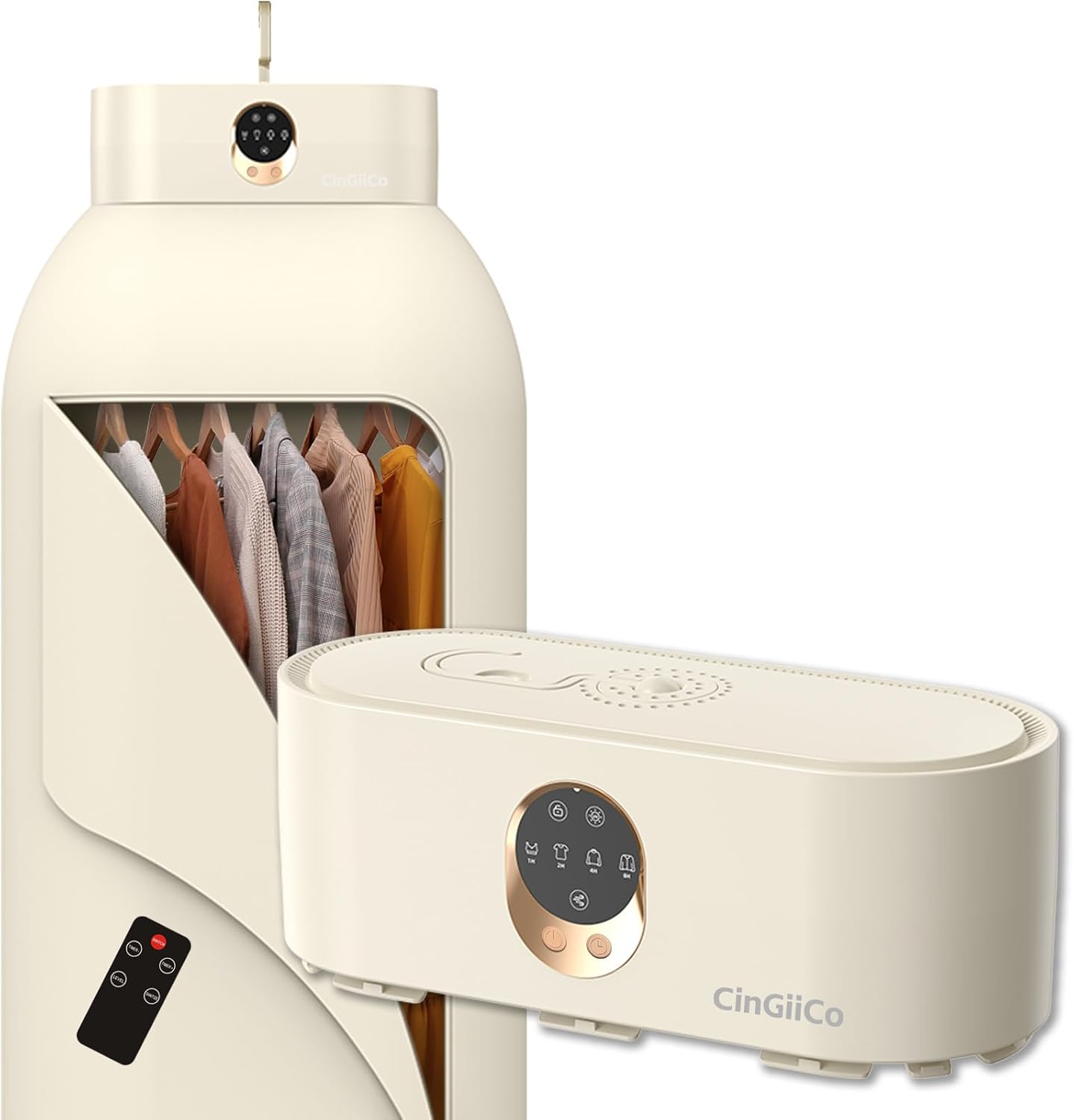
CinGiiCo Portable Clothes Dryer Y1
| Form Factor | Freestanding |
|---|---|
| Access Location | Top Load |
| Capacity | 12 load |
The CinGiiCo Portable Clothes Dryer Y1 is a small freestanding dryer intended for apartments, dorms, RVs, and travel where a full-size machine is impractical. It uses a waterfall-style heated airflow and warm air circulation to dry up to about 12 small items per cycle and offers two drying modes: a gentle care mode for delicates and a quick-dry mode for faster results. The unit includes four timer settings (1, 2, 4, and 8 hours), interior lighting, a constant-temperature safety system, and a remote control for hands-off operation. Practical benefits include low noise operation (as low as 44 dB), a compact footprint that does not require venting, and an energy-saving control chip the listing claims is more efficient than older models. Important limitations are the small capacity and long drying times compared with full-size dryers, and the need to thoroughly wring out garments before use to avoid damp loads and extended runtimes. For budget-minded users needing occasional, ventless drying for small loads, this model delivers straightforward, space-saving performance.
Best for: Buyers on a tight budget who need a compact, ventless dryer for occasional small loads in apartments, dorms, RVs, or temporary housing and who prioritize space and energy savings over speed.
Less Ideal for: Families or users who need to dry large loads quickly, expect full-size dryer performance, or want advanced cycle customization should consider a conventional or larger dryer instead.
- Compact freestanding design that does not require external venting
- Two drying modes including gentle care for delicates
- Four-timer settings plus remote control for convenient hands-off operation
- Low noise operation (reported around 44 dB) suitable for shared spaces
- Energy-saving control chip intended to reduce power use versus older models
- Small 12-item capacity means multiple loads for larger households
- Drying times can be long and depend on how well garments are wrung out
- Limited to top-load, single-compartment drying without advanced cycle controls
Verdict: A very affordable, space-saving ventless dryer that works well for occasional small loads and delicate items when a full-size machine is not an option.
BANGSON 1.5 Cu.Ft Portable Dryer

| Capacity | 1.5 cubic feet |
|---|---|
| Form Factor | Front Load |
| Power | 120V |
| Door Orientation | Right |
This compact vented dryer targets renters and small-space households that need a reliable, no-frills way to dry everyday laundry. It plugs into a standard 120V outlet and fits in tight areas like apartments, dorms, and RVs while the 1.5 cu ft drum handles typical loads such as shirts, underwear, and small towels. Controls are simple: a knob selects heat-dry cycles for deeper drying and cool-air modes for gentle refresh and delicates, and run times span from short refresh cycles up to long Super Dry settings for heavier items. The stainless steel drum and removable lint filter make maintenance straightforward and help reduce odor buildup over time. The unit ships with an exhaust hose and is light enough to move when needed. Limitations include its small capacity that requires splitting larger laundry batches and the need for venting, which may restrict placement options compared with condenser or ventless models. Noise and cycle length will be noticeable compared with full-size dryers, but for steady, dependable drying in constrained spaces this unit performs the core job well.
Best for: Buyers who prioritize a dependable, easy-to-maintain dryer for tight living spaces and want straightforward controls and plug-and-play reliability without complex features.
Less Ideal for: Large households or anyone who needs to dry bulky items in a single cycle should consider a full-size or higher-capacity dryer instead.
- Compact footprint fits tight spaces like apartments, dorms, and RVs
- Operates from a standard 120V outlet—no special wiring required
- Stainless steel drum and removable lint filter simplify cleaning and reduce odors
- Two drying modes (heat and cool air) offer options for delicates and heavier loads
- Includes exhaust hose so it is ready to install out of the box
- Small 1.5 cu ft capacity requires multiple loads for larger households
- Requires venting which limits placement compared with ventless designs
Verdict: A compact, plug-in dryer that delivers reliable, easy-to-maintain drying for small living spaces on a budget.
Euhomy Portable Clothes Dryer 1.5 Cu Ft

| Capacity | 1.5 cu. ft. |
|---|---|
| Power | 850W |
| Max temperature | 140°F |
| Maximum wet load | 10 lbs |
The Euhomy portable clothes dryer is a compact electric dryer designed for small households, apartments, dorms, and RVs that need an alternative to line drying. It accepts up to about 10 lb of wet laundry and uses an 850W heater that reaches roughly 140°F, with high, low and several timed programs — including cool, warm, hot, anti-wrinkle and air-freshen — so you can tailor drying for delicates, shirts, towels or small bulk loads. The drum is stainless steel and the 105° wide-angle door and lint filter make loading and maintenance straightforward, while the door-interlock and ETL/DOE certifications add safety assurance. Setup options include tabletop, wall mount or shelf placement, and the unit is reasonably quiet for use in shared spaces. Expect longer cycle times and smaller capacity compared with full-size dryers, and it requires pre-spinning clothes well for best results; heavy items or large bedding will not dry efficiently. As a budget-friendly, space-saving dryer it handles everyday small loads reliably but is not a replacement for a household's main dryer when larger capacity and faster drying are needed.
Best for: Buyers looking for a compact, safety-certified dryer to handle small, frequent loads in tight spaces and who value reliable, well-documented performance over maximum capacity.
Less Ideal for: People who need to dry large loads, bedding, or want fast turnaround for family-sized laundry sessions should choose a full-size dryer instead.
- Small footprint suitable for apartments and RVs
- Multiple timed modes including cool, warm, hot and air-freshen for fabric-specific care
- Stainless steel drum and wide 105° door for easy loading and reduced snagging
- Safety features and ETL/DOE certification provide independent safety verification
- Triple-layer lint filter helps contain lint and pet hair during cycles
- Limited 10 lb wet load capacity not suited for large items or households with heavy laundry needs
- Lower 850W power means longer drying times compared with full-size electric dryers
Verdict: A compact, safety-certified dryer that reliably handles small apartment or RV laundry loads when space and budget are the priorities.
MOJOCO Portable Dryer MJC-T03

| Form Factor | Top Load |
|---|---|
| Capacity | 22 pounds |
| Power | 600W |
| Included Components | Dryer, Dryer Bag |
The MOJOCO Portable Dryer is a small, top-load dryer meant for apartments, travel, and other tight spaces where a full-size dryer is impractical. It uses a 600W heater with two temperature modes and a timer to dry lightweight garments; the brand claims light items can be done in about 1–2 hours and heavier pieces may take longer. The unit is foldable and comes with a storage bag, so it is easy to move and store when not in use. Notable extras include a built-in LED UV sanitizing option and automatic overheat protection for safety, plus whisper-quiet operation suitable for bedrooms or RVs. Because it is low-power and compact, it can handle up to nine lightweight garments or a stated maximum load of 22 pounds, but drying times vary widely by fabric and how wet items are before starting. Expect slower cycles than conventional dryers and limited capacity for bulky items, and ensure adequate room ventilation when running. For budget-conscious users who need occasional small-batch drying without a laundry room, this is a practical, low-energy choice.
Best for: Buyers who need an inexpensive, low-power solution for drying small loads in apartments, dorms, RVs, or while traveling and prioritize portability and safety features.
Less Ideal for: Households that regularly dry large loads, bulky towels, or heavy fabrics should choose a conventional dryer with higher capacity and faster cycles.
- Compact, foldable design that is easy to store and transport
- Two heat settings plus timer let you tailor drying to delicate or faster cycles
- Built-in LED UV sanitizing for added garment freshness
- Automatic overheat protection and quiet operation enhance safety and indoor use
- Small capacity and slower drying times compared with full-size dryers
- Not suitable for heavy or bulky items that require tumbling
Verdict: A lightweight, budget-friendly portable dryer that saves space and energy for occasional small-load drying while adding UV sanitizing and safety features.
Choosing the Right Dryer on a Budget: Key Factors to Consider
Energy Efficiency and Operating Cost
Energy efficiency directly affects long-term cost. A dryer that uses less energy per cycle lowers monthly utility bills and offsets a modestly higher upfront cost over time.
Look for models with moisture sensors or low-heat options that reduce overdrying. Even on a strict budget, prioritizing efficient heating and good airflow pays off when you consider years of use.
Drum Capacity and Load Size
Capacity determines how much you can dry in a single cycle and affects both convenience and energy use. A larger drum is more efficient for bulky items like comforters because it reduces the need for multiple cycles.
If you regularly dry mixed loads, choose a size that fits your typical laundry habits. Undersized dryers force you to split loads, which increases total cycle time and energy consumption.
Drying Performance and Cycle Options
Basic cycles should cover cottons, delicates, and quick-dry needs. Moisture-sensing and timed options let you balance fabric care with speed.
More cycles are not always better if they are redundant or confusing. On budget models, clarity of controls and effective core cycles matter more than a long menu of specialty settings.
Vent Type and Installation Flexibility
Budget dryers come in vented and ventless designs. Vented models typically dry faster but require a suitable exhaust path. Ventless units are easier to place but may run longer and use more energy in some cases.
Consider available installation space and whether you can install or route an exhaust duct. Also check electrical requirements so the unit matches your home wiring without expensive modifications.
Ease of Maintenance and Filter Access
Regular cleaning of the lint trap, condenser (if present), and exhaust duct keeps a dryer efficient and safe. Models with accessible filters and simple maintenance tasks reduce the risk of lint buildup and fire hazards.
On budget units, durable and easy-to-replace parts matter. Look for clear access to the lint screen and user-serviceable areas to make upkeep straightforward.
Durability and Repairability
A low purchase price does not always deliver long-term value if the machine fails prematurely. Durable drum bearings, reliable heating elements, and common replacement parts extend useful life.
Choose models that use standard fasteners and readily available components so repairs are simpler and less costly when they are needed.
Vented Vs Ventless: Which Works for Tight Budgets
Vented dryers typically remove moisture faster because they expel humid air outside. That often translates to shorter cycle times and lower per-load energy use, which helps control operating cost over time. However, they require access to an exterior wall or duct route.
Ventless dryers, including condenser and heat-pump types, are more flexible to place and avoid external ductwork. On a tight budget, ventless condenser units can be attractive because they eliminate installation cost, but they sometimes run longer and may use more electricity per cycle than a vented counterpart.
- Choose vented if you have an available exhaust route and want faster drying.
- Choose ventless if installation flexibility matters or exterior venting is impossible.
- Factor in typical load types: bulky items dry better with vented airflow.
Sizing Your Dryer to Your Laundry Routine
Estimate weekly laundry volume and typical load compositions. If your household runs frequent full loads or dries bulky bedding, prioritize a larger drum. For singles or couples who do smaller loads often, a compact but efficient model can save space and initial cost.
Remember that a dryer sized to your washer avoids repeated partial loads. If the washer can handle larger loads than the dryer, you will end up running extra dryer cycles, negating upfront savings.
- Match dryer capacity to washer output to avoid reloading.
- Consider stacking or compact models for small laundry areas.
Practical Controls and Useful Features on a Budget
Look for clear, durable controls that make common tasks easy. Useful features on budget dryers include moisture sensors, timed dry, and a gentle or low-heat option for delicates. Avoid models with overly complicated touch panels that can be less reliable.
Simple indicators for cycle progress and easy access to the lint trap are high-value features. Extras like a tumbling-only or air-fluff function can help refresh clothes without heat, which is handy for delicate items.
- Prioritize moisture sensing over a long list of specialty cycles.
- Ensure controls are straightforward and labeled for quick use.
Noise, Vibration, and Placement Considerations
Noise level and vibration are practical concerns in shared living spaces. Even budget dryers vary in how they manage vibration from unbalanced loads. Look for units with basic anti-vibration design or adjustable leveling feet.
Placement near living areas or bedrooms argues for quieter operation or installation on vibration-dampening mats. If stacking with a washer, confirm compatibility and ensure stable mounting to reduce noise and wear.
- Level the dryer and check for excessive movement during a test cycle.
- Use vibration pads if the floor amplifies noise.
Maintenance Checklist for Long-Term Savings
Routine maintenance extends a dryer's life and keeps energy use low. Clean the lint trap after every load, check and clean the exhaust duct periodically, and inspect seals and vents for blockages. For condenser or heat-pump designs, follow manufacturer guidance on water reservoir or condenser cleaning.
Budget units that simplify these tasks reduce the chance of neglect. A preventative maintenance habit prevents efficiency loss and lowers the risk of faults that would necessitate costly repairs.
- Clean lint screen after each use.
- Inspect exhaust duct and clear blockages twice a year.
How We Chose the Best Dryer on a Budget
We shortlisted budget dryers that deliver dependable drying without extraneous features that raise long-term ownership cost. Our editorial filters favored units with clear capacity ratings, documented energy performance, and construction that supports regular household use. We prioritized models offering multiple sensible drying programs, reliable drum mechanics, and straightforward controls so owners can adapt cycle times and heat levels to fabric types. Key evaluation criteria included documented energy efficiency or estimated annual usage, drum capacity and load balance, cycle variety and moisture sensing, build quality and reliability indicators, and ease of maintenance including lint access and filter cleaning. We excluded units that lack basic safety features, are incompatible with common home venting or electrical setups, or rely solely on niche proprietary components that complicate repairs. The resulting list focuses on practical, affordable dryers that perform the core job well while keeping operating and upkeep costs predictable.
Our full evaluation process is outlined in our review methodology.
FAQ
How much energy does a typical budget dryer use?
Usage varies by model, load size, and cycle length. Budget vented dryers often use less energy per load than condenser units because they remove moisture faster. Look for moisture-sensing cycles and choose appropriate heat settings to reduce run time and energy use.
Can I install a vented dryer in any laundry space?
Not always. Vented dryers require an exterior vent path or a routed duct to expel moist air. If you lack an exterior wall or cannot run ducting, consider a ventless model instead. Also check local building codes and clearance requirements before installation.
Are budget dryers less durable than higher-end models?
Durability depends on components and maintenance rather than price alone. Many budget dryers use simpler mechanics that are easier to service. Regular upkeep, such as cleaning lint and checking vents, can keep a budget unit running reliably for years.
What maintenance should I perform to keep a dryer efficient?
Clean the lint trap after every load, inspect and clean the exhaust duct periodically, and check seals for wear. For ventless designs, empty or clean any water reservoirs and follow condenser maintenance guidance. These steps preserve airflow and drying efficiency.
Is it better to buy a larger dryer than I need?
Oversizing leads to wasted space and possibly longer heating times for small loads. Choose a capacity that fits your typical full load. If you occasionally need to dry bulky items, prioritize a model that comfortably handles those without being excessively large for daily use.
Final Verdict
When choosing a dryer on a budget, focus on capacity that matches your laundry habits, reliable drying controls, and energy-efficient features like moisture sensing. Tradeoffs are inevitable: simpler models cost less upfront but may lack advanced efficiency or noise mitigation. Prioritize models that are easy to maintain and have straightforward access to lint and vents. That approach keeps operating costs down and extends useful life, helping you get the best overall value from a budget dryer.