
Note: This article contains affiliate links. If you click on these links and make a purchase, we may earn a small commission at no extra cost to you. This helps support our research and content. Read our full affiliate disclosure here.
If you want to roast green coffee at home, picking the right electric coffee roaster matters for flavor, consistency, and day-to-day convenience. The right roaster will give you repeatable roast profiles, manageable smoke control, and parts that are easy to clean and maintain. This guide shortlists the top Electric Coffee Roasters for home use and evaluates them by roast consistency, user controls, and cleanup. Read on to find the type of machine and features that fit your kitchen and roasting goals.
Top Picks at a Glance
| Best Quality Built to a higher standard if you want something more solid | precision coffee roaster 1kg |  |
| Best Value The sweet spot between price and what you get | TaiShi Home Coffee Roaster 800g |  |
| Best Budget The cheapest option that still gets the job done reliably | LUOSHALIYA Electric Coffee Roaster |  |
| Top Rated A top-rated pick with lots of positive feedback | Fresh Roast SR800 Coffee Roaster |  |
| Best Seller A high-volume bestseller chosen again and again | JIAWANSHUN Home Coffee Roaster FBA066 |  |
precision coffee roaster 1kg

| Capacity | 1 kg |
|---|---|
| Wattage | 2000 watts |
| Voltage | 240 volts |
| Human Interface Input | Touchscreen |
| Power Source | AC |
This 1 kg commercial electric coffee roaster brings professional features into a compact package aimed at high-performance home or small-shop roasting. It uses a 2000W, 240V motor with upgraded bearings and a siphon exhaust fan to support heavier daily throughput, while the dual smart roasting system offers 10 preset profiles plus manual saving and Artisan software integration for curve import/export. A large 10.1-inch LCD touchscreen displays temperature and roast curves in real time, making it practical for profile-driven roasting and repeatable batches. Construction leans commercial with a stainless steel body and full metal front panel designed for high-temperature durability. Practical benefits include programmable automation for consistent results, manual controls when you want to experiment, and a microfilter to manage chaff. Limitations are its 240V requirement and substantial weight and footprint, which make it better suited to a dedicated space and users who need near-commercial throughput rather than a casual countertop roaster.
Best for: Roasters who prioritize control and repeatability and need a compact commercial-capable machine for consistent small-batch production or a startup cafe.
Less Ideal for: Casual home users who want a lightweight, plug-and-play countertop roaster or anyone without access to 240V power.
- Commercial-grade construction with stainless steel body and metal front panel for durability
- 2000W upgraded bearing motor and siphon exhaust fan support sustained daily roasting
- 10.1-inch touchscreen with real-time temperature and curve visualization
- Built-in auto profiles plus Artisan software compatibility for precise profile control
- Requires 240V power which limits placement without appropriate electrical supply
- Large size and heavy weight make it less portable and require dedicated space
Verdict: Choose this roaster if you need a durable, profile-capable 1 kg machine that brings near-commercial performance and Artisan software control to a small-batch setting.
TaiShi Home Coffee Roaster 800g
| Capacity | 800 g |
|---|---|
| Wattage | 800 watts |
| Voltage | 110 volts |
| Operation Mode | Fully Automatic |
| Power Source | electric |
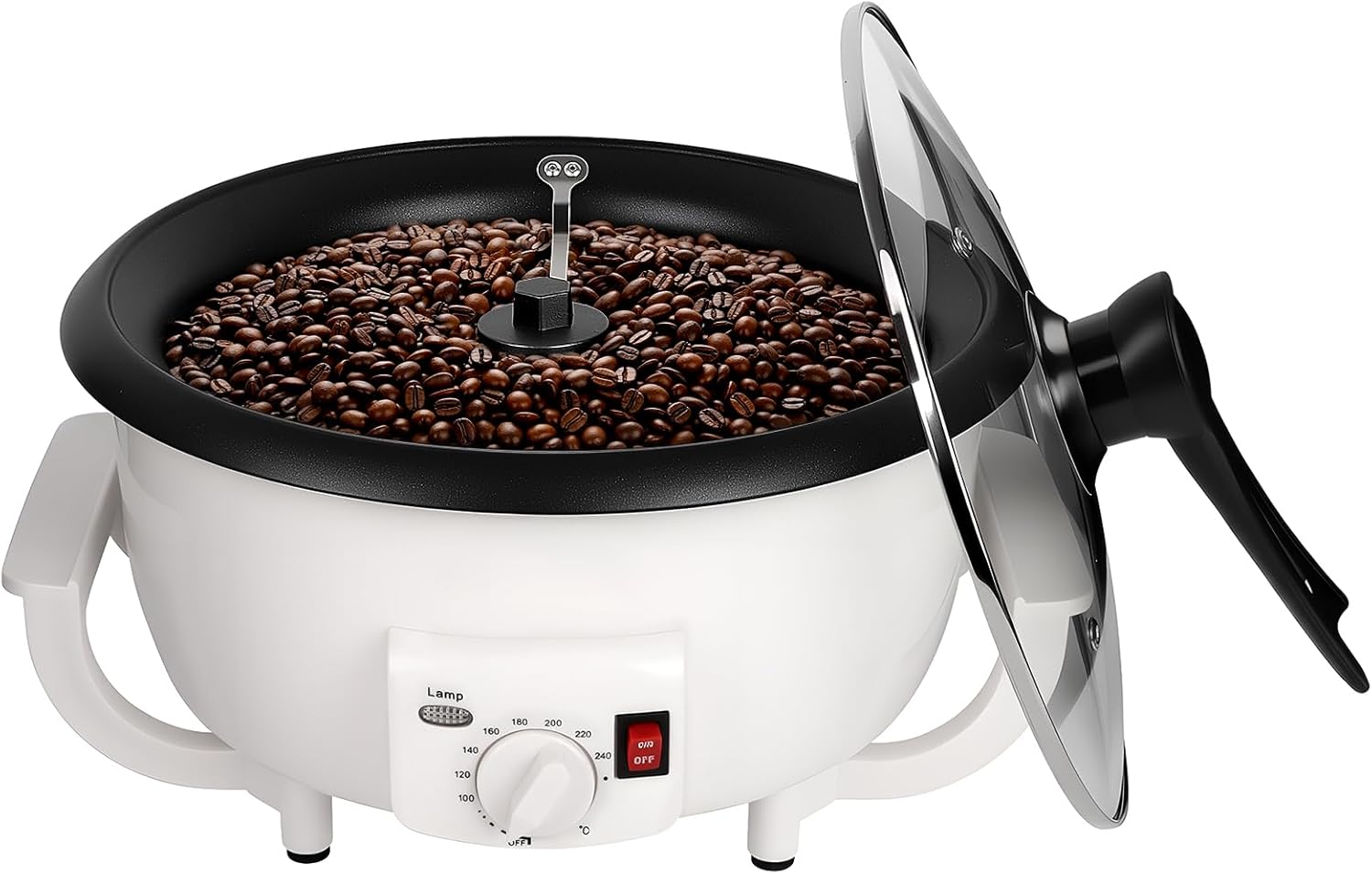
This compact electric coffee roaster is built for home users who want to roast small batches of beans without a commercial setup. It accepts green beans and other small items, runs on 110 V with 800 watts of power, and offers fully automatic operation with button controls and a built-in timer so you can set roast time and walk away. The stainless steel construction and reusable filter simplify cleanup, while the advertised optimal batch size of 300–500 g helps achieve more even roasts than filling to the 800 g maximum. Typical use is simple: load the beans, pick a time/temp profile, and monitor color and aroma through the process. Limitations include modest power compared with higher-end home roasters and the caution that very small or very large loads may roast unevenly, so results require some testing to dial in preferred roast levels. For hobbyists focused on practical, occasional home roasting, it provides a straightforward, space-efficient way to experiment with fresh roasts without complex controls.
Best for: Buyers wanting a practical, easy-to-use home roaster to experiment with fresh beans without complex setup or pro-level controls.
Less Ideal for: Serious prosumers who need precise temperature profiling, larger commercial throughput, or advanced roast logging should look at higher-end roasters instead.
- Supports small-batch home roasting with up to 800 g capacity
- Fully automatic with timer and simple button controls for easy operation
- Stainless steel build and reusable filter for easier cleaning and durability
- Advertised optimal batch guidance (300–500 g) helps users get more consistent roasts
- Power and control are basic compared with advanced countertop roasters
- Very small or overly large loads may roast unevenly and need trial-and-error adjustments
Verdict: A straightforward, stainless-steel home roaster that makes small-batch coffee roasting easy for practical hobbyists who want fresh beans with minimal fuss.
LUOSHALIYA Electric Coffee Roaster

| Rated power | 800w |
|---|---|
| Voltage | 110V,60HZ |
| Max capacity | 1500g |
| Best capacity | 300-500g |
| Operating time | 35 min max |
This compact LUOSHALIYA roaster is a budget-friendly desktop machine for small-batch coffee roasting at home. It runs on 110V and 800W power and uses a nonstick pan with internal rotating rods to stir beans for more even heating, while a transparent lid and vent holes let you monitor color and aroma during the roast. The unit offers temperature adjustment and a 0–35 minute timer, which makes it simple to experiment with light to medium roasts without manual stirring. The best capacity is 300–500 g, though it lists a maximum 1500 g capacity that may reduce uniformity at higher loads. Its PP shell and basic controls keep operation straightforward but mean it lacks precision controls, airflow management, or cooling features found on pricier roasters. For casual home roasters who want to try small batches and learn roast timing and color, this machine delivers usable results for the price; serious hobbyists seeking reproducible, high‑control roasts will likely want a more advanced model.
Best for: Home coffee enthusiasts shopping on a tight budget who want a straightforward, compact machine to learn roasting and experiment with small batches for personal use.
Less Ideal for: People who need professional-level control, consistent high-volume roasting, or rapid cooling after roast should consider more advanced, feature-rich roasters.
- Simple temperature control and 0–35 minute timer for easy small-batch roasting
- Nonstick heated pan with stirring rods promotes more even roasting and easy cleanup
- Transparent lid with venting holes lets you watch color development and monitor progress
- Compact, countertop-friendly design suited to home kitchens
- Limited roast precision and no active cooling system for rapid post-roast cooling
- Performance may be uneven if loaded near the stated maximum capacity
Verdict: A simple, affordable home roaster that lets budget-minded users experiment with small-batch coffee roasting without a steep learning curve.
Fresh Roast SR800 Coffee Roaster

| Roast capacity | 6–8 oz (170–226 g) per batch |
|---|---|
| Heat settings | 9 levels |
| Fan settings | 9 levels |
| Display | Real-time temperature digital display |
The Fresh Roast SR800 is a compact home coffee roaster designed to turn green beans into drinkable roasts in under ten minutes. Beans are loaded into a clear glass roasting chamber and roasted by adjusting a single push-turn knob that controls nine heat levels, nine fan speeds, and the timer while showing real-time temperature on the digital display. Typical use is small-batch roasting for daily fresh coffee or for experimenting with roast profiles and custom blends; the convection fan and speed-roast design promote fast, even development and the unit includes an auto cool-down/cooling stage to stop roasting quickly. Its simple one-knob interface makes it approachable for beginners, yet the adjustable controls and programmable start defaults give experienced users repeatable results. Trade-offs are the small batch size—meant for home use only—and the need to manage chaff and ventilation during roasting, so it is best used in a well-ventilated kitchen. The SR800 is a practical choice if you want fast, reliable small-batch roasts with hands-on control.
Best for: Buyers who prioritize consistent, repeatable home roasting and want hands-on control to produce fresh small-batch coffee on a regular basis.
Less Ideal for: Those who need to roast large quantities at once or who cannot provide a well-ventilated space should consider a larger or vented roasting solution instead.
- Fast small-batch roasting in under 10 minutes
- Adjustable 9-level heat and 9-level fan control for precise profiles
- Real-time digital temperature display for repeatable roasts
- Auto cool-down and clear chamber for easy visual monitoring
- Limited to 6–8 oz batches, not suitable for larger households or batch roasting
- Produces chaff and requires good kitchen ventilation during use
Verdict: Choose the SR800 if you want a reliable, small-batch electric roaster that delivers fast, controllable, repeatable home roasts.
JIAWANSHUN Home Coffee Roaster FBA066
| Capacity | 500g (recommended 300–500g) |
|---|---|
| Wattage | 1200 W |
| Temperature range | 100–240 ℃ |
| Voltage | 120 volts |
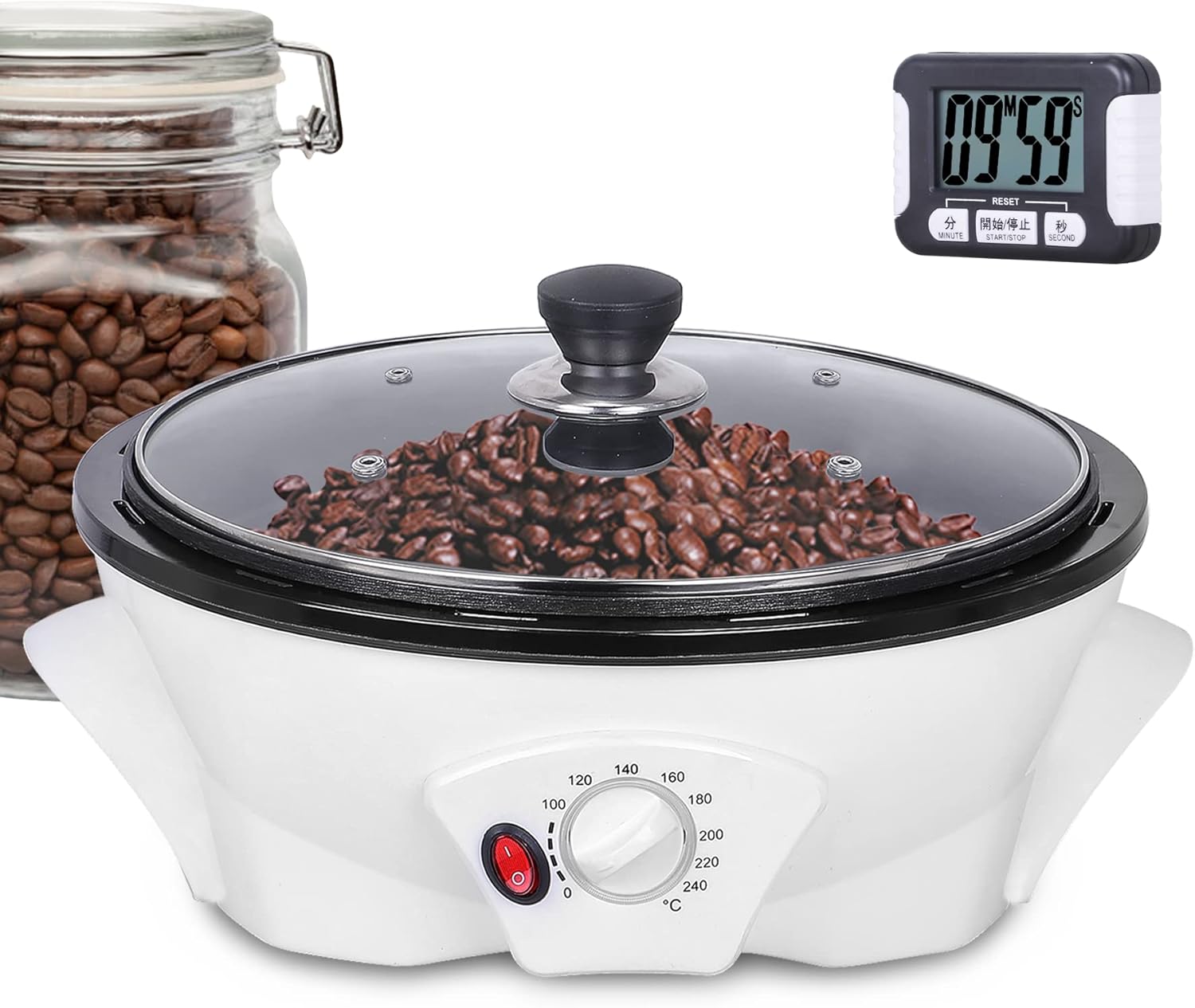
This JIAWANSHUN roaster is aimed at home users who want to roast small batches of beans with hands-on control. It accepts roughly 300 to 500 g per batch (800 g max listed) and uses a 1200W heater plus an automatic stirring rod to promote even roasting. You set temperature from about 100 to 240 C and use the timer to repeat preferred roast profiles, while the clear glass lid and ventilation holes let you watch color development. The honeycomb nonstick interior and removable stirring assembly make cleanup straightforward, and the manufacturer highlights compatibility with other dry foods like nuts and popcorn. Limitations to consider: it is a single-batch countertop unit so it is slower than commercial drum roasters and requires judgment to dial in roast levels, and the stirring rod can jam if defective or tiny beans are left in the load. For a cautious buyer this model offers a fairly simple, feature-focused way to start home roasting without advanced automation.
Best for: Home coffee hobbyists who want a straightforward, lower-risk way to roast small batches at home and prefer visible controls and a simple learning curve.
Less Ideal for: People who need high-volume or fully automated commercial roasting or those who want plug-and-play roast profiling without manual monitoring.
- Adjustable 100–240 C temperature range for light to dark roasts
- Built-in timer and one-key operation simplify repeatable batches
- Automatic mixing stirrer promotes more even roasting
- Transparent glass lid lets you monitor roast progress in real time
- Nonstick honeycomb interior is easy to wipe clean
- Single-batch home capacity so not suited for larger or continuous roasting
- Stirring rod can become obstructed by defective or very small beans
Verdict: A simple, visible, and controllable small-batch roaster that makes it easy for cautious home users to start roasting their own beans.
Choosing the Right Electric Coffee Roaster: Key Factors to Consider
Batch Size and Throughput
Batch size determines how much green coffee you can roast per cycle and affects roast consistency. Larger batches require more even heat distribution and stronger airflow to avoid underdeveloped or uneven beans. For most home users, small to medium batch capacities provide a good balance between a single-batch yield and manageable roast time. Choose a machine whose advertised batch size matches how frequently you plan to roast. If you roast several times per week, a slightly larger capacity reduces the need for repeated cycles. If you roast rarely or only want fresh single-cup batches, a compact unit designed for 100–250 grams may be more efficient and easier to store.
Temperature Control and Monitoring
Precise temperature control is essential for shaping roast development and replicating profiles. Look for roasters with reliable sensors, visible temperature readouts, and the ability to adjust heat in real time. Some units offer programmable profiles or manual controls that let you change heat and fan during a roast. Accuracy and responsiveness of the temperature system affect how predictable your roast curves will be. Machines with sluggish or poorly calibrated sensors make it hard to hit first and second crack consistently, which increases the time spent trialing and adjusting.
Airflow and Chaff Management
Airflow influences bean movement, heat transfer, and how effectively chaff is separated from the roast chamber. Controlled airflow promotes even roasting and can speed up drying and Maillard stages when used correctly. Effective chaff management, whether via integrated collection trays or external filters, keeps the workspace cleaner and reduces smoke buildup. Units with inadequate airflow or no chaff capture tend to produce more smoke and require more frequent cleaning. Consider how the machine vents and where collected chaff is stored to ensure safe operation inside a kitchen environment.
User Interface and Programmability
The user interface determines how easily you can repeat and refine roast profiles. Simple knob- or button-based controls can be ideal for beginners, while digital displays and programmable steps benefit roasters who want to log and repeat specific temperature and time sequences. Some roasters include USB or app connectivity for saving profiles and viewing curves. Think about whether you prefer manual, hands-on control or the convenience of preset programs. Programmability helps remove guesswork, but straightforward manual controls are often quicker for small experimental batches.
Build Quality and Materials
Durable construction affects long-term reliability and safety. Look for robust housings, heat-resistant internal parts, and components that tolerate repeated thermal cycling. Metal contact surfaces in the roast chamber generally outlast thin plastics when exposed to high temperatures. Solid build quality also simplifies maintenance because parts fit tightly and wear more slowly. Consider whether replacement parts are accessible and if common wear items like fans or seals are serviceable without specialized tools.
Cleaning, Maintenance, and Safety
Routine cleaning affects both performance and safety. Chaff accumulation can increase smoke and fire risk, so a design that allows fast access to chaff trays and removable screens will save time. Ease of disassembly for dust and oil removal keeps sensors and fans operating accurately. Also evaluate safety features such as thermal cutoffs or auto-shutoff at overheating. Machines that are easy to maintain encourage more frequent use and better roast results because you will keep the unit in top condition.
Types of Home Electric Coffee Roasters
Home electric coffee roasters generally fall into drum, air, and hybrid designs. Drum-style machines tumble beans on a heated surface and tend to produce traditional development with slower heat transfer. Air roasters use hot air to roast more quickly and can highlight clarity and acidity in lighter roasts.
Hybrid units blend convective and conductive heat to offer a middle ground between roast character and speed. Your choice should reflect the roast styles you prefer and how much manual control you want during a roast.
- Drum-style: More even conduction, often fuller-body results
- Air-style: Faster roast, clearer bright notes, lighter body
- Hybrid: Balance of speed and depth, versatile for many roast profiles
Setting Up Your Roaster and Ventilation
Proper setup and ventilation are critical for safe indoor roasting. Position your machine near a window or under range hood if possible, and make sure the exhaust path is unobstructed. Many home roasters generate some visible smoke, especially during first and second crack, so plan airflow accordingly.
Also place the unit on a heat-resistant surface and keep combustible materials clear. Regularly empty and secure the chaff collector to prevent buildup that can affect exhaust performance and create odors.
- Keep ventilation clear and direct exhaust away from living spaces
- Use a heat-resistant mat under the unit
- Empty chaff between sessions to reduce smoke
Developing Roast Profiles at Home
A roast profile is the time-temperature path that beans follow from green to desired development. Start with a conservative charge temperature and adjust the heat or airflow in predictable steps to control drying, Maillard, and development stages. Track time and temperature so you can reproduce successful roasts.
Listen for first and second crack and take notes on how changes in heat or fan settings affect flavor. Small incremental adjustments across batches are more useful than large swings, especially when you are dialing in a new bean or origin.
- Record charge temp, total roast time, first and second crack timings
- Adjust one variable at a time to isolate effects
- Aim for repeatability before aggressively pursuing radical profiles
Common Maintenance Tasks
Routine maintenance keeps a roaster performing reliably. Clean the chaff tray and any accessible screens after each roast. Periodically inspect fans, seals, and wiring for signs of wear or oil buildup. Some roasters allow partial disassembly for deeper cleaning; follow manufacturer guidance for safe procedures.
Calibration checks on temperature sensors help maintain consistent results. Replace worn gaskets or filters as needed to preserve airflow and safety features.
- Empty and clean chaff after every session
- Wipe internal surfaces to remove oil build-up periodically
- Check fans and sensors for proper operation
How Roast Style Affects Brewing Choices
The roast profile you choose will shape how you brew the coffee. Lighter roasts often highlight origin character and can reward pour-over or filter methods that emphasize clarity. Darker roasts produce more body and caramelization, working well with espresso and full-immersion brews.
When planning roasts, consider how you will brew the beans at home so you can tailor development to the desired cup profile rather than roasting to extremes that do not match your typical brewing routine.
- Match roast level to brewing method for best results
- Adjust development to balance acidity, sweetness, and body
- Sample small batches to refine roast for your preferred brew
How We Chose the Best Electric Coffee Roaster
We focused on machines designed for home and small-batch roasting, prioritizing features that affect roast quality and repeatability. Evaluation centered on roast consistency and temperature control, airflow and chaff management, build quality and durability, user interface and programmability, and ease of cleaning and maintenance. We gave extra weight to units that offer reliable temperature monitoring or profile memory and clear controls that let home roasters repeat successful batches. We excluded commercial-only equipment and single-use or disposable devices that do not support adjustable roast parameters. We also filtered out unventilated or poorly sealed designs that generate excessive smoke without adequate chaff capture. Final selections represent roasters that balance roast control, manageable cleanup, and long-term durability suitable for regular home use.
Our full evaluation process is outlined in our review methodology.
FAQ
How much green coffee should I roast at once?
Batch size depends on the roaster design and how often you brew. Many home roasters recommend 100 to 250 grams per batch for consistent results. Roasting the machine near its optimal capacity usually produces more even heat distribution than very small loads.
Do electric home roasters produce a lot of smoke?
Some smoke is normal, especially as oils heat and chaff burns during first and second crack. Smoke levels vary by roast level and machine ventilation. Proper exhaust and regular chaff cleaning minimize indoor smoke and odors.
How soon can I brew after roasting?
Freshly roasted coffee needs a short rest period to degas. For most home roasts, waiting 12 to 48 hours improves cup balance for filter brewing, while shorter rests may be acceptable for espresso. Optimal rest depends on roast level and personal taste.
What maintenance keeps my roaster accurate?
Regularly emptying chaff, cleaning internal surfaces, and checking temperature sensor operation preserves accuracy. Replacing worn seals or filters and ensuring fans are free of debris also helps maintain consistent airflow and temperature response.
Can I program custom roast profiles on home units?
Many electric home roasters offer manual control and some provide programmable steps or profile memory. Availability depends on the model, but programmable units make it easier to reproduce successful roasts and experiment systematically.
Final Verdict
Choosing an electric coffee roaster comes down to matching capacity, control, and maintenance needs to your roasting goals. Prioritize machines that provide reliable temperature feedback, manageable chaff collection, and a user interface you understand. Expect tradeoffs between speed and roast depth when comparing air and drum styles. Focus on repeatability and ease of upkeep rather than chasing the newest features. That approach will help you develop consistent profiles and get the most enjoyment from home roasting.