
Note: This article contains affiliate links. If you click on these links and make a purchase, we may earn a small commission at no extra cost to you. This helps support our research and content. Read our full affiliate disclosure here.
If you bake bread at home regularly, the right electric hand mixer can save time and shoulder strain while still producing a well-developed dough. Bread dough is heavier and tackier than cake batters, so you need a handheld mixer with lasting torque, sturdy beaters or dough hooks, and a comfortable grip for longer mixing sessions. This guide spotlights seven top electric hand mixers for bread dough that were shortlisted for their ability to handle dense mixes without overheating or splattering. Below we outline the practical strengths and tradeoffs of each option and explain the evaluation criteria we used so you can pick the best mixer for your baking routine.
Top Picks at a Glance
| Best Overall The best all-around choice for most situations | Braun MultiMix 5 Hand Mixer |  |
| Best Quality Built to a higher standard if you want something more solid | KitchenAid 9-Speed Hand Mixer KHM926 |  |
| Best Value The sweet spot between price and what you get | Lord Eagle Hand Mixer CX-6661 |  |
| Best Budget The cheapest option that still gets the job done reliably | OVENTE Hand Mixer HM151 |  |
| Top Rated A top-rated pick with lots of positive feedback | KitchenAid 5 Speed Ultra Power Hand Mixer |  |
| Most Popular A crowd favorite that many people choose with confidence | Hamilton Beach 6-Speed Hand Mixer |  |
| Best Seller A high-volume bestseller chosen again and again | WEPSEN Hand Mixer MX200 |  |
Braun MultiMix 5 Hand Mixer

| Wattage | 350 |
|---|---|
| Number of Speeds | 9 |
| Voltage | 120 |
| Special Features | Smartmix Technology, Variocontrol Speed Dial |
The Braun MultiMix 5 is a powerful hand mixer built to handle a wide range of kitchen tasks from whipping egg whites to kneading small bread doughs. Its 350W motor and SmartMix in-line vertical design shift weight into the bowl, which reduces wrist effort during longer mixing jobs. Controls are simple: a VarioControl thumb dial gives nine speeds plus Turbo, and a push button swaps accessories without interrupting your work. The included multi-whisk (whisk and beater in one), dough hooks, and a 2-cup chopper cover most prep needs for home bakers. The sealed housing reduces grime getting inside the motor and most attachments are dishwasher-safe, making cleanup straightforward. For heavier or very large bread batches the hand mixer still works but can run longer and feel taxed compared with stand mixers, and capacity is naturally limited by hand operation. Overall, this model balances power, ergonomics, and useful attachments for serious home bakers who need a versatile handheld tool rather than a full stand mixer.
Best for: Home bakers who want a capable, ergonomic hand mixer that can take on everyday batters and small to medium bread doughs without the footprint of a stand mixer.
Less Ideal for: Bakers who frequently make large batches of heavy dough or need prolonged continuous kneading should choose a stand mixer instead.
- Strong 350W motor that handles dense batter and small doughs
- SmartMix in-line motor design reduces wrist strain by shifting weight into the bowl
- Nine speeds plus Turbo with thumb-operated VarioControl for precise speed changes
- MultiWhisk, dough hooks, and chopper attachments increase versatility
- Sealed housing and dishwasher-safe parts simplify cleaning
- Not a substitute for a stand mixer on very large or heavy bread doughs
- Capacity and continuous kneading time are limited by handheld operation
Verdict: A high-power, ergonomic hand mixer that gives home bakers the power and attachments to handle most small-to-medium bread doughs without switching to a stand mixer.
KitchenAid 9-Speed Hand Mixer KHM926

| Number of Speeds | 9 |
|---|---|
| Wattage | 100 watts |
| Voltage | 120 |
| Controls Type | Push Button |
The KitchenAid 9-Speed Hand Mixer is a compact, corded mixer built to handle a wide range of home baking tasks, from light whipping to working denser doughs. In practice you pick one of nine speeds with push-button controls and the soft-start feature helps prevent splatter as the beaters accelerate. The kit includes Stainless Steel Turbo Beater II accessories plus two dough hooks and a blending rod, so you can mix cookie doughs, knead small yeast doughs, whip cream and blend dressings without changing appliances. The Turbo Beaters are sturdier than basic beaters and the pro whisk efficiently aerates egg whites. Accessories are dishwasher-safe and the set stores in the included bag for neat storage. Limitations: it is a hand mixer, so capacity for heavy or very large bread dough batches is limited and prolonged kneading can be fatiguing compared with a stand mixer, and the corded design restricts reach compared with cordless models.
Best for: Home bakers who prioritize mixing performance and want a single hand tool that can whip, mix, and knead small-to-medium dough batches without upgrading to a stand mixer.
Less Ideal for: Bakers who regularly make large loaves or high-hydration artisan doughs that need long, heavy kneading sessions should choose a dedicated stand mixer instead.
- Nine-speed range for precise mixing control from slow stir to high whip
- Includes Turbo Beater II accessories and two dough hooks for handling denser mixes
- Pro whisk and blending rod expand use cases beyond baking
- Dishwasher-safe accessories and storage bag simplify cleanup and organization
- Not suited for large or very heavy bread dough batches that require long kneading
- Hand mixer use can be tiring for extended kneading compared with a stand mixer
Verdict: Choose this KitchenAid hand mixer when you want a performance-focused handheld tool that can reliably mix and knead small-to-medium bread doughs without a stand mixer.
Lord Eagle Hand Mixer CX-6661

| Wattage | 400 watts |
|---|---|
| Number of Speeds | 5 |
| Voltage | 120 volts |
| Noise Level | 75 db |
| Included Components | Beaters × 2, Dough Hooks × 2, Whisk × 1, Snap-on Storage box × 1 |
The Lord Eagle CX-6661 is a compact 400W hand mixer meant for everyday baking tasks from eggs and batter to light doughs. It ships with two beaters, two dough hooks and a whisk, all stainless steel, plus a snap-on storage case so attachments stay organized. Five speed settings plus a turbo boost let you start slow to avoid splatter and then increase power for thicker mixes, while the ergonomic lightweight housing makes longer mixing sessions easier. The motor uses pure copper for improved durability and the design includes fast heat dissipation and overheat protection for safer repeated use. Noise is listed around 75 dB, so it is audible but comparable to other hand mixers. This model handles cookie and quick bread batters and small yeast doughs reasonably well, but heavier or very large bread doughs may strain the motor compared with stand mixers or higher-wattage hand mixers. Attachments are dishwasher safe, which simplifies cleanup. For home bakers who want a practical, space-saving mixer that includes dough hooks and tidy storage, this is a solid utility option.
Best for: Home bakers who optimize for practicality and space will appreciate a lightweight, organized mixer that handles everyday batters and small doughs without taking up counter space.
Less Ideal for: Serious bread bakers who regularly mix large batches or very stiff doughs should choose a stand mixer or a higher-wattage dedicated dough mixer instead.
- 400W pure copper motor for durable, consistent power
- Includes dough hooks, beaters and whisk for versatile mixing tasks
- Snap-on storage case keeps attachments organized and easy to store
- Dishwasher-safe stainless steel attachments simplify cleanup
- Five speeds plus turbo boost let you control mixing without splatter
- Not intended for large or very heavy bread doughs that require a stand mixer-level motor
- Noise level around 75 dB is noticeable during use
Verdict: A compact, no-frills 400W hand mixer with dough hooks and tidy storage that fits practical home bakers needing a space-saving tool for small bread and everyday mixing tasks.
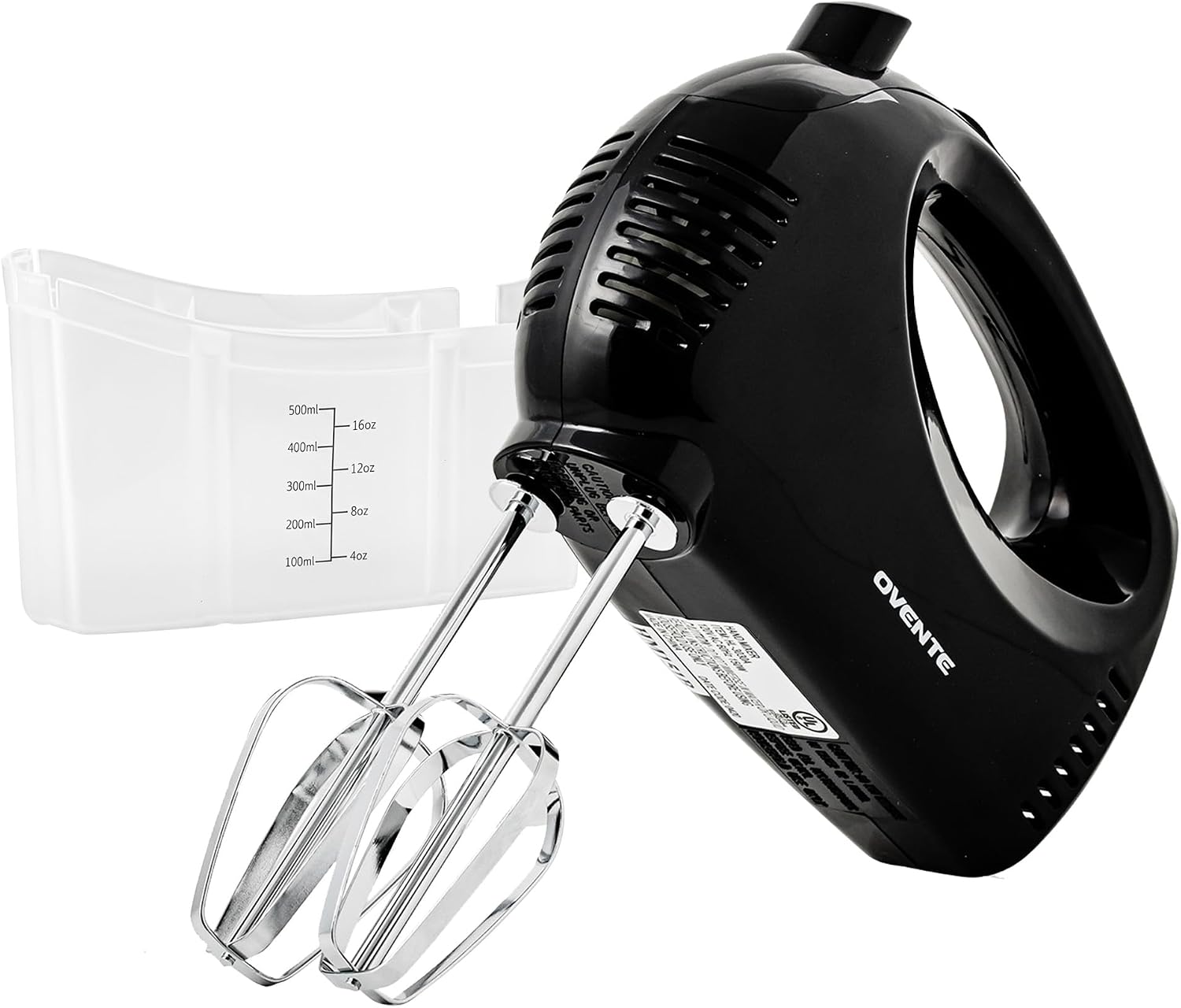
OVENTE Hand Mixer HM151
| Wattage | 150 watts |
|---|---|
| Number of Speeds | 5 |
| Voltage | 120 |
| Included Components | 2 Whisk Beater, Snap-On Case Storage |
The OVENTE HM151 is a lightweight, budget-friendly hand mixer intended for basic mixing and whipping tasks in the kitchen. Its 150W motor and five adjustable speeds cover common jobs like whipping cream, beating egg whites, and mixing batters, and the included stainless steel whisks are dishwasher-safe for easy cleanup. The ergonomic housing and one-touch eject make it simple to change attachments and store the unit in its snap-on case when not in use. For heavier doughs the motor is modest—this mixer handles small to medium cookie or quick bread batters but will strain on large, stiff bread doughs that require sustained torque. Practical benefits include compact storage, straightforward controls, and a low weight that reduces hand fatigue during short jobs. If you need a low-cost mixer for light baking and occasional dough mixing in small batches, this does the job; if you plan frequent, large loaf or high-hydration bread doughs, a stand mixer or higher-wattage hand model is a better match.
Best for: Buyers prioritizing a low-cost, easy-to-store hand mixer for everyday baking, light doughs, and occasional mixing tasks who want simple controls and easy cleanup.
Less Ideal for: Bakers who regularly mix large batches of dense bread dough or need heavy-duty, continuous kneading should choose a stand mixer or a higher-wattage, professional hand mixer instead.
- Five speed settings for controllable mixing consistency
- Two stainless steel whisk beaters that are dishwasher-safe
- Compact, lightweight design with a snap-on storage case for tidy storage
- Ergonomic grip and simple push-button controls for easy operation
- 150W motor is underpowered for large or heavy bread doughs
- Corded design limits reach compared with cordless models
Verdict: A very affordable, compact hand mixer that’s a smart pick for light baking and occasional small-batch doughs but not for heavy, frequent bread kneading.
KitchenAid 5 Speed Ultra Power Hand Mixer

| Number of Speeds | 5 |
|---|---|
| Wattage | 60 watts |
| Voltage | 120 volts |
| Included Components | (1) Hand Mixer, (2) Stainless Steel Turbo Beater Accessories |
The KitchenAid 5 Speed Ultra Power Hand Mixer is a small, reliable corded mixer intended for routine kitchen tasks like cookie dough, mashed potatoes and light bread dough mixing. It provides five speed settings plus a soft-start feel that helps prevent splatter, and the lockable swivel cord keeps the power cable out of the way while you work. Included Stainless Steel Turbo Beater accessories are built for heavier mixes and are dishwasher-safe for easy cleanup. The unit is compact and relatively lightweight, which makes it easy to handle for longer mixing sessions, though it is not a stand mixer replacement for heavy, large batches of bread dough. With a 60-watt motor the mixer has enough torque for small to medium doughs and frequent home use, and the detachable spindle and single-button eject make swapping attachments quick. The main limitation is power and capacity compared with a dedicated stand mixer, so expect slower kneading and the need for shorter batches when making bread dough regularly.
Best for: Home bakers who prioritize a dependable, easy-to-use corded hand mixer for occasional to moderate bread dough and general baking tasks, and who value simple maintenance and handling.
Less Ideal for: People who regularly bake large volumes of bread or need vigorous, long kneading cycles should consider a stand mixer with higher power and larger capacity instead.
- Compact and lightweight for easy handling during extended use
- Lockable swivel cord improves maneuverability at the bowl
- Includes two stainless steel Turbo Beater accessories rated for heavier mixes
- Dishwasher-safe beaters simplify cleanup
- Detachable spindle and one-button eject speed attachment changes
- 60-watt motor limits performance on very heavy or large bread dough batches
- Not a substitute for a stand mixer when kneading dense doughs frequently
Verdict: A sturdy, easy-to-use hand mixer that reliably handles small to medium bread doughs and everyday mixing without the complexity of a stand mixer.
Hamilton Beach 6-Speed Hand Mixer

| Wattage | 250 watts |
|---|---|
| Number of Speeds | 6 |
| Voltage | 120 volts |
| Included Components | Traditional Beaters, Whisk, Snap on Storage Case |
The Hamilton Beach 6-Speed Hand Mixer is a straightforward corded mixer for everyday baking tasks. It offers six speeds plus a QuickBurst button so you can move from gentle folding to short power bursts for thicker batters. The 250-watt peak motor handles typical cookie and cake batters and light dough mixing tasks, while the Bowl Rest lets you set the mixer on the bowl edge to avoid mess when pausing to add ingredients. It includes two traditional beaters and a whisk, all dishwasher safe, and a snap-on storage case that keeps the attachments and cord together. For anyone expecting to do heavy, long-duration dough kneading, this model is not a stand mixer replacement and will work best for small or occasional dough batches rather than continuous heavy bread dough. Its plastic controls and body keep weight down and make it easy to hold for short mixing sessions, but the build is aimed at home use rather than commercial or heavy-duty performance.
Best for: Home bakers who want a reliable, budget-friendly hand mixer for cookies, cakes and occasional small dough batches and who prioritize proven product popularity and user feedback.
Less Ideal for: Frequent bakers who need to knead large or dense bread doughs by hand should choose a stand mixer or a higher-power machine instead.
- Six speeds plus QuickBurst for flexible mixing control
- 250-watt peak motor suitable for common batters and light doughs
- Bowl Rest stabilizes the mixer on the bowl to reduce drips and free hands
- Snap-on storage case keeps beaters, whisk, and cord organized
- Dishwasher-safe attachments for easy cleanup
- 250-watt peak power is limited for heavy or prolonged bread dough kneading
Verdict: A well-reviewed, budget-friendly hand mixer that reliably handles everyday batters and occasional small dough jobs.
WEPSEN Hand Mixer MX200

| Wattage | 200 watts |
|---|---|
| Number of Speeds | 5 |
| Voltage | 120 volts |
| Capacity | 7 quarts |
The WEPSEN Hand Mixer MX200 is a compact 200-watt handheld mixer packaged with four nesting stainless steel bowls, measuring cups and spoons, beaters, whisks and dough hooks for basic home baking. It runs across five speed settings with push-button controls so you can ramp up slowly for batters, whipped cream and light cookie dough; attachments are removable and dishwasher-safe which simplifies cleanup. The included 7 quart and smaller bowls nest to save cupboard space and the stainless construction resists rust and staining. For heavier bread doughs the 200W motor and handheld form factor will handle small batches and light kneading with the dough hooks but it is not as powerful or as stable as a stand mixer for large, very stiff doughs, so expect longer mix times and more user attention. Overall it is a practical, space-saving kit that combines measuring tools and bowls with a versatile hand mixer for everyday home bakers working mostly with small to medium dough batches.
Best for: Home bakers who prioritize a ready-to-use baking kit and want a compact, easy-to-store mixer for small to medium doughs and frequent general mixing tasks.
Less Ideal for: Bakers who regularly make large loaves or very stiff doughs and need a heavy-duty stand mixer with higher horsepower and hands-off kneading capability.
- Complete kit includes mixer, four nesting stainless steel bowls and measuring cups and spoons
- Five speeds let you start slow and increase for different mixing tasks
- Removable stainless beaters, whisks and dough hooks are dishwasher-safe for easy cleanup
- Nesting bowls save storage space and the stainless steel resists rusting
- 200W motor limits effectiveness on large or very stiff bread doughs
- Handheld design requires user control during heavier mixing which can be tiring
Verdict: Pick this set if you want a compact, all-in-one baking kit with a versatile 200W handheld mixer and nesting stainless bowls for everyday small-batch doughs and baking tasks.
Choosing the Right Electric Hand Mixer for Bread Dough: Key Factors to Consider
Motor Torque and Speed Control
Bread dough is dense and requires steady low-speed power to develop gluten without overheating the dough. A hand mixer that lists sustained torque or a heavy-duty motor specification will resist stalling and keep beaters or hooks turning under load. Variable speed settings are useful, but for dough you will often rely on the lower speed range to combine flour and water before increasing briefly to incorporate additions. Strong torque also shortens kneading time and reduces the need to finish by hand.
When evaluating torque claims, consider real-world performance signals such as user reports of stalling under thick batter and the presence of metal gearing or reinforced housings. A mixer's ability to hold a steady low RPM under resistance is more meaningful than a high top speed number.
Attachment Type and Retention
Dough hooks are essential for bread mixing because they mimic kneading action more effectively than standard beaters. Look for hooks designed specifically for dough with a solid shaft and hook profile that moves and folds the dough rather than just churning it. The attachment locking mechanism should be robust; wobbly or loosely seated hooks increase wear and can make the mixer feel underpowered.
Ease of cleaning is also part of attachment choice. Removable stainless-steel hooks that are dishwasher-safe and have smooth joints help keep maintenance simple. Secure release buttons that still allow easy removal without forcing are ideal for frequent bakers.
Thermal Performance and Duty Cycle
Hand mixers are compact, and heavy dough puts sustained demand on the motor. Thermal design determines how long you can run the mixer without the motor cutting out or suffering accelerated wear. Models with built-in cooling vents, heat-resistant components, or explicit duty-cycle guidance are preferable for mixing dough in multiple batches.
If you plan to mix large batches or make several loaves at once, find mixers with better heat dispersion and recommended continuous run times. Even with good thermal design, allow cool-down periods between long mixing sessions to extend the motor life.
Ergonomics and Control During Long Mixes
Mixing bread dough can take several minutes, and a poorly balanced mixer will cause wrist and forearm fatigue. Look for a comfortable grip, low center of gravity, and a body shape that keeps the controls reachable without straining. Weight matters: heavier mixers may carry more torque components but can be tiring to hold for extended periods.
An easy-to-reach speed dial and a stable hand position help maintain control when the dough resists. Consider models with textured or contoured grips and thoughtful button placement to avoid accidental speed changes mid-mix.
Build Materials and Long-term Durability
A mixer that will see frequent bread-making use should be built from materials that stand up to repeated stress. Metal gears, reinforced shafts, and high-quality plastics in the housing all contribute to longevity. Examine how attachments connect to the gearbox and whether the manufacturer offers clear instructions for maintenance or part replacement.
Durability also encompasses how the mixer handles knocks and storage. Sturdier housings resist cracking and internal misalignment, which preserves motor alignment and torque transfer over time.
Cleaning and Maintenance Practicality
Bread dough can be sticky, so ease of cleaning affects how often you will use the mixer. Removable attachments that are dishwasher-safe or have smooth profiles reduce scraping and soaking time. Consider models where seams and ventilation ports are not easily clogged with flour or dough particles.
Maintenance considerations also include how easy it is to replace common wear parts such as beater shafts or release springs. A design that minimizes trapped dough and allows quick wipes between uses will keep the mixer hygienic and ready for the next bake.
How to Use an Electric Hand Mixer with Bread Dough
Start by combining the liquid ingredients and any yeast in the bowl before adding most of the flour. Use low speed to incorporate ingredients slowly; this prevents flour clouds and reduces stress on the motor. Once the dough comes together and the flour is mostly hydrated, switch to a dough hook attachment and continue at the lowest steady speed to develop gluten.
Monitor the mixer during the process and pause if you hear straining or smell burning. If the dough is particularly stiff, mix in short bursts to avoid overheating the motor and to let the dough relax between rotations. Finish kneading by hand only if the mixer cannot fully develop the dough within its recommended duty cycle.
- Begin on the lowest speed and increase only as needed.
- Use dough hooks rather than standard beaters for heavy bread dough.
- Mix in short intervals if the motor shows strain.
Batch Size and Mixer Capacity
Hand mixers are best-suited to small to medium dough batches. Very large doughs quickly overload the motor or cause uneven mixing, which is why understanding your typical loaf size matters. If you bake single loaves or two small loaves at a time, many heavy-duty hand mixers will suffice.
When preparing larger batches, divide the recipe or use shorter mixing intervals and fold manually between cycles. This prevents motor stress and produces more consistent gluten development.
- For 1 to 2 small loaves, most robust hand mixers can manage the job.
- Split larger recipes to protect motor life and improve mixing consistency.
Common Mistakes to Avoid
Avoid starting at high speed or forcing too much flour into the bowl at once. High speeds create splatter and increase the risk of motor overheating. Also, do not use beaters when the dough clearly benefits from a hook; the wrong attachment reduces efficiency and may overwork the motor.
Do not let attachments or the dough build up around the attachment hub. Regularly pause and scrape the bowl when needed to maintain even mixing and reduce stress on the mixer.
- Do not exceed recommended continuous run times.
- Do not force oversized quantities into the bowl in a single mix.
Maintenance Tips to Extend Mixer Lifespan
After each use, remove attachments and clean them promptly to prevent dried dough buildup. Wipe down the housing and vents with a damp cloth and avoid immersing the motor housing in water. Periodically inspect the attachment connection for signs of wear and ensure release mechanisms function smoothly.
If you notice unusual noises or reduced torque, stop using the mixer and allow it to cool. Continued operation under these conditions can accelerate wear and may void serviceability. Simple periodic care extends the usable life and reduces the chance of needing a replacement prematurely.
- Clean attachments immediately after use.
- Keep ventilation areas free of flour dust.
When to Choose a Hand Mixer Vs Stand Mixer
Hand mixers offer portability, easier storage, and lower weight, making them convenient for occasional bakers and small batches. They are also simpler to store and often less expensive than larger stand mixers. However, they are limited by motor size and duty cycle, which makes them less suitable for frequent large-batch bread production.
If you bake several loaves per week or work with very high-hydration doughs, a dedicated stand mixer may be more appropriate. For home bakers who prioritize flexibility and occasionally make bread, a heavy-duty hand mixer with strong torque can hit a sweet spot between performance and convenience.
- Hand mixers are best for portability and small to medium batches.
- Stand mixers excel at frequent, large-volume bread baking.
How We Chose the Best Electric Hand Mixer for Bread Dough
We focused on attributes that matter specifically for mixing bread dough by applying strict, kitchen-relevant filters. Our evaluation emphasized sustained motor torque, because consistent low-speed power prevents stalling when dealing with heavy, hydrated doughs. We tested reported thermal management and duty cycle specifications to ensure the mixer can run through longer mixing or autolyse stages without overheating. Attachment design and retention were another priority, with preference for robust dough hooks and secure locking mechanisms that resist slipping under load. Ergonomics and weight distribution were considered to reduce wrist fatigue during multi-minute mixing sessions. Durability and serviceability were reviewed through available materials and user-repairability cues, favoring metal gears or reinforced housings. We excluded lightweight, low-torque models and tools designed only for light batters because they are not suitable for bread dough. In short, we filtered for hand mixers that combine continuous torque, good heat management, solid attachments, and comfortable handling to meet the demands of home bread baking.
Our full evaluation process is outlined in our review methodology.
FAQ
Can a hand mixer knead all types of bread dough?
Often, a heavy-duty hand mixer with proper dough hooks can handle many common bread doughs, especially small batches. Very dense or very high-hydration doughs may exceed a hand mixer's torque or duty cycle and benefit from a stand mixer or manual kneading.
How long should I mix bread dough with a hand mixer?
Mixing times vary by recipe, but expect several minutes of low-speed mixing once the dough comes together. For heavier doughs, use short intervals with rest breaks to avoid overheating the motor and to let the dough relax.
Are metal attachments better than plastic for dough?
Metal attachments are generally more durable and transfer torque more effectively than plastic ones. Stainless-steel hooks resist bending and are easier to clean, making them a better choice for frequent bread baking.
Will using a hand mixer damage the motor if I knead often?
It depends on the mixer's design and duty cycle. Occasional kneading of small batches is usually fine, but frequent long sessions or consistently overloading the mixer can cause overheating and premature wear.
How can I tell if my mixer is straining?
Signs include slowed or jerky rotation, unusual noises, a burning smell, or tripping thermal cutouts. If you notice these, stop mixing, let the unit cool, and reduce batch size or mixing duration next time.
Final Verdict
For home bread bakers who want the convenience of a handheld tool, prioritize sustained torque, durable dough hooks, and good thermal design. Consider how often and how large your batches will be when deciding between a heavier-duty hand mixer and alternative mixing methods. Strong attachments and comfortable ergonomics will reduce fatigue and improve dough consistency, while proper maintenance will prolong the unit's useful life. Choose a mixer that matches your typical loaf size and mixing frequency, and you will get reliable performance without unnecessary compromises.