
Note: This article contains affiliate links. If you click on these links and make a purchase, we may earn a small commission at no extra cost to you. This helps support our research and content. Read our full affiliate disclosure here.
Picking the right water heater affects daily comfort, utility bills, and how much hot water you have during peak use. Whether you want steady showers, efficient long-term operation, or faster recovery after heavy use, the right unit makes a real difference for household routines. This guide presents five shortlisted water heaters that represent the best options for typical homes and evaluates them on the factors that matter for everyday performance. Expect clear explanations of efficiency, capacity, installation considerations, and longevity to help you pick with confidence. Below are the top picks and the criteria we used to evaluate them, followed by practical buying guidance for selecting the correct size and configuration for your home.
Top Picks at a Glance
| Best Overall The best all-around choice for most situations | Bosch Tronic 3000T ES2.5 Mini-Tank |  |
| Best Quality Built to a higher standard if you want something more solid | Stiebel Eltron Tempra 36 Plus |  |
| Best Value The sweet spot between price and what you get | ThermoMate ET080 8kW Tankless Heater |  |
| Top Rated A top-rated pick with lots of positive feedback | Rinnai RX199iN Tankless Water Heater |  |
| Best Seller A high-volume bestseller chosen again and again | Rheem RTEX-24 Tankless Electric |  |
Bosch Tronic 3000T ES2.5 Mini-Tank
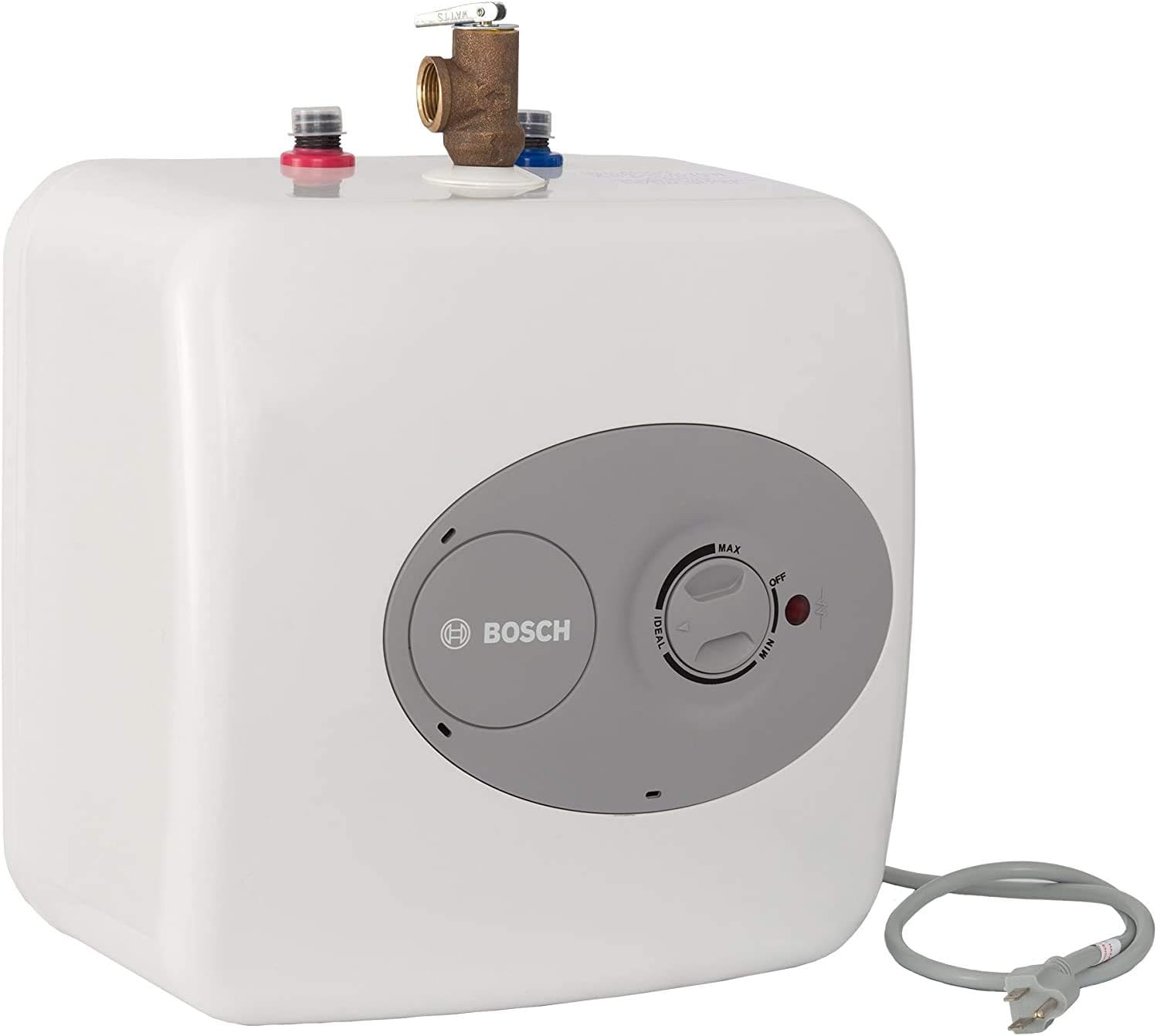
| Capacity | 2.5 gallons |
|---|---|
| Wattage | 1440 watts |
| Voltage | 120 volts |
| Maximum Temperature | 140 °F |
| Efficiency | 98% |
The Bosch Tronic 3000T ES2.5 is a compact point-of-use electric mini-tank that fits under a sink or mounts on a shelf or wall to deliver hot water on demand. It plugs into a standard 120V outlet or can be plumbed inline with a larger system, and the external dial makes temperature adjustments straightforward. The glass-lined tank and 98% thermal efficiency help retain heat so the unit recovers quickly and can supply hot water to one or two nearby fixtures. Installation is simple for a basic DIY or a plumber, and the included bracket and 36–37" power cord increase placement options. Expect modest capacity suited for handwashing, small dish loads, or a single lavatory rather than whole-house use, and the 1440W element limits maximum output compared with higher-wattage heaters. The unit is durable in appearance but carries only a one-year parts warranty, so buyers who want extended coverage should factor that in.
Best for: Buyers who want a reliable, easy-to-install mini-tank to eliminate long waits for hot water at a single sink or small workstation and value a compact, low-complexity solution.
Less Ideal for: Not suitable for whole-house hot water needs or households that require sustained high-flow hot water for multiple simultaneous fixtures.
- Compact point-of-use design fits under sinks or mounts on wall or shelf
- Plugs into standard 120V outlet for independent installation
- Glass-lined tank improves durability and heat retention
- External temperature dial for easy control
- Small 2.5-gallon capacity limits use to one or two fixtures
- 1440W heating element provides modest flow and slower recovery versus higher-watt models
Verdict: A compact, efficient point-of-use mini-tank that delivers quick hot water at a sink when you want a simple, space-saving solution.
Stiebel Eltron Tempra 36 Plus

| Wattage | 36 KW |
|---|---|
| Voltage | 240 volts |
| Flow Rate | 1.5 gpm |
| Maximum Temperature | 140 °F |
| Maximum Pressure | 150 psi |
The Tempra 36 Plus is a high-capacity electric tankless water heater built for households that need reliable, on-demand hot water. It uses self-modulating German-engineered electronics to adjust power draw to the current flow, keeping temperature steady while minimizing electricity use. Installation is wall-mounted and requires 240V hard wiring with substantial circuit capacity, and the unit's LED display makes set up and temperature monitoring straightforward. In practice it supplies multiple showers at a constant temperature in warm and moderate climates and can support most whole-home needs when sized properly. The compact, vent-free design saves space compared with tank systems and the copper internals promise durable heat transfer. Important trade-offs are the heavy electrical requirements and the need to confirm flow and climate for proper sizing, since performance depends on incoming water temperature and available breakers. For buyers prioritizing performance and efficiency in an electric tankless, the Tempra 36 Plus is a capable option.
Best for: Buyers who prioritize strong continuous hot-water performance and energy-efficient operation for whole-home use and who can accommodate heavy electrical service.
Less Ideal for: Homes without sufficient 240V electrical capacity or buyers unwilling to verify sizing for their climate and peak hot-water demands.
- High 36 kW heat output supports multiple simultaneous hot-water demands
- Self-modulating technology adjusts power to flow for steady temperature and improved efficiency
- Compact, wall-mounted design requires no venting and saves floor space
- LED display for straightforward temperature setting and monitoring
- Copper construction for effective heat transfer and durability
- Requires substantial 240V hard-wiring and high amperage breakers
- Flow rate and performance depend on incoming water temperature and correct sizing
Verdict: Choose the Tempra 36 Plus when you need a high-capacity, energy-efficient electric tankless heater that delivers steady hot water for whole-home performance.
ThermoMate ET080 8kW Tankless Heater

| Wattage | 8 KW |
|---|---|
| Voltage | 240 volts |
| Flow Rate | 1.9 gpm |
| Maximum Temperature | 131 °F |
| Mount Type | Wall |
The ThermoMate ET080 is an 8 kW, 240 V point-of-use electric tankless heater designed to supply instant hot water to one or two faucets. It mounts on the wall and uses a self-modulating control that adjusts power to water flow and inlet temperature, producing up to about 1.56 GPM at a 35°F rise and a maximum outlet temperature of 131°F. The unit separates the heating element from the water path with a cast aluminum heating chamber to reduce scale build-up and potential leaks, and it includes multiple safety features such as overheat protection and auto shutoff when no flow is detected. Installation requires a 40 A double-pole breaker and 8 AWG wiring and uses 1/2" NPT side water connections, so some users will need an electrician and plumber for a compliant hookup. Its small footprint saves floor space and makes it suitable for under-sink or remote applications, but the modest flow rate limits use to sinks or low-demand fixtures rather than whole-house supply.
Best for: Buyers who want a space-saving, energy-efficient point-of-use solution to replace a small under-sink heater or provide instant hot water to a single bathroom or kitchen sink while minimizing standby losses.
Less Ideal for: Homes needing whole-house hot water or multiple high-flow fixtures running simultaneously should choose a higher-capacity unit instead.
- Self-modulating control increases efficiency by matching power to flow and inlet temperature
- Cast aluminum heating chamber isolates elements to reduce scaling and leakage risk
- Compact wall-mounted design saves floor space and fits under sinks
- Built-in safety features include overheat protection and automatic shutoff on no flow
- Maximum flow rate around 1.56 GPM at a 35°F rise limits use to single sinks or low-demand fixtures
- Requires a 40 A double-pole breaker and 8 AWG wiring, which may need professional electrical work
Verdict: A compact, efficient point-of-use electric tankless heater that saves space and energy for single-fixture hot water needs.
Rinnai RX199iN Tankless Water Heater

| Power Source | Gas Powered |
|---|---|
| Flow Rate | 11 gpm |
| Maximum Temperature | 140 °F |
| Efficiency | UEF 0.98 |
| Mount Type | Wall |
The Rinnai RX199iN is a condensing tankless gas water heater designed to supply continuous hot water for larger homes and multiple simultaneous fixtures. It uses a Smart Sense gas control system and convertible design so installers can set it up for natural gas or propane and the Versa Vent option allows indoor or outdoor placement. With a rated flow of 11.1 gpm and a UEF of 0.98, it emphasizes efficient on-demand heating while saving space compared with tank systems. The unit includes an easy-to-use interface, a Quick Flush feature to simplify maintenance, and Wi-Fi capability via an optional module for remote diagnostics and setup help. Practical benefits include very high energy efficiency, compact footprint, and simplified servicing that help lower operating costs and downtime. Important limitations are that professional installation is recommended and the full smart features require an extra Control-R module, so expect added installation complexity and accessory costs.
Best for: Buyers who prioritize long-term reliability and low operating cost for a busy household that needs consistent hot water for multiple fixtures and professional-grade equipment.
Less Ideal for: Those looking for a plug-and-play electric option or a simple DIY swap of an existing tank heater should consider different, less installation-intensive models.
- Very high energy efficiency (UEF 0.98) reduces fuel consumption compared with conventional tanks
- Provides up to 11.1 gallons per minute to support multiple simultaneous fixtures
- Convertible for natural gas or propane and adaptable for indoor or outdoor installation with Versa Vent
- Quick Flush design and user interface make routine maintenance and troubleshooting easier
- Professional installation is recommended, adding installation cost and complexity
- Smart/Wi-Fi features require a separately sold Control-R module
Verdict: Choose the RX199iN when you want a compact, professional-grade tankless heater that reliably delivers high flow and industry-leading efficiency for a busy household.
Rheem RTEX-24 Tankless Electric

| Wattage | 24 KW |
|---|---|
| Voltage | 240 volts |
| Flow Rate | 5.9 gpm |
| Maximum Temperature | 140 °F |
| Mount Type | Wall |
The Rheem RTEX-24 is a 24 kW tankless electric water heater built to provide continuous hot water for multiple fixtures without a storage tank. It mounts on a wall and uses self-modulating power control and an adjustable digital temperature display to heat water on demand, with a rated maximum flow of 5.9 gallons per minute in warm-climate conditions. That flow lets it run two showers and two sinks simultaneously in favorable conditions, and the unit's compact stainless steel construction saves space compared with conventional tanks. Installation requires significant electrical capacity — three 40 A double-pole breakers and 240 V service are recommended — so expect a professional electrician for most homes. The RTEX-24 has no venting needs and the digital control makes setpoint changes straightforward, but real-world output depends on incoming groundwater temperature and household electrical availability. For buyers wanting a factory-quality, efficient tankless solution and who can meet the electrical requirements, this model delivers strong continuous performance and space savings.
Best for: Buyers who prioritize reliable, factory-quality on-demand hot water and are comfortable arranging professional electrical installation and panel capacity upgrades.
Less Ideal for: Homes without sufficient 240 V electrical service or limited breaker capacity, and buyers who cannot or prefer not to invest in electrical upgrades should consider lower-kW or gas options.
- High maximum heat output at 24 kW for whole-home hot water needs
- Up to 5.9 GPM flow rate suitable for multiple simultaneous fixtures in warm climates
- Self-modulating power control improves efficiency by using only the required power
- Compact wall-mounted stainless steel design saves floor space and eliminates venting
- Digital temperature display and adjustable dial make setpoint control simple
- Requires substantial electrical service and three 40 A breakers, often needing electrical panel upgrades
- Performance varies with incoming groundwater temperature, reducing GPM in colder regions
Verdict: Choose the RTEX-24 if you want a compact, high-output electric tankless heater that provides continuous hot water for multiple fixtures and you can supply the required electrical capacity.
Choosing the Right Water Heater: Key Factors to Consider
Capacity and First-Hour Rating
Capacity determines how much hot water is available at once and it directly impacts whether you can run multiple fixtures simultaneously without a cold spike. For tank models, the first-hour rating estimates how much hot water the unit can deliver in an hour starting with a full tank, which is the most practical way to size for morning showers and laundry loads.
Undersizing leads to interrupted hot water during peak times while oversizing increases standby heat loss and upfront cost. Match the capacity and first-hour rating to your household routines: number of occupants, typical simultaneous uses, and whether high-demand appliances run at the same time.
Energy Efficiency and Operating Cost
Efficiency ratings, such as energy factor or uniform energy factor, show how much of the energy input actually becomes usable hot water. Higher efficiency reduces monthly operating costs and is especially important if energy prices are high where you live.
Consider not just the rating but real-world factors like standby heat loss for tank models and modulation behavior for on-demand systems. A slightly more efficient unit can pay back over several years through lower utility bills, particularly in climate zones with year-round hot water needs.
Recovery Rate and Flow Performance
Recovery rate refers to how quickly a tank can reheat water after depletion, and for tankless systems it equates to maximum continuous hot water flow at a specified temperature rise. Faster recovery or higher flow capacity means fewer interruptions when multiple fixtures run.
Evaluate recovery and flow based on your peak demand. A household with back-to-back showers or simultaneous dishwasher and washing machine use benefits from higher recovery or higher continuous flow capacity.
Fuel Type and Venting Requirements
The energy source affects running costs, installation complexity, and venting. Natural gas and propane units often offer faster recovery but need proper venting and combustion air. Electric units are simpler to site but may require upgraded electrical service for high-capacity models.
Venting and fuel choice also influence installation location options. Verify local codes and whether your home can accommodate the venting configuration and fuel hookup required.
Installation Location and Space Needs
Where the heater will be installed affects both performance and convenience. Tank units require floor or near-floor clearance and typically more physical space, while tankless units are wall-mounted and can be placed closer to demand points to reduce heat loss in pipes.
Accessibility for maintenance matters too. Plan for condensate drainage if applicable, adequate clearances for service, and whether the chosen location minimizes distribution losses to major fixtures.
Maintenance, Warranty, and Serviceability
Regular maintenance extends service life. For tank models, that includes periodic flushing to remove sediment and checking the sacrificial anode. Tankless systems may require routine descaling in hard-water areas to maintain flow and efficiency.
Warranty terms and ease of finding qualified technicians should influence your choice. A longer warranty and accessible service network reduce long-term risk and unexpected costs.
Sizing a Water Heater for Your Household
Correct sizing balances hot water availability and operating cost. For tank units, add up typical simultaneous demand from showers, faucets, and appliances and compare that total to the unit's first-hour rating. For on-demand systems, calculate required gallons per minute at the expected temperature rise to ensure uninterrupted flow during peak use.
- Estimate peak simultaneous usage by listing fixtures used at the busiest hour
- Use first-hour rating for tank units and gallons-per-minute at a specific temperature rise for tankless
- Allow a margin for future household changes like additional occupants or a remodel
Installation and Venting Basics
Know the venting and combustion-air requirements before choosing a location. Gas-fired units need proper chimney or direct-vent paths and clearance for service. Electric units avoid venting but may need upgraded electrical panels or dedicated circuits. Condensing gas models require a drain for condensate and corrosion-resistant materials in the venting path.
- Confirm local code requirements and permits early
- Plan for service access and clearances
- Consider proximity to major hot-water demand points to reduce heat loss in piping
Hard Water and Corrosion Management
Water chemistry affects longevity. Hard water accelerates scale buildup in heat exchangers and tanks, reducing efficiency and capacity. Install water-softening measures or schedule more frequent maintenance if you have hard water to protect efficiency and service life.
Maintenance options include adding a softener, installing scale inhibitors, or selecting units with easily serviceable heat exchangers and replaceable anodes.
- Test local water hardness before deciding on system type
- Factor in maintenance or treatment costs for hard-water areas
- Choose accessible designs to simplify descaling and anode replacement
Energy Savings Strategies
Beyond unit efficiency, installation choices influence operating cost. Insulating hot-water pipes, lowering thermostat setpoints, and installing point-of-use units near high-demand fixtures reduce energy losses. Timed controllers or smart setpoints can also prevent unnecessary heating during low-use periods.
When evaluating models, compare standby losses for tank heaters and modulation efficiency for on-demand units to estimate realistic energy savings.
- Insulate accessible hot-water plumbing
- Set water temperature sensibly to balance safety and efficiency
- Place heaters to minimize pipe runs to frequent fixtures
How We Chose the Best Water Heater
We assembled this list by focusing on performance metrics and real-world homeowner needs. Primary selection criteria included measured energy efficiency, recovery rate or flow capacity, usable hot water volume for the tank size, and the expected service life based on typical materials and design. We also weighted installation flexibility, safety features, and maintenance requirements because these affect total cost of ownership and ease of ownership. We excluded units that only deliver niche benefits at the cost of practical daily performance, such as units with extremely limited flow rates or models lacking basic safety controls. We prioritized products that balance efficient operation with adequate hot water delivery for common household demand profiles. Our evaluation emphasized verified specifications and common installation scenarios to ensure recommendations are suitable for most homes. Editorial filters removed outdated designs and units with limited local serviceability. The result is a compact set of practical options that meet the core needs of homeowners: steady hot water delivery, manageable energy use, and predictable maintenance expectations.
Our full evaluation process is outlined in our review methodology.
FAQ
How do I size a water heater for a family of four?
For a household of four, use the first-hour rating for tank models and total expected simultaneous gpm for tankless units. Typical four-person households often need a tank with a first-hour rating in the mid- to high-range or a tankless unit sized to deliver two to three showers plus an appliance concurrently, depending on usage patterns.
Can a tankless unit handle two showers at once?
Possibly. It depends on the unit's maximum gallons-per-minute at your required temperature rise. In many homes a properly sized tankless can supply two showers, but heavy simultaneous use with appliances may require a higher-capacity model or multiple units.
How often should I flush a tank water heater?
Flush general sediment once a year in moderate-hardness areas; increase frequency for harder water. Frequent flushing helps maintain efficiency and extends the life of the tank and heating elements.
Is venting complicated for gas water heaters?
Venting can add complexity because it must follow local codes, handle combustion products safely, and match the appliance's draft type. Direct-vent and power-vent designs offer installation flexibility but require proper exhaust routing and electrical supply.
Do I need a water softener to protect the heater?
Not always, but hard water accelerates scale buildup. If your water test shows high hardness, a softener or targeted scale-control measures will reduce maintenance and improve efficiency over time.
Final Verdict
Choose a water heater by putting household hot-water demand, fuel availability, and installation constraints first. Prioritize units with the right capacity or flow rating for your peak usage, and balance that need against efficiency ratings and maintenance demands. Consider long-term operating cost and local installation requirements when deciding between tank and tankless designs. Ultimately, select a unit that matches your daily routines and site conditions and accept tradeoffs accordingly: higher initial complexity can bring lasting energy savings, while simpler installations may be easier and cheaper to service. Focus on capacity, recovery or flow, and durability to make a confident choice.