
Note: This article contains affiliate links. If you click on these links and make a purchase, we may earn a small commission at no extra cost to you. This helps support our research and content. Read our full affiliate disclosure here.
Choosing the right electric water heater for home matters because it affects comfort, monthly energy bills, and how well your plumbing keeps up with daily demand. The right unit delivers consistent hot water for showers, laundry, and dishes while minimizing wasted energy and maintenance headaches. This guide covers seven shortlisted electric water heaters that represent the best mix of recovery speed, efficiency, capacity, and long-term reliability. We explain the criteria used to select these options and highlight the practical tradeoffs to help you pick the model that fits your household size and usage patterns.
Top Picks at a Glance
| Best Overall The best all-around choice for most situations | EcoSmart ECO 18 Tankless Water Heater |  |
| Best Quality Built to a higher standard if you want something more solid | Stiebel Eltron Tempra 24 Trend |  |
| Best Value The sweet spot between price and what you get | SIVUATEK V7B-140B 14kW Tankless Water Heater |  |
| Best Budget The cheapest option that still gets the job done reliably | xwdzswgs 3000W Tankless Water Heater |  |
| Top Rated A top-rated pick with lots of positive feedback | Bosch Tronic 3000 T ES2.5 Mini-Tank |  |
| Most Popular A crowd favorite that many people choose with confidence | EcoSmart ECO 11 Tankless Water Heater |  |
| Best Seller A high-volume bestseller chosen again and again | Rheem RTEX-18 Tankless Electric Water Heater |  |
EcoSmart ECO 18 Tankless Water Heater

| Wattage | 18000 watts |
|---|---|
| Voltage | 240 volts |
| Flow Rate | 3.51 gpm |
| Efficiency | 99.8 % |
The EcoSmart ECO 18 is a compact, wall-mounted electric tankless water heater that delivers point-of-use hot water by heating water on demand rather than storing it. It is intended for climates where incoming water temperatures are about 62 F or higher and is typically used to supply one shower and a sink or two showers in warmer regions. The unit uses self-modulating technology to adjust power to flow and includes a digital temperature control that lets you set water temperature in 1 degree increments. Practical benefits include near-instant hot water for small to medium demands, high electrical efficiency, and a small footprint that is easy to tuck into utility spaces. Installation requires a 240V supply with two 40A double-pole breakers and 8 AWG wiring, so electrician work is usually needed. The main limitations are flow capacity — rated around 2.5 to 3.5 gpm depending on inlet temperature — which makes it unsuitable as a whole-house replacement in cooler climates, and it must be sized carefully to match local water temperature and peak demand.
Best for: Homeowners seeking a compact, energy-efficient electric point-of-use heater for modest hot-water needs in warmer climates and who prioritize precise temperature control.
Less Ideal for: Large households in cold regions or anyone needing whole-house high-flow hot water should choose a higher-capacity or alternative system instead.
- On-demand heating reduces standby energy loss compared with tank heaters
- Digital temperature control with 1 degree increments for precise setpoint
- Compact wall-mounted design saves floor space
- Self-modulating technology improves electrical efficiency by matching power to flow
- Limited flow rate means it is not suitable for high simultaneous hot water demand in cooler climates
- Requires 240V hardwiring and specific breaker/wire sizing, so professional installation is recommended
Verdict: Buy this if you want a compact, energy-efficient electric tankless unit that delivers precise, on-demand hot water for modest household needs in warmer climates.
Stiebel Eltron Tempra 24 Trend

| Wattage | 24 KW |
|---|---|
| Voltage | 240 volts |
| Maximum Temperature | 140 °F |
| Maximum Pressure | 150 psi |
| Special Features | LED Display |
The Tempra 24 Trend is a compact, hard‑wired electric tankless water heater that provides continuous on‑demand hot water without a storage tank. It uses self‑modulating electronics and a solid copper heating system to vary power with flow and maintain a set outlet temperature shown on an LED display, which makes it suitable for backing two showers in warm climates or one to one and a half showers in cooler areas. Installation requires 240V service and heavy‑duty breakers, so it best fits homes with adequate electrical capacity or professional wiring upgrades. The unit is space‑saving and runs quietly with no venting required, and its auto‑modulation helps reduce energy use compared with a tank system. Limitations include the need for substantial electrical service (manufacturer recommends large service capacity) and the flow‑dependent output that can restrict simultaneous high‑demand fixtures in colder incoming water conditions.
Best for: Buyers who prioritize steady, efficient on‑demand hot water and are willing to accommodate or upgrade home electrical service for a tankless solution.
Less Ideal for: Homes with limited electrical capacity that cannot support high‑amp hard‑wiring or households needing multiple simultaneous high‑flow fixtures in cold climates.
- Continuous on‑demand hot water without a storage tank
- Self‑modulating control for improved energy efficiency
- Digital LED temperature display for precise setpoint control
- Compact wall‑mount design requires no venting and saves space
- Requires substantial 240V electrical service and heavy breakers
- Flow‑dependent output can limit simultaneous use in cold climates
Verdict: Choose the Tempra 24 Trend if you want a compact, energy‑efficient electric tankless heater that delivers reliable on‑demand hot water and you can provide the required electrical capacity.
SIVUATEK V7B-140B 14kW Tankless Water Heater

| Wattage | 14 KW |
|---|---|
| Voltage | 240 volts |
| Flow Rate | 2.3 gpm |
| Maximum Temperature | 110 °F |
| Mount Type | Wall mounted |
The SIVUATEK V7B-140B is a compact 14kW electric tankless unit meant for point-of-use installation near a sink or shower. It self-modulates power based on flow and set temperature to provide stable hot water up to about 110°F with a listed flow rate around 2.3 gpm, and the unit powers up in seconds for near-instant heat. Controls are straightforward thanks to a digital display and touch panel that let you set temperature and monitor status, and built-in protections such as leakage detection, overheat protection, and auto-stop add safety for household or small commercial use. Its small footprint and standard 1/2" NPT fittings simplify installation for DIY-savvy homeowners who need a dedicated hot water source without a storage tank. Limitations to note are the 2.3 gpm flow, which restricts simultaneous high-demand use, and the requirement for a 240V, 14kW electrical supply which may need a circuit upgrade in some homes.
Best for: Households wanting a practical, energy-efficient point-of-use hot water solution who prioritize quick warm water for a single sink or shower and value simple digital controls and built-in safety.
Less Ideal for: Large families or applications needing simultaneous multi-fixture hot water or homes without an available 240V/14kW circuit without electrical upgrades.
- Compact point-of-use design fits near sinks or showers to reduce heat loss and wait time
- Self-modulating 14kW heating maintains stable temperature as flow changes
- Digital touch display for easy temperature setting and status monitoring
- Multiple built-in safety protections including leakage and overheat protection
- Standard 1/2" NPT plumbing fittings and included installation template/hardware
- Maximum flow rate of about 2.3 gpm limits use with multiple fixtures at once
- Requires a 240V, 14kW electrical circuit which may need professional electrical work
Verdict: Choose this compact tankless heater when you want a practical, efficient point-of-use unit that delivers near-instant hot water with easy digital controls and built-in safety.
xwdzswgs 3000W Tankless Water Heater

| Wattage | 3000 watts |
|---|---|
| Voltage | 110 volts |
| Flow Rate | 0.5 gpm |
| Maximum Temperature | 131 °F |
| Mount Type | Wall |
This compact 3000W tankless unit is designed for point-of-use installations under a sink or on a wall where space is limited. It heats water on demand, producing a rapid temperature rise at low flow rates and displaying set temperature on an LED screen with Celsius/Fahrenheit toggle. Safety features include dry-burning protection, leakage protection, automatic shutoff for over-temperature, and IPX4 splash resistance, and the unit mounts vertically using a G1/2-inch inlet. In practice it is best for single fixtures — kitchen sinks, bathroom lavatories, or an RV sink — where short bursts of hot water are needed without a storage tank. Installation is straightforward for someone comfortable with electrical work but the product requires a dedicated 110V circuit and the manufacturer recommends wiring and a 32A trip switch for safe operation. The small flow rate means it will not supply full household demand or multiple fixtures simultaneously, but for budget-focused buyers needing quick hot water at a single point it delivers a simple, space-saving solution.
Best for: Buyers on a tight budget who need a compact, no-frills solution for instant hot water at a single sink or small point-of-use location.
Less Ideal for: Households needing hot water for multiple fixtures at once or anyone who wants a higher-flow whole-house solution.
- Instant on-demand heating for point-of-use applications
- Compact, wall-mounted design saves under-sink space
- LED display with Celsius/Fahrenheit setting for visible temperature control
- Multiple built-in safety protections including dry-burn and over-temperature shutoff
- Includes standard G1/2-inch interface and basic mounting hardware
- Low maximum flow rate limits use to a single faucet or fixture
- Requires proper electrical wiring and a high-capacity trip switch for safe operation
Verdict: A compact, affordable point-of-use tankless heater that delivers fast hot water for a single sink with minimal space impact.
Bosch Tronic 3000 T ES2.5 Mini-Tank
| Capacity | 2.5 gallons |
|---|---|
| Wattage | 1440 watts |
| Voltage | 120 volts |
| Maximum Temperature | 140 °F |
| Efficiency | 98% |
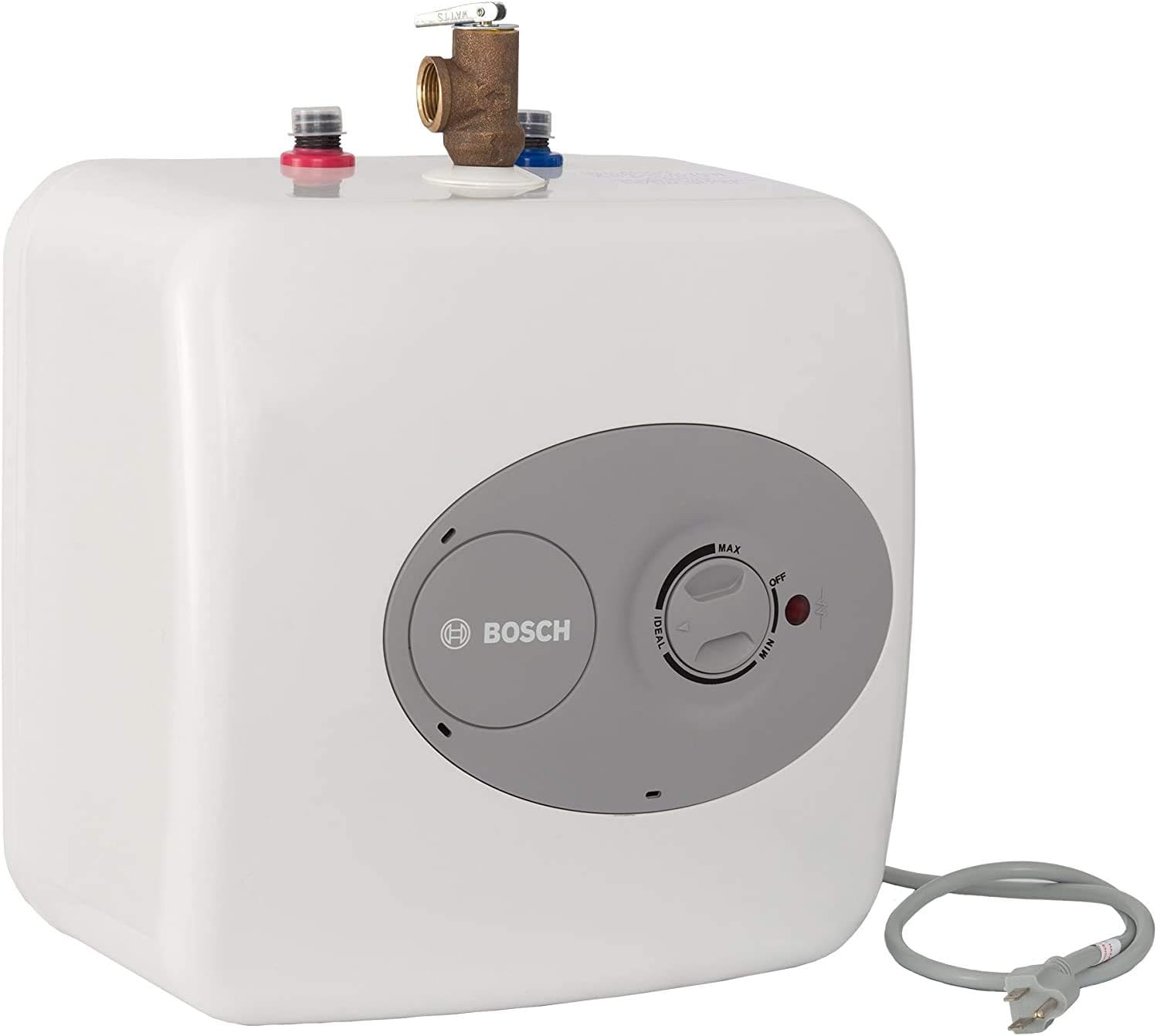
The Bosch Tronic 3000 T ES2.5 is a compact electric mini-tank made for point-of-use hot water needs. Mount it on a wall, shelf, or floor under a sink and plug the 120V cord into a standard outlet for independent operation, or install it inline with a larger system to reduce wait time for hot water. The glass-lined 2.5-gallon tank and 1440-watt element provide quick recovery and up to 140°F output while the external temperature dial and pressure-temperature relief valve add simple control and safety. Its lightweight design and included mounting bracket make installation straightforward for a homeowner or plumber, and the high claimed thermal efficiency helps minimize standby losses. Limitations include the small capacity, which is best for a single sink or two small fixtures rather than whole-house use, and the 120V power limits how fast it can heat compared with higher-voltage models.
Best for: Buyers who prioritize a reliable, simple solution to eliminate wait time for hot water at a single sink or small fixture group and want a product that is easy to install and maintain.
Less Ideal for: Homes needing hot water for showers, laundries, or whole-house supply should choose larger capacity or higher-voltage units instead.
- Compact point-of-use size fits under sinks or on a shelf
- Glass-lined tank for corrosion resistance and durability
- Plugs into a standard 120V outlet for easy, independent installation
- External temperature dial and relief valve provide simple control and safety
- Small 2.5-gallon capacity unsuitable for larger demands
- 120V/1440W power limits recovery speed compared with higher-voltage heaters
Verdict: Choose the Bosch Tronic 3000 T ES2.5 when you want a dependable, easy-to-install mini-tank that reliably delivers near-instant hot water at a single sink.
EcoSmart ECO 11 Tankless Water Heater

| Wattage | 13000 watts |
|---|---|
| Voltage | 220 volts |
| Flow Rate | 3.1 gpm |
| Maximum Temperature | 140 °F |
| Mount Type | Wall |
The EcoSmart ECO 11 is a wall-mounted, 13 kW electric tankless heater built to supply continuous hot water for a small bathroom, sink, or point-of-use location. It heats water as it flows through the unit using self-modulating technology so the unit adjusts power draw to match demand and maintain the set temperature. Typical uses include a single shower in mild climates or a sink and low-flow fixture together; flow rates are listed between 1.3 and 3.1 gallons per minute depending on inlet temperature. The unit has a digital temperature control with 1 degree increments and an LED display for straightforward setup, and its compact footprint frees floor space compared with conventional tanks. Important limitations are its modest flow capacity and significant electrical requirements at 240 volts and high amperage, so proper circuit sizing and professional installation are essential. For small, dedicated hot-water points this model offers efficient, on-demand performance in a small package, but it is not sized for whole-house high-flow needs.
Best for: Buyers who want an efficient, space-saving solution to provide reliable hot water at a single bathroom, sink, or small point-of-use and who prioritize verified real-world performance.
Less Ideal for: Homes that need whole-house high-flow hot water or buyers unwilling to arrange the required electrical circuit and professional installation should consider larger-capacity options.
- Compact wall-mounted design saves floor space and fits near point-of-use fixtures
- Self-modulating technology adjusts energy use to demand for efficient operation
- Digital temperature control with 1 degree increments and LED display for precise settings
- Provides continuous on-demand hot water for low-flow applications without a storage tank
- Limited flow rate makes it suitable only for one shower or a sink in most climates
- Requires a 240V high-amperage circuit and proper electrical sizing for safe installation
Verdict: Choose the EcoSmart ECO 11 if you need a compact, energy-efficient on-demand heater for a single bathroom or point-of-use application and want precise temperature control.
Rheem RTEX-18 Tankless Electric Water Heater
| Wattage | 18000 watts |
|---|---|
| Voltage | 240 volts |
| Flow Rate | 4.4 gpm |
| Maximum Temperature | 140 °F |
| Mount Type | Wall |
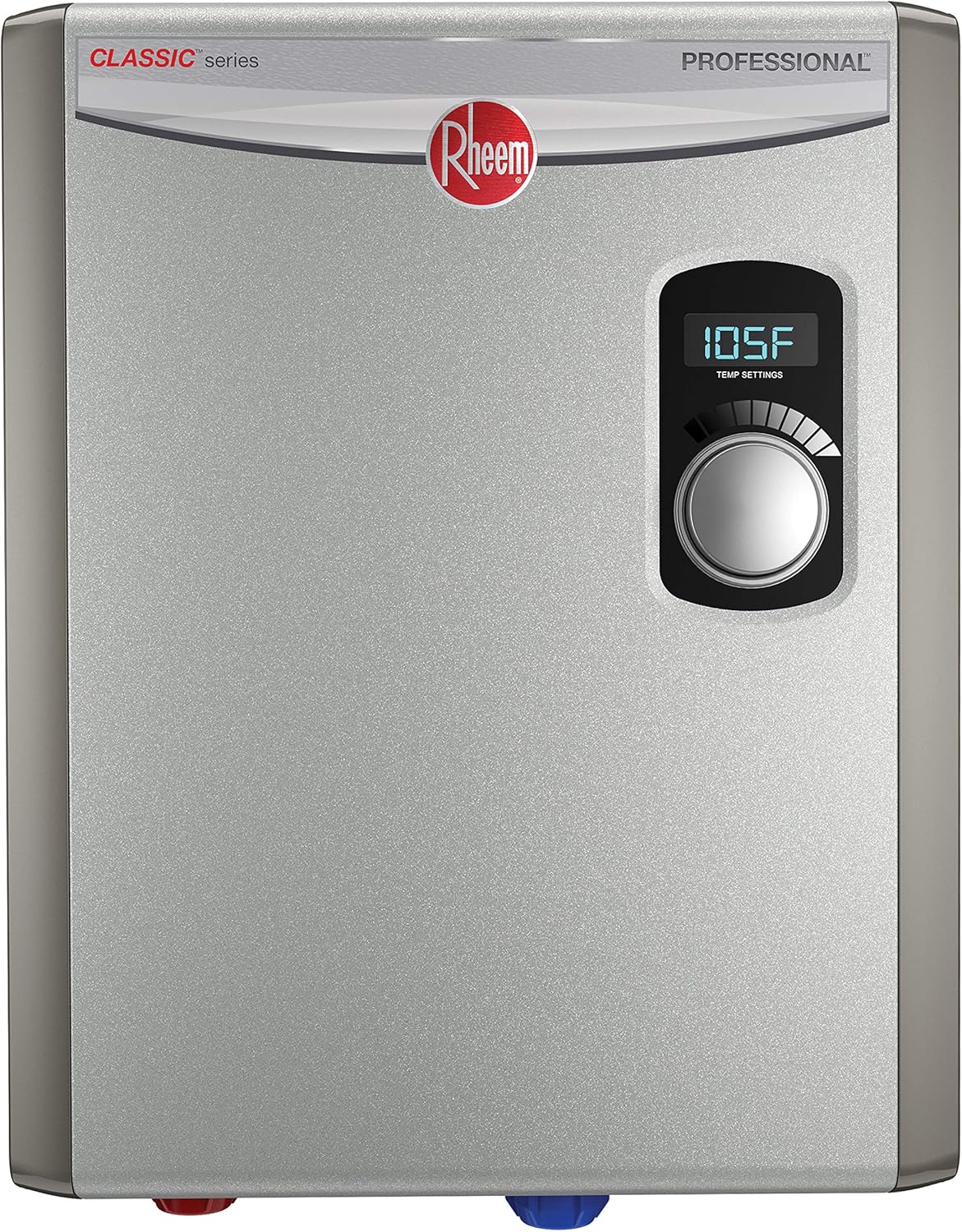
The Rheem RTEX-18 is a compact whole‑home tankless electric heater designed to supply continuous hot water for typical mid‑range households. It heats on demand using two field‑serviceable copper immersion elements and self‑modulation to match power to flow, which helps reduce energy use compared with a storage tank. The front LED temperature display offers accurate setpoint control and the unit requires no venting, so it can be wall mounted in a mechanical closet or central location. At its 18 kW rating and listed flow of up to 4.4 gpm, it is best suited for one to two simultaneous fixtures depending on inlet water temperature; installation needs properly sized 240V breakers and 3/4 inch NPT plumbing connections. Practical benefits include smaller footprint than a tank, lower standby energy loss, and straightforward digital control, while buyers should plan for higher electrical capacity requirements and expect flow rate to drop with colder incoming water. The RTEX-18 is a sensible, factory‑quality electric option for homes wanting endless hot water without venting or a large tank.
Best for: Buyers who prioritize reliable on‑demand hot water and lower operating energy use and who prefer a compact, wall‑mounted electric solution with straightforward digital controls.
Less Ideal for: Large households that routinely need multiple high‑flow fixtures at once or homes without adequate 240V electrical service should consider higher‑capacity systems or alternative configurations.
- Continuous on‑demand hot water with up to 4.4 gpm flow rate
- Self‑modulating control adjusts power to actual demand for better efficiency
- Digital LED temperature control for precise setpoint adjustment
- Compact wall‑mount design saves space and requires no venting
- Field‑serviceable copper heating elements for easier maintenance
- Requires significant 240V electrical capacity and appropriate breakers for installation
- Flow capacity may be limited for large households or simultaneous high‑demand fixtures
Verdict: Choose the RTEX-18 when you want a compact, factory‑quality electric tankless heater that delivers continuous hot water with efficient self‑modulation for mid‑size home use.
Choosing the Right Electric Water Heater for Home: Key Factors to Consider
Tank Size and Household Demand
Tank size determines how much hot water is available before the unit needs to reheat. For one to two people, a smaller tank may be sufficient, while families with multiple simultaneous hot-water uses need larger tanks. Choosing the right capacity reduces the chance of running out of hot water during peak times.
When sizing, think about typical concurrent uses such as showers, dishwasher cycles, and laundry. A daily usage pattern that includes back-to-back showers or simultaneous laundry will require both a larger tank and a faster recovery rate to maintain comfort.
Recovery Rate and Peak Usage
Recovery rate measures how quickly the heater can bring cold water up to temperature after hot water is used. A higher recovery rate helps in homes where hot water demand is bursty, for example, multiple showers in the morning. This factor matters as much as tank volume for households with tight turnaround needs.
Consider your household schedule. If you routinely run high-demand appliances while showers are happening, prioritize a unit with a strong recovery rating to avoid interruptions and cold spells.
Energy Efficiency and Insulation
Energy efficiency directly impacts operating costs over the heater's life. Better insulation and higher efficiency ratings reduce standby heat loss and lower electricity consumption. Look for well-insulated tanks and clear efficiency specifications when evaluating options.
Improved insulation can especially matter in unconditioned basements or garages where ambient temperature affects heat loss. Investing in higher efficiency reduces monthly bills and can offset a higher upfront installation complexity.
Installation Requirements and Footprint
Electric water heaters vary in physical size, electrical service needs, and mounting or clearance requirements. Ensure the unit fits the available space and that your home's electrical panel can supply the required amperage. Tight access or low ceilings can restrict which models will install cleanly.
Installation complexity affects both initial setup and future serviceability. Consider whether the unit needs a dedicated circuit, special venting, or additional clearance for maintenance. These details influence labor and long-term convenience.
Long-Term Reliability and Warranty
A reliable heater reduces repair frequency and extends service life. Look for durable materials, accessible service parts, and a warranty that covers critical components. A longer warranty on the tank or heating elements can indicate confidence in the product's longevity.
Check what the warranty covers and any maintenance requirements implied by the warranty terms. Regular maintenance like flushing to remove sediment can extend life and preserve efficiency, so factor expected upkeep into your decision.
Safety Features and Local Codes
Built-in safety features such as temperature-pressure relief valves and overheat protection are essential for preventing hazardous conditions. Make sure the unit meets local electrical and plumbing codes and that required safety devices are included or can be added during installation.
Safety-related installation details, such as drain pan requirements in certain locations or seismic straps where applicable, may affect placement choices and the overall installation plan.
Sizing Tips for Different Household Patterns
Match tank volume to typical usage rather than peak single events. For example, a household that spaces showers and appliance cycles across the day can often use a smaller tank than one that has tightly timed, back-to-back hot-water needs.
Estimate simultaneous demand by listing likely concurrent uses and their approximate flow rates. Add a safety margin for unexpected overlaps, and if in doubt, prioritize a slightly larger capacity or higher recovery rate.
- Single occupant or studio: prioritize compact footprint and lower standby loss
- Couples: moderate capacity with decent recovery
- Families: larger tanks and faster recovery
Electrical Considerations and Circuit Needs
Electric heaters require appropriate circuit capacity. Check your electrical panel for available breakers and confirm whether a dedicated circuit is necessary. Some higher-capacity models will need significant amperage that may require an electrician to install or upgrade wiring.
Also factor in how long the heater runs under heavy load and whether your home's service can handle simultaneous high-draw appliances. Proper wiring and breaker sizing are key to safe, reliable operation.
- Verify required voltage and amperage before purchase
- Plan for dedicated circuits on high-draw models
- Consult a licensed electrician if unsure
Maintenance Basics to Keep Performance Stable
Routine maintenance extends service life and preserves efficiency. Common tasks include flushing the tank periodically to remove sediment, inspecting anode rods if accessible, and checking pressure-relief components.
A simple maintenance schedule reduces the chance of premature failure and keeps recovery rates near rated levels. If access is tight, choose a model with easier service points to simplify upkeep.
- Flush tank annually in moderate-hardness water areas
- Inspect and replace anode rods when corroded
- Test pressure-relief valve periodically
Space-Saving and Retrofit Options
If replacing an existing unit in a cramped utility area, look for compact models or those with alternative footprint options. Measure clearances and plan for proper drainage and electrical access during selection.
Retrofit-friendly designs can reduce installation time and cost. Consider models with flexible connections, removable access panels, or slim profiles that work better in narrow utility closets.
- Measure height, width, and clearance before selecting
- Look for flexible connection points for easier retrofit
- Consider external drain pan needs
Energy-Saving Habits That Complement a New Heater
Behavioral changes amplify the benefits of choosing an efficient heater. Lowering setpoint temperatures a few degrees, staggering laundry and shower times, and installing low-flow fixtures all reduce demand and operating cost.
Combining a well-sized efficient unit with hot-water-saving habits can delay replacement and shrink monthly bills, making for a more comfortable and economical household system.
- Set thermostat to a safe but moderate temperature
- Use low-flow showerheads and faucet aerators
- Schedule high-demand tasks at separate times
How We Chose the Best Electric Water Heater for Home
We prioritized factors that matter most in everyday household use. Recovery rate and tank capacity were core filters because they determine whether a heater can supply continuous hot water for common tasks like showers followed by laundry. Energy efficiency and insulation were tested conceptually as decisive factors for ongoing operating costs and heat loss. Build quality and warranty coverage were used to gauge long-term reliability and service expectations. Installation flexibility and footprint were considered for homes with limited utility space or restricted access. We also accounted for safety features such as temperature-pressure relief and overheat protection. Products were excluded if they lacked clear efficiency specs, had inadequate capacity for typical household patterns, or did not provide standard safety protections. The final list favors models that balance quick recovery with insulation performance and straightforward installation, while also offering durable components and reasonable warranty terms. These criteria align with the scoring metrics shown on each product card.
Our full evaluation process is outlined in our review methodology.
FAQ
How do I know what tank size I need?
Estimate typical simultaneous uses such as showers and appliances, then choose a tank capacity that covers that volume plus a safety margin. For uncertain cases, prioritize a larger capacity or a model with a higher recovery rate.
How often should I flush my electric water heater?
Flushing once a year is common in moderate-hardness areas. If your water is very hard or you see reduced recovery performance, more frequent flushing helps prevent sediment buildup and maintains efficiency.
Can my existing electrical panel support a new electric heater?
It depends on the model's amperage and your panel's available capacity. Check required voltage and amperage against your panel and consult a licensed electrician to confirm whether an upgrade or dedicated circuit is necessary.
Are electric water heaters safe to install in small closets?
They can be, as long as local codes are followed, proper clearance is maintained, and required safety features such as a drain pan and pressure-relief valve are provided. Confirm code requirements for ventilation and access before installation.
Will better insulation on the tank reduce my electricity bill?
Yes. Improved insulation reduces standby heat loss, which lowers the amount of energy the heater uses to maintain temperature. The savings are more noticeable in colder or unconditioned spaces.
Final Verdict
Pick an electric water heater by balancing capacity with recovery rate and considering installation constraints in your home. Prioritize units with good insulation, appropriate electrical requirements, and accessible maintenance points to lower operating costs and reduce downtime. Weigh the tradeoffs between tank size, recovery speed, and installation complexity to choose the option that best matches your household routines. Focus on safety features and warranty coverage to protect the investment and ensure reliable hot water for years.