
Note: This article contains affiliate links. If you click on these links and make a purchase, we may earn a small commission at no extra cost to you. This helps support our research and content. Read our full affiliate disclosure here.
Picking the right tankless water heater for shower use reshapes daily comfort and utility costs. A unit that can sustain the flow needed for a comfortable shower while holding temperature steady under varying demand makes mornings easier and reduces wasted water. You also want to balance installation complexity and fuel type against long-term operating efficiency. This guide shortlists seven strong tankless water heaters for shower-specific use. We focus on capacity for typical shower flow rates, temperature stability, and practical installation considerations so you can match a model to your home and bathing habits. Read on for the evaluation criteria and the top options we considered.
Top Picks at a Glance
| Best Overall The best all-around choice for most situations | Stiebel Eltron Tempra 36 Plus |  |
| Best Quality Built to a higher standard if you want something more solid | Rinnai RX199iN 11.1 GPM |  |
| Best Value The sweet spot between price and what you get | ThermoMate Tankless Water Heater ET045CAN4 |  |
| Best Budget The cheapest option that still gets the job done reliably | FAME SUPERDUCHA Quattro |  |
| Top Rated A top-rated pick with lots of positive feedback | ThermoMate EH180 18kW Tankless Heater |  |
| Most Popular A crowd favorite that many people choose with confidence | CAMPLUX AY132 Portable Tankless Heater |  |
| Best Seller A high-volume bestseller chosen again and again | Rheem RTEX-18 Tankless Electric |  |
Stiebel Eltron Tempra 36 Plus

| Wattage | 36 KW |
|---|---|
| Voltage | 240 volts |
| Flow Rate | 1.5 gpm |
| Maximum Temperature | 140 °F |
| Maximum Pressure | 150 psi |
The Stiebel Eltron Tempra 36 Plus is a high-capacity electric tankless heater built to provide steady hot water for whole-home use or multiple simultaneous showers. It uses self-modulating technology to adjust power draw to demand, which helps maintain a set output temperature even when flow varies, and the unit includes an LED display for temperature feedback. Because it is hard-wired and provides up to 36 kW at 240 V, it is best suited for homes with the required electrical service and appropriate breaker capacity. Installation is simplified by the wall-mounted, vent-free design, and copper internal components offer durable heat transfer. Practical benefits include near-instant hot water without a storage tank, reduced standby losses, and claimed energy savings versus conventional tanks. Important limitations are the need for substantial electrical capacity and professional wiring, and output depends on incoming water temperature so performance varies by climate and sizing choices.
Best for: Buyers who want a reliable, whole-home electric tankless heater that delivers steady hot water for showers and other simultaneous uses and who can provide the necessary electrical infrastructure.
Less Ideal for: Homes without adequate 240 V electrical capacity or buyers who prefer a simple plug-and-play or gas-powered solution.
- High 36 kW heat output supports multiple showers or whole-home demand in compatible homes
- Self-modulating control maintains set temperature while minimizing electricity use
- Compact, wall-mounted, vent-free design saves space and simplifies placement
- LED display provides straightforward temperature feedback
- Copper construction for reliable heat transfer and durability
- Requires substantial 240 V electrical service and multiple high-amperage breakers
- Flow rate and hot-water capacity depend on inlet water temperature, so sizing is climate-sensitive
Verdict: Choose the Tempra 36 Plus if you need a robust electric tankless heater that supplies consistent hot water for multiple showers and have the electrical capacity to support it.
Rinnai RX199iN 11.1 GPM

| Power Source | Gas Powered |
|---|---|
| Flow Rate | 11 gpm |
| Maximum Temperature | 140 °F |
| Heat Output | 199000 british thermal units |
| Efficiency | UEF 0.98 |
The Rinnai RX199iN is a compact condensing tankless water heater built for high-demand homes that need reliable, continuous hot water for multiple fixtures. It produces up to 11.1 gallons per minute and up to 199,000 BTU, so it can run several showers simultaneously while maintaining temperature. The unit is convertible between natural gas and propane and can be adapted for indoor or outdoor installation using the Versa Vent, which adds installation flexibility. Notable features include an advanced Smart Sense gas control system, a user-friendly interface, quick-flush service access for easier maintenance, and a very high UEF of 0.98 for energy savings. Wi-Fi control is possible with an optional module for remote monitoring and troubleshooting. Practical limitations are that professional installation is recommended because of venting and gas conversion requirements, and add-on modules are needed for smart control. For buyers who prioritize steady high flow rates and long-term efficiency, this model brings strong real-world performance in a compact package.
Best for: Homeowners who need sustained high hot-water flow for multiple simultaneous showers or heavy fixture use and who prioritize efficiency and long-term performance.
Less Ideal for: Small households with minimal hot-water demand or buyers who want a plug-and-play electric solution without professional gas work.
- Very high efficiency (UEF 0.98) reduces energy use compared with standard tank models
- Delivers up to 11.1 GPM, able to support multiple showers and fixtures at once
- Convertible to natural gas or propane for installation flexibility
- Versa Vent option allows indoor or outdoor installation
- Quick Flush access simplifies routine maintenance
- Requires professional installation for proper venting and gas conversion
- Wi-Fi control requires purchasing an optional module
Verdict: Choose the RX199iN if you want a compact, high-output, ultra-efficient gas tankless heater that can run multiple showers reliably while saving energy.
ThermoMate Tankless Water Heater ET045CAN4

| Wattage | 4500 watts |
|---|---|
| Power Source | ac (120V hardwired) |
| Maximum Temperature | 131 °F |
| Special Features | Self-modulating Power, Touch Control, Waterproof |
This ThermoMate tankless unit is a compact, high-power point-of-use electric heater intended for under-sink or small shower use where instant hot water is needed. It uses a 4,500W self-modulating heating system that adjusts output to match flow and temperature rise, and the touch control with a digital display lets you set temperature in 1 degree increments between about 85 and 131°F. The unit is built with a cast aluminum heating element isolated from the stainless steel water tube to reduce scale and corrosion, and the IP25-rated enclosure and pre-wired pigtail simplify installation in tight spaces. Because it requires a dedicated 120V hardwiring with a 40A double-pole breaker and minimum 8 AWG wiring, plan for appropriate electrical work before buying. Its flow range is low (roughly 0.26–1.0 GPM) so it shines as a sink or single-fixture point-of-use heater and may struggle to sustain larger shower heads or simultaneous draws. Practical buyers will appreciate the compact footprint and precise temperature control, while installers should note the electrical demands.
Best for: Buyers who want a compact, efficient point-of-use heater to deliver precise on-demand hot water for a single sink or a low-flow shower and who prioritize space savings and temperature accuracy.
Less Ideal for: Homes needing whole-house or multi-fixture hot water, higher-flow showerheads, or simultaneous hot water use across several fixtures.
- High 4,500W power with self-modulating control for efficient on-demand heating
- Digital touch panel with 1°F adjustment for precise temperature control
- Cast aluminum heating element separated from the water tube to reduce scale and corrosion
- Compact footprint fits under sinks and tight spaces
- Pre-wired pigtail and IP25 rating simplify installation in damp locations
- Low maximum flow rate (about 0.26–1.0 GPM) limits use to single fixtures or very low-flow showers
- Requires dedicated 120V hardwiring with a 40A double-pole breaker and 8 AWG wire, which may need professional installation
Verdict: Choose this compact, high-power point-of-use tankless heater when you need precise, space-saving on-demand hot water for a single sink or low-flow shower.
FAME SUPERDUCHA Quattro

| Wattage | 4400 watts |
|---|---|
| Voltage | 110 volts |
| Flow Rate | 2.5 gpm |
| Mount Type | Wall |
| Maximum Pressure | 400 kilopascal |
The FAME SUPERDUCHA Quattro is a compact tankless electric shower designed to deliver on‑demand hot water with four temperature positions (cold, warm, hot, super hot) and a maximum heat output of 4400W. It mounts to the wall and ships with a shower head, 5.2 ft hand hose with bidet, bracket, flow reducer and a cable connector, making it suitable for straightforward retrofit installs where a dedicated circuit is available. The unit advertises energy savings in the lukewarm setting and supports a flow rate around 2.5 gpm, so it can provide a steady shower stream while limiting power draw at lower settings. Important installation notes are prominent: the heater requires a 40 A breaker and 10 AWG wiring and must be wired directly to the distribution box, so professional or confident DIY electrical work is needed. Build materials include polypropylene and copper conductive parts; surge protection and insulation are claimed for safety. If you need a no-frills, high‑power point‑of‑use electric shower for budget installations, this model covers basic needs, but expect to handle the electrical hookup and verify your household supply can support a 4400W draw.
Best for: Buyers who need an affordable, compact point‑of‑use electric shower that provides on‑demand hot water and are comfortable arranging the required electrical hookup.
Less Ideal for: Homes without the electrical capacity for a 4400W appliance or buyers who want a plug‑and‑play unit with included wiring and a built‑in switch.
- Four selectable temperature levels for flexible comfort
- Included shower head, hose, bracket and cable connector for ready installation
- High maximum power (4400W) supports faster water heating
- Compact wall‑mount design saves bathroom space
- Requires a dedicated 40 A circuit and 10 AWG wiring, which may need electrician work
- No connection cable or external switch included
Verdict: A cost‑minded instant electric shower that delivers strong on‑demand heating and basic included hardware, best for buyers who can provide the required dedicated electrical circuit.
ThermoMate EH180 18kW Tankless Heater

| Power Source | ac |
|---|---|
| Wattage | 18 KW |
| Voltage | 240 volts |
| Flow Rate | 4.4 gpm |
| Maximum Temperature | 140 °F |
The ThermoMate EH180 is a compact, wall-mounted electric tankless water heater designed to supply continuous hot water for showers and small multi-fixture use. It delivers a maximum 4.4 gallons per minute and uses a self-modulating control to adjust heat output based on flow and inlet temperature, which helps keep outlet temperature stable between 80 and 140 degrees F. The unit is built around a heavy-duty cast aluminum heating block and alloy elements and includes multiple safety protections such as anti-leakage, over-temperature cutoff, and surge protection, plus ETL listing to North American standards. Installation requires 240V service with two dedicated 40A double-pole breakers and 8 AWG wiring, so plan for proper electrical capacity. Its compact footprint fits small closets or bathrooms and eliminates tank standby losses, improving efficiency for showering and light whole-house use. Limits include the 4.4 GPM ceiling, which may not support simultaneous high-demand fixtures in larger homes, and the electrical upgrade needed where service capacity is marginal.
Best for: Buyers who prioritize dependable, stable hot-water performance for showers and small multi-fixture use and want a compact, safety-certified electric solution that minimizes standby losses.
Less Ideal for: Large households that regularly run multiple high-flow fixtures at once or homes without adequate electrical service capacity should consider higher-capacity or different fuel options.
- Self-modulating control maintains stable outlet temperature across varying flow rates
- Compact wall-mounted design saves floor space and fits small utility areas
- Heavy-duty cast aluminum heating block and alloy elements resist scale and corrosion
- Multiple built-in safety protections and ETL listing for North American standards
- Requires two dedicated 40A double-pole breakers and 8 AWG wiring, which may need electrical upgrades
- 4.4 GPM max flow may not support simultaneous full showers plus other high-flow fixtures
Verdict: Choose the ThermoMate EH180 if you want a compact, safety-certified electric tankless heater that delivers stable, on-demand hot water for showers and small multi-fixture use.
CAMPLUX AY132 Portable Tankless Heater

| Flow Rate | 1.32 gpm |
|---|---|
| Heat Output | 34,000 BTU |
| Power Source | Propane with 2 D batteries (ignition) |
| Water Pressure Range | 3-130 PSI |
| Capacity | 5 liters |
The CAMPLUX AY132 is a battery-ignited, propane tankless unit built for outdoor showers, RVs, and remote cabins where electricity is not available. It produces up to 1.32 gallons per minute and heats water instantly using a 34,000 BTU burner while running ignition from two D batteries, so you do not need shore power. The unit includes a folding handle, mounting options and a basic showerhead and gas regulator for quick setup, and built-in safety protections such as anti-freeze, flame failure, low-flow and overheat shutdowns give added peace of mind. Practical benefits are straightforward: fast hot water for rinsing off gear, washing dishes, or short outdoor showers, and operation with low inlet pressure down to about 3 PSI makes it compatible with small 12V pumps or gravity-fed bags. Limitations are its modest flow rate and maximum temperature ceiling, which make it unsuitable for continuous multi-person showers or high-demand household use, and it requires a propane supply and periodic battery changes for ignition.
Best for: Buyers who want a proven, safety-minded solution for occasional outdoor hot water—camping, RVing, or remote cabin use—and who prioritize reliable operation without electrical power.
Less Ideal for: Households seeking a high-flow indoor tankless replacement or continuous multi-person showering should choose a higher-capacity, hard-plumbed model instead.
- Runs off propane and two D batteries so no electrical hookup is required
- Low-pressure start works with small pumps or gravity-fed water sources (around 3 PSI)
- Compact, lightweight design with folding handle and included mounting hardware for easy transport and installation
- Multiple safety protections (overheat, flame failure, anti-freeze, low-flow) and CSA certification
- Comes with showerhead, hose and CSA-certified gas regulator for out-of-the-box use
- Maximum flow of 1.32 GPM and limited top temperature restricts it to short showers or single-user tasks
- Depends on propane cylinders and batteries for ignition, adding ongoing running supplies
Verdict: Choose the CAMPLUX AY132 if you need a portable, safety-focused propane tankless heater that delivers instant hot water off-grid for solo outdoor showers and campsite use.
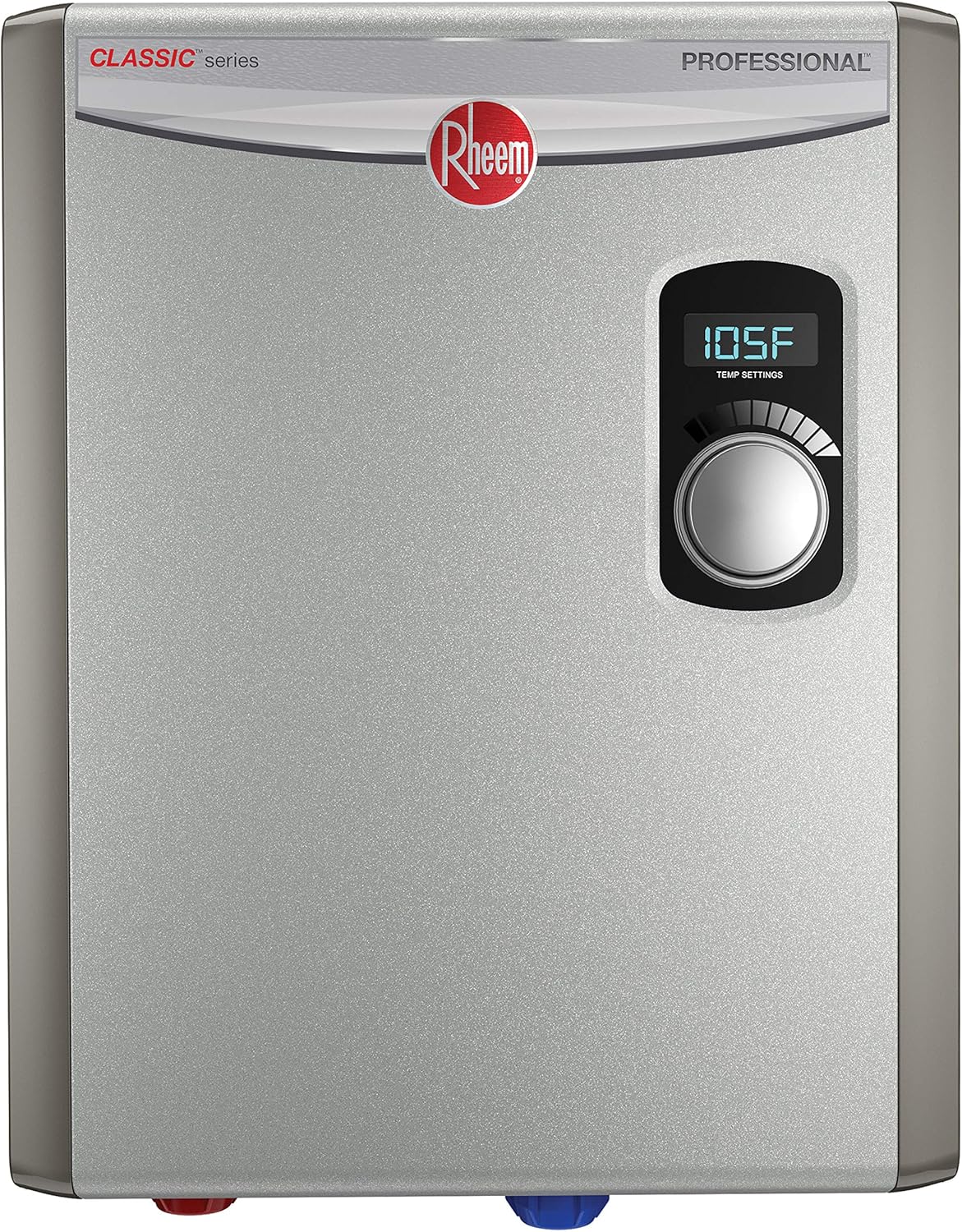
Rheem RTEX-18 Tankless Electric
| Wattage | 18000 watts |
|---|---|
| Voltage | 240 volts |
| Flow Rate | 4.4 gpm |
| Maximum Temperature | 140 °F |
| Efficiency | 99.8% |
The Rheem RTEX-18 is a compact wall-mounted tankless electric heater intended to deliver on-demand hot water for mid‑range whole‑home or single-shower applications. It uses self-modulating electronics and two field‑serviceable copper heating elements to adjust power to the flow, and the front LED temperature display lets you set outlet temperature to within about one degree. Installation is straightforward with bottom 3/4-inch NPT water connections and no venting required, which makes it easy to place on a utility wall or closet. At 18 kW and a rated flow up to 4.4 gallons per minute the unit can typically support one shower plus additional fixtures in warmer groundwater conditions, though performance depends on inlet temperature and simultaneous demand. The unit is stainless steel, relatively compact compared with tank heaters, and claims high efficiency through modulation. Important limits are its flow capacity and electrical requirement — an 18 kW unit needs substantial breaker capacity and will not match larger gas or higher‑kW electric models for multiple simultaneous high‑flow showers in cold climates.
Best for: Buyers who prioritize a reliable, compact electric tankless heater for a single shower or modest whole‑home needs and who prefer predictable operation and easy serviceability.
Less Ideal for: Large households that need multiple high‑flow showers at once or homes with limited electrical panel capacity should consider higher‑capacity or gas models instead.
- Digital LED temperature control with +/-1 degree accuracy for precise outlet temperature.
- Self-modulating power adjusts energy use to match hot water demand, improving efficiency.
- Compact wall-mounted design that requires no venting and simple bottom water connections.
- Field-serviceable copper heating elements that simplify maintenance.
- Maximum flow of 4.4 GPM limits simultaneous high-flow fixtures in cold inlet conditions.
- Requires significant 240V electrical capacity and dedicated breakers for safe operation.
Verdict: A dependable, compact 18 kW electric tankless heater that gives precise, energy‑smart hot water for single‑shower or modest whole‑home use.
Choosing the Right Tankless Water Heater for Shower: Key Factors to Consider
Flow Rate and Temperature Rise
Flow rate determines how many showers or fixtures the unit can support simultaneously. For shower use this matters because insufficient liters or gallons per minute will cause shower pressure or temperature to fall when other taps are used.
Temperature rise is the difference between incoming cold-water temperature and the desired shower setpoint. A tankless unit must deliver the required temperature rise at the flow rate you expect. If your incoming groundwater is very cold, you will need a higher-capacity unit to maintain comfortable shower temperatures.
Fuel Type and Energy Efficiency
Tankless units typically run on electricity, natural gas, or propane, and each fuel type affects operating cost, venting needs, and installation complexity. Gas models often deliver higher instantaneous flow at lower upfront electrical requirements but require proper venting and combustion clearances. Electric models are simpler to install in some homes but need sufficient electrical service and can have lower peak performance for high flow demands.
Energy efficiency ratings and features like modulating burners or condensing technology matter for long-term running costs. Look at realistic efficiency metrics rather than marketing claims to estimate annual energy use for shower-focused operation.
Installation Requirements and Venting
Installation factors can be the biggest practical hurdle. Wall-mount location, venting length and type, gas-line sizing, and electrical service upgrades are all common issues. In many homes, the cost and feasibility of running a dedicated vent or upgrading the electrical panel will affect which units are realistic choices.
Also consider access for maintenance and clearance for combustion air. Models with more flexible venting options or simpler electrical needs reduce overall installation time and complexity.
Controls, Temperature Stability, and Safeguards
How a unit controls temperature affects shower comfort. Precise thermostatic controls or digital thermostats help maintain steady outlet temperatures despite flow fluctuations. Some units include features like PID algorithms or flow-sensing modulation to reduce cold-water knocks when another tap opens.
Safety features such as over-temperature shutoff, anti-scald limiting, and freeze protection are important in bathrooms and unheated spaces. User-friendly controls and clear displays make it easier to set and maintain a comfortable shower temperature.
Durability and Warranty
Durable components like stainless steel or copper heat exchangers and corrosion-resistant materials extend service life. For shower applications, reliability is essential because repair disruptions directly impact daily routines. Longer or more comprehensive warranties indicate manufacturer confidence and can reduce lifetime ownership risk.
Consider ease of servicing and availability of replacement parts in your area. A unit with a documented local-service network or straightforward user-replaceable parts will typically cost less and be easier to maintain over time.
Sizing a Tankless Unit for Shower Use
Sizing hinges on expected shower flow rates and incoming water temperature. Start by estimating the typical showerhead flow in gallons per minute or liters per minute and factor in whether multiple fixtures may run simultaneously. For single-shower households, a lower flow-capacity unit may suffice, but for larger homes or bathrooms with separate tub and shower valves, choose a unit with headroom beyond your peak shower flow.
- Measure or check the rated flow of your showerhead.
- Estimate lowest seasonal incoming water temperature to calculate required temperature rise.
- Allow a safety margin above the expected peak flow to avoid temperature sag.
Understanding Installation Constraints
Before selecting a unit, inspect likely mounting locations, vent paths, and fuel or electrical access. Gas units need correct venting and clearance; electric units demand adequate circuit capacity. Permits, local code requirements, and accessibility for future servicing should guide placement decisions. If upgrades are needed, factor that into your planning timeline and budget.
- Check local codes for venting and combustion-air requirements.
- Verify available electrical panel capacity for electric models.
- Plan where service technicians can access the unit for maintenance.
Shower Performance and Water-Saving Options
Modern showerheads and fixtures can influence perceived performance. High-efficiency showerheads reduce flow, which lowers the heating load and allows smaller tankless units to maintain temperature. Conversely, multi-head systems or body sprays increase required flow capacity. Consider pairing a tankless heater with water-saving fixtures to improve energy efficiency without sacrificing comfort.
- Match showerhead flow to the tankless unit rating.
- Consider low-flow fixtures to reduce required unit size.
- Use thermostatic mixing valves for stable shower temperatures and added safety.
Maintaining Tankless Heaters for Reliable Showers
Regular maintenance keeps performance steady. Mineral buildup in the heat exchanger can reduce efficiency and flow capacity, especially in hard-water areas. Follow manufacturer guidance for descaling intervals, filter cleaning, and checking venting paths. Routine inspections help catch leaks, corrosion, or control issues before they affect shower comfort.
- Schedule regular descaling if you have hard water.
- Inspect venting and combustion components annually for gas units.
- Keep intake and outlet filters clean to maintain flow and efficiency.
How We Chose the Best Tankless Water Heater for Shower
Our selection process prioritized attributes that directly affect shower performance, safety, and long-term convenience. We assessed flow rate capacity and temperature rise to ensure each unit can support common shower flow settings without temperature drop. Energy efficiency and fuel type were evaluated to estimate operating cost differences and to match common household utilities. We reviewed the units' combustion or heating technology, venting and clearance requirements, and the realistic installation complexity for typical residential bathrooms. Durability indicators included heat exchanger material and warranty terms. Controls and safety features were also important: accurate thermostatic control, anti-scald protection, and freeze protection where applicable. We excluded units intended only for whole-house, non-bathroom installations or specialized commercial systems that far exceed residential needs. We also filtered out models lacking essential safety protections or inadequate documentation for standard installation. The final picks reflect balance across hot-water delivery for showers, energy use, installability, and built-in safety.
Our full evaluation process is outlined in our review methodology.
FAQ
How big a tankless unit do I need for a single shower?
It depends on your showerhead flow and incoming water temperature. For a typical 1.8 to 2.5 gpm shower and moderate incoming temperatures, a small residential tankless unit is often adequate. Calculate required temperature rise and choose a unit with a slightly higher rated flow at that rise to avoid sag.
Can a tankless water heater run multiple showers at once?
Sometimes. Whether a unit can serve multiple showers depends on its peak flow capacity and the temperature rise needed. Higher-capacity gas or larger electric models can handle two or more simultaneous showers, but sizing must reflect combined flow and cold inlet temperature.
Is venting complicated for gas tankless heaters?
Venting adds complexity because gas models require proper exhaust and combustion-air arrangements. Some units use direct-vent or sealed combustion systems that simplify placement, but vent length, termination location, and clearances all affect installability and must meet local codes.
How often should I descale a tankless heater used for showers?
Descaling frequency depends on water hardness and usage. In hard-water areas, annual descaling is common. Softer water or point-of-use filtration can extend intervals. Check the unit's maintenance recommendations and monitor for reduced flow or temperature fluctuations.
Are electric units better for bathroom retrofit projects?
Electric units can be easier where gas service or venting is difficult to add because they avoid combustion venting. However, they may require substantial electrical upgrades to meet peak demand and can have lower peak flow performance compared with gas units of similar size.
Final Verdict
For shower-focused use, prioritize flow rate at the temperature rise you need and temperature stability under real-world conditions. Balance fuel type and installation complexity against long-term efficiency and reliability, and choose units with solid safety features and accessible maintenance requirements. Decide based on where the unit will be installed, your incoming water temperatures, and how many fixtures might run at once. That approach will help you select a tankless water heater that consistently delivers comfortable showers with predictable operating and installation tradeoffs.