
Note: This article contains affiliate links. If you click on these links and make a purchase, we may earn a small commission at no extra cost to you. This helps support our research and content. Read our full affiliate disclosure here.
Picking the right electric water heater matters for daily comfort and monthly utility costs. The right unit delivers steady hot water for showers, laundry, and dishes while minimizing electricity use and avoiding unexpected cold snaps. This guide shortlists the top electric water heaters across common home capacities and installation types to help you match output, efficiency, and recovery needs to your household patterns. We evaluated units for their energy performance, recovery speed, ease of installation, and durability. Read on for the picks and the practical factors you should weigh before choosing.
Top Picks at a Glance
| Best Overall The best all-around choice for most situations | EcoSmart ECO 11 Tankless Water Heater |  |
| Best Quality Built to a higher standard if you want something more solid | Stiebel Eltron Tempra 24 Trend |  |
| Best Value The sweet spot between price and what you get | Fisoceny 2.5 Gallon Mini Tank Water Heater |  |
| Best Budget The cheapest option that still gets the job done reliably | xwdzswgs 3000W Tankless Water Heater |  |
| Top Rated A top-rated pick with lots of positive feedback | Stiebel Eltron SHC 2.5 Mini-Tank |  |
| Most Popular A crowd favorite that many people choose with confidence | Bosch Tronic 3000 T ES2.5 |  |
| Best Seller A high-volume bestseller chosen again and again | Rheem RTEX-18 Tankless Electric |  |
EcoSmart ECO 11 Tankless Water Heater

| Wattage | 13000 watts |
|---|---|
| Voltage | 220 volts |
| Flow Rate | 3.1 gpm |
| Maximum Temperature | 140 °F |
| Heat Output | 11 KW |
The EcoSmart ECO 11 is a wall-mounted tankless electric water heater built for point-of-use needs like a single bathroom, small sink, or office breakroom. It uses self-modulating technology to heat water only when needed, with digital temperature control and an LED display for 1 degree adjustments. At 13 kW and 240 volts it can deliver roughly 1.3 to 3.1 gallons per minute depending on inlet temperature, which is enough for one shower in cooler climates or two in warmer ones. The compact 11.5 x 8 x 3.75 inch footprint saves floor space and makes it straightforward to mount where a conventional tank would not fit. Installation requires appropriate electrical capacity and a compatible breaker, and performance will vary with incoming water temperature so sizing against your climate and flow needs is important. For small, dedicated hot-water points this model offers efficient, consistent on-demand hot water in a slim package, but it is not sized for whole-house high-flow demands.
Best for: Buyers who want an efficient, space-saving on-demand heater for a single bathroom, sink, or small breakroom and who prioritize energy savings and precise temperature control.
Less Ideal for: Homes needing whole-house hot water or multiple simultaneous high-flow fixtures should choose a higher-capacity or different system.
- Compact wall-mounted design saves floor space and fits tight locations
- Self-modulating technology only uses the energy needed to heat flowing water
- Digital temperature control and LED display allow precise temperature setting
- Delivers up to about 3.1 gpm for point-of-use applications depending on inlet temperature
- 13 kW capacity is limited to low-flow or single-point use and not suitable for whole-house high-demand scenarios
- Requires substantial dedicated electrical capacity and correct breaker sizing for installation
Verdict: A compact, energy-efficient tankless unit that reliably provides on-demand hot water for single-point or low-flow applications.
Stiebel Eltron Tempra 24 Trend

| Wattage | 24 KW |
|---|---|
| Voltage | 240 volts |
| Maximum Temperature | 140 °F |
| Maximum Pressure | 150 psi |
| Power Source | Hard Wiring Required |
The Tempra 24 Trend is a hard‑wired electric tankless unit that uses self‑modulating electronics to vary power with water flow, keeping output temperature steady while minimizing energy use. It installs on the wall and provides continuous hot water suitable for about two showers in warm climates or one to one‑and‑a‑half in cooler areas, with a digital LED temperature display for easy control. Notable features include a 24 kW heat output at 240 V, copper heating elements for durability, silent operation, and no venting requirement. Practical benefits are steady temperature control under varying flows and lower standby energy compared with a tank heater, plus a small footprint that frees up space. Important limitations are the high electrical service requirement—Stiebel recommends a minimum 150 A service and two 50 A breakers—so many homes will need an electrician and possibly a service upgrade before installation; flow capacity is constrained compared with larger whole‑house systems, so sizing to your climate and fixture count is essential.
Best for: Buyers who prioritize consistent on-demand hot water and energy-efficient performance for a small whole‑house setup and are willing to arrange proper electrical supply for installation.
Less Ideal for: Homes without the required electrical service or buyers needing high simultaneous flow for multiple large bathrooms in cold climates should consider higher‑capacity commercial units or gas options.
- Self‑modulating electronics deliver steady outlet temperature and reduce wasted energy
- Compact wall-mounted design saves space and requires no venting
- Digital LED temperature display for straightforward temperature control
- Copper heating elements and quiet operation support long service life and low noise
- Requires substantial electrical capacity and dedicated breakers which may necessitate an electrical service upgrade
- Flow capacity limits mean it may not support simultaneous high demand in cool climates
Verdict: Choose the Tempra 24 Trend when you want compact, energy‑efficient on‑demand hot water with precise temperature control and can provide the required electrical service.
Fisoceny 2.5 Gallon Mini Tank Water Heater

| Capacity | 2.5 gallons |
|---|---|
| Wattage | 1500 watts |
| Voltage | 120 volts |
| Flow Rate | 0.25 gpm |
| Maximum Temperature | 149 °F |
The Fisoceny 2.5 gallon mini tank is a compact under-sink electric water heater designed to provide quick hot water for a sink, RV, or small workspace. It uses a 1500W L-shaped heating element and a mechanical thermostat to heat the 2.5 gallon tank to the user-set temperature (86 to 149 F) in roughly 5 to 8 minutes, and a built-in insulation layer helps retain heat for up to 48 hours. The unit includes a 3-way diverter, two 1/2" FIP stainless steel hoses, a pressure relief valve, and mounting bracket for wall or floor installation. Safety features include overheat protection, anti-dry burn, and a pressure release mechanism with UL-certified cord. Practical limitations are its low flow rate (0.25 gpm) and small capacity, so it cannot supply continuous hot water for showers or simultaneous high-demand fixtures; users should expect pauses while the tank reheats. For a sink or point-of-use application where space is tight and quicker hot water is the priority, this is a sensible, energy-efficient option.
Best for: Buyers who need a compact, energy-conscious point-of-use heater for a kitchen sink, RV, or small office and prioritize quick hot water in tight spaces.
Less Ideal for: Do not choose this for supplying a shower, multiple fixtures at once, or any application that requires steady high flow or continuous hot water.
- Compact footprint fits under sinks or in RVs and supports wall or floor mounting
- 1500W heating element brings tank to set temperature in 5–8 minutes for fast on-demand hot water
- Includes necessary installation parts: 1/2" FIP hoses, pressure relief valve, mounting bracket and 3-way diverter
- Multiple safety protections including overheat, anti-dry burn, pressure release and UL-certified power cord
- High insulation and intelligent control help retain heat and improve energy efficiency
- Low flow rate and small tank capacity prevent continuous or simultaneous hot-water use for showers or multiple fixtures
- Mechanical knob control lacks a digital display for precise temperature readout
Verdict: Choose this mini tank when you want a compact, quick-heating, energy-efficient point-of-use solution for a sink or RV where continuous high flow is not required.
xwdzswgs 3000W Tankless Water Heater

| Power Source | ac |
|---|---|
| Special Features | Dry Combustion Protection, LED Display, Lightweight |
| Maximum Temperature | 122 °F |
| Heat Output | 131 °F |
| Mount Type | Wall |
This compact tankless unit heats water on demand using a 3000W element and an LED display for temperature monitoring, making it a practical point-of-use solution for sinks and small spaces. It installs vertically on a wall and connects to standard 1/2 inch NPT plumbing; the manufacturer recommends a dedicated circuit and heavier-gauge wiring for safe operation. Real-world use shows it provides instant hot water for kitchen sinks, utility sinks, RVs, and similar low-flow fixtures but is not intended for showers because flow increases reduce outlet temperature. Safety features include dry-burn protection, water-electrical isolation, IPX4 splash resistance, leakage protection, and automatic shutoff for overheating. The unit is lightweight and slim which eases installation in cramped locations, and the Fahrenheit/Celsius toggle via the power button is convenient. Important limitations are its modest flow-rate performance and vertical-only mounting requirement, and proper electrical setup is necessary to avoid faults. For buyers needing a simple, low-cost point-of-use heater, this model covers the basics effectively.
Best for: Buyers looking for an affordable, space-saving point-of-use heater to supply instant hot water to a single sink, RV, or utility area with minimal fuss.
Less Ideal for: People who need hot water for full bathrooms or multiple fixtures simultaneously or who cannot provide a dedicated electrical circuit and proper vertical mounting location.
- On-demand heating with 3000W power for quick hot water at low-flow fixtures
- Compact, ultra-thin design fits under sinks and in small spaces
- Multiple safety protections including dry-burn and leakage protection
- LED display with Celsius/Fahrenheit toggle for easy temperature monitoring
- Includes mounting screws and standard 1/2 inch NPT interface for plumbing
- Not suitable for shower use due to limited recommended flow rate
- Requires vertical-only installation which limits placement options
- Needs a dedicated circuit and heavier-gauge wiring for safe operation
Verdict: A budget-friendly, compact tankless heater that reliably supplies instant hot water to a single low-flow fixture and fits tight spaces.
Stiebel Eltron SHC 2.5 Mini-Tank

| Capacity | 2.5 gallons |
|---|---|
| Wattage | 1300 watts |
| Voltage | 120 volts |
| Flow Rate | 2.5 gpm |
| Maximum Pressure | 150 psi |
The Stiebel Eltron SHC 2.5 is a small electric mini-tank intended to deliver near-instant hot water for handwashing, kitchen sinks, and other low-flow fixtures. It mounts under or next to a sink with the included bracket, fills from the cold supply, and simply plugs into a standard 120V outlet so no special wiring is required. The unit uses a glass-lined steel tank, 1300 watts of heating power and a fast recovery for its size, which helps it supply 2.5 gpm flow for short uses while minimizing standby losses compared with larger tanks. Installation is straightforward for anyone comfortable with basic plumbing, and the unit is certified to common safety and lead-free standards with a six-year tank warranty. Expect limited hot-water volume by design—this is for point-of-use tasks rather than whole-home supply—and recovery and temperature limits reflect its small capacity. For buyers wanting a compact, reliable source of hot water at a sink, this mini-tank is practical and well built, but it will not replace a full-size water heater for showers or simultaneous multi-fixture use.
Best for: Buyers who prioritize a compact, dependable source of hot water at a single sink or small fixture and want a low-maintenance, easy-to-install unit for everyday handwashing and light kitchen tasks.
Less Ideal for: People who need hot water for full bathrooms, long showers, or to serve multiple fixtures at once should choose a larger tank or tankless system instead.
- Compact wall- or floor-mount design that fits under or next to sinks
- Plugs into a standard 120V outlet with only an 11 amp draw, no special wiring needed
- Glass-lined steel tank and certifications for lead-free compliance and safety
- Fast recovery and low standby loss for a mini-tank, suitable for point-of-use hot water
- Includes T and P valve and mounting bracket for easier installation
- Only 2.5 gallon capacity, so it cannot support showers or multiple simultaneous fixtures
- Maximum adjustable temperature and recovery are limited by the small heater wattage
Verdict: A compact, reliably built mini-tank that delivers convenient near-point hot water where space and simple installation are priorities.
Bosch Tronic 3000 T ES2.5
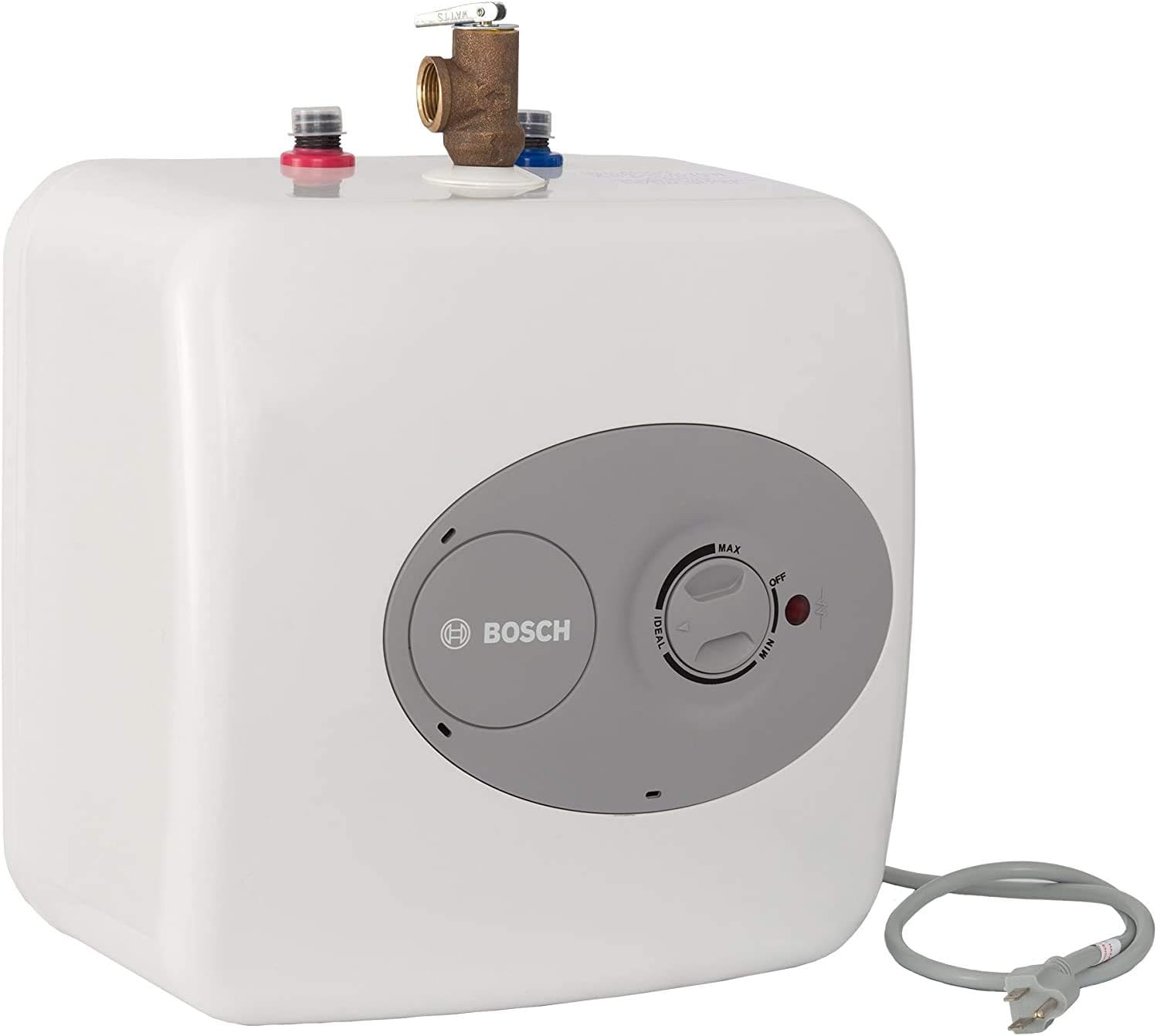
| Capacity | 2.5 gallons |
|---|---|
| Wattage | 1440 watts |
| Voltage | 120 volts |
| Maximum Temperature | 140 °F |
| Efficiency | 98% |
The Bosch Tronic 3000 T ES2.5 is a compact point-of-use electric mini-tank that fits under a sink or mounts to a wall to provide quick hot water where a central heater is slow to reach. It uses a 1440 W element on 120 V power and a glass-lined 2.5-gallon tank for corrosion resistance and insulation, and it can be plugged into a standard outlet or hardwired in-line with a larger system. An external temperature dial and a pressure-temperature relief valve make basic control and safety straightforward, and the unit's high reported efficiency and fast recovery rate let it serve one or two nearby sinks without long waits. Because capacity is small, it is best for occasional washing, handwashing, or a single prep sink rather than full showers or heavy continuous use. Installation is simple for a licensed plumber or a handy homeowner, and the compact footprint and included mounting bracket ease placement in tight spaces.
Best for: Buyers who want a proven, compact solution to eliminate long waits for hot water at a sink and who prefer a well-known brand with lots of user feedback.
Less Ideal for: Homes needing hot water for full bathrooms, multiple simultaneous fixtures, or long continuous runs should choose a larger tank or a dedicated on-demand system.
- Compact 2.5-gallon tank fits under sinks or on walls for true point-of-use hot water
- Glass-lined tank improves durability and reduces corrosion
- Plugs into a 120 V outlet for independent installation without specialty wiring
- External temperature dial and pressure-temperature relief valve simplify control and safety
- Small capacity is unsuitable for showers or prolonged high-flow use
- 12.5 A draw and 1440 W output limit flow rate compared with higher-wattage models
Verdict: Choose the Bosch Tronic 3000 T ES2.5 when you need a compact, reliable point-of-use heater to deliver quick hot water at a sink with minimal space and simple installation.
Rheem RTEX-18 Tankless Electric
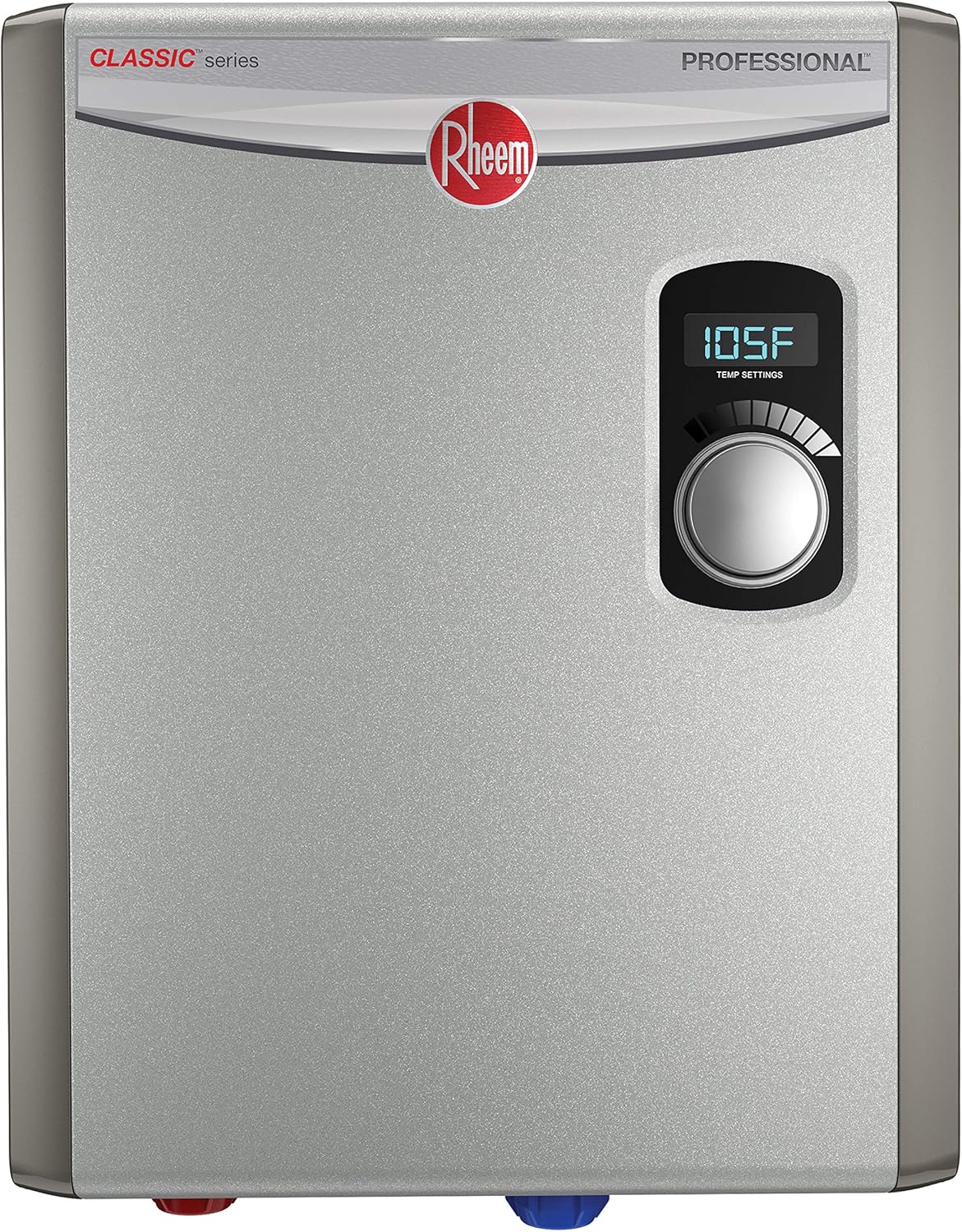
| Wattage | 18000 watts |
|---|---|
| Voltage | 240 volts |
| Flow Rate | 4.4 gpm |
| Maximum Temperature | 140 °F |
| Efficiency | 99.8% |
The Rheem RTEX-18 is a compact tankless electric heater that provides on‑demand hot water for mid‑range whole‑home applications. It installs on the wall and uses 18 kW of power to produce up to about 4.4 gallons per minute, which in many homes supports a shower plus a sink or two lower‑flow fixtures simultaneously. The unit has a front LED digital temperature control for precise setpoint adjustment and self‑modulating electronics that vary power to match flow and reduce wasted energy. Because it is electric and requires no venting, placement is flexible and it saves space compared with a conventional tank. Practical limitations include the need for substantial electrical capacity at installation and the flow rate drops as inlet water temperature decreases, so its real output depends on climate and plumbing. The RTEX‑18 is serviceable with replaceable heating elements, which helps with long‑term maintenance compared with sealed units.
Best for: Buyers who prioritize reliable, energy‑efficient on‑demand hot water and want a compact, serviceable electric solution for a mid‑size home.
Less Ideal for: Homes without sufficient electrical service or buyers who need consistently high flow for multiple simultaneous showers in cold‑water regions should consider higher‑capacity options or different fuel types.
- Delivers continuous on‑demand hot water for typical mid‑range household needs
- Digital LED temperature control for accurate setpoint adjustments
- Self‑modulating power improves energy use by matching heat to demand
- Compact, wall‑mounted design saves space and requires no venting
- Field‑serviceable copper heating elements for easier repairs
- Requires high electrical capacity and appropriate breakers for installation
- Flow rate depends on inlet water temperature so output varies by climate
Verdict: Choose the RTEX‑18 if you want a compact, energy‑smart tankless electric that reliably supplies on‑demand hot water for typical mid‑size whole‑home use.
Choosing the Right Electric Water Heater: Key Factors to Consider
Tank Size and Household Demand
Choose a tank capacity that matches daily hot-water routines. A small household with one or two occupants typically needs less stored hot water than a family with multiple simultaneous hot-water uses like showers and laundry.
Selecting the right tank size affects both comfort and efficiency. Oversizing wastes energy maintaining a larger volume of stored hot water, while undersizing creates frequent recovery cycles that can leave occupants waiting for hot water. Consider peak-hour demand—how many fixtures run at once—and aim for a capacity that covers that window with a margin for unexpected use.
Recovery Rate and Heating Elements
Recovery rate indicates how quickly the unit can heat incoming cold water after hot water is drawn. Faster recovery reduces the risk of running out during heavy use and may be more important than raw tank size for some households.
Electric water heaters often use one or two heating elements. Higher wattage elements and multiple-element configurations improve recovery but may require suitable electrical service. Balance desired recovery speed against available circuit capacity and local electrical codes.
Energy Efficiency and Insulation
Insulation quality and standby heat loss determine how much energy the heater wastes maintaining temperature between uses. Better-insulated tanks reduce running costs, especially in homes with irregular hot-water use or long idle periods.
Look for units with thicker insulation and lower standby loss ratings. Efficient models can shave a noticeable percentage off electric water heating bills over time, which matters because electricity is typically more expensive than other energy sources.
Installation Requirements and Electrical Service
Electric water heaters require compatible electrical service, correct circuit protection, and space for proper venting of heat and access for maintenance. Some higher-capacity or faster-recovery models need dedicated circuits or specific breaker sizes.
Plan for professional installation if your panel or wiring does not meet requirements. Proper installation affects safety, performance, and warranty coverage, so factor in space, access, and wiring constraints when choosing a unit.
Durability and Corrosion Protection
Tank longevity depends on materials, internal lining, and corrosion protection such as sacrificial anode rods. Longer-lasting tanks reduce lifetime replacement costs and the risk of leaks.
Inspect specifications for tank construction and corrosion mitigation features. Regular maintenance, like replacing anode rods, extends service life, so consider how easy it will be to perform recommended upkeep when comparing models.
Controls, Safety, and User Convenience
User controls and safety features influence daily use and peace of mind. Adjustable thermostats, temperature limiting features, and clear diagnostics help maintain comfort while avoiding scalding risks.
Safety elements such as high-limit cutoffs, pressure relief valves, and accessible drain valves matter for both routine maintenance and emergency situations. Choose units with straightforward controls that match the technical comfort level of the homeowner or installer.
Sizing an Electric Water Heater for Your Home
Sizing a tank is about matching peak-hour hot-water use, not just total daily consumption. Count likely simultaneous uses—showers, dishwasher cycles, and laundry—during the busiest 30- to 60-minute period to estimate necessary first-hour delivery.
Once you have a target first-hour capacity, choose a tank with the needed stored volume plus a recovery rate that closes the gap during extended use. Consider future household changes such as additional occupants or a new bathroom.
- Estimate peak use by counting fixtures running at once
- Match first-hour rating to peak demand
- Allow margin for guests or schedule changes
Electrical Upgrades and Circuit Considerations
Many electric water heaters run on dedicated 240V circuits with specific breaker sizes. Confirm your electrical panel capacity and available breaker slots before selecting a higher-wattage model.
If an upgrade is needed, plan for professional electrical work and factor the time and complexity of permitting and panel changes into your installation timeline.
- Verify voltage and breaker requirements
- Account for potential panel upgrades
- Ensure wiring and disconnects meet code
Maintenance Checklist to Extend Service Life
Routine maintenance preserves efficiency and helps avoid premature failure. Key tasks include periodic flushing to remove sediment, checking and replacing the sacrificial anode rod as needed, and testing the temperature-pressure relief valve.
Create a simple annual checklist and set a reminder for these tasks. Many issues become more costly if neglected, so easy preventive steps can extend a tank's useful life considerably.
- Flush tank annually to reduce sediment
- Inspect and replace anode rod every few years
- Test pressure relief valve periodically
Space, Venting, and Placement Options
Plan where the heater will sit to ensure access for service and safe clearance. While electric tanks do not require combustion venting, they do need room for wiring, connections, and a drain line or pan in case of leaks.
Consider locating the unit near high-demand areas to reduce distribution heat loss and waiting time for hot water, but leave enough space around the tank for maintenance and replacement.
- Provide service clearance around the tank
- Use drain pans or catchment below the unit
- Locate close to main hot-water demand when possible
Thermostat Settings and Energy Savings
Setting the thermostat to a moderate temperature can reduce scald risk and cut energy consumption. Typical settings around 120 degrees Fahrenheit balance safety and comfort for most households.
Lowering setpoints when away for extended periods or using vacation modes can produce measurable savings. Smart or programmable controllers can automate temperature setbacks and provide usage insights.
- Aim for safe, efficient thermostat settings
- Use setback modes for long absences
- Consider smart controls for better monitoring
How We Chose the Best Electric Water Heater
We focused on attributes that directly affect homeowner experience and operating cost for electric water heaters. Primary evaluation criteria included energy efficiency as measured by standby heat loss and insulation quality, recovery rate that determines how quickly the tank can refill with hot water, and capacity sizing to match typical household demand patterns. We also assessed durability factors such as tank construction and corrosion resistance, plus ease of installation and serviceability for routine maintenance. Finally, we considered safety features and available controls that affect user convenience and risk reduction. Units were excluded if they lacked clear published efficiency metrics, failed to meet common residential electrical connection standards, or were designed exclusively for commercial or niche applications. The resulting shortlist emphasizes balanced performance across efficiency, recovery, installation, and longevity rather than extreme specs that suit only specialized installs.
Our full evaluation process is outlined in our review methodology.
FAQ
How do I know what capacity electric water heater I need?
Estimate the number of hot-water fixtures likely to run simultaneously during peak use and check the tank's first-hour rating. Match that rating to your peak demand, and add a small margin for unexpected use.
Can I install an electric water heater myself?
Basic physical installation may be straightforward for experienced DIYers, but electrical connections, breaker sizing, and code compliance usually require a licensed electrician. Professional installation helps ensure safety and warranty validity.
How often should I flush the tank to prevent sediment buildup?
Flushing once a year is a common recommendation to reduce sediment accumulation, though frequency depends on local water hardness. Regular flushing maintains efficiency and extends tank life.
Will a larger tank always mean fewer hot-water shortages?
Not always. A larger tank stores more hot water but may have slower recovery. A balanced approach considers both tank volume and recovery rate to avoid running out during prolonged use.
What safety features should I look for on an electric water heater?
Key safety features include a reliable temperature-pressure relief valve, durable thermostats with high-limit cutoffs, and accessible drain valves. Clear labeling and service access also improve safe maintenance.
Final Verdict
When choosing an electric water heater, prioritize a combination of right-sized capacity and adequate recovery rate for your household's peak-hour needs. Energy efficiency and good insulation reduce ongoing operating costs, while durable tank construction and accessible maintenance points protect long-term value. Balance these factors against your electrical service limits and installation constraints to pick a unit that delivers dependable hot water without unnecessary energy waste.