
Note: This article contains affiliate links. If you click on these links and make a purchase, we may earn a small commission at no extra cost to you. This helps support our research and content. Read our full affiliate disclosure here.
If you store bulk groceries, game, or long-term meal prep, an energy-efficient chest freezer can lower operating costs and keep food reliably frozen. The right freezer balances low power draw, consistent temperature control, and practical storage so your food stays safe while electricity use stays down. This guide presents six shortlisted energy-efficient chest freezers that meet different space and capacity needs. We evaluated thermal performance, insulation quality, and usable storage to focus on long-term running cost and day-to-day convenience. Read on for the criteria we used and the features to prioritize when choosing a chest freezer for efficient cold storage.
Top Picks at a Glance
| Best Overall The best all-around choice for most situations | EUHOMY 3.5 Cu.Ft Chest Freezer |  |
| Best Value The sweet spot between price and what you get | Frigidaire Chest Freezer 2.0 Cu Ft |  |
| Best Budget The cheapest option that still gets the job done reliably | BODACIOUS 3.5 Cu. Ft Chest Freezer |  |
| Top Rated A top-rated pick with lots of positive feedback | Northair 3.5 Cu Ft Chest Freezer |  |
| Most Popular A crowd favorite that many people choose with confidence | Kismile Chest Freezer BD-80 |  |
| Best Seller A high-volume bestseller chosen again and again | BODACIOUS 7.0 Cu Ft Chest Freezer |  |
EUHOMY 3.5 Cu.Ft Chest Freezer

| Capacity | 3.5 cubic feet |
|---|---|
| Wattage | 65 watts |
| Voltage | 115 volts |
| Number Of Shelves | 2 |
This EUHOMY 3.5 cu ft chest freezer is a small, energy-conscious deep freezer designed for kitchens, garages, or tight corners. It uses an R600a compressor that the brand rates as low-noise (about 38 dB) and claims around 0.53 kWh per day, which makes it a sensible pick for buyers focused on energy use. The top-opening lid hides a removable mesh basket for organizing smaller items, a drainage port for defrosting, and a seven-position thermostat knob that lets you dial temperature from roughly 10°F down to about -7.6°F in 2°F increments. Practical touches like a lid hinge that holds at various angles and an included ice shovel simplify everyday access. On the other hand, the unit is compact at 3.5 cubic feet so it will not replace a full-size freezer for bulk storage, and setup notes recommend letting it sit upright 24 hours before use. For households wanting a modest, quiet, energy-aware chest freezer for extra meat, seafood, or meal prep storage, this balances features and operating efficiency well.
Best for: Buyers who want a quiet, energy-conscious secondary freezer that fits in small spaces for regular meal prep, frozen groceries, or seasonal extras.
Less Ideal for: People who need large-capacity or commercial-level freezing for bulk long-term storage should choose a bigger upright or chest model instead.
- Energy-efficient R600a compressor with low claimed daily consumption
- Quiet operation around 38 dB suitable for living areas
- Seven-step adjustable thermostat for precise cold control
- Removable storage basket and drainage port simplify organization and defrosting
- Compact footprint fits under cabinets or in small spaces
- Limited 3.5 cu ft capacity not suited for large bulk storage
- Manual knob thermostat lacks digital readout or precise setpoint display
Verdict: A compact, energy-efficient chest freezer that delivers quiet, adjustable deep-freezing for small households and secondary storage needs.
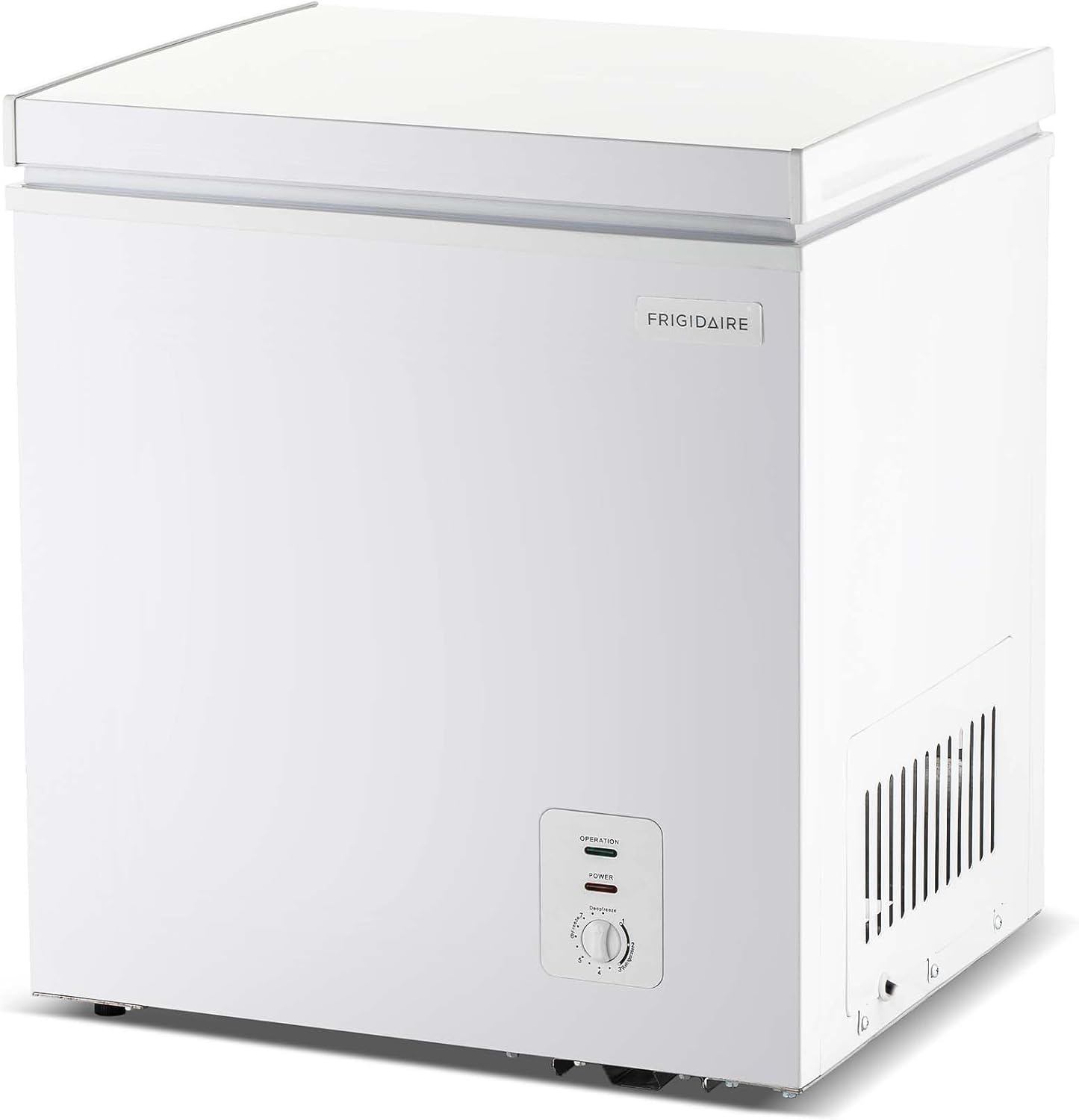
Frigidaire Chest Freezer 2.0 Cu Ft
| Capacity | 2.1 cubic feet |
|---|---|
| Wattage | 300 watts |
| Voltage | 120 volts |
| Number Of Shelves | 1 |
| Installation Type | Freestanding |
This Frigidaire chest freezer is a small, straightforward freezer designed to add extra cold storage in tight spaces like a garage, basement, or apartment. It uses a top-opening lid with a removable vinyl-coated wire basket for organizing smaller items, and an adjustable exterior thermostat so you can set the internal temperature manually. Practical touches include a compressor-on indicator, an easy-access defrost drain and adjustable leveling legs for placement on uneven floors. The unit is freestanding and compact, so it fits where a full-size freezer would not, and the 2.1 cubic foot interior makes it useful for seasonal food, meat storage, or meal prep. Expect manual defrosting rather than frost-free convenience, and the simple mechanical controls mean there are no smart features or advanced energy management; that said, the modest wattage and compact footprint make it a sensible, energy-conscious addition for buyers who want reliable frozen storage without extra complexity.
Best for: Buyers who need a compact, no-frills extra freezer and prioritize straightforward, energy-conscious performance over automation or smart features.
Less Ideal for: Those who want a large-capacity, frost-free freezer or hands-off maintenance should consider larger or automatic-defrost models instead.
- Compact footprint fits small spaces and garages
- Adjustable thermostat for manual temperature control
- Removable vinyl-coated wire basket helps organize small items
- Easy-access defrost drain simplifies manual defrosting
- Adjustable legs improve stability on uneven floors
- Manual defrost requires periodic draining and thawing
- No frost-free function or advanced energy-management features
Verdict: A compact, energy-conscious chest freezer that delivers reliable extra frozen storage with simple manual controls and easy-to-service features.
BODACIOUS 3.5 Cu. Ft Chest Freezer

| Capacity | 3.5 cubic feet |
|---|---|
| Voltage | 110 volts |
| Number Of Shelves | 1 |
| Specification Met | ETL |
This compact chest freezer provides basic deep-freezing in a small footprint suited to apartments, garages, or RVs. It uses thick foam insulation and an energy-saving design that the listing estimates at about $15.33 per year, and a turbo-freeze mode that claims to pull room-temperature items down to 0°F in roughly 90 minutes. Practical touches include a top-opening lid with recessed handle, a removable basket for organization, a built-in drain for manual defrosting, and simple temperature control. Noise is kept low at under 40 dB, so it will not be intrusive in living spaces. Expect a no-frills, freestanding unit that focuses on efficiency and value rather than advanced features like automatic defrost or digital controls. If you need larger capacity, faster recovery under heavy loads, or commercial-grade temperature stability, this small model will be limiting, but for steady household frozen storage on a tight budget it covers the essentials well.
Best for: Buyers looking for an affordable, energy-efficient secondary freezer for limited spaces who prioritize low running costs over premium features.
Less Ideal for: Households needing large-capacity or high-throughput freezing for bulk meal prepping, large families, or commercial use should choose a bigger, more robust unit.
- Low estimated annual energy use (listed around $15.33/year) for budget-conscious operation
- Compact footprint fits tight spaces such as apartments, RVs, or beside laundry machines
- Quiet operation under 40 dB suitable for living areas
- Removable basket and built-in drain make organization and manual defrosting easier
- Manual defrost requires periodic maintenance rather than automatic defrost convenience
- Small 3.5 cu ft capacity limits long-term bulk storage or large families
Verdict: A compact, budget-focused chest freezer that delivers very low operating cost and quiet, reliable frozen storage for small spaces.
Northair 3.5 Cu Ft Chest Freezer

| Capacity | 3.5 cubic feet |
|---|---|
| Voltage | 110 volts |
| Number Of Shelves | 1 |
| Installation Type | Freestanding |
This 3.5 cu ft Northair chest freezer is a small, energy-conscious deep freezer intended for homes, bars, and event use. It uses a compressor cooling system with a digital control that adjusts from about -4°F to 6.8°F across seven settings, letting you dial in a colder or milder freeze for long-term meat storage or everyday frozen foods. The unit is designed to run quietly and lists modest energy consumption (0.45 kWh/24h), which helps keep operating costs low. Storage is organized by two removable baskets and a single interior shelf area, and the lid holds between 45 and 90 degrees for hands-free access. Practical limitations are its compact capacity and single-zone layout, so it is best for supplemental freezing rather than replacing a full-size freezer; the temperature range is less extreme than some -40°F specialty freezers. Setup is straightforward as a freestanding unit and the exterior thermostat makes adjustments simple.
Best for: Buyers who prioritize a dependable, low-energy secondary freezer for everyday frozen food and occasional long-term storage and want a quiet unit that fits a small space.
Less Ideal for: Users needing large-capacity freezing, multi-zone temperature control, or extreme ultra-low freezing below the listed range should look elsewhere.
- Low energy use rated at 0.45 kWh per 24 hours for lower operating costs
- Quiet compressor design suitable for living-space placement
- External adjustable thermostat with seven settings for simple temperature control
- Two removable baskets for easy organization and access
- Small 3.5 cu ft capacity limits bulk storage and large items
- Single-zone interior without specialized ultra-low settings for niche needs
Verdict: Choose this compact Northair chest freezer if you want a reliable, energy-efficient supplemental freezer that runs quietly and is simple to operate.
Kismile Chest Freezer BD-80

| Capacity | 3.2 cubic feet |
|---|---|
| Door Orientation | Top |
| Number Of Shelves | 1 |
| Installation Type | Freestanding |
This Kismile chest freezer is a small, space-saving unit aimed at holding extra frozen goods in a home, dorm, or office. It offers 3.2 cubic feet of storage with two removable baskets that make organizing smaller items easy and let you access frequently used foods without digging. Temperature is controlled by a 7-grade adjustable thermostat that ranges roughly from 6.8°F to -7.6°F so you can choose between milder cooling and deeper freezing, and indicator lights show power and run status. The balanced hinge lid stays open at several angles, which helps when loading or cleaning, and a built-in drain speeds defrosting. The unit uses a low-energy compressor and claims about 0.68 kWh per day with noise under 40 dB, so it is suitable where quieter, energy-efficient operation matters. Limitations are its small capacity compared with full-size freezers and the fairly narrow temperature range if you need very deep freezing; also the power cord placement and exact dimensions warrant checking for tight spaces. For buyers prioritizing compact, efficient extra freezer space, it delivers sensible features at its size.
Best for: Buyers who want a compact, energy-conscious secondary freezer for everyday frozen goods and limited-space environments and who value quiet operation and easy organization.
Less Ideal for: Households needing large-capacity freezing, long-term storage of very low-temperature items, or those who require specific professional freezing temperatures.
- Compact 3.2 cu ft footprint fits small kitchens, dorms, or offices
- Two removable baskets keep small items organized and easy to reach
- 7-level adjustable thermostat for flexible cooling from mild to deep freeze
- Energy-efficient compressor with low noise (under 40 dB) and low daily energy use
- Balanced hinge lid that can stay open at multiple angles and a convenient drain for defrosting
- Limited overall capacity compared with larger chest freezers
- Temperature floor (about -7.6°F) may not be cold enough for some long-term deep-freeze needs
Verdict: A quiet, energy-efficient compact chest freezer that fits small spaces and keeps everyday frozen items organized.
BODACIOUS 7.0 Cu Ft Chest Freezer

| Capacity | 7 cubic feet |
|---|---|
| Voltage | 110 volts |
| Number Of Shelves | 2 |
| Specification Met | ETL |
| Installation Type | Countertop, Freestanding |
This BODACIOUS chest freezer is a compact, energy-conscious option for adding frozen storage in a small kitchen, apartment, garage, or RV. It delivers 7.0 cubic feet of usable space with two removable storage baskets that help organize meats, prepared meals, and bulk items. The unit is built around an energy-saving compressor and advertises operation under 40 dB, making it suitable for locations where noise matters, and a 6-step adjustable thermostat with LED indicator gives control from -0.4°F to 32°F. Practical touches include stabilizer feet, a built-in drain for easy defrosting, and double-hinged metal hardware that holds the lid open between 45° and 85° for loading. Expect straightforward installation as a freestanding or countertop unit, and the brand recommends letting it sit 24 hours before first use. Important trade-offs are that this is a basic chest freezer without advanced features like a lock, alarm, or auto-defrost, and the compressor can run more when set to the coldest setting which raises energy use and noise.
Best for: Buyers who prioritize low-noise, energy-conscious secondary frozen storage for small homes, garages, or RVs and want a simple, reliable chest freezer with basic controls.
Less Ideal for: Shoppers who need automatic defrost, smart monitoring, or heavy-duty commercial capacity should consider larger upright models or feature-rich alternatives.
- Generous 7.0 cu ft capacity for a compact footprint
- Energy-efficient compressor rated below 40 dB for quiet operation
- Six-step thermostat with LED indicator for precise temperature control
- Removable baskets and built-in drain simplify organization and defrosting
- Double-hinged metal lid provides stable, adjustable opening angles
- No advanced features such as alarm, lock, or automatic defrost
- May run more frequently and use more power when set to the coldest thermostat position
Verdict: A quiet, energy-efficient 7.0 cu ft chest freezer that suits risk-averse buyers needing dependable, simple frozen storage for small spaces.
Choosing the Right Energy-Efficient Chest Freezer: Key Factors to Consider
Annual Energy Use
Annual energy use determines the ongoing cost of ownership and is the clearest metric for efficiency. Look for published kilowatt-hour estimates or energy ratings and compare them relative to the freezer's internal capacity. A physically larger unit will usually consume more energy in absolute terms but can be more efficient per cubic foot.
Consider how often you open the lid and the freezer's location. Units in unconditioned spaces face larger temperature swings and will cycle more often, increasing annual consumption. Pay attention to standby and idle draw as well as compressor runtime to estimate real-world usage.
Thermal Stability and Compressor Performance
How well a freezer holds a steady temperature affects both food safety and energy consumption. Fast, stable cooling after the lid is closed reduces compressor run time and prevents thaw cycles. Look for indicated temperature variance or descriptions of tight temperature control.
Compressor design and defrost strategy influence stability. Manual-defrost chest freezers typically maintain temperature with less frequent cycling than auto-defrost systems, but they require occasional manual maintenance. Understand the tradeoff between convenience and baseline efficiency when choosing between defrost types.
Insulation Quality and Lid Seal
Thicker, higher-quality insulation slows heat gain and reduces compressor load. Construction details such as foam thickness and whether the cabinet has thermal breaks can make a practical difference in warm garages or basements. Check for serviceable gaskets and well-designed lid seals that prevent warm air infiltration.
A well-sealing lid with durable hinges and a tight gasket reduces frost buildup and reduces energy loss. Consider models with lockable or stay-open lids if you frequently load or organize the freezer; these features can reduce the time the lid is open and therefore energy loss.
Storage Layout and Accessibility
Usable storage affects how efficiently you use the freezer. Baskets, dividers, and clear organization reduce the time spent searching inside and limit warm-air intrusion. The easiest-to-use interior layouts let you keep frequently used items near the top and bulk storage below.
Consider how the interior dimensions match your typical loads. Flat, wide footprints work better for long cuts of meat or trays, while deeper chests might hide items at the bottom. Shelving accessories that reduce digging improve daily efficiency and lower the number of lid openings.
Noise and Location Suitability
Noise and vibration matter for freezers kept near living spaces. A quieter compressor and well-damped cabinet reduce annoyance and mean you can place the unit closer to living areas. Manufacturers sometimes publish decibel figures but testing conditions vary; look for user-focused descriptions of runtime hum and vibration.
If the freezer will live in a garage or basement, consider models designed for wider ambient-temperature ranges. Those built for conditioned indoor spaces may run more frequently or suffer stress in extreme cold or heat, reducing efficiency and longevity.
Maintenance and Long-Term Reliability
Ease of maintenance affects lifecycle costs and long-term efficiency. Look for simple drain access, removable baskets, and user-serviceable seals. Manual-defrost units need periodic thawing and cleaning, so think about how easy that task will be based on the drain location and interior access.
Serviceability also matters for preserving efficiency over time. Replaceable gaskets, accessible compressors, and clear documentation make it easier to maintain peak performance and avoid energy waste due to wear or seal failure.
How Chest Freezer Efficiency Is Measured
Efficiency for chest freezers is typically expressed as annual energy consumption in kilowatt-hours or as a rated energy score when available. Those figures estimate how much electricity the unit draws under standard test conditions and give a baseline for comparing different capacities and designs.
Thermal mass and insulation strongly influence test outcomes. Because chest freezers require less forced-air circulation than upright models, they often post lower energy numbers for the same capacity. When comparing models, divide the annual energy use by usable cubic feet to evaluate efficiency on a per-volume basis.
- Look for kWh/year or a published energy rating when available
- Compare energy per cubic foot for fair comparisons across sizes
- Account for installation location since ambient temperature affects real-world energy use
Placement and Ventilation Tips to Preserve Efficiency
Where you place the freezer affects how hard it must work. Keep the unit away from heat sources such as direct sunlight, furnaces, or water heaters to reduce compressor workload. Ensure adequate clearance around the cabinet for air circulation to help the compressor shed heat efficiently.
In garages or unheated basements, ambient temperature swings can increase run time. If your space gets very cold in winter, choose a model rated to operate at lower ambient temperatures or plan to relocate the freezer to a more temperate spot during extreme months.
- Allow recommended clearance around the freezer for airflow
- Avoid direct sunlight and nearby heat-producing appliances
- Keep the lid gasket clean to prevent warm-air leaks
Organizing for Fewer Openings and Less Energy Loss
Effective organization minimizes lid-open time and reduces energy loss. Use removable baskets for frequently accessed items and label containers so you can grab what you need quickly. Keep an inventory list on the outside of the freezer to avoid unnecessary searching.
Group similar items together and store long-term bulk items at the bottom. Regularly rotate stock so nothing is forgotten and takes up space inefficiently. Small behavioral changes can noticeably reduce compressor cycles over weeks and months.
- Use shallow baskets for top-level access to common items
- Label and date frozen goods to prevent redundant searching
- Adopt a first-in, first-out rotation system to optimize space
Manual Defrost Versus Automatic Defrost
Manual-defrost chest freezers generally maintain temperature with less frequent compressor cycling and can be more energy-efficient, but they require periodic thawing to remove frost. Automatic-defrost systems add convenience by reducing manual maintenance but can increase energy use because they periodically warm the interior to clear frost.
If minimizing energy use is the priority and you do not mind performing occasional maintenance, a manual-defrost unit is worth considering. If you prioritize hands-off convenience and live in a high-humidity environment that causes heavy frost, an automatic or frost-control feature may be preferable despite a modest energy penalty.
- Manual defrost: lower baseline energy, requires periodic thawing
- Auto defrost: more convenience, usually higher energy usage
- Consider humidity and frost risk when choosing defrost type
Upgrading Insulation and Accessories
Some energy-conscious buyers add insulation pads or use fitted covers during extended periods of low access to further reduce heat gain. While factory insulation is usually optimized, aftermarket covers or insulated blankets can help in particularly warm locations or when the unit will be opened infrequently.
Accessories such as dividers, additional baskets, and interior lighting improve usability and reduce open-lid time. Choose accessories that do not block airflow to the compressor area or interfere with lid sealing to avoid negating efficiency gains.
- Insulation covers can reduce heat gain in warm locations
- Avoid accessories that interfere with seals or airflow
- Use organizational accessories to cut lid-open time
How We Chose the Best Energy-Efficient Chest Freezer
We shortlisted models based on measurable efficiency, usable capacity, and real-world practicality for long-term frozen storage. Our filters included Energy use and thermal retention as primary factors, verified by published power-consumption figures and insulation specifications. We prioritized temperature stability and compressor runtime because consistent cold reduces food loss and affects energy consumption. Storage usability was judged by internal layout features like baskets and shelf options that reduce cold air loss during access. Noise level and compressor cycling patterns were evaluated for households where the freezer sits in a garage, basement, or utility room. Reliability considerations included build quality indicators such as chest seal design and accessible drain systems. We excluded units that lacked clear efficiency data, had inadequate insulation ratings, or were designed primarily for compact countertop use rather than long-term frozen storage. Overall, we favored units that combined low continuous power draw with features that reduce door-open time and simplify organization.
Our full evaluation process is outlined in our review methodology.
FAQ
How much energy does a typical chest freezer use each year?
Typical annual energy use varies by size and insulation but is often published as a kilowatt-hour estimate. Expect significant variance between small and large units, so compare kWh/year figures relative to usable cubic feet.
Is a manual-defrost chest freezer more efficient than an auto-defrost model?
Often yes. Manual-defrost units usually avoid frequent warm cycles used to clear frost, which can lower baseline energy use. However, manual units require regular thawing to maintain performance, which is an operational tradeoff.
Will placing a freezer in an unheated garage increase energy use?
It can. Large ambient temperature swings make the compressor work harder to maintain set temperatures. Choose a model rated for wider ambient ranges or plan for a more temperature-stable location when possible.
Do insulation upgrades or covers meaningfully reduce running costs?
They can help in warm locations or during long idle periods by reducing heat gain. The effectiveness depends on existing insulation quality and how frequently the lid is opened; modest gains are most likely in challenging ambient conditions.
How should I size a chest freezer for efficient operation?
Choose a size that matches your actual storage needs. Oversizing leads to unnecessary energy use, while undersizing can force more frequent refilling and longer door-open times. Consider usable internal volume and how you plan to organize items.
Final Verdict
Prioritize a chest freezer that balances low annual energy use with stable temperature control and an interior layout that minimizes lid-open time. Expect tradeoffs between convenience and maximum efficiency, particularly when choosing between manual and automatic defrost systems. Factor in where the unit will live and how often you will access it; these real-world details often matter more than small differences in published energy figures. Focus on insulation quality, a tight lid seal, and usable storage features to get the best combination of low operating cost and practical performance.