
Note: This article contains affiliate links. If you click on these links and make a purchase, we may earn a small commission at no extra cost to you. This helps support our research and content. Read our full affiliate disclosure here.
When your business depends on consistent frozen storage, choosing an energy-efficient commercial freezer can cut operating costs and improve temperature stability. The right freezer reduces electricity consumption without sacrificing usable capacity or cooling performance, which matters for long-term food safety and predictable utility bills. This guide covers six shortlist picks focused on efficiency, insulation, and usable storage. We evaluated units against real-world decision criteria so you can match capacity and energy performance to your operation. Read on for the key factors we used and the products that met those standards.
Top Picks at a Glance
| Best Overall The best all-around choice for most situations | Coolake MF49 Commercial Upright Freezer |  |
| Best Quality Built to a higher standard if you want something more solid | ORIKOOL 54" Display Freezer SD1390F |  |
| Best Value The sweet spot between price and what you get | SMETA Chest Freezer 21 Cu. Ft |  |
| Best Budget The cheapest option that still gets the job done reliably | Smad Chest Freezer DSC-400WU |  |
| Top Rated A top-rated pick with lots of positive feedback | PEAKCOLD Single Door Commercial Freezer |  |
| Most Popular A crowd favorite that many people choose with confidence | KoolMore KM-SCF-30C Chest Freezer |  |
Coolake MF49 Commercial Upright Freezer

| Capacity | 49 cubic feet |
|---|---|
| Number Of Shelves | 8 |
| Wattage | 598 watts |
| Voltage | 115 volts |
| Temperature Range | -13°F to -5°F |
The Coolake MF49 is a heavy-duty commercial upright freezer designed for foodservice use, offering 49 cubic feet of interior space and eight adjustable shelves for flexible storage. It uses an R290 refrigerant with a bottom-mount compressor and forced-air circulation to maintain cabinet temperatures between -13°F and -5°F while providing automatic defrosting, which reduces manual maintenance and helps keep the interior usable. The unit includes a digital controller and LED display for monitoring, interior LED lighting that activates on door open, and four pre-installed casters (two with brakes) for modest mobility during cleaning or repositioning. Its stainless steel exterior and 430 stainless interior prioritize durability and cleanability in busy kitchens, and ETL listing to NSF-7 standards plus multi-year compressor and parts coverage add commercial reliability. Trade-offs are its large footprint and substantial weight, which require dedicated floor space and handling during installation, and the 598 watt rating indicates steady power draw typical of commercial freezers rather than ultra-low energy consumption.
Best for: Operators who need dependable, high-capacity frozen storage for restaurants, catering, or bakery prep areas and prioritize durable construction and consistent temperature control.
Less Ideal for: Small businesses or situations with very tight floor space, residential users, or buyers seeking the absolute lowest-running-energy consumer models.
- Large 49 cu ft capacity with eight adjustable shelves for scalable storage
- Frost-free forced-air system eliminates manual defrosting and promotes even temperatures
- Bottom-mount compressor with R290 refrigerant for efficient cooling and faster temperature recovery
- Durable stainless steel interior and exterior designed for commercial cleaning and heavy use
- Digital controller, LED display, and interior lighting simplify monitoring and access
- Large size and heavy weight require dedicated floor space and professional handling for installation
- 598 watt power draw reflects typical commercial energy use rather than minimal electricity consumption
Verdict: Choose the Coolake MF49 when you need a rugged, large-capacity commercial freezer that delivers reliable forced-air, frost-free cooling and easy temperature monitoring for busy kitchens.
ORIKOOL 54" Display Freezer SD1390F

| Capacity | 44.7 cubic feet |
|---|---|
| Wattage | 860 watts |
| Voltage | 115 volts |
| Number Of Shelves | 8 |
| Specification Met | ETL |
This ORIKOOL 54" display freezer is built for commercial use where visible product presentation and reliable low temperatures matter. It uses a CAREL digital controller to hold freezer temperatures between -8 and -1°F with automatic defrost cycles and dynamic fan cooling, and the Embraco compressor and R290 refrigerant improve thermal efficiency. The low-e triple hollow tempered glass doors and magnetic gasket help reduce heat gain while LED interior lighting keeps product visible. Adjustable wire shelves and wide 225° door swing make stocking and cleaning straightforward, and heavy-duty casters simplify positioning. Practical trade-offs are its large footprint and heavy weight, which require planning for delivery and floor space, and the unit needs standard 115V power and professional installation for optimal performance. For buyers prioritizing energy efficiency and display performance in a retail or foodservice environment, this freezer delivers the key features to keep product cold and visible with lower running costs.
Best for: Buyers who need an energy-conscious, visually appealing display freezer for steady commercial use and who value precise temperature control and efficient operation.
Less Ideal for: Small businesses with very limited floor space or those seeking a lightweight, mobile freezer for occasional use should consider smaller or different-format units.
- Large 44.7 cu.ft. capacity for high product volume
- Digital CAREL temperature controller with precise setpoint control
- Low-e triple hollow tempered glass and magnetic gasket reduce heat gain
- Automatic defrost and fan cooling support consistent temperatures
- Universal casters with brakes and adjustable shelves for easy setup and merchandising
- Heavy and large footprint requires careful delivery and floor planning
- Requires 115V connection and likely professional installation
Verdict: Choose this freezer when you need a high-capacity, energy-efficient glass-door merchandiser that keeps product cold and visible with precise digital control.
SMETA Chest Freezer 21 Cu. Ft
| Capacity | 21 cubic feet |
|---|---|
| Wattage | 115 watts |
| Door Orientation | Top |
| Installation Type | Freestanding |
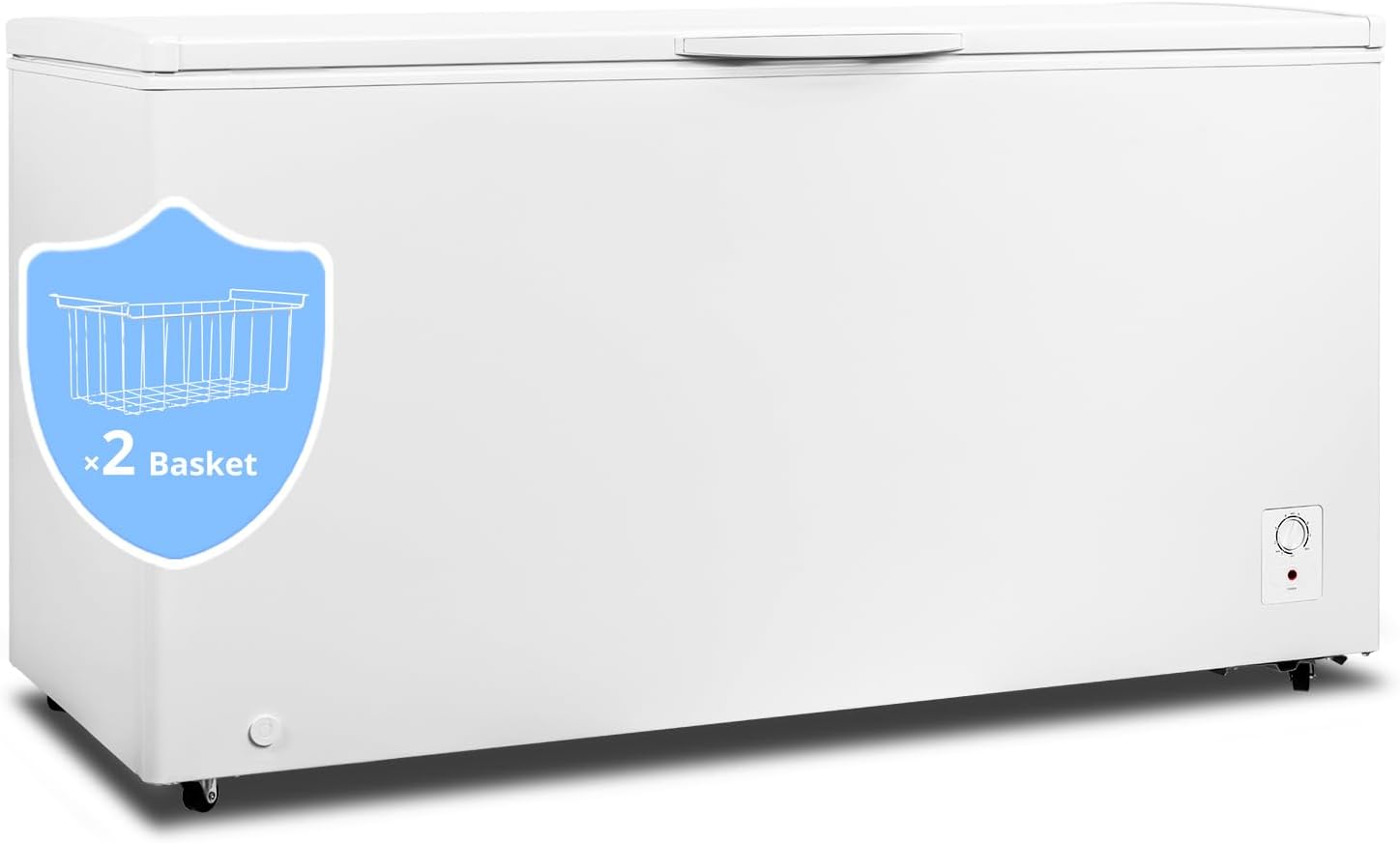
The SMETA 21 cubic foot chest freezer is a large-capacity freestanding unit designed for extended cold storage of meat, bulk groceries, and long-term items. It uses an R600a compressor with a seven-level adjustable thermostat that ranges roughly from 10.4°F down to -4°F, so you can tune the temperature for quick-freezing or long-term preservation. The top-hinged lid locks between about 45° and 90° which helps hands-free loading, and four smooth-rolling wheels plus adjustable feet make placement and leveling simple in the garage, basement, or kitchen. Inside, removable baskets keep small items accessible while the embossed aluminum liner and front water drain simplify defrosting and cleaning. The unit is marketed as low-noise and energy efficient; at 115 watts it should be cheaper to run than larger, less efficient models. Trade-offs include the chest format which requires bending to reach deep items and the lack of more advanced features like digital controls or alarm systems.
Best for: Buyers who prioritize maximizing frozen storage and keeping operating costs low will appreciate this roomy, energy-focused chest freezer for home, garage, or basement use.
Less Ideal for: Shoppers who need upright-style organization, frequent one-handed access, or digital monitoring features should consider other freezer types.
- Large 21 cu ft capacity for bulk storage
- Adjustable thermostat with seven levels for temperature control
- Removable baskets and embossed liner for organized storage and easier cleaning
- Wheels and adjustable feet simplify placement and leveling
- Uses R600a compressor with relatively low 115-watt power draw for energy-efficient operation
- Chest layout requires bending to access items at the bottom
- No digital display, alarm, or smart features for temperature monitoring
Verdict: Choose this chest freezer if you want large, energy-conscious frozen storage with simple, durable features for home or garage use.
Smad Chest Freezer DSC-400WU

| Capacity | 14 cubic feet |
|---|---|
| Wattage | 230 watts |
| Voltage | 110 volts |
| Number Of Shelves | 1 |
This Smad chest freezer is a straightforward deep freezer that prioritizes usable capacity and basic convenience features for small businesses or families. It offers seven temperature settings ranging roughly from -10 C to -24 C so you can dial in colder or milder storage depending on the load, and a removable basket helps separate frequently accessed items from the bulk below. The top-opening lid includes a stay-open feature and a 90 degree hinge for easier loading, and four casters plus an external handle make it simple to reposition when needed. The unit is rated to run quietly at about 42 dB and lists 230 watts and 110 volts, which helps keep operating noise and energy use modest for its size. Expect standard chest-freezer behavior: efficient long-term storage and lower energy use versus upright counterparts, but you will need to bend to reach items at the bottom and plan organization accordingly. For buyers focused on straightforward capacity and energy-conscious operation without premium extras, this is a practical choice.
Best for: Buyers seeking a cost-conscious, energy-efficient chest freezer for steady long-term food storage in a garage, small cafe, or household who prioritize usable volume over bells and whistles.
Less Ideal for: Shops or users needing frequent upright-style access, precise digital controls, secure locking, or integrated shelving systems should consider other freezer types.
- Large 14 cubic feet capacity suitable for family or light commercial stock
- Seven adjustable temperature settings for precise cold control
- Removable basket and stay-open 90° lid improve access and organization
- Quiet operation around 42 dB and modest 230 watt power draw
- Four wheels and external handle for easier repositioning
- Top-access design requires bending to reach lower items
- No advanced features like digital thermometer, alarm, or lock
Verdict: A practical, energy-conscious 14 cu. ft. chest freezer that delivers large usable storage and quiet operation for budget-minded businesses and households.
PEAKCOLD Single Door Commercial Freezer

| Capacity | 23 Cubic Feet |
|---|---|
| Temperature Range | -8 to 0°F (-22 to -18°C) |
| Voltage | 110 volts |
| Number Of Shelves | 3 |
| Specification Met | DOE, ETL |
This PEAKCOLD single-door commercial freezer is a workhorse suited to busy kitchens that need reliable, consistent freezing. It holds 23 cubic feet and uses a Dixell digital controller to maintain temperatures between -8 and 0°F, with adjustable automatic defrost timing to match your environment. The white aluminum interior, stainless steel floor, LED interior light, and three adjustable heavy-duty PVC-coated shelves make it straightforward to organize, clean, and resist spills. The door is self-closing and designed to stay open past 90 degrees for loading, and the included casters simplify positioning and cleaning underneath. It runs on standard 110V power and uses R290 refrigerant for improved energy efficiency and a lower environmental impact. Limitations include its large footprint and substantial weight, which require planning for delivery and placement, and the single-door layout may be less convenient for very high-volume operations compared with multi-door units. For kitchens prioritizing steady temperatures, easy maintenance, and energy-minded cooling, this freezer delivers dependable performance.
Best for: Operators who need a dependable, energy-conscious upright freezer that keeps temperatures steady and is easy to clean and service in a commercial kitchen.
Less Ideal for: Small businesses with limited floor space or operations that require multiple simultaneous access points should consider smaller or multi-door units instead.
- Programmable Dixell digital controller for precise temperature control and adjustable automatic defrost
- R290 refrigerant for better energy efficiency and lower environmental impact
- Durable stainless steel exterior and stainless steel floor for easy cleaning and long service life
- Adjustable heavy-duty shelves and LED interior lighting for efficient organization and visibility
- Self-closing door that stays open past 90 degrees and included casters for easier loading and positioning
- Large, heavy unit that requires space planning and may need professional handling for placement
- Single-door design may limit quick access in very high-turnover kitchens
Verdict: Choose this freezer when you want a durable, energy-efficient upright that reliably holds commercial-grade freezing temperatures and is easy to clean and maintain.
KoolMore KM-SCF-30C Chest Freezer

| Capacity | 30 cubic feet |
|---|---|
| Voltage | 115 volts |
| Door Orientation | Top |
| Specification Met | ETL |
The KoolMore KM-SCF-30C is a large-capacity, two-door chest freezer built for commercial and heavy residential use where volume and access matter. It offers 30 cubic feet of storage and dual top-opening doors that make loading bulky items and organizing inventory easier than a single-lid chest unit. The unit is ETL certified and intended to run in varied ambient conditions, which supports garage or back-of-house placement, and the straightforward manual-defrost system keeps operation simple and can be more energy efficient when used and maintained correctly. Practical touches include two included storage baskets and a freestanding design for flexible placement. Downsides to expect are the manual defrost requirement, which means occasional maintenance and temperature recovery time after defrost, and the large physical footprint and weight that require planning for delivery and installation. For buyers prioritizing dependable, high-volume frozen storage, this freezer delivers the core features most kitchens need.
Best for: Buyers who need dependable high-volume frozen storage for a commercial kitchen or busy household and who prefer proven, safety-certified equipment backed by real-world use cases.
Less Ideal for: Those who want a low-maintenance, frost-free freezer or who have limited floor space or need a lightweight, portable solution.
- Generous 30 cu. ft. capacity suitable for commercial or high-volume residential storage
- Dual top-opening doors provide easier organized access to stored items
- ETL certified for safety and reliable operation
- Designed to operate in a range of ambient conditions for garage or utility placement
- Manual defrost requires periodic user maintenance and causes temporary downtime
- Large footprint and weight make delivery, placement, and relocation more difficult
Verdict: Choose this freezer when you need a proven, high-capacity chest freezer for heavy use where safety certification and reliable performance matter most.
Choosing the Right Energy-Efficient Commercial Freezer: Key Factors to Consider
Energy Consumption and Operating Cost
Energy consumption directly affects operating expenses for any commercial freezer. Look for units with published kWh ratings, energy certifications, or measured power draw under typical commercial loads. Lower running watts and smart defrost cycles reduce monthly utility bills and improve long-term cost predictability.
A freezer with lower energy consumption may have a higher upfront cost but will usually deliver savings over years of continuous operation. Consider how often the unit runs its compressor, the impact of defrost cycles on energy use, and whether the controls allow for scheduling or economy modes to lower draw during slow periods.
Insulation and Thermal Envelope
Quality insulation and a tight thermal envelope reduce how often the compressor must run. Look at insulation thickness and type, door design and gasket quality, and how well the unit seals when loaded with inventory. Better insulation also reduces temperature fluctuations when doors are opened frequently.
Insulation affects both efficiency and temperature stability, which is critical for food safety. Poorly insulated walls or worn gaskets increase run time and compressor wear, negating any nominally efficient compressor design. Choose freezers with durable gaskets and accessible replacements.
Usable Capacity and Layout
Usable capacity matters more than cubic feet on paper. Shelving design, shelf adjustability, and how the compressor and coils are integrated determine how much storage you can practically use. An efficient freezer with awkward interior design can force more frequent door openings or inefficient stacking that increases energy use.
Consider workflow needs: frequent door access favors sliding or well-sealed door designs with rapid recovery, while bulk storage might prioritize wider shelves and fewer obstruction points. Verify how much of the stated capacity is actually usable for the types of products you store.
Compressor Efficiency and Controls
The compressor and control strategy drive real-world efficiency. Variable-speed or high-efficiency compressors reduce cycling losses and maintain steady temperatures with less energy. Electronic controls with accurate thermostats, adaptive defrost, and diagnostic readouts help optimize run time and catch problems early.
Controls that allow temperature setpoint fine-tuning and smart defrost scheduling are beneficial in commercial settings. Avoid units that rely solely on coarse mechanical thermostats if precise temperature stability and minimal energy use are priorities.
Defrost Method and Impact
Defrost method affects both energy use and product management. Manual defrost systems require downtime and labor but can be energy efficient when scheduled. Auto-defrost or adaptive defrost systems add convenience but may run additional heaters that increase short-term energy use; however, well-implemented adaptive defrost limits unnecessary cycles and can save energy overall.
Assess how defrost cycles interact with your storage patterns. For operations with frequent door openings and humidity exposure, more aggressive defrost control may be necessary to prevent ice buildup that reduces cooling efficiency.
Serviceability and Commercial Support
In commercial environments, downtime is costly. Serviceability includes easy access to compressors and components, availability of replacement parts, and whether the unit is designed for field servicing. Units built with modular components and accessible electrical panels reduce repair time and maintenance cost.
Check whether gaskets, shelves, and common wear parts are replaceable without specialized tools. A unit that is easier to service will typically maintain efficient operation longer because routine maintenance is simpler to perform.
Sizing and Capacity Planning for Your Operation
Match freezer size to anticipated inventory turnover rather than peak storage once in a while. Oversized freezers increase energy use, while undersized units force overpacking and longer door-open times. Estimate daily removal and restock volumes to size capacity.
Also think about layout and placement. Allow adequate clearance for airflow around condenser coils and plan shelf configurations for real products you store. Good planning reduces door openings and keeps recovery times short after access events.
- Estimate inventory turnover and peak load separately
- Plan for airflow clearance around condenser areas
- Choose adjustable shelving to optimize usable space
Installation Tips to Preserve Efficiency
Proper installation has a measurable impact on energy use. Level the unit and allow manufacturer-recommended clearances on all sides, especially near the condenser. Poor ventilation increases compressor run time and accelerates component wear.
Place freezers away from heat sources, direct sunlight, or ovens. Ensure electrical circuits are properly sized to avoid voltage drop that can reduce compressor efficiency. Consider dedicated circuits and surge protection in high-use commercial environments.
- Maintain clearance for ventilation
- Avoid heat sources and direct sunlight
- Use properly sized electrical supply and protections
Managing Door Use and Workflow
Human behavior is one of the largest drivers of energy waste in commercial refrigeration. Train staff to minimize open-door time, stage retrievals, and avoid unnecessary stock checks. Consider organizing high-turn items near the door and low-turn items deeper inside.
Where appropriate, use door alarms or auto-closing mechanisms to reduce accidental long openings. Consistent door management lowers compressor cycling frequency and preserves temperature stability.
- Organize inventory for quick access
- Use auto-close doors or alarms
- Schedule stocking during off-peak hours if possible
Monitoring Performance and Preventive Maintenance
Regular monitoring catches inefficiencies early. Track energy consumption over time, note changes in run cycles, and monitor temperature recovery after door openings. Small increases in energy use often precede larger mechanical issues.
Institutionalize basic preventive maintenance: clean condenser coils, replace worn gaskets, check refrigerant pressures, and confirm defrost cycles are functioning. Preventive care preserves efficiency and extends the service life of commercial freezers.
- Log run cycles and energy use for trend detection
- Clean condenser coils on a regular schedule
- Replace gaskets and worn parts promptly
Choosing the Right Defrost Strategy
Match the defrost approach to your humidity exposure and door usage. Adaptive defrost works well where door openings are unpredictable, while scheduled manual defrost may be more efficient in dry, low-traffic environments. Understand the tradeoffs between convenience and incremental energy use.
Consider how defrost cycles affect inventory access. Defrost timing should minimize disruption during peak service hours and avoid exposing sensitive products to temperature swings.
- Consider adaptive defrost for variable-use environments
- Schedule defrost during low-demand periods
- Monitor ice buildup as an indicator of defrost effectiveness
How We Chose the Best Energy-Efficient Commercial Freezer
We shortlisted commercial freezers that prioritize low energy use while still delivering dependable temperature control and practical storage layouts. Our selection filters focused on measured power draw or certified energy ratings, insulation quality and thickness, compressor efficiency and duty cycle, usable interior capacity versus footprint, and serviceability for commercial uptime. We excluded consumer-grade or residential designs, units without verifiable efficiency ratings, and any freezer lacking professional repair support or replacement parts availability. We also filtered out units with designs that significantly reduce usable shelving or obstruct airflow. The criteria that mattered most were thermal envelope quality, compressor and controls efficiency, accurate temperature maintenance under load, and usable shelving/footprint balance. We prioritized models with accessible maintenance points and proven commercial components that reduce downtime. Units were then evaluated for noise, defrost method impact on energy use, and installation flexibility within typical commercial workflows.
Our full evaluation process is outlined in our review methodology.
FAQ
How much energy can I expect to save with an energy-efficient commercial freezer?
Savings vary based on current equipment and usage patterns, but most efficient units reduce run-time or demand peaks, often lowering energy use noticeably. Actual savings depend on hours of operation, door openings, and local energy rates.
Does better insulation always mean higher upfront cost?
Generally better insulation adds manufacturing cost, but it reduces compressor run time and often pays back over years through lower energy bills. Consider lifecycle cost rather than purchase price alone.
Are adaptive defrost systems worth it in a busy kitchen?
Adaptive defrost can be beneficial because it reduces unnecessary defrost cycles, saving energy and maintaining steadier temperatures. In high-humidity or high-traffic kitchens, adaptive systems help prevent excessive ice buildup while optimizing defrost frequency.
What maintenance practices most affect efficiency?
Keeping condenser coils clean, replacing worn door gaskets, and ensuring proper airflow around the unit are the highest-impact maintenance tasks. Regular checks of defrost operation and thermostat accuracy also preserve efficiency.
Can I relocate a commercial freezer without affecting efficiency?
Relocation is possible but plan for proper clearances and avoid hot zones. Moving a freezer to a poorly ventilated area or near heat sources will increase compressor load and reduce efficiency.
Final Verdict
Prioritize real-world operating costs and uptime when choosing an energy-efficient commercial freezer. Focus on energy consumption metrics, insulation quality, usable interior layout, and compressor controls that match your workflow. Balance upfront cost against likely savings from reduced run time and lower maintenance needs. Make serviceability and installation considerations part of the decision so the unit remains efficient over years of commercial use. With the right combination of thermal envelope, controls, and sensible workflows, you can reduce energy expense while keeping inventory reliably frozen.